Wednesday, 22 April 2020

In pursuit of giant pliosaurids and whale-sized ichthyosaurs

Some marine reptiles - like Shonisaurus popularis - were big. So big, in fact, that you can't fit them all into a picture. But just how large did the largest marine reptiles get? Finding the answer can be more involved than you'd think. This image is a cropped version of a larger picture, which you can see at my Patreon.
The size of Mesozoic marine reptiles is undeniably a big part of their charm and popular appeal. And yet, if you want to know how big some of these animals really got - and by 'really', I mean 'size estimates preferred by contemporary scientists based on our latest data' - you might have a struggle on your hands. Marine reptile media is full of varying size estimates for different groups, some of which are accurate to modern science, some of which were accurate to old science, and many of which were never accurate to begin with. It's not always easy to tell which is which.

I've recently had cause to ascertain reliable size estimates for a number of marine reptile clades and found it far more involving than I anticipated, especially for pliosaurids and ichthyosaurs. This isn't necessarily because it's hard to find an article or paper giving figures of total length or mass, but because confused taxonomies, a deficit of complete skeletons and opaque comments in technical literature complicate efforts to recover and understand maximum size estimates from peer-reviewed, reliable sources. I thought it might be of interest to share some of my findings here, focusing specifically on those two aforementioned groups - pliosaurids and ichthyosaurs - as I feel their upper size range is perhaps most in need of clarification.

Before we get going, it's worth reminding ourselves of how estimating the size of very large extinct individuals is fraught with challenges, and how the numbers and stats we throw around are often based on relatively little data. Many well-known scaling problems apply to ichthyosaurs and pliosaurs. Our remains of especially large individuals are not only rare but are often relatively scrappy, and our capacity to scale reliably from other, smaller animals is frequently more limited than we might like. As is often necessary, there's a need to distinguish between size estimates that are generally reliable, being based on relatively complete large skeletons, and those which are only indicative, on account of being scaled from fragmentary remains. At the risk of spoiling details of the article below, there doesn't seem to be a clear answer to "what's the biggest pliosaurid" or "what's the biggest ichthyosaur" because the size estimate error bars for most very large specimens are too wide to give precise assessments.

Giant pliosaurids

The great size of certain Late Jurassic and Lower Cretaceous pliosaurids has made them famous, perhaps especially so in the UK and Australia where giant animals are particularly well represented. Since their discovery in the mid-19th century, there has been no doubt that certain pliosaurids attained enormous sizes and dwarfed virtually all other organisms in their respective palaeoenvironments (e.g. Owen 1841; Longman 1924; Tarlo 1959).

How the world met pliosaurids: plate 68 of Owen's Odontography (1841). That's a life-sized Pliosaurus tooth at the bottom of the page. Note the spelling - "Pleiosaurus". It's not clear why Owen changed the name later, but "Pleiosaurus" has not been widely used since the 1840s and Pliosaurus has, by rules of zoological nomenclature, won out.
But the question of how large pliosaurids were has, for a long time, not had a straightforward answer. An ongoing problem with estimating their size is that complete pliosaurids, in stark contrast to plesiosauroids, which are known from abundant complete remains, are actually pretty rare. Any attempt to estimate their size thus has to tackle uncertainty about their body proportions. It took over a century for palaeontologists to attempt the first calculations of pliosaurid body length, and these were still produced while aspects of vertebral number, torso length and so on remained unknown (Romer and Lewis 1959). This estimate was associated with the famous 12 m long Harvard Kronosaurus mounted skeleton, a reconstruction that has unfortunately covered the original fossil in so much plaster that it's now hard to examine in detail. It's now generally considered that the Harvard mount has too many vertebrae and is thus too long (McHenry 2009). The subsequent recovery of relatively complete pliosaurid specimens has supplied useful data for estimating their size (e.g. Noè et al. 2001; McHenry 2009) but we are still working with a very provisional dataset and assuming that the proportions of a handful of species apply to pliosaurids in general.

Newman and Tarlo's (1967) unnamed pliosaurid reconstruction, interpreted by McHenry (2009) as the 10 m long Pliosaurus macromerus (a species of uncertain validity today - see Knutsen 2012 vs. Benson et al. 2013) or Liopleurodon ferox, based on a near-complete, 4.88 m long specimen held in Tübingen, Germany (Noè 2001). I like the generous soft-tissue outline of this illustration - it looks appropriately bulky and well-muscled.
Famously, 1999 saw claims of whale-sized pliosaurs take root in public conscience courtesy of the BBC documentary Walking with Dinosaurs. The antagonist of the Jurassic marine-focused third episode was a 25 m, > 100-tonne Liopleurodon ferox which was, even given the general uncertainty about pliosaur size, a very controversial reconstruction for a species only known from much smaller remains. Our largest Liopleurodon skull (discovered in the early 20th century, so known to the producers of the programme) is 1.54 m long (Benson et al. 2013) so, assuming a skull:body length ratio of about 1:5 (Noè et al. 2001; McHenry 2009), we can predict that large Liopleurodon individuals were about 8 m long. How did this value become tripled for the documentary? Writing in 2000, two of my colleagues - David Martill (my PhD supervisor, also a consultant for WWD) and a pre-TetZoo Darren Naish explored the rationale of this decision:
This size created much debate in palaeontolgoical circles following the first airing of the programme, as no palaeontologist thinks Liopleurodon really got this big.
Although several complete [Liopleurodon] skeletons have been discovered, these are of individuals of between five and ten metres in length. It is less complete remains discovered in the Oxford Clay that indicate lengths greater than this, though here we move into an area of rough estimates and guesswork. A vertebra at the Peterborough Museum, brought to light in 1996, would seem to indicate a pliosaur of between seventeen and 20 metres in length, and various fragments of snout and lower jaw in other museum collections suggest specimens of similar size. Whether these fragments are actually from Liopleurodon is uncertain, and the animal to which they belonged has been nicknamed 'Megapleurodon'. Given that it is unlikely that these bones really represent the very biggest pliosaur specimens that ever lived, some experts cautiously suggest that Liopleurodon and related forms may have achieved total lengths of around 25 metres.
Martill and Naish 2000, p 80.

The WWD Liopleurodon was a showstopper back in 1999, and one of the stars of the series. Its arrival brings the end to this sequence showing Ophthalmosaurus giving birth. Clip from Walking with Dinosaurs, uploaded to Youtube by BBC Earth.

As is clear from this text and subsequent Tetrapod Zoology articles, both Dave and Darren knew that this size estimate was very speculative and an indulgent move by the programme-makers. But while a 25 m long pliosaur isn't defensible, supersized pliosaurs were not entirely out of the question 20 years ago. In addition to the specimens mentioned by Martill and Naish, a fragmentary Mexican pliosaurid (the so-called "Monster of Aramberri") was inferred as reaching 15 m just a few years after WWD aired (Buchy et al. 2003). While this is still some distance from 25 m, these data were pointing to pliosaurs of much larger sizes than generally anticipated during the late 1990s and early 2000s.

Unfortunately for those excited by the idea of a whale-sized pliosaurid, the specimens touted as rationalising the WWD monster have not delivered on their promise. In what is perhaps the most detailed assessment of maximum pliosaurid size conducted to date, Colin McHenry (2009) discussed all the fragmentary material from Britain and Mexico linked with supersized pliosaurids and found that they represented very large animals, but not whale-sized giants. Colin confirmed that the vertebra housed at Peterborough Museum was indeed very large - 252.5 mm wide by 219 mm tall - but its total body length estimate was just 11.6–14.2 m when scaled to well-known pliosaur remains [Note added 24/04/20: also see the comment from Colin below, for an update on this specimen). A large Jurassic mandibular symphysis archived in the Natural History Museum, London might represent an animal anywhere between 9.1 and 15.1 m long, while OUM J.10454, a near-complete, 2.8 m long lower jaw dubiously referred to Pliosaurus macromerus and known informally as the 'Cumnor mandible', scales to a surprisingly low 12.7 m. In subsequent years this estimate has also become questionable as we've realised how reconstructed the Cumnor mandible is: it remains to be determined what size range the original specimen represents (Benson et al. 2013).
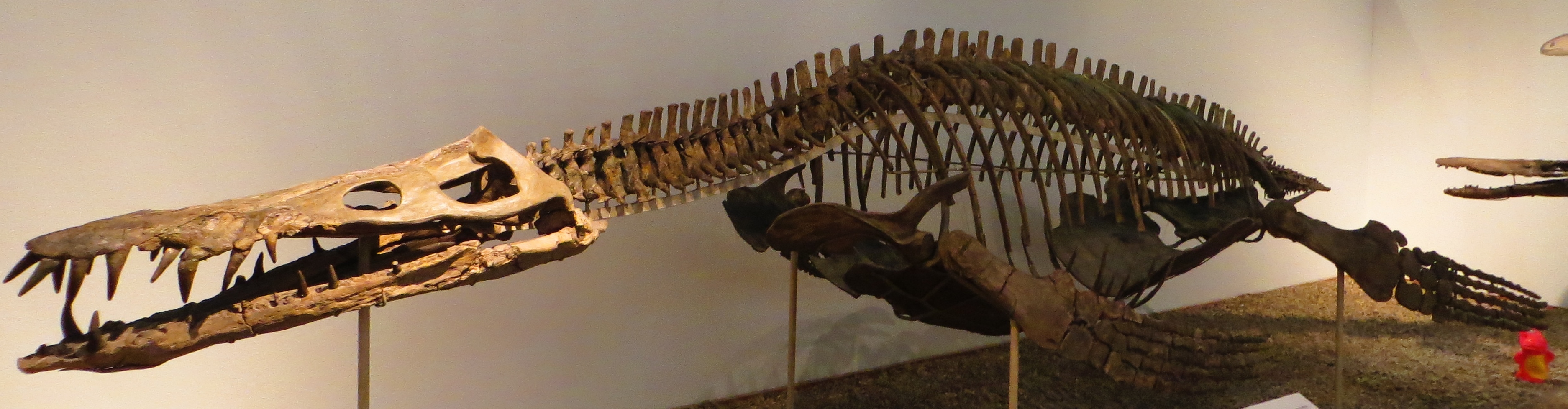
The Tübingen University specimen of Liopleurodon ferox, a near-complete 4.8 m long juvenile. This is a key specimen for our understanding of Jurassic pliosaur proportions, and thus the size of the biggest individuals. From Wikimedia user Ghedoghedo, CC BY-SA 3.0.
The same story plays out across all other giant pliosaurid fragments, including the Mexican Monster of Aramberri. It seems that when scaled using our best data on pliosaurid proportions and growth allometry, most 'giant' pliosaurid fossils return total length estimates in the 10 m range, with only the upper bounds of our least reliable length estimates falling outside this (McHenry 2009). There's perhaps a moral here about reading too much into the size of giant but fragmentary bones. As stated by McHenry (2009):
Estimates made on incomplete series of vertebrae, or even a single vertebrae, are subject to the natural variation of vertebral dimensions and should be used with caution. The dimensions of individual vertebrae can be affected by taphonomic processes, in particular sedimentary compaction, and when size estimates are extrapolated from single elements small errors can be greatly magnified. The same applies to any allometric variation than is not accounted for in scaling models... any estimates based upon more complete pliosaurid material requires extrapolation over at least an order of magnitude of body mass, a leap that means even small errors in the estimate of allometric or intraspecific variation will produce a large range of results.
McHenry 2009, p. 422

My take on one of the largest Jurassic pliosaurids, Pliosaurus kevani. It was probably about 10 m long, assuming similar proportions to other pliosaurids. The smaller animal above is a calf.
So, putting the ideas of gigantic pliosaurs to the side, what are our most reliable estimates for the maximum sizes of these animals? Detailed assessments of the very large and relatively well-known pliosaur Kronosaurus queenslandicus suggest that a total length of 10.5 m and a mass of 11 tonnes is likely (McHenry 2009). Kronosaurus is one of the few large pliosaurids known from decent and articulated postcranial remains so this figure involves minimal extrapolation, and should be regarded as one of our more reliable insights into the maximum size of these animals. It seems that c. 10 m is about right for other large pliosaurids, too. The skulls of large Kronosaurus are 2.3 m long, a value comparable to measured and estimated skulls lengths of the largest Jurassic pliosaurid, Pliosaurus (2-2.5 m; Knutsen et al. 2011; Benson et al. 2013). If pliosaurid skulls account for roughly 20% of their body length, these are on target for a Kronosaurus-like size of 10 - 12.5 m. While that upper range is obviously higher than Kronosaurus, we shouldn't put much stock in it yet. Our 12.5 m Pliosaurus is a body length extrapolation based on a rough skull size calculation, and both these values hinge on the specimen in question having the same skull and body proportions as other, mostly non-Pliosaurus pliosaurids. Our 12.5 m Pliosaurus is thus perched on a stack of assumptions, each one compounding any errors of the one beneath it. Such methods are fine for getting ballpark size figures but they are far from precise and we should treat them with appropriate caution. Greater understanding of the size of the biggest pliosaurs will require discovery of more substantial skeletons of large pliosaur individuals.

Giant ichthyosaurs

It's remarkable to me that the giant ichthyosaurs, which are without doubt the largest marine reptiles of all time, appeared in the Late Triassic - just a few tens of millions of years after marine reptiles entered the seas. Ascertaining details of how large these animals got is complicated but not, as with pliosaurs, because of scant remains. To the contrary, we actually have several excellent fossils of very large ichthyosaurs (Camp 1980; Kosch 1990; McGowan and Motani 1999; Nicholls and Manabe 2004), and our challenge is instead related to working out what taxa they represent. The history of two ichthyosaur genera associated with giant size - Shastasaurus and Shonisaurus - is complex and intertwined. While there's no doubt that Shonisaurus contains at least one species of very large ichthyosaur (Sho. popularis), it's not always been clear whether Shastasaurus also contained giant animals, nor to which of these genera the largest ichthyosaur remains should be referred to. The confused treatment of these animals in technical literature has spread into the popular realm and it's very easy to find articles and art treating Shastasaurus and Shonisaurus interchangeably. This is unfortunate because, as we'll see, they're actually very different animals.

Quarry map of the holotype specimen of Shonisaurus sikanniensis, the biggest marine reptile yet known from a decent portion of skeleton, from Nicholls and Manabe (2004). The last decade has seen differing teams debating whether this animal is actually Shastasaurus or Shonisaurus. Note the 1 m scale bar at the bottom of the illustration - this animal was very big.
I won't recount the full taxonomic history of these genera here, it will suffice to say that long-running uncertainty about recognising and diagnosing Shastasaurus and Shonisaurus is the crux of this issue. Both genera have housed an ever-changing number of specimens and species in their long histories (Shastasaurus was named in 1895, Shonisaurus in 1976) and most of their new species have proved problematic one way or another: generally being undiagnostic, based on controversial specimen allocations, or being better referred to other named ichthyosaurs. The conflicted history of Shastasaurus and Shonisaurus continues today as authors continue to disagree over which specimens and species should be allocated to each genus (e.g. McGowan and Motani 1999, 2003; Nicholls and Manabe 2004; Sander et al. 2011; Ji et al. 2013).

This affects our assessment of ichthyosaur size because the taxonomic fate of several giant specimens are at stake in these disagreements, including the holotypes of "Shastasaurus careyi" and Sho. sikanniensis. This might not seem like a big deal - a giant ichthyosaur is a giant ichthyosaur, right? - but not all Triassic ichthyosaurs are alike, and the generic identification of these specimens influences our predictions of body dimensions. Although both Shonisaurus and Shastasaurus are generally considered to be shastasaurids, this group is not anatomically uniform enough that we can liberally borrow proportions from other species to calculate size. Some taxa, such as Shonisaurus, were long-snouted, deep-bodied forms, while other genera, such as Guanlingsaurus, were very long, slender animals with small skulls and short faces. For Shastasaurus in particular, trying to work out the anatomical characteristics of this genus is very challenging from all the material referred to it. Even the configuration of the skull seems open to question: was it a long-snouted, toothed form (e.g. Callaway and Massare 1989) or a short-snouted, edentulous form (Sander et al. 2011)?

Not all shastasaurids were deep-bodied, Shonisaurus-like animals. Several genera, like Guanlingsaurus and probably Shastasaurus, were slender, long-bodied animals with shortened faces, so it's important we know what sort of body plan our giants had to calculate their proportions. From Ji et al. 2013.
Happily, it seems that some clarity is emerging from this murk. A large number of ichthyosaur workers are now taking relatively conservative taxonomic approaches to Shastasaurus and Shonisaurus, restricting their specimen inventories to incontrovertibly assigned historic material and rationalising species taxonomy down to better-known, well-diagnosed fossils. This renders Shastasaurus a monospecific genus containing just Sha. pacificus, while Shonisaurus has two well-represented species, Sho. popularis and Sho. sikanniensis. This tidying up means we have a more concrete idea about their shape and form, and has had one surprising outcome: after decades of being touted as an ichthyosaur giant, it turns out that Shastasaurus was actually of unremarkable size. I couldn't find a published body length calculation for Shastasaurus, so I roughly predicted a total length of just 6-7 m using the partial skull illustrated by Sander et al. (2011) and the proportions of a large Guanlingsaurus. I admit to being a little disappointed, as I quite liked the idea of giant ichthyosaurs including both robust, deep-bodied forms like Shonisaurus as well as long, slender animals like Shastasaurus but... oh well. Unless something changes in future, we need to stop talking about Shastasaurus as a giant ichthyosaur.

The skull of Shastasaurus pacificus, illustrated by Sander et al. (2011). Stripped to the core hypodigm and type species, Shastasaurus is neither a well-known nor particularly big animal. I roughly estimate this skull to have been c. 60 cm long, which is big, but not remarkably so for a shastasaurid. Note the large eye socket and pinched snout: Shastasaurus had quite a different skull to the more traditionally ichthyosaurian Shonisaurus.

This leaves the Shonisaurus species as the named record holders of ichthyosaur size, and by some margin. Both species are known from substantial remains that allow us to be fairly confident in our body length estimates. We can actually get a lot of data from simply measuring their articulated skeletons. Our best size predictions for these animals shake out to 13-15 m for Sho. popularis (McGowan and Motani 1999) and a whopping 21 m for Sho. sikanniensis (Nicholls and Manabe 2004). Using data from Gutarra et al. (2019), these equate to approximate body masses of 20-30 and 80 tonnes, respectively. The Shonisaurus species were huge animals, among the largest to ever swim the seas.

As with our giant pliosaurs, several fragmentary Triassic ichthyosaur fossils are touted as indicating larger animals. Himalayasaurus tibetensis, if valid and not another representation of Shonisaurus, is not well known but seems to have rivalled or exceeded Sho. popularis in size, though by how much cannot be reliably ascertained (Motani et al. 1999). Giant remains dubbed the "Mount Potts ichthyosaur" from New Zealand, first reported in 1874, included vertebrae of some 450 mm diameter and ribs exceeding a metre long, making them comparably-sized or bigger than other known ichthyosaur fossils. Alas, they are now lost and these claims cannot be investigated further, making them fairly meaningless anecdotal evidence for extreme ichthyosaurian body size (Fleming et al. 1971). A portion of posterior lower jaw known informally as the "Lilstock ichthyosaur" from Somerset, UK, has been roughly estimated as being similar in size to Sho. sikanniensis at 20 - 25 m long, and another UK fragment (from Aust Cliff, Gloucestershire) possibly hints at an even larger or more robust individual (Lomax et al. 2018). These specimens are genuinely large chunks of bone and perhaps represent our most intriguing hint of even larger marine reptiles, but they're also such small pieces of evidently gigantic animals that we can only very roughly anticipate their size, especially since our scaling calculations for giant ichthyosaurs are still unable to factor proportional changes with growth (Lomax et al. 2018). It's thus hard to know exactly what to make of these specimens, except that they show additional evidence of roughly Sho. sikanniensis-sized creatures in the Late Triassic. For now, values around 21 m remain our most substantiated length estimates for giant ichthyosaurs, and the upper size threshold for marine reptiles as a whole.

My take on a 21 m long Shonisaurus sikanniensis, shown here with generic, 6 m long, Sha. pacificus-sized shastasaurids to stress the size difference between these two 'giant' genera. Shastasaurus is a little older than Shonisaurus and the two didn't live alongside one another but, if they had, Shastasaurus would have been dwarfed by its larger cousin.

What hope is there for blue whale-sized marine reptiles?

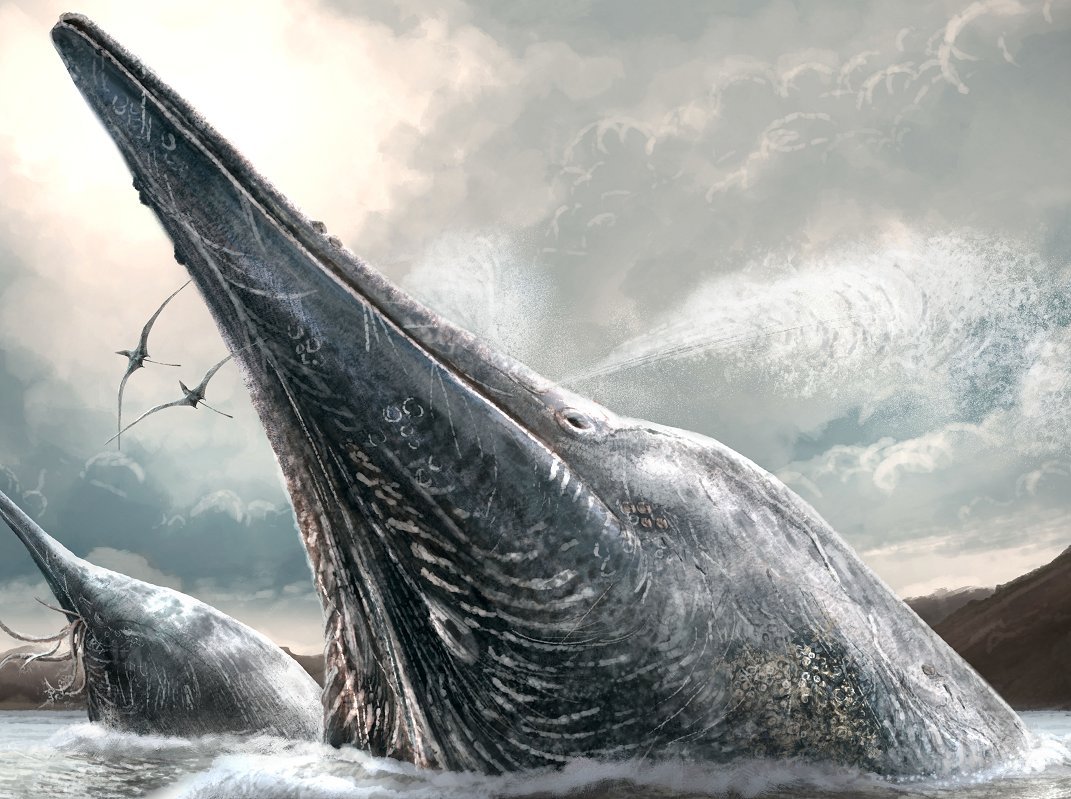
As an epilogue to the discussion above, I want to briefly share some thoughts on a marine reptile Holy Grail: a species comparable in size to the modern blue whale Balaenoptera musculus. Despite no marine reptile approaching the size of the largest blue whales (c. 30 m total length, over 100 tonnes) it's easy to find media comparing marine reptiles against our biggest modern cetaceans. Size estimates for the largest shastasaurids match the proportions of very large baleen whales, including certain Pacific blue whale populations - which generally reach 20-something metres in length - but obviously fall short of the largest, primarily North Atlantic and Antarctic B. musculus individuals. Should ever expect to find a 30 m long, 100+ tonne marine reptile?

It's easy to be blase about whales, but the fact we share the planet with the biggest animals to have ever lived on Earth is not to be taken for granted. It seems that the extreme sizes of large rorquals, like this blue whale, may be tied to certain unique biological and environmental properties, which means 30 m body lengths may not be attainable for just any marine tetrapod. (Image from Wikimedia, in public domain).
Studies on the factors influencing body size in marine animals indicate that food availability and foraging efficiency might be strong limiting factors on their upper size limits, and that increasing feeding efficiency via bulk filter-feeding gives rorquals a substantial edge over other species (Goldbogen et al. 2011; Gearty et al. 2018). Enhanced capacity to obtain energy from foraging means more resources to build body tissues, which feeds directly into physiological advantages of larger body size. Together, these strongly incentivise the development of gigantism where rorquals can find enough food, and it seems large blue whales have run with this about as far as they can, reaching predicted biomechanical limits for operating their jaws in water (Potvin et al. 2012). We can thus infer that the extreme size of living baleen whales is dependent on both their unique foraging mechanism and periods of high oceanic productivity (Gearty et al. 2018). This latter factor might explain why whales only developed extreme gigantism in the last few million years, despite their likely development of baleen 23 - 35 million years ago (Gearty et al. 2018; Peredo et al. 2018).

We should, not, therefore, look at the maximum size of rorquals and assume that they represent a universally obtainable figure for all marine vertebrates. As with all organisms, upper size limits are dependent on a complex interplay of anatomy, physiology and environment that are unique to every species, and it's not a given that marine reptiles had the same adaptive potential to reach the same size as the largest rorquals. While it's hard to know exactly how productive Mesozoic oceans were, we can certainly identify the lack of bulk filter-feeding mechanisms as a probable size-limiting factor for marine reptiles, and this may well explain why we've yet to find indications of ichthyosaurs much above 20 m long. Of course, we can't say that fossils of larger marine reptiles aren't out there, waiting to be found, but my guess is that, if giant blue whale-sized marine reptiles existed, they would be anatomically and ecologically very different to our currently known species.

Enjoy monthly insights into palaeoart, fossil animal biology and occasional reviews of palaeo media? Support this blog for $1 a month and get free stuff!

This blog is sponsored through Patreon, the site where you can help online content creators make a living. If you enjoy my content, please consider donating $1 a month to help fund my work. $1 might seem a meaningless amount, but if every reader pitched that amount I could work on these articles and their artwork full time. In return, you'll get access to my exclusive Patreon content: regular updates on upcoming books, papers, paintings and exhibitions. Plus, you get free stuff - prints, high-quality images for printing, books, competitions - as my way of thanking you for your support. As always, huge thanks to everyone who already sponsors my work!

References

  • Benson, R. B., Evans, M., Smith, A. S., Sassoon, J., Moore-Faye, S., Ketchum, H. F., & Forrest, R. (2013). A giant pliosaurid skull from the Late Jurassic of England. Plos One, 8(5).
  • Buchy, M. C., Frey, E., Stinnesbeck, W., & López-Oliva, J. G. (2003). First occurrence of a gigantic pliosaurid plesiosaur in the Late Jurassic (Kimmeridgian) of Mexico. Bulletin de la Société géologique de France, 174(3), 271-278.
  • Camp, C. L. (1980). Large Ichthyosaurs from the Upper Triassic of Nevada. Palaeontographica Abteilung A, 139-200.
  • Callaway, J. M., & Massare, J. A. (1989). Shastasaurus altispinus (Ichthyosauria, Shastasauridae) from the Upper Triassic of the El Antimonio district, northwestern Sonora, Mexico. Journal of Paleontology, 63(6), 930-939.
  • Fleming, C. A., Gregg, D. R., & Welles, S. P. (1971). New Zealand ichthyosaurs—a summary, including new records from the Cretaceous. New Zealand journal of geology and geophysics, 14(4), 734-741.
  • Gearty, W., McClain, C. R., & Payne, J. L. (2018). Energetic tradeoffs control the size distribution of aquatic mammals. Proceedings of the National Academy of Sciences, 115(16), 4194-4199.
  • Goldbogen, J. A., Calambokidis, J., Oleson, E., Potvin, J., Pyenson, N. D., Schorr, G., & Shadwick, R. E. (2011). Mechanics, hydrodynamics and energetics of blue whale lunge feeding: efficiency dependence on krill density. Journal of Experimental Biology, 214(1), 131-146.
  • Gutarra, S., Moon, B. C., Rahman, I. A., Palmer, C., Lautenschlager, S., Brimacombe, A. J., & Benton, M. J. (2019). Effects of body plan evolution on the hydrodynamic drag and energy requirements of swimming in ichthyosaurs. Proceedings of the Royal Society B, 286(1898), 20182786.
  • Kosch, B. F. (1990). A revision of the skeletal reconstruction of Shonisaurus popularis (Reptilia: Ichthyosauria). Journal of Vertebrate Paleontology, 10(4), 512-514.
  • Knutsen, E. M., Druckenmiller, P. S., & Hurum, J. H. (2012). A new species of Pliosaurus (Sauropterygia: Plesiosauria) from the Middle Volgian of central Spitsbergen, Norway. Norwegian Journal of Geology, 92, 235-258.
  • Ji, C., Jiang, D. Y., Motani, R., Hao, W. C., Sun, Z. Y., & Cai, T. (2013). A new juvenile specimen of Guanlingsaurus (Ichthyosauria, Shastasauridae) from the Upper Triassic of southwestern China. Journal of Vertebrate Paleontology, 33(2), 340-348.
  • Lomax, D. R., De la Salle, P., Massare, J. A., & Gallois, R. (2018). A giant Late Triassic ichthyosaur from the UK and a reinterpretation of the Aust Cliff ‘dinosaurian’ bones. PloS one, 13(4).
  • Longman, H. A. (1924). Some Queensland fossil vertebrates. Memoirs of the Queensland Museum, 8(1), 16-28.
  • Martill, D. M., & Naish, D. (2000). Walking with dinosaurs: the evidence. BBC.
  • McHenry, C. R. (2009). Devourer of gods: the palaeoecology of the Cretaceous pliosaur Kronosaurus queenslandicus (Doctoral dissertation, University of Newcastle).
  • Mcgowan, C., & Motani, R. (1999). A reinterpretation of the Upper Triassic ichthyosaur Shonisaurus. Journal of Vertebrate Paleontology, 19(1), 42-49.
  • McGowan, C., & Motani, R. (2003). Handbook of Paleoherpetology, Part 8 Ichthyopterygia. Verlag Dr. Friedrich Pfeil, Munich, 175.
  • Owen, R. (1841). Odontography, Part II. Hippolyte Baillière, London, 655.
  • Newman, B., & Tarlo, L. H. (1967). A giant marine reptile from Bedfordshire. Animals, 10(2), 61-63.
  • Nicholls, E. L., & Manabe, M. (2004). Giant ichthyosaurs of the Triassic—a new species of Shonisaurus from the Pardonet Formation (Norian: Late Triassic) of British Columbia. Journal of Vertebrate Paleontology, 24(4), 838-849.
  • Noè, L. F. (2001). A taxonomic and functional study of the Callovian (Middle Jurassic) Pliosauroidea (Reptilia, Sauropterygia).
  • Noè, L. F., Liston, J., & Evans, M. (2003). The first relatively complete exoccipital-opisthotic from the braincase of the Callovian pliosaur, Liopleurodon. Geological Magazine, 140(4), 479-486.
  • Peredo, C. M., Pyenson, N. D., Marshall, C. D., & Uhen, M. D. (2018). Tooth loss precedes the origin of baleen in whales. Current Biology, 28(24), 3992-4000.
  • Potvin, J., Goldbogen, J. A., & Shadwick, R. E. (2012). Metabolic expenditures of lunge feeding rorquals across scale: implications for the evolution of filter feeding and the limits to maximum body size. PLoS One, 7(9).
  • Romer, A. S., & Lewis, A. D. (1959). A mounted skeleton of the giant plesiosaur Kronosaurus. Breviora 112, 1-15.
  • Sander, P. M., Chen, X., Cheng, L., & Wang, X. (2011). Short-snouted toothless ichthyosaur from China suggests Late Triassic diversification of suction feeding ichthyosaurs. PLoS One, 6(5).
  • Tarlo, L. B. (1959). Stretosaurus gen. nov., a giant pliosaur from the Kimmeridge Clay. Palaeontology, 2(1), 39-55.

Friday, 27 March 2020

Realistic raptors: pop-culture dromaeosaurs vs current science, part 1

Recently, I shared this image of our greyhound, Beau, next to a Velociraptor* skeleton on social media. Twitter quickly lit up with likes and comments...
...many of which remarked on how, despite being dwarfed by a big, but not exceptionally large dog, Velociraptor was still a formidable animal that would turn Beau into mincemeat should the two ever meet in real life. Poor old Beau. She doesn't deserve that: she's barely a risk to a bag of kibble.

*Probably 'velociraptorine', to be honest: there's some uncertainty about the identification of the specimen this replica was cast from.

Reading through the comments on this tweet reinforced how Velociraptor-like dinosaurs have been mythologised in popular culture. Thanks largely to Jurassic Park, Raptor Red and other 1990s palaeo media, these dinosaurs are regarded as some of the fastest, most vicious and meanest creatures of all time. Commonly discussed aspects of their savagery include razor-sharp claws capable of ripping into and disembowelling prey; strong legs for delivering rapid slashing attacks; ferocious bites and flesh-rending teeth; cheetah-like speed and agility; and high intelligence. They sound, from this description, like some of the most terrifying predators to have ever existed.

As is often the case, our pop culture takes on Velociraptor and co. have not always aligned with scientific thinking. A case can be made for Velociraptor-like dinosaurs having attained a near-fantastical public reputation reminiscent of Western pop-culture takes on ninjas. Both are genuine historical entities capable of awesome and fascinating feats, but both are also so fundamentally and unrealistically overhyped by popular culture that they bear little resemblance to the real deal.

To attempt to shed some real light on what these famous but often misrepresented dinosaurs were like, I want to compare our pop-culture takes on Velociraptor and similar dinosaurs with some of our more robust recent science on these animals. My intention is not to provide a tried and tested "what Jurassic Park got wrong about Velociraptor-type post" or to discuss basic stuff you can read about elsewhere, like the undoubted presence of extensive feathering in these dinosaurs (Turner et al. 2007; DePalma et al. 2015), but to focus on aspects of lifestyle, biomechanics and ecology. There's a lot to talk about here, so I'm dividing this article into two posts.

The 1993 Jurassic Park Velociraptor, a Hollywood creation that introduced much of the world to dromaeosaurid dinosaurs, and which probably remains the chief point of public reference for their appearance and behaviour. There is, of course, a slew of well-known anatomical issues with the JP Velociraptor that conflict with science published in the last few decades, but that's not what I want to talk about here. Image © Universal, I'm not sure who originally put it online.
Before we begin we need to quickly discuss some aspects of terminology. Firstly, exactly what group of dinosaurs are we focusing on here? Velociraptor is a member of Dromaeosauridae, a group of bird-like feathered theropods generally characterised by large, sickle-shaped claws on their second toes; long, stiffened tails; and narrow, lightweight skulls lined with sharp, serrated teeth. Fossils show that their feathering was broadly comparable to living birds such that, in life, they probably looked like long-tailed, toothy avians. But dromaeosaurs were a diverse bunch which, in addition to Velociraptor-like forms, also included the long-skulled, long-legged unenlagiines, the small-bodied and sometimes 'four winged' microraptorines, and the newly identified Halszkaraptorinae, an enigmatic group containing the semi-aquatic Halszkaraptor. The "raptors" of popular convention - mid- to large-sized dromaeosaurs with large foot claws - are perhaps best matched among palaeontological classifications by Eudromosauria, a group generally considered to include several household names: Velociraptor, Deinonychus, Utahraptor, Dromaeosaurus and others. Eudromaeosauria is not a universally recognised group as the exact composition and arrangement of Dromaeosauridae remains the subject of ongoing study. However, it's a neat match for the public perception of dinosaurian "raptors" and will serve us well in our discussion, regardless of whether it's a true taxonomic group or merely a collection of anatomically similar, but unrelated species.

Secondly, a qualifier on the word "raptor". While "raptor" has been synonymous with "birds of prey" for about two centuries, it has increasingly been used to refer to dromaeosaurids and similar non-avian dinosaurs since the Jurassic Park franchise introduced it as shorthand for Velociraptor (see Farquhar 2017 for the complex history of this word). While some purists dislike the latter use (myself included, to be honest), technical palaeontological literature has started to adopt "raptor" as a colloquialism for Dromaeosauridae as well. Miserable old-fashioned folks like myself thus need to concede that "raptor" has grown to encompass members of Dromaeosauridae even though this complicates discussions where raptorial birds and dromaeosaurs are mentioned simultaneously. Thus, to avoid confusion, my use of "raptor" here is meant in the traditional avian sense of the word, unless otherwise specified.

These points in place, let's get moving through pop-culture takes on eudromaeosaurs to see how they stand up to scientific scrutiny.

Pop-culture concept. Eudromaeosaur species are basically all the same animal expressed at different body sizes.

It's difficult to mention dromaeosaurs online without discussion turning to the real taxonomic identity of the Velociraptor featured in the Jurassic Park series. Deinonychus and Utahraptor are often mentioned as the actual basis for the animals featured in those films*. These discussions imply that all eudromaeosaurs were generally similar in appearance to Deinonychus or Velociraptor: fairly gracile animals with long-ish limbs, large claws, long tails and low, slender skulls, and that size was their main distinguishing feature.

*It's worth taking a moment to give some additional information on this oft-discussed point. The preface of Robert Bakker's 1995 novel Raptor Red gives a behind-the-scenes insight on this matter, acknowledging that the size of the Jurassic Park Velociraptor was not based on anything other than the desires of the filmmakers, and that their scaling of these animals to sizes beyond those of Deinonychus - the biggest dromaeosaur known until 1993 - was cause for concern among some involved in the film. The Jurassic dromaeosaurs were made vastly bigger than both Velociraptor and Deinonychus because the real size of these animals wasn't considered intimidating enough. The 1993 discovery of Utahraptor, while giving the filmmakers a reprieve for making their dromaeosaurs so big, didn't fully justify their scaling either as this animal was initially thought to be around 7 m long: about twice the size of those in the film (Kirkland et al. 1993). The man-sized Jurassic 'raptors' thus lacked a good size match among Dromaeosauridae in the early 1990s and, in my view, are best viewed as 'generic' eudromaeosaurs shaped to the requirements of the film, rather than being based on any particular genus.

Not all eudromaeosaurs were variants on Velociraptor. Utahraptor ostrommaysorum sits at the other end of their anatomical range, being a large (5-6 m long), 300-500 kg predator with a proportionally large head, stout limbs and enormous claws. It almost resembles a dromaeosaur wanting to revert to a more traditional theropod body plan, without sacrificing some key dromaeosaur adaptations.
A fair degree of anatomical variation has been apparent in Eudromaeosauria since at least the early 1990s, however. Though sharing a similar body plan, eudromaeosaurs differ in attributes of limb length, limb bone proportions, head size, jaw depth, dental configuration, claw sizes, tail flexibility and many other smaller anatomical components (e.g. Turner et al. 2012; Paul 2016). They ranged from smallish animals less than 1.5 m in length and perhaps just 5 kg in weight (Bambiraptor) to grand species some 5-6 m long and exceeding 300 kg (Utahraptor). At least some of these large-bodied species, such as Utahraptor and Achillobator, were stocky, large-headed creatures with deep jaws, heavy hips, stout limbs, large sickle claws, and relatively powerful bites (above). Other giant eudromaeosaurs were not especially robust however, with Dakotaraptor being of similar build to Deinonychus-like morphs despite being one of the largest dromaeosaurs (DePalma et al. 2015). Smaller eudromaeosaurs were also anatomically varied, with genera such as Dromaeosaurus and Atrociraptor bearing short, deep snouts and robust teeth, instead of the long, slender jaws of Deinonychus-like species. Some real oddballs are also known, such as Adasaurus mongoliensis: a smallish eudromaeosaur with a somewhat reinforced posterior skull and a vastly reduced sickle claw (Turner et al. 2012).

The wimpy sickle claw of Adasaurus, as illustrated by Turner et al. 2012.
Although these differences are undeniably small compared to the disparity of theropods as a whole, they would surely be very obvious should we have seen these animals in life. Eudromaeosaurs were not merely differently-scaled variants on Velociraptor, but differently adapted species with a range of functional morphologies and behaviours. Eudromaeosauria was a widespread and long-lived group and these distinctions probably reflect adaptations to the range of prey species, as well as environmental and climatic regimes experienced by its members. We should probably view eudromaeosaurs as having a similar anatomical and ecological range to some living carnivore groups, such as felids or raptorial birds, which range from tiny hunters of small animals to heavyset predators of larger game. As with cats and raptors, those concerned with the accurate conveyance of eudromaeosaur biology have to be careful not to over-generalise details of their anatomy and appearance.

Pop culture concept. Eudromaeosaurs were lightning fast, streaking after their prey at speeds comparable to the fastest living land animals.

The silver-screen Velociraptor of Jurassic Park has, time and again, been shown as an incredibly swift animal. Described as having cheetah-like speed in the first film (which equates to a maximum speed of 109.4–120.7 kph, or 68.0–75.0 mph), we've since seen them running down hadrosaurs in Jurassic Park III and leading jeeps and motorcycles in Jurassic World. These pop-culture depictions align with energetic names and artwork associated with these animals for almost a century. Deinonychus was, of course, a poster child of the dinosaur renaissance and an animal which helped change thinking about dinosaur metabolism and activity rates. Robert Bakker's famous sprinting Deinonychus reconstruction (below, first published in Ostrom 1969) is a famous and influential palaeoartwork demonstrating eudromaeosaurs as fast, agile creatures. The names of classic eudromaeosaur taxa - Dromaeosaurus ("running lizard"), Velociraptor ("fast thief") - emphasise their swiftness and raptorial nature, implying speed and agility above the dinosaurian average.

Bakker's sprinting Deinonychus antirrhopus from Ostrom (1969). Now over 50 years old and dated in many respects, it remains an iconic image of the Dinosaur Renaissance and conveys the important message that dinosaurs - including dromaeosaurs - were fast, powerful creatures.
Perhaps surprisingly given their reputation, studies show that eudromaeosaurs weren't exactly speed-demons. A caveat here is that it's actually pretty difficult to know exactly how fast extinct animals could move because speed is influenced by a range of factors which are challenging to predict reliably from fossils. These include animal mass, muscle fractions, muscle speed, bone strength, stride length and others. Trackways can give an idea of velocity for a given individual - and they are known for dromaeosaurs - but they may not record animals moving at their maximum speeds. We can, however, make decent assessments of extinct animal speed from their limb proportions and by searching for anatomies that are common to fast runners today. From these, we've known for at least half a century that eudromaeosaurs were not among the quickest dinosaurs (Ostrom 1969; Paul 1988; Kirkland et al. 1993; Carrano 1999; Persons and Currie 2016), despite contrary claims in popular works and their treatment in some scientific literature.

What slows eudromaeosaurs down is that, in contrast to cursorial (= fast running) animals, they lack elongated distal limb segments, reduced and streamlined toe anatomy, and narrowed, fused metatarsals. Studies suggest that eudromaeosaur hindlimbs, although clearly well-muscled, sacrificed speed for strong, grasping foot anatomy (Ostrom 1969; Fowler et al. 2011). Biomechanical studies show that appendage strength and running speed are something of an adaptive fork in the road as they exert conflicting demands on muscle distribution, limb length and bone robustness. Close relatives of eudromaeosaurs, including the unenlagiines and troodontids, adapted towards greater cursorial abilities at the expense of foot power and were probably far nimbler, faster creatures than equivalently-sized eudromaeosaurs (Carrano 1999; Persons and Currie 2016).

Eudromaeosaurs were probably not the fastest dinosaurs, but they were lightly built, well-muscled animals that could surely move at a reasonable speed for at least a short amount of time to catch their prey. Here, Velociraptor chases down Zalambdalestes.
This all said, no-one thinks eudromaeosaurs were exactly slowpokes. As generally smallish, lightly built dinosaurs with somewhat elongated and well-muscled hindlimbs, eudromaeosaurs were probably capable of moving quickly at times, just not for sustained periods or at record-breaking speeds. Their stiffened tails are clear hallmarks of rapid locomotion, being ideally suited to facilitating quick changes in direction at speed (Ostrom 1969; Persons and Currie 2012). It seems reasonable to assume that eudromaeosaurs were adept at ambushing prey, relying on a short burst of speed and agility to catch fleeing animals from a covered position, but that target species might have had an advantage if a long pursuit was involved.

Certain eudromaeosaurs, such as the large-bodied Utahraptor, were probably not especially quick animals, however. Their hindlimb proportions are even less suited to running than other eudromaeosaurs and their tails were not significantly stiffened, suggesting lessened agility as well as speed (Kirkland et al. 1993). Judging from their proportions, it looks like these species compromised their running capabilities to facilitate greater body mass, hindlimb power and head size. Hopefully, as we learn more about these very large eudromaeosaur species we'll develop more insights into their locomotion.

Pop culture concept. Eudromaeosaurs had tremendously strong bites.

An idea popularized in at least the Jurassic Park novel is that eudromaeosaurs, in addition to being blade-wielding superninjas, were also armed with a bite that would make an alligator feel inadequate. In this book Velociraptor literally chews through steel bars in a noble but ultimately futile effort to kill one of fiction's most irritating characters, Ian Sodding Malcolm. While this doesn't seem to be a particularly widespread popular assumption about eudromaeosaurs, responses to the Beau vs. dromaeosaur tweet certainly included a few comments about powerful bites.

Terrifically preserved skull of Velociraptor mongoliensis showing the low, narrow, lightly built skull construction typical of most eudromaeosaurs. These are not the skulls of powerful biters, but of lightweight, fast-moving animals with teeth suited to rapid tearing of flesh. From Turner et al. (2012).
Dromaeosaur bite strength is something that we've addressed on this blog before so I won't dwell on it long here. Deep bite marks on a Tenontosaurus fossil have been attributed to Deinonychus and promoted as evidence for a powerful, alligator-grade bite in this genus by one set of authors (Gignac et al. 2010), but virtually all other studies conducted on the skull strength and bite forces of eudromaeosaurs have drawn conflicting conclusions (Therrien et al. 2005; Sakamoto 2010; Fowler et al. 2011). Eudromaeosaur skulls are generally lightweight structures composed of thin bars and sheets of bone, and were thus poorly suited to powerful biting. In all likelihood, those Tenontosaurus bones were bitten by another animal. Therrien et al. (2005) predicted the bite force of Deinonychus as being comparable to that of a 30 kg wolf, a value which seems impressive until we remember that Deinonychus was about twice that size (c. 80 kg). This difference likely reflects the fact that canids are adapted for chewing into bone, while eudromaeosaurs have the slender teeth and relatively delicate jaws of dedicated flesh-eaters. They surely ate around or swallowed skeletal elements whole so as not to damage their teeth chewing into bones. Thus, while it would not be wise to put your hand in a eudromaeosaur's mouth, there are plenty of other animals out there that could bite you harder. An unknown quantity here is how powerful the bite of something like Utahraptor was: there is good reason to think these animals had large, relatively strong skulls that may have allowed for greater bite forces, but we need more substantial fossils of these giant dromaeosaurs to understand their bite performance.

Pop culture concept. Eudromaeosaurs attacked their prey with razor-sharp claws, slicing deep into their flesh to leave long, bloody lacerations.

The eudromaeosaurs I knew from my childhood dinosaur books - both educational and fiction - were imagined as having ferociously sharp claws which could be deployed in an especially gory, grotesque fashion to dispatch prey. Palaeoart fans will not need to be reminded of the glut of 1990s dinosaur art showing this: swarms of dromaeosaurs using their claws to clamber over prey species, tearing into their hides to leave long, deep gashes. I have no doubt that these predatory scenarios were a major part of why dromaeosaurs became a firm favourite among dinosaur fans and the public alike. My own childhood sketchbooks were certainly full of bloody, gory dromaeosaur art inspired by these ideas.

Page from the 1993 comic serial Age of Reptiles showing Deinonynchus bringing down a sauropod with slashing, razor-sharp claws. Though portrayed in a comic book, this is pretty close to how dromaeosaur claw function was predicted by scientists in the early 1990s. Art by Ricardo Delgado, borrowed from Dark Horse Comics.
Flesh-ripping dromaeosaur claws have some actual basis in science, this being the accepted interpretation of sickle and hand claw function in the mid to late 20th century (e.g. Ostrom 1969; Bakker 1986, 1995; Paul 1988; Kirkland et al. 1993). Their deep, bladed nature and large flexor tubercles (the part of the claw anchoring flexing musculature) of dromaeosaur hand and sickle claws give this idea some credibility, and the size of most eudromaeosaurs claws is undeniably remarkable: there's no doubt that they were paramount to their predatory behaviour.

However, this concept has come under fire in recent years as we've started to assess the lifestyles of eudromaeosaurs in a more detailed and biomechanics-led fashion. It's quite well established, for instance, that while dromaeosaur claws are narrow, they aren't quite knife-like enough to facilitate easy cutting of skin and muscle tissue. Their cross-sections are somewhat like a stretched, inverted pear (below) with a narrow but distinctly rounded inner margin (Carpenter 2000; Farlow et al. 2011). It is also unlikely that their claws were shaped into razor-like cutting edges by keratinous sheaths, unless they had a sheath-claw bone relationship unlike anything seen in birds and reptiles today (Carpenter 2000; Manning et al. 2006). These are major problems for the slashing hypothesis because, as many of us know from personal dining experiences, it can be challenging to cut animal skin and flesh without a well-sharpened blade (Carpenter 2000). That dromaeosaurs could hone and maintain a razor-like claw edge against routine abrasion and wear is a naive assumption: claw tips can be sharpened by the removal of abraded and ragged sheath layers (as the trashed furniture of many cat owners will attest) but it's harder to hone the edge of an entire claw without dedicated technology (Carpenter 2000).

Eudromaeosaur claw shape as illustrated by Carpenter (2000). Note the width of the claws and lack of bladed cutting edges along their inner margins.
A further problem for the slashing hypothesis is the amount of force eudromaeosaurs could transmit to their sickle claws during kicks or other attacks with extended legs. Many of us are familiar with artwork of aggressive dromaeosaurs posed in this way, but it turns out that outstretched legs are actually the weakest configuration for application of claw force (Farlow et al. 2011; Bishop 2019). Eudromaeosaur hindlimbs actually delivered a lot more power through their sickle claws when the leg was crouched or otherwise flexed (Fowler et al. 2011; Bishop 2019) and, perhaps surprisingly, the overall force achieved at the claw tips was not great relative to the strength of prey animal tissues (Manning et al. 2006; Bishop 2019). Thus, even under optimal conditions, it's unlikely that eudromaeosaurs had sufficient strength to create long, deep wounds in animal flanks. Neither claw shape nor our understanding of hindlimb mechanics corroborates the use of eudromaeosaur claws as ripping and slashing structures.

A counterargument to this might be the commonality of foot slashing behaviour by sparring birds. Many avian species, including those with formidable claws for raptorial or perching behaviour, kick and slash at each other when settling disputes in a manner not entirely unlike that traditionally predicted for predatory dromaeosaurs. Might not similar movements, scaled up to the size of large eudromaeosaurs, have been effective means to bring prey down? In my mind, the behaviour of modern sparring birds might actually be further evidence against claws inflicting major injury through kicking actions. In all but the most serious bouts - where slashing and kicking turns to wrestling, pecking and eye-gouging, or where circumstances do not allow for escape for a weakened bird - avian sparring rarely leads to more than superficial injuries. In some species, including those with large talons and curved claws like eagles and seriemas, talon clashing is even employed in non-aggressive acts such as courtship and between parents and juveniles (e.g. Silva et al. 2016). The fact that birds can endure kicks from clawed feet without great concern is further evidenced by brutish humans equipping cockfighting roosters with artificial spurs - metal blades and so on - to allow them to inflict deeper, more critical wounds when sparring**. Though not a perfect analogue for eudromaeosaur slashing predation, these avian behaviours demonstrate that simply having large claws on powerful legs does not turn animals into deadly bladed assassins, and seemingly concurs with the predicted weak performance of claws in kicking or slashing. There's more to say on how dangerous bird claws can be when employed aggressively, and we'll return to this topic in the next article.

**In what might be seen as poetic justice, the addition of artificial spurs to fighting chickens turns them into animals that are also deadly to humans. At least three people have been recorded as dying after attacks or accidents involving sparring cockerels with razors added to their legs.

The flexed left foot of Deinonychus as illustrated by Fowler et al. (2011). I find this image absolutely compelling evidence of the powerful grip provided by these feet in life, and more than a little intimidating. Note the lateral flexion of the fourth toe afforded by the ball and socket-like joint at the end of the metatarsal. Scale bar is 100 mm.

So if they weren't for cutting and tearing, what were eudromaeosaur sickle claws for? A breakthrough interpretation of their function has stemmed from realising that we should focus on eudromaeosaur feet as a whole, and not just the impressive sickle claws on digit II (Fowler et al. 2011). Armed with this perspective, it becomes apparent that their whole foot structure is well adapted to piercing and powerful gripping. Their claws are mechanically strong against the forces associated with puncturing skin (Manning et al. 2009) and, although ill-suited to ripping flesh, physical modelling implies a great ability to dig into and hold bunched animal tissues (Manning et al. 2006, though see Fowler et al. 2011 for a critique of this research). Articulating well-preserved eudromaeosaur feet shows that they could form a formidable-looking 'fist' in which the middle toes (the sickle claw and digit III) clenched tightly in line with the long bones of the foot, and the lateral toes (the hallux, and a relatively mobile fourth digit) gripped from opposing sides (Fowler et al. 2011). This gripping function benefits enormously from the short, wide and unfused metatarsus of the eudromaeosaur foot as this provides room for multiple strong ligaments and gives a robust, strain-resistant base to the clenching digits. Presumably, this gripping adaptation is the payoff for reduced eudromaeosaur running speed (Fowler et al. 2011). An ability to form a tight fist with the foot is shared with many living raptors, and studies have found numerous hitherto unappreciated similarities between the feet of these species, with eagles among the best modern analogues (Fowler et al. 2009, 2011).

This revelation that dromaeosaur feet are more about gripping than slashing has important implications for how we imagine the ecology of these animals, and suggests many of our traditional concepts of eudromaeosaur prey apprehension are unlikely. It seems that the formidable claws of these animals were not quite the be-all and end-all of eudromaeosaur predation that we once thought, and that they were instead part of a prey immobilisation strategy that involved their entire bodies. Exactly what that predatory strategy might have been is something we'll get to in the second part of this series.

Enjoy monthly insights into palaeoart, fossil animal biology and occasional reviews of palaeo media? Support this blog for $1 a month and get free stuff!

This blog is sponsored through Patreon, the site where you can help online content creators make a living. If you enjoy my content, please consider donating $1 a month to help fund my work. $1 might seem a meaningless amount, but if every reader pitched that amount I could work on these articles and their artwork full time. In return, you'll get access to my exclusive Patreon content: regular updates on upcoming books, papers, paintings and exhibitions. Plus, you get free stuff - prints, high-quality images for printing, books, competitions - as my way of thanking you for your support. As always, huge thanks to everyone who already sponsors my work!

References

  • Bakker, R. T. (1986). The dinosaur heresies. William Morrow.
  • Bakker, R. T. (1996). Raptor red. Bantam.
  • Bishop, P. J. (2019). Testing the function of dromaeosaurid (Dinosauria, Theropoda) ‘sickle claws’ through musculoskeletal modelling and optimization. PeerJ, 7, e7577.
  • Carpenter, K. (2000). Evidence of predatory behavior by carnivorous dinosaurs. Gaia, 15, 135-144.
  • Carrano, M. T. (1999). What, if anything, is a cursor? Categories versus continua for determining locomotor habit in mammals and dinosaurs. Journal of Zoology, 247(1), 29-42.
  • DePalma, R. A., Burnham, D. A., Martin, L. D., Larson, P. L., & Bakker, R. T. (2015). The first giant raptor (Theropoda: Dromaeosauridae) from the hell creek formation. Paleontological Contributions, 2015(14), 1-16.
  • Farquhar, C. C. (2017). Commentary: Raptor—Evolution of the Term. Journal of Raptor Research, 51(2), 172-179.
  • Fowler, D. W., Freedman, E. A., & Scannella, J. B. (2009). Predatory functional morphology in raptors: interdigital variation in talon size is related to prey restraint and immobilisation technique. PloS one, 4(11).
  • Fowler, D. W., Freedman, E. A., Scannella, J. B., & Kambic, R. E. (2011). The predatory ecology of Deinonychus and the origin of flapping in birds. PLoS One, 6(12).
  • Gignac, P. M., Makovicky, P. J., Erickson, G. M., & Walsh, R. P. (2010). A description of Deinonychus antirrhopus bite marks and estimates of bite force using tooth indentation simulations. Journal of Vertebrate Paleontology, 30(4), 1169-1177.
  • Kirkland, J. I., Gaston, R., Burge, D., Kirkland, J. I., & Burge, J. D. (1993). A large dromaeosaur (Theropoda) from the Lower Cretaceous of eastern Utah. Hunteria, 2, 1-16.
  • Manning, P. L., Payne, D., Pennicott, J., Barrett, P. M., & Ennos, R. A. (2006). Dinosaur killer claws or climbing crampons?. Biology Letters, 2(1), 110-112.
  • Manning, P. L., Margetts, L., Johnson, M. R., Withers, P. J., Sellers, W. I., Falkingham, P. L., ... & Raymont, D. R. (2009). Biomechanics of dromaeosaurid dinosaur claws: application of X‐ray microtomography, nanoindentation, and finite element analysis. The Anatomical Record: Advances in Integrative Anatomy and Evolutionary Biology: Advances in Integrative Anatomy and Evolutionary Biology, 292(9), 1397-1405.
  • Ostrom, J. H. (1969). Osteology of Deinonychus antirrhopus, an unusual theropod from the lower Cretaceous of Montana. Peabody Museum of Natural History, Yale University Bulletin, 30, l65.
  • Paul, G. S. (1988). Predatory dinosaurs of the world: a complete illustrated guide. Simon & Schuster.
  • Paul, G. S. (2016). The Princeton field guide to dinosaurs. Princeton University Press.
  • Persons IV, W. S., & Currie, P. J. (2012). Dragon tails: convergent caudal morphology in winged archosaurs. Acta Geologica Sinica‐English Edition, 86(6), 1402-1412.
  • Persons IV, W. S., & Currie, P. J. (2016). An approach to scoring cursorial limb proportions in carnivorous dinosaurs and an attempt to account for allometry. Scientific reports, 6(1), 1-12.
  • Sakamoto, M. (2010). Jaw biomechanics and the evolution of biting performance in theropod dinosaurs. Proceedings of the Royal Society B: Biological Sciences, 277(1698), 3327-3333.
  • Silva, A. N., Nunes, R., Estrela, D. C., Malafaia, G., & Castro, A. L. (2016). Behavioral repertoire of the poorly known Red-legged Seriema, Cariama cristata (Cariamiformes: Cariamidae). Rev. Bras. Ornitol, 24, 73-79.
  • Therrien, F., Henderson, D. M., & Ruff, C. B. (2005). Bite me: biomechanical models of theropod mandibles and implications for feeding behavior. The carnivorous dinosaurs, 179-237.
  • Turner, A. H., Makovicky, P. J., & Norell, M. A. (2007). Feather quill knobs in the dinosaur Velociraptor. Science, 317(5845), 1721-1721.
  • Turner, A. H., Makovicky, P. J., & Norell, M. A. (2012). A review of dromaeosaurid systematics and paravian phylogeny. Bulletin of the American museum of natural history, 2012(371), 1-206.

Thursday, 12 March 2020

The ugly truth behind Oculudentavis

Fig. 1
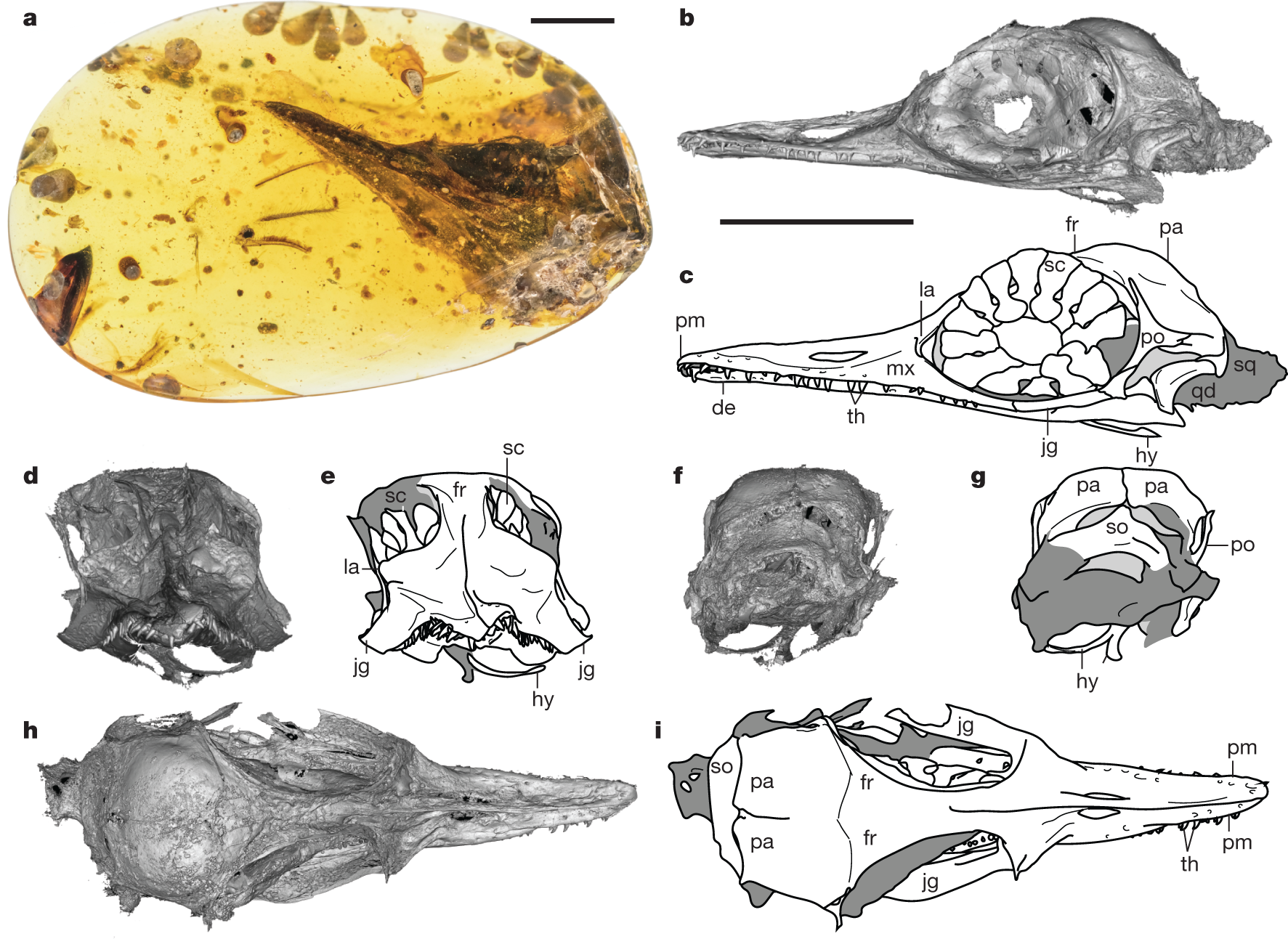
The beautiful tiny fossil skull of Oculudentavis khaungraae in its amber tomb and reconstructed state, as figured by Xing et al. (2020). Behind this beauty, however, lies an ugly, seemingly under-known truth about where these amazing amber specimens come from.
Yesterday, the description of an exciting new fossil bird was published in the world's leading scientific journal, Nature. The discovery concerns the complete but tiny skull and lower jaw of an archaic bird trapped in amber, called Oculudentavis khaungraae by the describers. News of this fossil has rippled around the world, and understandably so. It is, after all, among the smallest dinosaurs of all time with a skull length comparable to diminutive modern hummingbirds, and it gives us a lot to think about as goes avian evolution and the composition of Mesozoic ecosystems. Scientifically speaking, it's undoubtedly an amazing discovery. Social media is awash with discussion about the details of the paper, and palaeoartists are already sketching and painting speculative takes on this new smallest Mesozoic dinosaur

But while Oculudentavis is small, it can't hide an enormous elephant in the room: where it came from. Oculudentavis is one of many spectacular specimens to be described in recent years from the Early Cretaceous amber mines of Myanmar. The amber from this site, for whatever reason, is especially rich in all sorts of biological inclusions: bits of plant, whole insects, spiders, lizards, and even parts of dinosaurs. It's undeniably a fossil locality of tremendous global importance that promises to tell us much about Mesozoic life. It's also, however, a humanitarian nightmare which poses a significant ethical dilemma to anyone working on the biota from this site. These conditions have been the subject of numerous news articles in the last year (see New Scientist, The Atlantic, The New York Times, Science) and yet many of us - journalists included - are only talking about the cool science of Oculudentavis and other Myanmar amber specimens, and not the far more important ethical complications they are associated with.

But let's not get ahead of ourselves: what, exactly, are these issues? To get the best idea, please read the articles linked to above, but I will attempt a short summary here. The Myanmar amber mines are a series of hazardous, narrow tunnels dug by thousands of people under duress - one hesitates to use the word 'slave', but the comparison has been brought up in some reports. The richest amber horizons are about 100 m below the surface, so the tunnels to reach them are long and treacherous. Much of the mining is performed by teenagers because younger people tend to be thin, and the mines are so narrow that only slender people can navigate them. Hundreds of miners are injured or killed each month by tunnel collapses and flooding, and there is no compensation or healthcare for injury or death for the workers or their families. If that's not dangerous enough, the mines are situated in a zone of conflict between Kachin separatists and the Burmese army, so the surrounding area is littered with landmines. Much of the conflict in these areas - which has lasted now for several generations - stems from rival political factions fighting over the amber and other natural resources. Thousands of people have died in the fighting since the resumption of hostilities in 2011, and the conflict is associated with displacement of civilians, genocide, child soldiers, systematic rape and torture. Burmese amber stems from a region of harrowing, terrifying violence.

For a little over two years, this conflict has seen the deepest amber mines closed as the Burmese military occupies important mining sites, but with 10 tonnes of amber being recovered each year for the last few decades, there is no shortage of new and stockpiled specimens to sell. Most of the amber goes to markets in southern China, where it's converted into jewellery to contribute to a $1 billion dollar Chinese amber industry. But a minority - those with interesting inclusions - are sold to scientists. These transactions are not illegal in China, but their initial transference from Burma to China often is - they are frequently smuggled over the border. In at least some instances, these transactions are not carried out through officious museum administration departments, but rather in hotel rooms at palaeontological conferences. Katherine Gammon's Atlantic article describes scientists leaving these rooms with bagfuls of specimens for study having paid serious money for their wares. A well-preserved and unusual invertebrate inclusion will retail at over ten thousand dollars, and you could buy a luxury car for the cost of a Myanmar vertebrate. These fees are paid despite the provenance of the fossils often being unclear. It's thought that the Burmese mines could represent several millions of years of deposition but the amber horizons are not logged in detail, creating ambiguity about how old the specimens are and their ages relative to one another. What's clearer is that the money from these sales funds the various factions fighting over Burmese resources, which in turn spurs the Myanmar government to retaliate and violently suppress this insurgency. Make no mistake: Myanmar amber is big business and, from discovery to sale, they are conflict resources - the palaeontological equivalent of blood diamonds.

A lot of these details have only come to light in the last 12 months, and the palaeontological community is still working out how to process the news. It goes without saying that, even within the narrow scope of academia, the Myanmar specimens create a slew of ethical questions. Is it OK to buy and work on this material? Should museums feel comfortable archiving it? Should journals accept papers describing it? Should referees feel comfortable reviewing those papers? These are questions for academic palaeontology to address - hopefully with a sense of urgency - in due course. In the meantime, several palaeontologists are already refusing to associate with Myanmar amber in any way. This includes individuals who were previously working on Myanmar specimens. They won't research it, won't review papers on it, and won't comment on it to the press, other than to highlight the ethical issues behind it. Some are even calling for a total boycott of research on these specimens, with the hope that it will cut off a source of revenue for the ongoing Kachin conflict.

Other palaeontologists, however, are producing a huge amount of research, maybe even building careers, on Myanmar specimens. It's reported that that dozens of papers on Burmese amber are published every month, equating to hundreds a year. And do not think that this work is produced in ignorance: a lot of the details of the mining conditions of Burmese amber come from the same palaeontologists who publish on the specimens. Against the obvious question of whether this constitutes sound ethical practise, one of the authors behind Oculudentavis is quoted as saying "are we really going to turn our backs on this priceless scientific data?" in the New York Times. At time of writing, professional palaeontological and geological associations do not have official stances or guidelines on this issue.

It's against this backdrop that I've found it increasingly hard to stomach the growing hype around Oculudentavis. Seeing a new discovery being shared, discussed and restored is ordinarily fun, but, in this case, it seems criminal that this is occurring without wider recognition for the very real and great human cost these fossils are associated with. I appreciate that a lot of our joyful reaction to Oculudentavis stems from naivety about the history of the Myanmar amber - it's not like the conditions of the mines and their relevance to the Kachin conflict is mainstream news - but it's such a big part of what these fossils are about that we're almost being lied when authorities neglect to mention it. The story of a tiny Mesozoic bird isn't cute or fun when you know people have been dying in their hundreds in the place where it was found.

I figure the best thing we can do is make sure the context of Myanmar fossils is shared as widely as possible, so people can make their own judgement about the ethics and morals of sharing and promoting this story. For me, I can't celebrate Oculudentavis as a scientific achievement. For all its beauty and untapped knowledge, I just can't look at Myanmar amber with a normal sense of intrigue and wonder, because I can't stop thinking about how many kids might have died in a mine to obtain them, or how many guns were bought from their sale. These are not fun new fossil discoveries, but harrowing artefacts of a national crisis.

There is nothing we can now do to remove Oculudentavis or other published Myanmar specimens from our collective knowledge: they're out there, archived in scientific literature, and we have to engage and work with them in the way we do all fossils. But please, if you're going to write about or share the news of these discoveries, or are producing restorations of them, please treat them with due gravitas. The excitement of a new fossil discovery can be intoxicating, especially when they're as intriguing as the excellently preserved Myanmar material, but we should not forget that these specimens come at the direct expense of hundreds of poorly treated people, and contribute to the suffering of thousands more. Behind these beautiful and fascinating fossils is an ugly truth, and presenting them without due context omits important information that challenges how we conduct our science, and trivialises a very real crisis being faced by our fellow humans in a forgotten part of the planet.

Reference

  • Xing, L., O’Connor, J.K., Schmitz, L. et al. (2020). Hummingbird-sized dinosaur from the Cretaceous period of Myanmar. Nature 579, 245–249. 

Tuesday, 11 February 2020

Horn function in Arsinoitherium OR... the ArSUMOitherium Hypothesis™

Hello, 2017 painting of sheathed-horn Arsinoitherium zitteli. Time to see if we can figure out what those horns were for, other than looking regal in artwork.
Recently, I was in the Teylers Museum, Haarlem, for the opening of their sensational palaeoart-themed Dinomakers exhibit*, where a fine cast of the skull of the Palaeogene Afro-Arabian embrithopod Arsinoitherium zitteli is perched in the main fossil gallery. Arsinoitherium is a pretty darn fascinating mammal that we're all familiar with, yet we rarely give exclusive focus too. I assume this reflects its scientific vintage. Arsinoitherium was discovered well over a century ago and is now featured in so many books and museums that it's part of the popular palaeo furniture. Its size, fantastic cranial horns and status as the last of the embrithopods make it a remarkable and charismatic fossil species, but it just doesn't seem to be cutting it with the kids.

*If you're a regular reader and are in the Netherlands before June, you really want to check this out. It has heaps of original palaeoartworks, including many by classic artists - Hawkins, Knight, Burian, and some exceptional modern work from the Kennis brothers. I have stuff there too.

Today, Arsinoitherium is mostly discussed by palaeontologists documenting new Palaeogene faunas in Eocene-Oligocene sites of Africa and the Arabian Peninsula, but several fascinating behavioural and ecological revelations about this sometimes controversial mammal have also been published in recent years. It's increasingly apparent, for instance, that Arsinoitherium was anatomically conservative, the oldest members of the lineage being little different, morphologically speaking, to the youngest. Despite this, it was a very long-lived and widespread genus which must have been highly adaptable to demonstrate sustain such a broad geographic and stratigraphic range (Jacobs et al. 2005). It evidently lived in a range of habitats, the most surprising of which are upland regions well away from the coastlines and estuaries thought to be traditionally Arsinoitherium country (Kappelman et al. 2003). This adaptability occurs despite the unusual multifunctional dentition of Arsinoitherium being adapted to specialised browsing (Court 1992): perhaps it was more of a generalist than we realised.

More specific insights into Arsinoitherium palaeobiology have been proposed too. Studies of their ear anatomy, principally for their phylogenetic signature, have found adaptations to hear infrasound in the same manner as modern elephants (Benoit et al. 2013), and a compelling case is being built against the popular idea that Arsinoitherium was a hippo-like semi-aquatic animal. This proposal was founded on both functional and taphonomic grounds (e.g. Court 1993) but a suite of opposing data, including tooth wear, occurrences in relatively dry palaeoenvironments, the presence of graviportal limbs and details of bone chemistry, are now pointing to more terrestrial habits (e.g. Clementz et al. 2008; Sanders et al. 2010). Revisions to Arsinoitherium taxonomy are also shedding insights on behaviour. Two Arsinoitherium species are now recognised - the well known A. zitteli and the larger, relatively longer-legged A. giganteum - and prior taxonomic distinctions accounting for a third species are now interpreted as evidence of probable exaggerated sexual dimorphism in A. zitteli (Sanders et al. 2004, 2010). Behind the scenes, we're building a developed picture of what Arsinoitherium was like as a real animal, and not just a long-standing museum fixture.

Image result for arsinoitherium knight
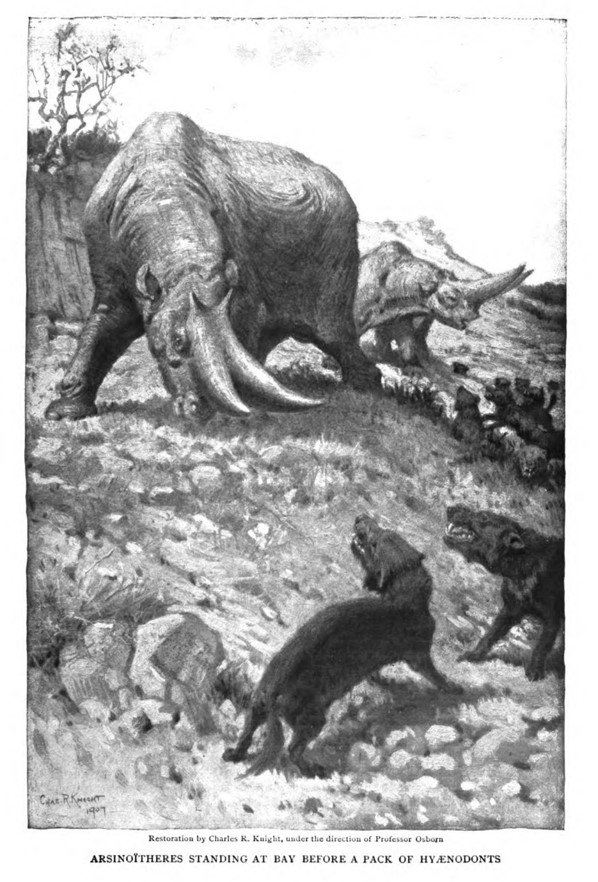
One of my favourite images of Arsinoitherium is this 1907 piece by Charles Knight, published in Osborn (1907). Despite that awesome headgear, Arsinoitherium isn't often illustrated doing much else than standing around, so it's nice to see it having something to do. Hat-tip to Chris Manias for posting this image and making me aware of it.
But one aspect of Arsinoitherium palaeobiology that does not seem to have been discussed at length is horn function. Long-term readers may recall that this is not the first time I've mentioned these structures, as the life appearance of Arsinoitherium horns was the exclusive subject of a 2017 blog post. The take-home of that article is that we artists have probably been incorrect in generally restoring Arsinoitherium horns with facial skin. Rather, their horn surface texture, structure and growth mechanic is consistent with a bovid-like horny sheath. This is not a new idea, with sheathed horns being proposed by several authors (e.g. Andrews 1906; Sanders et al. 2010), but contradicted by others (e.g. Prothero and Schoch 2002; Rose 2006).

Assessing life appearance already tells us something about horn function as a covering of tough, insert tissue has some major biomechanical implications. Arsinoitherium horn cores are deceptively delicate on account of their hollow construction. Despite the skulls of these animals reaching over 80 cm long and their owners attaining masses of around two tonnes (Sanders et al. 2010), Arsinoitherium horn cores were constructed from bones just 5-10 mm thick. Without additional protection, such delicacy might prohibit antagonistic use and a more passive function would seem likely, such as visual communication or acoustic augmentation (sensu Benoit et al. 2013). But modern species show that a horny sheath over a hollow horn core creates an amazingly strong, impact-absorbing and bending resistant organ that can be used to bludgeon, wrestle and lance other animals or to forcefully modify the surrounding environment. The physics of this is pretty simple: the hollow bone core provides great bending resistance and reduces weight, while the horny sheath absorbs and dissipates shocks and impacts (Drake et al. 2016). We've seen this exact configuration evolving time and again across Tetrapoda, and its presence in Embrithopoda shouldn't be viewed as weird or improbable.

Partly restored left horn of the Teylers' Arsinoitherium zittelli skull showing the characteristic epidermal correlates (numerous oblique foramina and anastomosing blood vessels) for a bovid-like horn sheath. These horns are identical in texture to what you might see under a cow horn.
But while the horns themselves look formidable enough, their use would be limited without a substantial neck to support and wield the head. It's for this reason that I was pleased to see the Teylers' skull without any pesky postcrania obscuring details of its posterior face. The rearward aspects of animal skulls are often overlooked in favour of more spectacular anatomy but, if you're seriously interested in the functional morphology of fossil animal crania, you need to look at the occiput and other aspects of the posterior skull surface to assess the head/neck soft-tissues. These regions reveal much about neck muscle size and distribution, as well as something of head mobility via the shape of the occipital condyle. Even at a glance, you can often say something intelligent about how animals were wielding their heads by looking at the posterior skull.

I was thus greatly interested to see that the Teylers' posterior Arsinoitherium skull bore several features unfamiliar to me from other large animals. Here's what you can see of the back the skull as it stands in the Teylers gallery. I think there's some reconstruction in places but the skull of Arsinoitherium is completely known from several specimens, and any sculpting seems to be a faithful recreation of real anatomy.

Posterior view of the Teylers Museum Arinoitherium zitteli skull cast, as seen in January 2020.
And here's the same thing, more or less, as illustrated by Andrews (1906):

Image from Andrews (1906, courtesy Wikimedia), public domain.
The exciting parts here are not the unsurprisingly robust nature of the skull-neck junction or the general indications of expansive neck musculature. Nor even is it the substantially-sized occipital condyle that is almost as wide as the skull itself, and has a shape seemingly permitting more dorsoventral motion than lateral (a thought posited previously by Andrews, 1906). Rather, the interesting aspect is the unusual configuration of the bones surrounding the occipital condyle. Most animals, even species with large, heavy heads, have relatively flat occipital faces, but the medial dorsal region of the Arsinoitherium occiput is deeply recessed between two large protuberances which extend posteriorly almost as far as the occipital condyle. The dished medial region extends forward quite some way, projecting far over the braincase to form a deep depression in the skull roof (below). The neighbouring protuberances are prominent, posteriorly-directed outgrowths of the dorsal occipital margin (the superior nuchal line) which curve somewhat towards the skull midline, and are supported below by thick bony buttresses. I've looked for similar anatomy in a number of other large mammal skulls and, while my research isn't exhaustive enough to claim Arsinoitherium has an entirely unique posterior skull configuration, I'm happy to declare it unusual.

Dorsolateral view of the Arsinoiherium zittelli occiput, showing the large basin formed by the dorsal region and the two neighbouring projections. Note the complex surface and texturing, indicating scars and attachment sites of neck musculature.
Since seeing this, I've been wondering what it tells us about how Arsinoitherium neck tissues were arranged and what that might mean for horn function. I decided that a good place to start was a stab at reconstructing the muscles of the occipital region, which you can see below. A word of caution about this image: this is not a watertight study of Arsinoitherium specimens based on days and days of work, but more an attempt to get a basic understanding of what that peculiar anatomy represents if we assume conventional mammal occiput myology. I like to think it's not total garbage, but don't treat it as gospel either. I included the classic Gray's Anatomy human occiput illustration in there, scaled to the size of an average human adult (≈ 30 mm wide foramen magnum, apparently), to ram home how large the skulls of Arsinoitherium are.

My attempt to figure out what's going on at the back end of the Arsinoitherium skull. Skull outline after Andrews (1906), with some minor modification (including removal of the restored horn tips). That's an 'average' human occiput on the right, taken from Wikipedia (public domain). Does anyone else feel weirdly inadequate when looking at this image? I mean, I know it's not all about size and all, but still...
If my noodling on this is correct, then dorsomedically-anchoring muscles typically involved with elevating the neck (e.g. Semispinalis capitis, Trapezius) are now anchored partially on the skull dorsal surface, with the anteriormost located some distance forward of the occipital condyle. Such a configuration surely means that their contraction would not only elevate the neck (as expected) but also tip the head upwards to an unusual extent, and the increased distance between the occipital condyle and these muscles signifies a longer lever arm, and thus greater torque, on the head-neck joint. The lateral protuberances aren't quite in the right place for neck elevators however, and I initially wondered they were something to do with jaw musculature. Expanded temporalis muscles often create extended crests at the back of animal skulls but this is not the case in Arsinoitherium, where the temporal muscle housing clearly terminates well anterior to the occipital face. It seems more likely that these protuberances are something to do with laterally-placed skull-neck muscles - perhaps a set of considerably expanded obliquus capitis superior. These are muscles which run between the atlas (the first neck vertebra, a structure which is also huge in Arsinotherium) and the posterior skull to deliver fine control to head elevation and lateral rotation. But because the protuberances have migrated to somewhat overhang the atlas vertebra, the vertical action of these muscles was likely enhanced relative to other mammals. As with the muscles of the dished medial occipital region, this realignment of the oliquus capitis superior would likely see the head pitching up during contraction. Further large muscles are indicated by the broad mastoid and jugular processes, regions which anchor muscles that variably elevate, rotate and laterally flex the head and neck.

All being equal, it seems that the posterior Arsinoitherium skull wasn't just about supporting the head with a series of big, powerful muscles, but also specifically configured to enhance the extension of the craniocervical joint - in other words, to forcibly swinging the head upwards relative to the neck. Much of the rearrangement of the posterior skull seems to be geared towards this, both in terms of expanding muscle attachment area and also reorienting muscle vectors to better serve vertical head motion. This, of course, also fits well with observations that the occipital condyle is structured to facilitate more dorsoventral movement than lateral. I suspect we do not see an equivalent configuration in other mammal skulls because most heavy-headed mammals also possess expanded head-neck muscles anchored to withers (tall vertebral spines of the shoulder region). This configuration allows them to lift their heads and necks around using drawbridge-like actions whereas Arsinoitherium, which lacked significant withers (Andrews 1906), probably had to rely more on muscles localised around neck vertebrae to support and move its head.

Skull variation in Arsinoitherium, as figured in my previous blog post on Arsinoitherium. Note the changing posterior shape from the smallest to the largest skull.
What might all this mean for horn function? It goes without saying that enhanced adaptations for swinging a skull upwards could have a lot of functional implications when that skull is covered in horns. It seems reasonable to assume that Arsinoitherium could use this for a number of practical purposes, such as taking forceful swipes at predators or using its headgear to knock over trees and other vegetation to access certain food sources. However, it's noteworthy that the only the biggest (potentially male?) Arsinoitherium that have the most developed version of the complex occiput morphology outlined here (see image above), suggesting that enhanced head and horn motion was of principal use for big, mature animals concerned with territories, mates and other resource competition. Might this indicate that intraspecific combat, such as horn-locked wrestling matches with rival individuals, was an adaptive pressure here? I'm not aware of tests to see how well Arsinoitherium horns interlocked (as has been done for horned dinosaurs - see Farke 2004) but they certainly look like they'd slot between each other in a way that would allow for intraspecific wrestling, and powerful neck and head elevators would be useful to shove and unbalance opponents, deliver pointed jabs and parry incoming blows. If Arsinoitherium sheathed horns were as strong as those of modern mammals I suspect they could easily withstand the strain of such bouts, and their wide occipital condyle and cervical series would do well to resist the torsion incurred by wrestling activity. Of further significance is that Court (1993) noted that the limbs of Arsinoitherium were adapted for forceful retraction, a feature he assumed was useful for swimming. But a terrestrially wrestling Arsinoitherium would find that useful too, as powerful limb actions would push the body forward against a rival. I'm not sure these retractors would indicate running and charging behaviours however because, even with strong limb muscles, Arsinoitherium has stumpy distal bones ill-suited to rapid locomotion. In my mind, I'm visualising this hypothesis as four-horned sumo wrestling over jousting or fencing.

The idea of Arsinoitherium using its horns aggressively is not, of course, a radical or special insight - any three-year-old could make the same suggestion based on the observation that sharp, pointy bits of animals tend to be used in such ways. But I think it's neat that there might be an overlooked functional signature of this behaviour in the predicted tissues and structure of the horns as well as the morphology of the posterior skull, and suggest this might warrant further research. It seems to fit multiple aspects of Arsinoitherium functional morphology and chimes well with behaviour in large living herbivorous mammals: it's actually difficult to think of large mammals with substantial horns or tusks that don't use them for intraspecific fights. It'd be cool to see this investigated further, but that's beyond the scope of this article. For now, I'll leave you with my artistic take on what's clearly got to be called the Arsumoitherium Hypothesis - with a name like that, this idea has to be correct, right?

Two Arsinoitherium zitteli engaged in a wrestling bout - does antagonistic behaviour explain those powerful head extensors? Those neck humps aren't muscle, by the way, but rhino-like pads of neck tissue. Also, has anyone else rendered Arsinoitherium in this way? I can't find any other examples, but also refuse to believe that no-one has illustrated something similar since Arsinoitherium was described in 1903.

Enjoy monthly insights into palaeoart, fossil animal biology and occasional reviews of palaeo media? Support this blog for $1 a month and get free stuff!

This blog is sponsored through Patreon, the site where you can help online content creators make a living. If you enjoy my content, please consider donating $1 a month to help fund my work. $1 might seem a meaningless amount, but if every reader pitched that amount I could work on these articles and their artwork full time. In return, you'll get access to my exclusive Patreon content: regular updates on upcoming books, papers, paintings and exhibitions. Plus, you get free stuff - prints, high-quality images for printing, books, competitions - as my way of thanking you for your support. As always, huge thanks to everyone who already sponsors my work!

References

  • Andrews, C. W. (1906). A descriptive catalogue of the Tertiary Vertebrata of the Fayum. Publ. Brit. Mus. Nat. Hist. Land. XXXVII.
  • Benoit, J., Merigeaud, S., & Tabuce, R. (2013). Homoplasy in the ear region of Tethytheria and the systematic position of Embrithopoda (Mammalia, Afrotheria). Geobios, 46(5), 357-370.
  • Clementz, M. T., Holroyd, P. A., & Koch, P. L. (2008). Identifying aquatic habits of herbivorous mammals through stable isotope analysis. Palaios, 23(9), 574-585.
  • Court, N. (1992). A unique form of dental bilophodonty and a functional interpretation of peculiarities in the masticatory system of Arsinoitherium (Mammalia, Embrithopoda). Historical Biology, 6(2), 91-111.
  • Court, N. (1993). Morphology and functional anatomy of the postcranial skeleton in Arsinoitherium (Mammalia, Embrithopoda). Palaeontographica Abhandlungen A, 226, 125-169.
  • Drake, A., Donahue, T. L. H., Stansloski, M., Fox, K., Wheatley, B. B., & Donahue, S. W. (2016). Horn and horn core trabecular bone of bighorn sheep rams absorbs impact energy and reduces brain cavity accelerations during high impact ramming of the skull. Acta Biomaterialia, 44, 41-50.
  • Farke, A. A. (2004). Horn use in Triceratops (Dinosauria: Ceratopsidae): testing behavioral hypotheses using scale models. Palaeontologia Electronica, 7(1), 10p.
  • Jacobs, B. F., Tabor, N., Feseha, M., Pan, A., Kappelman, J., Rasmussen, T., ... & Massini, J. L. G. (2005). Oligocene terrestrial strata of northwestern Ethiopia: a preliminary report on paleoenvironments and paleontology. Palaeontologia electronica [electronic resource]. Vol. 8, no. 1 (2005): 19 p.
  • Kappelman, J., Rasmussen, D. T., Sanders, W. J., Feseha, M., Bown, T., Copeland, P., ... & Jacobs, B. (2003). Oligocene mammals from Ethiopia and faunal exchange between Afro-Arabia and Eurasia. Nature, 426(6966), 549-552.
  • Osborn, H. F. (1907). Hunting the Ancestral Elephant in the Fayûm Desert: Discoveries of the Recent African Expeditions of the American Museum of Natural History. Century Company, October 1907, 815-835.
  • Prothero, D. R., & Schoch, R. M. (2002). Horns, tusks, and flippers: the evolution of hoofed mammals. JHU Press.
  • Rose, K. D. (2006). The beginning of the age of mammals. JHU Press.
  • Sanders, W. J., Kappelman, J., & Rasmussen, D. T. (2004). New large-bodied mammals from the late Oligocene site of Chilga, Ethiopia. Acta Palaeontologica Polonica, 49(3), 365-392.
  • Sanders, W.J., Rasmussen, D.T., & Kappelman, J. (2010). Embrithopoda. In: Werdelin, L., Sanders, W.J. (Eds.), Cenozoic mammals of Africa. The University of California Press, Berkeley, Los Angeles, London, pp. 115–122.