Monday, 31 January 2022

The silent dinosaur hypothesis

The story of how dinosaurs were resurrected for cinema in the early 20th century tends to focus on the visual components of these technical feats: the 2D animation and stop-motion technology that made long-extinct reptiles move again. But alongside making dinosaurs walk and run, cinematic dinosaurs also gave them a voice, imagining their snarls, barks, screeches and roars. Perhaps the first film to do this (or certainly the first mainstream, widely-seen film, at any rate) was 1933’s King Kong, where a charging Stegosaurus might take the title of first vocalising dinosaur in cinematic history:

The crew of the Venture encounter a Stegosaurus: a famous scene from 1933's King Kong and, potentially, the first dinosaur cinema audiences ever heard vocalise. From Youtube's Prehistoric Classics.

The same film would give us plenty of other prehistoric animal action and noise, but by far the most famous is surely the snarling, screeching Tyrannosaurus:

Tyrannosaurus takes on King Kong in er, King Kong (1933). We've all seen it a million times, but go on, watch it again: you know you want to. Note the screechy tyrannosaur noises, presumably to contrast with Kong's throaty roars. From Youtube's Movieclips.

Over the last century, cinematic dinosaur appearance and the technologies used to depict them have changed dramatically but one thing has remained the same: dinosaurs are as loud and noisy as ever. We’ve even seen the development of conventions and tropes around what dinosaurs sounded like. Sauropods are often given haunting, humpback whale-like songs and dromaeosaurs are frequently assigned aggressive, high-pitched snorts, snarls and crackles. And, of course, big theropods — especially Tyrannosaurus — invariably have deep, bellowing roars. It’s no exaggeration to say that the Jurassic Park Tyrannosaurus roar is as iconic and recognisable as its now-famous (maybe infamous?) design.

The desire to depict talkative, raucous dinosaurs has long transcended media capable of conveying sound. Even movie dinosaurs were noisy and boisterous before we had the technology to make them truly roar on screen. The 1925 silent film The Lost World features plenty of roaring, snarling and bellowing stop-motion dinosaurs framed by director Harry O. Hoyt in dramatic close-up. Even in silence, the intent of these shots is obvious, and we simply have to imagine their vocalisations ourselves. Fantasia’s famous 1940 Rite of Spring sequence performed a similar trick for artistic reasons, juxtaposing a roaring Tyrannosaurus against booming segments of Igor Stravinsky’s famous composition. Static, traditional palaeoart also has a strong emphasis on animal vocalisations. Peruse any gallery of prehistoric animal restorations (such as this, at my new website!) and we inevitably find heaps of artworks showing grunting, chirping, screaming dinosaurs. Viewed objectively, it is a little strange that we focus so much on this behaviour in our artwork. Why don’t we render more non-acoustic behaviours that are arguably better suited to a totally visual medium? And furthermore, why draw so much attention to an aspect of dinosaur behaviour we don't know much about? Subconsciously, we just can’t get away from the call — pun not intended — of depicting extinct animals vocalising.

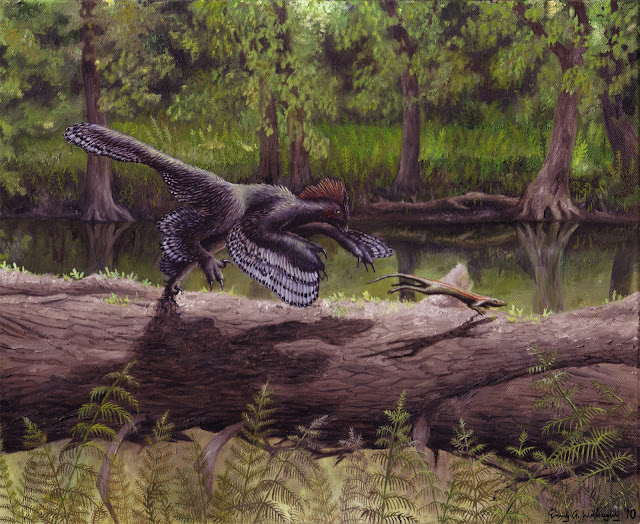
An Archaeopteryx siemensii perches on driftwood, opens its mouth and calls out... what, exactly? We palaeoartists can't resist drawing animals posed mid-vocalisation, despite our lack of knowledge about extinct animal sound production.

Clearly, we've collectively decided that prehistoric reptiles were vocal, noisy species, and this is understandable. It is, after all, what we experience around us today. Our world is full of singing, calling birds and barking, bellowing mammals. Whales sing, lions roar, and frogs croak. It stands to reason, then, that dinosaurs would be just as vociferous, and that a Jurassic or Cretaceous dawn would be full of strange, wondrous hoots, bellows, chirrups and songs that we can only imagine. I am, of course, leading up to a weighty “however”. What if our assumption of noisy, vociferous dinosaurs is simply... wrong?

This is, of course, a very strong accusation, especially because we can say very little definitively about dinosaur vocalisation owing to our lack of fossilised dinosaur throat tissues and vocal organs. The preservation of such anatomies among Mesozoic dinosaurs is not impossible, these having been found in Vegavis iaai, a Mesozoic bird that lived in Antarctica 69-66 million years ago (Clarke et al. 2016); but this remains an exceptional occurrence: Vegavis is the only Mesozoic dinosaur known with preserved vocalisation anatomy. We can, however, use fossils and data from extant reptiles and birds to make predictions about dinosaur vocal ability, and several researchers have attempted this (e.g. Weishampel 1981; Senter 2008; Brazaitis and Watanabe 2011; Clarke et al. 2016; Reide et al. 2016). Among the more famous examples of such works is Phil Senter’s 2008 Voices of the past: a review of Paleozoic and Mesozoic animal sounds, a synthesis of what we know of sound production among ancient animals. In his section on birds and their ancestors, Senter makes the bold suggestion that non-avian dinosaurs may have been — yikes — entirely non-vocal (Senter 2008). In other words, this posits that dinosaurs may have not only been much quieter than their pop culture counterparts, but actually reliant on non-vocal acoustics when they wanted to communicate audibly. This notion — which I’m calling the "silent dinosaur hypothesis” — gained a fair bit of discussion online when first published and still crops up in modern conversations about dinosaur behaviour. But how does it hold up over a decade on, and did it ever have a sound basis to begin with?
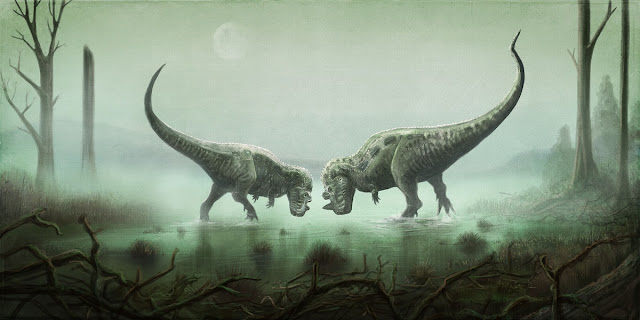
Non-vocal (or, at least, closed-mouth) interaction between male and female Ceratosaurus nasicornis. Were dinosaurs limited to posturing and other means of display for their communication with one another? Some hypotheses suggest so.

To explore this further, it will help to outline what non-vocal animal acoustics are. We animals make noise all the time simply by existing and going about our lives. These ‘passive’ noises are classed as non-vocal acoustics. They include sounds that come from acts like breathing, forcing air around your throat tissues, and hitting or rubbing body parts against each other or external objects. Many animal species exploit these phenomena to make deliberate, structured sounds for communication. A hiss, for example, is little more than forcefully expelling air through our throats and mouths. A snort is much the same, except using our noses. We can also purposefully slap or rub body parts together or against the ground, water or vegetation to create loud noises. Some species have developed special anatomy purely to create non-vocal sounds, with the most obvious example being rattlesnake tails. Non-vocal acoustics are everywhere once we start noticing them, and Senter (2008) argued that they may have been the only sounds made by dinosaurs. It's incontrovertible that these are the only noises we can be confident that dinosaurs made because they can be generated regardless of vocal capability. Whatever other noises dinosaurs created, we know that they could hiss, snort, stamp their feet and so on, and living diapsids show that such behaviours are used as communication strategies among extant dinosaur relatives. Non-vocal acoustics are also perfectly compatible with the large noses and crests that may have acted as resonating chambers in certain dinosaurs, too (e.g. Weishempel 1981; Witmer and Ridgely 2009). We know, for instance, that some non-vocal snake species use resonating cavities in their throats to turn hisses into growls (Young 1991; see an example here of the slightly terrifying noises from of a king cobra).

So, yes, non-vocal acoustics make a lot of sense for dinosaurs — documentary makers, take note. But Senter's (2008) accusation is that dinosaurs could only make non-vocal sounds, and that requires us to consider 'true' vocalisations: the sounds animals make by forcing air through their vocal organs. Mammals, amphibians and non-avian reptiles use a larynx for this purpose, while birds have their own, unique voice organ: the syrinx. It’s the evolution of this structure that prompted Senter’s suggestion of non-vocal dinosaurs. Unlike the larynx, which is situated at the top of the throat, the syrinx is located at the base of the trachea where the airway forks into the lungs. It also works in a different way to a larynx. Rather than passing air over vocal folds, the syrinx generates sound from the airway walls themselves. Rushing air from the lungs flutters these membranes and associated cartilages in a manner that produces sound, and the location of the syrinx at the fork where the trachea becomes a pair of bronchial tubes allows for especially complex vocalisations: each bronchial component can vibrate asymmetrically, making two sounds at once. To keep their airways open, avian syrinxes are reinforced with well-mineralised cartilaginous rings. In modern birds, it seems that syrinxes can also only function with assistance from a clavicular air sac (Senter 2008), although experiments indicate vocalisation without this structure may be possible (Clarke et al. 2016).
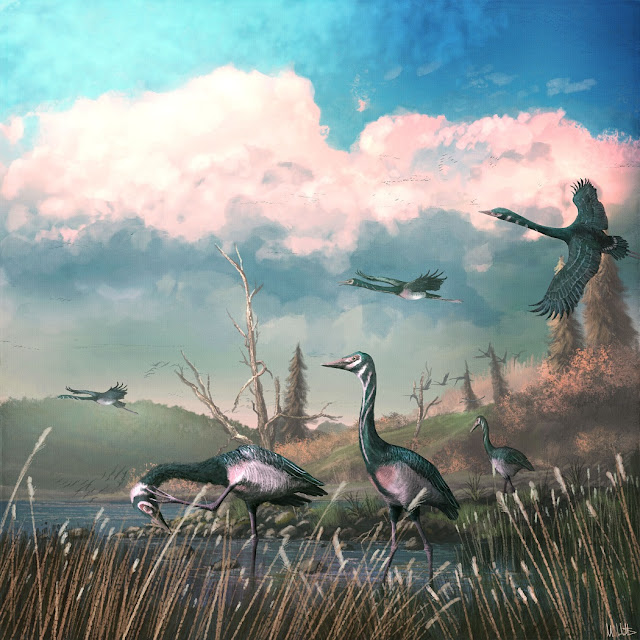
Thanks to fossils of Vegavis, we can be confident that extinct duck and goose relatives like Conflicto antarcticus — a Palaeogene species from Antarctica shown here — were capable of making honking, goose-like sounds. But we have very little direct evidence for the sort of noises more rootward dinosaurs were able to make.

The reinforced structure of the syrinx and its possible association with an air sac means that, unlike larynxes, they have some geologically detectable elements. In theory, this allows us to gauge roughly when, and in which lineages, they evolved even if fossil syrinxes themselves are rare. We can search for evidence of the clavicular air sac pneumatising the bones of the pectoral girdle and forelimb, as well as fossils of those reinforcing, mineralised rings holding the syrinx open. Although soft-tissue in nature, these structures are found in Cenozoic bird fossils (Clarke et al. 2016), so they evidently have decent enough fossilisation potential in the right circumstances.

The results of such searches have come back without much to report, however. Even in well-preserved Mesozoic dinosaurs, we find no consistent evidence for clavicular air sacs outside of the ornithothoracines (the group of avialans that includes enantiornithines and crown birds, but see Senter 2008; Wedel 2009 for a few exceptions) and not a single mineralised airway has been discovered in a non-avian dinosaur (Senter 2008; Clarke et al. 2016). This suggests that the syrinx was developed very late in dinosaur evolution, perhaps not even being present in feathered, otherwise extremely-bird-like dinosaurs (Clarke et al. 2016; Kingsley et al. 2018). We should not assume, of course, that the avian syrinx sprang into existence fully-formed — surely it had to develop via intermediary ‘proto-syrinx’ structures first (Kingsley et al. 2018) — but we don’t know what that structure was nor what features might evidence its existence. With our present dataset, all we can say is that the avian syrinx as we know it probably wasn’t present in most non-bird dinosaurs. It follows that if dinosaurs did not have a syrinx, they were probably incapable of making the rich, complex noises of modern birds.

And this is where things get especially interesting. OK, so dinosaurs weren't singing like passerines, but most reptiles have a larynx, and we can be pretty certain that dinosaurs did too. So Senter must be wrong, right? Dinosaurs merely vocalised like modern reptiles: case closed. Well, not necessarily, because we don't know if the dinosaur larynx was functional. Many lizard larynxes lack vocal folds and thus cannot vocalise, and opinions differ on whether their vocal abilities were independently lost from a vocal reptilian ancestor (e.g. Kingsley et al. 2018) or convergently gained from a historically silent one (e.g. Russel and Bauer 2021). Furthermore, birds also have a larynx, but it's also non-functional. This leaves dinosaurs evolutionarily bracketed by crocodylians (with a functioning larynx) and birds (with a non-functioning larynx), creating ambiguity about the ancestral state of dinosaur vocal organs. The ancestral acoustic capabilities of other reptiles is thus very important to determining what the original state of archosaur vocalisation was. There are two possible models (Kingsley et al. 2018): perhaps archosaurs were ancestrally silent, with crocodylians and birds to developing functional vocal organs independently of one another; or they were vocal, with birds augmenting and/or replacing the larynx for an unknown reason late in dinosaur evolution. And this touches on another key question with bearing on dinosaur vocalisation: why did birds develop the syrinx at all? One possibility is that the syrinx evolved in response to having lost, or having never developed, a vocal organ in the first place (Kingsley et al. 2018), a scenario implying that at least some theropods, if not all dinosaurs, went through a silent phase in their evolutionary history. The bottom line is that there's still a lot to learn about the evolution of reptile vocalisation, and there are reasonable, entirely plausible models that align with Senter’s (2008) proposal that dinosaurs were non-vocal (below).
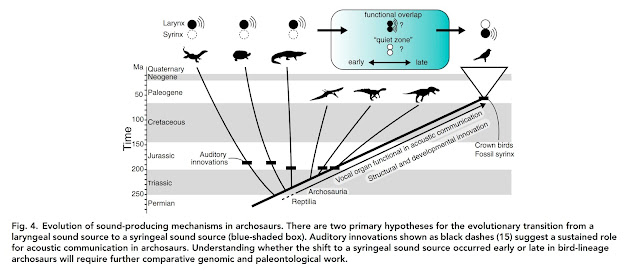
A handy graphic showing two competing models of syrinx evolution, from Kingsley et al. 2018. This assumes that reptiles were ancestrally vocal, but this doesn't change considerations of syrinx evolution too much. Essentially, we have two options: birds evolved a syrinx alongside a functioning larynx, or the dinosaur larynx wasn't functional, and the syrinx evolved as a novel structure to exploit vocal communication. The latter model, of course, implies at least some non-vocal dinosaurs.

These ideas are, of course, very difficult to test without appropriate fossil data. Senter (2008) noted some support from non-vocal lizards using visual communication instead of aural, thus placing extra significance on the often extravagant display structures of dinosaurs. Might all those crests, horns, frills, fancy scales and elaborate feathers have evolved because dinosaurs were essentially mute, primarily visual communicators (Senter 2008)? A counterargument to this is that lizards communicate visually without such crests, horns and so on, but the concept of some dinosaurs using display structures to compensate for a lack of vocal capability is still an interesting idea.

But before we get carried away with all this, we should note that the silent dinosaur hypothesis is not the only model of archosaur acoustic evolution on the table. A case can be made that, whatever weirdness was going on with syrinx evolution, dinosaurs were still capable of making laryngeal sounds. It has been noted that birds and crocodylians share several similar vocal behaviours that implies inheritance from a shared, vocal ancestor (e.g. Brazaitis and Watanabe 2011; Clarke et al. 2016) and some models of reptile evolution posit that all reptiles were ancestrally vocal, implying a functioning larynx in Dinosauria (Kingsley et al. 2018). Such concepts predict that dinosaurs vocalised at least in relation to matters of territory and courting, as well as to communicate between parents and offspring (Clarke et al. 2016). It’s difficult, of course, to know what specific sounds were made, and this isn't just because larynxes rarely fossilise: it's also because reptilian vocal anatomy is just not as well studied as that of birds and mammals (e.g. Rittenhouse et al. 1998; Reide et al. 2015; Russel and Bauer 2021). Recent work has shown that, although most reptile vocalisations are relatively simple compared to those of frogs, mammals and birds, there is a lot of variation in larynx structure across reptile species, and that their vocal tissues and acoustic capabilities can be very sophisticated, sometimes competing with mammals and birds in complexity (Brazaitis and Watanabe 2011; Reide et al. 2015; Russel and Bauer 2021). Among the most developed reptile vocal capabilities are those of crocodylians, which include a repertoire of behaviourally-specific hisses, grunts, bellows, snorts and chirps (Garrick et al. 1978), and those of geckoes, which use a range of single and repetitive chirps for advertising and alarm purposes (Russel and Bauer 2021). Perhaps, assuming dinosaurs did have functional larynxes, they made similar sounds.

I'll take any excuse to link to videos of bellowing alligators. American alligators typically bellow in water, but — as this video shows — they perform a similar behaviour on land, too. Note the closed mouth and inflating neck tissues here, and read on. From Youtuber JadeAtema.

We should clarify that the comparisons made by some researchers between reptilian and mammalian larynxes does not necessarily imply that dinosaurs vocalised like mammals. The throat tissues of reptiles and mammals are quite different in that reptiles can inflate their neck tissues with air from their lungs, whereas mammalian throat cartilage and muscles prohibit this action (Reide et al. 2016). This equips diapsids with a distinct mechanism for loud, deep sound production: closed-mouth vocalisation. By closing their mouths to prevent air escape and pumping air into their necks, reptiles and birds can create resonating chambers which allow for much deeper, lower-frequency vocalisations than could be achieved with a 'standard' open mouth call. We might intuitively think of crocodylians employing this behaviour to create loud, awesome bellows (especially the American alligator, which is the champion of crocodylian bellowing - see Garrick et al. 1978 and video above) but this tactic is not just used by big, exotic species: the cooing of pigeons and the ‘a-woo’ of eider ducks are also closed-mouth vocalisations. These acoustics have developed repeatedly throughout archosaur evolution and may have been practised by the dinosaur-crocodylian ancestor (Reide et al. 2016), so it seems reasonable to imagine this behaviour being used by dinosaurs making especially loud, deep and far-reaching noises. This may have been especially so among large species as, in birds at least, closed-mouth vocalisations have mostly evolved among bigger-bodied lineages (Reide et al. 2016). Predictions of archosaur voice evolution do not suggest that all dinosaur vocalisation would be closed-mouth (Reide et al. 2016), but those of us interested in depicting dinosaurs making their loudest, most intimidating noises should consider closed-mouth behaviours more likely than the usual stereotype of cat-like roaring (indeed, the roaring ability of Panthera species is associated with an unusual throat and laryngeal configuration (see Weissengruber et al. 2002), so we shouldn’t regard it as a ‘typical’ noise for any extinct animal to make, especially a reptile).

But we're getting a little off-topic now: we're here to talk about silent dinosaurs, not booming ones. So let's wrap things up. To summarise, there are a few take-homes here. The first is that the general assertion that we know nothing about dinosaur vocalisation isn’t really true: we certainly don’t know much, but we’re not entirely devoid of intelligent comment, either. A lot of the papers cited in this post are available online and are well-worth reading if you want to know more about the topics discussed above. The second is that the silent dinosaur hypothesis is far from a done-deal, but it has a more legitimacy than we might first expect. It's not, despite its unorthodoxy, a crazy idea and actually fits some interpretations of dinosaur vocal evolution, even if we can't really tell how right or wrong it is at the moment. There are huge caveats around any model of dinosaur vocal evolution, of course, the most important being that our models are so poorly informed by fossil data that one new discovery could turn everything we’ve predicted on its head. And that leads to a third main point: whatever ideas of dinosaur vocalisation we think are correct, we should appreciate that they’re not much more than personal preferences at the moment. But that’s fine, and it's even liberating for artists and filmmakers. This uncertainty gives us a huge playground for depicting dinosaur behaviour in ways we haven’t considered before. What does a non-vocal Tyrannosaurus do instead of roaring when it wants to look impressive? How do sauropods communicate without singing? What noises did Mesozoic birds make before they developed the syrinx? We don’t know, but it’s sure a heck of a lot of fun to think about.

Enjoyed this post? Support this blog for $1 a month and get free stuff!

This blog is sponsored through Patreon, the site where you can help artists and authors make a living. If you enjoy my content, please consider donating as little as $1 a month to help fund my work and, in return, you'll get access to my exclusive Patreon content: regular updates on upcoming books, papers, paintings and exhibitions. Plus, you get free stuff - prints, high-quality images for printing, books, competitions - as my way of thanking you for your support. As always, huge thanks to everyone who already sponsors my work!

References

  • Brazaitis, P., & Watanabe, M. E. (2011). Crocodilian behaviour: a window to dinosaur behaviour?. Historical Biology, 23(01), 73-90.
  • Clarke, J. A., Chatterjee, S., Li, Z., Riede, T., Agnolin, F., Goller, F., ... & Novas, F. E. (2016). Fossil evidence of the avian vocal organ from the Mesozoic. Nature, 538(7626), 502-505.
  • Garrick, L. D., Lang, J. W., & Herzog, H. A. (1978). Social signals of adult American alligators. Bulletin of the AMNH; v. 160, article 3.
  • Kingsley, E. P., Eliason, C. M., Riede, T., Li, Z., Hiscock, T. W., Farnsworth, M., ... & Clarke, J. A. (2018). Identity and novelty in the avian syrinx. Proceedings of the National Academy of Sciences, 115(41), 10209-10217.
  • Riede, T., Li, Z., Tokuda, I. T., & Farmer, C. G. (2015). Functional morphology of the Alligator mississippiensis larynx with implications for vocal production. The Journal of experimental biology, 218(7), 991-998.
  • Riede, T., Eliason, C. M., Miller, E. H., Goller, F., & Clarke, J. A. (2016). Coos, booms, and hoots: The evolution of closed‐mouth vocal behavior in birds. Evolution, 70(8), 1734-1746.
  • Russell, A. P., & Bauer, A. M. (2021). Vocalization by extant nonavian reptiles: a synthetic overview of phonation and the vocal apparatus. The Anatomical Record, 304(7), 1478-1528.
  • Senter, P. (2008). Voices of the past: a review of Paleozoic and Mesozoic animal sounds. Historical Biology, 20(4), 255-287.
  • Weishampel, D. B. (1981). Acoustic analyses of potential vocalization in lambeosaurine dinosaurs (Reptilia: Ornithischia). Paleobiology, 7(2), 252-261.
  • Weissengruber, G. E., Forstenpointner, G., Peters, G., Kübber‐Heiss, A., & Fitch, W. T. (2002). Hyoid apparatus and pharynx in the lion (Panthera leo), jaguar (Panthera onca), tiger (Panthera tigris), cheetah (Acinonyx jubatus) and domestic cat (Felis silvestris f. catus). Journal of anatomy, 201(3), 195-209.
  • Witmer, L. M., & Ridgely, R. C. (2009). New insights into the brain, braincase, and ear region of tyrannosaurs (Dinosauria, Theropoda), with implications for sensory organization and behavior. The Anatomical Record: Advances in Integrative Anatomy and Evolutionary Biology, 292(9), 1266-1296.

Thursday, 16 December 2021

An interview with Emily Willoughby, author and artist of Drawing and Painting Dinosaurs

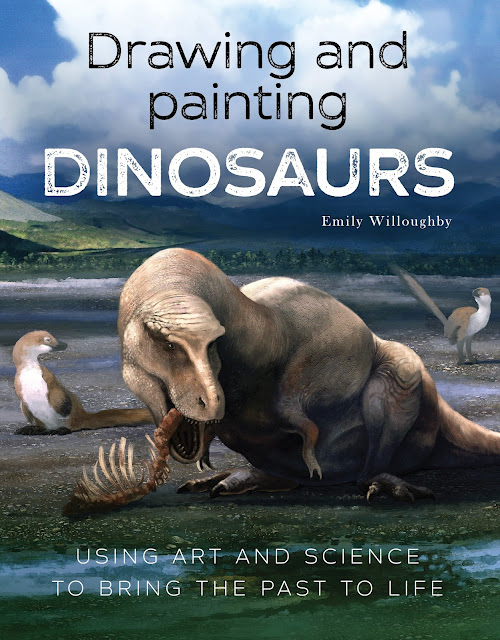
That most obscure theropod taxon Tyrannosaurus chews on bones on the front cover of Emily Willhoughby's new book, Drawing and Painting Dinosaurs: the latest entry into the growing literature dedicated to palaeoartistry. Can we talk about how nice that tyrannosaur knee is? From the Crowood Press website.
The last decade or so has seen the arrival of several notable palaeoart books, articles and book chapters that showcase the works and voices of palaeoart practitioners past and present, such that it seems we’re in a particularly rich literary era for this specialised artform. Among these works are a slowly growing number dedicated to palaeoart methodology: the hows, whats and whys of restoring the life appearance of extinct organisms from fossil remains. In late October of this year, another book in this vein arrived to add to your palaeoart library: Emily Willoughby’s Drawing and Painting Dinosaurs.

I was fortunate enough to be sent a review copy of this new book by Crowood Press, who you may know from my own The Palaeoartist’s Handbook (2018) and the upcoming Witton and Michel volume The Art and Science of the Crystal Palace Dinosaurs (coming May 2022, vintage palaeoart fans!). Much as I wanted to write about Emily's book, my involvement with Crowood presents a conflict of interest to presenting any thoughts I may have, and the fact that Emily kindly contributed artwork to The Palaeoartist’s Handbook only complicates matters further. But in wanting to do something to promote what I think is a useful, welcome addition to our collective palaeoart bookshelf, I reached out to Emily to see if she’d agree to an interview about creating Drawing and Painting Dinosaurs. As you’ll have guessed by now, Emily kindly agreed to answer my questions and the full interview is below.

But before we get to that, we should give a quick introduction to the book in question. Split into eight chapters and two appendices, Drawing and Painting Dinosaurs is a good-sized (280 x 220 mm, 176 pages), well-produced and affordable (RRP £18.99) softback that covers the basics of the palaeoart process as well as reconstruction approaches to several dinosaur groups. Chapters 1-4 cover the basics of palaeoartistry, from restoring anatomy to recreating environments, chapters 5-6 cover restoring pennaraptorans, tyrannosauroids, ornithischians and sauropods, and chapter 8 uses the evolution of feathers as a case study for palaeoartistic prediction. Emily’s qualifications to write such a book, of course, are in no doubt. She is one of the leading palaeoartists of modern times and has been particularly influential in the field of restoring feathered dinosaurs - especially dromaeosaurs. Readers will surely be familiar with Emily’s takes on these animals from her online presence (website, Facebook, Twitter), press release artworks, museum exhibitions and inclusion in landmark palaeoart collections (e.g. Titan Books’ Dinosaur Art II). Even if you’ve been living under a palaeoart-impervious rock for the last decade and somehow missed Emily's stuff, the simple fact is that anyone who can draw and paint dinosaurs like this…

...is clearly someone to pay attention to when they're offering pointers and advice on restoring fossil organisms.

Drawing and Painting Dinosaurs is packed with illustrations - over 250, according to the back cover. Many of them are new (at least, I didn't recognise them from other sources) and it's fun seeing Emily take on taxa we've rarely seen her restore before - giant dinosaur herbivores, big carnivores and so on. You don't need to read a word to realise that this is a must-buy for palaeoart fans: simply having page after page of Willoughby palaeoartworks on your bookshelf is worth the cover price alone. Emily’s world-leading reputation is well-earned for her attention to detail, technical excellence and eye for composition. Eschewing the open plains, giant animals and big skies that have been a staple of dinosaur palaeoart for generations, Emily’s artwork is often more intimate, frequently set in densely forested habitats with fallen logs, patchworks of light and colour, and delicate foliage. Her restorations are not only enormously charismatic but also grounded in observations of modern species, good knowledge of animal behaviour, and an appreciation for real natural spaces. Her combination of skills and approaches makes her Mesozoic dinosaur artwork fantastic to look at and also eminently believable. It's difficult not to think her paintings (especially her more recent and detailed pieces) were not drawn from scenes witnessed with her own eyes. We might not know for certain what Mesozoic dinosaurs looked like or how they behaved, but Emily’s artwork is surely in the right ballpark.

Fortunately for those of us secretly plotting to steal Emily’s artistic essence who’d like to learn to restore dinosaurs with that Willoughby touch, Drawing and Painting Dinosaurs has a greater emphasis on artistry and technique than we’re seen in most other palaeoart guides published to date. The closest comparisons I can think of are Douglas Henderson's palaeoart chapters in the first two Complete Dinosaur books but, with a full book of her own, Emily obviously has a lot more opportunity to discuss her craft. She outlines several methods used in creating her artworks such as painting from models, drawing over articulated fossils, and finding inspiration among real environments, while also giving pointers on matters such as composition, traditional painting techniques and finding basic forms within dinosaur bodies. This approach, combined with her patient, clearly-written text, will make the book especially useful to non-specialists. Technical terms are used here and there, of course (it’s basically impossible to write at length about palaeoart theory without some jargon) but in-text explanations and a glossary make the introduction of such terminology a learning experience, not a barrier to understanding. This is not to imply that the book is just for beginners, of course: there are plenty of useful ideas and takes on dinosaur palaeobiology that will be invaluable to artists of all levels. There were certainly some facts, perspectives and methods that were new to me, for whatever that's worth.

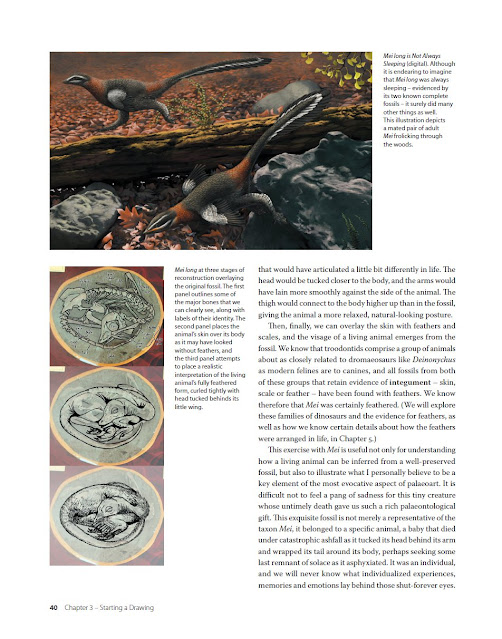
A sample page from Drawing and Painting Dinosaurs, from the Crowood Press website. This page features Emily's drawover of the Mei long holotype, a technique that helps artists not only understand the anatomy of their subjects but also appreciate fossil specimens as the remains of individuals, not as mere scientific concepts. Seeing fossils as the remains of specific creatures forms one philosophical core of the book.

And speaking of the text, I found Drawing and Painting Dinosaurs pleasant to read for its informative, slightly conversational tone. It presents a unique voice in palaeoart discourse, neither written with the disembodied neutrality of a scientist nor with overconfidence about her preferred interpretations of the past. There's an obvious respect for the work and insight provided by scientists but also plenty of informed personal contemplation and opinion on matters of reconstructing anatomy and ancient environments. The book is sprinkled with reflections on specific artworks and projects that give a sense of the enjoyments and frustrations of the palaeoart experience, such as including having artwork dating within days of its completion, the intrigue of reworking a familiar taxon with new data, and the thrill of restoring a newly discovered species. It not only reassures us that Emily is experienced at the trade she’s teaching but gives the book a sense of personality. We're also given insights into how Emily views the past, and her obvious connection to her fossil subjects stands out as something I've not seen expressed in palaeoart literature before. Emily reminds us that fossils are not mere geological phenomena or abstract concepts like species, but the petrified tissues of individuals that lived and died for us to discover millions of years later. It's a sobering, thoughtful take on palaeoart that establishes a personal connection between artist and their extinct subject matter across Deep Time.

One inescapable feature of Drawing and Painting Dinosaurs is its strong focus on dromaeosaurs and related, fully-feathered theropods - especially Deinonychus - for both artistic and case study subjects. These animals really do take centre stage - something like 80% of the artwork features dromaeosaurs or similar dinosaurs - and they serve as go-to species for demonstrating palaeoart principles throughout most of the book. Tyrannosauroids, sauropods and all ornithischians also feature in their own discrete chapters, but Drawing and Painting Dinosaurs is undeniably a show driven by feathered dinosaurs. I feel this is the only aspect of the book that might prove divisive, especially if readers are expecting a more general guide to the life appearance of dinosaur groups. There is value, however, in this doubling down on pennaraptorans. Writing any text like Drawing and Painting Dinosaurs always boils down to a question of breadth vs. depth and, in choosing the former, the book sacrifices some use as a general reference for demonstrating how a deep understanding of a fossil group can enhance our palaeoartistry. Knowing every species, every trace fossil, and every specimen of a clade allows for especially informed and nuanced palaeoartistic approaches, and that’s strongly evident in Emily’s pennaraptoran dinosaur art. For less experienced artists, the amount of information she demonstrates can be transferred from fossils to palaeoartworks may be surprising, and this would not have been so obvious had Emily discussed more clades in less detail. Seeing what can be done with dromaeosaurs and their relatives provides an impetus to learn about our favourite subjects in just as much depth, for which readers are given the right guidance for what to research and where to find it.

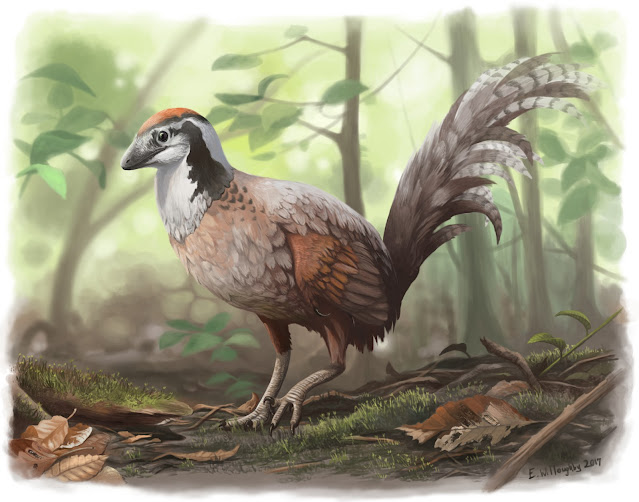
The (2017) Jinfengopteryx restoration Emily created for Nature. This image perfectly captures my comment about Willoughby art nailing believability: the colours, the sense of scale and the demeanour of the subject are such that I can totally buy Jinfengopteryx as looking like this. From Emily's website, © Emily Willoughby.

Anyway... this isn't meant to be a review, and here I am writing everything I like about the book. That should give you a flavour of what the book is all about and, as you can tell, I have nice things to say about it. With claxons blazing for those conflicts of interest mentioned above, I recommend anyone interested in palaeoart check it out. But we're not here for my thoughts: let's move on to what we’re actually here to read - Emily’s insights into how the book came to be, the original plans for the project, how she creates her artworks and even some free tips for us budding artists. Huge thanks to Emily for agreeing to this interview, and I hope it inspires you to put Drawing and Painting Dinosaurs on your Christmas list, if it’s not there already.

--

MW. It’s felt like a book such as Drawing and Painting Dinosaurs was going to happen eventually: a professional, world-leading palaeoartist imparts their experience and knowledge about illustrating the most popular and in-demand palaeoart subjects. I’ve certainly been around pub tables where artists have discussed it. What made you step up to the plate and think “yep, I’ll take that project on”

EW. It had been a dream of mine to publish a book like this someday, but my experience thus far with bringing book proposals to publishers and agents had been largely disappointing. For my first book, God’s Word or Human Reason?, I and my coauthor sent a total of about a hundred query letters to agents without a single positive response. So when Crowood Press reached out to me and asked if I’d be interested in such a project, there was no hesitation on my part!

Your text has an especially patient, welcoming quality that carefully explains a lot of information for newbies, encourages readers to draw along as they read, and there are several step-by-step illustration guides. It contrasts with what I’ve come to expect from palaeoart guides, which can slide into machine-gunning anatomical facts and interpretations about extinct animals at the reader. Was this simply your intuitive approach, or something you deliberately crafted when writing your book?

You were actually a pretty big inspiration for the approach I decided to take in this book. Since Crowood also published your wonderful The Palaeoartist’s Handbook, I knew from the outset that I needed to take an approach that would not overlap too much in content and style with your own. I played with a lot of different ideas early on — including, for example, a separate chapter on each medium I typically work in (gouache, digital, pencil, and so on), but felt that approach was too “arty” and not “sciency” enough. Ultimately I wanted to create something that seamlessly entwined the scientific and epistemological bases of paleontology with the hands-on artistic techniques, and this led to a structure that attempted to educate both professional and lay readers by providing context-driven examples.

This book was an enormous education to me in how damned difficult it is to craft a coherent structure of an entirely new book without much outside feedback. The first month or so of its creation was dedicated entirely to what seemed like endless deliberation, revision, and hand-wringing over the structure, approach and focus. I think the decision I went with turned out decently enough, but I still have a lot to learn in this respect.

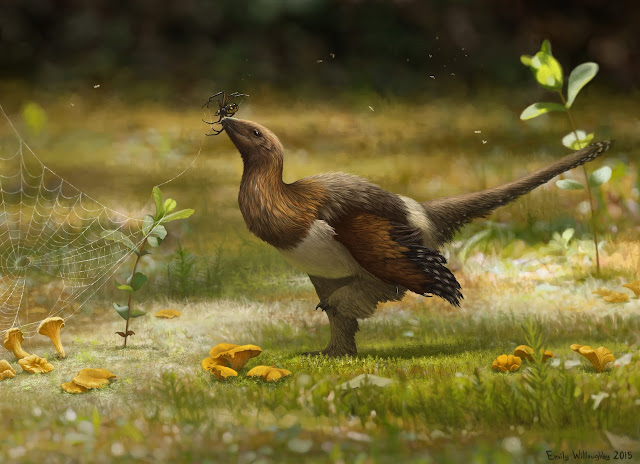
More terrific Willoughby artwork, The Silky Serikornis (2015). A masterclass of using depth of field to convey scale. From Emily's website, © Emily Willoughby.

Drawing and Painting Dinosaurs has a huge number of images - over 250 - and you created virtually all of them yourself. How much of that was new artwork for this book, and how long did it take to produce? A lot of them seem very recent - were you basically painting 24/7 until the book was finished?

I would estimate that over half of the illustrations are ones that were created specifically for this book, including a large selection of less time-intensive diagrams and sketches. Of the illustrations that were previously completed, many of them were progress shots or thumbnails that haven’t been put to good use until now (I knew there might a good reason someday for me to save progress shots of long-ago artworks!). A handful were also from various projects over the years that never managed to see completion for one reason or another, and some were finished up from early works-in-progress that were subsequently abandoned.

I had about a year total to complete the book from start to finish. I’m still kind of dumbfounded that I managed to get the book together during the same year in which I wrote and defended my Ph.D. dissertation! I have no doubt that’s something I’ll look back on in my twilight years and think “how on earth did I ever have the energy!”

We get to revisit some of your older artworks in Drawing and Painting Dinosaurs which have a slightly different style and mood to your more recent work. Thinking specifically about palaeoart-specific skills, how has your art and approach developed since their creation?

I still have a long way to go, but I like to think that my work has improved tremendously since I first started doing serious paleoart. For one thing, I’ve learned to enjoy reconstructing taxa I’m relatively unfamiliar with, whereas I started out painting feathered theropods and little else. While the new book still largely features dromaeosaurs and their kin, I had a lot more fun than I expected to have on the sauropods, tyrannosauroids, and various ornithischians that were included. For another thing, I’ve expanded my artwork to a variety of media I never worked in regularly early on—oil paint, gouache, acrylics, and graphite.

I’ve also become more comfortable in testing out new ideas and compositions. Recently I’ve been putting more effort into the environment and setting, which I used to think of as a chore that took away from the fun of painting the dinosaurs themselves. But once it starts becoming fun to paint environments, it also becomes easier. My experience is that the single largest improvement in my artwork isn’t so much in a piece’s overall quality per se, but in learning to work more efficiently—better quality per unit time.

As anyone familiar with your portfolio might expect, Drawing and Painting Dinosaurs has a very strong focus on dromaeosaurs and their relatives, especially Deinonychus. What’s the draw of these dinosaurs over sauropods, ornithischians or more rootward theropods?

It’s no secret that my biggest focus in paleoart has always been dromaeosaurs and other feathered coelurosaurs—I’m a feather-fancier, it’s true. Although I did enjoy branching out a bit for this book, dromaeosaurs remain the group of dinosaurs that I find most captivating and arresting. I suppose the reason for this is that feathered dinosaurs were responsible for my introduction to paleoart after a lifetime of obsessive interest in birds and evolution in general. In the early 2000s, I recall reading articles about some of the exquisitely preserved Liaoning fossils, including Sinorthithosaurus, Sinosauropteryx and especially Microraptor. When I first saw a photograph of the fossil of Microraptor in 2003, I was utterly fascinated, and it caused the realization that birds were dinosaurs to register new and profound understanding. The rest is history!

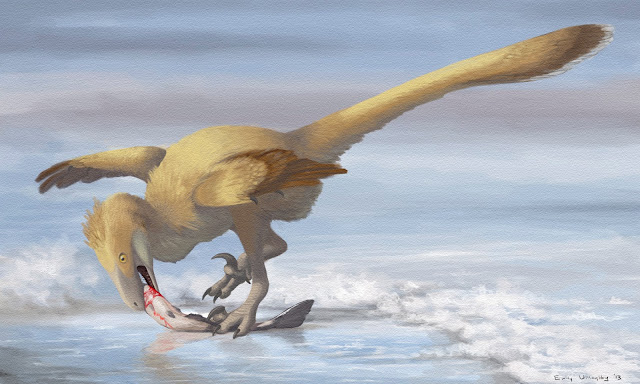
An inescapable conclusion of Drawing and Painting Dinosaurs is that Emily Willoughby ♥ Deinonychus. But her frequent portrayals of this animal are not repeats of palaeoart stereotypes and clichés. In this 2013 painting, Deinonychus is shown opportunistically feeding on a fish, reflecting the less than fussy dietary preferences of living predators. From Emily's website, © Emily Willoughby.

There’s an emotional component to your book that is unusual for discussions about the technicalities of palaeoart. You write about the personal affinities and emotions you’ve developed for certain subjects, and that you regard fossils as not just specimens of not only long-extinct animals, but as long-deceased individuals. An ode to extinct animals, the poem Not Forgotten by Jonathan Kane, ends chapter 1, and you describe Deinonychus as possibly being “the most beautiful animal that ever lived”. There’s a clear attachment to many of your extinct subjects - how much of an influence does this have on your artwork, and do you feel the same about all extinct animals? Or are some subjects “just a job”?

I do think that many natural subjects are beautiful, and it’s hard to not express this when trying to communicate that beauty in my own art. Although I used to think of some natural subjects as “just a job” (especially environments and flora), I feel less that way over time—all natural subjects are beautiful and fascinating, though of course I have my own attachments and biases. Moreover, though, I think that communicating this passion to the public is important to encourage people to think of dinosaurs as real animals, and to cultivate a sense of awe and respect that I feel extinct animals deserve.

You detail both digital and traditional painting techniques in your book. Do you have a preferred medium?

Part of what I enjoy about working in different media is that it’s harder for me to become bored and frustrated. Sometimes I get annoyed at how cluttered and messy my study gets when I work in gouache and (especially) oils for a while, so I switch back to working digitally for a while. Then I may start getting annoyed at how often Photoshop crashes or how Procreate constrains layers and resolution so harshly, so back to gouache it is! Learning and practicing new media is always interesting and keeps me engaged. I need variety. Currently, my favourite medium to work in is Procreate—I love how easy it is to blend, and I can take my iPad to meetings and work. Gouache has always been my traditional medium of choice, but that may change as I work more in acrylics and oils.

I’m also curious to know if you’ve attempted to update traditional paintings when new science forces us to revise older reconstructions.

The one piece of traditional art I spent a lot of time repainting was my 2010 painting of Anchiornis, which I talk about in the book. New to oils at the time, I painstakingly painted a mottled brown and white birdlike critter dashing through a lush green jungle. It was literally days after I was finally satisfied with its completion that the first color study was published, showing that Anchiornis was more likely to be black, grey and red than brown and white. I could have justified the piece as a juvenile, subspecies, or female, but instead I repainted the animal and adjusted the background to the new contrast it required. I’m glad I did, and I sometimes do include minor updates to older pieces, but usually I prefer composing a new piece altogether when new data comes to light.

Emily's 2010 take on Anchiornis huxleyi. This is the second version of this painting which had to be redone after new data on Anchiornis palaeocolour was published shortly after the original's completion. From Emily's website, © Emily Willoughby.

The palaeoart community has long been dominated by males, both in terms of practitioners and fans, such that Drawing and Painting Dinosaurs is among the first, if not the first, palaeoart guide written by a female author and artist. With so much discussion around the lack of diversity in palaeontology, your book feels like an important milestone in diversifying the voices shaping palaeoart. Was this something you were conscious of when creating your book

I don’t think it occurred to me at the time that I was the first, given that there aren’t many paleoart guides out there to begin with. But I’m honoured to represent that milestone if so, and I hope the example may encourage others. I’ve already gotten a few emails and even an interview for a project from a few school-aged girls who want to become palaeoartists, which is frankly one of the very most rewarding things about working in this field to me.

You cover a heck of a lot of ideas and techniques in your book, from finding inspiration among natural settings to building models, to constraining colour patterns using living animals to modifying modern plant leaves to resemble those of the past… and much more. Out of this extensive toolbox, are there any that you regard as especially essential - the one or two that, whatever your approach to palaeoart is, we should all be doing?

Remember that prehistoric subjects were living things, and look to other living things (their anatomy, their ecology and evolution, their behaviour, the way they move and interact in their environment, and so on) for inspiration to capture that sense of lifey-ness that lifeless things are meant to have in paleoart. Although many prehistoric organisms were quite unlike anything alive today, they all share an important thing: they evolved to live and move in their environments. I think that this single injunction can go a long way towards facilitating accurate, interesting, and unique paleoart.

It’s not always wise to ask about the Next Big Project so soon after finishing one, but are there any big Willoughby projects we should look out for soon? Emily Willoughby’s SuperBig Dulux Coffee Table Book of Dromaeosaur Art has a nice ring to it...

So glad that you asked! I am about halfway through a new project: Marks on Time, an illustrated anthology of natural history poetry written by my coauthor Jonathan. This will be a collection of 25 poems about evolution, dinosaurs, and human nature, accompanied by about 40 full-colour and brand-new illustrations. If any publishing agents happen to be reading this, please drop me an email. ;)

--

Thanks again to Emily for her interview responses, and I wish her all the success her book deserves. Drawing and Painting Dinosaurs is available now from Crowood Press, priced £18.99, as well as from all the usual book retailers.

Enjoy these insights into palaeoart, fossil animal biology and occasional reviews of palaeo media? Support this blog for $1 a month and get free stuff!

This blog is sponsored through Patreon, the site where you can help online content creators make a living. If you enjoy my content, please consider donating $1 a month to help fund my work. $1 might seem like a trivial amount, but if every reader pitched that amount I could work on these articles and their artwork full time. In return, you'll get access to my exclusive Patreon content: regular updates on upcoming books, papers, paintings and exhibitions. Plus, you get free stuff - prints, high-quality images for printing, books, competitions - as my way of thanking you for your support. As always, huge thanks to everyone who already sponsors my work!


Tuesday, 30 November 2021

The long, winding road to the first sauropod palaeoartworks

It's a well-verified fact that the best dinosaurs to draw are the sauropods, exemplified here by the mighty Giraffatitan brancai. But the route to this modern realisation was a difficult one. When sauropods were first discovered no one wanted to restore them at all: their fossils were always in the hands of the wrong people, at the wrong time, and our first attempt at restoring their life appearance was many decades after their discovery. A strange story awaits.
Is there any shape more emblematic of prehistoric life than the silhouette of a sauropod? The combination of long neck, long tail, round body and four robust limbs is universal visual shorthand for anything to do with dinosaurs and, more broadly, extinct life, such that sauropods are bone fide superstars of palaeontological pop-culture. The world-renowned Sinclair logo, Gertie, the leads of The Land Before Time and The Good Dinosaur, the scene welcoming us to Jurassic Park… all sauropods.

Much of the most famous sauropod iconography is, as with so much palaeontological media, related to fully-fleshed sauropod reconstructions rather than their fossil bones, so we can consider much of their popular appeal lying within paleoart. Given the undeniable spectacle and wonder associated with sauropod fossils, where even single bones can be jaw-dropping museum centrepieces, we might imagine that early scientists and palaeoartists jumped at the chance to put flesh on the skeletons of these long-necked reptiles as soon fossil material revealed their basic shape. And yet, this was not the case. The story of how sauropods entered the palaeoart canon and became ambassadors for all things dinosaurian and extinct is a peculiar one, where a full half-century passed between their discovery and their palaeoart canonisation. This is a story of how combative attitudes and egos, missed opportunities and perceived failures in early palaeoartworks stymied life reconstructions of sauropods for much of the 19th century.

(The following post owes much to the history of sauropod research outlined by Mike Taylor (2010) and Mark Hallett and Matt Wedel (2016). Be sure to check these out if you want a more detailed perspective on 19th century sauropod science.)

Fragmentary beginnings

Our tale begins, of course, with the discovery and description of the first sauropods Cetiosaurus and "Cardiodon" by Richard Owen in 1841. As with all the first dinosaur discoveries, our first sauropod fossils were isolated bones from southern Britain. Little could be said about the life appearance of the animals they represented other than that they were enormous reptiles. On account of their size, it was assumed sauropods must have been aquatic and – like all giant sea creatures – carnivorous. Perhaps, it was wondered, they were the arch predators of Mesozoic oceans: the devourers of plesiosaurs and ichthyosaurs. Owen speculated that such a creature must have borne a well-developed caudal fin perhaps similar to that of an ichthyosaur, but this awesome vision of sauropods did not lead to any life reconstructions despite the cavalier reputation of early 19th century Europeans for restoring extinct animals (if you’ve been reading my blog since its origins, you may remember an article on this very topic).

We might wonder why this was the case. After all, animals like Megalosaurus were initially represented by little more material than Cetiosaurus, but they were still restored within just a few years of their discovery. The absence of early 19th century sauropod reconstructions shows, to my mind, some level of nuance about early Victorian palaeoartists. Though often characterised as wild and speculative, the early Victorian palaeoart canon was surprisingly conservative, mainly showing similar scenes populated by the same species in the same anatomical guises. Many of their depictions were also of animals with decent fossil representation like marine reptiles, pterosaurs and fossil mammals, such that the restoration of poorly-represented species, like dinosaurs, can be viewed as exceptional. Moreover, and in further defence of the first palaeoartists, dinosaur anatomy wasn’t a total unknown in the early 19th century. Several species had been attributed characteristic anatomical features such as nose horns, body armour, or distinctive teeth, so there was something to hang restorations around. But sauropods lacked even a basic defining feature, and thus had no way of being distinguished or characterised from other restored giant reptiles. Should vindictive time-travellers ever force early Victorians to draw fleshed-out sauropods, the result would probably be nothing more than generic, giant carnivorous reptiles, perhaps little different to some of John Martin’s whale-sized, lizard-like dinosaurs.

John Martin's frontispiece to G. F. Richardson's 1842 book Geology for Beginners, entitled Age of Reptiles. A lot of early 19th century dinosaur palaeoart was not especially attentive to details of anatomy and form, such that sauropods, if they had been illustrated, probably would have looked much like the (?)Megalosaurus in this piece.


The whale lizard flounders in the palaeoart doldrums

A major step towards understanding sauropod life appearance was made in the late 1860s when a large haul of Cetiosaurus bones were found in Oxfordshire, UK. Described by geologist John Phillips in the 1871 book Geology of Oxford and the Valley of the Thames, this partial skeleton included limb bones, ribs, limb girdles and many vertebrae, and thus provided our first decent insight into the sauropod body plan. In what seems like a cruel twist of fate, no neck or skull bones were recovered, denying knowledge of the most defining characteristic of the group for another few years. Nevertheless, Phillips had enough anatomy to start making the first relatively informed insights into sauropod appearance and behaviour, and he devoted several pages of his book to discussing the size, habits and even skin of Cetiosaurus. Much of what we now think about sauropods was prophesied here, with Phillips describing very large, scaly reptiles that lived on land and ate plants. He made a number of favourable comparisons to Iguanodon in his discussion of Cetiosaurus habits such that he may have imagined it as an especially gigantic large-bodied, quadrupedal herbivore in the vein of Waterhouse Hawkins’ Crystal Palace Iguanodon and Hylaeosaurus. It is curious, therefore, in light of this evident interest, that Phillips did not attempt some sort of reconstruction. He had enough bones to at least construct a decent skeletal diagram. But, OK - maybe reconstructions weren’t Phillip’s thing. With all this anatomical information, surely someone else picked up the baton?

John Phillips' quarry map of a partial Cetiosaurus skeleton found in 1869-70. A lot of the vertebrae and smaller bones are amalgamated into packages in this drawing, but the glut of material is obvious. This was the first significant insight into sauropod life appearance... but not much came of it among Victorian palaeoart. From Phillips (1871).

And it’s at this point that our story becomes rather strange. Cetiosaurus, which was by now as well represented as other animals routinely featured in palaeoart, continued to be snubbed by artists. We have to take a step back from sauropod palaeoart history and expand our scope to the discipline as a whole to understand why. Along with Cetiosaurus, a number of genuinely important, game-changing dinosaur discoveries had been made across Europe in the mid-1800s that included Scelidosaurus (the first complete dinosaur skeleton), Compsognathus, Hypsilophodon, and Archaeopteryx. All were represented by excellent fossils that dramatically enhanced our understanding of dinosaurs and had major implications for reconstructing their life appearance, and yet none were canonised into palaeoart of the day. If you look hard enough you may find some simple line drawings of Archaeopteryx here and there, but there were no lavish paintings, no sculptures or elaborate lithographs celebrating these new animals.

Evidently, Cetiosaurus itself wasn't being snubbed. These superior sauropod remains had arrived while European palaeoart was in a funk that would last several decades, an era when most new palaeoartworks featured restorations recycled from the early 1800s instead of novel reconstructions of newly-discovered species. A contributing factor to suppressed creativity in late 19th century European palaeoart was, ironically, the Crystal Palace Dinosaurs (Secord 2004; Nieuwland 2019). Although popular with the public, most academic response to the 1854 unveiling of these models was negative. Criticisms were many, focusing on their speculated elements, the juxtaposition of modern landscapes with extinct animals, and accusations that they were simply scaled up, monsterised living species. Several Crystal Palace reconstructions were also rapid embarrassed by new fossil data, such that these flagships of Victorian palaeoart were now misleading or confusing the public more than educating them. The Crystal Palace Dinosaurs had given scholars of the 1870s good reason to be sceptical of palaeoart, and the creation of new life reconstructions fell out of fashion for a generation.

American palaeoart to the rescue… sort of

The awakening of American palaeoartistry is one of the few major events that occurred in palaeoart history in the early-late 19th century. While American palaeoartists slowly found their feet, the discovery of excellent sauropod material in western states in the 1870s finally revealed the full spectacle of these amazing, unique animals. Among the first relatively well-known American sauropods was Camarasaurus, found in 1877 and described by Edward Drinker Cope in the same year. These specimens, at last, revealed something of the iconic sauropod neck. Scientists were finally impressed enough to reconstruct a sauropod skeleton, and the result was John A. Ryder’s composite mounted skeleton of a ribless, sail-tailed Camarasaurus, complete with a speculated skull. This mount was around 50 ft long and exhibited at a meeting of The American Philosophical Society in Philadelphia in December 1877, but no images of it were not published until 1914. Nor, for that matter, was it accompanied or followed by a life reconstruction. In fact, I don’t know that anyone has attempted to restore Ryder’s Camarasaurus, so I set aside an hour or so in preparation of this article to finally correct this important injustice. I'd love to see more from different artists - #justiceforRydersaurus!

OK, yes, John A. Ryder's 1877 Camarasaurus skeletal is a little bizarre, but the essence of sauropod form is there. It's a stone-cold crime that no one reconstructed the life appearance of this skeleton, so I've had a go here. Some attempt has been made to give the restoration a classical 19th century, Hawkinsian palaeoart flavour.

The absence of an 1877 Camarasaurus life restoration is all the more curious because of Cope’s association with this specimen. Cope is most famous for his feud with Othniel Marsh and the ‘Bone Wars’ period of American vertebrate palaeontology, but he was also one of the main instigators of American palaeoartistry. During the 1860s Cope produced iconic artworks of dinosaurs known from New Jersey which can be considered among the first flesh reconstructions of recognisable, basically anatomically accurate dinosaurs, as well as well-known depictions of taxa from the Western Interior Seaway. He was an advisor in the 1868 reconstruction of Hadrosaurus by Joseph Leidy and Benjamin Waterhouse Hawkins, and thus had connections to the first grandmaster of palaeoart himself, who was often based in the US for palaeoartistic purposes in the 1860s and 1870s. And yet, around all this, Cope never produced a published sauropod life reconstruction, and nor did his relationship with Hawkins yield any (published) sauropod illustrations. We may ascribe the latter to Hawkins’ dislike of Cope, whom he regarded as an overbearing, fussy collaborator. On at least one occasion he threatened to abandon a project entirely if Cope was involved (Bramwell and Peck 2008). Who knows how the early history of American palaeoart would have played out had these two giants of their disciplines been on better terms.

Othniel Marsh's 1883 restoration of Brontosaurus - a significant advance over the Ryder sauropod skeletal of just a few years prior.

Cope was, of course, not the only major player in the discovery of American sauropods. Indeed, Cope’s rival, Marsh, probably has a greater legacy with these animals, not only naming more species but also coining the name ‘Sauropoda’. Marsh named and described many now-iconic sauropods including Brontosaurus, Apatosaurus and Diplodocus, and in 1883 he published a Brontosaurus skeletal reconstruction that was, anatomically speaking, vastly superior to Ryder's Camarasaurus. Marsh was thus another person well-placed to facilitate the first artistic resurrection of sauropod life appearance… if only it weren't for his career-long disdain for palaeoart. Here's what he said on this topic in 1875:

I do not believe it possible at present to make restorations of any of the more important extinct animals of this country that will be of real value to science, or the public. In the few cases where materials exist for a restoration of the skeleton alone, these materials have not yet been worked out with sufficient care to make such a restoration perfectly satisfactory, and to go beyond this would in my judgment almost certainly end in serious mistakes. Where the skeleton, etc., is only partly known, the danger of error is of course much greater, and I would think it is very unwise to attempt restoration, as error in a case of this kind is very difficult to eradicate from the public mind… A few years hence we shall certainly have the material for some good restorations of our wonderful extinct animals, but the time is not yet.

(Marsh 1875, quoted in Dodson 1996, p.74)

Marsh’s criticism of palaeoart has a lot of implications for the development of the discipline in general, and almost certainly contributed to the delayed canonisation of sauropods. He held many of the best cards when it came to understanding sauropod life appearance but was the last person who would include a life restoration in a publication. Moreover, his reputation, influence, and longstanding criticism of palaeoart may have further dampened drives to restore newly discovered taxa in Europe, where some of his fiercest denouncement of palaeoartworks were expressed. Marsh’s views were surely a major contributor to the strange fact that the Bone Wars era - one of the most intense periods of discovery and analysis in early dinosaur history – was entirely bereft of associated palaeoart. And while Cope could, in theory, have picked up these palaeoartistic pieces, the ferocity of his feud with Marsh surely meant that he avoided reconstructing Marsh taxa, no matter how spectacular they were. There’s some irony in Marsh and Cope being so instrumental to our early conceptualisation of sauropods but that their various hang-ups - with each other, with other people, and with palaeoart - only kicked the can further down the road.

Finally, a life reconstruction! ...that everyone ignored

By this time - the late 1870s or early 1880s - sauropods had been known to science for about 40 years, with decent, restorable remains on record for at least half that time. Their gigantic size and spectacular anatomy were well appreciated and, thanks to Marsh, their skeletal anatomy had been committed to scientific literature. In these circumstances, surely someone was going to crack and attempt a flesh restoration? Yes, finally, someone did - but not in either of the historic homes of sauropods, Britain and the US. Rather, it was the French author Nicolas Camille Flammarion who provided the first (to my knowledge) sauropod life restoration in his 1886 book Le Monde Avant la Création de l’Homme, courtesy artist J. Blanedet. Behold:

Finally, a sauropod life restoration! J. Blanedet's 1886 Atlantosaurus poses with an elephant for scale. From Flammarion (1886).

Flammarion’s book is a landmark work for depictions of prehistoric life, containing a mix of old and new restorations that went some way to relieving the drought of new reconstructions in the late 19th century. Perhaps reflecting Flammarion’s outsider position from sauropod research, his choice of sauropod was not something well-known like Cetiosaurus, Camarasaurus or Brontosaurus, but the obscure “Atlantosaurus”. This was one of the first discovered Morisson Formation sauropods but, on account of its scrappy remains, it was on its way to becoming a historic footnote in 1886. Today, Atlantosaurus is generally considered a nomen dubium. Obscure taxon choice aside, here, finally, was a sauropod in the flesh. And, all things considered, the reconstruction was pretty good. Marsh’s 1883 Brontosaurus reconstruction was featured in the same book and its shared DNA with the Atlantosaurus illustration is obvious. In the accompanying text, Flammarion describes several sauropods in essentially accurate ways: as gigantic, long-necked animals with small heads, of herbivorous character, and as denizens of terra firma, not lakes and swamps. This was a pretty progressive take on sauropods that built on ideas expressed by Phillips, and they stand in contrast with sauropods’ fast approaching 20th-century relegation to semi-aquatic life.

In a different universe, Flammarion’s Atlantosaurus and other novel reconstructions were the start of a new wave of palaeoartworks based on updated science and newly discovered species. Alas, in our universe, the new artworks in Flammarion’s book made little impression on palaeoart development, and didn’t shake older takes on extinct animals from their foothold in 19th century palaeoart. Even as the 20th century loomed, Hawkinsian, Kuwassegian and Copeian dinosaurs were still populating artworks of Deep Time. From a historic perspective, Flammarion’s Atlantosaurus is more of an Easter egg than the moment sauropod palaeoart truly arrived.

The 1890s: the dam bursts

Joseph Smit's 1892 Brontosaurus, from Henry Hutchinson's Extinct Monsters: A Popular Account of Some of the Larger Forms of Ancient Animal Life. Although not as influential or well known today as the sauropod artworks of Charles Knight, the success of Hutchinson's book would have made this the first life restoration seen by many people, certainly in the English speaking world.

It was only as the sandgrains in the 19th century hourglass ran dry that a collective epiphany about sauropods struck the minds of museum developers, artists and book authors around the world. Finally, after more than a half-century of avoiding sauropod palaeoart, flesh restorations of long-necked dinosaurs entered the mainstream during the 1890s. But, again, it was not America, with its embarrassment of sauropod fossils, that instigated this. Rather, it was a revived British interest in palaeoart that championed sauropods, with one book, in particular, cresting a new wave of new palaeoartistic reconstructions: Henry Neville Hutchinson’s 1892 ;Extinct Monsters: A Popular Account of Some of the Larger Forms of Ancient Animal Life. This featured illustrations by the Danish artist Joseph Smit based on Marsh's skeletal diagrams and the results were so successful that Extinct Monsters was reprinted several times over the next two decades. It was also eventually repackaged with another Hutchinson book, Creatures of Other Days. Smit illustrated both Diplodocus and Brontosaurus in these works, based on Marsh's groundwork, establishing their canonical presence in palaeoart from then onwards.

One of the most iconic palaeoart images of the late 19th century: Charles Knight's 1897 swamp-bound Brontosaurus and grazing Diplodocus. Knight's affiliation with the American Museum of Natural History and the publicity-hungry Henry Osborn brought palaeoart into a new era where dinosaurs would become increasingly dominant art subjects, and sauropods would become superstars.

Shortly after, American palaeoart finally woke up to the splendour of sauropods. The American Museum of Natural History, under the supervision of Henry Osborn, had identified the power of palaeoart as an educational, promotional and commercial tool and realised the role dinosaurs could play in this campaign. The result were sauropod illustrations by Charles Knight, which surely rank as the most famous of all early sauropod artworks. Knight’s iconic 1897 Brontosaurus and Diplodocus in a swamp, produced with direction from Osborn, was among the first of these works, but a lesser-known sketch of a snorkelling Amphicoelias was produced around the same time. The latter is notable for being produced under guidance from Cope, who sketched a rough version for Knight to replicate. Cope’s choice to depict the fragmentarily known Amphicoelias, which he named in 1878, over a better-known Marsh species is surely an instance of their old rivalry dying hard. Many Knight images of sauropods would follow in the next few decades.

In the last year of his life, Edward Drinker Cope tutored Charles Knight in the anatomy of extinct animals so as to help Knight better understand his palaeoart subjects. Among the images they worked on together was this 1897 scene of Amphicoelias, which Cope sketched out for Knight to replicate. Note the interesting stripes and spotting used here. Although now standard in palaeoartworks, such intricate patterning was rare in 19th century palaeoart.

And it’s here, at the turn of the 20th century, that our story picks up with more familiar beats. After their slow adoption into palaeoart and popularised palaeontology, sauropods quickly appeared everywhere dinosaurs were mentioned. American museums put sauropods front and centre of their galleries and, courtesy of Andrew Carnegie, many museums around the world soon sported Diplodocus in their dinosaur halls. Gertie the Dinosaur and the 1925 adaption of The Lost World, where Brontosaurus pioneered cinematic monsters smashing cities for our amusement, made sauropods the focus of early dinosaur films. Life-sized models of sauropods appeared in Europe by 1910 and then in the United States and Russia in the 1930s. Around all this, artists like Knight, Smit, Heinrich Harder and Alice Woodward cemented sauropods into the mainstream palaeoart canon. Surely helped by their palaeoartistic popularity, sauropods had become cultural icons almost overnight.

The story of sauropods entering palaeoart canon is more than a tale of 19th century attitudes to reconstructing extinct animals: it’s also a case study in the vagaries of science communication and gatekeeping. We often discuss why certain facets of science, like dinosaurs, are so popular, while others are not. How much of this reflects the inexplicable, innate interestingness of a topic, and how much of it is manufactured? Many of us would agree that sauropods are some of the most fascinating and spectacular animals to have ever lived but, even when their anatomy was well-realised, this was not enough for mainstream culture to adopt them passively. Even artists and scientists who knew about them were not falling over themselves to restore and promote them, and it really wasn’t until individuals at the turn of the 20th century wanted, or needed, to promote sauropods that they began their journey towards being palaeontological icons. I’ve argued in the past that dinosaurs have a certain fundamental appeal that draws us to them, and that might be true, but stories like this show that our awareness and access to spectacular, easy-sell science, such as that of the biggest dinosaurs to have ever existed, is managed by a privileged few.

Enjoy these insights into palaeoart, fossil animal biology and occasional reviews of palaeo media? Support this blog for $1 a month and get free stuff!

This blog is sponsored through Patreon, the site where you can help online content creators make a living. If you enjoy my content, please consider donating $1 a month to help fund my work. $1 might seem like a trivial amount, but if every reader pitched that amount I could work on these articles and their artwork full time. In return, you'll get access to my exclusive Patreon content: regular updates on upcoming books, papers, paintings and exhibitions. Plus, you get free stuff - prints, high-quality images for printing, books, competitions - as my way of thanking you for your support. As always, huge thanks to everyone who already sponsors my work!

References

  • Bramwell, V., & Peck, R. M. (2008). All in the bones: a biography of Benjamin Waterhouse Hawkins. Academy of Natural Sciences.
  • Dodson, P. (1998). The horned dinosaurs: a natural history. Princeton University Press.
  • Flammarion, C. (1886). Le monde avant la création de l'homme: origines de la terre, origines de la vie, origines de l'humanité. C. Marpon et E. Flammarion.
  • Hallett, M., & Wedel, M. J. (2016). The sauropod dinosaurs: life in the age of giants. JHU Press.
  • Nieuwland, I. (2019). American Dinosaur Abroad: A Cultural History of Carnegie's Plaster Diplodocus. University of Pittsburgh Press.
  • Phillips, J. (1871). Geology of Oxford and the Valley of the Thames. Clarendon Press.
  • Secord, J. A. (2004). Monsters at the crystal palace. In: de Chadarevian, S, & Hopwood, N. (eds). Models: the third dimension of science, Stanford University Press. 138-69.
  • Taylor, M. P. (2010). Sauropod dinosaur research: a historical review. Geological Society, London, Special Publications, 343(1), 361-386.