Thursday, 30 March 2023

New paper: Fresh evidence and novel analyses strongly suggest that theropod dinosaurs were lipped

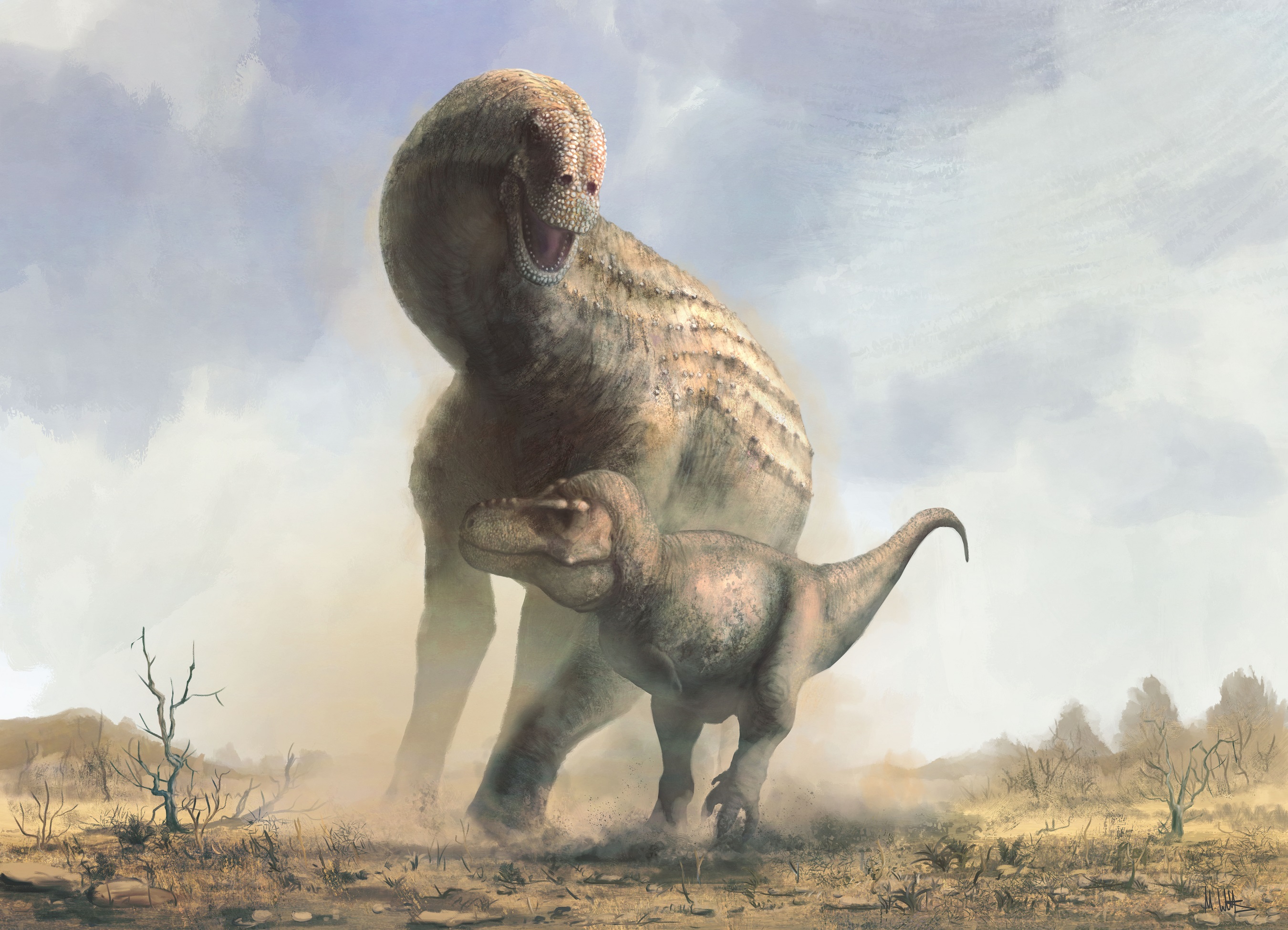
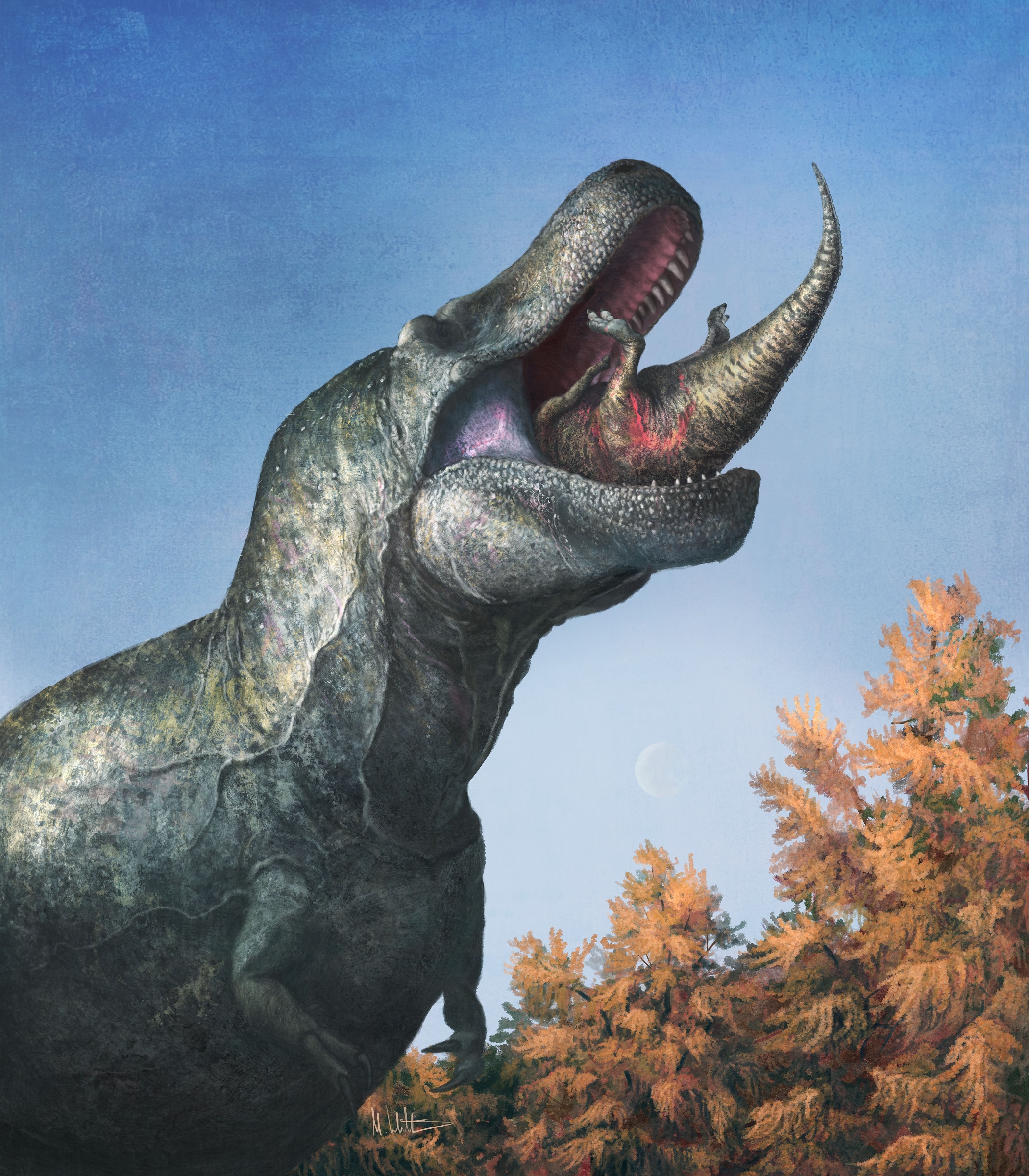
A juvenile Edmontosaurus disappears into the enormous, lipped and gummy mouth of Tyrannosaurus. Those of us in the palaeoart community are used to seeing lips on dinosaurs now, but neither the lipped or lipless hypothesis has been given a thorough seeing-to in peer-reviewed literature yet. Until, that is, today. This is the PR art for our new paper, Cullen et al. 2023, that dives into the question of lips for theropod dinosaurs.
If you follow developments in palaeoart to any level of detail, you can’t have missed “the Lips Debate”: the controversy surrounding the application of extra-oral tissues (essentially various kinds of lips and cheeks) to extinct animals. This discussion has touched on virtually all fossil vertebrates at some time or another, but the presence or absence of lips on dinosaurs has, predictably, been the major focus for most palaeoartists. Owing to their general popularity, the lipped-or-not status of the predatory theropod dinosaurs has drawn a particularly large amount of attention. This debate is now so well covered online that its basic tenets will be familiar to many: the question of whether extant dinosaur relatives offer misleading insights for facial reconstruction; the importance of tooth size and angle to dental “sheathability”; the similarities and differences of jaw bone morphology between crocodylians, lizards and theropods, and so on.

But for all of this online visibility, the question of dinosaur lips and cheeks has received only a little attention from dinosaur researchers. A number of conference abstracts have been presented in this area, but only a handful of these studies have been pushed through peer review to become fully published scientific papers (e.g. Galton 1973; Ford 1997; Knoll 2008; Keillor 2013; Nabavizadeh 2020). It’s largely been dinosaur artists, mostly writing for blogs (such as this, this and this), social media posts or specialist books and magazines (e.g. Witton 2018; Paul 2019), that have provided the bulk of recent conversation on this issue. Whatever merits these discussions have (and there are some very fine, commendable assessments out there), the lack of detailed, authoritative scientific studies has allowed trends in dinosaur facial reconstruction to be shaped by popular culture, palaeoart memes and the opinions of influential palaeoartists more than conventional science. This means that, however comfortable we are with our opinions on dinosaur mouth appearance, this question would benefit from more study, more data and more insight from experts in reptile facial anatomy.

A visual review of where we are with restoring theropod mouths, from Cullen et al. 2023. Do you prefer your Tyrannosaurus without lips (B and C), or with lips (D and E)? And far more importantly, which of these is better supported by fossil data?

To that end, today is a good day. I’m part of an international team of researchers publishing a major new paper in Science dedicated to the question of whether theropod dinosaurs possessed lips. Led by Thomas M. Cullen and receiving contributions from Derek W. Larson, Diane Scott, Tea Maho, Kirstin S. Brink, David C. Evans and Robert Reisz, this is the end product of a long-running investigation into theropod faces that was first initiated by Robert 11 years ago. I was invited onto the project at the end of 2020 to create some artwork of lipped and lipless Tyrannosaurus (above) and, once onboard, I’m pleased to say I was able to help contextualise and interpret our data alongside providing some pretty pictures. But the real hard graft of the research was performed by others on the authorship team, so they deserve full credit for the nitty-gritty science and methodological concepts. They also taught me a lot about reptile jaws, teeth and oral soft tissues, so I’m in their debt for this experience.

As you’ll have guessed from the PR artwork that greeted you above, we conclude that yes, theropods almost certainly had lips. As evidence of this, we present multiple lines of evidence that all point to lizard-like scaly tissues covering predatory dinosaur teeth, and perhaps even other types of lizard-like oral tissues as well. Our work can be divided into four independent investigations that collectively support our assertions.

Jaw and tooth form

Firstly, we make some broad-brush comparisons between the tooth orientation and jaw bone morphology of lizards, crocodylians and theropods, some of which will be familiar to those who’ve followed the Lips Debate so far. We note that theropods, early croc-line archosaurs and lizards are similar in having low numbers of jaw bone foramina* distributed along their oral margins, as well as vertically-aligned teeth. Extant crocodylians, in contrast, have splaying teeth and hundreds of evenly-distributed foramina across their skull bones, the functions of which are more specialised than the lip-nourishing jaw openings of lizards.

*If you're new to all this, foramina are small holes in bones that typically house nerve tissues or blood vessels, but can also record other structures, like outgrowths of air sacs.
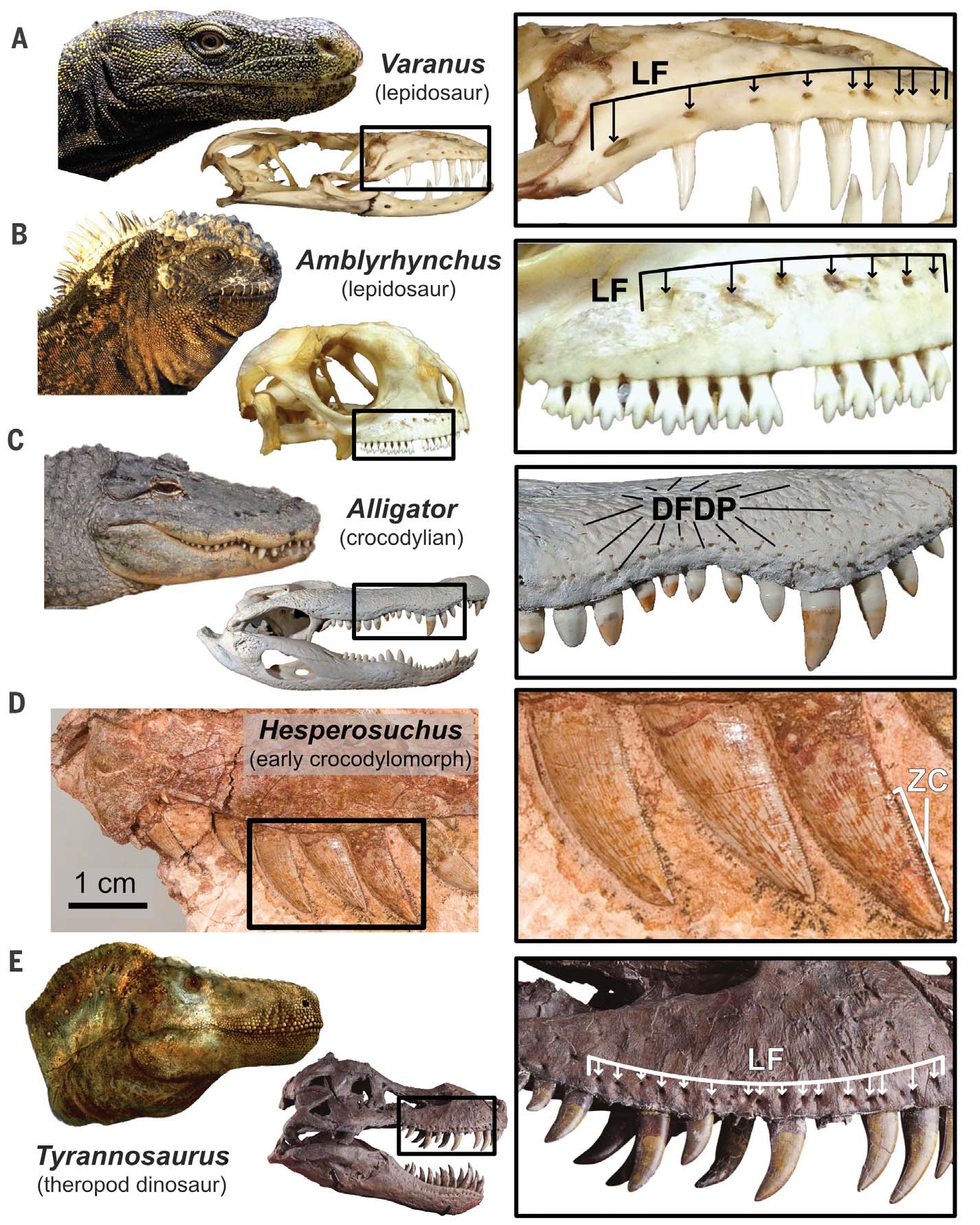
Reptile jawbone surface textures and foramina distribution compared, from Cullen et al. (2023). I think this image speaks for itself: the arrangement of theropod jaw foramina (those holes along the jawline) is far more lizard-like than croc-like.

Some of these observations are not novel as the significance of jaw bone foramina to the theropod lip question has long been recognised (e.g. Bakker 1986; Morhardt 2009; Keilor 2013; Barker et al. 2017; Carr et al. 2017). Our resurrection of this point is, in part, a response to Thomas Carr and colleagues' 2017 paper on Daspletosaurus horneri, which favourably compared tyrannosaur jaw surfaces to those of crocodylians. We don’t think they’re actually much alike at all, especially in foramina distribution, so disagree with that assessment. Carr et al. (2017) also assumed that the thick, immobile facial anatomy of living archosaurs — crocs and birds — was ancestral to their entire group, including non-bird theropods. We question this too. Like theropods, the jaw surface properties and tooth orientations of early croc-line archosaurs recall those of lizards more than modern crocodylians, probably reflecting a different soft-tissue configuration. We thus agree with the increasingly evidenced view that the faces of living archosaurs are specialisations suited to very particular lifestyles and that the dinosaur extant phylogenetic bracket is of limited use for inferring their facial anatomy.

Enamel, hydration, and tooth wear

Secondly, we discuss the damage and wear inflicted on permanently exposed teeth, a conversation that is mostly about enamel hydration. Enamel is one of the hardest tissues that animals can synthesise and is thus highly resistant to damage, but its resilience is dependent on moisture. Hydrated enamel is more plastic, and thus more resistant to abrasion, than dehydrated enamel, which is brittle and prone to cracking and breaking under strain. To that end, teeth emerging from oral margins tend to be more damaged and worn than those kept within a moist, sealed mouth. This difference can be seen with the naked eye but is particularly obvious under microscopic examination. In our paper, we show that the tips of alligator teeth are shorn off on their outward-facing, exposed surfaces, with both the enamel and several layers of dentine worn to a flattened edge. Tooth dehydration almost certainly factors into crocodylians frequently suffering from broken and cracked dentition, and they have to replace their teeth regularly (something like 45-50 times in a lifetime — Grigg and Kirchner 2015) to maintain a set of fully functional jaws.

These observations give us a clear hypothesis regarding theropod oral tissues. If they were permanently exposed, theropod teeth should show, at minimum, similarly obliterated enamel and dentine layers at their tips. The poster children of exposed dinosaur teeth, adult tyrannosaurids, are especially relevant here as they replaced their teeth at a very slow, sometimes even biennial rate (Erickson 1996). What’s more, they engaged in particularly violent, tooth-on-bone feeding strategies. So, if any theropods are going to have knackered, abraded teeth, it’s tyrannosaurids.

Detailed comparisons of tyrannosaurid (upper row) and crocodylian (lower row) tooth wear. Note how the Daspletosaurus tooth, despite being over 500 days old, is intact despite dinosaurs teeth having particularly thin enamel layers. The alligator tooth tip, by contrast, has not only lost the enamel coating on its outer surface, but also several layers of underlying dentine. A fully intact, enamel-covered erupting alligator tooth is shown in panel H to show that these are features of wear, not the original tooth condition. From Cullen et al. (2023).

But extracting a fully grown, c. 510-day-old tooth from a Daspletosaurus maxilla revealed a tooth tip in great condition. Both the inner and outer surface retained their relatively thin enamel covering and the only minor damage found was on its medial, inward-facing surface, possibly as a result of occasional tooth-on-tooth contact. This confirms what has generally been observed for theropod dental wear in other studies and conflicts with what we'd expect from a dehydrated, perpetually exposed tooth. We take this as evidence of theropod dentition being maintained in a moist, well-hydrated setting, and being located within a lipped mouth is realistically the only way this might be achieved.

Too big to sheath?

We also address the possibility that some theropods had teeth that were simply too big to cover with lips (e.g. Ford 1997). Our focus here is not on the widely known, but still surprisingly prevalent issue of artists and researchers not accounting for tooth slippage in fossil specimens**. Rather, we focus on realistic estimates of tooth crown height when they are fully socketed in theropod mouths. We calculated a ratio of tooth crown height to skull length for 37 theropod specimens and compared them with the same metric in 40 varanids, the monitor lizards. Varanids are, of course, well-known for possessing large, theropod-like teeth, as well as copious amounts of lip and gum tissue.

**This is the decay of tooth-anchoring ligaments resulting in teeth sliding somewhat from their sockets, preserving them at longer lengths than they held in life.

Tooth size: theropods vs varanids. It turns out that both groups have similarly-sized teeth relative to skull length and, while this doesn't directly tell us if theropods had lips, it shows that their dentition was of a size that we know can be sheathed by extra-oral tissues today. From Cullen et al. (2023).

Plotting these data showed that theropod and monitor teeth are about the same size for their skull lengths and even increase in proportion at the same approximate rate. But the winner of the biggest tooth contest wasn’t something like T. rex: it was the varanids. Some monitor species, like the crocodile monitor Varanus salvadorii, have almost cartoonishly-large dentition. From this, we suggest that theropods did not need unprecedentedly big lips to cover their mouths and the largest theropods wouldn't look, in terms of lip proportions, very different to something like a komodo dragon. Indeed, we note that monitors are able to cover their teeth with the same basic configuration of labial and gingival tissues across a 12-fold size difference. The discrepancy between the largest monitor skull and our largest theropods is only half that: 6-fold. So if lizard lips and gums can scale 12 times over without substantial anatomical deviation, perhaps they could stretch to cover the teeth of much bigger animals without much change, too? Whether we've realised it or not, a lot of us already evidently believe this is possible, given the abundance of lippy, monitor-esque mosasaur reconstructions.

Sealing the deal

These are the points we cover in the main paper but, this being an article in Science, it’s essential to also check out the supplementary files for additional discussion and context. Therein we raise another point that resulted from our efforts at reconstructing a scientifically-informed illustration of a lipless Tyrannosaurus: it’s really, really hard, maybe even impossible, to seal at least some theropod mouths without lips. Forming an oral seal, even if it’s just by pressing lipless jaws against one another, is important to avoiding dehydration as well as maintaining basic oral health and hygiene. We could not, however, find a way to reconstruct T. rex jaws without leaving a gap behind their maxillary teeth. I actually pushed our lipless reconstruction (Fig. 1B in the paper) a little beyond what I think is reasonable and we're still left with a small opening.

We are not the first people to ponder this issue, and dinosaur literature has contrasting views on how far theropods could close their jaws. Some authors propose that theropod mandibles could be pulled way up into the cavity of the upper jaw and have even identified landmarks for the resting position of the lower teeth (below). These include depressions in the walls and roof of the upper oral chamber that seem suited to act as socket-like structures for receipt of the lower dentition (e.g. Molnar 1991; Ford 1997; Currie 2003; Hendrickx et al. 2014). Others, most notably Tyler Keillor (2013) in his excellent book chapter on restoring the face of the “Jane” Tyrannosaurus, have questioned this idea on grounds that theropod mandibles can’t close so tightly without literally bashing into problems.

Examples of landmarks suggested to record the resting poses of theropod lower jaws. Maxillary wall sockets are depressions in the internal wall of theropod oral cavities, and some theropods are also preserved with round depressions in the roofs of their mouths. Neither are universal features of all theropods, however. Images from Osborn (1912), Lü et al. (2014) and Cullen et al. (2023).

Reconstructing the face of T. rex for our paper saw us agreeing with Tyler's conclusions. At a certain point of mouth closure, theropod lower jaws collide with bones under the eye socket (specifically, the ectopterygoid) so that further adduction either requires the jaws to literally crush themselves shut, or else the bones of the posterior skull act as a hinge, swinging the jaw tip into the mouth but dislocating the jaw joint. Ford (1997) proposed that a notch in the ectopterygoid accommodated the closed lower jaw during mouth closure but we don’t think this is plausible. Theropod ectopterygoids can be complex shapes and yes, some have regions that superficially look like they could nestle the lower jaw, but these were almost certainly filled by deep jaw muscles in life (e.g. Gignac and Erickson 2017). There are, of course, theropod skulls preserved with their jaws tight shut in the fossil record but we have to be careful assuming these represent in vivo conditions, given how routine processes of decay and fossilisation can pull and crush carcasses into unnatural configurations.

Inspired by this, we devote some discussion to how theropods posed their closed jaws in life. Beyond ruling out impossible, jaw-busting configurations, it's difficult to know exactly how tightly theropods held their mouths, but this is something for artists to consider. X-rays and scans of lizard carcasses show that their jaws are far from clenched shut when their mouths are closed and, in some species, their upper and lower dentition barely overlaps. If we go "full lizard" with our theropod reconstructions, where we apply minimal overlap of the upper and lower toothrows, their lips would have been deep and their snouts much taller than we’re used to. We play about a little with this visually in the paper and I was struck at the blocky, chunky cranial profile of our lizard-like, loose-mouthed T. rex (below).
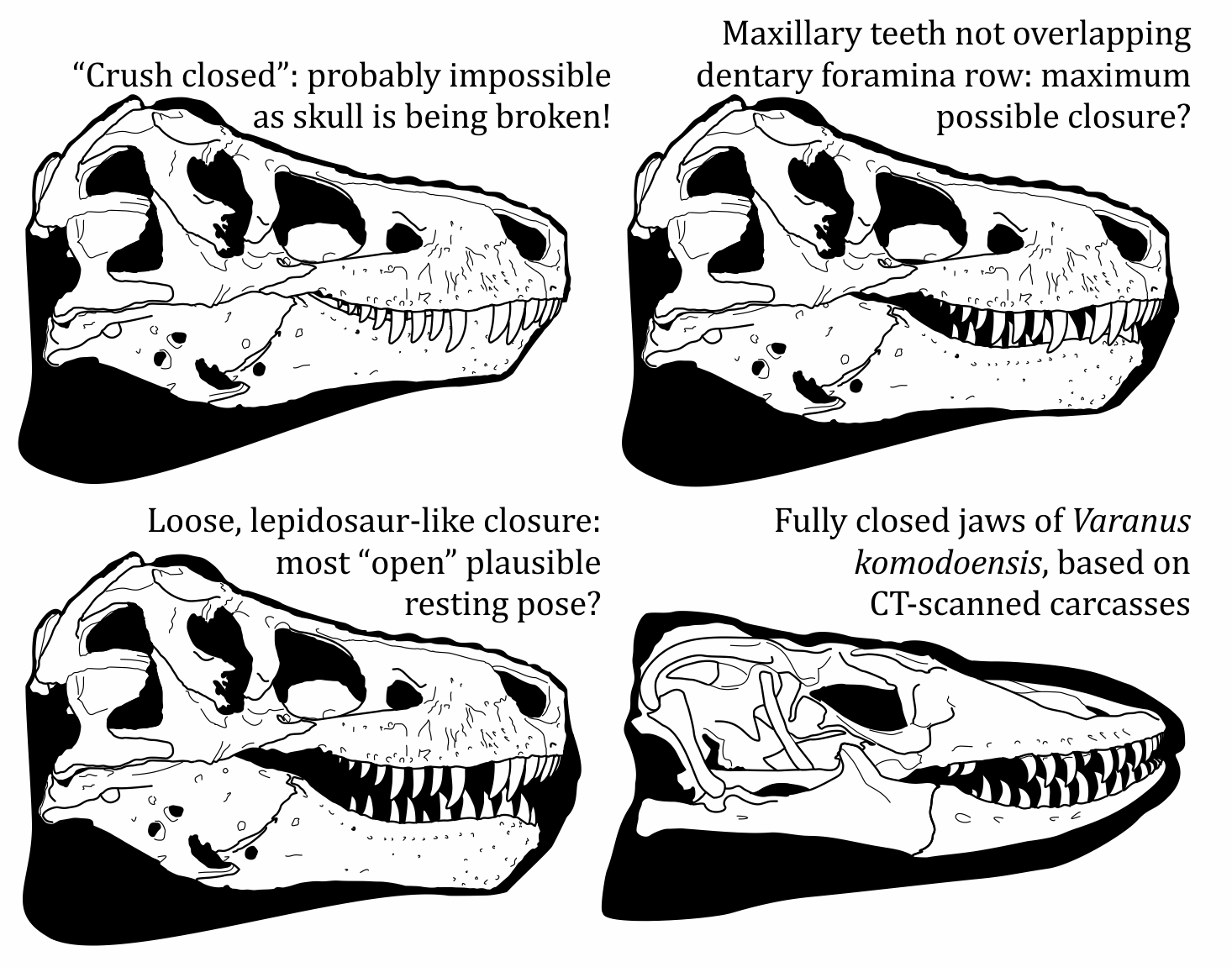
Some of our experimentation with theropod mouth postures. The "crush closed" pose is almost certainly impossible, but it's hard to say how relaxed theropod resting gapes may have been held. If modern lipped reptiles are anything to go by, they may have been held far more "open" than we're used to. Modified from Cullen et al. (2023).

Conclusion: theropod jaws only make sense if they had lips

Putting all this together, our investigations of jaw structure, tooth size, tooth wear and jaw closing all point to the same inference: theropod jaws don’t make much anatomical or functional sense without lips of some kind. To validate the alternative lipless model, we have to engage in a lot of special pleading and scientific weaselling. Exposed theropod teeth would have to be unprecedentedly resistant to wear; all our understanding of jaw structure and foramina distribution correlating with oral soft tissues would have to be wrong, and theropods would need to be unique in not bothering to create oral seals. If we're being good scientists, we can’t currently say that theropods definitely had lips, drop the microphone and walk off stage, but I think we've made it far more challenging for anyone to legitimately object to the lipped theropod hypothesis. Time will tell on that front.

In addition to substantiating the lipped hypothesis of theropod appearance, our hope is that our paper may establish some lines of inquiry for the oral tissues of other extinct animals. Many of the most extreme dentitions to ever evolve belong to fossil taxa, after all, and theropods are far from the only species with uncertain facial appearances. What of nimravids, gorgonopsians, uintatheres, or Thylacosmilus? And what, for that matter, of the superficially crocodile-like spinosaurids and other weird theropods — were they lipped or not? If our ideas hold water, they provide a relatively straightforward way of deducing whether the teeth of these animals were held within oral tissues.

We can't, of course, finish without some brief notes on the life appearance of lipped theropods. We address this a little in our supplementary information and conclude that lepidosaurs, the lizards and tuataras, are the best modern analogue for theropod lips and gums. This is, admittedly, a “best of a bad situation” recommendation because there are plenty of differences between theropod and lepidosaur jaws that preclude total confidence in their comparison, but we only have so many extant reptile groups to choose from and lepidosaurs are, on the whole, morphologically closer to theropods in areas we think are influential on labial and gingival tissues.

What did lipped theropods actually look like? Lizard mouths have a lot more soft-tissue surrounding their teeth (jaw cross sections show a komodo dragon, B, and alligator, C), and this might be something we need to bring into our theropod artwork. The gaping T. rex shown here is outfitted not only with large lips, but also a conservative 25% of its tooth height covered with gums. From Cullen et al. (2023, supplementary data).

This being the case, our model for theropod mouths is that they were sealed by non-muscular*** lips covered with scales or — to hedge our bets a little more — whatever epidermal covering was present on the side of the snout. Lepidosaurs show variation in lip size, with most having generous upper lips but some having thinner lower lips than others. This variation continues to their gums. Lepdiosaur gingivae are more voluminous than those of mammals and crocodylians and generally cover at least 20-25% or so of tooth crown height. This is why lizard teeth aren’t always that conspicuous in their open mouths. Varanids take these enlarged gingivae to an extreme, hiding almost all of their formidable teeth with enormous gums. We currently don’t have much insight into where theropods sat within this range. Paul (2019), independently of our study, advocates for full monitor-like conditions for theropods, and this might be possible, but we can't rule out smaller gums or, indeed, a unique theropodan take on oral soft-tissues at this time. We propose, however, that since extant lipped reptiles have at least 25% of their tooth crown heights covered with gums, we should apply that to theropods, too. We’ve explored this in our paper and PR art with that gummy, lippy T. rex shown above.

***It’s not strictly true that lizards have no muscles around their mouths. Some agamids have muscles that move their lips or flaps of mouth-adjacent skin for communicative purposes. I'm no expert on these structures, but I think it’s fair to assume that they are specialisations of their respective lineages, not the remnant of a once ubiquitous, clade-wide lepidosaur ability.

And I think we’ll leave it there for now. There’s more to say on the tyrannosaur restorations we created for the paper with their small eyes and some of their skin details, but at least some of that discussion needs to wait for developments in other research I’m involved in (I'm so, so sorry, Dave). For now, I’ll thank my coauthors once again for inviting me onto such a great project, and I’ll leave you with this handy infographic summary of our research, which you can share around the internet to instigate discussion of dinosaur life appearance wherever you may be. The QR code in the corner will take you directly to the paper so, if you or anyone you encounter wants to know exactly what we have to say about theropod lips, you can always find it from this image.

Enjoyed this post? Support this blog for $1 a month and get free stuff!

This blog is sponsored through Patreon, the site where you can help artists and authors make a living. If you enjoy my content, please consider donating as little as $1 a month to help fund my work and, in return, you'll get access to my exclusive Patreon content: regular updates on upcoming books, papers, paintings and exhibitions. Plus, you get free stuff - prints, high-quality images for printing, books, competitions - as my way of thanking you for your support. As always, huge thanks to everyone who already sponsors my work!

References

  • Bakker, R. T. (1986). The dinosaur heresies: new theories unlocking the mystery of the dinosaurs and their extinction. William Morrow.
  • Barker, C. T., Naish, D., Newham, E., Katsamenis, O. L., & Dyke, G. (2017). Complex neuroanatomy in the rostrum of the Isle of Wight theropod Neovenator salerii. Scientific Reports, 7(1), 3749.
  • Carr, T. D., Varricchio, D. J., Sedlmayr, J. C., Roberts, E. M., & Moore, J. R. (2017). A new tyrannosaur with evidence for anagenesis and crocodile-like facial sensory system. Scientific Reports, 7(1), 1-11.
  • Cullen, T. M., Larson, D. W., Witton, M. P., Scott, D. Maho, T. Brink, K. S., Evans, D. C. and Reisz, R. (2023). Theropod dinosaur facial reconstruction and the importance of soft tissues in paleobiology. Science, 379, 1348-1352.
  • Currie, P. J. (2003). Cranial anatomy of tyrannosaurid dinosaurs from the Late Cretaceous of Alberta, Canada.
  • Ford, T. L., 1997, Did Theropods have Lizard Lips? Southwest Paleontological Symposium – Proceedings, 1997, 65-78.
  • Galton, P. M. (1973). The cheeks of ornithischian dinosaurs. Lethaia, 6(1), 67-89.
  • Gignac, P. M., & Erickson, G. M. (2017). The biomechanics behind extreme osteophagy in Tyrannosaurus rex. Scientific Reports, 7(1), 2012.
  • Grigg, G., & Kirshner, D. (2015). Biology and Evolution of Crocodylians. Csiro Publishing.
  • Hendrickx, C., & Mateus, O. (2014). Torvosaurus gurneyi n. sp., the largest terrestrial predator from Europe, and a proposed terminology of the maxilla anatomy in nonavian theropods. PloS one, 9(3), e88905.
  • Keillor, T. M. (2013). Jane, in the flesh. In: J. M. Parrish, R. E. Molnar, P. J. Currie, E. B. Koppelhus, (eds.). Tyrannosaurid Paleobiology. Indiana University Press.
  • Knoll, F. (2008). Buccal soft anatomy in Lesothosaurus (Dinosauria: Ornithischia). Neues Jahrbuch fur Geologie und Palaontologie-Abhandlungen, 248(3), 355-364.
  • Lü, J., Yi, L., Brusatte, S. L., Yang, L., Li, H., & Chen, L. (2014). A new clade of Asian Late Cretaceous long-snouted tyrannosaurids. Nature communications, 5(1), 3788.
  • Molnar, R. E. (1991). The cranial morpholgy of Tyrannosaurus rex. Palaeontographica. Abteilung A, Paläozoologie, Stratigraphie, 217, 137-176.
  • Morhardt, A. C. (2009). Dinosaur smiles: Do the texture and morphology of the premaxilla, maxilla, and dentary bones of sauropsids provide osteological correlates for inferring extra-oral structures reliably in dinosaurs?. Western Illinois University.
  • Nabavizadeh, A. (2020). New reconstruction of cranial musculature in ornithischian dinosaurs: implications for feeding mechanisms and buccal anatomy. The Anatomical Record, 303(2), 347-362.
  • Osborn, H. F. (1912). Crania of Tyrannosaurus and Allosaurus; Integument of the iguanodont dinosaur Trachodon. Memoirs of the AMNH; new ser., v. 1, pt. 1-2.
  • Paul, G. S. (2019). Non-ornithischian dinosaurs probably had lips. Here’s why. Prehistoric Times 127, 44-49.
  • Witton, M. P. (2018). The Palaeoartists' Handbook. Crowood Press.

Tuesday, 28 February 2023

Horned dinosaurs vs. theropods: how much did horns matter?

The hero of the hour, Triceratops horridus. But how often were those long horns stuck into predatory dinosaurs in defensive action? I feel a long discussion coming on...

A persistent idea around dinosaur biology is that the ceratopsids, or horned dinosaurs, were among the most formidable prey for predatory theropods. Though lacking armour, the large cranial horns and frills of these dinosaurs have been widely interpreted as having anti-predator potential, functioning like a knight’s lance and shield in their capacity to stab and parry attacking carnivores. Such notions are well over a century old and have taken on a life of their own in palaeontological media, especially thanks to widespread romanticising of the relationship between Triceratops and Tyrannosaurus, genera that we’ve decided represent the ultimate expression of dinosaurian predator and prey. Henry Fairfield Osborn wrote on such matters as early as 1917:

“The first of these [dinosaurs with anti-predator anatomy] are the aggressively and defensively horned Ceratopsia, in which two or three front horns evolved step by step, with a great bony frill protecting the neck. This evolution took place stage by stage with the evolution of the predatory mechanism of the carnivorous dinosaurs, so that the climax of ceratopsian defense (Triceratops) was reached simultaneously with the climax of Tyrannosaurus offense. This is an example of the counteracting evolution of offensive and defensive adaptations, analogous to that which we observe today in the evolution of the lions, tigers, and leopards, which counteracts with that of the horned cattle and antelopes of Africa, and again in the evolution of the wolves simultaneously with the horned bison and deer in the northern hemisphere.”

Osborn 1917, p. 224-225.

At this early stage in dinosaur research, the likes of Triceratops and Tyrannosaurus weren't viewed as laudable champions of evolution, but as animals so stupid and instinct-driven that their predatory and anti-predatory strategies had to be as simple and idiot-proof as possible. Tempting as it is to reduce this passage from William Matthew’s 1915 American Museum of Natural History book Dinosaurs to some choice soundbites, it’s such an amazing window into old-school concepts of dinosaurian stupidity that I present it here in its full glory.

“[Tyrannosaurus] probably reached the maximum of size and of development of teeth and claws of which its type of animal mechanism was capable. Its bulk precluded quickness and agility. It must have been designed to attack and prey upon the ponderous and slow moving Horned and Armored Dinosaurs with which its remains are found, and whose massive cuirass and weapons of defense are well matched with its teeth and claws. The momentum of its huge body involved a seemingly slow and lumbering action, an inertia of its movements, difficult to start and difficult to shift or to stop. Such movements are widely different from the agile swiftness which we naturally associate with a beast of prey. But an animal which exceeds an average elephant in bulk, no matter what its habits, is compelled by the laws of mechanics to the ponderous movements appropriate to its gigantic size. These movements, directed and controlled by a reptilian brain, must needs be largely automatic and instinctive. We cannot doubt indeed that the Carnivorous Dinosaurs developed, along with their elaborately perfected mechanism for attack, an equally elaborate series of instincts guiding their action to effective purpose; and a complex series of automatic responses to the stimulus afforded by the sight and action of their prey might very well mimic intelligent pursuit and attack, always with certain limits set by the inflexible character of such automatic adjustments. But no animal as large as Tyrannosaurus could leap or spring upon another, and its slow stride quickening into a swift resistless rush, might well end in unavoidable impalement upon the great horns of Triceratops, futile weapons against a small and active enemy, but designed no doubt to meet just such attacks as these. A true picture of these combats of titans of the ancient world we cannot draw; perhaps we will never be able to reconstruct it. But the above considerations may serve to show how widely it would differ from the pictures based upon any modern analogies.”

Matthew 1915, p. 52-53.

The image that launched a thousand Cretaceous daydreams... but not the version you know. This is the rarely-seen, 96 cm wide (presumably preparatory) version of Charles Knight's classic 1928 Triceratops vs. Tyrannosaurus mural, held today at Princeton University Art Museum. Knight's near-blindness meant that he could only execute the mural at scale; other artists then painted the better-known, full-size version. I don't need to explain why this image is included in this post.

Over the last century, our views on dinosaur physiology and intelligence have (perhaps thankfully) changed, but the concept of horned dinosaurs protecting themselves with their facial ornaments has not. Some authors (e.g. Colbert 1948) have seen anti-predator functions as the primary role of ceratopsid horns, and even those who view these structures as evolving under different selection regimes (e.g. Hone et al. 2011) assume some predator defence was possible. Seminal figures like Robert Bakker have worked sweeping hypotheses from concepts of long-standing predator-prey interactions between dinosaur species, rephrasing Osborn’s “counteracting evolution of offensive and defensive adaptations” into the catchier “Mesozoic arms race” (Bakker 1986). Of course, Triceratops and Tyrannosaurus are considered the final, ultimate example of this era-spanning feud. On their relationship, Bakker wrote:

“No matchup between predator and prey has ever been more dramatic. It’s somehow fitting that these two massive antagonists lived out their co-evolutionary belligerence through the very last days of the very last epoch in the Age of Dinosaurs.”

Bakker 1986, p. 240.

Gregory S. Paul, also a fan of the idea that Triceratops was the apex challenger to theropod aggressors (Paul 1988), has further worked the concept of ceratopsid predatory combat into other hypotheses. Specifically, in 2008 he proposed that such dangerous prey items were a factor in the short (c. 30 year) lifespans of tyrannosaurids, while also echoing Bakker’s concept of an “arms race” between these clades (“the upgrading the weaponry in tyrannosaurids and ceratopsids… may represent a Red Queen arms race”; Paul 2008, p. 344.).

Today, a large body of evidence has challenged the idea that ceratopsid evolution was driven by developments in predatory dinosaurs. Instead, it points to ceratopsid skulls being primarily shaped by their own intraspecific behaviour. First proposed in the 1970s, this concept arose after researchers noted the many similarities between the sexually-selected horns of living animals and the ornaments of horned dinosaurs. These shared features include their exaggerated and often complex shapes, their functional peculiarity (i.e. that many seem maladapted for other activities, including predator defence), their positive allometry (that they grow faster than the rest of the skull), their high amount of intraspecific variation, and their high morphological diversity between species (e.g. Farlow and Dodson 1975; Spassov 1979; Sampson et al. 1997; Horner and Goodwin 2006, 2008; Hone et al. 2011, 2016; Knell et al. 2012). Evidence that horned dinosaurs injured each other in ways consistent with modelled ritualised combat (e.g. Farke 2004; Farke et al. 2009; D’Anastasio et al. 2022) supports the hypothesis that their horns were employed against one another, not necessarily other dinosaurs, and, along with their fossilisation in huge monospecific bonebeds, we can readily rationalise horned dinosaurs as boisterous animals with somewhat bovid-like behaviours.

Centrosaurus aperatus, a ceratopsid that's so familiar nowadays as to seem unremarkable. But look at that face anew, dear reader: what a crazy animal. Skulls like those of ceratopsids are ripe contenders for dinosaur anatomy shaped by sexual, or at least intraspecific, selection pressures.

The concept of ceratopsid horns serving primarily as anti-predator devices idea has not, however, entirely been set aside despite these data. Nowhere is this more obvious than in popular culture, where horned dinosaurs frequently employ their ornament in life-or-death struggles against predators, and we routinely discuss “armed” dinosaurs as being more dangerous prey than their "unarmed" relatives. But are these action-packed scenarios really a defensible alternative to their horns being used in intraspecific display and aggression? How realistic, really, are these predatory scenarios? Rather than taking the tried and tested route to address this by looking into ceratopsid skull form and function, we’re going to look at the use and evolution of horn-like structures (horns, antlers, ossicones etc.) in living vertebrates. Our view on extinct animal behaviour, after all, is seen through the lens offered by living species and it’s generally our assessment of modern taxa that dictates behavioural models for extinct animals, not the other way around. The anti-predator behaviour of living animals, even just those with horns, is a huge topic that is far too broad and multi-faceted to cover in detail here — especially as I need this to be a relatively short article* — but even in this brief visit, I hope we can hit a few key points that may give food for thought on horn function in Mesozoic animals.

*Yeah, nice try, Past-Mark.

An obvious place to begin is with well-known examples of horn-like structures being used as predator deterrents. It’s absolutely true that some species, like muskox, African buffalo, various rhinos and red deer use their cranial ornament aggressively against predators (Geist 1966, 1999; Schaller 1972; Kruuk 1972) and it is assumed that predator deterrence may explain the presence of horns in a great number of bovids (e.g. Packer 1983; Bro-Jørgensen 2007; Stankowich and Caro 2009; Metz et al. 2018). However, the idea of widespread horn use against predators has been challenged because field observations show such behaviour is rare among many species, and often of limited effectiveness (Estes 1991; Roberts 1996; Gerstenhaber and Knapp 2022). Some groups, like antelopes, are rarely or never witnessed using their sometimes enormous horns in defence against attacking carnivores, even when faced with certain death (Schaller 1972). Most deer seem to behave in a similar fashion, preferring to run or hide from predators despite their capacity to gore and kill conspecifics with their antlers. Indeed, there are indications that antlers may have a deleterious effect on prey species, with Geist (1966) reporting that antlerless moose are more capable opponents against wolves than their "armed" relatives. This may not be the case for all deer, however, with American elk proving more vulnerable to predators once their antlers are cast (Metz et al. 2018). But sometimes losing cranial weaponry makes no difference to predator vulnerability at all, as is the case for black rhinoceros. The necessary act of dehorning these animals to deter poachers shows that both adult and calf survivability are little affected by the removal of their horns (Chimes et al. 2022), suggesting that these structures have a non-essential role in thwarting predatory efforts.

When discussing anti-predation strategies involving horns, the African buffalo Syncerus caffer is one of the go-to species. And yet, these large, formidably armed animals are some of the preferred prey of lions, and are sometimes subdued by single individuals. Photo from Wikimedia, by Diamond Glacier Adventures, CC-BY 2.0.

Perhaps against expectation, not all animals with horn-like structures employ them in defence. Moose generally kick attackers, a behaviour they share with giraffes, who also lash out at predators with their powerful legs rather than bludgeoning them with their armoured, tri-horned heads (Gesit 1966, 1999). Kicking strategies are, of course, also available to species that we might mistake for being “defenceless” from their lack of horn-like anatomy. In some cases, these animals can be far more aggressive than their better-armed contemporaries. Horses, especially zebras, exhibit pronounced anti-predator aggression where they bite and kick attacking cats and hyenas (Kruuk 1972), and with such force that they may explain sightings of lions with shattered jaws (Schaller 1972). Zebras are also recorded as charging towards predators in a fashion that neutralises predatory effort. I like ecologist George B. Schaller’s account of this behaviour where he describes lions simply watching zebras running at them, as any effort to grab them would be “like jumping on a fast-moving train from a standstill” (Schaller 1972, p. 265).

We can augment our discussion further by switching our focus from prey species to their predators. If cranial weapons are effective predator deterrents, we might expect predators to avoid species with horn-like structures or, at least, those more likely to wield them aggressively. And yet, prey preferences seem largely determined by the energy investment demanded in animal capture (Schaller 1972) rather than the presence or absence of cranial armaments. Pouring cold water on romantic notions of life-and-death battles of horns and hooves vs. claws and teeth, field ecology suggests that large predators preferentially target species that are abundant, live in dense populations, and are of a size that provides a suitable reward against the effort of capture. Potential prey species are more likely to be ignored because they are too small, and thus do not provide enough nutrients for the predatory effort, or are too big, and will thus require an unreasonable degree of energetic investment to bring down. This is not to imply that the threat of injury isn’t factored into these behavioural calculations, but we just don’t routinely see predators avoiding horned, aggressive prey in modern ecosystems. On the contrary, both spotted hyenas and lions routinely attack African buffalo (lions especially), a species which is very well known for its horn-led predator defence (Kruuk 1972; Schaller 1972).

Clearly, the idea that horn-like structures serve as anti-predator devices is complicated by a lot of conflicting data. While no one doubts that these anatomies are sometimes used to deter predators, zoologists are engaged in a long-running scientific conversation about the extent and significance of their anti-predator role (e.g. Geist 1966; Estes 1991; Roberts 1996; Caro et al. 2003; Gerstenhaber and Knapp 2022). One especially important issue, which has implications for our discussion of dinosaurs, is whether the horn-like structures of female mammals exist primarily to deter predators (Bro-Jørgensen 2007; Stankowich and Caro 2009). While the formidable cranial weaponry of male mammals is often readily explainable through sexual selection (on which, see below), the function of the same anatomies in females is harder to fathom. Some argue that predator defence is their main purpose, which would imply a much wider role for this behaviour than has been documented in field studies. But others point to social selection as their principal adaptive driver (e.g. to dispute territories or mimic males) or simply regard them as non-functional, suggesting they only exist at all because of a genetic link to male horns. The latter must be the case for the females of some species, such as giraffes, which reportedly never seem to do much of anything aggressive with their heads.

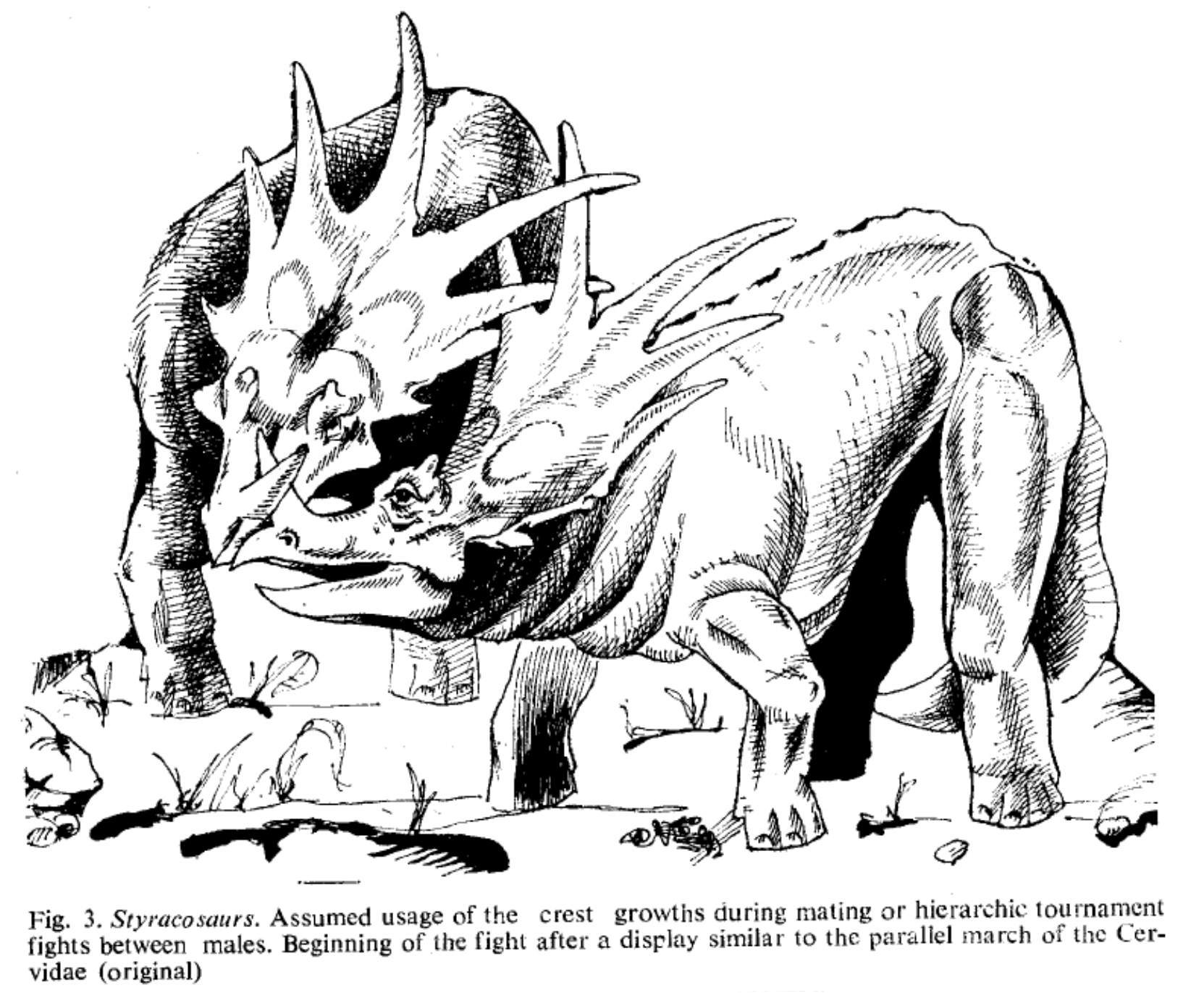
I really like this image from Nikolay Spassov's (1979) paper on horned dinosaur evolution for its novel depiction of horned dinosaur combat. I especially like the interlocking of the frill spikes as we (or, at least, I) tend to forget about them possibly playing a role in physical competition. The horn-like structures of male mammals are shaped to match certain styles of intraspecific combat, and it's possible that ceratopsids were driven by similar evolutionary forces.

Thankfully, we can push most of these conflicting ideas and caveats aside to discuss the horn-like structures of male mammals. It is beyond doubt that intraspecific interactions have a far greater role in shaping these anatomies than interspecific ones, with the cranial ornaments of male giraffids, bovids, cervids and other taxa strongly influenced by sexual selection (Geist 1966; Bro-Jørgensen 2007; Knell et al. 2012). Their cranial structures are so strongly moulded by intraspecific adaptive pressures that they adopt sizes, shapes, textures and orientations that exclude them from effective predator defence (Estes 1991; Roberts 1996), instead becoming better suited to absorbing, catching and parrying the blows of rivals during physical intraspecific contests (Geist 1966; Packer 1983; Bro-Jørgensen 2007). They do not evolve these morphologies randomly, either, but change in response to specific fighting strategies and environmental circumstances. Horned female bovids may also engage in fights with other individuals (both male and female) of their species for resources, but their lessened behavioural emphasis on these bouts means their horns remain less developed than those of males — the significance of this is yet another area of discussion among zoologists.

So, having just thoroughly complicated this seemingly simple topic to a great extent, let’s bring this discussion back to dinosaurs and the assumption that horned dinosaurs wielded their horns like swords against dragon-esque theropods. While models of ceratopsids defending themselves with their horns are undoubtedly validated by the behaviour of some living species, a case can be made that we’ve overstated the importance of horns in predator defence among living animals and, by extension, dinosaurs. The message from the modern day is that horn-like structures can and might be used against predators, but that this behaviour is by no means ubiquitous. It may not even be that common, according to some researchers. It seems that intraspecific selection is more than sufficient to explain most horn-like structures among living species and that predatory influences, if present at all, are relatively minor for most species. We can’t know how much of this insight can be transferred over to dinosaurs, but if ceratopsid facial anatomy was being shaped by intraspecific factors (and we think it was; see above), then we have to entertain all that this brings. This means, in addition to the traditional view of horned dinosaurs being effective foils of predatory theropods, we have to consider some other possibilities suggested by their modern analogues. These could include, for instance, that only some horned dinosaurs actively fought predators; that their retaliations against attacks may have been ineffectual; and that some species may have rarely, and maybe never, turned their horns against other species. And this door swings another way: we have sufficient data from living animals to stop thinking that horned or spiked dinosaurs were the most formidable prey species and that “defenceless” dinosaurs like hadrosaurs and sauropods would be pushovers for their lack of obvious weaponry. Determining which fossil animals are “the most dangerous” from their raw anatomy overlooks the huge impact of non-fossilisable factors that contribute to anti-predator responses, such as temperament, prey awareness, physiology, intelligence, behavioural plasticity and so on. It’s a disappointing limitation of the fossil record that we can investigate what dinosaurs and other extinct animals were capable of, but we’ll never know what they were truly like. Questions about "the most dangerous dinosaur" and similar fall into that void.

Megasuperhypertheropod Tyrannosaurus encounters the unarmed sauropod Alamosaurus. "They said it was defenceless! Defenceless!"

So, in sum, the take-home here isn’t that anti-predator roles for ceratopsid horns are a non-starter, but that the behaviours of living animals complicate this seemingly simple hypothesis. If intraspecific evolutionary pressures on horns and related structures operate mostly independently of predatory pressures today, that has to be our model for Deep Time as well. This opinion comes loaded with caveats, of course, the biggest one being that we’re in a shifting landscape as goes determining the exact roles of horn-like structures in living species; as this changes, so might our ideas on extinct animals. And there’s a lot more we could discuss, too. There’s the aforementioned data about ceratopsid cranial functionality, there’s that healed, T. rex-bitten Triceratops horn described by Happ (2008) that is taken by some as evidence of defensive horn use (I’m not sure I agree; there’s no way of knowing the exact circumstances under which that horn was bitten), there’s the bigger picture of armed dinosaur co-evolution with different theropod clades… but we have to end here. I’ll conclude by borrowing a line from Farlow and Dodson (1975) who succinctly put the ceratopsid anti-predator hypothesis where it should be almost fifty years ago with the mere use of italics: “the evolution of ceratopsian cranial morphology probably reflects diversification through species-specific compromises among various selective pressures… and possibly predator resistance”.

Enjoyed this post? Support this blog for $1 a month and get free stuff!

This blog is sponsored through Patreon, the site where you can help artists and authors make a living. If you enjoy my content, please consider donating as little as $1 a month to help fund my work and, in return, you'll get access to my exclusive Patreon content: regular updates on upcoming books, papers, paintings and exhibitions. Plus, you get free stuff - prints, high-quality images for printing, books, competitions - as my way of thanking you for your support. As always, huge thanks to everyone who already sponsors my work!

References

  • Bakker, R. T. (1986). The Dinosaur Heresies. William Morrow and Company. Inc.
  • Bro‐Jørgensen, J. (2007). The intensity of sexual selection predicts weapon size in male bovids. Evolution, 61(6), 1316-1326.
  • Caro, T. M., Graham, C. M., Stoner, C. J., & Flores, M. M. (2003). Correlates of horn and antler shape in bovids and cervids. Behavioral Ecology and Sociobiology, 55, 32-41.
  • Chimes, L. C., Beytell, P., Muntifering, J. R., Kötting, B., & Neville, V. (2022). Effects of dehorning on population productivity in four Namibia sub-populations of black rhinoceros (Diceros bicornis bicornis). European Journal of Wildlife Research, 68(5), 58.
  • Colbert, E. H. (1948). Evolution of the horned dinosaurs. Evolution, 145-163.
  • D’Anastasio, R., Cilli, J., Bacchia, F., Fanti, F., Gobbo, G., & Capasso, L. (2022). Histological and chemical diagnosis of a combat lesion in Triceratops. Scientific Reports, 12(1), 3941.
  • Estes, R. D. (1991). The significance of horns and other male secondary sexual characters in female bovids. Applied Animal Behaviour Science, 29(1-4), 403-451.
  • Farke, A. A. (2004). Horn use in Triceratops (Dinosauria: Ceratopsidae): testing behavioral hypotheses using scale models. Palaeontologia Electronica, 7(1), 10p.
  • Farke, A. A., Wolff, E. D., & Tanke, D. H. (2009). Evidence of combat in Triceratops. PLoS One, 4(1), e4252.
  • Farlow, J. O., & Dodson, P. (1975). The behavioral significance of frill and horn morphology in ceratopsian dinosaurs. Evolution, 353-361.
  • Geist, V. (1966). The evolution of horn-like organs. Behaviour, 27(1-2), 175-214.
  • Geist, V. (1999). Deer of the World. Swan Hill Press, Shrewsbury.
  • Gerstenhaber, C., & Knapp, A. (2022). Sexual selection leads to positive allometry but not sexual dimorphism in the expression of horn shape in the blue wildebeest, Connochaetes taurinus. BMC Ecology and Evolution, 22(1), 107.
  • Happ, J. (2008). An analysis of predator-prey behavior in a head-to-head encounter between Tyrannosaurus rex and Triceratops. In Larson P. & Carpenter, K. Tyrannosaurus rex the Tyrant king, Indiana University Press. p. 355-370.
  • Horner, J. R., & Goodwin, M. B. (2006). Major cranial changes during Triceratops ontogeny. Proceedings of the Royal Society B: Biological Sciences, 273(1602), 2757-2761.
  • Horner, J. R., & Goodwin, M. B. (2008). Ontogeny of cranial epi-ossifications in Triceratops. Journal of Vertebrate Paleontology, 28(1), 134-144.
  • Knell, R. J., Naish, D., Tomkins, J. L., & Hone, D. W. (2013). Sexual selection in prehistoric animals: detection and implications. Trends in ecology & evolution, 28(1), 38-47.
  • Kruuk, H. (1972). The Spotted Hyena. A Study of Predation and Social Behavior. University of Chicago Press.
  • Mallon, J. C. (2017). Recognizing sexual dimorphism in the fossil record: lessons from nonavian dinosaurs. Paleobiology, 43(3), 495-507.
  • Matthew, W. D. (1915). Dinosaurs with Special Reference to the American Museum: Collections (No. 5). American museum of natural history.
  • Metz, M. C., Emlen, D. J., Stahler, D. R., MacNulty, D. R., Smith, D. W., & Hebblewhite, M. (2018). Predation shapes the evolutionary traits of cervid weapons. Nature Ecology & Evolution, 2(10), 1619-1625.
  • Osborn, H. F. (1917). The origin and evolution of life: on the theory of action, reaction and interaction of energy. C. Scribner's sons.
  • Packer, C. (1983). Sexual dimorphism: the horns of African antelopes. Science, 221(4616), 1191-1193.
  • Paul, G. S. (1988). Predatory dinosaurs of the world: a complete illustrated guide. Simon & Schuster.
  • Paul, G. S. (2008). The extreme lifestyles and habits of the gigantic tyrannosaurid superpredators of the Late Cretaceous of North America and Asia. In Larson P. & Carpenter, K. Tyrannosaurus rex the Tyrant king, Indiana University Press. p. 307-354.
  • Roberts, S. C. (1996). The evolution of hornedness in female ruminants. Behaviour, 133(5-6), 399-442.
  • Sampson, S. D., Ryan, M. J., & Tanke, D. H. (1997). Craniofacial ontogeny in centrosaurine dinosaurs (Ornithischia: Ceratopsidae): taxonomic and behavioral implications. Zoological Journal of the Linnean Society, 121(3), 293-337.
  • Schaller, G. B. (1972). The Serengeti Lion: A Study of Predator-Prey Relations. University of Chicago Press.
  • Spassov, N. B. (1979). Sexual selection and the evolution of horn-like structures of ceratopsian dinosaurs. Paleontol. Stratigr. Lithol, 11, 37-48.
  • Stankowich, T., & Caro, T. (2009). Evolution of weaponry in female bovids. Proceedings of the Royal Society B: Biological Sciences, 276(1677), 4329-4334.

Tuesday, 31 January 2023

Can studies of living animal colour constrain the colours of dinosaurs? A case study with big theropods

Mighty Tarbosaurus bataar carries its Therizinosaurus cheloniformis prey through a Masstrichtian forest in the rain. Colour-wise, I've decided that a ruddy-orange dorsum, light venter, disruptive black stripes, rings and large eye masks are meant to hide this 10 m long animal during predatory acts. But without direct palaeocolour data for Tarbosaurus, could we ever evaluate how sensible this colour scheme is?

Today we’re looking at one of the most commonly asked questions about restoring extinct dinosaur appearance: colour. For centuries, queries about the colours and patterns of dinosaurs, and, indeed, most extinct vertebrates, have been effectively non-answerable, save for some arm waving about the merits of camouflage for predation and display patterns for social signalling. Nowadays, advances in analyses and understanding of fossil pigments have allowed us to reconstruct the foundation colours of several dinosaurs in detail, along with those of other popular taxa like pterosaurs and marine reptiles (see Vinther 2015 and Smithwick and Vinther 2020 for overviews). This new frontier in dinosaur science has helped to flesh out not only the life appearance of dinosaurs, but also their ecology: their habitat preferences, their daily activity patterns, their predation concern and so on (e.g. Vinther et al. 2016).

Deducing dinosaur colour to this level of precision requires exceptionally high-quality preservation of their skin, down to the microscopic level, so that their pigment cells (melanosomes) can be identified. Unfortunately, this excludes the vast majority of dinosaur specimens from such analyses. Dinosaur skin is not only rare, but often occurs as mere sediment impressions rather than films of geochemically-preserved organic matter. This preservation style applies to a great number of the most famous dinosaurs so, unless some radical new science finds a way to assess colour from skin texture alone, the colours of our favourite extinct saurian taxa will probably be lost to time forever.

But can we tackle this problem from another angle? In recent decades, biologists have made enormous strides in understanding living animal colouration, looking at how it relates to habitat preferences, camouflage, signalling behaviour, body size, posture, visuality acuity and so on. Has the science around modern animal colouration advanced to the point where we can start to make tighter predictions about the colours of extinct animals? I regard this as an important question because, as much as our depictions of dinosaur anatomy have tightened since the late 20th century, our application of colour is still pretty lawless, even among professional palaeoartists. We present the same animals with colour schemes that are totally adaptively opposed to one another — one artist’s vivid blue hadrosaur is met with another’s muted browns and reds — and yet they’re both meant to be of equal scientific credibility. But how can that be so? Colours and patterns are generally thought to be under the same adaptive pressures as other parts of animal anatomy and thus should correlate, to a greater or less extent, with aspects of behaviour and ecology. There probably is, at some level, a "right" and "wrong", or at least a "likely" and "less likely" aspect to colour restoration, just as there is with all other aspects of palaeoartistry. But how can we evaluate this without palaeocolour data? Enter, stage left, the last two decades of studies of living animal colour. Can they help constrain, even in a general way, our efforts at colouring animals from Deep Time?

What flavour Australovenator wintonensis is your favourite — red, green, blue or orange? It's strange that, as consistent as we're getting with depicting dinosaur anatomy, you could present any one of these contrasting colour variants with equal scientific validity, even though they each imply very different interpretations of Australovenator biology.

Time for a case study

To investigate this, I thought we could look at a well-known group of dinosaurs to see what, if anything, living animals might suggest about their colouration. As you’ve guessed from the article title, we're using big predatory theropods for this exercise, for several reasons: 1) they’re a popular art subject, so this article should be of wide interest; 2) as regular readers will have worked out, I’m currently involved in a few big theropod projects so have been drawing them fairly continuously for a while now; and 3), the biology and ecology of big theropods are comparatively well-researched, and that helps when plugging fossil data into models of extant animal colour. And yes, we could restrict this to a more specific theropod clade but, from what I know about giant predatory dinosaurs, I’m not sure the conclusions we’d draw for big allosauroids would be much different to those of tyrannosaurines or large megalosauroids. If we’re sticking to what we know about these animals, not what we speculate and imagine about them, they only offer so much data to compare against living species.

There are plenty of caveats with this comparison, of course. No living creature is ecologically or phylogenetically close to the largest Mesozoic theropods, and our modern environments are different to those inhabited by our case study subjects. But we might also consider the importance of uniformitarianism, the adage that “the present is the key to the past”. We can’t say whether modern animals are perfect models for the colour of Mesozoic species, but they offer the only large, statistically-viable sample size of biological colour for us to work with. We are surely better off making informed guesses about extinct animal appearance using modern species as a guide, dodging known pitfalls where we can, than simply speculating wildly.

More worrying than concerns about comparing the past with today is that the controlling factors of animal colouration are extremely complicated, and it’s not clear how we can account for this. Indeed, for all of our science and ideas around animal colour, we still have lots to learn about it. Many popular, widely communicated interpretations of animal colours and patterns are only now being experimentally evaluated (Caro 2005), which means we are still struggling to understand some foundational aspects of certain colour schemes (Caro 2013). This is especially the case for predatory species, the colours of which have been relatively unexplored compared to those of prey animals (Pembury Smith and Ruxton 2020). To that end, we must temper our expectations. As neat as it would be to pour details like extinct animal size, habitat preference and trophic level into an algorithm to receive — *ping!* — a series of likely colours and patterns, our conclusions here, if any, are going to be of a more generalistic, broader nature.

Camouflage and detectability in large living predators: what does it mean for big theropods?

For all the new work that’s been done on animal colour, we still recognise that the principal pressures on animal colouration are essentially what Darwin observed in his 1871 book The Descent of Man. This is a conflict between natural selection, which promotes colour configurations that help animals remain undetected by predators, avoid temperature stress and generally survive from day to day, and sexual selection, which promotes the adoption of bold, broadcasting colours and patterns that attract mates and deter social rivals. So the first thing we might explore for big Mesozoic dinosaur predators is how our largest living terrestrial carnivores express this conflict: are they more concerned with basic natural functionality or sexual signalling? We're specifically interested in our giant theropod ecological analogues here: big animals that hunt and kill relatively large prey items. Predators that subsist on smaller, bite-sized animals don't qualify, because their ecology isn't sufficiently similar.

A selection of the largest predatory animals of modern times and their camouflage schemes, universally showing a strong adaptive emphasis on concealment regardless of habitat type, phylogeny or locomotor method. A, Ora, or Komodo dragon Varanus komodoensis (background matching); B, lion, Panthera leo (background matching); C, tiger Panthera tigris (disruptive colouration); D, polar bear Ursus maritimus (background matching); E, saltwater crocodile Crocodylus porosus (background matching); F, golden eagle Aquila chrysaetos (background matching); G, great white shark Carcharodon carcharias (countershading). All images from Wikimedia: A, Yuliseperi2020, CC BY-SA 4.0; B, Bernard DUPONT from FRANCE, CC BY-SA 2.0; C, Charles J. Sharp, CC BY-SA 4.0; D, Andreas Weith, CC BY-SA 4.0; E, fvanrenterghem, CC BY-SA 2.0; G, Juan Lacruz, CC BY-SA 3.0.

Across vertebrate groups, and across habitat types, our biggest modern predators are pretty consistently (maybe entirely consistently) primarily coloured for concealment: that is, they have camouflaging colours and patterns which hide their presence from their prey. This applies as much to mammals, which are a relatively drab group overall on account of several ecological and physiological factors (Caro 2013), as it does to clades that have the adaptive capacity to produce the most brilliant and striking colour schemes in nature, such as lizards, snakes, birds and fish. So maybe that’s our first note: big predators in the modern day are all about cryptic colouration, with little in the way of conspicuous display patterning.

Research on the impact of body size on predatory ecologies sheds light on why big predators seem to be consistently camouflage-coloured, and it’s a simple explanation: bigger animals are generally more conspicuous than smaller ones, even when they're trying their best not to be seen. The relationship between predator size and concealment capacity is still being investigated but a trend between size and conspicuousness seems to apply widely across Animalia, even in species with famously adept camouflage adaptations, like chameleons (Cuadrado et al. 2001; Pembury Smith and Ruxton 2020). Size doesn’t just affect detectability, either: it also correlates with prey response. Bigger predators instigate more vigorous reactions than smaller ones, such that prey species react sooner, flee further, or initiate more aggressive counter-responses (Stankowich and Blumstein 2005). There are strong pressures, therefore, on big predators to do what they can to remain hidden. Their size already puts them at a disadvantage for stealthily approaching prey, and they are going to have to run further or fight harder once they give up their hiding spot. Given that the largest theropods are the biggest terrestrial predators that have ever lived, we have to wonder what this link between body size and cryptic capacity implies for their colouration. Is one obvious inference that big theropods needed all the help they could get to remain inconspicuous? Would predators already handicapped by their greater detectability and exaggerated prey responses really have some of the signalling-dominant, hyper-obvious colour schemes we've given them from time to time?

Giganotosaurus adapted for the open county with high-bodied, sharply marked countershading, from my recent post about the possible facial anatomy of this animal. But note the ornament on this animal's head: I feel I gave it a pretty meaty set of soft-tissues around its snout and eye, but Giganotosaurus is still pretty undecorated compared to some theropods. Is this something we can read into — does the extent of cranial ornament tell us something facial colouration?

While fossils do not tell us anything about this correlation directly, I wonder if some anatomical evidence points to larger predatory dinosaurs aiming to be less conspicuous. Mid-and large-sized theropod fossils tend to have bony cranial ornaments more often than smaller ones (Gates et al. 2016), but in my estimation (by which I mean, this hasn't been verified by any study), the ornamentation in very large species is generally reduced and less spectacular than that of their smaller cousins. In tyrannosauroids, for instance, we see a general shift away from tall midline cranial crests in smaller, earlier species towards low-relief rugose surfaces, small horns or blunt bosses in larger taxa (Gates et al. 2016). Indeed, the very largest theropods are some of the dullest-looking, at least in terms of cranial ornament. Consider the flattened orbital bosses and rostral rugosities of Tyrannosaurus and Tarbosaurus, or the low, corrugated textures over the snouts of giant carcharodontosaurids. We can only speculate on what impact these ornaments might have had on theropod camouflaging efforts, but it’s well-established that distinctive body outlines can increase detectability, to the extent that modern predators attempt to hide them from their prey where possible (see below).

Whatever their adaptive significance, these reduced facial ornaments give us grounds to think about cranial colouring. Faces are often sites for signalling patterns and colours in modern species (e.g. Caro et al. 2017) and a reduction in bony facial ornament could indicate a lessened emphasis on this behaviour, possibly including muted facial colouration. A caveat here is that elaborate osteological features are only ever suggestive of striking colours and patterns, not directly correlated. But part of the palaeoart game is looking for clues about the nature of these animals wherever we can, and an absence or reduction of showy features is something we can factor into the reasoned speculation we must utilise when creating colour schemes.

I don't think we make enough of how display-adapted Spinosaurus aegyptiacus was, and how weird that is for not only a giant dinosaur predator, but any giant predator. Here, a gaggle of Spinosaurus show off their sails and tails, display structures (well, probable display structures, in the case of the tail) that use almost every inch of their axial length for showing off. So how does this fit into your "big theropods were camouflage-colour dominant" narrative, smart guy?

The elephant in the room here, of course, is Spinosaurus, which is highly unusual for being a giant apex predator with the same tailor as a peacock. This was a carnivore with an unprecedented disregard for remaining inconspicuous or having an anonymous body profile. For all the controversy over this animal, one aspect we all agree on is that its enormous sail was a sociosexual display device (see Hone and Holtz 2021 for references and discussion). Doesn’t this doesn’t torpedo the wider point being made here about predator size and possible camouflage needs? On the contrary, it might support it. As something straddling the terrestrial-aquatic realm, normal rules about camouflage and crypsis may not have applied to Spinosaurus. We see this evidenced in modern times in that the "rules" of camouflage in terrestrial settings are not the same as those of aquatic habitats (Caro 2013), and we should probably allow for, or even expect, some weirdness from animals operating at that interface. The atypical ecology of spinosaurids may have liberated them from the adaptive pressures experienced by purely terrestrial dinosaur predators, allowing them to become more ornamental and spectacular. Perhaps the fishy prey of Spinosaurus barely saw the full outline of their largest predator, an especially viable idea in the (I think, superior) “giant heron” ecological model favoured by several authors (e.g. Hone and Holtz 2021; Sereno et al. 2022).

Pigment availability

Moving on, can we get a sense of the skin pigmentation available to giant theropods, thus letting us know which paints/colouring pencils/digital palettes to crack open? Here, we have to think about the availability of environmental pigments, like carotenoids. Many readers will know that animals cannot create all the pigments used in their integument and that some are obtained through eating plants or microbes. Carotenoids and other environmental pigments create some of the most vivid colours seen on animals today, including hot reds, bright oranges and canary yellows. But environmental pigments are hard to source in terrestrial settings, to the extent that even tiny songbirds compete with one another to source them (Blount 2004; Biard et al. 2005). Outside of specialist ecologies, the most famous being that of flamingoes, larger terrestrial animals tend to make do with pigments they can manufacture themselves, such as melanin. This is one reason why so many terrestrial animals are earthy tones, such as greys, blacks, browns, orange-reds, and white (where pigment is withheld). But structural colour, features of skin, scales and feathers that manipulate light to create colour without pigmentation, has also been developed across all vertebrates and is exploited to produce greens and blues. In all probability, it’s from these basic pigment and structural palettes that giant theropods were deriving their hues. Unless conditions of the past were very different to those of today, it’s hard to imagine multi-tonne terrestrial animals finding enough carotenoids to develop large patches of particularly intense pigmentation.

Specifics of patterning

Our discussion raises a notch in complexity as we move to consider giant theropod skin patterns, even if we stick within the camouflage-dominant framework outlined above. Concealment strategies are adapted to specific habitats, predation styles and prey types because no one system is universally effective. Indeed, one of the few constant rules of camouflage — that, no matter how perfectly a crypsis strategy works on a stationary animal, movement always gives the game away (Pembury Smith and Ruxton 2020) — is of little use to us here because we don’t know where and how big theropods hunted. The concealment strategy of an endurance predator, one that simply hounds its prey tirelessly, waiting for it to become vulnerable from exhaustion, might be different to that of an ambush predator that relies on surprise, springing at its prey at the last moment for a short chase.

These are only the first factors to consider. Predator colours are also modified by the time of day the predator tends to operate, as well as their position in the food chain: some have to be worried about being prey items themselves. And that, in turn, is altered by the colour schemes that can be created by different integument types (e.g. fibres vs. naked skin vs. scales), as well as the functional impacts of pigmentation. Darker pigments, for instance, can protect skin from harmful UV rays and may have antibacterial properties but, conversely, also absorb more solar heat and increase an animal’s thermal load (Walsberg 1983; Caro 2005; Caro and Mallarino 2020). There’s a lot to think about here, and the fact we still can’t account for these and other variables reliably in living animals is why biologists still consider our knowledge of animal colour to be fairly limited. It goes without saying that, if we’re still working out what’s happening among living species, robust predictions of camouflage patterning in extinct animals are way off.

The colour schemes we give our dinosaurs have functional implications beyond interacting with other animals. This dark, adult Tyrannosaurus would be well-protected from solar radiation by its dark skin, but it would absorb a lot of heat in direct sunlight.

Nevertheless, we may be able to narrow down some possibilities for giant theropods by looking at what works for large modern predators. Most employ background matching, where their skin tone approximates that of their surroundings, or else they use countershading, where dark upper regions and lighter undersides disrupt the formation of shadows, diminishing contrast with the background (note that this is disputed by some, there is actually a fair amount of controversy around countershading function: see Ruxton et al. 2004; Rowland 2009). Other predators use disruptive colouration, where high-contrast colours break up body outlines and disguise distinctive features such as eyes. Unlikely strategies for big theropods are masquerading tactics: attempts to match unexciting objects like rocks or twigs. To pull off this illusion, masqueraders have to resemble something of equivalent size and shape, and that becomes harder at larger sizes, perhaps explaining the absence of this method among large terrestrial predators today. This strategy is distinct from mimicry, where an organism adopts the appearance of another species to be misleading about its true nature (Skelhorn et al. 2010).

With several patterning options on the table, progressing further with this discussion is only possible if we start making assumptions about giant theropod ecology, pushing us further into the realm of inference and speculation. But we can ground ourselves by considering the results of studies into camouflage function and performance. For instance, if countershading does indeed work to disrupt shadowing, then studies show that a sharp, high-body colour transition would work better in an open setting than a more gradual colour change lower on the flank, which obscures animals more effectively in forested settings (Vinter et al. 2016). We generally see more uniform, low-contrast colours on big animals in open habitats because large patches of colour generally don’t conceal animals as well in woodlands (Pembury Smith and Ruxton 2020, although flat-grey elephants are reportedly remarkably difficult to find once they enter forests — see Caro 2013). Conversely, high-contrast patterns seem to work better at hiding animals in vegetated or otherwise busier environments.

Baby tyrannosaurs, barely a metre long, with cryptic colours that help them blend into the forest floor. In all likelihood, baby tyrants were at high predation risk and it seems reasonable to assume they used camouflage tactics to avoid being eaten. But the colour schemes of infants may not have worked so well for their gigantic parents, nor even older juveniles or subadults. Might tyrannosaurs and other giant theropods have tracked through multiple colour morphs en route to somatic maturity?

We can consider things like the age of our restoration subjects, too. In scaly animals (the only skin type we currently have direct evidence for in giant predatory theropods, even if we can’t rule out the possibility of some protofeathering), colour vividness tends to reduce with age (Olsson et al. 2013). This change may not just be physiological, but also adaptive. The juveniles of all animals, including apex predators, are targetted by carnivores and their colouration has to be multi-functional, hiding them from predators as well as — in precocial species — their prey. This is often achieved with disruptive patterning. Stripes, spots, bars and other features may serve an additional role, achieving a “motion dazzle” effect that confuses predators about animal speed and direction, or draws focus to less critical anatomies, like tail tips (Murali & Kodandaramaiah 2016). Dazzling capacity diminishes at lower speeds and agility, and is thus less useful in larger animals (Pembury Smith and Roxton 2020), perhaps partly contributing to the dulling of living reptiles as they approach adulthood. We should not imagine that juvenile theropods transitioned to their adult colours straight away, however. It took decades to grow gigantic theropodan predators and, in all probability, the route to adulthood was via several different ecological niches (e.g. Holtz 2021), each of which may have had different adaptive pressures on colouration. So maybe giant theropods had several colour schemes throughout their lives, and we should render them as being colour-adapted to their various age-specific lifestyles? We could go on listing the adaptive aspects of different animal skin patterns all day, but you get the idea. There's a lot of camouflage science we could factor into our reconstructions, even if we can't ever know the real colours and patterns of our subject species.

So... does animal colour science help us in palaeoart?

Background-matching, age-dulled Tyrannosaurus rex takes on a countershaded, partly disruptively-coloured Edmontosaurus annectens. These guys are mainly here to stomp about and wake people up with some Hardcore Dino Action™ in case anyone has drifted off when reading this long, long post.

Let’s conclude by returning to our main question: can studies of living animals constrain our speculations about the colours of dinosaurs, or will colour restorations forever remain a crapshoot when we don’t have palaeocolour data? Here, we've extrapolated the findings of predator-specific colour studies to giant, terrestrially-hunting theropods and, based on these, we've suggested that large dinosaur predators...

  • were likely under very strong pressures for crypsis
  • probably didn't load their skin with many environmental pigments
  • likely expressed background matching, countershading or disruptive patterning, depending on their specific ecologies
  • may have had several colour schemes throughout their lives as their ecology changed with age
Down the line, we can discuss the merits of these predictions — do remember that you're reading a secondary take on all the science discussed here and that you may come to different interpretations based on your own literature crawl. But it's not these specific findings that are most important here. Rather, it's that this case study shows what animal colour science can offer to the process of restoring one type of extinct animal, as well as its broader potential for focusing our loosely-constrained applications of colour within palaeoart. The points made above, or others like them, do not give a colour scheme for giant theropods, but they do suggest that some concepts are more likely than others, and even rough guidance isn't to be sniffed at when we're otherwise running virtually blind. It's strange that palaeoartists are often able to point to core palaeontological studies for interpreting fossils, and core anatomical studies for depicting anatomy, but we don't generally talk about or know the same literature on animal colour. I wonder if it'll eventually be worth keeping up with developments in this field as much as we do new fossil and anatomical data — if we’re not at this point already. The result can only be more scientifically credible and realistic artwork, and that's a win for everyone.

Enjoyed this post? Support this blog for $1 a month and get free stuff!

This blog is sponsored through Patreon, the site where you can help artists and authors make a living. If you enjoy my content, please consider donating as little as $1 a month to help fund my work and, in return, you'll get access to my exclusive Patreon content: regular updates on upcoming books, papers, paintings and exhibitions. Plus, you get free stuff - prints, high-quality images for printing, books, competitions - as my way of thanking you for your support. As always, huge thanks to everyone who already sponsors my work!

References

  • Biard, C., Surai, P. F., & Møller, A. P. (2005). Effects of carotenoid availability during laying on reproduction in the blue tit. Oecologia, 144, 32-44.
  • Blount, J. D. (2004). Carotenoids and life-history evolution in animals. Archives of biochemistry and biophysics, 430(1), 10-15.
  • Caro, T. I. M. (2005). The adaptive significance of coloration in mammals. BioScience, 55(2), 125-136.
  • Caro, T. I. M. (2013). The colours of extant mammals. In Seminars in Cell & Developmental Biology (Vol. 24, No. 6-7, pp. 542-552). Academic Press.
  • Caro, T., & Mallarino, R. (2020). Coloration in mammals. Trends in Ecology & Evolution, 35(4), 357-366.
  • Caro, T., Walker, H., Santana, S. E., & Stankowich, T. (2017). The evolution of anterior coloration in carnivorans. Behavioral Ecology and Sociobiology, 71, 1-8.
  • Cuadrado, M., Martín, J., & López, P. (2001). Camouflage and escape decisions in the common chameleon Chamaeleo chamaeleon. Biological Journal of the Linnean Society, 72(4), 547-554.
  • Gates, T. A., Organ, C., & Zanno, L. E. (2016). Bony cranial ornamentation linked to rapid evolution of gigantic theropod dinosaurs. Nature Communications, 7(1), 12931.
  • Holtz Jr, T. R. (2021). Theropod guild structure and the tyrannosaurid niche assimilation hypothesis: implications for predatory dinosaur macroecology and ontogeny in later Late Cretaceous Asiamerica1. Canadian Journal of Earth Sciences, 58(9), 778-795.
  • Hone, D. W., & Holtz Jr, T. R. (2021). Evaluating the ecology of Spinosaurus: Shoreline generalist or aquatic pursuit specialist?. Palaeontologia Electronica, 24(1), 1-28.
  • Murali, G., & Kodandaramaiah, U. (2016). Deceived by stripes: conspicuous patterning on vital anterior body parts can redirect predatory strikes to expendable posterior organs. Royal Society Open Science, 3(6), 160057.
  • Olsson, M., Stuart-Fox, D., & Ballen, C. (2013). Genetics and evolution of colour patterns in reptiles. In Seminars in cell & developmental biology (Vol. 24, No. 6-7, pp. 529-541). Academic Press.
  • Pembury Smith, M. Q., & Ruxton, G. D. (2020). Camouflage in predators. Biological Reviews, 95(5), 1325-1340.
  • Rowland, H. M. (2009). From Abbott Thayer to the present day: what have we learned about the function of countershading?. Philosophical Transactions of the Royal Society B: Biological Sciences, 364(1516), 519-527.
  • Ruxton, G. D., Speed, M. P., & Kelly, D. J. (2004). What, if anything, is the adaptive function of countershading?. Animal Behaviour, 68(3), 445-451.
  • Sereno, P. C., Myhrvold, N., Henderson, D. M., Fish, F. E., Vidal, D., Baumgart, S. L., ... & Conroy, L. L. (2022). Spinosaurus is not an aquatic dinosaur. Elife, 11, e80092.Skelhorn, J., Rowland, H. M., Speed, M. P., & Ruxton, G. D. (2010). Masquerade: camouflage without crypsis. Science, 327(5961), 51-51.
  • Smithwick, F., & Vinther, J. (2020). Palaeocolour: A History and State of the Art. In: Foth, C., Rauhut, O. (eds) The Evolution of Feathers. Fascinating Life Sciences. Springer. 185-211 pp.
  • Stankowich, T., & Blumstein, D. T. (2005). Fear in animals: a meta-analysis and review of risk assessment. Proceedings of the Royal Society B: Biological Sciences, 272(1581), 2627-2634.
  • Vinther, J. (2015). A guide to the field of palaeo colour: Melanin and other pigments can fossilise: Reconstructing colour patterns from ancient organisms can give new insights to ecology and behaviour. BioEssays, 37(6), 643-656.
  • Vinther, J., Nicholls, R., Lautenschlager, S., Pittman, M., Kaye, T. G., Rayfield, E., ... & Cuthill, I. C. (2016). 3D camouflage in an ornithischian dinosaur. Current Biology, 26(18), 2456-2462.
  • Walsberg, G. E. (1983). Coat color and solar heat gain in animals. BioScience, 33(2), 88-91.