Showing posts with label Azhdarchidae. Show all posts

Thursday, 31 May 2018

Why we think giant pterosaurs could fly

Giant azhdarchid pterosaur in flight. Images like this virtually always trigger discussions about the validity of giant pterosaur flight hypotheses.
Every so often the idea of flightless giant pterosaurs circulates in the press or on social media. It doesn't take much to ignite these discussions: a new giant pterosaur fossil, a PR event from a museum, or simply artwork emphasising the size of giant flying reptiles will see someone, somewhere, questioning their flightworthiness. These suggestions are often made with strong conviction, to the extent of dismissing or even arguing with scientists who study pterosaur anatomy and biomechanics. After all, how can any sensible individual think that animals with 10 m wingspans and body masses hovering around 250 kg were capable of flight? At most they were gliders, or flighted as juveniles and flightless as adults, right?

Confession time: as someone actively involved in research and outreach on these animals, I often find these discussions frustrating, for two reasons. The first is that, among those who actually study pterosaur functional morphology – that is, those who make detailed observations and measurements of pterosaur fossils, compile biomechanical data and use computer modelling to objectively test their flight capacity – there is no controversy about the volant nature of these animals, even at their maximum size. Peer-reviewed claims that pterosaurs were flightless are genuinely rare (perhaps limited to Sato et al. 2009; Henderson 2010 and Prentice et al. 2011 in the last decade) and have a consistent record of being flawed on some critical anatomical or functional detail (Witton and Habib 2010). There is no debate about giant pterosaur flight among those of us who study their fossils: the press and social media fuss about the topic is a genuine palaeontological nontroversy.

The second source of frustration is that, away from technical literature, discussions of giant pterosaur flight frequently suffer from major cases of Dunning-Kruger effect, especially when parties have knowledge of planes. I've experienced this a lot in my career, and not just in the wilds of social media: many of my TV and film consultancy jobs have required defending basic tenets of pterosaur anatomy - even their basic, there-for-all-to-see proportions preserved in articulated fossils - to folks who just can't or won't believe what the fossils show. Having a casual understanding of engine-driven man-made flying machines does not equate to knowing all there is about everything that has ever flown, but you would not know this from some conversations.

Our controversial giant azhdarchid friends Arambourgiania philadelphiae (middle) and Hatzegopteryx thambema (right), compared to a record-breaking giraffe and the Disacknowledgement.
Whether through naivety of palaeontological theory or unwillingness to accept good data, the lack of accessible overviews of current thinking on giant pterosaur flight probably fuels this ongoing nontroversy. What's needed, it seems, is a synthesis of modern ideas on giant pterosaur flight and justification for why pterosaur experts don't challenge this idea. I've attempted this below, including sufficient methodological detail and references so that anyone wanting to understand these ideas will have a useful jumping-off point, and to establish what needs to be overturned to challenge the null hypothesis of giant pterosaur locomotion. Our focus will be on the largest of all pterosaurs, giant members of the clade Azhdarchidae, as they are the main subject of most flightless claims (above). They are also among the most familiar giant pterosaurs, their number including species such as Quetzalcoatlus and Hatzegopteryx. The general points made below pertain to all large pterosaurs, however.

Evidence from comparative anatomy

Giant azhdarchids are invariably known from scant remains, sometimes a handful of fragments representing bones from across the skeleton or, in the case of Quetzalcoatlus northropi, an incomplete left wing (e.g. Lawson 1975; Frey and Martill 1996; Buffetaut et al. 2002; Vremir 2010; Martill and Moser 2018). Ordinarily, fragmentary remains are a barrier to interpreting the locomotory strategies of extinct organisms but flighted lifestyles adapt animal bodies to such an extreme degree that just a few bones can betray volant habits. It’s evident that even the largest pterosaurs bore wing anatomy comparable to their smaller, incontrovertibly flightworthy relatives. Although no complete giant wings are known, our fragments indicate similar linear forelimb bone proportions to smaller azhdarchids. Their wing joints – including details of their elbows, wrists and wing finger knuckle – are well understood, and indicate typical properties of pterosaur wing motion and function. We can make a number of predictions concerning muscle extent for giant taxa, the most important being related to the presence of a huge deltopectoral crest on their humeri. This broad flange of bone, situated at the proximal end of the humerus, anchored many muscles running from the shoulder to the wing and powered flapping motions in flight (Bennett 2003), so is a clear correlate for powered flight in giant species. The seemingly-small deltopectoral crest on the Hatzegopteryx humerus is sometimes raised as evidence of reduced flight ability: it’s actually just badly preserved with lots of bone missing on all margins (Buffetaut et al. 2002).

A collection of giant azhdarchid bones: A, cervical vertebra of Arambourgiania philadelphiae; B, humerus of Quetzalcoatlus northropi, C-D, the rather broken proximal humerus of Hatzegopteryx thambema. Other than their huge size (scale bars represent 100 mm) and some details of robustness, these bones are identical to those of smaller, incontrovertibly flying pterosaurs.
The only significant difference between the wings of giant and smaller azhdarchids concerns bone robustness, especially that of their joints. We would predict expanded wing bone diameters in large fliers as they enhance resistance to bending, and as giant animals they are going to experience proportionally greater bending stresses. If they flew, giant pterosaurs should have very large wing bones indeed, and - as is evident from the adjacent images - this is exactly what we find. Witton and Habib (2010) noted that the humeral shafts of giant azhdarchids are comparable in diameter to those of giant mammals, like hippos, despite the pterosaurs being a fraction of their weight (Witton 2008; Henderson 2010). Giant azhdarchid wing bones perform exceptionally well in bending strength tests, being able to resist multiple body weights before failing (Witton and Habib 2010), and their expanded diameters maintaining relative failure levels comparable to those of small or mid-sized pterosaurs, despite their size (Witton et al., in prep).

Pterosaur humeral scaling: as pterosaurs got bigger, their wing bones and joints expanded disproportionately to accommodate greater stresses incurred in flight and launch. Image from Witton (2013).
But for all their expansion, giant azhdarchid wings retain exceptionally thin bone walls. Even in Hatzegopteryx, the most robust of the group, they’re only 4-7 mm thick. This is a high value for a pterosaur, but still (in relation to bone diameter) at the low end of the cortical thickness spectrum. Other giant species have cortices of just 2 mm or so, values only just slightly larger than those of mid-sized pterosaurs. Expanded but bone-lite wings are another feature of flying creatures, being common to most flying birds and all large pterosaurs, and offering their owners a lightweight but bending-resistant flight skeleton. However, what optimises these skeletons for flight compromises resistance to buckling forces, which is why most non-volant animals tend to have much thicker cortices. The correlation between thin bone walls and flight is not watertight (Hutchinson 2001) but it's a feature we would predict for any seriously large flying animal, and is thus consistent with volant habits in giant pterosaur species.

Flight models

It’s often asked how animals as large as the biggest azhdarchids could attain and sustain flight. It’s important to stress that no-one imagines giant azhdarchids as breezy fliers flitting around Cretaceous plains like busy songbirds. As animals operating close to the size limits of flight for the azhdarchoid bauplan (Marden 1994; Habib and Cunningham pers. comm. in Witton 2010; Habib 2013) we should assume a flight frequency comparable to our largest modern fliers – creatures like bustards, geese, swans, albatrosses and so forth. Though different in flight mechanics these birds are united in their relatively low launch frequencies, taking to the air when they must (such as to evade danger) or when they have long distances to travel. Launch is very energy-demanding because of their great body masses, and in some cases specific environmental conditions are needed (such as space for taxiing in albatross), limiting their options for frequent takeoff. We should assume the same was true for large azhdarchids: their functional morphology and trackways show strong terrestrial abilities (Hwang et al. 2002; Witton and Naish 2008, 2013) and they probably spent a lot of time grounded, only flying when harassed, or wanting to move far and fast.

When imagining giant pterosaurs flying, we need to have birds like the kori bustard in mind: large, powerful animals which are strong fliers, but unable to flit about the sky like small songbirds or bats. When these guys take off, they mean it. Photo by Arnstein Rønning, from Wikimedia, CC BY 3.0.
Indeed, in all likelihood giant pterosaurs couldn’t launch every few moments. Flying animals tend to allocate about 20-25% of their body mass to flight musculature, which gives our large azhdarchids 50 kg or so of flight muscle to use in launch and flight (Paul 2002; Marden 1994). Even so, models of muscle energy availability show that giant pterosaurs could not launch aerobically (that is, using muscle contractions supplied with oxygen) and they had to rely on stronger, but less endurable, anaerobic muscle contractions. Anaerobic muscle power is essential to launch in the largest birds and almost certainly played a role in extinct giant insect flight, too (Marden 1994, see graph below), so its inferred use in giant pterosaurs is quite plausible. This reliance on anaerobic muscle power would necessitate resting periods between launches (hence the inability to launch continuously like a small flyer) as well as after vigorous bouts of flapping. Witton and Habib (2010) predicted that the hard flapping window for a giant azhdarchid was about 90 seconds, after which a rest was needed. So, does that limit our giants to turkey-like burst flights?


Launch for giant azhdarchids - like Quetzalcoatlus northropi - would be no more challenging than it is for large birds. The dotted line on this graph represents the minimum muscle energy output needed for flight. Using the same mechanism of anaerobic muscle power as large living fliers, giant azhdarchids are on the right side of that line. From Marden (1994).
Probably not. One of the world's leading experts on animal flight, Mike Habib, found that Colin Pennycuick’s freeware Flight programme – software designed to model bird flight - can be easily modified to predict pterosaur gliding and soaring capabilities, even accounting for the differences between feathered and membranous wings (see Witton and Habib 2010 for this methodology). Using this software, Mike and I predicted that giant azhdarchids were supreme soarers, easily able to sustain long-distance gliding even at body masses of 180-250 kg (Witton and Habib 2010). Predicted giant flight velocities exceeded 90 kph and, in that 90 second flapping burst, giant azhdarchids would cover several kilometres - plenty of distance to seek areas of uplift such as deflected winds or thermals. Having located these, azhdarchids could easily adopt energy-saving soaring to recover their flight muscles, their glide ratios being consistent with those of large soaring birds such as storks, Procellariiformes and raptors. Mike has presented calculations that these giants would have sufficient on-board energy resources to travel the planet, their speed and flight range being sufficient to ignore most geographical barriers. Note that these models assume modern day parameters of atmospheric density and gravity: we do not need to modify these to keep giant azhdarchids airborne. Sure, if you did change these parameters you might make the job easier, but the giants already have very strong flight performance without it. If you don't buy this, remember that you can play around with Flight yourself: download the program, get the method and pterosaur parameters from our open access paper and go at it. None of the science behind these animals is mystical - the methods are entirely conventional and repeatable.

Too heavy to fly?

For all this talk of modelling pterosaur flight at quarter-tonne masses, two sets of authors have proposed that giant pterosaurs were simply too heavy to attain flight. Sato et al. (2009) based this on their understanding of procellariiform takeoff, modelling a maximum possible volant mass of 40 kg for these birds and assuming the same limit must apply to pterosaurs. The next year, Don Henderson (2010) compiled a series of volumetric estimates of pterosaur mass including a 450 kg Quetzalcoatlus. Don – probably correctly – assumed that such an animal would be too heavy to fly.

Mike and I addressed both these proposals in a 2010 publication about giant pterosaur flight. On Sato et al. (2009), we found numerous problems with the overt biomechanical links drawn between bird and pterosaur flight. Avian and pterosaur anatomy is comparable enough to assume some broad analogies in wing shape and flight styles (e.g. Hazlehurst and Rayner 1992), but the detailed kinematics of flight – including launch – are too distinct to assume that the size limits of one group apply to the other. There are reasons to think pterosaurs launched in a very different way to birds (see below) and were subject to a different set of scaling regimes and size limits (Habib 2008, 2013; Witton and Habib 2010). Sato et al. (2009) may have predicted a flight mass limit for long-winged, dynamically soaring birds, but the application of this limit to flying reptiles is not supported by our understanding of pterosaur and avian biomechanics.

Don Henderson's (2010) Quetzalcoatlus model compared to the articulated skeleton of the small, completely known azhdarchid Zhejiangopterus linhaiensis. Note the clear distinction in torso size, and the actual torso length of the fossil pterosaur compared to the humerus. Images from Henderson (2010) and Cai and Wei (1994).
We found a much simpler issue with Don Henderson’s half-tonne Quetzalcoatlus model: its body was simply too large. Don based his work on a silhouette in Wellnhofer’s (1991) pterosaur encyclopaedia, a reasonable decision given the paucity of reconstructions of this animal at the time, but ultimately a problematic one for making accurate mass estimations. Azhdarchoids were relatively poorly known in the early 1990s and Wellnhofer’s silhouette reflects this, being a mostly imaginary pterosaur only accurate in wingspan. Crucially, its body is monstrously oversized at 1.5 m long. Complete azhdarchoids discovered since this time, including that of the azhdarchid Zhejiangopterus, have shoulder-hip lengths only 30-50 % longer than their humeri (above) and - in lieu of giant pterosaur torso fossils - we have to assume this was true for the giants, too. The 544 mm long humerus of Q. northropi translates to a predicted torso length of just c. 750 mm – a fraction of the size used in Don’s estimate. Mike and I adjusted Don's calculations to a more reasonable body proportion and, presto, the predicted mass was in the more familiar quarter-tonne range, a value flight models are happy to see launching and soaring without difficulty (Witton and Habib 2010).

The key to everything: quad launch

A critical hypothesis for giant pterosaur flight concerns recent interpretations of their launch strategy. This idea is that pterosaurs – probably all of them – took off from a quadrupedal start, not a bird-like bipedal one. The quad-launch hypothesis has origins in technical literature dating back to 2008 (Habib 2008, 2013, Witton and Habib 2010) but has a longer history through Mike H’s and Jim Cunningham’s contributions to the Dinosaur Mailing List. In retrospect, quad launch can be seen as a unifying hypothesis in studies of giant pterosaur flight, the piece of the jigsaw that allowed us to see how data from comparative anatomy, body masses and relative bone strength fit together. Before quad-launch, pterosaur flight models struggled to transfer giant azhdarchids from the ground to the air and were forced to cap their body masses at unrealistically low values (e.g. 75 kg in Chatterjee and Templin 2004) in order to launch them like big birds. Other than the fact that masses of 75 kg are untenable for creatures the size of giraffes (they’d need to be something like 70-80% air; Witton 2008), bipedal launch models suffer from several biomechanical issues involving bone strength, limb bone scaling and muscle size, as well as inconsistencies concerning pterosaur gaits. It's these issues which Mike and Jim investigated in their studies, making them the first researchers to approach pterosaur launch with objectivity, rather than a priori assuming an avian launch model, and bending pterosaur palaeobiology until it fit.

Ratios of limb bone strength in birds and pterosaurs. Positive values trend towards strength in humeri vs. femora, while negative values skew towards stronger femora vs. humeri. I've left the caption on for greater explanation. From Habib (2008).
Let's unpack these points in a little more detail. Firstly, the main launch limbs of flying animals are - above body masses of 500 g - stronger than their non-launching counterparts, and scale with more pronounced positive allometry (Habib 2008). This reflects launch being the most demanding part of flight. Look closely at a launching animal (high speed video helps) and you'll see that flight does not begin with a flap, but a leap: something like 80-90 % of launch effort stems from a powerful jump initiated by the main launch limbs. This explains why birds have proportionally robust and strong hindlimb skeletons but relatively slender wing bones: as they increase in size, their legs must become proportionally stronger to initiate flight at greater masses (Habib 2008). Pterosaurs, in contrast, show the opposite condition: their forelimbs are larger and stronger than their legs, with this relationship increasingly pronounced in larger species. Mike's 2008 study quantified this distinction, showing that the section modulus - a value proportionate to the strength of a given cross section - is consistently larger in pterosaur humeri than femora, and vice versa in birds, and that these ratios are more extreme at larger body sizes (see diagram, above). We presented similar data highlighting distinction in limb bone scaling in our 2010 paper, as well as quantifying the relative weakness of azhdarchid femora - their neck vertebrae are actually stronger than this major limb bone. Their humeri, in contrast, were very strong even in giant taxa modelled at the upper limits of pterosaur mass estimates (below). This is already a strong sign of a forelimb-dominated launch strategy in giants, and there's more to consider yet.

Raw data on azhdarchid limb bone strength from Witton and Habib (2010). Note the 'avian expectation' column - pterosaur bones do not scale in the same manner as bird bones, indicating a different regime of biomechanical selection pressures, and thus different limits on parameters like size.
Secondly, the avian skeleton has two large girdles for limb muscles: an enlarged shoulder and chest region for flight muscles, and an enhanced pelvic region to anchor those powerful hindlimb launch muscles. Pterosaurs, in contrast, have only one large limb girdle - their shoulders, making this the de facto likely candidate for powering their launch cycles. Using volumetric modelling, Paul (2002) predicted that a giant azhdarchid would have space for 50 kg of muscle in their pectoral region, a value appropriate for initiating flight in 200-250 kg animals (Marden 1994). This strategy is a far more economical use of muscle mass because the same muscles that power flight can also initiate launch, thus allowing quad launchers to have smaller torsos - and thus lower masses - than bipedal launchers. For all their power, the moment birds have launched their legs are effectively useless - they're just dead weight to be hauled around until it's time to land.

Reconstructed skeletons of large and giant azhdarchids in quad-launch poses, from Naish and Witton (2017). Note how the nearly completely known Quetzalcoatlus sp.D - E - lacks a large site for hindlimb muscles - that's typical of all pterosaurs, and an important argument in favour of quad launch.
This is an critical point for giant pterosaur flight as it allows us to make hypotheses about body size maximums related to launch strategy. Because quad launch is a mass-efficient route to flight we can hypothesise that quad launchers could attain much larger overall sizes and masses than bipedal launchers (Witton and Habib 2010; Habib 2013). As everyone knows, this is borne out in our fossil record of volant birds, which max out at 5-6 m wingspans and masses of 22-40 kg (Ksepka 2014), while giant azhdarchids attained wingspans of 10 m and 200-250 kg body masses. Mass-efficient launch mechanics is almost certainly a major factor in how azhdarchids became so big, especially combined with the exceptional azhdarchoid ability for skeletal pneumaticity (Claessens et al. 2009).

Fossil birds like Pelagornis sandersi are pretty big (extant bird with the greatest wingspan, the wandering albatross, shown top right), but they wouldn't be able to poke giraffes in the face when standing next to them. 5-6 m wingspans are the known size limit for bird flight, and their inefficient launch mechanism is probably the cause. From Ksepka (2014).
A further line of evidence for quad launch concerns pterosaur trackways. Habib (2008) also notes that launch in living tetrapod fliers correlates to terrestrial gait: the number of limbs used to locomote on the ground is the same as the number used to take-off. Birds walk and launch with two legs, while bats walk and launch using all four. An extensive record of pterosaur trackways shows that pterosaurs were quadrupedal animals like bats, and it stands to reason that they also launched from four limbs: they would contrast with our living fliers if they had to shift gaits to take off. Our pterosaur footprint record includes trackways of quadrupedal giant pterosaurs (Hwang et al. 2002), so we can comfortably extend this observation to them, too. Incidentally, the fact that several bats take off quadrupedally is often overlooked in discussions of pterosaur launch: bird-like bipedal launches dominate our consciousness only because we see them taking off every day, but they do not represent the only way tetrapods can become airborne.

Quad launch cycle in vampire bats Desmodus rotundus, traced from video footage: this is a real, proven launch mechanic folks, not something dreamt up by pterosaur workers desperate to prove giant azhdarchids could fly. Several other bats launch in this way, too. From Schutt et al. (1997).
These points - bone strength, concentrations of muscle bulk, limb bone scaling and trackway data - are the cornerstones of the pterosaur quad launch hypothesis, an idea which explains many independently observed features of pterosaur biomechanics, bone proportions and absolute size. Crucially, all of these points can be investigated for giant azhdarchids, and there are no red flags suggesting quad launch did not apply to these pterosaurs. We can thus assume that giant azhdarchids used the most efficient launch mechanism conceivable for a tetrapod, negating any need for unreasonably low mass estimates or cliff jumping to become airborne. They were simply 'extreme' versions of the pterosaur bauplaun, not evolutionary weirdos that take us back to the biomechanical drawing board.

Despite the sound scientific basis to quad-launch, it is sometimes dismissed out of hand, perhaps because many folks just can't imagine it working: this excellent video by Mike and Julia Molnar does a good job of showing the kinematics. My experience is that counter-arguments are made without knowledge of its supporting data as they focus on less knowable components of the launch cycle, such as the speed of wing action or intuitive ideas about how high pterosaurs could leap. These are poor arguments because they a) are largely speculative, and not based on measurable/observable phenomena like bone strength or trackways; and b) ignore the fact that any launch mechanic requires rapid deployment of wings or an ability to obtain good ground clearance. We have to assume giant pterosaurs could achieve these feats no matter what our preferred launch strategy is. Moreover, somewhat ironically, the elevated flight speeds necessitated by giant pterosaur mass actually minimises some of these concerns. Flapping amplitude scales negatively with animal size and flight speed, making ground clearance less of an issue for large fliers than smaller ones (Habib 2008).

Flying the gauntlet

Let's put all this together - congratulations if you've waded through this long, often technical post. Giant azhdarchids...
  • are poorly known, but have anatomy consistent with volant habits in every known aspect.
  • do not seem to have struggled with take-off energetics more than any other large flyer.
  • are often anatomically mischaracterised, being overly compared to extant birds or modelled in ways which distort their likely flight parameters.
  • evolved from animals with a fundamentally more efficient launch strategy than that of birds, which lifts their body mass ceiling well above that predicted for avians. Every tested aspect of giant azhdarchid anatomy points to retention of this launch strategy even at their huge sizes.
  • have flight parameters which, when modelled using conventional animal flight software in modern-grade atmosphere and gravity, equate to excellent flight performance, analogous to that of large soaring birds.
The take-home message is that interpretations of giant azhdarchids as flying animals are based on numerous lines of investigation and hypotheses which support and predict one another. Moreover, the methods used in these studies are entirely conventional techniques of palaeontological inquiry, and to disregard or ignore them requires dismissal of entire scientific fields of study. Don't buy the limb bone strength studies? Fine, then you also don't buy beam theory or structural engineering. Don't believe the flight analyses? OK, but you're also challenging software written by noted experts in animal flight, using data measured from real flying animals and a deep understanding of aerodynamics.

This is not to say that we know all there is to know about giant pterosaur flight - far from it. They remain poorly known animals and we can only guess at their variation in flight performance. Who knows, maybe a flightless species will turn up one day - this is not a ridiculous concept, we just don't have any evidence for it yet. But, for now, anyone seriously wanting to challenge this interpretation needs to discredit a robust theoretical foundation of pterosaur flight mechanics and provide a superior interpretation of the many strands of evidence we've discussed. This seems like a tall order to me, but it's the gauntlet that anyone who says giant pterosaurs were 'too big to fly' or 'they needed different gravity' has to run. Such comments reflect an ignorance or unwillingness to engage with a growing body of sound technical research on these animals, and - unlike giant pterosaurs - these arguments just don't fly.

Enjoy monthly insights into palaeoart, fossil animal biology and occasional reviews of palaeo media? Support this blog for $1 a month and get free stuff!

This blog is sponsored through Patreon, the site where you can help online content creators make a living. If you enjoy my content, please consider donating $1 a month to help fund my work. $1 might seem a meaningless amount, but if every reader pitched that amount I could work on these articles and their artwork full time. In return, you'll get access to my exclusive Patreon content: regular updates on research papers, books and paintings, including numerous advance previews of two palaeoart-heavy books (one of which is the first ever comprehensive guide to palaeoart processes). Plus, you get free stuff - prints, high quality images for printing, books, competitions - as my way of thanking you for your support. As always, huge thanks to everyone who already sponsors my work!

References

  • Bennett, S. C. (2003). Morphological evolution of the pectoral girdle of pterosaurs: myology and function. Geological Society, London, Special Publications, 217(1), 191-215.
  • Buffetaut, E., Grigorescu, D., & Csiki, Z. (2002). A new giant pterosaur with a robust skull from the latest Cretaceous of Romania. Naturwissenschaften, 89(4), 180-184.
  • Chatterjee, S., & Templin, R. J. (2004). Posture, locomotion, and paleoecology of pterosaurs (Vol. 376). Geological Society of America.
  • Claessens, L. P., O'Connor, P. M., & Unwin, D. M. (2009). Respiratory evolution facilitated the origin of pterosaur flight and aerial gigantism. PloS one, 4(2), e4497.
  • Frey, E., & Martill, D. M. (1996). A reappraisal of Arambourgiania (Pterosauria, Pterodactyloidea): one of the world's largest flying animals. Neues Jahrbuch für Geologie und Paläontologie, 199, 221-247.
  • Habib, M. B. (2008). Comparative evidence for quadrupedal launch in pterosaurs. Zitteliana, 159-166.
  • Habib, M. (2013). Constraining the air giants: limits on size in flying animals as an example of constraint-based biomechanical theories of form. Biological Theory, 8(3), 245-252.
  • Hazlehurst, G. A., & Rayner, J. M. (1992). Flight characteristics of Triassic and Jurassic Pterosauria: an appraisal based on wing shape. Paleobiology, 18(4), 447-463.
  • Henderson, D. M. (2010). Pterosaur body mass estimates from three-dimensional mathematical slicing. Journal of Vertebrate Paleontology, 30(3), 768-785.
  • Hutchinson, J.R., 2001b. The evolution of femoral osteology and soft tissues on the line to extant birds (Neornithes).Zoological Journal of the Linnean Society. 131, 169–197.
  • Ksepka, D. T. (2014). Flight performance of the largest volant bird. Proceedings of the National Academy of Sciences, 111(29), 10624-10629.
  • Hwang, K. G., Huh, M., Lockley, M. G., Unwin, D. M., & Wright, J. L. (2002). New pterosaur tracks (Pteraichnidae) from the Late Cretaceous Uhangri Formation, southwestern Korea. Geological Magazine, 139(4), 421-435.
  • Lawson, D. A. (1975). Pterosaur from the latest Cretaceous of West Texas: discovery of the largest flying creature. Science, 187(4180), 947-948.
  • Naish, D., & Witton, M. P. (2017). Neck biomechanics indicate that giant Transylvanian azhdarchid pterosaurs were short-necked arch predators. PeerJ, 5, e2908.
  • Marden, J. H. (1994). From damselflies to pterosaurs: how burst and sustainable flight performance scale with size. American Journal of Physiology-Regulatory, Integrative and Comparative Physiology, 266(4), R1077-R1084.
  • Martill, D. M., & Moser, M. (2018). Topotype specimens probably attributable to the giant azhdarchid pterosaur Arambourgiania philadelphiae (Arambourg 1959). Geological Society, London, Special Publications, 455(1), 159-169.
  • Paul, G. S. (2002). Dinosaurs of the air: the evolution and loss of flight in dinosaurs and birds. JHU Press.
  • Prentice, K. C., Ruta, M., & Benton, M. J. (2011). Evolution of morphological disparity in pterosaurs. Journal of Systematic Palaeontology, 9(3), 337-353.
  • Sato, K., Sakamoto, K. Q., Watanuki, Y., Takahashi, A., Katsumata, N., Bost, C. A., & Weimerskirch, H. (2009). Scaling of soaring seabirds and implications for flight abilities of giant pterosaurs. PLoS One, 4(4), e5400.
  • Vremir, M. (2010). New faunal elements from the Late Cretaceous (Maastrichtian) continental deposits of Sebeş area (Transylvania). Acta Musei Sabesiensis, 2, 635-684.
  • Wellnhofer, P. (1991). The illustrated encyclopedia of pterosaurs. Crescent Books.
  • Witton, M. P. (2010). Pteranodon and beyond: the history of giant pterosaurs from 1870 onwards. Geological Society, London, Special Publications, 343(1), 313-323.
  • Witton, M. P. (2008). A new approach to determining pterosaur body mass and its implications for pterosaur flight. Zitteliana, 143-158.
  • Witton, M. P., & Habib, M. B. (2010). On the size and flight diversity of giant pterosaurs, the use of birds as pterosaur analogues and comments on pterosaur flightlessness. PloS one, 5(11), e13982.
  • Witton, M. P., & Naish, D. (2008). A reappraisal of azhdarchid pterosaur functional morphology and paleoecology. PLoS one, 3(5), e2271.
  • Witton, M. P., & Naish, D. (2013). Azhdarchid pterosaurs: water-trawling pelican mimics or “terrestrial stalkers”?. Acta Palaeontologica Polonica, 60(3), 651-660.

Wednesday, 18 January 2017

New paper: when the short-necked, giant azhdarchid pterosaur Hatzegopteryx ruled Late Cretaceous Romania

In an ideal world, all blog posts would start with images like this one. (Edited talk title slide I used back at SVPCA 2013 - we've been working on the project discussed below for a while now.)
In the last year we've spoken at great length about the giant azhdarchid pterosaurs, those toothless, tube-necked, 10 m wingspan behemoths that awesomed their way into existence at the end of the Cretaceous Period (if you need more of an introduction, check out these posts). Of the three named giant species, we've discussed what is really known of Quetzalcoatlus northropi and outlined why their least famous representative - Arambourgiania philadelphiae - is worthy of greater attention. But we've yet to tackle the most recently named and, in some respects, intriguing giant of them all: the heavily built, giant-headed Romanian behemoth Hatzegopteryx thambema.

A quick primer for those of you who aren't familiar with Hatzegopteryx. The first fossils of this Romanian, Maastrichtian pterosaur were announced in 1991 but, on account of their considerable size and robustness, they were interpreted as belonging to a large theropod, not a pterosaur. Eric Buffetaut and colleagues reassessed these bones some years later and made their azhdarchid pterosaur identity apparent (Buffetaut et al. 2002, 2003). As with all giant azhdarchids, only scraps of Hatzegopteryx are known. Bits of skull and a broken humerus from the Densuș Ciula Formation form the holotype, and a large femoral shaft from the same formation may belong to this animal as well. All these elements are remarkable for their size - wingspan estimates of 10-12 m seem sensible (Buffetaut et al. 2003; Witton and Habib 2010) - as well as an unusual degree of internal reinforcement. In addition to thick bone walls (4-6 mm, which doesn't seem much, but is impressive for a pterodactyloid pterosaur), both Haztegopteryx humeral and jaw elements possess large amounts of coarse spongiose bone. This reinforcement may be related to the evolution of some very substantial anatomy. Buffetaut et al. (2003) were able to make a compelling case for a 50 cm wide jaw for this animal, and even conservative extrapolation of that figure suggests Hatzegopteryx was among the longest-jawed non-marine tetrapods to have ever lived (Witton 2013). Such an unusual pterosaur seems fitting for its provenance, the Densuș Ciula Formation representing part of the ancient and peculiar 'Hateg Island' ecosystem. This setting will be familiar to many as an ancient, large Cretaceous island well-separated from the rest of Europe by deep seas, and populated by archaic, sometimes dwarfed or otherwise peculiar dinosaur lineages (e.g. Benton et al. 2010).

Since Hatzegopteryx was named in 2002 several Romanian sites of equal age and palaeoenvironmental setting have provided new fossils of giant pterosaurs. Some of them have a real Hatzegopteryx flavour (Vremir 2010; Vremir et al. 2013) and, although a complete specimen remains far from realised, a crude picture of this giant pterosaur is slowly being put together. These specimens are being worked on by different teams and, hopefully soon, we'll have a lot of new Haztegopteryx (or at least large azhdarchid) material to play with.

But that's not to say there's nothing new about Hatzegopteryx to discuss here. In fact, today Darren Naish and I published a new, open-access peer-reviewed form-function assessment of a Hatzegopteryx vertebra which takes us a step closer to understanding this enigmatic animal (Naish and Witton 2017). Long-term readers of this blog or Tetrapod Zoology will know that Darren and I team up semi-regularly to write about azhdarchid palaeobiology and may have played a role in shaping modern interpretations of these pterosaurs (Witton and Naish 2008, 2013). Our work this time focuses on a remarkable pterosaur bone known as EME 315, a giant azhdarchid cervical briefly described by Vremir (2010) and likely representing the first described axial element of Hatzegopteryx*. Our ideas about the proportions, structural properties and surrounding musculature of this bone are quite different to what has previously been said about Hatzegopteryx and other azhdarchids and, if we were sensible people, we would have kept quiet until today. However, our enthusiasm for the project and as well as a long, complex writing process has made for a particularly leaky embargo (artwork of our new interpretation of Hatzegopteryx made it into my art book, Recreating an Age of Reptiles, of instance) and many readers may be aware of our punchline: Hatzegopteryx may have a been a particularly powerful and 'short necked' azhdarchid, and maybe even a dominant predator of the topsy-turvy island ecosystem of ancient Hațeg. With the cat already somewhat out of the bag, let's take a look at our substantiation for what is a bold, counter-intuitive claim: could a pterosaur, even a giant azhdarchid, have been a formidable arch predator?

*EME 315 is from the Sebeș Formation, and thus not from the same formation as the H. thambema type, and does not overlap with our existing thambema inventory. However, it has the same characteristically thick bone walls, spongiose internal texture and stupendous size that we can recognise in the Hatzegopteryx type specimen. This, and its extremely close geographic and chronostratigraphic (Maastrichtian) occurrence, make referral to Hatzegopteryx reasonable, although we hedge our bets a little in not referring it to H. thambema itself. We settled on H. sp.


Mighty EME 315 as presented in our paper. The scale bar represents 100 mm - for a pterosaur vertebra, this is a massive bone. Note the graph at the base of the image - for its size, EME 315 is a clear outlier to other azhdarchid cervical specimens. That's the Arambourgiania type cervical V for contrast. From Naish and Witton (2017).

Estimating the neck length of Hatzegopteryx

Figuring out the proportions of an animal from one bone is not easy, and is especially challenging for a group with a subpar fossil record like azhdarchids. We were thus quite careful not to push our proportional interpretations of EME 315 too far, but some aspects of the size and basic anatomy of the EME 315 individual can be deduced quite readily. In turn, they provide some insight into the basic shape of Hatzegopteryx. It goes without saying that EME 315 was from an enormous animal. Its width is almost three times that of the next largest known pterosaur vertebra, and that puts it into the 'giant azhdarchid' category without hesitation. We were able to use some fundamental aspects of pterosaur neck construction to conclude that EME 315 might belong to similarly-sized animal as the (estimated) 10-12 m wingspan Hatzegopteryx holotype individual, the same one that has the 50 cm wide skull. That makes sense to me - an animal with a jaw that wide - and who knows how long? - is going to need a chunky set of neck bones to support and operate it.

Complete azhdarchid necks are rare, but we were able to track down data for six associated or reconstructed cervical series to plot their scaling regimes and predict the neck length for EME 315. These vertebral series also allowed us to make a predication for where in the neck EME 315 came from - we concluded that it likely represents a seventh cervical, one of the smaller vertebrae from the back of the 'functional' cervical skeleton. Our identification contradicts Vremir (2010), who suggested it was a third cervical, but there are good reasons to doubt this ID. Rehashing our long discussion of the vertebral ID here would be both tedious and unnecessary, especially given that interested readers can head to the paper for our full assessment. It will suffice to say that we're confident a cervical VII identification is much more likely than a cervical III, and this was the assumption we employed for the neck length estimate.

Our neck dataset predicted a cervical III-VII length of 1.5 m for EME 315, which sounds impressive, until you realise that the much smaller, 4.6 m wingspan azhdarchid Quetzalcoatlus sp. has a neck of equal size - 1.49 m long (below). By contrast, the giant holotype cervical of Arambourgiania, which probably also represents a gigantic animal of 10 m(ish) wingspan, gives a reconstructed cervical III-VII length of 2.65 m. So EME 315 has a neck no longer than that of a pterosaur with perhaps half its wingspan, and much shorter than that of at least one other giant species. We thus suggest that, for its size, Hatzegopteryx had an abbreviated neck skeleton. Of course, this is not the first time the potential of short-necks in azhdarchids has been raised - it's not even the first time Darren and I have discussed it in a peer-reviewed paper (Vremir et al. 2015). But Naish and Witton (2017) is the first time this hypothesis has been outlined in detail and substantiated with a dataset of neck bone measurements, so it feels that we've elevated the idea to something that can be discussed and challenged more legitimately.

Neck lengths in large and giant azhdarchids. A and B show Hatzegopteryx in lateral and dorsal aspect (B shows EME 315 and the holotype jaw bones only, but gives you an idea how chunky its neck was); C, shows Arambourgiania (known bones in white) with a reconstructed neck (grey elements); D and E, Quetzalcoatlus sp., lateral skeletal and dorsal view of skull and neck. From Naish and Witton (2017).
A short-necked azhdarchid may not seem like a big deal, but they're potentially important for at least two reasons. The first is that azhdarchids are in part classified by their super-elongate neck bones, but our data indicates that this may not be a universal trait. We used our neck bone dataset to predict that the longest bone in the EME 315 neck - cervical V - would have only just exceed 400 mm, which makes its length less than twice the width of EME 315. By contrast, a typical azhdarchid cervical V is 5-8 times longer than wide. We need to find a complete Hatzegopteryx neck without hypertrophied mid-series cervicals to confirm our calculations, and have little idea how common this 'short necked' variant might be within Azhdarchidae as a whole (we helped describe another proportionally short Romanian azhdarchid vertebra, R.2395, which could be a second 'short necked' species a few years back - Vremir et al. 2015), but - if verified - a 'short necked' morph could complicate how we characterise Azhdarchidae.

Secondly, and perhaps of more general interest, this calculation adds to increasing evidence that azhdarchids may have differed rather dramatically in overall proportions. A number of workers have criticised the concept of azhdarchid anatomical uniformity in recent years (Vremir et al. 2012, 2013, 2015; Witton 2013), and our new paper adds further force to that argument: data for skulls, wing morphologies and now necks hint at a range of bauplans within the group. Their categorisation may not be as simple as 'robust' and 'gracile' forms as I've previously suggested (Witton 2013), but it's increasingly difficult to view Azhdarchidae as a parade of Quetzalcoatlus clones. This is of interest to not only researchers - differing forms might indicate differing behaviours and ecologies - but is something for artists to take note of too.

Arambourgiania vs. Hatzegopteryx: Neck Wars

Just how does our new 'short-necked' Hatzegopteryx compare to a regular, long-necked giant form? Something like this. That's our Industry Standard 5.8 m tall male Masai giraffe on the left, the Disacknowledgement centre left, Arambourigania centre right, and Captain SuperChunk on the right. As restored here, Hatzegopteryx is nowhere near as tall as Arambourgiania, but the bulk of its skull and neck likely made it a more formidable animal.
Being interested in azhdarchid ecology, we wondered how the different proportions and internal anatomy of giant azhdarchid cervicals might influence their ability to withstand neck stresses caused by foraging, supporting their heads and so on. We performed a range of bending strength assessments on both the robust and thick-walled EME 315 and the elongate, slender-walled tube that is the giant holotype Arambourgiania cervical V. There are too many variants of the experiments to report all the results here (again, see the paper for details), but the TL;DR version is that the performance difference was consistently huge. OK, no-one was expecting the long, gracile Arambourgiania vertebra to outperform EME 315 in a bone strength competition, but the difference between the two is significant enough to indicate very different neck functions. Even comparing Arambourgiania's best bending performance against EME 315's worst, the latter is ten times stronger. We extrapolated our data to assess bending strength in the longest (and therefore weakest) neck bone in the Hatzegopteryx skeleton (a hypothetical cervical V) and it still outperformed its counterpart in Arambourgiania by several biomechanical miles. A larger cross-section, shorter vertebral body and thicker bone walls all contribute to EME 315's stellar bending performance, and we identify several additional aspects of reinforcement and strengthening of EME 315 in our paper.

It's therefore clear that the neck structure of Hatzegopteryx was in a different biomechanical league to that of Arambourgiania, and this implies vastly different neck functions in these species. We expect that one factor in this distinction is the wide, presumably heavy head ascribed to Hatzegopteryx, and infer that the weaker neck bones of Arambourgiania would require a narrower, gracile variant of the azhdarchid skull (maybe something a bit Q. sp-like). But the strength of the Hatzegopteryx neck seems high even accounting for its likely skull size, and we postulate that additional loads - big prey items, violent uses of the head and beak during foraging - may have contributed to its boosted structural properties.

Supporting this hypothesis are features indicative of large soft-tissue volumes around the neck of Haztegopteryx. Classically, the reduced features of azhdarchid neck vertebrae have seen them regarded - and depicted - with minimised cervical musculature and ligaments. We regard this view as problematic for a number of reasons. The first is that complete azhdarchid necks show that only the mid-series vertebrae lack complex anatomy indicative of muscle and ligament attachment. The complexity of their neck skeleton as a whole is not far off that of a 'normal' tetrapod, where the anterior and posterior vertebrae are relatively complicated to allow for greater volumes and intricacies of soft-tissues in these regions. Yes, azhdarchids do reduce their vertebral complexity further than most species, but not so far that we should assume their in vivo necks were little more than bony tubes covered in skin.
Reconstructed cervical series and associated azhdarchid specimens show that their necks were not just made of bony tubes, but variably complicated bones in a pattern structurally typical of other long-necked tetrapods. What might this mean for soft-tissue development? One obvious implication is that at least the anterior and posterior neck regions were likely fleshier than often considered. From Naish and Witton (2017).

Furthermore, assuming azhdarchid neck muscles and ligaments were basically homologous to those of living reptiles, some attachment sites must be regarded as expanded, not shrunken. These include particularly deep shoulder blades (for anchoring neck elevators and lateral flexors) and deep basins at the back of the cranium (for anchoring neck-skull extensors). While famously lacking vertebral processes on their mid-series cervicals, a suite of scars along the dorsal surfaces of azhdarchid cervicals betray long muscle or ligament attachments, while the vertebrae at the extremes of the neck have well-developed neural spines. Most startlingly, the expansion of their zygagpophyses take on new significance when we realise that these structures anchor numerous neck muscles in living sauropsids. So yes, azhdarchids certainly lost and reduced some areas of neck muscle attachment, but others were enhanced. The peculiar cervical anatomy of azhdarchids likely reflects an economising, rather than all-round loss, of neck soft-tissues.

Bringing this discussion of soft-tissue back to the giants, we have to look at Arambourgiania and Hatzegopteryx as once again reflecting very different types of animals. Our Arambourgiania cervical has much smaller areas for soft-tissue attachment compared to EME 315, which has immense, complicated anatomy in all the areas we associate with cervical soft-tissues in living sauropsids. This may partly be explained by EME 315 and the holotype Arambourgiania cervical being from different parts of the neck, but complete azhdarchid necks suggest these bones provide some general sense of neighbouring cervical skeleton anatomy - it would be weird if the Arambourgiania cervical V was juxtaposed with a massive, EME 315-type bone, for instance. We take this to indicate that EME 315 was not only a strong bone in a robust neck, but that the cervical skeleton of this animal was perhaps wrapped in large, powerful muscles and ligaments - exactly the sort of soft-tissues that can deliver those demands hinted at by our bending strength tests, and would be needed to wield that enormous head.

Ecological diversity of giant azhdarchids

These results get most interesting when we plug them into the bigger picture of giant azhdarchid anatomy and lifestyles, because there seem to be a couple of different stories being hinted at here. For example, we can take the long neck, relatively low cervical bending strength and lessened areas of muscle attachment in Arambourgiania as placing restrictions on prey size as well as precluding violent, dynamic foraging strategies and other behaviours that would impart high stresses on its neck anatomy. Assuming the 'terrestrial stalker' model for azhdarchid lifestyles (Witton and Naish 2008, 2015) applies to the giants, we might imagine Arambourgiania as preferring smaller prey and relatively lightweight foodstuffs: smallish animals, the eggs of larger reptiles and birds, and generally anything that wouldn't put up too much of a fight. These would still be formidable animals - remember that they stand 4-5 m tall - but all indications are that they represent the 'lightweight' end of the azhdarchid palaeoecology spectrum, and likely behaved accordingly.

Giant azhdarchid pterosaurs, diet edition. What we know of Arambourgiania implies they preferred smaller prey, such as diminutive dinosaurs, which may have been caught using relatively undemanding means.From Naish and Witton (2017).
The emerging picture is rather different for Hatzegopteryx. Here, we can plug our results of a relatively short, strong neck and high fractions of cervical musculature into its overall robust construction, reinforced bones, massive and wide jaws, and stupendous size. Collectively, this paints an image of a far more solidly built and powerful animal than Arambourgiania. If - as most of us now seem to think - azhdarchids were 'terrestrial stalkers', we can imagine Hatzegopteryx as as a giant azhdarchid turned up to 11: a prairie-roaming giant with elevated maximum prey size and capacity for violent and forceful foraging tactics. Given how dangerous we know modern azhdarchid-like birds can be, and armed with a powerful neck and giant, reinforced skull, we might even imagine Hatzegopteryx using powerful bites, bludgeoning blows of its head and stabbing motions to tackle prey too large to swallow whole. If we're right, Hatzegopteryx was both a truly awesome, but also entirely terrifying animal. There is not exact modern analogue for this sort of creature, but if you imagine a giant mix of a shoebill stork, a ground hornbill, and the Terminator you might be pretty close.

The Hatzapocalypse: a group of foraging Hatzegopteryx find a chunky, subadult rhabdodontid Zalmoxes. Rather than pursuing baby sauropods or raiding nests, our interpretation of Hatzegopteryx implies it was a dangerous predator of mid-sized or larger animals. Whether it used the catchphrase "Hatze la vista, baby" after each successful hunt remains a matter of debate among scientists. From Naish and Witton (2017).
It is significant to this hypothesis that no large theropods are known from the same sediments as Hatzegopteryx. We can never say never with negative evidence, but the Maastrichtian sediments of Romania have been sampled for centuries and not a single large predatory dinosaur bone has been found - not even a single tooth. These are the only sediments in the world where you stand a better chance of finding a giant pterosaur than a large theropod, and it's hard not to look at that as intriguing. Hatzegopteryx is the only carnivorous animal we know of from this time and place which was large enough, and robust enough, to tackle good-sized prey, and we postulate that it may have taken the 'arch predator' niche occupied by theropods elsewhere in the world.

Further work on new Romanian pterosaur fossils, as well as new discoveries, will show if this view is correct or not. Moreover, they'll help answer the many, many questions that remain concerning giant azhdarchid anatomy, evolution and palaeobiology. For me, among the most significant of these questions is what Hatzegopteryx signifies in the context of Late Cretaceous pterosaur disparity, ecological diversity and their eventual extinction. The latter is something we discuss briefly in our paper, as we've classically interpreted Maastrichtian pterosaurs as a biologically conservative group living on borrowed time. But our new work on Hatzegopteryx, as well as the potential recovery of a small-bodied pterosaur from Campanian sediments of Canada (Martin-Silverstone et al. 2016), and ongoing work on non-azhdarchid pterosaurs found near to the K/Pg boundary from Morocco (these being presented at SVPCA 2016 by Nick Longrich and colleagues) complicates that picture. It's looking more and more likely that our perception of the last pterosaurs as a low diversity, dying group has been distorted by sampling biases, and they may have actually been doing just fine until the end of the Mesozoic. Perhaps pterosaur extinction was a more significant event than previously realised.

But these questions will have to wait. For now, it's satisfying to finally be talking about these new data on what was clearly one of the coolest animals in the pterosaur canon. I'll leave you with a thought echoed from our paper: whether the ideas discussed here are right or wrong, the fact we can discuss 'the Hatzegopteryx arch predator hypothesis' without laughing is a real sign that interpretations of azhdarchids - and pterosaurs generally - have moved on considerably. Could our colleagues of 50-60 years ago have imagined pterosaurs - considered lame, underweight, creaky-winged gliding things - would be discussed in this sort of context? I imagine not.

(We're not done with pterosaurs, or new papers, at the blog just yet: stay tuned for more pterosaur news in the very near future.)

This paper, blog post and paintings are made possible by Patreon

The content featured here is sponsored by another group of short-necked tetrapods, my Patreon backers. Supporting my blog from $1 a month helps me produce researched and detailed articles with paintings to accompany them, as well as peer-reviewed papers on which to base them. In return for being a Patreon backer you get access to bonus blog content: additional commentary, in-progress sneak-previews of paintings, high-resolution artwork, and even free prints. For this post, we'll be looking the four years of development that went into the Hatzegopteryx painting shown above, revealing the earliest versions up to the final, published version. Sign up to Patreon to get access to this and the rest of my exclusive content!


References

  • Buffetaut, E., Grigorescu, D., & Csiki, Z. (2002). A new giant pterosaur with a robust skull from the latest Cretaceous of Romania. Naturwissenschaften, 89(4), 180-184.
  • Buffetaut, E., Grigorescu, D., & Csiki, Z. (2003). Giant azhdarchid pterosaurs from the terminal Cretaceous of Transylvania (western Romania). Geological Society, London, Special Publications, 217(1), 91-104.
  • Martin-Silverstone, E., Witton, M. P., Arbour, V. M., & Currie, P. J. (2016). A small azhdarchoid pterosaur from the latest Cretaceous, the age of flying giants. Royal Society Open Science, 3(8), 160333.
  • Naish, D. & Witton, M. P. (2017). Neck biomechanics indicate that giant Transylvanian azhdarchid pterosaurs were short-necked arch predators. PeerJ, 5:e2908; DOI 10.7717/peerj.2908
  • Vremir, M. (2010). New faunal elements from the Late Cretaceous (Maastrichtian) continental deposits of Sebeş area (Transylvania). Acta Musei Sabesiensis, 2, 635-684.
  • Vremir, M., Kellner, A. W., Naish, D., & Dyke, G. J. (2013). A new azhdarchid pterosaur from the Late Cretaceous of the Transylvanian Basin, Romania: implications for azhdarchid diversity and distribution. PLoS One, 8(1), e54268.
  • Vremir, M., Witton, M., Naish, D., Dyke, G., Brusatte, S. L., Norell, M., & Totoianu, R. (2015). A Medium-Sized Robust-Necked Azhdarchid Pterosaur (Pterodactyloidea: Azhdarchidae) from the Maastrichtian of Pui (Haţ eg Basin, Transylvania, Romania). American Museum Novitates, (3827), 1-16.
  • Witton, M. P. (2013). Pterosaurs: natural history, evolution, anatomy. Princeton University Press.
  • Witton, M. P., & Naish, D. (2008). A reappraisal of azhdarchid pterosaur functional morphology and paleoecology. PLoS one, 3(5), e2271.
  • Witton, M. P., & Naish, D. (2015). Azhdarchid pterosaurs: water-trawling pelican mimics or “terrestrial stalkers”?. Acta Palaeontologica Polonica, 60(3), 651-660.

Thursday, 23 June 2016

Why the giant azhdarchid Arambourgiania philadelphiae needs a fanclub

Two giant azhdarchids, Arambourgiania philadelphiae, attempt to portion a troodontid. The troodontid objects.
When people talk about giant azhdarchid pterosaurs (odds are most readers of this blog don't need an introduction to azhdarchids, but if you do, click here) they typically mention two taxa. The first is Quetzalcoatlus northropi, a giant Texan pterosaur discovered in the 1970s and now one of the most famous pterosaurs of all (Lawson 1975, Langston 1981). The second is Hatzegopteryx thambema, a relatively robust giant discovered in the 1990s and initially - because of its size and reinforced bone construction - thought to be a giant predatory dinosaur (see Buffetaut et al. 2003). From internet forums to TV show producers, if you want to chat about giant pterosaurs, these species are your most likely subjects.

Many readers will be aware that these aren't the only giant azhdarchids, however. The record of these animals cannot be described as extensive, but it is sufficient to indicate that they were present across most of the world and probably not particularly rare in Late Cretaceous ecosystems. But most fossils of giant azhdarchids are unnameable on account of being too fragmentary, being represented by parts of undiagnostic anatomy, or being too poorly preserved. This makes it all the more surprising that the third named giant azhdarchid doesn't get much attention: the Maastrichtian species Arambourgiania philadelphiae, known from several bones from phosphate mines in Jordan.

I'm not sure why we generally overlook this giant. Perhaps it's because Arambourgiania - 'Arambourg's giant' - is one of those old-fashioned names which works better in translation than the original Greek. It certainly doesn't sound as evocative or exotic as Quetzalcoatlus or Hatzegopteryx. Moreover, it's the least known of the three named giants, being primarily represented by a long - 620 mm - cylindrical neck vertebra, and not much else. The other named giants are not well represented either, but we have more than a handful of bones for them, and they're represented by intuitively intriguing anatomies: giant wing skeletons, bits of skull and jaw and so on. But whatever the cause, there are reasons to consider our relative neglect of Arambourgiania as unwarranted. It may not be as well-known as Quetzalcoatlus, or as immediately intriguing as Hatzegopteryx, but if you're interested in giant azhdarchids (and, hey, who isn't?) you this animal deserves your attention just as much as the other species. Here are just three reasons why.


History has been unkind to Arambourgiania

We typically start the story of giant azhdarchid studies in the early 1970s and the discovery of Quetzalcoatlus, but Arambourgiania was found and described long before then. Indeed, it's among the first accounts of an azhdarchid in scientific literature. When exactly the first Arambourgiania material was unearthed remains mysterious - it was likely the late 1930s or early 1940s - but the holotype cervical vertebra emerged in a scientific paper in 1954 thanks to French palaeontologist Camille Arambourg. Five years later, he would name this bone Titanopteryx philadelphiae (Arambourg 1959), a title which would be modified to Arambourgiania in the 1980s once the preoccupation of Titanopteryx by a black fly became apparent.

Aramboug misidentified this vertebra as being wing metacarpal of a large pterosaur (below). This might seem surprising - how do you confuse a vertebra for a wing bone? - but this tubular bone must have been a bizarre object to him. Consider that no-one in the 1950s had a clue what an azhdarchid was; that no-one imagined pterosaurs could have the incredibly long necks now known for azhdarchids; and that there weren't any pterosaur specialists at this time (pterosaur researchers collectively took a breather in the early-mid part of the 20th century, only really returning to work from the 1970s onwards). The vertebra itself is near-devoid of features we would expect from an axial element, with only the lightest development of typical vertebral processes, and it has a near circular cross section, a condition at odds with a typical pterosaur vertebra but pretty typical of limb bones. In the context of the time, wing metacarpal was not a silly suggestion.

Despite his misidentification, Arambourg made one thing very clear in his reports: his animal was big. In both his 1954 and 1959 works he wrote that this bone, fragmentary as it was, clearly indicated an animal vastly superior in size to the 7 m wingspan Pteranodon, then considered the largest flying animal of all time. This is important: as early as the 1950s Arambourgiania was being interpreted as evidence that pterosaurs with wingspans rivalling small planes once existed.
Arambourg's (1954) illustration of the Arambourgiania vertebra as a wing metacarpal.
What Arambourg didn't do was elaborate on this point further: he made no fanfare about 'largest flying animal of all time' or whatever, though he might have been justified in doing so. I quite admire Arambourg's restraint in not running too far with the size of his giant: sometimes it's good to admit we don't have enough data to provide a full answer to certain questions, and given how bizarre this bone must have seemed he probably made the right call in being conservative. But his lack of excitement about his gigantic animal might explain why little fuss was made over Arambourgiania after the 1950s. The discovery of Quetzalcoatlus in the 1970s made the vertebral identification of the Arambourgiania holotype clear (Lawson 1975; Wellnhofer 1978), but no mention was made of its significant size compared to the then newly discovered Quetzalcoatlus vertebrae, nor its implication that giant azhdarchids were not only gigantic in wingspan, but must be enormous in neck proportions too.

Other authors missed the significance of Arambourgiania too. For instance, when writing about giant pterosaur flight in 1974, Cherrie Bramwell and G.R. Whitfield stated that Pteranodon was the largest flier ever. Ross Stein's (1975) work on a similar topic provided the same fact, and Wellnhofer's (1978) review of Pterosauria made no mention of the size of Arambourgiania. It wasn't until the 1980s and 1990s that Arambourg's interpretations finally penetrated the pterosaur research zeitgeist, but by this time a flurry of media and scientific attention had made Quetzalcoatlus 'the' giant pterosaur. Arambourgiania would eventually get more dedicated scientific treatment - including wingspan estimates - in the mid 1990s (Frey and Martill 1996; Steel 1997; Martill et al. 1998), but this did little to elevate the status of Arambourg's work and his giant in the story of giant azhdarchid research.

I have to admit that I'm as guilty as anyone in not been kind to Arambourgiania. In Witton (2010), a paper on the history of giant pterosaur discoveries, I didn't even feature it in this figure of 'world record' claims of pterosaur wingspans and equivalent standing heights. A, a 3 m span Andean condor (Vultur gryphus); B, 3 m span wandering albatross (Diomedea exulans); C, Marsh’s 1876 7.6 m span Pteranodon longiceps; D, Stoyanow’s 1936 (apocryphal, and never published in a peer reviewed journal) 10 m span Jurassic pterosaur; E, Harksen’s 1966 9.1 m span Pteranodon sternbergi (now considered too big - 6-7 m max is likely for Pteranodon); F, Lawson’s 1975 11 m span Quetzalcoatlus northropi; G, Buffetaut et al. (2002) 12 m span Hatzegopteryx thambema (probably a smidgen too large); H, another apocryphal giant, a 20 m wingspan form announced at the BA Festival of Science. I want to stress that this animal really, really doesn't exist. Humans used for scale are 1.75 m tall.
Of course, it's easy to see why the 1970s discovery ofQuetzalcoatlus had the impact it did: the fossil material was better, it was announced in Science, and the Texan team did a lot of work to promote their discovery (indeed, there might be more information about Quetzalcoatlus in popular articles than in scientific papers...). By contrast, Arambourg presented Arambourgiania in a couple of very dry articles, published all his work on this animal in French*, and without fanfare. Needless to say, history is more likely to record the bigger splashes than the ripples on the pond, and Quetzalcoatlus made a big splash. But with hindsight, I think we can say that the sidelining of Arambourg's work in historic accounts and our frequent omission of Arambourgiania in discussions of these animals is something we should address. Arambourg was saying decades before anyone else that Arambourgiania was significantly bigger than Pteranodon, and we have to recognise the concept of 'truly' giant pterosaurs as his creation. We might have put numbers to his animals with our 10 m wingspan estimates and 200-250 kg mass predictions, but he put the concept on paper first. The fact he did this from such scant material, and at a time when our knowledge of pterosaur palaeontology was rusty, is impressive, and it really doesn't matter that he got a few things wrong. So yeah, from now on I'm saying that Arambourgiania - not Quetzalcoatlus - was, and always has been, the original giant azhdarchid, and that Arambourg knew this decades before anyone else.

Predicted size and neckage of Arambourgiania next to a Masai giraffe and a human wife. Arambourg predicted this 20 years before anyone else, yet we rarely give him any credit for his insight.

Arambourgiania is more than just a neck bone

It's rarely mentioned that Arambourgiania is known from material other than just a gigantic neck bone: a smattering of other bones from the same Phosphate mines might - probably- pertain to the same species. These were re-discovered and outlined by Frey and Martill (1996), and comprise the proximal and distal end of first wing phalanx (below), and a heavily eroded bone interpreted as a second cervical vertebra. Given the uncertainty about their association with the holotype - remember that the circumstance of its collection are lost to history - Frey and Martill classified these as cf. Arambourgiania.

Line drawing and reconstruction of the lesser seen cf. Arambourgiania first wing phalanx fragment (a, c-d). That's the wing phalanx of Quetzalcoatlus sp. in panel b. Scale bars equal 20 mm, which shows the cf. Arambourgiania bone as pretty darned big. From Frey and Martill (1996).
There isn't that much which can be said about the additional cervical - it has some identifiable features, but it's a few flecks of broken bone and bumps of internal mould away from being a featureless tube. It's a little smaller in diameter than the big holotype vertebra, and much shorter. I'm not sure it should be considered as belonging to an animal of the same size as the holotype individual.

The wing phalanx elements however, are more interesting. For one, they're enormous, and look proportionate to the holotype vertebra when juxtaposed in a skeletal reconstruction (below). If they're not from the same individual, they must be from a very similarly sized one. Frustratingly, the wing phalanx ends are broken in a way that hints at the bone shaft bone surviving to the modern day as well, but being lost in recent times.
Arambourgiania (known elements in white, restored, hypothetical neck length of 2.6 m indicated by grey vertebrae) compared to Quetzalcoatlus sp. Note the chunky wing finger bones.

It might be difficult to understand why these scraps of a wing bone are exciting, but they inform us of some fundamental aspects of giant azhdarchid anatomy and wing structure. There aren't many giant pterosaurs where we have recognisable wing and neck material from the same species so, however scrappy it might be, this is already useful material for building a picture of their proportions and appearance. From a functional perspective, they are interesting in showing that wing finger of Arambourgiania articulated with the metacarpal in exactly the same way as it did in smaller pterosaurs. This is good to know, as it confirms the notion that understanding the smaller azhdarchid species is our best route to fathoming the bigger ones. And of further mechanical note is that these elements show the wing finger as proportionally robust, with a big articular surface for the metacarpal/phalanx joint and a wide space for insertion of ligaments pulling the wing open in flight. Increased robustness is a sign of greater resistance to stresses and strains, and a good indication that Arambourgiania had scaled its wing bones to be flightworthy. This is an important counterpoint to proposals from some researchers that the extreme size of giant azhdarchids rendered them flightless. Of course, these scraps of wing bone don't tell us much about flight performance or style, but they are a good indication that flight of some kind was happening in these forms.

The neck of Arambourgiania was a high point of tetrapod evolution, and we need to learn more about it

Of course, we can't talk about Arambourgiania without mentioning its long, tubular neck skeleton. To appreciate it fully, we should outline some generalities of azhdarchid neck anatomy. Proportionally speaking, azhdarchids have some of the longest necks of any tetrapod, a feat all the more remarkable given several aspects of their head and neck skeleton. While the idea of their necks being made of nothing more than simple, near-featureless tubes is overstated, we can't escape the fact that the majority of the azhdarchid neck skeleton had highly reduced features: no big processes, no elongate cervical ribs, no complicated corporeal geometry. This means they had atypically reduced opportunities for muscle attachment and soft-tissue neck support, and they must have been doing something clever to keep their necks aloft - exactly what that was remains a mystery. Like all pterosaurs, azhdarchids also only had seven 'true' cervicals (cervicals eight and nine are 'dorsalised') so that their neck length largely had to stem from just a few bones. This can be seen as peculiar as other long necked reptiles tend to increase their cervical counts to aid elongating their necks, but azhdarchids made do with their ancestral condition. The job of the azhdarchid neck was a significant one: most long necked animals have proportionally small heads, but azhdarchid heads were enormous (see Quetzalcoatlus skeletal restoration, above) and, even allowing for pneumaticity, they probably represented a good chunk of their body mass. Indeed, azhdarchid skulls are big for any tetrapod, their jaws being about about three times longer than their bodies, and those of the giants are predicted as being among the longest of any terrestrial animals, ever. The fact these huge heads were atop these long, skinny neck skeletons is pretty remarkable. In my view we should consider the azhdarchid neck as a real marvel of evolution: these animals did some pretty amazing things with an outwardly simple approach, and achieved some pretty extreme anatomy using a seemingly maladapted approach to enlarging neck tissues.

The 620 mm long holotype of Arambourgiania philadelphiae as illustrated by Martill et al. 1998. Top is ventral view, bottom is left lateral. Anterior is to the left of the image, scale bar is 100 mm. This bone is predicted to reach 770 mm when complete.
Taking all these points and multiplying them across the Arambourgiania holotype cervical suggests this tubular bone is a pretty fantastic piece of anatomy. We can reconstruct the length of the holotype cervical (presumed to be a fifth, the longest bone in the neck) as 770 mm, and this translates to a neck length estimates of 3 m using scaling based on Quetzalcoatlus (Frey and Martill 1996), or 2.6 m using a range of azhdarchid necks (specifically lengths of cervicals III-VII - this from an unpublished dataset). However you want to cut it, it's clear this was a very long-necked animal, perhaps up there with the longest necked of all non-sauropodan terrestrial animals (below). On top of this we have to put a big azhdarchid skull, which is going to be about 2-3 m long for a giant. If these estimates are correct, Arambourgiania would be loaded with 5 m of neck and head, and was supporting the whole lot with a small number of bones resembling packing tubes. It has to be regarded as one of the most 'extreme' tetrapod bodyplans known.

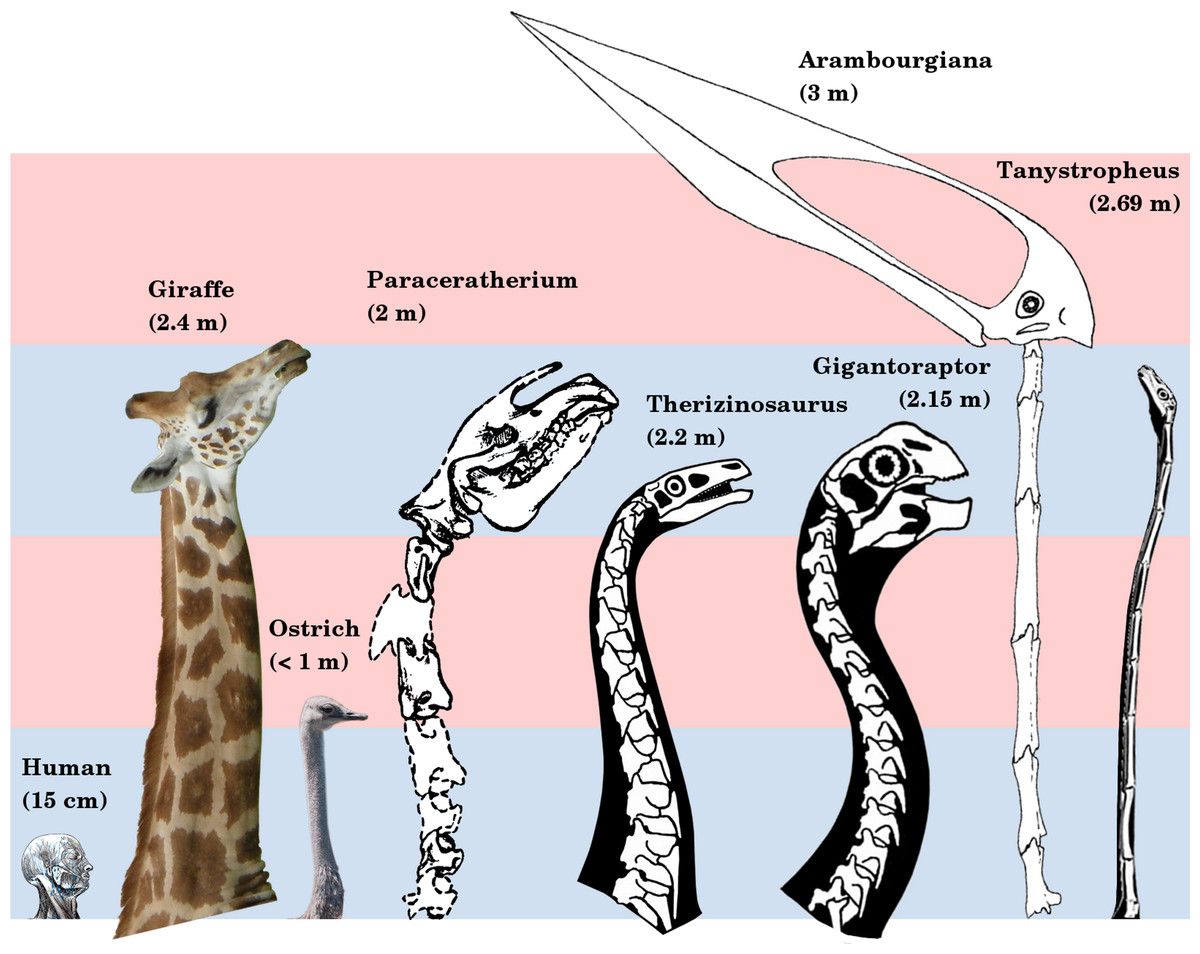
Mike Taylor and Matt Wedel's (2013) take on the non-sauropod contest for longest tetrapod neck. It's a close call in my mind as to who wins out of Arambourgiania and a large Tanystropheus, but the important point is that Arambourgiania has an extremely long neck.
So how did the neck of Arambourgiania work? How did a series of bony tubes support a 2-3 m long head? Where did the muscles attach to on the simple structure of cervical V? Full answers to these questions remain part of a broader mystery about the functionality of azhdarchid necks, and this is something that researchers are only just starting to address. But what we know of Arambourgiania is sufficient to give some provisional, partial insight here. The basic construction of the Arambourgiania cervical is basically similar to what we see in smaller azhdarchids, where large, stiffened joints between the neck bones helped support and reinforce the neck (artists: please stop drawing azhdarchids with S-shaped necks in flight!). But subtle modifications to its vertebrae likely enabled each element to grow to much greater lengths without failing. Most azhdarchid cervicals are dorsoventrally flattened, which makes them weakest against vertical loads. Most of the time, vertical loading is created by the weight of the neck and head, but it will also include any food being picked up. The Arambourgiania cervicals are expanded dorsoventrally to the extent that they are slightly taller than wide (Frey and Martill 1996), reinforcing them against vertical bending, and thus potentially able to support greater weights than their smaller cousins. Furthermore, in expanding the bone dimensions to a near circular cross section, and all the while retaining a characteristically thin pterosaurian bone wall, Arambourgiania likely had vertebrae more resistant to torsion and bending than those of the smaller forms.

So counter-intuitive as it seems, making a neck out of tubes is a good way to produce a strong, long, lightweight skeleton, especially if it has to support heavy loads like a huge head. Pterosaurs used the same tactic to enhance their wings, and it seems azhdarchids - especially Arambourgiania - transferred some of these mechanical properties to their vertebral column. While assessments like this are very basic and clearly only the tip of the iceberg as goes azhdarchid neck mechanics, they demonstrate that Arambourgiania is, and will continue to be, a critical species for understanding the neck proportions, mechanics and scaling of giant azhdarchids.

So, what I'm saying is...

These are just three reasons why we shouldn't be overlooking Arambourgiania when considering the largest pterosaurs. It might not have the sexiest name, and it might not be known from as many elements as the other named giants, but it has historic and anatomical significance that cannot, or should not, be eclipsed by other species. It's clearly an animal that needs to be brought back into the fold of popular science so, the next time giant azhdarchid pterosaurs come up in conversation, remember that there are three named giant species, not just those other two, and that forgotten, old-timer Arambourgiania still has plenty of things to tell us about giant azhdarchid palaeobiology.

Coming really, really soon: you guys like pterosaurs, right?


This bout of championing an old, somewhat forgotten dead reptile was sponsored by Patreon

The paintings and words featured here are sponsored by the best people on the planet, my Patreon backers. Supporting my blog from $1 a month helps me produce researched and detailed articles with paintings to accompany them, and in return you get access to bonus blog content: additional commentary, in-progress sneak-previews of paintings, high-resolution artwork, and even free prints. Accompanying this post is an animation and discussion of the production of my Arambourgiania painting at the top of the post. Sign up today to access it and other exclusive content!

References

  • Arambourg, C. (1954). Sur la presence dun pterosaurien gigantesque dans les phosphates de Joradanie. Comptes Rendus Hebdomadaires des Seances de l'Academie des Sciences, 238(1), 133-134.
  • Arambourg, C. (1959). Titanopteryx philadelphiae nov. gen., nov. sp., ptérosaurien géant. Notes et Mémoires sur le Moyen-Orient, 7, 229-234.
  • Bramwell, C. D., & Whitfield, G. R. (1974). Biomechanics of Pteranodon. Philosophical Transactions of the Royal Society B: Biological Sciences, 267(890), 503-581.
  • Buffetaut, E., Grigorescu, D., & Csiki, Z. (2002). A new giant pterosaur with a robust skull from the latest Cretaceous of Romania. Naturwissenschaften, 89(4), 180-184.
  • Buffetaut, E., Grigorescu, D., & Csiki, Z. (2003). Giant azhdarchid pterosaurs from the terminal Cretaceous of Transylvania (western Romania). Geological Society, London, Special Publications, 217(1), 91-104.
  • Frey, E., & Martill, D. M. (1996). A reappraisal of Arambourgiania (Pterosauria, Pterodactyloidea): One of the world's largest flying animals. Neues Jahrbuch fur Geologie und Palaontologie-Abhandlungen, 199(2), 221-248.
  • Langston, W. (1981). Pterosaurs. Scientific American, 244, 122-136.
  • Lawson, D. A. (1975). Pterosaur from the Latest Cretaceous of West Texas. Discovery of the Largest Flying Creature. Science, 187: 947-948.
  • Martill, D. M., Frey, E., Sadaqah, R. M., & Khoury, H. N. (1998). Discovery of the holotype of the giant pterosaur Titanopteryx philadelphiae ARAUBOURG 1959, and the status of Arambourgiania and Quetzalcoatlus. Neues Jahrbuch fur Geologie und Palaontologie-Abhandlungen, 207(1), 57-76.
  • Steel, L., Martill, D.M., Kirk, J., Anders, A., Loveridge, R.F., Frey, E. J.G. Martin (1997). Arambourgiania philadelphiae: giant wings in small halls. The Geological Curator, 6(8): 305-313
  • Stein, R. S. (1975). Dynamic analysis of Pteranodon ingens: a reptilian adaptation to flight. Journal of Paleontology, 534-548.
  • Taylor, M. P., & Wedel, M. J. (2013). Why sauropods had long necks; and why giraffes have short necks. PeerJ, 1, e36.
  • Wellnhofer, P. 1978. Handbuch der Paläoherpetologie. Teil 19: Pterosauria. Gustav Fischer Verlag, Stuttgart. 82 pp.
  • Witton, M. P. (2010). Pteranodon and beyond: the history of giant pterosaurs from 1870 onwards. Geological Society, London, Special Publications, 343(1), 313-323.