Showing posts with label Crystal Palace. Show all posts

Saturday, 30 April 2022

Introducing The Art and Science of the Crystal Palace Dinosaurs: out next month!

Behold, the cover of The Art and Science of the Crystal Palace Dinosaurs, available for preorder now, and on general sale next month!

Next month sees the publication of what might be one of the more important projects I’ve ever been involved with: a new book, The Art and Science of the Crystal Palace Dinosaurs, co-authored with Ellinor Michel and published by Crowood Press. This is a large, richly illustrated hardback that, as the title suggests, discusses the creation, scientific content, artistry and historic legacy of the world-famous Crystal Palace Dinosaurs, a story we tell in lots of detail and with hundreds of photos, illustrations and diagrams, both vintage and modern.

The good news is that, as of a few days ago, the book became officially available for preorders so palaeoart and history of science aficionados can start bagging copies for delivery next month. The exact publication date has been hard to pin down because of the many global incidents disrupting shipping and transportation, but mid-May is looking like the point when it will be available. You’ll be able to pick it up from just about wherever books are sold, but, with apologies to North American readers, you’re going to have to wait a bit longer for your release as you’re on a different distribution network to us here in the UK (that’s not to say you can’t order it from Europe and have it shipped over to you, of course). The cover price is £30 and, as we’ll detail more below, every sale directly contributes towards the care and maintenance of the Dinosaurs themselves.

With preorders now being taken, we can finally start to talk about our book more openly. The Crystal Palace Dinosaurs can be described, without exaggeration, as some of the most famous pieces of palaeoart in the world and they are true mainstays of dinosaur books and documentaries. They encompass a series of Victorian prehistoric animal sculptures and recreated geological features based in Penge, in the southeastern suburbs of London. The most famous components of the site are the prehistoric animal models, which were built between 1852 and 1855 by their chief architect and artist, Benjamin Waterhouse Hawkins, ostensibly under the watchful eye of Victorian palaeontological mastermind Richard Owen. Much of the original site is still with us today and can be visited freely if you want a glimpse of what cutting-edge palaeontology looked like in the early 1850s. Of the 30 sculptures still standing, the four dinosaurs, representing Iguanodon, Megalosaurus and Hylaeosaurus, are genuine icons of 19th century palaeoart, and a large amount of effort has been exerted over the years to keep the site in fair condition (though read on).

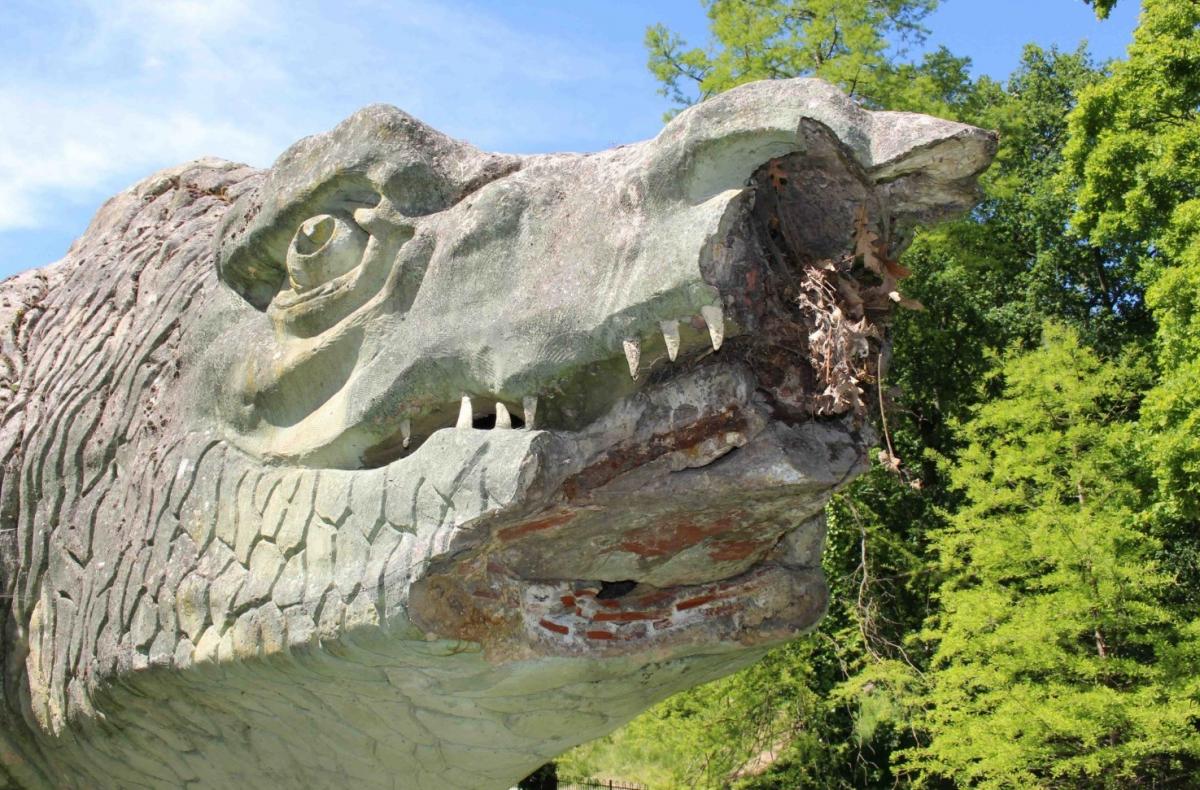
The face that launched this particular ship: the broken Crystal Palace Megalosaurus, as photographed by the Friends of Crystal Palace Dinosaurs in May 2020. As this image shows, the conservation risk to the site is very real and a sense of wanting to do something to help is what got this book rolling.

The origins of our book give a pretty good idea of our aims and hopes for this project. In May 2020 the jaws of the Crystal Palace Megalosaurus were severely damaged in a mysterious incident: the cause is assumed to be final succumbence to weathering or simply vandalism, or a combination thereof. Both, sadly, are common agents of deterioration at the site. The photos of the damaged sculpture shared online were pretty disheartening and, having been working with the Friends of Crystal Palace Dinosaurs to augment their website (you may remember a series of blogposts I wrote related to this project from 2019: part 1, 2, 3 and 4), I wondered if turning my notes and illustrations into a book that we could sell to benefit the sculptures was a good idea. I floated this to Ellinor, who's chair of the Friends of Crystal Palace Dinosaurs, and we then approached Crowood, who you may know from my Palaeoartist’s Handbook and Emily Willoughby’s Drawing and Painting Dinosaurs, to make the project a reality. The pitch was to analyse the Crystal Palace Dinosaurs as an enormous palaeoart project where we looked at their conceptualisation, construction and legacy in context with 19th century palaeontology and palaeoartistry while also, in addition, creating a book that would directly benefit the Dinosaurs themselves. To that end, neither Ellinor nor I have received a penny for producing it: all the usual advances and royalties that go to book authors are instead being donated to the Friends of Crystal Palace Dinosaurs to further their efforts in understanding and maintaining the Dinosaurs and their home.

We finished writing the book in August 2021 and, I must admit, it was a lot more work than I initially anticipated. This not only reflected the complications of writing a book during Covid-induced national lockdowns but also the volume of material to discuss. Ellinor and I are far from the first scholars to write about the Crystal Palace Dinosaurs, with notable contributions to the literature having been made by Martin Rudwick (1992), Peter Doyle (Doyle and Robinson 1993, 1995; Doyle 2008), Jim Secord (2004), Gowan Dawson (2016), Valerie Bramell and Bob Peck (2008), and Steve McCarthy and Mick Gilbert (1994). Our palaeoart-focus, aided by the modern searchability of digital archives, meant we were able to unearth a lot of obscure details about the Dinosaurs not mentioned elsewhere. My initial thoughts that this would be a quick and straightforward project — perhaps not much more than expanding and stapling my blog series together and writing a few discussion chapters — quickly evaporated when the amount of information to sift through and analyse became apparent. The book ballooned by 20,000 words from my initial projection and it was still a squeeze to get everything in. My somewhat immodest view is that we’ve compiled a new, richer synthesis about the Crystal Palace Dinosaurs through both our own findings as well as coalescing important points raised by other recent authors into our text; in doing so, we’re helping to establish a deeper narrative about this familiar, but still only partially understood site.

A sneak peek at one of the early chapters of the book, focusing on the 1853 New Year's Eve banquet held inside the clay mould of the standing Iguanodon.

Wrangling the story of the Crystal Palace into some sort of order created a book of three parts and 13 chapters:

Part 1. Islands covered by strange figures

1. Historic prehistory in South London

2. Ancient worlds through a Victorian lens: planning the Geological Court

3. Bricks, iron and tiles: rebuilding the past

Part 2. Animals long since extinct

4. The sculptures: Mammals

5. The sculptures: Mosasaurus hoffmanni

6. The sculptures: Flying reptiles

7. The sculptures: Dinosaurs

8. The sculptures: “Teleosaurus chapmani”

9. The sculptures: Enaliosaurs

10. The sculptures: “Labyrinthodon”

11. The sculptures: Dicynodon

Part 3. A difficult and, perhaps, too bold, attempt

12. The reception and legacy of the Geological Court

13. Past becomes future: the conservation of the Geological Court

You can gauge a lot about the book from that chapter list but, to get a superior sense of what we cover, let’s go into a little more detail.

Part 1. Islands covered by strange figures

The first section serves as an introduction to the world of the Crystal Palace Dinosaurs by discussing the principles and individuals behind their construction as well as the building of the site itself. Very quickly within the narrative, we establish that the label “Crystal Palace Dinosaurs” is not always useful or apt because it omits the major structures that accompanied Hawkins’ palaeontological sculptures: the Geological Illustrations. These are a series of reconstructed geological outcrops that extend around the Dinosaurs' landscape, being created either by importing tonnes of rocks chosen for their age and fossil content from sites around the UK or, alternatively, by recreating complex sedimentary strata using building materials. These rocks were not distributed haphazardly around the park, either, but in realistic stratigraphic congruence: in other words, they are in proper geochronological order, such that Triassic rocks are next to Jurassic rocks, which are then next to Cretaceous rocks, which are then next to "Tertiary" rocks and so on, and the palaeontological sculptures were placed around these in an appropriate geological context. The almost uninterrupted sequence (there are deliberately no Permian rocks) allows visitors to walk continuously from the Devonian to the Quaternary, seeing signature rock types and fossil species along the way.

Our map summarising the full extent, both planned and actual, of the Geological Court. Note the complexity of the geology as well as large numbers of missing models, denoted by red graphics and text, and the extent of never-realised models on the Tertiary Island.

Mapping the strata as real geological features reveals a very sophisticated and complex arrangement of manufactured geology, even incorporating simulated unconformities (missing rock layers, which account for the absence of Permian features) and faults to condense much of the geological column, as it was known in the 1850s, into a small area (Doyle and Robinson 1993). The economic importance of geology to Victorian culture was highlighted with not only a partly artificial coal seam (real coal, partially fake rocks) but a motherflippin’ artificial mine and cave, some 20 m long, within which manufactured stalactites and floatstones, along with mining tools, gave visitors the experience of traversing a real lead mine. The unsung heroes of this forgotten aspect of the park were geologists David Thomas Ansted and James Campell, and we suggest that they need as much recognition as Hawkins or Owen for their contributions to this project. Reflecting this, we mostly refer to the “Geological Court” instead of “Crystal Palace Dinosaurs” throughout the text. This was the name originally given to Crystal Palace’s combined geological and palaeontological display and better encapsulates the full extent of the project. The Geological Illustrations receive a lot of attention in our book, for which we need to tip our hat to Peter Doyle for laying critical interpretive groundwork that we could build on (Doyle and Robinson 1993, 1995; Doyle 2008).

Today located far away from public footpaths is the Carboniferous Mountain Limestone, which contains an artificial cave and lead mine. This is one of the most complex of all the Geological Illustrations and it's also huge: the original Mountain Limestone "outcrop" represented 90 tonnes of real Carboniferous limestone imported from Matlock, in the UK Midlands. This was removed in the mid-20th century so the Mountain Limestone you see now (including in this photo) is a reconstruction from the early 2000s. The cave is original, but is now half-filled with sediment and inaccessible to the public.

Our opening chapters also offer a deep dive into the construction of the models themselves, both in terms of the palaeoartistic principles employed by Hawkins as well as the physical building process. We speak a lot about the importance of 19th century “anatomical correlation” in predicting the life appearance of fossil animals from scrappy bones (Dawson 2016) and analysed photographs and illustrations of the models under construction — some familiar, others less so — to obtain new details of how these often gigantic creations* were assembled. It seems there was no one method behind their realisation, but a mix of techniques that probably depended on practical considerations as well as the availability and cost of materials. The Megatherium was unqiuely carved from blocks of limestone (Doyle 2008) while most of the models were composites of bricks, concrete and metal that could be moved about the site on carts and trollies. The dinosaurs were constructed more like houses, adding bricks, mortar and concrete around deep foundations and enormous iron frameworks (Hawkins 1854). The construction of the Court took place under the eager eyes of international media, and we also use these early chapters to review this interest in the Geological Court. Part of this discussion focuses on the famous 1853 New Year’s Eve banquet in one of the clay Iguanodon moulds. This event has been retold so often that a certain amount of truth has leaked from the original story but, using newspaper accounts and archive material, we think we’ve managed to tidy up what truly happened and answer obvious questions, such as how several dozen people squeezed into a very large, but not enormous dinosaur belly (spoilers: there was an adjoining table, so not everyone sat within the Iguanodon itself. See this Twitter thread if you’d like to know more).

*And I do mean “gigantic”: the Megalosaurus is 12 m long and the Iguanodon and Temnodontosaurus are not much smaller. Photos don’t convey how seriously big some of these sculptures are, and another novelty of our book is providing basic measurements of each one, an obvious aspect to report but, to our knowledge, unrecorded until now. My boots are still drying out from wading through the waters surrounding the marine reptiles.

Part 2. Animals long since extinct

The middle of the book is a sculpture-by-sculpture analysis of the palaeontological creations, comprising the mammals, the various marine reptiles, the pterosaurs, dinosaurs, amphibians and Dicynodon. This is the longest section of the book and perhaps the main draw for palaeoart fans. Alas, we still don’t have much insight into Hawkins’ original plans for his sculptures — no relevant notebooks, sketches or correspondence to this effect are known anywhere — but efforts were made to “reverse engineer” the palaeoartistry of each model by comparing what Hawkins produced against palaeontological science of the 1850s. This was similar to the approach I used in my Crystal Palace Dinosaurs blog posts but we go way beyond the details discussed in those articles. Each sculpture is given a photographic montage to show features of interest as well as a diagram showing what fossil specimens or modern animals likely referenced each body part.

An example of the breakdowns given to each restored species at Crystal Palace: what fossils were available to inform Hawkins' restorations? Here, we see how the Iguanodon is really a hodgepodge of different iguanodont material, and not a reconstruction of a single species.

Analysing the sculptures at this level allowed us to break down their “real” identities, and we can see today that many were chimeric mixes of different species. "Labyrinthodon pachygnathus", for instance, can be considered an early attempt at reconstructing the (possible) ctenosauriscid (those neat sail-backed croc-line archosaurs) Bromsgrovia rather than a prehistoric amphibian, and the known reference specimens for Iguanodon do not include any “true” Iguanodon material in the sense that we recognise it now. It’s actually difficult to know what to classify the Iguanodon as in a modern sense, as at least two, and maybe three iguanodont species were factored into its restored form. If we force the issue, Barilium dawsoni, a large iguanodont that was used to establish the size of the Iguanodon sculptures and other components of its anatomy, is perhaps the most dominant species used in the build, so maybe that’s the closest we have to the “true” identity of these sculptures.

Assessing the fossil composition of Hawkins' recreations allowed us to ally species to the Crystal Palace project that are not normally associated with it. They include the possible ctenosauriscid Bromsgrovia walkeri, which is too poorly known to restore itself, but might have resembled Arizonasaurus babbitti. This is a nice reminder that the British fossil record contains a lot of remarkable animals, even if some of their fossils are less than exemplary.

We also compare each species with modern interpretations of the same taxa, and I used these sections as an excuse to sneak in some of my own artwork to show 21st views of the Crystal Palace species. These are all-new restorations rather than recycled images from my 2019 blog posts, and some feature fun callbacks to classic Hawkins imagery. It’s easy to be a little blasé about some of the Crystal Palace taxa because many are well-trodden palaeoart subjects, like Megalosaurus, Megaloceros, Iguanodon etc., but the reality of some of the animals restored for the Geological Court is pretty wild. Leptonectes, for instance, with its grumpy face and massive pectoral fins, is definitely an unusual ichthyosaur, while Cimoliopterus — the animal behind the Chalk pterosaurs — belongs to the long-winged, giant-headed pterosaur group Ornithocheiromorpha. Among everything else, this book was a nice opportunity to draw attention to some lesser-known British fossils that, owing to being poorly preserved, are often overlooked.

I created something like 30 new paintings for The Art and Science of the Crystal Palace Dinosaurs, including this image of the uppermost Triassic ichthyosaur Leptonectes tenuirostris. This reality of this frowny-faced, giant-flippered ichthyosaur is quite different to what was restored at Crystal Palace, where it looks a lot more conventional.

Looking at the sculptures in such detail allowed us to write at length about how excellently executed they are, from their depicted musculature and fine anatomical detailing to their considered behavioural depictions. Hawkins was really ahead of his time by creating palaeoart that showed plausible, realistic-looking animals rather than, as was then common, either super-conservative reconstructions with minimal detailing or, more commonly, fantastic restorations that have more in common with mythology than zoology. Interestingly, we did find evidence that Hawkins considered more aggressive and dynamic posing for at least some of his models before settling on their more sedate poses.

We also compared Hawkins' work to Owen’s publications to gauge how closely Hawkins was working with his consultant. The large number of deviations we found is, we argue, further evidence of Owen being a pretty useless consultant. Owen's contributions to the project have been enormously overstated, with records showing that he neglected to visit the construction site or Hawkins' workshed outside of a handful of instances, and that was also largely ignorant of the appearance of the sculptures until he saw them completed and installed in the park grounds (Secord 2004; Dawson 2016). That Hawkins made some errors Owen could have corrected is entirely consistent with this narrative. Owen also loses points in our dissection of his 1854 Geological Court guidebook, which is often inconsistent with the content of the site itself. Indeed, Owen’s slim overview of the site didn't mention major components of the display, including the bulk of the Geological Illustrations and mammal sculptures. Owen doesn’t quite warrant writing out of the history of the Geological Court, but he definitely needs recasting as a peripheral character who did little to help Hawkins and the Crystal Palace Company accomplish their goals.

The missing paleontological sculptures of Crystal Palace: two pterosaurs, three "Anoplotherium gracile", one Palaeotherium magnum and one female Megaloceros (red arrow). Note the different face on "Palaeotherium minus" and the real antlers on Megaloceros; both have since been replaced with substitutes that no longer resemble the originals. The photographs in this image were kindly provided by the Crystal Palace Foundation.

The final, and perhaps most significant, component of these chapters I want to mention is their discussions of missing models. Exactly how many models and the number of different species they represent has been variably interpreted (e.g. Doyle and Robinson 1993; McCarthy and Gilbert 1994) because of the complex and tumultuous history of certain sculptures. Some have been moved about, mislabelled or even been removed from the site over the last 170 years, leaving researchers to draw different conclusions about what’s left in the park today, and what was there originally. We attempted to get definitive numbers on both counts and concluded that our modern Geological Court holds 30 sculptures of 21 species. In 1855 however, when the Court was at its most complete, it had 37 sculptures and 24 species. That’s a higher count than any previous calculation, but one we’re confident about thanks to data from historic guidebooks, illustrations and photographs. The seven lost models include a fourth Megaloceros (specifically, another model of a reclined doe), the two Jurassic pterosaurs, the large Palaeotherium species P. magnum and, finally, three models of “Anoplotherium gracile”.

The "Megaloceros fawn", which we reidentify as a different animal entirely: "Anoplotherium gracile" or, in modern terminology, Xiphodon gracilis. As explored more below, there is no evidence that this animal represents a juvenile Megaloceros but plenty of evidence to tie it to Xiphodon. How and why this sculpture became associated with the Giant Deer display is not currently understood.

The existence of the latter three sculptures is worth going into a little more because it’s one of our biggest discoveries and ties into another important conclusion. If you’ve visited the Crystal Palace Dinosaurs you’ll know that a small Megaloceros fawn sits close to the three surviving Giant Deer adults in the Quaternary end of the Court. We present evidence that this, in fact, is not a juvenile deer at all, but the sole survivor of a group of four “Anoplotherium gracile”. Known as Xiphodon gracilis today, the presence of this guanaco-like Eocene species among the Crystal Palace fauna has long confused researchers because, despite being mentioned in several guidebooks, it was thought that no obviously Xiphodon-like animals were known at the site, nor were any witnessed in familiar vintage photos or illustrations. Some authors have attempted to reconcile these facts with a more gracile Anoplotherium commune sculpture, assuming that this represented Xiphodon (Doyle and Robinson 1993; McCarthy and Gilbert 1994), but I’ve never found this interpretation convincing. Even in the 1850s scholars knew that A. commune and Xiphodon contrasted in size, build and proportions. The “fawn”, however, is a dead-ringer for historic takes on Xiphodon anatomy, and an image of Hawkins’ workshed shows this same sculpture with three others of the same species (above). Conversely, we found no evidence whatsoever of a Megaloceros fawn existing at the site before modern times. Putting these pieces together, it looks like the blank spots in the history of the displays are large enough to both obscure the loss of three Xiphodon sculptures and also hide the relocation of the surviving Xiphodon alongside the Giant Deer, where it has masqueraded as a juvenile Megaloceros for the entirety of living memory. I admit to finding this as worrying as I do exciting. Discovering not just one Xiphodon but records of four is very cool, but it also shows how enormous the holes in our knowledge of the Geological Court are. If something as fundamental as the existence of a whole set of sculptures can go virtually unrecorded, what else are we missing?

Part 3. A difficult and, perhaps, too bold, attempt

The last section contains two chapters, one on the complex legacy of the Geological Court and another on its constant battles with degradation. The chapter on the post-development history of the Crystal Palace Dinosaurs is one of the largest in the book and attempts to make sense of a complicated story. It’s fair to say that they were neither the major successes nor major failures they have been portrayed as by different authors, and reactions to the Geological Court have fluctuated enormously in the last 170 years. Early scientific views, for example, were very hostile. Hawkins’ rapidly-dating sculptures vindicated palaeoart sceptics who saw full, elaborate restorations of extinct life as premature and, as has been noted by others (Secord 2004; Nieuwland 2019), the Geological Court seems to have lessened appetites for palaeoart among many, perhaps most, 19th century palaeontologists. It took decades for more sympathetic views to develop among academics (e.g. Hutchinson 1893; Becker 1911) and for palaeoart to regain its early 19th century mojo. Among the public, the Geological Court was a source of equal parts fascination and confusion, as the displays — which lacked any sort of signage or explanation, as per Crystal Palace Company policy — represented content too far from general knowledge for lay audiences to grasp their significance. Some gathered that they were looking at animals that existed before humans (Martineau 1854), but others thought they were grossly-distorted sculptures of living species, or even attempts to show the dangers of intoxication (Owen 1894). As well as cataloguing this diversity of opinion, we also cover the cancellation of the Geological Court’s development, the unrealised models and geological components (in addition to at least a dozen more mammals and birds, planned works included additional Cambrian, Silurian and “Tertiary” Geological Illustrations), vintage Crystal Palace Dinosaur merchandise, and the career impacts of the project for Hawkins and Owen.

A selection of dinosaur palaeoartworks produced after Crystal Palace. It took several decades for scientists to start regularly commissioning artwork of new fossil animals, allowing Hawkinsian dinosaurs to linger in paleoartworks until the late 19th century, as in the lower right images. Novel reconstructions of upright dinosaurs were produced as early as the 1860s (top images), but were rare until palaeoart got its mojo back in the 1890s. Was the scientific backlash against the Crystal Palace Dinosaurs responsible for this dearth of new artworks? There is certainly circumstantial evidence supporting this view.

All this leads to our final chapter, the inevitably stern-faced discussion of the site’s ongoing conservation and maintenance issues. It would have been nice to end the book on a more positive note but it would have been misleading to portray anything other than the truth: that our collective efforts to keep the Geological Court in good condition have not been exemplar and, unless this changes, the long-term outlook for the site isn’t great. We review the patchy conservation history of the site and highlight that no consistent approach to maintenance has ever been followed: repair work has really been a series of occasional interventions, not a routine, regular event. Even more amazingly, outright destruction of some components were justified in the mid-20th century to make way for other Park developments. We can’t be sure, but we think these events were likely responsible for the removal or destruction of the missing palaeontological sculptures. These issues have persisted to modern times and it's a sad fact that the current appearance of the site we're attempting to celebrate is rather sorry. We often had to source photos from the last decade to illustrate the displays in a more intact, less overgrown condition.

A shot from my last visit to the Geological Court in July 2021, showing the extent of overgrowth and degradation among some of the marine reptiles. To give a sense of the scale of the vegetation in this photo, that middle ichthyosaur is one of the largest models at the site: the c. 12 m long Temnodontosaurus. The broken jaw of Ichthyosaurus communis, which you can see in the background, was a recent incident which has now been fixed. Needless to say, allowing the displays to get to this state is pretty criminal, and without a significant, long-term change to maintenance and conservation approaches, we risk losing the site forever.

Thankfully, the Crystal Palace Dinosaurs are now protected against further wanton development by having attained Grade 1 listed status. This recognises the Geological Court as having exceptional historic interest and brings a level of care and protection from Historic England, the public body that manages places of national importance to English heritage. Much is hoped from this relatively recent development and projects to save the site are underway, but we shouldn’t pretend there isn’t a lot of work to do. Behind the visibly crumbling displays are problems as fundamental as subsidence and complex internal damage caused by degradation of their metal frameworks. In addition to dramatic interventions to solve these problems, a regular management strategy to keep on top of perpetual conservation risks is also critical. Without interventions to halt plant growth on the displays and deter human trespassers, the Dinosaurs and Geological Illustrations will quickly fall back into disrepair. Ensuring that the Geological Court endures for another 170 years will not be easy or cheap, and requires a broad shift in how we value the site as a nation. Today, we’re perhaps at a critical point for deciding its future. If we don’t invest our energy and money now, we may be among the last generations to witness something approximating its original grandeur.

TL,DR: buy our book; learn cool things; save some dinosaurs.

And that, in a several thousand-word nutshell, is our book. But this post is really just a teaser of what we have to say: there is so much more to discuss around the Crystal Palace Dinosaurs that we struggled to get everything into this one tome. But for all this, there’s still plenty that we couldn’t write about, because there are enduring mysteries that we were unable to crack. What, for example, are the mysterious Wisbech Museum models of the Crystal Palace species? Do we really not have a single record for what happened to all those palaeontological sculptures, not even in some council development office somewhere? Why were so many models repaired with unsuitable replacement parts at some point in the 20th century? Will anyone, ever, find some of the original designs for the Geological Illustrations or extinct animal restorations? These, and other questions, are for future researchers to look into. For now, we’re happy to have moved the conversation along as far as we have, and to once again be shining the light on the conservation plight of a site unique in its significance to the history of science. We’re especially happy because all this will simultaneously help fund the Friends of Crystal Palace Dinosaurs and their work monitoring and maintaining the Geological Court. Check out The Art and Science of the Crystal Palace Dinosaurs if you want to appreciate the full awesomeness of this very special place.

And finally…

As a quick closing comment, I want to extend a quick personal thanks to a group of people who made this book possible: the folks who support my work at Patreon. Researching, writing and illustrating a book is a huge amount of work and the only way I could commit so much time to a charity project like this was through their monthly donations. So sincere thanks to everyone who supports me there: any positive impact this book has is, in part, related to your continued donations.

References

  • Becker, H. (1911). Alte und neue Rekonstruktionen ausgestorbener Tiere. Die Umschau.
  • Bramwell, V., & Peck, R. M. (2008). All in the bones: a biography of Benjamin Waterhouse Hawkins. Academy of Natural Sciences.
  • Dawson, G. (2016). Show me the bone: reconstructing prehistoric monsters in nineteenth-century Britain and America. University of Chicago Press.
  • Doyle, P. (2008). A vision of ‘deep time’: the ‘Geological Illustrations’ of Crystal Palace Park, London. In: Burek, C. V. & Prosser, C. D. (eds). The History of Geoconservation. Geological Society Special Publications, 300(1), 197-205.
  • Doyle, P., & Robinson, E. (1993). The Victorian ‘Geological Illustrations’ of Crystal Palace Park. Proceedings of the Geologists' Association, 104(3), 181-194.
  • Doyle, P., & Robinson, E. (1995). Report of a field meeting to Crystal Palace Park and West Norwood Cemetery, 11 December, 1993. Proceedings of the Geologists' Association, 106(1), 71-78.
  • Hawkins, B. W. (1854). On visual education as applied to geology, illustrated by diagrams and models of the geological restorations at the Crystal Palace. Journal of the Society of Arts (78): 443-449.
  • Hutchinson, N. H. (1893). Creatures of other days. Chapman & Hall
  • [Martineau, H.]. (1854). The Crystal Palace. Westminster Review, 62, 534-50.
  • McCarthy, S., & Gilbert, M. (1994). The Crystal Palace Dinosaurs: The story of the world's first prehistoric sculptures. Crystal Palace Foundation.
  • Nieuwland, I. (2019). American Dinosaur Abroad: A Cultural History of Carnegie's Plaster Diplodocus. University of Pittsburgh Press.
  • Owen, R. (1894). The Life of Richard Owen. J. Murray.
  • Rudwick, M. J. (1992). Scenes from deep time: early pictorial representations of the prehistoric world. University of Chicago Press.
  • Secord, J. A. (2004). Monsters at the crystal palace. In: de Chadarevian, S, & Hopwood, N. (eds). Models: the third dimension of science. Stanford University Press. 138-69 pp.

Friday, 31 July 2020

Benjamin Waterhouse Hawkins: the first grand master of palaeoart

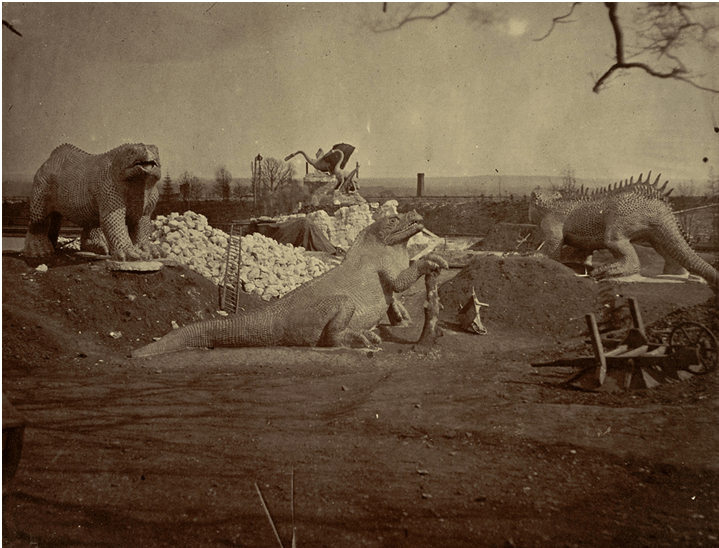
Few of us need an introduction to the Crystal Palace dinosaur sculptures (here shown during construction in 1854), or their artist, Benjamin Waterhouse Hawkins, but not many of us know much about Hawkins or his work beyond this one installation, thus overlooking a major contributor and pioneer in the early history of palaeoart. Image from the Friends of Crystal Palace Dinosaurs blog.

Most of us would agree that palaeoart history is marked by a few key figures that, for one reason or another, define their generation. Knight, Burian, and Paul are perhaps the most considered of these, each producing an iconic portfolio of work that set the bar for other artists and recast how we might view and consume palaeoartworks. But the professional grandfather to all these famous figures is Benjamin Waterhouse Hawkins, a familiar name to anyone interested in palaeoart or vertebrate palaeontology, and yet one that doesn't always receive the accolade and praise it perhaps deserves. Hawkins - whose life spanned 1807-1894 - became the first great palaeoartist at a time when both palaeoart and palaeontology was still finding their feet. We all know of Hawkins' work at Crystal Palace, where he built 33 life-sized restorations of prehistoric mammals, reptiles and amphibians as part of the grand educational and commercial extravaganza, but many of us do not know much about him, his other works, or even how groundbreaking and unique his Crystal Palace sculptures were, demonstrating the sort of good practise and insight that we regard as essential in modern palaeoart.

[page image]
[page image]
[page image]
Hawkins was a skilled anatomist who wrote several books on animal anatomy and form. These images, from his 1860 book A comparative view of the human and animal frame, show his mastery of osteology and anticipate the now-common convention of a dark soft-tissue silhouette behind our skeletal reconstructions.

An appreciation of Hawkins is helped by learning something of his life. Although featuring frequently in accounts of Victorian-age natural history, the details of Hawkins' life had not been pieced together in real detail until his great great, great-granddaughter Valerie Bramwell and historian Robert M. Peck synthesised his personal and professional records into a concise biography (Bramwell and Peck 2008). Hawkins' existence was an eventful one, including both great professional success and tragedy, as well as a complex and somewhat mysterious personal life. The latter is perhaps the most cryptic and unexpected part of the Hawkins story, as he somehow sustained nearly four decades of bigamy (juggling two wives and 10 children, seven of whom survived infancy) without his families discovering the deception. His strange domestic life was found out in the mid-1870s, not long before a string of personal tragedies and a stroke brought Hawkins' life to a sad, inauspicious end. But despite his bizarre private dealings, Hawkins seems to have been a well-liked, generous man known as hardworking, personable and charming, equally confident of his abilities as an artist and anatomist but also reverential and respectful to his peers, especially the academics and intellectuals he frequently worked with.

Hawkins never secured permanent or long-lasting employment but instead moved from commission to commission and project to project. Though he dabbled in a few other careers, his chief profession was creating art of animals - initially living, and eventually extinct. Known best today for his sculpture, Hawkins only began working in 3D during the 1840s, well after he had established himself as an expert painter and illustrator. He was regarded as a high-quality, experienced natural history artist early in his career such that, even before he reached his career peak - the Crystal Palace geological restorations - he was sought-after as an illustrator of zoological specimens. He produced art for many of the biggest names in contemporary palaeontology and biology, including William Buckland, Gideon Mantell, Richard Owen, Thomas Henry Huxley, Charles Darwin and Joseph Leidy (interestingly, Hawkins could have worked with another big name, Edward Cope, but he disliked and refused to work with him - see Desmond 1976). Hawkins' association with Darwin and Huxley is of interest because he became an outspoken anti-evolutionist in later life, a position he expressed directly and clearly in many of the popular public lectures he delivered in his post-Crystal Palace career.

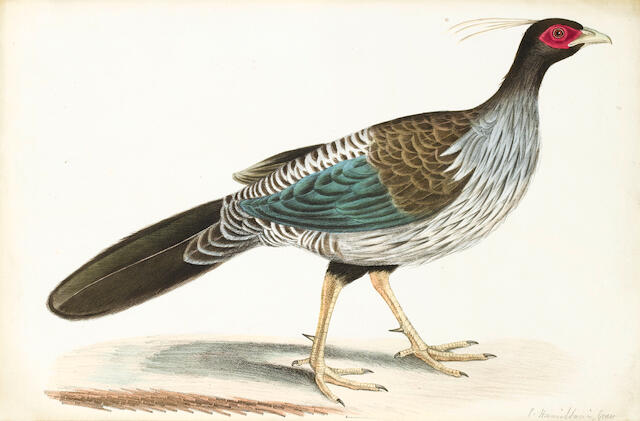
Before Hawkins recreated extinct dinosaurs, he was a prolific and sought-after illustrator of the modern kind, along with many other types of animals. This illustration of a White-crested Kalij was produced for John Edward Gray's Illustrations of Indian Zoology (1830-1835). (From Bonhams; incidentally, original Hawkins' lithographs like this sell for hundreds or even thousands of pounds to private collectors, a sad contrast with the under-financed conservation of his Crystal Palace works.)

Hawkins was well-known for his expertise in animal anatomy and form, which he learned primarily from zoological museum specimens as well as drawing captive animals (Bramwell and Peck (2008) recount an urgent trip to Paris in 1849 to sketch a newly born giraffe calf). As would happen later with Charles Knight, this expertise with living animals was instrumental in his later work at reconstructing extinct ones. Hawkins authored several books on animal anatomy and from the 1850s onward spent a large amount of time - and commanded a high fee - for grand public lectures. At his lecturing acme, Hawkins produced large drawings of prehistoric animals on stage (of such size that a ladder was required to reach the top of the board canvas) to bring his restorations direct to his audience. A gleaming reputation among British academics meant he enjoyed a warm reception in the US where he was offered many auspicious platforms and opportunities by well-regarded officials and academic institutions. These included the production of (sadly never realised) Crystal Palace-like prehistoric animals installations in Central Park and the Smithsonian, and production of the first-ever mounted dinosaur skeleton (Hadrosaurus), of which several casts were made (of which only one skull survives).

Hawkins' Central Park Workshop, c. 1869, with an assembled Hadrosaurus mount and the beginnings of a Laelaps skeletal reconstruction alongside - note the mount outline to the right of the Hadrosaurus ;skeleton. This terrific image (reproduced from Bramwell and Peck 2008) is a treasure trove of detail: look out for various mouldings of reptile skin, including a carnivorous species on the left, real animal skeletons in the background and unmounted bone replicas on the floor (are these bits of Laelaps?). There's also a lack of vermin - Hawkins' Crystal Palace workshop was shown with rats and birds scampering over the floor, and described as lying among a muddy swamp. The content of this workshop was destroyed by order of corrupt New York politicians, which devasted Hawkins.

There's a lot more we could say about Hawkins career, but you get the point: Hawkins wasn't a flash-in-the-pan artist who happened to land the Crystal Palace gig, nor was he someone who just knew how to throw clay and concrete around to someone else's design. He was a distinguished and respected intellect with expertise in natural history and anatomy, and brought considerable experience to his palaeoart commissions. Indeed, historians are uncovering increasing evidence that Hawkins was the principle intellect behind many of the Crystal Palace sculptures. We touched on this in my previous discussions of the Crystal Palace palaeoartworks but it's worth repeating: Richard Owen, lauded by many (e.g. Phillips 1854; Owen 1894; Desmond 1979; Beaver 1986; McCarthy and Gilbert 1994) as the brains and overseer of the Crystal Palace models, was actually barely involved and may have even held disdain for this grand project (Secord 2004; Dawson 2016). Numerous pieces of evidence, the best of which are the private correspondence from Hawkins, Crystal Palace officials and others, show that Owen only visited the models once during their construction for the famous 1853 New Years's Eve banquet held in the clay Iguanodon. Most tellingly, Hawkins is on record as stating that Owen "afforded no assistance" while the models were being built (Dawson 2016). Owen later attempted - as was his custom - to take greater credit for his role in the project, but his actual contributions seem restricted to input on some early clay maquettes constructed by Hawkins; a short, incomplete guide book about the sculptures (Owen 1854); some promotional duties; and allowing his name to be used to give the restorations scientific authenticity. We can thus draw two conclusions: 1) having been largely abandoned by his consultant, Hawkins' expertise and anatomical confidence were probably instrumental in seeing the models realised and completed on time; and 2) the sculptures are not - as so often stated - Owenian theory brought to life, but Hawkins' personal take on the works of Owen, Mantell and Cuvier. This probably explains why, as we discussed previously, many details of the models are at odds with Owen's ideas, as well as the nitpicking tone his 1854 sculpture guidebook.

File:Benjamin Waterhouse Hawkins Moas of Prehistoric New Zealand ...
Hawkins' 1870s take on the moa, produced for College of New Jersey (now Princeton University). The moa is not a creature we intimately associate with Hawkins, but its research history - where its form was predicted from a small amount of fossil material - underpinned Hawkins career as a palaeoartist. From Wikipedia.

It's in this largely unguided context that we have to view many of the details in Hawkins' Crystal Palace work as the product of a genuine palaeoart master, and especially so given their incorporation of an important but ultimately flawed 19th century way of interpreting extinct animals. Hawkins was a student of the then-in vogue Cuvierian philosophy of anatomical correlation: that is, the idea that whole animals could be reconstructed with some degree of precision from very few anatomical remains. This concept, explored in depth by Gowan Dawson in his 2016 book Show Me the Bone, gained traction after successful demonstrations in the early 1800s by Cuvier and then, most famously, by Owen's seemingly miraculous reconstruction of the moa from a femoral fragment. Anatomical correlation became the principle philosophy guiding the earliest visualisations of all poorly known extinct creatures and became celebrated as a scientific marvel in popular and academic spheres alike. Although some scholars - including Mantell - developed misgivings about anatomical correlation by the time the Crystal Palace project began in August 1852, Hawkins relied on this technique to restore his dinosaurs as well as Dicynodon, Mosasaurus and Labyrinthodon, none of which were known from more than scraps of bone at the time. In lieu of a reliable consultant, such predictive restorations might have been disastrous, had they ever been achieved at all, but Hawkins' anatomical expertise instead saw the creation of genuinely lifelike, plausible-looking restorations. Moreover, as discussed in my previous posts, his restorations of Crystal Palace are often more precedent than they first appear, anticipating not only many genuine aspects of prehistoric animal anatomy but also demonstrating sound, logical palaeoart approaches that we can approve of today.

The buffalo-like shoulder hump of Hawkins' Megalosaurus has a slightly complex backstory. Sometimes logically assumed to reference the tall-spined vertebrae of Altispinax dunkeri (a species once part of the Megalosaurus taxonomic complex), it was actually a Hawkinsian speculation that large-skulled dinosaurs needed vast neck and shoulders musculature to support their heads. Initial interpretations of Altispinax seemingly proved Hawkins right, but, of course, we've since realised that the Altispinax vertebrae belong much further down the body, possibly representing a Concavenator-like sail.

Using the dinosaur sculptures as an example of this, it's evident that Hawkins was anticipating the sort of anatomy that giant, somewhat mammal-like giant reptiles might have had to support their vast frames, and was moving well beyond the brief lifestyle and functional commentary provided by Owen and Mantell. He predicted, for instance, that the large heads of dinosaurs would need additional support from their shoulder regions, leading to the portrayal of both Megalosaurus and Iguanodon with shoulder humps of varying size (this is especially obvious in the Megalosaurus, but a shoulder prominence is also discernable in the reclined Iguanodon, while the shoulders of the standing animal bulge into a voluminous, rhino-like neck). This was an entirely sensible prediction that mirrors how we approach reconstructing fossil animals today: when we see robust and large osteological features, we assume they had correspondingly developed soft tissues for support and motion. In this respect Hawkins was ahead of some later artists who essentially ignored aspects of functional morphology and biomechanics in their work, leading to emaciated, peculiarly proportioned animals, such as the emaciated Stout and Kish dinosaur reconstructions from the 1970s and 1980s. Moreover, Hawkins was proved correct in assuming dinosaurs with large heads needed additional neck support, once (as it would turn out, erroneously) during his lifetime when Owen referred the tall-spined dorsal vertebrae of Altispinax dunkeri to the shoulder of Megalosaurus, specifically commenting on their use to support the head (Owen 1856) and, later, by the genuine shoulder and skull anatomy of ceratopsids and certain theropods, which bear augmented anatomy related to skull support.

Hawkins also predicted that dinosaur torsos may differ markedly depending on diet and habits, moreso than they do in conventional reptiles. The herbivorous Iguanodon has a vast belly that spreads in the reclined sculpture, simulating the weight of a large animal resting on a voluminous gut. In contrast, the Megalosaurus has a taut, narrow torso without a significant gut region, more in line with that of a carnivore. At this point in history virtually nothing concrete was known about dinosaur toro dimensions, so these reconstruction choices - also borne out by later discoveries - were sensible predictions of the functional properties of dinosaur guts. A third example concerns his dinosaur musculature, which was modelled after a mammalian, rather than lizard-like fashion. Though mammals are not the best reference for dinosaur myology, Hawkins was right in assuming that large, powerful animals needed large, powerful limbs, and realised that mammals were a more appropriate model than modern reptiles. In this regard, Hawkins was more insightful than some of his successors, who would restore dinosaurs with skinny, lizard-like limbs ill-suited to their (by then well-known and obvious) limb girdles (see artwork by Cope, Knight, Smit etc.). He also went so far as to add features in his art that we associate with especially thorough extinct animal reconstructions today, such as skin webs linking limbs and body, tissue deformation, pose-based muscle bulges and so on.

It's been said before, but it's worth saying again: the reclining Crystal Palace Iguanodon is an amazing work of animal reconstruction. This 30-tonne concrete and brick model captures minutiae of superficial musculature and other nuanced features of anatomy. The world had not seen anything like this in 1854, and even today it knocks the stuffing out of the detailing seen on many dinosaur sculptures.

These points demonstrate how excellent Hawkins was at solving anatomical 'problems' thrown up by fossil remains with an appropriate and sensible corresponding morphology. They belie an experience and instinct with anatomy and biological functionality that remains essential to high-quality palaeoart today, and this was undoubtedly a major factor in how these largely speculative creatures look so realistic. Hawkins' predictions were not always correct of course, but his decisions were logical given the material available to him - the best we can aim for in any palaeoartwork, regardless of its vintage. Needless to say, plenty of people were amazed by his work, and both its popularity and seeming scientific authenticity saw it referenced and replicated by artists for decades to come.

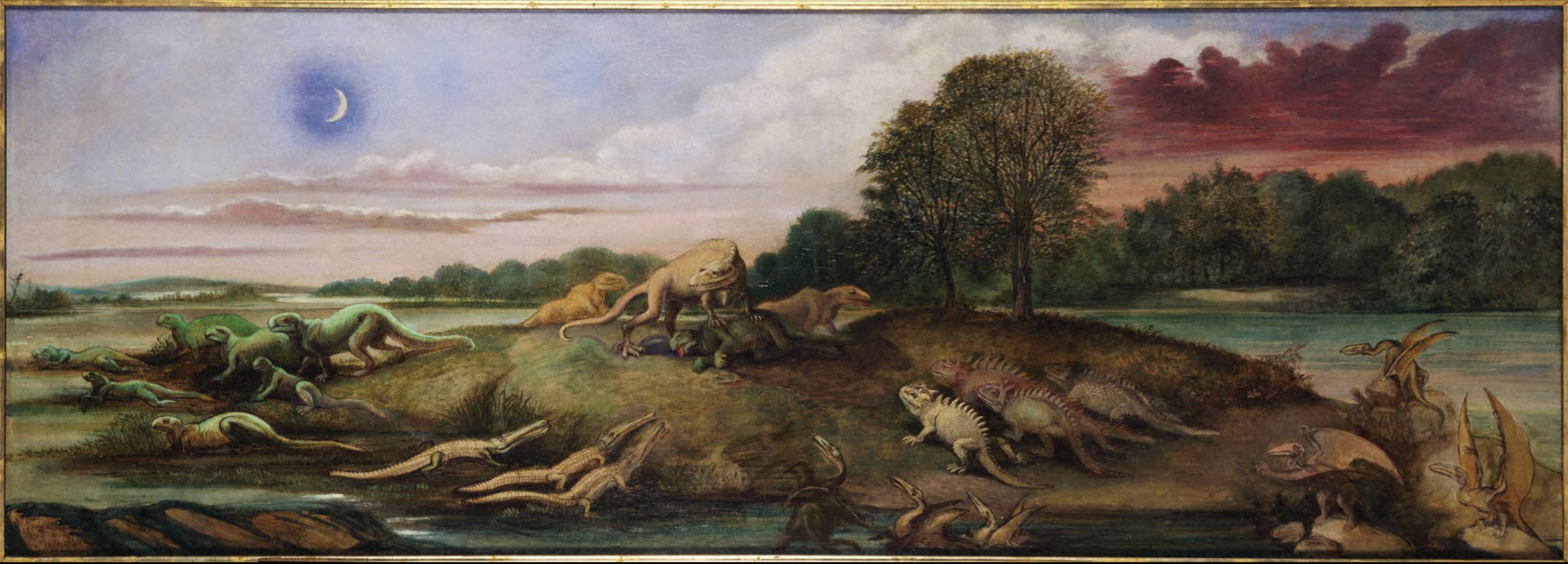
Because Hawkins is mainly known for the Crystal Palace models few people realise that he enjoyed a significant post-Crystal Palace career revolving around reconstructing extinct life. His skills were sought out by various bodies for use in museums, posters and other artworks. During lengthy visits to the United States, he almost re-realised the grandeur of the Crystal Palace models (first in Central Park, later the Smithsonian), but circumstances were never on his side and these projects never materialised or - in the case of the Central Park Paleozoic museum - were sabotaged. Hawkins continued to produce palaeoart until at least the 1870s where he completed what could be considered as his second most substantial set of palaeoartworks: 17 paintings of different geological periods for the College of New Jersey (now Princeton University). These artworks capture the evolution of Hawkins' personal ideas on prehistoric life and are also worth tracking down as exemplary takes on prehistory from the late 19th century. Among the most interesting is the 1877 painting Jurassic Life of Europe where Hawkins revisited his Crystal Palace subjects for (so far as I know) the final time. Hawkins got a lot of professional mileage from the Crystal Palace project and many of his subsequent artworks referenced his sculptures in detail, down to their posing, but by 1877 he must have realised that many of his reconstruction choices were no longer tenable. Both the now-hornless Iguanodon and Megalosaurus bear visibly short forelimbs, long, bird-like hindlimbs, and relatively slender necks with somewhat smaller, less bulky heads. Although still quadrupedal, these restorations indicate the influence of new dinosaur discoveries on Hawkins' classic dinosaur interpretations. This 1877 work might be criticised for his animals not having attained the status of true bipeds, as Hawkins realised was appropriate for both Hadrosaurus and "Laelaps", but consider that Megalosaurus was still considered to have powerful, bulky shoulders at this time (a holdover from Owen's interpretations) and that, while Iguanodon was considered by Mantell (1848) to have relatively gracile limbs capable of non-supportive functions (e.g. grasping vegetation), an explicit case for Iguanodon bipedality had not yet been made - the famous Bernissart Iguanodon skeletons would not be found until a year after Hawkins completed his painting, in 1878. Jurassic Life of Europe is surely among the last palaeoartworks where overtly Mantellian and Owenian interpretations of dinosaurs could be said to have some validity.

Image
Hawkins' 1877 painting Jurassic Life of Europe, produced for the College of New Jersey (from Princeton University Art Museum).

Jurassic Life of Europe and its sister paintings demonstrate Hawkins' adaptability and humility as a palaeoartist. Much of Hawkins fame came from the Crystal Palace Company promoting their dinosaurs as authentic, wholly accurate creations, so their adaption to fit more modern ideals was an admission that his most revered work was not without some significant errors, and that the predictive principle at the heart of the geological court was not infallible. Concerns that the Crystal Palace sculptures were flawed were not new at this point (Dawson 2016) but, by the late 19th century, they were subject to increasing vicious comments from detractors. Othniel Marsh, speaking in 1895, remarked
The dinosaurs seem... to have suffered much from both their enemies and their friends. Many of them were destroyed and dismembered long ago by their natural enemies, but, more recently, their friends have done them a further injustice by putting together their scattered remains, and restoring them to supposed lifelike forms... So far as I can judge, there is nothing like unto them in the heavens, or on the earth, or in the waters under the earth. We now know from good evidence that both Megalosaurus and Iguanodon were bipedal, and to represent them as creeping, expect in their extreme youth, would be almost as incongruous as to do this by the genus Homo.
Othniel C. Marsh, 1895 (quoted in Desmond 1976)

Marsh and other late 19th century critics were, of course, not being entirely fair to Hawkins by comparing his work to their contemporary knowledge of prehistory, and not judging it by the standards of decades prior. Perhaps, for those living through the rapid paleontological advancements of the late 19th century, Hawkins' attempts to reconstruct fossil animals from fragmentary remains, and the genuine belief that they were credible takes on their true form, seemed premature, arrogant and foolish. There may be some truth to this: the 19th century acceptance of anatomical correlation is surely a major case of Dunning-Kruger effect, where scholars had yet to be humbled by the bewildering anatomical diversity present in Deep Time and believed their mastery of modern natural history equipped them to make bold, confident predictions about the past. But it's surely also the case that, while the science of his time was flawed, Hawkins' work was as true to that science as could realistically be expected. Like the kids say, don't hate the player.

Mark Witton on Twitter: "Yes, they seem to linger on in mainland ...
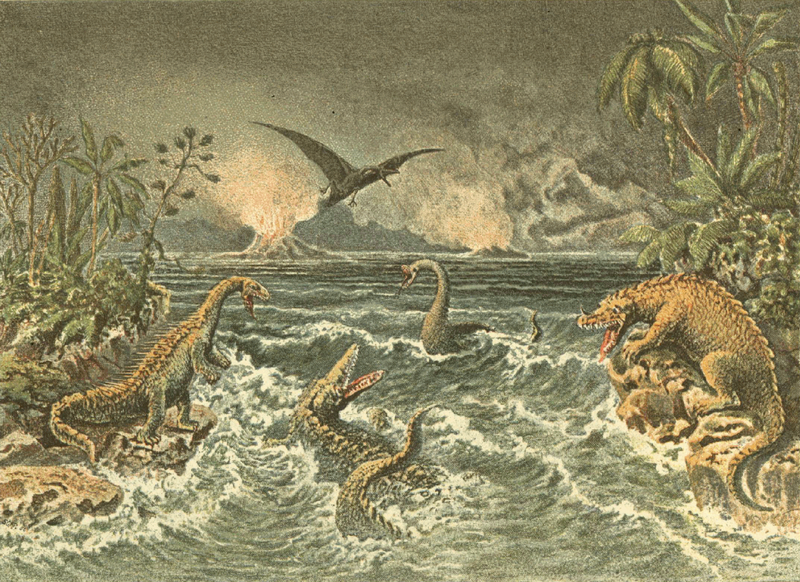
The final extinction of Hawkinsian dinosaurs: the frontispiece to Camille Flammarion's Le monde avant la création de l'homme& (1886). In this (possibly) last use of Hawkins' restorations in a non-historic, non-ironic context, a Crystal Palace Iguanodon (right) meets an early interpretation of Stegosaurus (left) - a representation of New World dinosaurs coming into focus. By this time, new European fossils had already made Hawkins' reconstructions long in the tooth, and American specimens were showing how wide of the mark his predictions were.

Hawkins' death in 1894 occurred without note, despite his significant contributions to science, public outreach, and education. Thankfully, his legacy has not gone neglected and increasing research into his life and work has seen his stock as an artist and intellect grow considerably, at least among academics. But it remains the case that showcasing Hawkins' work to even palaeoart fans sees it quickly dismissed, as by Marsh, as inaccurate and thus now worthless takes on prehistory. It's surely the case, however, that drawing attention to the inaccuracies of Hawkins' palaeoart is the most superficial and least interesting observation one can make of it, and defies the obvious fact that palaeoart of any kind must be evaluated in an appropriate historic context. Of course Hawkins' work is inaccurate, and pointing it out does not make one look smart or insightful. Rather, look closely and we see the work of someone who, with no prior experience in prehistoric animal restoration, took early palaeaort into a different league of quality and popularity; pioneered principles of soft-tissue restoration and attention to detail that we consider essential today; and demonstrated that even the most unusual extinct animals, with sufficient knowledge of living species, could be restored to plausible, life-like forms. The outdated science underlying Hawkins' work may make not it the most accessible of vintage palaeoart, but it's quality, the knowledge that informed it, and historic significance leaves little doubt that Hawkins was a true master of the genre, and worthy of deeper study and appreciation by palaeoart enthusiasts.

Postscript

In June 2020 the face of the Crystal Palace Megalosaurus, surely one of the most iconic works of Victorian palaeoart on the planet, was significantly damaged. The survival of these works, and Hawkins' legacy, is a continued fight against the elements and the thoughtless people who routinely clamber over them. Image from the Friends of Crystal Palace Dinosaurs website.

Having just written about Hawkins at length, it would be remiss not to mention the terrible damage that recently occurred to the iconic Crystal Palace Megalosaurus, where the front of the face was broken off through suspected vandalism. The Friends of Crystal Palace Dinosaurs charity is now working to repair the damage with Historic England, Bromley Council and specialist conservators, as well as to address issues with the security of the island that houses most of Hawkins' sculptures. Note that this incident has nothing to do with the new bridge to the island, which has not yet been installed and, in any case, will be a rotating structure inaccessible to the public most of the time. Instead, the chief security issue is the low water level around the island, making it easy to access. As you can imagine, fixing this damage and ensuring the security of the Crystal Palace models is an expensive undertaking, so please support the charity if you can. If you really think Hawkins' work is worth preserving long-term, you can set up a recurring monthly donation - a small amount each month can quickly build into a substantial contribution, and gives the FCPD more reliable income over time.

References

  • Beaver, P. (1986). The crystal palace: A portrait of Victorian enterprise. Phillimore & Company.
  • Bramwell, V., & Peck, R. M. (2008). All in the bones: a biography of Benjamin Waterhouse Hawkins. Academy of Natural Sciences.
  • Dawson, G. (2016). Show me the bone: Reconstructing prehistoric monsters in nineteenth-century britain and America. University of Chicago Press.
  • Desmond, A. J. (1976). The hot-blooded dinosaurs: a revolution in palaeontology. Dial Press.
  • Mantell, G. A. (1848). XIII. On the structure of the jaws and teeth of the Iguanodon. Philosophical Transactions of the Royal Society of London, (138), 183-202.
  • McCarthy, S., & Gilbert, M. (1994). The Crystal Palace dinosaurs: The story of the world's first prehistoric sculptures. Crystal Palace Foundation.
  • Owen, R. (1854). Geology and inhabitants of the ancient world (Vol. 8). Crystal palace library.
  • Owen, R. (1856). The fossil Reptilia of the Wealden Formations. Part III, Megalosaurus bucklandi. Palaeontographical Society. Monographs, 9, 1-26.
  • Owen, R. (1894). The Life of Richard Owen by His Grandson the Rev. Richard Owen,... with the Scientific Portions: An Essay on Owen's Position in Anatomical Science by the Right. John Murray.
  • Phillips, S. (1854). Guide to the Crystal Palace and park. Crystal Palace Library.
  • Secord, J. A. (2004). Monsters at the crystal palace. In: de Chadarevian, S, & Hopwood, N. (eds). Models: the third dimension of science, Stanford University Press. 138-69.

Thursday, 25 July 2019

The science of the Crystal Palace Dinosaurs, part 4: The mammals of the Tertiary Island

An 1853 illustration of one of the Crystal Palace mammals, Palaeotherium magnum, imagined next to the plesiosaurians it would eventually share the Geological Court with. The Palaeotherium sculpture that this image is based on is now lost, just one of many misfortunes to befall the Crystal Palace mammals. From Die Gartenlaube, archived at Wikipedia.
It's time for our final visit to the prehistoric animal sculptures of Crystal Palace Park. Having toured through the Palaeozoic and Mesozoic exhibits in the last three posts (part 1, part 2, part 3), today we turn our attention to the Cenozoic section of the Geological Court, one containing exclusively mammalian palaeoart subjects. As with previous entries in this series, these words stem from writing palaeoart notes for the Friends of Crystal Palace Dinosaurs charity - please check out part 1 for additional context about their work and the ongoing need for care and maintenance of the Crystal Palace sculptures. You can help conservation efforts by donating money or volunteering your time to keep the Geological Court maintained.

At risk of being melodramatic, I find it difficult to escape a sense of tragedy when concerning myself with the Crystal Palace mammals. They are the least documented, least discussed and most suffering of the sculptures, with several bearing obvious hallmarks of neglect and low-quality repair work. Even in the 1850s they were being sidelined to make way for the more spectacular fossil reptiles, a fact all the more tragic because extinct mammals were the inspiration for having prehistoric animals at Crystal Palace in the first place (McCarthy and Gilbert 1994). Initially, Hawkins planned to restore a woolly mammoth and other large mammals but, when developing his display, his attention was drawn to the dinosaurs and fossil reptiles which would ultimately consume most exhibition space and public interest. Once located on their own 'Tertiary Island' (Doyle and Robinson 1993), the mammals are today situated on the 'mainland' component of Crystal Palace and it's hard not to view them as being a little tucked away. Although close to the reptile displays (within sight of the Mosasaurus), most of the mammals are located on a separate path to the reptilian sculptures and they are often obscured by foliage. It's quite easy to miss them on a casual walk around the park.

A sense that the mammals were being overshadowed by reptiles may explain why Hawkins wanted to expand this component of the park. He wrote to Owen in 1855 with a plan to augment his Cenozoic fauna considerably, including models of a mammoth, a bathing Deinotherium, glyptodonts, Sivatherium and extinct bison, as well as moa, dodo, turtles and snakes (Doyle 2008; Dawson 2016). This letter was dated a full month after Hawkins was no longer working for the Crystal Palace company however, who thought he had constructed enough models and would not even let him finish a half-completed mammoth sculpture. The official reason for terminating Hawkins' work was allegedly an artistic one of “less being more” (McCarthy and Gilbert 1994), but the abrupt termination of Hawkins’ project surely reflected the financial struggles of the Crystal Palace Company shortly after the park opened (Dawson 2016). It’s certainly difficult to believe that the same company who filled their park with reconstructed ancient buildings, expanded the Crystal Palace to incredible dimensions and built fountains rivalling the biggest in Europe would suddenly be concerned about artistic excess. Some idea of what Hawkins’ mammoth, Sivatherium and turtles may have looked like may be taken from his later drawings and paintings, including his 1860s poster series that borrowed heavily from his Crystal Palace designs (Rudwick 1992).

Hawkins' grand plans for the Tertiary Island, drawn on the back of a letter to Owen in 1855. He wanted it packed with Cenozoic mammals, reptiles and birds, but the Crystal Palace Company thought this was excessive (or, more likely, couldn't afford to pay for the work). From Doyle (2008).
To my knowledge, very little information survives regarding Hawkins’ construction of the four Crystal Palace mammal species. They were built and installed at the same time as the other models but were not mentioned in Owen’s (1854) Geological Court guidebook despite his interest in fossil mammals (e.g. Owen 1846). Perhaps this is further evidence of Owen’s general disinterest in the Crystal Palace project? Victorian visitors had to make do with a very brief and incomplete overview of the mammal fauna provided in the general Crystal Palace Park guide (Phillips 1854). Later versions of this book would tweak their text on the mammals to provide short, but often historically important, insights into their composition and display. So lacking is the documentation of the mammals that we're sometimes reliant on the throwaway text in these guides to tell us how many sculptures were originally installed!

From a palaeoartistic perspective, a clear distinction between Hawkins’ task with the mammal reconstructions and his more famous reptilian efforts was the availability of anatomical information. Mammalian palaeontology was considerably more advanced than studies of fossil reptiles in the early 1800s. Complete skeletons had been known for several of the Crystal Palace species for several decades, allowing scholars to describe, illustrate and restore the osteology of these animals in detail. Hawkins surely benefitted from Owen being an authority on the anatomy of mammals (e.g. Owen 1846), including the Crystal Palace species, and probably also made use of several pioneering skeletal reconstructions, muscle studies and life restorations published by Georges Cuvier. Neglected and somewhat forgotten as they are, the Crystal Palace mammals are actually pretty good takes on the form of their subject species, and clearly demonstrate Hawkins as the equal of later palaeoart masters.

Palaeotherium

The surviving Palaeotherium sculptures in their original site at Crystal Palace, photographed in 2013. These models were temporarily moved for a period in the mid-20th century, which may explain the damage to the sitting model and loss of a third, larger sculpture.
The Eocene equoid Palaeotherium was one of the first discovered fossil mammals and was studied in detail by Georges Cuvier during the early 1800s. Its entire osteology was understood from more or less the moment it was found thanks to near-complete skeletons being recovered from French gypsum deposits at the turn of the 19th century. These brought several Palaeotherium species to the attention of early palaeontologists and led to it being the subject species for some of the oldest palaeoartworks. Both its skeleton and body outline were restored by Cuvier and artists in his employ in the early 1800s (Rudwick 1992, 1997) and these images - after some initial hesitation from Cuvier - were eventually widely published in European literature. With so much data available, Hawkins probably had little difficulty restoring Palaeotherium in three dimensions for the Geological Court.

The Crystal Palace Palaeotherium have an unfortunate history. Two models survive today but photographs from 1958 (see McCarthy and Gilbert 1994), 19th century illustrations, and later editions of Crystal Palace Park Guide (Anon. 1871) indicate that a third model once existed. It was clearly larger and anatomically distinct from the surviving models, but at present no-one seems to know what happened to it - a most regrettable circumstance. It may have been relocated or destroyed when the Tertiary Island site was taken over with a small zoo in the 1950s (we know that parts of the zoo directly encroached into the space for the models - the base of the Megatherium was part of a goat enclosure, for example (see McCarthy and Gilbert 1994)) or else when the smaller mammal models were temporarily moved in the post-war period (Doyle and Robinson 1993). I hope it hasn't been destroyed and may still turn up in some neglected part of the park or emerge from someone's garage.

Two of the three Palaeotherium models photographed in 1958, printed by McCarthy and Gilbert (1994). The standing model shown here is remarkably different in form and size from the surviving Palaeotherium sculptures and almost certainly represents a different species (P. magnum?). Its whereabouts is unknown today.
The surviving Palaeotherium have not escaped misfortune either. The sitting sculpture lost its head at some point in the late 20th century and has been fitted with a replacement, but photographs show that the original head was quite different to the one it has now (compare image above with that below). The replacement is probably a replica or cast from the other surviving Palaeotherium. Both heads are very similar in the snout, ear and eye region, and the differences - the abbreviated cheek and braincase in the sitting statue - are likely results of marrying the head of the standing animal to a sitting one. The neck has also evidently been lengthened since the 1950s and the head/neck join lacks the well-executed muscle contours characteristic of Hawkins' work. It is not the only example of strange, somewhat crude, restoration work on the Crystal Palace mammals (see below).

The sitting Palaeotherium as it appears today - note the different head to the photo from 1958 above, and the slightly awkward manner in which the head replicated from the standing animal has been grafted to the neck.
Questions about lost models and restoration work are not the only uncertainties about these models. I’m not aware of any literature that identifies the Palaeotherium sculptures beyond generic level, but my assumption is that at least one of the surviving models represents P. minus. This sheep-sized species was well described and illustrated by Cuvier and others in the early 1800s, providing Hawkins with ample reference material. I'm uncertain whether both existing sculptures represent P. minus given their historic differences in head shape and other anatomies, but each was clearly distinct from the missing third model, which was significantly larger and of contrasting form. From photographs and illustrations I estimate that the missing model was about the size of a small horse, and this almost certainly labels it as P. magnum, another species that was well illustrated in literature of the early 1800s.

I see you, cryptic P. magnum, hiding in plain sight within P. H. Delamotte's 1853 illustration of Hawkins' workshop. I've long wondered what this sculpture was given that it didn't quite fit anything on display at Crystal Palace, but it's a perfect match for the missing P. magnum model - note the concave back, upright head, straight forelimbs and Gonzo-esque nose. Image modified from Wikipedia.
It’s difficult to evaluate the Palaeotherium models against the science of their day because of modifications made since their installation. Scholars of the early 19th century regarded Palaeotherium as a tapir-like animal with a short proboscis. Cuvier went as far as to suggest that some Palaeotherium species would, should we see them alive, be virtually indistinguishable from modern tapirs (Rudwick 1997). Hawkins evidently followed this suggestion with his smaller standing model, giving it a long, tapir-like face, an arched back, a podgy, creased torso recalling the Malayan tapir, and short, round ears. He opted to give the feet a more horse-like appearance however, which is appropriate to Palaeotherium limb anatomy. The sitting Palaeotherium model also has a tapir-like body, but it lacks the obvious creases of the other surviving model. Perhaps they are, indeed, meant to be different species. The previous head of this sculpture was certainly very different in being much shorter and smaller, and doesn't bear a strong resemblance to any living animal.

Stranger still is the lost model, which was far removed from a tapir-like form except for its short trunk. This large sculpture rather recalls African bush elephants, including a concave back, wrinkled skin, stocky limbs, a deep, short face, prominent brow and conspicuous orbital margins. The skull of P. magnum was not entirely known in the early 1800s and Hawkins may have taken this as an opportunity to be creative with the facial form of the larger model. His apparent referencing of elephants may seem unusual but, even though Palaeotherium was regarded as being related to horses even in the early 1800s, it was also considered a member of Pachydermata. Today, the term ‘pachyderm’ is best known as being an obsolete taxon for elephants, rhinoceros and hippos, but in the early 1800s it included many hoofed mammals too. Under this classification, it might not have seemed much of a stretch to include some elephantine anatomy in a P. magnum restoration.

Palaeotherium magnum as we might reconstruct it today: essentially a robust, compact horse.
Hawkins’ surviving take on Palaeotherium - muddied as they’ve been by time - are not too far off how we regard this creature today: a browsing hoofed herbivore that must have looked something like a tapir or small horse. The now-lost short faces of the sitting and large sculpture are admittedly peculiar as all Palaeotherium have long, somewhat horse-like skulls (Rémy 1992), a fact well established by the 1850s. The introduction of elephant features into the P. magnum reconstruction is, of course, questionable. Elephants are now considered very distant relatives of hoofed mammals and there is no reason to think that they are a good soft-tissue analogy for Palaeotherium. The depiction of trunks is also probably erroneous. Short trunks have evolved repeatedly in perissodactyls and can be predicted for fossil species through a range of bony correlates (Wall 1980). Palaeotherium bears features indicating a particularly fleshy set of lips, but it lacks the full suite of features we associate with having a proboscis.

Anoplotherium

A parade of Anoplotherium commue hanging out at the water's edge in 2013. These remain, a few details aside, pretty darned good takes on Anoplotherium anatomy. Note the impression of musculature in the tails: even though they're hanging low, they look powerful and mobile.
Like Palaeotherium, Anoplotherium was an early subject of palaeoartistic reconstruction at the hands of Georges Cuvier. Two incomplete skeletons of this peculiar hoofed mammal were recovered from Eocene gypsum deposits adjacent to Paris at the turn of the 19th century and, with these, Cuvier was able to reconstruct most of its osteology in a series of papers published from 1804 to 1825 (see Rudwick 1997 and Hooker 2007 for discussion and references). Cuvier's skeletal reconstructions and basic life restorations of Anoplotherium were widely reproduced and would have been well-known among Victorian scholars. Cuvier privately developed muscle studies based on the same illustrations but did not publish them out of concern that they were too speculative for scientists of the early 19th century (Rudwick 1992, 1997). Cuvier was clearly ahead of his time in this regard, foreshadowing a practice that would become important to studies of functional morphology as well as an essential part of the palaeoartistic reconstruction processes.

Cuvier is thus very much the architect of the Crystal Palace Anoplotherium, and Hawkins followed his vision fairly faithfully. He deviated by giving the Anoplotherium camel-like facial details, including large lips, small, rounded ears and a sloping skull roof. Referencing camel anatomy was not Hawkins’ whimsy but informed by early ideas of where Anoplotherium sat in mammalian systematics. This depiction was a departure from scientific credibility however, and Cuvier’s take, with its lower snout and modest lip tissues, was more in keeping with the underlying skull and inferred soft-tissue anatomy of Anoplotherium. This seems to be another example of Hawkins transferring anatomy from living species rather than, as he often did, reconstructing it objectively from fossil bones. Another error is the reconstruction of four toes on each foot. Anoplotherium feet actually had three toes each: two hoofed main digits, and single, somewhat opposable ‘thumbs’ on the inside of each limb (Hooker 2007). Cuvier was aware of there being three digits on the forelimbs at least, and it’s possible that Hawkins added more toes because he thought the fossils were incomplete or otherwise somehow anomalous. After all, Anoplotherium is meant to be an even-toed hoofed mammal, and even today it's an oddball for its unusual toe counts. But other than these relatively minor errors, the Anoplotherium sculptures are compelling reconstructions that are still used to illustrate the form of this taxon today (e.g. Prothero 2017). I particularly like the strong, flexible-looking tails and the form of their muscular torsos.

Anoplotherium commune, the middle portion of a Venn diagram containing Bambi, Lassie and Rory Calhoun, in its characteristic feeding posture. Our anatomical interpretation of this animal is very similar to how Cuvier and Hawkins reconstructed it, but we have different ideas about its lifestyle.
Hawkins created three Anoplotherium sculptures: one standing, one resting, and one in a curious half-crouched pose with an outstretched neck and head*. I’m not entirely sure what behaviour the latter is meant to depict. In the early 1800s Anoplotherium was regarded as a swimming animal that used its powerful tail to propel itself through water, perhaps like an otter or coypu (e.g. Owen 1846). Maybe the third animal is meant to be shaking itself, dog-style, to dry off as it emerges from the water surrounding the Tertiary Island? The soft-tissues of the neck are inconsistent with the other models, and this is not the result of damage or poor conservation. Might it represent deformation of the skin as the neck is shaken about? Today, Anoplotherium is interpreted as a fully terrestrial animal adapted for high browsing (Hooker 2007). Peculiarities of its pelvis are shared with mammals that regularly stand upright on two legs, and it’s probable that Anoplotherium adopted this pose to browse above the feeding envelope of contemporary mammals (Hooker 2007). The strong tail, in this hypothesis, becomes a stabilising organ rather than a swimming aid.

*The 1854 Routledge's Guide to the Crystal Palace and Park at Sydenham suggests there are meant to be four Anoplotherium, but I'm not aware of any other documents indicating this. Is there another missing model, or was this a typo?

"Anoplotherium" gracilis - or, more appropriately, Xiphodon gracilis. Some authors suggest that some of the Crystal Palace Anoplotherium sculptures represent this species, but I strongly doubt this. gracilis has a completely different shape to commune and this was understood early in the 1800s. This image is by Georges Cuvier, and it pre-dates the Crystal Palace project by several decades. From Rudwick (1997).
According to McCarthy and Gilbert (1994) and Doyle and Robinson (1993), two species of Anoplotherium are represented at Crystal Palace: the two standing individuals are A. commune, and the reclining sculpture is “A”. gracilis. It’s not clear to me that this is accurate, however. Firstly, by the time Crystal Palace Park opened A. gracilis was well-differentiated taxonomically from A. commune. Cuvier placed gracilis in a subgenus, Xiphodon, in 1822, and this was erected to a full genus by M. Paul Gervais in 1845. Owen agreed with this change and stopped referring to “Anoplotherium gracilis” at some point between the mid-1840s and mid-1850s (see Owen 1846, 1856, 1857). By the time the Crystal Palace sculptures were being commissioned the disassociation between Anoplotherium and X. gracilis was thus well established, and we have to assume that Hawkins and Owen were aware of it. A complication to this is that Hawkins still referred to A. gracilis in the early 1860s (judging by the labelling on one of his 1862 posters), but this brings us to our second point: that Hawkins evidently knew how different gracilis and commune were anatomically. His 1862 posters show commune as reconstructed at Crystal Palace while his gracilis are the long-legged, long-necked, and short-tailed creatures of Cuvier and other artists in the early- and mid-1800s (see Rudwick 1997 for Cuvier’s own detailed accounts on the anatomy of this species). This isn’t surprising: in the early 19th century commune and gracilis were regular fixtures in palaeontological texts, and skilled, intelligent artists like Hawkins would not readily confuse them. This is not to say that claims of gracilis being featured at Crystal Palace are baseless, but they neither marry up with the Anoplotherium statues we have today nor the history of Anoplotherium research. As with the uncertainty about the taxonomic representation of the Palaeotherium sculptures, the poor records and deficit of historic interest in the Geological Court mammals do little to help resolve this confusion.

Megatherium

Towering above surrounding vegetation is Hawkins' Megatherium americanum, shown here as it was in 2013. There's always some vegetation obscuring this sculpture and, last time I visited the park, it was near impossible to see Megatherium at all. This obscures, among other things, the expertly sculpted feet, legs and tail. Controversy still reigned about the foot posture of ground sloths in the 1850s, but Hawkins was spot on in his depiction.
The research history of Megatherium americanum began nearly six decades before Hawkins commenced work on his model. Despite this long research lead, Hawkins’ rearing, tree-grasping Megatherium was ultra-progressive for the time. It was one of the first depictions of Megatherium in a pose that chimes with our modern understanding of giant sloth habits and actually pre-dated publication of ideas that it was capable of such feats. Megatherium was, for much of the early 1800s, regarded as Georges Cuvier imagined it in the latest 1700s: a flat-footed, trunked quadruped with particularly dextrous forelimbs (Rudwick 2005, Argot 2008). Even into the 1850s scholars were still confused over aspects of how this animal lived, with authors like François Jules Pictet-De la Rive writing long discussions about its capacity for burrowing, climbing, and harvesting vegetation. Owen's studies on another species, Mylodon darwinii, elucidated many aspects of ground sloth lifestyle and anatomy that would inform Hawkins model. Owen showed that Mylodon walked on the sides of its feet and the shorter, clawless fingers of its hands. He viewed giant sloths as browsers and tree fellers based on numerous lines of anatomical evidence (Owen 1842) and, under his direction, a Mylodon skeleton was restored as a tree-rearing biped at the Hunterian Museum in the late 1830s/early 1840s. In contrast, contemporary European mounts of Megatherium and illustrations of its skeleton retained fully quadrupedal, flat-footed stances.

The Crystal Palace Megatherium being manufactured in an image published by Die Gartenlaube in 1853. Note the size of the hands, which are much larger than the surviving hand on the model today. From Wikipedia.
Owen eventually wrote at length about tree-rearing giant sloths when discussing the anatomy and habits of Megatherium, but only well after the Crystal Palace models were completed. An article in the German magazine Die Gartenlaube shows that Hawkins’ Megatherium model was completed in 1853, a year that could - if Hawkins had been strictly following available Megatherium reconstructions - have seen the Crystal Palace ground sloth restored as a Cuvierian quadruped. The fact that Hawkins avoided this implies that he either combined Owen’s ideas on Mylodon with the anatomy of Megatherium, or else that Owen tipped him off about the direction of his future research. Either way, the portrayal of an elephant-sized mammal rearing into a tree has to be regarded as extremely progressive for the 1850s. Other early 19th century scholars assumed such animals were confined to quadrupedal poses (Argot 2008) and, while it was not a stretch to imagine the bear-sized Mylodon routinely rearing onto its back legs, it was a bold prediction to portray an enormous Megatherium doing the same. As demonstrated in many Crystal Palace models, Victorian scholars often imagined fossil animals as variants on recognisable modern forms - paleotheres as tapirs, dicynodonts as turtles, pterosaurs as birds - but Hawkins’ Megatherium was boldly different from anything alive today, and foreshadowed the way we would start visualising prehistoric species as our science and data improved.

The Crystal Palace Megatherium is of further note for being one of the oldest life restorations of a ground sloth. Though several skeletal reconstructions were published prior to the 1850s, few, if any, restorations with a complete suite of soft-tissues were attempted. (It’s curious that none have been found among Cuvier’s archives, given his links to Megatherium and his habit of restoring the anatomy of fossil mammals). Despite its vintage, Hawkins’ Megatherium has held up well as a portrayal of ground sloth form. A commendable portrayal of proportion and musculature is buried under layers of long, shaggy hair, with the muscular, relatively slender shoulders contrasting appropriately against the wide and robust pelvic region. The feet are appropriately inturned and the arms are depicted as if grasping a tree to access vegetation or push it over, entirely in accordance with Owen’s interpretations of sloth behaviour. Hawkins’ depiction of shaggy hair anticipated the discovery of giant sloth hair by almost half a century (Woodward and Moreno 1899) and, although it remains unclear whether Megatherium itself was covered in such fur, this take is certainly consistent with the fossil skin of several giant sloth species.

Megatherium americanum as we know it today - really not so different from how Hawkins envisaged it 165 years ago.
Two major difference between Hawkins’ Megatherium and our modern reconstructions are obvious. The first is the presence of a short proboscis, a Cuvierian interpretation also endorsed by Owen (1842). Hawkins’ restoration would have pleased Victorian scientists, but trunked sloths have not withstood modern scrutiny. Today, it is instead thought that ground sloths had extensive nasal cartilage and prominent lip tissues (Bargo et al. 2006), but they lack features indicative of trunks or proboscides.

It's hard to see the Megatherium sculpture in full, especially from anterior view, so I've borrowed this photo from the Friends of Crystal Palace Dinosaurs website. Note the excellent rendering of the crouching, pedolateral hindlimbs, and also the strangely small left hand (the right is missing). You can see the colour mismatch between the left forearm and elbow - this marks a site of repair where the tree outgrew the grip of the sculpture. But what's with that tiny hand? Its detailing and grafting onto the forelimb is weird and doesn't match illustrations of the Megatherium sculpture from the 1850s (above). It's surely a crudely-sculpted replacement, not a replica of the original.
The hands (or rather, the hand - the right seems to be missing at present) are the second anomaly, and are far less explicable. As represented today, the surviving hand is curiously undersized, lacks claws and is so poorly shaped that I initially assumed it was a post-Hawkins replacement, akin to the replaced Palaeotherium head. The left hand was replaced after the growing girth of the tree broke the sculpture’s left forearm, and I presumed a diminutive hand was added due to lack of space. But no, at least according to McCarthy and Gilbert (1994), the Megatherium hand currently on the model is a replica of the real deal. This seems peculiar, and I'm not sure I buy it. Hawkins’ illustrations of Megatherium from the 1850s and 60s (including artwork associated with Crystal Palace) show appropriately large, clawed hands, and an illustration of the model being constructed in 1853 (above) shows it grasping a tree with sizeable, robust extremities. The rest of the model is so exact to Megatherium form that the embarrassingly inaccurate hands are entirely out of place - they look like they were made by someone who had no idea about Megatherium anatomy, which is patently not the case for the rest of the model. I strongly suspect that the hands of the model are crude replacements of lost originals, and that there’s a missing chapter in the history of this model.

Megaloceros, the Irish elk

The Crystal Palace Megaloceros bucks and doe on display in 2018. The attention to detail on these models is superb and, today, their situation close to pathways around the Geological Court allows visitors to get extremely close.
Probably the most spectacular mammal sculptures at Crystal Palace Park are the four Megaloceros giganteus situated in at the northeastern extent of the Geological Court. A reposed doe and fawn feature alongside two large bucks, each standing in a classic ‘regal’ pose with antlers aloft. So imposing are these sculptures that they would not look out of place situated among grand governmental buildings, or atop an enormous plinth in a city square. It seems strange that no iterations of the 19th century Crystal Palace Park Guides suggested starting tours of the Geological Court with this display. The Megaloceros, after all, slowly leads us into the strangeness of extinct animals ("they're deer, Jim, but not as we know them") as well as demonstrates Hawkins’ ability to create believable animals (a fact far easier to deduce with a deer than a dicynodont). Beginning a tour from the other end of the court, with the far less impactful and more distant Dicynodon, robs us of this effect. I also feel that the grandeur and strangeness of Victorian dinosaurs, marine reptiles and giant sloths overshadows Megaloceros somewhat. Sure, it's big and the antlers are impressive, but its "wow" factor is diminished after meeting the stranger, larger reptiles situated a few hundred metres away. I can understand why Hawkins was pushing for additional, less-familiar species - mammoths, dodos, moas - to place around this end of the Court before his funding was pulled.

Hawkins had no concern for missing anatomy or predicting proportions with Megaloceros. Decades before the Crystal Palace project was even conceived, Megaloceros osteology was extensively described and illustrated. From Cuvier (1827).
Megaloceros was a historic fossil species even to Hawkins and Owen. Remains of this animal were found in the late 1600s and, by the early 1800s, enough material was known to reconstruct the entire skeleton. Cuvier (1827) published several such illustrations, including two skeletal reconstructions that were widely reproduced in later texts on fossil mammals. This, and the glut of Megaloceros material held by British museums, would have given Hawkins an excellent insight into its anatomy. Visitors to Crystal Palace would not have known the Irish Elk as Megaloceros giganteus, however, but under Owen’s 1844 name for the species, Cervus (Megaceros) hibernicus. The nomenclatural history of M. giganteus is confused by several names being coined for this species in the 18th and 19th centuries. Owen’s subgenus (eventually promoted to a ‘true’ genus) Megaceros was the first to enter widespread use and almost became the accepted generic name for giganteus. However, Megaloceros was resurrected in 1945 (albeit somewhat corrupted from its original spelling, Megalocerus) and both names were applied to the Irish Elk until the 1980s. Adrian Lister (1987) finally brought an end to decades of confusion by establishing Megaloceros giganteus as the most appropriate name on grounds of both nomenclatural priority and usage.

Hawkins' Megaloceros doe and fawn, as seen in 2013. I really enjoy the detailing on their feet - if there was any doubt that Hawkins could make realistic-looking familiar creatures as well as weird fossil ones, these models dispel it.
Megaloceros was surely the least demanding of Hawkins' reconstruction assignments because of its close relationship to living deer. As did Cuvier, Owen realised that early interpretations of Megaloceros as a giant moose-like cervid were incorrect, and he placed it among Cervus, a genus that includes several other large, Old World deer species (e.g. Owen 1844). Hawkins appears to have referenced several Cervus anatomies in his reconstructions, especially the thick neck manes, deep fur over the withers, and a line of long, shaggy fur along their bellies. These are especially obvious on the bucks, but also present on the reclined doe. Manes are not common to many deer females, and I suspect Hawkins was referencing the winter appearance of certain elk subspecies (‘elk’ as in the wapiti Cervus canadensis, not the Eurasian elk/moose). The short, blunt tails seem to agree with this interpretation too. It would later be traditional to reconstruct Megaloceros like the red deer Cervus elaphus, but I wonder if Hawkins thought the shaggy appearance of winter elk was more apt for an Ice Age animal, or else if he thought the longer fur would look more obvious on his sculptures.

Hawkins' reconstructions of Megaloceros are, of course, some of the most scientifically credible of all his Crystal Palace artworks. But I have to admit that, on grounds that their restoration was nowhere near as complex as the other sculptures, I don’t think they’re the best examples of his palaeoartistic abilities. They certainly leave little doubt that Hawkins could produce convincing portrayals of semi-recognisable animals, but Megaloceros probably wasn’t much of a stretch for him. His artistic expertise included illustrating living mammals and he eventually wrote a series of books on this very topic (including one featuring deer, in 1876). For me, it’s his deductions about lesser-known and wholly unfamiliar fossil species that place him among the old masters of palaeoart, even though these insights are associated with sculptures that are scientifically more dated.

Today, we imagine Megaloceros almost as Hawkins did, excepting some different ideas about their colouration and soft-tissue anatomy. These have been provided by cave art and revelations about their relationships with modern deer.
While Hawkins’ Megaloceros are impressive reconstructions, they differ from our considerations of this animal today. It seems that Megaloceros was more closely related to fallow deer Dama than Cervus, and this implies some differences in facial anatomy and colouration, as well as some particulars of fur and soft-tissue distribution (e.g. a bulging laryngeal region and brush-like genital sheath). Some of these anatomies are confirmed in Megaloceros cave art (Geist 1999; Guthrie 2005), which also records other details unknown from fossils. These include a shoulder hump (presumably long hairs, fat or both) and a series of dark stripes: one at the base of the neck, one running from the shoulder towards the knee, and another surrounding a pale rump. Cave art also suggests, though not conclusively, that the head and neck were pale or white, while the body was darker, perhaps light brown. (There's a terrific summary of Megaloceros life appearance over at Tetrapod Zoology - check that out for additional details and discussion). This information was entirely unknowable to Hawkins, however, as the discovery of ancient European cave art post-dated the Crystal Palace project by over a decade, and its acceptance as the work of authentic Palaeolithic humans, and not modern vandals, was even longer coming. Moreover, even once ancient cave art was accepted as a genuine part of European history in the early 20th century, it would take decades to discover enough Megaloceros cave paintings to deduce meaningful details of its anatomy and colouration.

So, about those Crystal Palace Dinosaurs...

That brings our palaeoartistic review of the Crystal Palace palaeoartworks to a close, kudos to anyone who's read the entire series. This was meant to be little more than a series of brief notes and it's ended up being a number of long articles. Having already been interested in the Crystal Palace sculptures before writing this, I must admit to having a true fascination with them now. Writing these pieces has revealed so many gaps in our understanding of their history and development, allowed me to appreciate just what a good artist Hawkins was, and driven home the fact that the Geological Court sculptures were really not an Owen-Hawkins collaboration, but almost a solo Hawkins project. The latter point is already well made by records of correspondence between Owen and those involved in the Crystal Palace project, but trying to 'reverse engineer' Hawkins' artwork further demonstrates the token involvement Owen must have had. In this light, Hawkins really needs to be discussed more widely as one of the all-time greats of palaeoart. Despite relatively little scientific assistance, he produced spectacular, realistic and charismatic takes on fossil animals at a time when our understanding of animal anatomy - both fossil and modern - was a fraction of what it is today. Yes, he got many things 'wrong' with respect to our modern understanding and he perhaps leaned on living animals more than we would nowadays, but to focus on this, and not his achievements in anatomical prediction, his knowledge of contemporary science and attention to anatomical detail, does him a disservice. We have to evaluate the Geological Court models in light of what was known at the time, and in this respect they are truly first rate. Far superior in science and art, in fact, to the vast majority of palaeontological sculptures exhibited today.

Furthermore, I feel more committed than ever to the fact that these models should, no, must be conserved for future generations. As globally unique monuments to Victorian science and culture, we should regard them with pride, reverence and admiration, and not allow them to deteriorate through neglect, underfunding and (sad to say) deliberate vandalism. The ongoing work by the Friends of Crystal Palace Dinosaurs is essential to this mission and I salute them for pushing the value of these sculptures against the odds, and for their successes so far. As I've said repeatedly throughout this series, if you share my interest and concern for Hawkins' Crystal Palace palaeoartworks then check out the FOCPD website you see how you can help: chip in some money to help conserve the models or provide some elbow grease to help maintain the Geological Court. If we let these models slide too far into disrepair there's no coming back for them: all their artistry, history and scientific significance will be gone for good. Please take interest and help out if you can.

Enjoy monthly insights into palaeoart, fossil animal biology and occasional reviews of palaeo media? Support this blog for $1 a month and get free stuff!

This blog is sponsored through Patreon, the site where you can help online content creators make a living. If you enjoy my content, please consider donating $1 a month to help fund my work. $1 might seem a meaningless amount, but if every reader pitched that amount I could work on these articles and their artwork full time. In return, you'll get access to my exclusive Patreon content: regular updates on upcoming books, papers, painting and exhibitions. Plus, you get free stuff - prints, high-quality images for printing, books, competitions - as my way of thanking you for your support. As always, huge thanks to everyone who already sponsors my work!

References

  • Anonymous. (1871). Crystal Palace: Guide to the Palace and Park. R.K. Burt, London.
  • Argot, C. (2008). Changing views in paleontology: the story of a giant (Megatherium, Xenarthra). In Mammalian Evolutionary Morphology (pp. 37-50). Springer, Dordrecht.
  • Bargo, M. S., Toledo, N., & Vizcaíno, S. F. (2006). Muzzle of South American Pleistocene ground sloths (Xenarthra, Tardigrada). Journal of Morphology, 267(2), 248-263.
  • Cuvier, G. (1827). Essay on the Theory of the Earth. W. Blackwood.
  • Dawson, G. (2016). Show me the bone: Reconstructing prehistoric monsters in nineteenth-century Britain and America. University of Chicago Press.
  • Doyle, P. (2008). A vision of ‘deep time’: the ‘Geological Illustrations’ of Crystal Palace Park, London. Geological Society, London, Special Publications, 300(1), 197-205.
  • Doyle, P., & Robinson, E. (1993). The Victorian ‘Geological Illustrations’ of Crystal Palace Park. Proceedings of the Geologists' Association, 104(3), 181-194.Hooker, J. J. (2007). Bipedal browsing adaptations of the unusual Late Eocene–earliest Oligocene tylopod Anoplotherium (Artiodactyla, Mammalia). Zoological Journal of the Linnean Society, 151, 609-659.
  • Geist, V. (1999). Deer of the World. Swan Hill Press, Shrewsbury.
  • Guthrie, R. D. (2005). The Nature of Paleolithic Art. The University of Chicago Press.
  • Lister, A. M. (1987). Megaceros or Megaloceros? The nomenclature of the giant deer. Quaternary Newsletter, 52, 14-16.
  • McCarthy, S., & Gilbert, M. (1994). The Crystal Palace dinosaurs: The story of the world's first prehistoric sculptures. Crystal Palace Foundation.
  • Woodward, A. S., & Moreno, F. P. (1899). On a Portion of Mammalian Skin, named Neomylodon listai, from a Cavern near Consuelo Cove, Last Hope Inlet, Patagonia. Proceedings of the Zoological Society of London, 67, 144-156.
  • Owen, R. (1842). Description of the Skeleton of an Extinct Gigantic Sloth: Mylodon Robustus, Owen, with Observations on the Osteology, Natural Affinities, and Probable Habits of the Megatherioid Quadrupeds. J. van Voorst.
  • Owen, R. (1846). A History of British Fossil Mammals, and Birds. J. Van Voorst.
  • Owen, R. (1854). Geology and inhabitants of the ancient world (Vol. 8). Crystal Palace Library.
  • Owen, R. (1856). On the Affinities of the Stereognathus ooliticus (Charlesworth), a Mammal from the Oolitic Slate of Stonesfield. Quarterly Journal of the Geological Society, 13, 1-11.
  • Owen, R. (1857). Description of the Lower Jaw and Teeth of an Anoplotherioid quadruped (Dichobune ovina, Ow.) of the size of the Xiphodon gracilis, Cuv., from the Upper Eocene Marl, Isle of Wight. Quarterly Journal of the Geological Society, 13 254-260.
  • Phillips, S. (1854). Guide to the Crystal Palace and park. Crystal Palace Library.
  • Prothero, D. R. (2016). The Princeton field guide to prehistoric mammals. Princeton University Press.
  • Rémy, J. A. (1992). Observations sur l'anatomie crânienne du genre Palaeotherium (Perissodactyla, Mammalia); mise en évidence d'un nouveau sous-genre, Franzenitherium. Palaeovertebrata.
  • Rudwick, M. J. (1992). Scenes from deep time: early pictorial representations of the prehistoric world. University of Chicago Press.
  • Rudwick, M. J. (1997). Fossil Bones and Geological Catastrophes. New Translations & Interpretations of the Primary Texts. University of Chicago Press.
  • Rudwick, M. J. (2005). Bursting the limits of time: the reconstruction of geohistory in the age of revolution. University of Chicago Press.
  • Wall, W. P. (1980). Cranial evidence for a proboscis in Cadurcodon and a review of snout structure in the family Amynodontidae (Perissodactyla, Rhinocerotoidea). Journal of Paleontology, 54, 968-977.