Showing posts with label Triassic. Show all posts

Friday, 30 November 2018

Helveticosaurus: the small-headed, long-armed Triassic marine reptile that just wants to be your friend :(

Helveticosaurus zollingeri, one of those strange Triassic marine reptiles that no-one ever talks about, wrestling in a coastal swamp. Not everything about being a marine tetrapod takes place in the sea.
The fossil record is full of fascinating, relatively well-represented species that, on paper, seem like they should be widely known and featured in all sorts of palaeontological media, and yet in reality are almost entirely overlooked in popular literature, documentaries and games. Triassic marine reptiles are definitely among these animals. Many are distinctive, unusual and well-researched species that are just as interesting (if not more so) than many more familiar Triassic animals, and yet their popular coverage is frequently dire: even their Wikipedia pages are little more than footnotes.

In interests of trying to correct this injustice even a little, it's time to talk about a Triassic marine reptile with a criminally poor popular coverage/deserved interest ratio: Helveticosaurus zollingeri. Discovered in Middle Triassic rocks of Switzerland in 1933 and described some years later (Peyer 1955), this small-headed, long-armed marine reptile represents a unique anatomical experiment among aquatic tetrapods: a sort of lizard-seal thing with a skull from an '80s supernatural horror film. Its basic bauplan is well demonstrated thanks to a mostly complete and reasonably preserved holotype, missing only the end of the tail and some parts of the limbs. Alas, some especially informative aspects of its anatomy are poorly represented, including the skull, distal limbs and pelvis. Though all are present, they are disarticulated and difficult to interpret. Additional Helveticosaurus specimens are known (Kuhn-Schnyder 1974), but are not as well preserved or complete as the holotype and don't add much to our knowledge of this species (Rieppel 1989). Though attracting reasonable scientific interest in the last half century, much about its lifestyle and evolutionary relationships remain unexplored or contentious.

The Helveticosaurus zollingeri holotype, as illustrated by Kuhn-Schnyder (1974). Although a little jumbled, a good portion of the skeleton is preserved. It's unfortunate the skull is such a mess. Check out Wikipedia for a photo of the actual specimen.
Much of our modern take on this animal has been informed by Olivier Rieppel's 1989 paper on its anatomy and function, and the following overview is largely based on this assessment. Helveticosaurus was a small-headed creature with a short neck, long body and a tail of unknown length. The preserved portion of the tail comprises large, well developed vertebrae and it doesn't seem unreasonable to assume it was much longer when complete. If we had a more secure idea of the phylogenetic position of Helveticosaurus we might take a stab at estimating the tail length, but this doesn't seem possible at the moment.

Tail proportions are not the only issue confusing predictions of the overall body length of this animal. When preparing this post I found that the total length estimates of Helveticosaurus provided in modern papers are at odds with measurements of skeletal elements within the holotype, to the effect that we might be significantly underestimating its overall size. Recent papers give a total predicted length of c. 2 m for the holotype animal (e.g. Rieppel 1989; Cheng et al. 2014), while also reporting that the lower jaw of the same specimen is 250 mm long, and the humerus as 205 mm (Rieppel 1989; Cheng et al. 2014). Even just eyeballing images of the holotype suggests some sort of miscalculation here: there's no way the entire animal - including the missing tail - is just 10 times the length of these bones. Using a line drawing of the holotype from Khun-Schnyder (1974) and the reported mandible and humerus measurements, I found that 2.1 - 2.8 m better describes the length of the preserved skeleton (see calculations in the image below, note that the reported 45 mm difference between the humerus and mandible length is not obvious in the drawing I used, resulting in two different body length estimates. Scaling from photos or illustrations is not a substitute for measuring actual specimens). This is back-of-the-envelope stuff, but it's enough to convince me that Helveticosaurus wasn't a 2 m long animal. I wonder if the figures reported by Khun-Schnyder (1974) are more plausible: he reported a 2.5 m length for the preserved holotype skeleton, and an estimated total length of 3.6 m. That would add another metre onto the holotype, which seems quite plausible - maybe even conservative - to me.

Just how big was Helveticosaurus? It's hard to say without a complete specimen, but the individual represented by the holotype skeleton clearly exceeded the oft-cited 2 m body length. Perhaps other published estimates of 3.6 m are more reasonable?
One of the most interesting features of Helveticosaurus is its short, c. 25 cm long skull. Alas, the best Helveticosaurus skull remains we have look as if they were hit by a truck before fossilisation: scattered, broken, and with many unidentifiable parts (Rieppel 1989). Enough is known to allow for a tentative reconstruction but a confident picture of the face of Helveticosaurus awaits better preserved material. The front of the upper jaw was abbreviated, blunt and tall, creating a skull profile that might have been somewhat box-like in lateral aspect. The orbital and temporal regions are poorly known, but they seem to hint at the presence of an upper and lower temporal fenestrae and a large eye socket. A number of oversize conical teeth line each jaw. The exact number of teeth is unknown, but a notable feature is the large 'canine' in the upper jaw. Neither the size of the temporal region or the lower jaw (the latter being one of the best preserved cranial elements) imply an especially large set of jaw muscles, though the mandible has an expanded retroarticular process - a prong of bone at the back of the jaw associated with opening the mouth. This likely has implications for the feeding style of Helveticosaurus, although I'm unaware of any studies into its function. The aberrant size of the Helveticosaurus skull is peculiar for a marine reptile lacking a long neck, and perhaps only challenged in proportion by the Triassic marine vacuum cleaner Atopodentatus (Cheng et al. 2014). Distinct anatomy make it clear that these animals were very different ecologically however, and it's possible that their diminutive skulls reflect very different adaptive regimes.

Tentative Helveticosaurus skull reconstruction, from Rieppel (1989). The jaws remain the best known elements, and some question exists over the arrangement of the rest of the skull. Scale bar represents 50 mm.
The body of Helveticosaurus is similar, at least superficially, to many other Triassic marine reptiles, especially early sauropterygians. It's torso was long, with well-developed and high-spined vertebrae, stout ribs and an extensive set of gastralia (belly ribs). Differentiation between the vertebral spines at the front and back of the body hint at some functional distinction, perhaps related to larger muscles associated with the shoulder region (Rieppel 1989). As is assumed for plesiosaurs, the combination of stout ribs and gastralia likely reduced the flexibility of the torso and may have improved swimming efficiency. The tail, so much as it is known, bears the same high neural spines as the trunk vertebrae, as well as caudal ribs. These features indicate it was likely well-muscled for use in sculling propulsion, although the chevrons are not particularly large. Assuming these anchored the caudofemoralis muscle, as they do in most reptiles, I wonder if this indicates diminished musculature associated with hindlimb retraction.

After the peculiar head, the forelimbs of Helveticosaurus are perhaps its most unusual feature. They anchored to an atypically well-developed pectoral girdle which - unlike most marine reptiles - has a long, robust scapula. Marine reptile shoulder blades are often extremely reduced, little more than bony nubbins that create a shoulder joint. But here, the scapulae are long enough to create a deep, U-shaped shoulder girdle that would not look out of place on a terrestrial animal (Rieppel 1989). The forelimb itself is proportionally elongate, both with respect to the body and in comparison to the hindlimb. It's exact length remains uncertain because the bones of the hand are scattered, but the major limb bones are each 10% longer than their counterparts in the hindlimb. The humerus in particular is very long for a marine reptile, and maintains hallmarks of functionality beyond just being the top of an stiffened flipper (Rieppel 1989). The fingers are hyperphalangic (i.e. they have an enhanced number of finger bones) in a fashion typical of marine tetrapods, and - in contrast to several Helveticosaurus palaeoartistic reconstructions (all five of them that exist) - they lack claws. The arrangement of the fingers requires some reconstruction but their slender bones and arrangement in the holotype implies more of a broad, rounded paddle than a narrow ichthyosaur or plesiosaur-like flipper.

Helveticosaurus forelimb, as illustrated by Rieppel (1989). Some ribs and gastralia have been removed for clarity. Note the elongate scapulae and long forelimb elements - this is not a typical marine reptile arm. Scale bar represents 100 mm.
The hindlimb shares some general characteristics with the forelimb - relatively elongate limb bones for a marine form, hyperphalangy, spreading, unclawed digits - but is shorter, noticeably more gracile and probably more cartilaginous than the forelimb. The pelvis is poorly known, but it also appears to have been at least partly cartilaginous, the joints of the pelvic bones being insufficient to contact one another around the hip joint without some additional skeletal material (Rieppel 1989). These features imply that the hindlimb was structurally weaker than the forelimb.

How might this mix of anatomies have functioned? A qualified assessment by Rieppel (1989) makes some sensible interpretations of Helveticosaurus locomotion. On the whole, the animal is mostly adapted for life in water, with aquatic adaptations being especially obvious on the limbs, pelvis and tail. Although the tail is missing, its robust, high-spined and complex vertebrae are consistent with features of sculling animals and we might envisage Helveticosaurus propelling itself with powerful motions of its tail when swimming, akin to marine iguanas or crocodylians. The weak pelvis and hindlimb indicate the rear limbs contributed less to propulsion. Rieppel proposes that, like swimming lizards, they may have been pulled against the body when swimming save for the occasional action to help with steering or thrust. The forelimbs were evidently strong and likely useful in swimming, though the configuration of the shoulder girdle does not imply any rigid kinematics for underwater flight in the manner of a penguin or turtle. They might have functioned more like the foreflippers of otariid seals (the eared seal group: sealions, fur seals etc.) in providing some thrust, but also playing important roles in steering and breaking (Rieppel 1989). While the shoulder girdle does not seem optimised for powerful downstrokes, the large size of the arm, and implied articulation of at least some parts of the limb (see below), suggest it was a dynamic steering aid. Helveticosaurus may have been quite an agile swimmer.

But where Helvetiosaurus becomes especially interesting is out of the water. Even in the Middle Triassic many marine reptiles had wholly committed themselves to aquatic lifestyles, but Helveticosaurus appears to have remained some terrestrial capabilities. Why it did this remains uncertain: did it still lay eggs? Did it have a complex life history involving both land and sea phases? Did it live in settings where periodic escapes from the sea were advantageous? We don't have insights into any of this yet, but we can predict how Helveticosaurus might have moved around on land. Supporting limbs during terrestrial gaits is not simply a matter of having strong limb bones, it's also necessary to have a robust and stable limb girdle. For shoulders, this requires support and control exerted by muscles attached to the torso and neck, as well as having a big enough scapula for these to act on. The robust shoulder girdle of Helveticosaurus seems to meet these criteria. It not only provides space for the necessary muscle to support and move the forelimb on land but also - with particular reference to the relatively big scapula - is sufficiently developed to brace the shoulder against the body skeleton (Rieppel 1989). The length and robustness of the forelimb is also notable, as are the retention of humeral features associated with flexing the lower limb. Marine reptile limbs are often immobile south of the shoulder or hip, and readers with good memories might recall that this makes terrestrial locomotion difficult. The articulations of the Helveticosaurus limb are not well preserved - they seem to have been highly cartilaginous - so we don't know the full extent of its forelimb mobility, but muscle attachment scars hint at abilities to flex the wrist and fingers (Rieppel 1989). Any flexible jointing would enhance its terrestrial potential, so this is another tick in the box for relatively proficient land locomotion. The hindlimb, in being less developed and more cartilaginous, probably contributed little to terrestrial locomotion. Helveticosaurus may have therefore crawled and flopped around more like a seal than a lizard, using its arms to drag and push itself around, maybe occassionally assisted by its legs and thrashing motions of the tail to propel itself faster. It must have been pretty neat to see a reptile move like this: a sort of creeping, lolopping reptile-mermaid topped off with the face of the Engineer from Hellraiser.

When Helveticosaurus collide. In the image illustrating this article, I've assumed that the terrestrial capabilities of Helveticosaurus were sufficient to bring them into terrestrial coastal habitats, perhaps for mating, nesting or some other reason. We have no evidence of this happening, but analogous behaviours are seen today in turtles and seals, some of which travel kilometres inland despite their limited terrestrial abilities. Maybe some Mesozoic marine reptiles did the same.
We can't go this far into discussion of Helveticosaurus without questioning its ecology. I'm not aware of any analyses that address this issue, so this paragraph is shot from the hip based on what others have said about its functional morphology and a basic form-function reading of Helveticosaurus anatomy - take it with an appropriate pinch of salt. As already noted, the skull of Helveticosaurus is too poorly preserved to say much about specifics of foraging, but its long, slender teeth clearly betray a predatory lifestyle. Worn tooth tips indicate that it did not eat entirely soft, fleshy prey, but the teeth are not robust enough to suggest a tough diet. I'm aware that a similar suite of dental features occur in pterosaurs that are assumed to small fish, squid and other diminutive swimming creatures (Ősi 2010), and I wonder if a similar diet might apply here. The skull of Helveticosaurus is also too small to suggest it routinely ate large prey, though I guess scavenging carcasses is difficult to rule out. The enlarged retroarticular process is of interest because such features are often seen in suction feeders - aquatic animals which rapidly open their mouths to suck up prey within a pressure gradient. Short faces often characterise suction feeders too, but we need knowledge of other anatomies - such as the bones of the throat - to reliably infer such foraging strategies (Motani et al. 2014). We also have to acknowledge that a short jaw and specifics of the posterior mandible can be related to other functions. A small head capable of fitting between rocks and other obstacles would be useful if Helveticosaurus sought benthic or demersal prey, for instance. The combination of a swimming tail and large limbs may have made Helveticosaurus relatively agile, a useful trait when chasing small prey. In all, I wonder if the seal analogy applied to some aspects of Helveticosaurus anatomy and locomotion might extend to its lifestyle. It would be great to see this looked into with a dedicated study.

Bringing this post back to firmer scientific ground, it's finally time to ask: just what the heck is Helveticosaurus? Initially interpreted as a placodont (Peyer 1955), Helveticosaurus has since jumped all over the reptile tree as different teams use different approaches to resolve its placement. There are probably several reasons for our inability to pin down the evolutionary home of Helveticosaurus. Firstly, the anatomy of Helveticosaurus confuses character distribution in phylogenetic trees, it having features of enough groups to scramble easy reading of homologies and convergences (Ezcurra et al. 2014). This makes Helveticosaurus very sensitive to taxon and character choices used in our evolutionary calculations, and prone to shifting in position dramatically from one cladogram to the next (e.g. Chen et al. 2014). Helveticosaurus is far from the only marine reptile to present such a problem, and there are debates among researchers about how to deal with what some regard as a problematic amount of convergence between aquatic Mesozoic reptiles (see, for recent takes, Chen et al. 2014 vs. Scheyer et al. 2017). A third issue concerns the ongoing controversy over the origins of marine reptiles generally. The relationships of even well-supported groups like ichthyosauromorphs, turtles and sauropterygians to other reptiles remain contested, and these clades have major 'pull' in phylogenies when they move about, hauling possible relatives like Helveticosaurus around as tree topologies change.

We don't know of any species quite like Helveticosaurus, but the Triassic diapsid Eusaurosphargis dalsassoi - here represented by an excellent fossil of a juvenile skeleton - has been recovered as a near relative in several recent analyses. Intriguingly, it also seems well adapted for terrestrial locomotion, implying that such abilities may have been common to their branch of marine reptile evolution. Image from Scheyer et al. (2017).
Perhaps for this reason, it's not uncommon to see many authors sidestepping classifying Helveticosaurus altogether, instead simply labelling it an 'enigmatic diapsid' and moving on. But others have tackled the issue more head on and, while it would be premature to say we know what Helveticosaurus is, some clarity is emerging about which branch of reptile evolution it belongs to (even if the position of that branch is a more open question). The placodont affinity for Helveticosaurus has been questioned on grounds of very limited shared anatomies (Sues 1987; Rieppel 1989) and this identification has not been supported in recent analyses. Other ideas - a tentative interpretation as some sort of archosauromorph (Rieppel 1989; Naish 2004) or a near relative of lepidosaurs (Chen et al. 2014) - have also not found much traction. But a large number of authors have recovered Helveticosaurus as a close relative of Sauropterygia (Müller 2004; Bickelmann et al. 2009; Li et al. 2011, 2014; Neenan et al. 2013; Chen et al. 2014; Scheyer et al. 2017), and it's looking like this is the best horse to back concerning the phylogenetic position of this historically enigmatic animal.

Alas, this is not the neat end of the story we might think it is, as the origins of Sauropterygia itself remain poorly understood. In at least some analyses Helveticosaurus and Sauropterygia is part of a marine reptile 'superclade', a huge, unnamed group containing ichthyosaurs, sauropterygians and a number of Triassic lineages that have long struggled to find homes. Another Swiss Triassic reptile, the possibly mostly terrestrial Eusaurosphargis dalsassoi (above), has been postulated as a close relative of Helveticosaurus several times (e.g. Scheyer et al. 2017). Sauropterygians are deeply nested in this 'superclade' and the position of the terrestrially-enabled Helveticosaurus and Eusaurosphargis is interesting with respect to the evolution of aquatic lifestyles in Triassic marine reptiles. Given that more rootward lineages in the 'superclade' are entirely aquatic forms, might genera like Helveticosaurus and Eusaurosphargis represent animals that returned to land from swimming ancestors, or are they representatives of a more basic semiaquatic ancestral bauplan that remains underrepresented in other lineages? At the risk of ending on an old palaeontological cliche, we need more specimens, more data and more investigations to answer these questions.

It turns out that marine reptiles are a pretty fun group, I think you'll be seeing more art and reading more about them here in the coming months. If all goes to plan, we'll be walking (or not) with plesiosaurs and meeting some giant ichthyosaurs before too long.

Enjoy monthly insights into palaeoart, fossil animal biology and occasional reviews of palaeo media? Support this blog for $1 a month and get free stuff!

This blog is sponsored through Patreon, the site where you can help online content creators make a living. If you enjoy my content, please consider donating $1 a month to help fund my work. $1 might seem a meaningless amount, but if every reader pitched that amount I could work on these articles and their artwork full time. In return, you'll get access to my exclusive Patreon content: regular updates on research papers, books and paintings, including numerous advance previews of two palaeoart-heavy books (one of which is the first ever comprehensive guide to palaeoart processes). Plus, you get free stuff - prints, high quality images for printing, books, competitions - as my way of thanking you for your support. As always, huge thanks to everyone who already sponsors my work!

References


  • Bickelmann, C., Müller, J., & Reisz, R. R. (2009). The enigmatic diapsid Acerosodontosaurus piveteaui (Reptilia: Neodiapsida) from the Upper Permian of Madagascar and the paraphyly of “younginiform” reptiles. Canadian Journal of Earth Sciences, 46(9), 651-661.
  • Chen, X. H., Motani, R., Cheng, L., Jiang, D. Y., & Rieppel, O. (2014). The enigmatic marine reptile Nanchangosaurus from the Lower Triassic of Hubei, China and the phylogenetic affinities of Hupehsuchia. PLoS One, 9(7), e102361.
  • Cheng, L., Chen, X. H., Shang, Q. H., & Wu, X. C. (2014). A new marine reptile from the Triassic of China, with a highly specialized feeding adaptation. Naturwissenschaften, 101(3), 251-259.
  • Ezcurra, M. D., Scheyer, T. M., & Butler, R. J. (2014). The origin and early evolution of Sauria: reassessing the Permian saurian fossil record and the timing of the crocodile-lizard divergence. PLoS One, 9(2), e89165.
  • Kuhn-Schnyder, E. (1974). Die Triasfauna der Tessiner Kalkalpen. Neues Jahrbuch der Naturforschenden Gesellschaft in Zürich, 176, 1–119
  • Li, C., Rieppel, O., Wu, X. C., Zhao, L. J., & Wang, L. T. (2011). A new Triassic marine reptile from southwestern China. Journal of Vertebrate Paleontology, 31(2), 303-312.
  • Li, C., Jiang, D. Y., Cheng, L., Wu, X. C., & Rieppel, O. (2014). A new species of Largocephalosaurus (Diapsida: Saurosphargidae), with implications for the morphological diversity and phylogeny of the group. Geological Magazine, 151(1), 100-120.
  • Motani, R., Ji, C., Tomita, T., Kelley, N., Maxwell, E., Jiang, D. Y., & Sander, P. M. (2013). Absence of suction feeding ichthyosaurs and its implications for Triassic mesopelagic paleoecology. PLoS One, 8(12), e66075.
  • Müller, J. (2004). The relationships among diapsid reptiles and the influence of taxon selection. In G. Arratia, M. V. H. Wilson & R. Cloutier (eds.): Recent advances in the origin and early radiation of vertebrates, 379-408.
  • Naish, D. (2004). Fossils explained 48: Placodonts. Geology Today, 20(4), 153-158.
  • Neenan, J. M., Klein, N., & Scheyer, T. M. (2013). European origin of placodont marine reptiles and the evolution of crushing dentition in Placodontia. Nature Communications, 4, 1621.
  • Ősi, A. (2011). Feeding‐related characters in basal pterosaurs: implications for jaw mechanism, dental function and diet. Lethaia, 44(2), 136-152.
  • Peyer, R. (1955). Die Triasfauna der Tessiner Kalkalpen. XVIII. Helveticosaurus zollingeri, n. g. n. sp. Schweizerische Palaeontologische Abhandlungen, 72, 1–50.
  • Rieppel, O. (1989). Helveticosaurus zollingeri Peyer (Reptilia, Diapsida) skeletal paedomorphosis, functional anatomy and systematic affinities. Palaeontographica Abteilung A, 123-152.
  • Scheyer, T. M., Neenan, J. M., Bodogan, T., Furrer, H., Obrist, C., & Plamondon, M. (2017). A new, exceptionally preserved juvenile specimen of Eusaurosphargis dalsassoi (Diapsida) and implications for Mesozoic marine diapsid phylogeny. Scientific reports, 7(1), 4406.
  • Sues, H. D. (1987). On the skull of Placodus gigas and the relationships of the Placodontia. Journal of Vertebrate Paleontology, 7(2), 138-144.

Thursday, 27 April 2017

Walking with ichthyosaurs: the amphibious ichthyosaur hypothesis

Benjamin Waterhouse Hawkin's (1858?) sketch of amphibious marine reptiles, including a large shambling ichthyosaur. Image borrowed from Frank T. Zumbach's Mysterious World.
One of the most charming aspects of mid-19th century palaeoart are those amphibious marine reptiles: depictions of ichthyosaurs and plesiosaurs that hauled themselves onto rocks or beaches to rest, or lunge with open jaws at passers by (above). To modern eyes these images look naive and quaint, a clear reminder of how far our understanding of fossil animals has progressed in the last two centuries.

Of course, art has a habit of imitating life and, a good 150 years after amphibious marine reptiles became unfashionable in palaeoartworks, Ryosuke Motani and colleagues (2014) published a new marine reptile suggested to be capable of locomotion on land as well as in water: the ichthyosauriform Cartorhynchus lenticarpus. This Chinese, Early Triassic species is anatomically remarkable in several respects. Although reminiscent of early ichthyosaurs in overall shape, it has a considerably reduced snout, seems to lack teeth, is just 20 cm from snout to vent despite indications of osteological maturity, and bears enormously long forelimbs. Though unique when first discovered, another, much larger Cartorhynchus-like species has since been found in the same deposits, Sclerocormus parviceps. Together, these animals form a clade at the base of Ichthyosauriformes known as Nasorostra, the 'nose beaks', referring to a defining feature where their nasal bones reach the jaw tip (Jiang et al. 2016).

Holotype specimen of Cartorhynchus lenticarpus. Note the enormous forelimbs with their expansive unossified wrists, indicated by the distal phalanges being well posteriorly displaced from the upper arm bones. From Motani et al. (2014).
The amphibious habits of Cartorhynchus are primarily based on its unusually large forelimbs and small body size, it being reasoned that Cartorhynchus could drag or propel itself over exposed sediments like a mudskipper, turtle or pinniped. I find this idea fascinating: an ichthyosauriform that was at home outside of water? Cartorhynchus certainly deviates from ichthyosaur anatomy and evolutionary trends enough to inspire inquiry about its weird bauplan - if it was not amphibious, it might be doing something else equally unexpected. The amphibious Cartorhynchus hypothesis has received surprisingly little detailed attention online, save for coverage of a 2014 press release and this excellent primer article at Tetrapod Zoology, so there's scope for a closer look at this idea. What is the evidence for amphibious habits in Cartorhynchus, and how does this concept fit models of early ichthyosaur evolution?

The functional basis for an amphibious lifestyle in Cartorhynchus

Motani et al. (2014) present a fairly detailed argument in favour of amphibious habits in Cartorhynchus. The chief lines of evidence are those expansive forelimbs, but it's not just their size that matters: their enormous, unossified carpal regions are also significant. Several early ichthyosauriforms have poorly ossified carpal bones but the unossfied region in Cartorhynchus flippers is proportionally bigger by some margin. This would allow these ordinarily-rigid marine reptile flippers an unusual degree of flexibility and optimise them for terrestrial locomotion. Flipper-based terrestrial motion is surprisingly tricky because its users tend to be suboptimally designed for movement out of water and they almost always have to overcome drag forces acting on the body as well as shove themselves around. Moreover, substrates associated with coasts and waterways tend to be unstable, yielding under pressure and being challenging for even proficient terrestrial animals. These factors mean flippers can easily dig into substrate or slip across it rather than propel their owners about, and it's easy to see why beaching is fatal for so many specialised aquatic species.

Studies (using robot turtles!) suggest that rigid flippers are generally poor at terrestrial locomotion and may even be incapable of moving animals over some surfaces (Mazouchova et al. 2013). A bendy flipper, in contrast, works well, allowing the forelimb to flex before the substrate moves, spreading the weight of the animal over the distal limb and allowing the proximal flipper region to elevate and support the body (Mazouchova et al. 2013; Motani et al. 2014). The unusually expanded flexion zone in Cartorhynchus forelimbs would be well suited to this purpose, and certainly much better at this task than those of other ichthyosaurs. We might note, as an aside, that the lack of flexion zones in other marine reptile flippers, such as those of plesiosaurs, might be good reason to doubt their ability to crawl over land.

Did I mention the robot turtles? There are robot turtles. Supplementary video data from Mazouchova et al. (2013).

The downside of having lots of cartilage in a long flipper is that they are weaker against bending than a more ossified one, so their utility as a walking limb lessen as the forces involved in moving the body increase. It's here where the small size of Cartorhynchus comes into play. Small size equates to low body masses and smaller forces associated with lifting the body, less structural demand on the flipper, and reduced drag effects from the sliding belly. As is so often the case in evolution, small body size might be an enabler for evolutionary experimentation in Cartorhynchus, allowing it to perform feats that its bigger relatives just couldn't even if they were also equipped with giant, bendy fins.

The tail of Cartorhynchus is incompletely known but it's anatomical and phylogenetic proximity to the completely-known Sclerocormus suggests that its tail was long, flexible, and lacked any sort of fin or fluke (Jiang et al. 2016). A relatively simple tail lessens the risk of it dredging sediment or catching on debris during terrestrial locomotion and its flexibility might have permitted its use as a prop or even propulsive organ: fish such as the Pacific leaping blenny show how a long, bendy tail can be used to powerful effects in semi-terrestrial locomotion (Heish 2010, also below). Combinations of fin and axial motion in land-crawling fish can be surprisingly effective over a range of substrates (Standen et al. 2016) and we might assume similar options were available to Cartorhynchus.

 
Leaping blennies, robot turtles... is this the best blog post ever? From Wikipedia, source: Hsieh (2010).

The torso of Cartorhynchus is also of interest for this hypothesis. In contrast to some other Triassic ichthyosaurs, Cartorhynchus has a broad, stout torso rather than a long, laterally-compressed one (Carrol and Dong 1991). Though a wider torso would impart more drag during terrestrial crawling, it would aid stability when crawling over land. Moreover, torso drag can be lessened by shortening the body overall, giving new significance to the low Cartorhynchus pre-sacral vertebral count of 31 vertebrae, instead of a more typical ichthyosaurian count of 40-80 (Motani et al. 2014). Short, narrow hindlimbs, rather than the broad pelvic flippers of some other early ichthyosaurs, might have further aided drag reduction.

Cartorhynchus in context

It seems there's a prima facie argument for considering Cartorhynchus as equipped with some amphibious features. However, we should not get carried away - a suite of evidence for an aquatic lifestyle suggests it wasn't it a specialist denizen of shallow, partly-exposed habitats, but more of an animal able to exploit two realms. It has pachyostotic bones, true flippers rather than webbed walking limbs, and is adapted for suction-feeding: a mechanism where the combination of a small mouth and a large oral cavity creates a pressure differential during feeding, literally sucking small prey into the mouth if it's opened quickly (Motani et al. 2014). This foraging strategy cannot work outside of water so is strong support for Cartorhynchus foraging in fully aquatic settings.

Cartorhynchus also stems from the Nanlinghu Formation, a mudrock and limestone marine deposit rich in fossils of aquatic reptiles and marine invertebrates: ammonoids, bivalves and conodonts. We might take these data as signs that Cartorhynchus was quite happy in water and maybe spent most of its time there, visiting coastlines and beaches on occassion, rather than living there permanently. We should also regard it as a marine animal, not an inhabitant of rivers or swamps (though it would be extremely cool if one turned up in such deposits!).

Holotype of Hupehsuchus nanchangensis, a marine reptile seemingly more closely related to the ancestor of ichthyosaurs than Cartorhynchus. These guys surely deserve their own blog post and painting at some point. From Carroll and Dong (1991).
The relationships of Cartorhynchus to other marine reptiles is also interesting in light of the amphibious hypothesis. You could be forgiven for interpreting Cartorhynchus as some sort of bridge between ichthyosaurs and terrestrial reptiles, but, no, the nasorostran clade seems to nest above the root of the ichthyosaur line between 'true' ichthyosaurs and the fully marine, ichthyosaur-like hupehsuchians (Motani et al. 2014; Jiang et al. 2016). The ichthyosaur + hupehsuchian clade, Ichthyosauromorpha, may be further allied to another group of marine reptiles, the amphibious thalattosaurs (Motani et al. 2014 - Darren Naish has an excellent overview of this topic here). This surrounds Cartorhynchus with lineages that had taken to water in a significant way and we should conclude that any amphibious adaptations of Cartorhynchus do not represent an ichthyosaurian invasion of the sea, but ichthyosaurs returning to land.

Some might consider this surprising evolutionary scenario evidence against the amphibious hypothesis - why would a lineage of marine reptiles start retracing their adaptive steps to become landworthy, when the rest of the group is pressing ahead with more specialised aquatic lifestyles? In response, perhaps we should ask if a potentially amphibious marine reptile is really that surprising. A huge number of vertebrates have transferred between terrestrial and aquatic lifestyles in the last 400 million years, sometimes contrasting with wider adaptive trends taking place in closely related species. Well-understood evolutionary 'transitions' also show that large-scale adaptive phases are often complex with all manner of evolutionary experimentation and dead-end offshoots. We know that bridging aquatic and terrestrial realms can be advantageous to aquatic species - refuge from predators or rough seas, access to food off-limits to other marine species, access to safe habitats for rest or reproduction, etc. - and there's no reason to think ichthyosaurs were incapable of capitalising on these advantages, or immune to their selective draws. With all this in mind, the concept of a marine reptile exploiting semi-exposed habitats isn't really that radical. Maybe the key question here isn't 'why would a marine reptile go rouge and turn landward?' but is 'why aren't we seeing more of this sort of thing?'.

What about Sclerocormus?

A question currently unaddressed in technical literature is whether the other currently known nasorostran, Sclerocormus, might have also bear amphibious hallmarks. It has virtually all the same features that we likened to amphibious adaptations above, the only distinctions being marginally enhanced ossification of the forelimb (though it still retains a comparatively enormous unossified carpal region) and greater size overall (body length of 160 cm, representing an animal about 3.3 times larger than Cartorhynchus). In lieu of a detailed, quantified assessment it's difficult to say whether Sclerocormus was too heavy to pull itself along on land, but we can note that it is not especially big compared to the truly massive aquatic animals we have scampering over beaches today - leatherback turtles, giant pinnipeds, the odd manatee (Motani et al. 2014) and so on. Some of these animals weigh several tonnes and, if they can haul themselves out of water, maybe Sclerocormus could too.

Holotype specimen of the larger nasorostran species, Sclerocormus parviceps. From Jiang et al. (2016).
I find this question particularly interesting given how similar Sclerocormus and Cartorhynchus are in virtually all aspects (above). Is nasorostra a clade of potentially amphibious ichthyosaurs, or are we actually looking at growth stages of one oddball species? Their proportions are near identical, and they are only separated by fine details of anatomy (Jiang et al. 2016). Many proposed differences might be attributable to intraspecific variation, too. For instance, the significance of their slightly different vertebral counts is questioned through populations of living snakes, limbless lizards and fish with variable numbers of axial elements (Tibblin et al. 2016). Individually variable vertebral counts seem common in species with large numbers of axial elements, and this might have been true for ichthyosaurs. Ontogeny and scaling effects could explain other differences, including overall size, greater ossification of the postcranial skeleton, and subtle arrangements of skull bones. It can't be overlooked that these near identical species, unique in morphology in the grand scheme of ichthyosaur evolution, also happen to occur in the same member of the same formation, separated by only 14 m of strata (Jiang et al. 2016). For the time being, the identification of 'adult' skull fusion and textures in Cartorhynchus suggests they aren't the same species, but the marine reptile trait of retaining poorly fused skeletons into adulthood makes identifying adult forms especially tricky, especially with so few specimens to look at (Motani et al. 2014). It also seems worryingly difficult to tease fossil adults from juveniles without histological assessments, even with large sample sizes and good growth series (e.g. Prondvai et al. 2009). Perhaps we're waiting on histological examinations and more specimens to make a call on this.

So, walking with ichthyosaurs?

And finally, a painting: Cartorhynchus goes for a drag around a Triassic lagoon.
Putting all the strands of the amphibious Cartorhynchus hypothesis together, I don't see reason for excessive suspicion about the idea of beach hauling nasorostrans. At the core of the pro-amphibious argument is that Cartorhynchus (and perhaps, by extension, Sclerocormus) has weird anatomy that requires an explanation - it's just too different from other ichthyosauromorphs to pretend it wasn't doing something unusual, maybe even unexpected. Amphibious behaviours are an explanation that seem to chime well with provisional form-function investigations and seem a sensible hypothesis at this time. That said, we should be appropriately cautious in our interpretations of these animals: our understanding of nasorostrans is in its infancy and alternative, currently-unexplored functional hypotheses could explain their anatomy as well, or better, than the amphibious concept in future. Fingers crossed that these animals receive more dedicated functional investgiations in years to come.

Or maybe more robot turtles. Either is good with me.

Enjoyed this blog post? Want free art, books and other cool stuff? Consider supporting this work with a monthly micropayment

This blog is sponsored through Patreon, the site where you can donate a few dollars to your favourite online content creators to help them make a living. It takes time to produce the paintings and write the essays you see here and, if you enjoy this content, please consider becoming a patron for as little as $1 a month. In return, you get regular updates on projects I'm working on, including research, papers, books and paintings. Currently, this includes two palaeoart-heavy books, and my Patreon pages are filling with advance previews of their content. Plus, you get free stuff - prints, high quality images for printing, books, competitions - as way of thanking you for your support. As always, thanks to everyone who already sponsors my work!

References

  • Carroll, R. L., & Zhi-Ming, D. (1991). Hupehsuchus, an enigmatic aquatic reptile from the Triassic of China, and the problem of establishing relationships. Philosophical Transactions of the Royal Society of London B: Biological Sciences, 331(1260), 131-153.
  • Hsieh, S. T. T. (2010). A locomotor innovation enables water-land transition in a marine fish. PloS one, 5(6), e11197.
  • Jiang, D. Y., Motani, R., Huang, J. D., Tintori, A., Hu, Y. C., Rieppel, O., ... & Zhang, R. (2016). A large aberrant stem ichthyosauriform indicating early rise and demise of ichthyosauromorphs in the wake of the end-Permian extinction. Scientific reports, 6, 26372.
  • Mazouchova, N., Umbanhowar, P. B., & Goldman, D. I. (2013). Flipper-driven terrestrial locomotion of a sea turtle-inspired robot. Bioinspiration & biomimetics, 8(2), 026007.
  • Motani, R., Jiang, D. Y., Chen, G. B., Tintori, A., Rieppel, O., Ji, C., & Huang, J. D. (2015). A basal ichthyosauriform with a short snout from the Lower Triassic of China. Nature, 517(7535), 485-488.
  • Prondvai, E., Stein, K., Ősi, A., & Sander, M. P. (2012). Life history of Rhamphorhynchus inferred from bone histology and the diversity of pterosaurian growth strategies. PLoS One, 7(2), e31392.
  • Standen, E. M., Du, T. Y., Laroche, P., & Larsson, H. C. (2016). Locomotor flexibility of Polypterus senegalus across various aquatic and terrestrial substrates. Zoology, 119(5), 447-454.
  • Tibblin, P., Berggren, H., Nordahl, O., Larsson, P., & Forsman, A. (2016). Causes and consequences of intra-specific variation in vertebral number. Scientific reports, 6, 26372.

Monday, 12 September 2016

A salute to the Erythrosuchidae

Two Garjainia madiba decide who gets the table scraps. The reconstructions here are modified from the life reconstruction I provided for Gower et al. (2014).
I find erythrosuchids, large, big-headed Triassic archosauriforms, very charismatic fossil animals. If nothing else, it's hard not to admire their no-nonsense approach to carnivory. Take a fairly standard reptilian bauplan, weld an oversize theropod dinosaur face to the front, then point it at the things you want to die: simple. They're the Mesozoic equivalent of mounting a howitzer on a golf cart and calling it a tank. We might question the rudimentary nature of the design, but we can't argue with the results.

Alas, erythrosuchids don't get as much love from palaeoartists or outreach projects as they deserve. Their marriage of a proportionally huge, sharp-toothed skull with a crocodile- or lizard-like body is unlike anything around today and it's difficult not to wonder how they functioned as living animals. Closer inspection of their anatomy reveals more sophistication than we might assume from the few illustrations of these animals available online or in books, and it seems that their role in Mesozoic ecosystems and reptile evolution was an important one. These were a successful, abundant group of predators with an evolutionary run spanning the Early and Middle Triassic (12 million years in total) and a near cosmopolitan distribution. Moreover, they remain important species for understanding the early evolution of archosaur-line reptiles. They really do have a lot going for them, but they just haven't quite caught public imagination.

A few years ago I was commissioned to reconstruct the small(ish), early erythrosuchid Garjania madiba for David Gower and his colleagues for their 2014 descriptive paper (below). The brief was for a straight illustration of the animal rather than a restored scene, and I promised the team I would put this reconstruction in a landscape one day. Two years later, I've finally got around to it: the results are above. Posting this painting seems like as good an excuse as any to lavish some much needed attention on these most encephalised of reptiles, so let's get stuck in.

G. madiba reconstruction from Gower et al. (2014). Note prominent bosses on the face, a characteristic feature of this species.

What, exactly, is a erythrosuchid?

You can find erythrosuchids in Triassic rocks on every continent except North America and Antarctica and, although relatively complete specimens are not common, many species are represented by large inventories of bones. Despite this relative glut of material, the classification of erythrosuchids - from the fine anatomical characteristics of the group, to their position in the reptilian tree and the number of species contained in the clade - has been the subject of long-standing, ongoing discussions among palaeontologists. Older erythrosuchid literature is confused by a multitude of different classifications which entwine erythrosuchids with other large-headed, carnivorous archosauriforms such as raisuchians and proterosuchids. Researchers have long realised the problems with these schemes, but unpicking the relationships of these groups and other early archosaur-line reptiles has been tricky. With the arrival of extremely detailed and well sampled cladistic analyses of archosauromorphs (e.g. Nesbitt 2011; Ezcurra 2016) we might be moving towards greater consensus on the systematics of these animals, however. In modern schemes, erythrosuchids are recovered as non-archosaur archosauriforms close(ish) to the base of Archosauria. More specifically, they are the sister clade to the the Eucrocopoda, the large clade that contains the likes of Euparkeria and proterochampsids, as well as the true archosaurs (Ezcurra 2016).
Erythrosuchus africanus skull, restored by Gower (2003). Note the extremely robust construction of the bones and expanded areas for neck muscle attachment.
Several erythrosuchid species are well known: Erythrosuchus africanus from the Middle Triassic of South Africa, Garjainia prima from the Early Triassic of Russia, and Shansisuchus shansisuchus (that's not a typo) from the Middle Triassic of China. These species are represented by associated remains as well as large numbers of fragmentary referred specimens, and allow for a relatively complete insight into their overall form. The largest taxa, like Erythrosuchus, are big animals with head-tail lengths approaching 5 m - the length of a good-sized car - and even small taxa like Garjainia are over 2 m long. The most arresting aspect of eyrthrosuchid anatomy is, of course, their skulls (above). Superficially theropod-like, these long, deep and robust structures are sub-rectangular in lateral view, but taper markedly towards the snout in dorsal or ventral aspect. These animals are yet another reminder that restoring fossil animals needs more than a lateral view of a skeleton: those massive skulls are considerably narrower than we might expect. Their teeth are thecodont, large, serrated and recurved. A characteristic of the group is the complicated shape of the upper jaw, where the jaw tip is vertically displaced from a ventrally bowing maxillary region (Parrish 1992), creating something of a 'notch' towards the front of the jaw. Beneath this, the mandible has a slightly dorsoventrally expanded tip, as well as a swollen posterior region. At least the skull of Erythrosuchus is essentially akinetic, although minor movements of some bones may have been possible (Gower 2003). Although erythrosuchid skulls are fairly conservative in morphology, some species were not above frivolous accessorising: prominent bosses above and below the eye are known from Garjainia madiba (Gower et al. 2014 - see reconstructions, above), and Pickford (1995) reports a long, low boss on the snout of an undescribed Karoo Basin specimen.

Although erythrosuchid skulls were almost certainly pneumatised in some areas, the largest opening in the skull is not, as we might expect in such large headed animals, anything to do with a pneumatic cavity. Rather, it's the lower temporal fenestra, an opening typically associated with allowing bulges of the jaw adductor muscles. This, as well as the presence of a small sagittal crest between the superior temporal openings (which overly the same muscle block) and the depth of the posterior mandible likely betrays the presence of massive adductor muscles in temporal region of the skull. Eryhtrosuchid skull bones certainly look sufficiently robust to withstand powerful biting, the bones forming the temporal fenestra, jaw and orbital margins being extremely massive and thick and tightly interlocking with complex sutures between each bone. Interestingly, Shansisuchus has the same partly invaded orbit shape that Henderson (2003) linked with reinforcement against heavy bite forces in theropod dinosaurs: perhaps similar buttressing was taking place in these Triassic reptiles

The dorsal extent of the occipital face in Eryhtrosuchus africanus, posterior view. The rounded flanges at the top poke above the rest of the skull, and perhaps indicate expanded neck muscles in this and other species. From Gower (2003).
The posterior surface of the skull is interesting. Rather than the relatively flat surface we see in most animals, the posterior erythrosuchid skull is recessed so that several aspects of the skull - the jaws and lateral extents of the occipital surface - extend further back than the vertebral/skull joint. The area which anchored the neck musculature extended across this recessed surface, even exceeding the dorsal margins somewhat by means of a pair of semiscircular flanges projecting above the rest of the skull (visible in at least Erythrosuchus and Garjainia - see above). Assuming a typically reptilian muscle plan, these indicate that muscles anchoring above the skull-neck articulation were larger than usual, as might be expected for animals with ginormous heads. Similar dorsal expansion of the occipital region is seen in tyrannosaurids, and is also thought to reflect large cervical musculature (Paul 1988). It thus seems the vertebrae and posterior skull of erythrosuchids were deeply buried in neck tissues, befitting animals with a giant head to support and utilise in predatory acts. But I wonder if all this support and strength compromised the mobility of the skull-neck joint somewhat. Moving the neck articulation forward to sit within the boundaries of the skull likely shortened the length of the skull flexor muscles, as well as buried the joint in masses of potentially restrictive muscle and bone. Motion of the head may have been limited at the front of the neck, then, but unfortunately for erythrosuchid prey, the size of the shoulder skeleton and stoutly built humeri suggest this was accounted for with powerful muscles at the base of the neck, as well as forelimbs able to shove the forequarters around at speed. Dashing left or right against a charging erythrosuchid was unlikely to save you from a nasty, gigantic and powerful bite.

Behind the skull we see a fairly typical Triassic archosauriform body (below). The neck is short, and especially so in some of the larger species, and the majority of the vertebrae are adorned with tall neural spines: these almost certainly provided anchorage for axial musculature related to supporting the head and back. The pectoral elements, which are also employed somewhat in neck musculature, are also robust. Their tails are moderately long, with deep chevrons in the anterior region likely related to hindlimb musculature. Behind these, the tail becomes rather slender. Gower (2001) proposed that Erythrosuchus vertebrae possessed pits and depressions possibly related to the development of post-cranial pneumaticity, the first found outside of pterosaurs and dinosaurs. This would be a significant find, telling us something of erythrosuchid lung structure as well as the early evolution of postcranial pneumaticity in archosaur-line reptiles. However, both O'Connor (2006) and Butler et al. (2012) argued against this interpretation, noting that the features in question were not associated with internal cavities, thus failing to meet criteria for structures of pneumatic origin. An important caveat to this, however, was raised by Butler et al. (2012): the phenomenon of pneumatic tissues invading vertebrae and other postcranial bones almost certainly did not evolve in one swoop. Its earliest stages may have simply been pneumatic tissues 'pushing' against external bone walls, forming pits and cavities, rather than invading them entirely. If so, the sort of thing Gower (2001) found in Erythrosuchus might be what we'd expect of early stage, postcranial pneumaticity. So while we have to concede that these structures do not meet our current definition of a postcranial pneumatic structure, perhaps we also need to learn more about the early evolution of postcranial pneumaticity before this hypothesis can be ruled out entirely.

Mounted Garjainia prima skeleton as mounted at the Paleontological Institute, Moscow. Certain aspects of this skeleton are reconstructed or sculpted, so take some details with a pinch of salt. From Ivakhnenko and Kurochkin (2008).
The limbs of erythrosuchids are not, to my knowledge, completely known from any species but their major limb bones are powerfully built and surprisingly lengthy: you could never call them 'long-limbed', but they are not the stumpy-legged animals we often see them reconstructed as. Their hands and feet are poorly known. Rare examples of erythrosuchid ankles are thought to indicate an mesotarsal condition (Gower 1996), and their pelves show signs of advanced features that we see developed further in true archosaurs. These features led to our G. madiba reconstruction having semi-erect hindlimbs, while the forelimbs remained sprawling. The typical pose of erythrosuchids remains to be determined from further study of their limb bones.

A point of contention among researchers is whether or not erythrosuchids had osteoderms. Two examples of such structures have been found in association with a specimen of Erythrosuchus, but they show no consistency in their morphology (Gower 2003). Moreover, the extensive inventory of Erythrosuchus and other erythrosuchids have yet to show additional evidence of dermal bones (Ezcurra et al. 2013). The safe bet, for the time being at least, is to assume these reptiles did not have osteoderms, and that those previously referred to the group were a fluke association from another animal.

The life and times of Triassic big-heads

We have much to learn about many aspects of erythrosuchid palaeobiology: details of their dietary preferences, locomotor mechanics and likely habitats remain only provisionally researched. Much of what we've learned about their lifestyles comes from 'bigger picture' assessments of Triassic diversity and faunal turnover, so we can only paint a broad-brush picture of their ecology at this time. That's not to say we have no specific palaeobiological insights into these animals, however. For instance, there is consistent histological evidence that erythrosuchids grew quickly, perhaps at rates comparable to pterosaurs and dinosaurs, until they reached reproductive maturity (de Ricqlès et al. 2008; Botha-Brink and Smith 2011; Ezcurra et al. 2013). Given that this trait is not limited to erythrosuchids among Early and Middle Triassic reptiles, this is one reason it's thought that archosaur-line reptiles may not be ancestrally ectothermic. Whatever the cause, rapid growth may have played some role in the success of erythrosuchids and other reptiles as ecosystems were rebuilt in the early Mesozoic (Sookias et al. 2012).

Erythrosuchid ecology remains only lightly investigated, but they have been considered arch terrestrial predators by some (Sennikov 1996 - see below). Interestingly, their size puts them among the largest terrestrial animals known from their respective faunas (Sookias et al. 2012). This is unusual: in post-Middle Triassic ecosystems we generally find herbivores are the largest animals in terrestrial ecosystems, so what's going on here? It's thought that physiological distinctions between large Early-Middle Triassic reptiles and the synapsid herbivores they coexisted with may explain the size difference (briefly summarised, archosauriform growth rates and respiratory anatomy may have permitted larger overall body size than therapsids - see Sookias et al. 2012), but how did this translate into ecological balance? Energy is lost as it is transferred between species in food webs, so how did populations of relatively 'giant' top-tier erythrosuchids sustain themselves on consistently smaller prey? Perhaps they were simply comparatively rare, or very energy-efficient, or maybe they supplemented their diet with non-terrestrial food items - did they also take food from aquatic realms, perhaps?

An Early Triassic terrestrial food web, reconstructed for the Yarenga Formation by Sennikov (1996). In this scheme, most things ended up in the bellies of erythrosuchids or rausuchians.
Speaking of aquatic habitats, the concept of erythrosuchids as strictly terrestrial predators is not the only interpretation of their habits. Indeed, for much of the 20th century erythrosuchid proportions were considered evidence of aquatic or semi-aquatic habits: their huge heads and robust limbs were thought to permit only cumbersome, laboured movement on land (see Ezcurra et al. 2013 for a brief review). The words offered by Reig (1970) paint an excellent summary of these older interpretations: "We doubt that bulky and clumsy animals like Erythrosuchus and Shansisuchus should be considered very active animals... It is more likely that they were inhabitants of swamp marshes, able to prey upon big, slow herbivorous vertebrates, inhabiting the same environments, which could be caught by a relatively slow and heavily built predator" (p. 261). Potentially further evidence of semi-aquatic lifestyles are the relatively thick limb bone walls common to all erythrosuchids, these being comparable in thickness to those of modern alligators (Botha-Brink and Smith 2011; Gower et al. 2014).

In recent years, however, erythrosuchids seem to have been perceived as more terrestrial animals (Sennikov 1996; Botha-Brink and Smith 2011; Ezcurra et al. 2013). Their thick bone walls are explained as being a consequence of their large size rather than aquatic habits (Botha-Brink and Smith 2011) and the deficit of obvious aquatic adaptations in their skeletons has been noted by several authors (Botha-Brink and Smith 2011; Ezcurra et al. 2013; Gower et al. 2014).

Aquatic, semi-aquatic or fully terrestrial? This guy's meant to have taken a dip in the water, but was it intentional or accident? We may not have the data to say exactly what erythrosuchids did for a living yet.
All this said, I must admit to desiring more work in this area. The habits of strange Triassic animals are difficult to fathom in many instances, and we're yet to see particularly comprehensive assessments of the most basic elements of erythrosuchid functional anatomy, let alone application of modern techniques like isotope analysis, stress modelling of jaws and so on to this problem. My gut feeling - and thus in no means a basis for a hypothesis - is open to both interpretations of erythrosuchid habits, and I wouldn't be surprised if terrestrial and aquatic prey were on their radars. I'm suspicious about the weight of the head being a problem for terrestrial locomotion. A decade of looking at terrestrially-competent, large-headed pterodactyloid pterosaurs and recent monkeying about with mass fractions of giant-necked Tanystropheus suggest our intuitive grasp of front-heaviness might be poorly calibrated. Animal heads and necks are often much lighter than we think in contrast to torso and limb masses, and we should remind ourselves that erythrosuchid skulls are actually quite narrow, presumably well-pneumatised structures. This is the sort of thing that can be relatively easily investigated using digital models, and we might hope this approach is applied to erythrosuchids in future. But if that supports a terrestrial habit, the notched upper jaw and swollen mandibular tip of erythrosuchids argues contrarily: similar jaw tips are seen in fish-eating animals like modern crocodylians and pike conger eels, as well extinct presumed fishers such as spinosaurids and some pterosaurs. Might this not imply that small swimming animals were sometimes eaten by erythrosuchids, too? Lest we forget, animals do not necessarily need to be dedicated swimmers to be able to eat aquatic prey. There's a lot of scope for further work and investigation here, and it would be great to see some dedicated functional assessments and ecological investigations of erythrosuchids in future.

I love it when a bauplan comes together

Perhaps one of the most interesting things mentioned recently about erythrosuchids is how little their postcrania differs from those of other archosauriforms, despite their substantial cranial modifications (Ezcurra 2016). This is something we see again and again in Triassic reptiles: relatively conservative bodies with highly localised outlandish anatomy, and is true even for the weirdest Triassic creatures. For example, Tanystropheus isn't that strange aside from its incredible neck, and (what we know of) the body of Sharovipteryx is not that atypical in spite of its leg-wings. I wonder if Triassic animals get the short shrift in popular circles because they're viewed as boring 'also rans' taxa which evolved strange, untenable anatomies but without moving too far from a typically 'reptilian' visage.

But perhaps what we're seeing with these animals is far more interesting than it first appears: a display of the intrinsic adaptability of the archosauromorph bauplan, and how applicable it was to many lifestyles with only localised modification. We can be particularly impressed with erythrosuchids because of their rapid evolution so early in the Triassic: they very quickly and successfully jumped into the niche of large, hypercarnivorous apex-predator after the end-Permian extinction event, and then held that niche worldwide for 12 million years. The fact they did so without much additional modification to the postcrania is evidence that their success was not a fluke, and that the basal archosaur-line body plan was a strong one. Perhaps instead of looking at erythrosuchids and other Triassic archosauromorphs as those strange, but ultimately dull animals that struck it lucky before the more successful ones took over, we might view them as some of the earliest evidence that the archosaur-line bauplan had real potential, and a sign of what was to come.

Big blog posts about big headed reptiles need big support - thank goodness for Patreon

The paintings and words featured here are sponsored by a group of tetrapods with more modestly proportioned skulls, my Patreon backers. Supporting my blog from $1 a month helps me produce researched and detailed articles with paintings to accompany them, and in return you get access to bonus blog content: additional commentary, in-progress sneak-previews of paintings, high-resolution artwork, and even free prints. For this post, we'll be looking at the history of the painting up top, documenting its long 2-year journey from illustration to, er, a more detailed illustration. I'll also share the bizarre, sausage piglet monster version of Garjainia that you were never meant to see. Sign up to Patreon to get access to this and the rest of my exclusive content!

References

  • Botha-Brink, J., & Smith, R. M. (2011). Osteohistology of the Triassic archosauromorphs Prolacerta, Proterosuchus, Euparkeria, and Erythrosuchus from the Karoo Basin of South Africa. Journal of Vertebrate Paleontology, 31(6), 1238-1254.
  • Butler, R. J., Barrett, P. M., & Gower, D. J. (2012). Reassessment of the evidence for postcranial skeletal pneumaticity in Triassic archosaurs, and the early evolution of the avian respiratory system. PloS one, 7(3), e34094.
  • de Ricqlès, A., Padian, K., Knoll, F., & Horner, J. R. (2008). On the origin of high growth rates in archosaurs and their ancient relatives: Complementary histological studies on Triassic archosauriforms and the problem of a “phylogenetic signal” in bone histology. In Annales de paleontologie (Vol. 2, No. 94, pp. 57-76).
  • Ezcurra, M. D., Butler, R. J., & Gower, D. J. (2013). ‘Proterosuchia’: the origin and early history of Archosauriformes. Geological Society, London, Special Publications, 379(1), 9-33.
  • Ezcurra, M. D. (2016). The phylogenetic relationships of basal archosauromorphs, with an emphasis on the systematics of proterosuchian archosauriforms. PeerJ, 4, e1778.
  • Gower, D. J. (1996). The tarsus of erythrosuchid archosaurs, and implications for early diapsid phylogeny. Zoological Journal of the Linnean Society, 116(4), 347-375.
  • Gower, D. J. (2001). Possible postcranial pneumaticity in the last common ancestor of birds and crocodilians: evidence from Erythrosuchus and other Mesozoic archosaurs. Naturwissenschaften, 88(3), 119-122.
  • Gower, D. J. 2003, Osteology of the early archosaurian reptile Erythrosuchus africanus, Broom. Annals of the South African Museum, 110(1), 1 - 84.
  • Gower, D. J., Hancox, P. J., Botha-Brink, J., Sennikov, A. G., & Butler, R. J. (2014). A new species of Garjainia Ochev, 1958 (Diapsida: Archosauriformes: Erythrosuchidae) from the Early Triassic of South Africa. PloS one, 9(11), e111154.
  • Henderson, D. M. (2003). The eyes have it: the sizes, shapes, and orientations of theropod orbits as indicators of skull strength and bite force. Journal of Vertebrate Paleontology, 22(4), 766-778.
  • Ivakhnenko, M. F. & Kurochkin, E. N. (eds.) 2008. Fossil Vertebrates of Russia and adjacent countries. Fossil reptiles and birds. Part 1: A. Reference book for paleontologists, biologists and geologists. GEOS, 2008, 348 pp.
  • Nesbitt, S. J. (2011). The Early Evolution of Archosaurs: Relationships and the Origin of Major Clades. Bulletin of the American Museum of Natural History, 1-292.
  • O'Connor, P. M. (2006). Postcranial pneumaticity: An evaluation of soft‐tissue influences on the postcranial skeleton and the reconstruction of pulmonary anatomy in archosaurs. Journal of Morphology, 267(10), 1199-1226.
  • Parrish, J. M. (1992). Phylogeny of the Erythrosuchidae (Reptilia: Archosauriformes). Journal of Vertebrate Paleontology, 12(1), 93-102.
  • Paul, G. S. (1988). Predatory dinosaurs of the world: a complete illustrated guide. Simon & Schuster.
  • Pickford, M. (1995). Karoo Supergroup palaeontology of Namibia and brief description of a thecodont from Omingonde. Palaeontologia Africana, 32, 51-66
  • Sennikov, A. G. (1996). Evolution of the Permian and Triassic tetrapod communities of Eastern Europe. Palaeogeography, Palaeoclimatology, Palaeoecology, 120(3), 331-351.
  • Reig, O. A. (1970). The Proterosuchia and the early evolution of the archosaurs; an essay about the origin of a major taxon. Bulletin of the Museum of Comparative Zoology, 139(5), 229-292.

Wednesday, 6 July 2016

And drepanosaurs might fly... wait, really?

Minor update (06/07/16): Thanks to Andrea Cau, a few additional citations and points of discussion have been made below - the thrust and arguments of the post are the same, but the context is improved. Thanks Andrea!

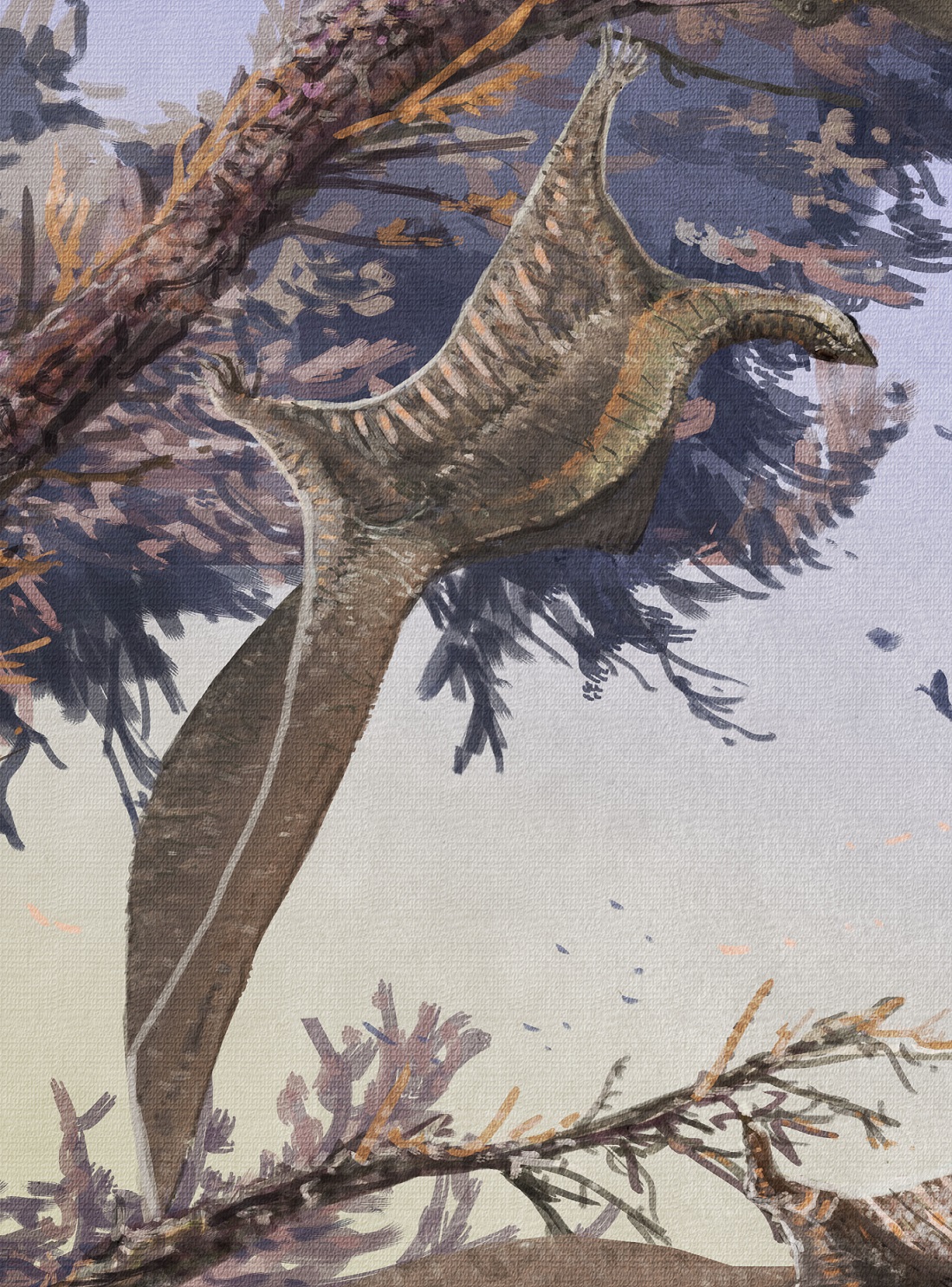
Hypuronector limnaios restored as a glider. Have palaeontologists been smoking something of variable legality, or is there some basis to this?
Assuming you've reached level 5 of palaeontological geekdom you can't fail to know of the exceptionally weird Triassic clade Drepanosauromorpha. These generally small, long-bodied reptiles are largely, but not incontrovertibly, thought to nest at the base of Archosauromorpha (so between lizards and crocs in the landscape of modern animals) and are famous for their highly aberrant anatomy. Gracile, bird-like heads and necks sit atop long, robust and tubular bodies with deepened tails and stout limbs. The hands and feet are highly modified in each species, some bearing powerful claws, others having chameleon-like opposable digits. The end of their tails are modified into either grasping, prehensile organs or sharp hooks, these being interpreted as adaptions for anchoring the tail to vegetation or substrata. Exactly what drepanosaurs did for a living has long been a subject of discussion among academics, and they are nowadays generally considered arboreal or fossorial - or a blend of both. They're pretty awesome animals.

Because the Triassic was evolution's drug-fuelled, rebellious college days, it can't be considered shocking to learn that there's a drepanosaur species which is to drepanosaurs what they are to everything else. This distinctive, strange, and controversial species is Hypuronector limnaios (above). Reasonably good fossils of this small (c. 12 cm long) animal have been known for decades from upper Triassic deposits of New Jersey, but it received its name only relatively recently (Colbert and Olsen 2001). Hypuronector is often regarded as a swimming creature because of its dorsoventrally expanded, 'leaf-shaped' tail which lacks a hooked or prehensile termination (Colbert and Olsen 2001). Its tail is remarkable for the enormous chevrons (prongs of bone projecting downwards from the underside of tail vertebrae) which extend far below and behind their vertebra of origin to create the majority of the tail depth and its 'leaf-like' profile. Some authors have likened the outline of the tail skeleton to the body shapes of gymntoid or gymnarchid fish and suggested that it propelled Hypuronector through the deep, freshwater lakes its fossils were buried in, perhaps in a newt- or crocodile-like fashion (Colbert and Olsen 2001). Although possessing unusually long legs relative to other drepanosaurs and swimming animals, it's been argued that these were also related to an aquatic lifestyle. Specifically, it's suggested that they held the long, deep tail off the ground during terrestrial bouts, the tail apparently being incapable of elevation at its base (Colbert and Olsen 2001). This aquatic Hypuronector hypothesis has been around for some time. The animal was informally known as the 'deep tailed swimmer' in the 1980s (Fraser and Renesto 2005) and this moniker was transferred more or less entirely to its scientific name in 2001: loosely translated, Hypuronector means 'deep-tailed lake swimmer'.

Hypuronector limnaios skeletal reconstruction, from Renesto et al. 2010. Scale represents 10 mm.
At first glance at least, none of this sounds too outlandish: the tail of Hypuronector certainly has an oar-like shape, and we all know that lateral undulation of a tail is the commonest means of water propulsion for vertebrates. But there are other interpretations of Hypuronector which suggest it may not have been a swimmer at all. These alternative views suggest it was more like other drepanosaurs in being suited to climbing but, more remarkably, possibly a glider (Renesto et al. 2010). Sharing early versions of my gliding drepanosaur art (above) suggests that the latter hypothesis is not well known, even among experts. However, I want to stress from the outset that this is not All Yesterdays-style artistic speculation or the bizarre opinion of a 'fringe' worker. Challenges to the aquatic Hypuronector concept and suggestions that Hypurnoector was a more 'typical' arboreal form have been made by several authors (e.g. Senter 2004; Spielmann et al. 2006; Renesto et al. 2010; Castielloa et al. 2015), and the notion that it may have been a glider has been raised on reasonable (if perhaps not yet conclusive) evidence (Renesto et al. 2010). It follows older suggestions that some drepanosaurids - Megalancosaurus specifically - were gliders (see below; Ruben 1998; Renesto 2000) and, though this all might seem bizarre, there is some genuine scientific basis to it.

The aquatic Hypuronector hypothesis under scrutiny

Aquatic drepanosaurs are were first proposed in the early 90s (Berman and Reisz 1992) and quickly received criticism from drepanosaur workers (see Renesto 2010 for history). Hypuronector perhaps remains the best candidate for an aquatic, or at least amphibious species because of its unusual tail, but somewhat ironically, it's actually this paddle-shaped organ which seems to be the main problem for this hypothesis.

Holotype of Hypuronector limnaios, a partial skeleton with the 'paddle tail' (left), disarticulated torso and bits of limb and limb girdle. From Colbert and Olsen (2001).
One thing we should address straight out is that the resemblance of the Hypuronector tail to the body of certain fishes is not a the best endorsement for swimming habits. Fish do not swim using their whole bodies (the front end of any undulating swimmers needs to be stiff), and the gymntoid or gymnarchid fish likened to the Hypuronector tail don't really move their bodies at all when swimming. Rather, they propel themselves with oscillations of long, low fins along the top of bottom of their bodies. Thus, they may be a poor shape analogue for a sculling organ, and we're better off looking at the fins and paddles of swimming animals, not their entire bodies, for clues about the aquatic potential of the Hypuronector tail.

It stands to reason that Hypuronector would have swum like a crocodylian, newt or swimming lizard, where waves of lateral undulation in the tail generate forward thrust (Colbert and Olsen 2001). This requires tail anatomy which can accommodate a lot of lateral motion, and it's here that Renesto et al. (2010) suggest we hit a major issue. The caudal vertebrae of Hypuronector seem to permit some movement at the base and tip of the tail, but the mid-tail was pretty stiff. This is because the zygaopophyeses - processes of bone that overlap neighbouring vertebrae to guide their motion - are very long and have steep articular surfaces (below). In simple terms, they seem to have 'clamped' their adjacent vertebrae rather than - as expected for an undulatory tail swimmer - provided flat, horizontal surfaces for the vertebrae to slide over.

Further rigidity is provided by those amazing chevrons (Renesto et al. 2010). These rearward-projecting bones underlie the articulations of the adjacent 7-8 vertebrae, meaning any lateral motion at the vertebral joints had to overcome the stiffness of the 7-8 bony rods hanging beneath them. Although thin bones are somewhat compliant and the Hypuronector chevrons may have been flexible to a degree, it's difficult to see their arrangement as optimised for sculling habits: they may made the tail more paddle shaped, but to obvious detriment of tail flexibility and sculling potential. Indeed, we have to note that this configuration is very similar to biological structures adapted to resist bending. Tetrapod wings are a good example: the arrangement of bat fingers, pterosaur structural fibres and bird feather shafts with respect to the wing bones echoes the chevron distribution in Hypuronector. By contrast, deep-tailed swimmers, like crocodylians and newts, have chevrons which are short, robust, and do not significantly underlie neighbouring vertebrae. They are ideal structures for anchoring tail musculature, increasing tail depth and not interfering with tail motion. I have to agree with Renesto et al. (2010) that the potential of the Hypuronector tail as a swimming organ seems limited.

Hypuronector limnaios posterior trunk (left) and tail base (right) - note elevation of the latter with respect to the former, and the significant overlap of the zygapophyses. From Renesto et al. 2010, scale represents 10 mm.
Of further relevance here are the limbs of Hypuronector, which do not have obvious aquatic signatures. Aquatic, or even semi-aquatic animals tend to have proportionally short, squat limbs, often with expanded, paddle-like bones. But the limbs of Hypuronector are elongate, gracile and hollow (Renesto et al. 2010). Its hands and feet are not well known and variably interpreted, but the elements we have suggest that they were not paddle-like. Colbert and Olsen (2001) proposed that the limbs of Hypuronector were long to lift the tail from the ground when it left the water, their work suggesting that the vertebral column was too stiff to lift the tail on its own. But this can be seen as problematic for three reasons. Firstly, as pointed out by Renesto et al. (2010), articulated fossils of Hypuronector show the tail arcing upwards with respect to the trunk vertebrae (above): this is not thought to be taphonomic or diagenetic distortion. Secondly, the forelimbs of Hypuronector are somewhat longer than the hindlimbs, which is perhaps the opposite of what we would expect if dragging the tail was a concern - surely the body would tilt backwards with this arrangement? Thirdly, since when did reptiles, aquatic or otherwise, care about dragging tails? We need to be careful that we're not providing 'empty support' for hypotheses by inventing problems for our fossil animals to solve.

Maybe Hyperonector isn't 'the weirdo drepanosaur 'after all?

Taken collectively, these points about tail shape, tail arthrology and limb size must be viewed as problematic for the aquatic Hypuronector hypothesis, and maybe we should see if there are other interpretations of Hypuronector lifestyle which are more in tune with its anatomy. A good strategy for understanding strange fossil animals is putting the controversial, weird bits of anatomy to the side and first focusing on the more reliably interpreted components. With that said, let's ignore the controversial tail of Hypuronector for a moment and look at its limbs, limb girdles and trunk anatomy. As with all drepanosaurs, the shoulder and hip bones of Hypuronector are very tall and somewhat reminiscent of the limb girdles of chameleons (Renesto et al. 2010). It is thought both limb sets were highly mobile, although the drepanosauromorph fusion of the pectoral girdle into one solid structure, as opposed to having two separate halves like chameleons, would limit forelimb reach somewhat. The limbs were likely held in a sprawling pose and, because the femora and humeri are greatly elongated, Hypuronector likely had a wide, stable base to walk and stand on.

Bits and pieces of AMNH Hypuronctor specimens, including the only known cranial material (mandible, A-C) and the ventral view of a trunk and pectoral skeleton. Note the huge, curving ribs. From Renesto et al. 2010.
Hypuronector lacks the large, fused vertebrae over the pectoral region that we see in other drepanosauromorphs, but given that these likely reflect increased forelimb muscle mass and a reinforced pectoral region for digging and prey-capture (Castielloa et al. 2015), this may not impact locomotor mechanics too much. The trunk of Hypuronector was evidently powerfully muscled all the same, the tall neural spines of the dorsal vertebrae and the presence of large, curving ribs along the entire torso suggesting large muscles enveloped most of the body.

It can be seen that Hypuronector trunk and limb anatomy matches pretty well with what we see in other drepanosaurs: powerful torsos and mobile limbs that seem well suited to walking and climbing. We might view its limb elongation as an adaptation to climbing, the increased length of the upper limb segments simultaneously increasing stability and enhancing reach while also keeping the centre of mass close to the substrate. Perhaps more surprisingly, Hypuronector is also similar to other drepanosaurs in certain aspects of tail anatomy. Although its tail has a different overall shape and lacks the derived tail-tips of true drepanosaurids, it shares the specifics of drepanosaur tail motion - flexible base and tip, rigid mid-length - with the rest of the group (Renesto et al. 2010). So perhaps the tail of Hypuronector was just a simpler, oddly-shaped variant on the drepanosauromorph tail and used for similar purposes: stability when climbing (a simple prop can aid traction, balance and recovery from accident), a brace when rearing to dig and feed, or simply for showing off (Renesto et al. 2010).

Putting these lines of evidence together, several authors have started to interpret Hypuronector as a more 'typical' drepanosaur, albeit a less-specialised species that lived like a modern arboreal lizard rather than a reptilian tree pangolin or pygmy anteater (Spielmann et al. 2006; Renesto et al. 2010). If this is true, we might view the shape of its tail as a mechanical red-herring, something which seems more important to Hypuronector behaviour than it actually was. Perhaps it had no more significance to locomotion and behaviour than do the cranial ornaments of dinosaurs and pterosaurs, structures which most now agree were more to do with communication and display than the mechanics of day-to-day life.

Yes yes yes, but we're here for the gliding stuff

Taking this idea of a climbing, generalist Hypuronector a step further, Renesto et al. (2010) note that there are several features of Hypuronector which might indicate it was a patagial glider - that is, an animal with membranes extending between its limbs to facilitate slower falls from elevated positions or glide between perches. The chief features of interest here are the the elongate limbs and, in particular, the forelimbs being as long, if not slightly longer, than the hindlimbs. This configuration is uncommon among reptiles. Well known reptiles with disproportionately long arms include canopy-browsing herbivorous dinosaurs, completely aquatic lineages like ichthyosaurs, derived sauropterygians and turtles, and flying animals like pterosaurs. It's clear that the former animals are playing an entirely different game to drepanosaurs, but the basic similarity between pterosaurs - small, gracile boned creatures which probably had climbing and gliding ancestors - and Hypuronector might be a little more intriguing. Forelimb elongation occurs again and again in patagially gliding tetrapods - pterosaurs, cologus, scaly tailed gliders etc. - and it's not unreasonable to wonder if the same phenomenon in Hypuronector betrays the presence of gliding membranes. The limb proportions of this species are not so extreme as to think it was an exemplar glider and able to travel long distances from vertical starts, but they may have housed membranes of sufficient size to cushion the fall of these small animals if they jumped or fell from high places. The deep, rounded shape of the tail becomes something to pay attention to here as well, it perhaps being well-shaped to help 'correct' a tumbling Hypuronector into the right posture for a steady glide.

Which might have been handy if the initial glide trajectory was what glider pilots call 'less than ideal'
As noted above, at least Megalancosaurus has been also posited as a potential glider in the past (Ruben 1998; Renesto 2000). These conversations were inspired (at least in part) by long-defunct (if you could ever really consider them credible!) ideas that birds may have had shared, close ancestry drepanosaurs or drepanosaur-like animals - let's quickly duck aqay further discussion of that. But why has the idea of gliding Megalancosaurus not caught on? Although not ruled out entirely (Renesto 2000), gliding doesn't seem to have stuck with this species because it its spiked tail, highly mobile wrists and ankles, and grasping appendages suggest it was quite highly adapted to climbing. While climbing and gliding are not incompatible, it also lacks features like the long, gracile limbs we would expect from flighted animals. The anatomy of Hypuronector, by contrast, is a little more generalised and ticks enough boxes in the glider column to think it could be possible.

Of course, it's worth stressing that any gliding drepanosaur is hypothetical at this stage, but we should not take this as reason to dismiss the idea out of hand. In addition to the evidence mentioned above, consider that many, perhaps all drepanosauromorphs seem to have been climbers of one kind or another, and we know from extant faunas that the step from climbing to gliding is often a short one (Renesto 2000). It's really not crazy to think extinct lineages were any less able to develop gliding forms than our modern ones, and drepanosaurs were exapted for gliding flight in many ways. Their skulls had large brains and overlapping visual fields (Renesto and Dalla Vecchia 2005) (ideal for judging distance and processing flight data); they were generally small animals with hollow limb bones (lightweight); their torsos were stiffened and reinforced (aids stability); their limbs were powerfully muscled and highly mobile (control of aerofoils) and their deep, strong tails might be ideal rudders and stabilisers. And as bizarre as it may seem to be discussing the possibility of gliding in an animal only known from bones, recall that pterosaurs were identified as flying animals in the early 1800s long before we discovered fossil remains of their wing membranes: we can identify flying animals if we look carefully enough at their bones. The challenge now is to see if we can test these ideas, perhaps carefully comparing the limb anatomy and myological signatures of Hypuronector with other drepanosaurs, modelling the effects that crazy tail has on a falling animal and so on. We can also look for Renesto et al.'s membranes on Hypuronector fossils, examining them with UV light and being extra-careful when preparing future Hypuronector specimens: experience with other delicate reptile specimens shows that it helps to know where to expect soft tissue when removing matrix.

So there we go, then: the Triassic, and drepanosaurs, might have just got even weirder/cooler/complicateder/more frustratinger than we all knew. I'm thinking we need to hang out in the Triassic even more in future blog posts - check out this label for previous conversations on Triassic topics. And note that my new art book, Recreating an Age of Reptiles, has several pages dedicated to Triassic animals - including Drepanosaurus.

This blog glides on the gentle, supportive updrafts of Patreon

The paintings and words featured here are sponsored by the organisms almost as awesome as Hypuronector: my Patreon backers. Supporting my blog from $1 a month helps me produce researched and detailed articles with paintings to accompany them, and in return you get access to bonus blog content: additional commentary, in-progress sneak-previews of paintings, high-resolution artwork, and even free prints. For this post, we'll be taking a look at a (currently unpublished) painting of a more familiar drepanosaurid.

References

  • Berman, D. S., & Reisz, R. R. (1992). Dolabrosaurus aquatilis, a small lepidosauromorph reptile from the Upper Triassic Chinle Formation of north-central New Mexico. Journal of Paleontology, 66(06), 1001-1009.
  • Castiello, M., Renesto, S., & Bennett, S. C. (2015). The role of the forelimb in prey capture in the Late Triassic reptile Megalancosaurus (Diapsida, Drepanosauromorpha). Historical Biology, 1-11.
  • Colbert, E. H., & Olsen, P. E. (2001). A new and unusual aquatic reptile from the Lockatong Formation of New Jersey (Late Triassic, Newark Supergroup). American Museum Novitates, 1-24.
  • Fraser, Nicholas C., and Silvio Renesto. Additional drepanosaur elements from the Triassic fissure infills of Cromhall Quarry, England. Virginia Museum of Natural History, 2005.
  • Renesto, S. (2000). Bird-like head on a chameleon body: new specimens of the enigmatic diapsid reptile Megalancosaurus from the Late Triassic of Northern Italy. Rivista Italiana di Paleontologia e Stratigrafia (Research In Paleontology and Stratigraphy), 106(2).
  • Renesto, S., & Dalla Vecchia, F. M. (2005). The skull and lower jaw of the holotype of Megalancosaurus preonensis (Diapsida, Drepanosauridae) from the Upper Triassic of Northern Italy. Rivista Italiana di Paleontologia e Stratigrafia (Research In Paleontology and Stratigraphy), 111(2).
  • Renesto, S., Spielmann, J. A., Lucas, S. G., & Spagnoli, G. T. (2010). The taxonomy and paleobiology of the Late Triassic (Carnian-Norian: Adamanian-Apachean) drepnosaurs (Diapsida: Archosauromorpha: Drepanosauromorpha): Bulletin 46 (Vol. 46). New Mexico Museum of Natural History and Science.
  • Ruben, R. R. (1998). Gliding adaptations in the Triassic archosaur Megalancosaurus. Journal of Vertebrate Paleontology, 18 (3), 73A.
  • Senter, P. (2004). Phylogeny of Drepanosauridae (Reptilia: Diapsida). Journal of Systematic Palaeontology, 2(3), 257-268.
  • Spielmann J. A., Renesto S. and Lucas S. G. (2006). The utility of claw curvature in assessing the arboreality of fossil reptiles.Bulletin of the New Mexico Museum of Natural History and Science 37: 365-368.