Friday, 25 March 2016

The lives and times of flying reptiles as told by the fossil record, part 1: azhdarchid pterosaurs

The undignified end to the life of a large (6m wingspan) azhdarchid: being squabbled over by Saurornitholestes and other local ruffians. We know a scene like this must have occurred at least once thanks to an azhdarchid fossil discussed below, and a growing number of specimens are providing similar insights into the place of azhdarchids in Mesozoic food webs.

Discussions of the lifestyles of fossil animals primarily centre around their functional morphology - the use of comparative anatomy and biomechanical calculations to assess their anatomical suitability to certain habits and behaviours. We use these approaches to deduce their likely diets, locomotory strategies, likely interactions with ancient environments and other organisms, and so on. But despite the widespread and proven utility of these techniques, it's widely regarded that these approaches can only provide probabilities and hypotheses about fossil habits. They allow us to predict, but not necessarily know how ancient animals functioned in their respective ecosystems. For the latter, we rely on fossils to provide us with direct records of animal habits - gut content, evidence of animals attacking and ingesting each other, trace evidence of foraging strategies and so on. For vertebrates, these fossils are very rare - hence our general reliance on functional anatomy - and single examples of palaeoecologically-significant fossils can provide crucial insights into ancient lifestyles and ecosystems.

As you might expect, such fossils are particularly rare for pterosaurs. Flying reptiles were not prone to fossilisation at the best of times and this - through simple probability - dramatically lowers their chance of forming fossils with palaeoecological significance. As recently as the 1990s some authors lamented the lack of these fossils and tried to ascribe some significance to their rarity. But renewed interest in pterosaur science, an increased rate of discovery of flying reptile remains and greater alertness for details on fossil specimens has seen our sample size of palaeoecologically-significant pterosaur specimens grow considerably in the last few years. These records have been augmented more in some taxa than others so that our record of pterosaur palaeoecology is looking increasingly patchy: some groups now now have a half-dozen or more of these fossils to their names, others have none at all. There's probably no real significance to this other than the habits and anatomy of some pterosaurs being more suited to recording these fossils than others.

I thought it might be fun to take a look at two pterosaur taxa with increasingly good palaeoecological records. In an upcoming post, we'll look at the really quite excellent palaeoecological data for the Jurassic pterosaur Rhamphorhynchus muensteri, but today I want to discuss the palaeoecology of azhdarchids. That's right: the lifestyles of these sometimes giant, sometimes long necked, always edentulous, and increasingly famous flying reptiles are not only predicted by functional morphology, but can be deduced somewhat from fossils too. Thanks to a number of specimens discovered in recent decades we have an idea what happened to azhdarchids when they died, what sort of animals they must have encountered in day to day life, and maybe even how they foraged.

Meeting the (teeth of the) neighbours

The majority of the azhdarchid palaeoecological record pertains to specimens showing which animals ate them, their teeth and puncture marks being left on azhdarchid bones, or else azhdarchid remnants being found in the torsos of other animals as gut content. One of the most famous of these fossils is an incomplete azhdarchid skeleton from the upper Cretaceous Dinosaur Park Formation of Canada. This fossil is noteworthy for not only being one of the most substantial pterosaur fossils from Canada, but also for the tooth gouges and embedded dinosaur tooth found at the distal end of the tibia (Currie and Jacobsen 1995). The tooth belongs to the 2 m long dromaeosaur Saurornitholestes langstoni, and the size and provenance of the gouges indicate they were probably made by the same species, perhaps the same individual. The size discrepancy between the pterosaur and dinosaur here is pretty dramatic. Check out the size of the tibia of the (c. 6 m wingspan) pterosaur compared to the embedded tooth:
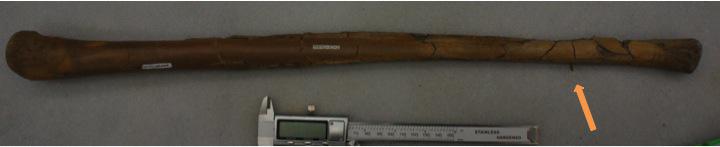
Immature azhdarchid tibia from the Dinosaur Park Formation of Alberta, Canada, with an embedded dromaeosaur tooth (arrowed). Note the size of the pterosaur remains compared to those of the dinosaur. Image by Liz Martin-Silverstone, borrowed from her Twitter account.
This is not the only known occasion of a dromaeosaur interacting with an azhdarchid. Recently Dave Hone and colleagues (2012) described an articulated Velociraptor mongoliensis specimen from Tugrikin Shireh (Gobi Desert, Mongolia) with fragmentary remains of an azhdarchid pterosaur in its gut (below). That this reflects true gut content, and not just chance association of pterosaur bones with those of a dinosaur, is indicated by the articulation of the specimen and location of the pterosaur remains within an envelope of dorsal ribs. It's presumed that the dinosaur was eating bits of pterosaur bone with meat attached, not just swallowing chunks of bone.

A Velociraptor mongoliensis chest cavity with pterosaur remains, probably belonging to an azhdarchid, as gut content. Black arrows show pterosaur bone, white arrow indicates a pathological rib. Borrowed from Dave Hone's Archosaur Musings.
Crocodyliforms are also thought to have consumed azhdarchids. Possible puncture wounds from these reptiles are found on the holotype specimen of the Eurazhdarcho langendorfensis, from the upper Cretaceous Sebeş Formation of Transylvania (Vremir et al. 2013). Round bite marks and crushing are found on the cervical vertebrae (below) and distal metacarpal IV of this specimen. In this instance the azhdarchid was unlikely to have been receiving selective treatment by the local reptile fauna, as crocodyliform biting traces are common to many bones from this formation (Vremir et al. 2013).

Holotype cervical vertebrae III and IV of Eurazhdarcho langendorfensis, with possible crocodyliform tooth marks outlined and arrowed. From Vremir et al. (2013).

Azhdarchid bones as an insect hotel?

A further possible record of azhdarchid consumption pertains to strange oval punctures at the back of a Quetzalcoatlus sp. skull (Kellner and Langston 1996). These may record tooth marks, although there is no obvious indication as to what animal might have made them. A rather different take on them was suggested by Kellner et al. (2010), who noted that insect borings had been found the same Quetzalcoatlus material. Kellner et al. suggest that these borings were described by Kellner and Langston (1996) but, to my knowledge, this suggestion is an error as I can find no mention of insect borings in the 1996 paper. I assume this comment provides a different interpretation of the skull punctures, but it might not. I'd really like to know more about this, as there are as yet no confirmed cases of pterosaur bones being utilised by insects. I wonder if this is a simple mistake, or might pertain to details of as-yet undescribed portions of Quetzalcoatlus anatomy?

An azhdarchid foraging trace?

Pterosaur foraging traces are known from a number of Jurassic and Cretaceous tracksites (Lockley and Wright 2003). Most look very similar to those known for birds - paired impressions made in the substrate surfaces by beaks pecking at the ground. Interested parties need only check out the mudflats frequented by wading birds to see analogous traces left by modern fliers. Sometimes we find longer scrapes or gouges made by pterosaur beaks sweeping low across sediments, too. These are sometimes interpreted as tail drags, but it's difficult to envisage sensible scenarios where short-tailed pterodactyloid pterosaurs - those thought to have been creating the pterosaur tracks we know of - randomly sweep their tails across the ground.

Such a beak scrape might be known preserved alongside a possible azhdarchid track from the Late Cretaceous (Campanian) Cerro del Pueblo Formation of North Mexico (Rodriguez-de la Rosa 2003). This track comprises one well-preserved footprint and a series of handprints, alongside several sharp, linear gouges. Other tracks from this locality - known as the El Pelillal tracksite - include turtles, crocodylomorphs, theropods and mammal-like creatures, and the sedimentary setting is considered a shallow, freshwater environment. When described, these pterosaur prints were considered to represent the generic pterodactyloid trace Pteraichnus (Rodriguez-de la Rosa 2003), but the footprint bears little similarity to the broad, triangular-shaped impressions of this ichnotaxon (below). In my 2013 book I argued that the narrow form, pronounced heel impression and short, blunt toes of this print much more reminiscent of Haenamichnus, a trace thought with good reason to represent the footfalls of azhdarchids (below, Hwang et al. 2002; Witton 2013). The age of the specimen is further indication of an azhdarchid identity, the Campanian being a stage of the Mesozoic where azhdarchids seem to largely dominate pterosaur evolution.
The El Pelillal pterosaur trace described by Rodriguez-de la Rosa (2003), argued here and elsewhere to represent an azhdarchid trace (Haenamichnus) rather than a generic pterosaur track (Pteraichnus) - see for yourself in the inset. Illustrations after Rodriguez-de la Rosa 2003 and Hwang et al. 2002.
If this is an azhdarchid track, could the sediment gouges represent marks made by the same animal? The original 2003 description provides little commentary little on these marks, but, to be fair, we only really started discussing pterosaur foraging traces in the early 2000s and prospects of terrestrial foraging were considered poor to non-existent by most workers at that time. Perhaps the concept of pterosaur foraging traces were just not on the radar for many researchers in 2003. In any case, these gauges do look similar to marks thought to record sweeping pterosaur beaks at other track sites (Lockley and Wright 2003), so the El Palillal gouges might indeed represent similar phenomena. If this is the case, this specimen might have some important implications for how we interpret azhdarchid pterosaur habits. Speaking of which...

What these fossils might indicate about azhdarchid pterosaur palaeobiology

What we have here is the start of a fossil dataset on azhdarchid palaeoecology, comprising several indications of which animals ate them, possible indications of animals using their remains for shelter, and possible trace evidence of a foraging azhdarchid. The data is currently of a small sample size - only five specimens in total - but already offers several points of interest those wanting to understand azhdarchid habits. 

Firstly, these occurrences show azhdarchids interacting with animals known to have existed in inland habitats. Several of the involved animals are entirely terrestrial, and the most aquatically adapted species yet known to have accosted an azhdarchid bone is a crocodyliform. Given that the latter group is a primarily freshwater lineage (and, indeed, the crocodyliforms in question lived in a freshwater deposit), this data is not inconsistent with this model. As regular readers may appreciate, an 'inland' palaeoecological signature is consistent with the 'terrestrial stalker' mode of azhdarchid life proposed in by myself and Darren Naish in 2008 (see below, also Witton and Naish 2008, 2015), where we argued that azhdarchids were not aquatic or marine adapted species, but much more at home in woodlands and plains, picking up small game with their oversize beaks. I see these palaeoecologically-relevant fossils as a test of this idea, and am happy to see that - so far - they are consistent with the model we proposed. 

Azhdarchid terrestrial stalking, the infographic. From Witton and Naish 2015.
Secondly, if we do indeed have an azhdarchid foraging trace, proposals that azhdarchids can reach the ground with their jaw tips to feed are vindicated. Darren and I initially encountered some resistance to our 2008 'terrestrial stalker' proposal because some peers thought the azhdarchid neck would not permit the jaws to reach the ground. We argued that the jaw is so long that only minimal neck motion, or even just a bit of forelimb flexion, would see the jaws reaching the ground without problem. Azhdarchid beak scrapes would indicate that this was indeed the case and put this minor debate to rest. 

Thirdly, the terrestrial stalker model might predict the presence of beak scrapes alongside azhdarchid footprints. After all, azhdarchids looking for or striking at prey may sometimes have held their jaw tips close to the ground - modern animals track prey in this fashion, after all. The potential existence of beak marks with the El Pallilal track may be 'smoking gun' evidence of azhdarchids foraging on the ground in the manner proposed in 2008. I stress that the El Pallilal tracks need re-examination to confirm these ideas, but, if I'm correct, these traces augment the 'terrestrial stalker' argument considerably.

One question I expect will be asked about these fossils will be whether they tell us much about azhdarchid susceptibility to predation. This is something which has been discussed at a technical level (see this blog post for details), but I'm not sure these specimens help us understand it further. My issue is that, although various ideas have been published on the likelihood of certain azhdarchid fossils representing scavenging or predation (mainly involving relative masses of the animals involved), I'm not sure we can account for the many factors behind the circumstances recorded in these remains. Those azhdarchids outlined above were certainly dead, or near death, when being chewed on as their bones show no signs of healing from the inflicted damage, but a number of scenarios could account for this. We know that modern predatory events are influenced by the health of the animals involved, the skills and behaviour of different predatory species and individuals, and circumstances of time and place. These are difficult to account for with those bitten and chewed azhdarchid fossils we currently have, so I prefer to have no opinion on these matters and focus on the significance of things we can say more positively.

OK, that's all for now. In the next, and concluding part of this series we'll see what the fossil record tells us about the rhamphorhynchiest pterosaur of all, Rhamphorhynchus muensteri

Enjoyed this post? Support me on Pateon!

The artwork and words you see here are supported by folks who back me on Patreon, the service which allows you to directly support artists and authors with monthly payments. You can support this blog from $1 a month and, in exchange, get access to bonus art, discussion and rewards - the more you pledge, you more bonuses you receive! For this post, my patrons were able to see the painting at the top of the article as it developed from an old (2006) original into a much more detailed, interesting scene, and we'll be discussing a little more about pterosaur paleoecology there shortly. Thanks to everyone who already supports me!

References

  • Currie, P. J., & Jacobsen, A. R. (1995). An azhdarchid pterosaur eaten by a velociraptorine theropod. Canadian Journal of Earth Sciences, 32(7), 922-925.
  • Hone, D., Tsuihiji, T., Watabe, M., & Tsogtbaatr, K. (2012). Pterosaurs as a food source for small dromaeosaurs. Palaeogeography, Palaeoclimatology, Palaeoecology, 331, 27-30.
  • Hwang, K. G., Huh, M., Lockley, M. G., Unwin, D. M., & Wright, J. L. (2002). New pterosaur tracks (Pteraichnidae) from the Late Cretaceous Uhangri Formation, southwestern Korea. Geological Magazine, 139(04), 421-435.
  • Kellner, A. W., & Langston Jr, W. (1996). Cranial remains of Quetzalcoatlus (Pterosauria, Azhdarchidae) from Late Cretaceous sediments of Big Bend National Park, Texas. Journal of Vertebrate Paleontology, 16(2), 222-231.
  • Kellner, A. W., Rich, T. H., Costa, F. R., Vickers-Rich, P., Kear, B. P., Walters, M., & Kool, L. (2010). New isolated pterodactyloid bones from the Albian Toolebuc Formation (western Queensland, Australia) with comments on the Australian pterosaur fauna. Alcheringa, 34(3), 219-230.
  • Lockley, M. G., & Wright, J. L. (2003). Pterosaur swim tracks and other ichnological evidence of behaviour and ecology. Geological Society, London, Special Publications, 217(1), 297-313.
  • Rodriguez-de la Rosa, R. A. (2003). Pterosaur tracks from the latest Campanian Cerro del Pueblo Formation of southeastern Coahuila, Mexico. Geological Society, London, Special Publications, 217(1), 275-282.
  • Vremir, M., Kellner, A. W., Naish, D., & Dyke, G. J. (2013). A new azhdarchid pterosaur from the Late Cretaceous of the Transylvanian Basin, Romania: implications for azhdarchid diversity and distribution. PLoS One, 8(1), e54268.
  • Witton, M. P. (2013). Pterosaurs: natural history, evolution, anatomy. Princeton University Press.
  • Witton, M. P., & Naish, D. (2008). A reappraisal of azhdarchid pterosaur functional morphology and paleoecology. PLoS One, 3(5), e2271.
  • Witton, M. P., & Naish, D. (2015). Azhdarchid pterosaurs: water-trawling pelican mimics or “terrestrial stalkers”?. Acta Palaeontologica Polonica, 60(3), 651-660.

Monday, 14 March 2016

The magnificent Caviramus, an early example of an anatomically 'extreme' pterosaur

The Carnian/Norian Swiss pterosaur Caviramus schesaplanensis, one of the earliest species to take pterosaur anatomy to strange new places. Anyone else want to make puns about 'Cave-iramus' with this picture? No? Anyone...?
What happens when you take the innate weirdness of the Triassic Period - the evolutionary equivalent of the late 1960s in terms of experimentation, weirdness and tragic ends to interesting lineages - and multiply it by a pterosaur? One answer is the marvellously strange Late Triassic flying reptile Caviramus schesaplanensis. This animal is a relative newcomer to the pterosaur roster, first being described in 2006 based on an incomplete lower jaw from Switzerland (Fröbisch and Fröbisch 2006), before better material in the form of an incomplete skeleton turned up a few years later* (Stecher 2008). Several cranial and dental features indicate Caviramus had kinship with other European pterosaurs such as Eudimorphodon and Campylognathoides, but that it was a rather distinctive animal compared to even close relatives. This 1.35 m wingspan animal had a chunky skull, large crests on both upper and lower jaws, densely packed and gnarly teeth, long, slender wings and a robust, lengthy set of hindlimbs (Stecher 2008). Several of these features are 'extreme' variants of pterosaur anatomy common to other Triassic animals, and others represent the most pronounced development of anatomical traits of any pterosaur. They mean that, even a decade after the first remains of this animal were published, Caviramus still gives us a lot to think about as goes its life appearance, lifestyle and functional anatomy.

*This skeleton was described as the holotype of a new genus and species, Raeticodactylus filisurensis, but a number of recent workers have shown it to be very likely congeneric, if not entirely synonymous, with C. schesaplanensis. I'm treating the two as the same taxon here.


Fossil material referred to Caviramus. Above, the holotype jaw of Caviramus schesaplanensis, below, the incomplete holotype skeleton of "Raeticodactylus filisurensis", a taxon now considered by most to be Caviramus and perhaps even Caviramus schesaplanensis itself. From Fröbisch and Fröbisch (2006) and Stecher (2008).
One atypical aspect of Caviramus is the cranial crest. Sure, pterosaur headcrests are really not uncommon (it's perhaps fair to say seems crestless species are more unusual than crested ones) but they remain fairly rare in the Triassic and, even compared to much later pterosaurs, Caviramus is pretty well endowed in the crest department. Rather than the low midline ridge typical of many pterosaur bony crests, this structure projects rudely from the front of the snout to reach well above the rest of the skull. We don't see anything like this again in the pterosaur record until the lower Cretaceous, when the famously elaborate tapejarids adopted a similar configuration. As with these pterosaurs, it's likely a soft-tissue component extended the Caviramus crest tissues in some way. The posterior crest border of the only known Caviramus skull is badly preserved, but the lateral crest surfaces have the same fibrous textures as pterosaurs known to have large soft-tissue crest components, such as Pterodactylus and Tupandactylus. The most parsimonious interpretation of this is that Caviramus had a big soft-tissue crest too, and - if the bony crest portion is indicative of the soft-tissue extent, as seems apparent from some pterosaur fossils - it might have been quite a spectacularly adorned animal. Caviramus seems to represent one of the first experiments with this sort of outlandish headgear, there being only one other Triassic species which could rival it for crest development (Austriadactylus cristatus - see Dalla Vecchia et al. 2002) .

Multiple aspects of the Caviramus jaw are of interest. It was probably a powerful biter, and perhaps regularly consumed relatively tough prey such as invertebrates with thick exoskeletons or fish with hard scales. Such a diet is indicated by its blunted and worn tooth tips, and the enamel of the anterior teeth being strongly rugose - some readers may recall from a recent article that these features also occur in other specialists of hard prey, such as the giant, turtle-eating Cretaceous crocodylian Deinosuchus. Caviramus dentition is morphologically complicated and, again, indicates some specialisation. As with many Triassic pterosaurs, the teeth are differentiated into large, curving anterior fangs at the jaw tips and complicated, multicusped teeth behind these. These posterior teeth are so numerous and tightly packed that they actually sit obliquely in the jaw, overlapping one another to form a continuous, 'megaserrated' cutting surface. The depression of the jaw joint (another atypical feature for a pterosaur, and one that won't reappear until later in pterosaur evolution) permitted these teeth to occlude simultaneously rather than gradually, as occurs in animals with jaw joints level with the toothrow. Areas of Caviramus jaw muscle attachment are large, including a broadly expanded posterior lower jaw. The mandible and skull are not, as with some pterosaurs, delicately built from slender struts but comprised of deep bars and robust bone junctions. Cross sections of the Caviramus holotype jaw indicate that some cavities were present in the cranial skeleton, but that bone volumes were superior in at least some places. This was clearly an skull capable of delivering and withstanding forceful bites, and its configuration recalls some dinosaur species which are sometimes considered to be omnivorous (e.g. many small ornithischians). Maybe it was equipped with powerful jaws so that it could tackle a wide range of tough foods, including nutritious plant matter.

Cross section through the posterior (specifically, coronoid) section of the Caviramus holotype jaw. Grey shading represents bone, white indicates hollow regions. From Fröbisch and Fröbisch (2006).
This strong skull and dental apparatus seems odd compared to the Caviramus humerus. This bone is about as long as expected for a pterosaur of this kind, but is distinctive for being very, very slender. Usually, pterosaur humeri are the most robust elements in the limb skeleton, but that of Caviramus is no wider than the more distal wing elements. So proportionally different is this bone that the shoulder and upper arm were probably much more slender in life than those of other pterosaurs. Quite what this means for Caviramus locomotion has not been looked into yet, and any attempt to assess this will be frustrated by the only known Caviramus humerus being somewhat imperfectly preserved. Still, it's known in enough detail to at least permit some basic comments.

One obvious question concerns what this humerus means for quadrupedal launch potential in this animal. A core basis to this hypothesis is that pterosaur humeri are much stronger than their femora (Habib 2008) but - going on a basic assessment of bone shape here - this is not obviously the case for Caviramus. We should not automatically default to assuming Caviramus was a bipedal launcher however, as it is small enough to not need atypically strengthened limb elements for launch. The limb bones of volant animals are expected to start showing strong signals of a launch strategy once their body mass hits 2 kg (i.e. it's above this mass where the humerus or femur strength starts to become disproportionately strong compared to the other limb elements - see Habib 2008 for details) but, at only 1.35 metres across the wings, Caviramus probably only massed a little over one kilo. I'm sure Caviramus did have a preference for a particular launch strategy (I'm not aware of any animals which can readily flip between quadrupedal and bipedal launch, except under special circumstances), but its size means we might need dedicated investigation to know which was more likely. Given that all other pterosaurs seem to be quad-launchers, my suggestion is to assume this as the null hypothesis for now until we have reason to assume otherwise.

Caviramus schesaplanensis skeletal reconstruction, somewhat updated from the original version in Witton (2013). Unknown elements based on Campylognathoides liassicus (see Padian 2008).
The slenderness of the Caviramus humerus might have impacted flight once airborne, too. Caviramus joins pterosaurs like Eudimorphodon and Campylognathoides in having very long wings, but lacks the stocky, probably powerfully muscled humeri of these species. These might have enabled Eudimorphodon et al. to be forceful fliers capable of rapid flapping, elevated speeds and high agility. But the delicately constructed humerus supporting a long distal wing in Caviramus might have curbed any potential for being a powerful flapper or aerial acrobat - its humerus would have been far more vulnerable to bending than those of other pterosaurs. This is not to say that it was purely restricted to gliding, however. Studies of avian wing construction show that their humeri do not have to be enormously strong to permit flapping flight (indeed, their humeral strength seems to scale more or less isometrically with body size - Witton and Habib 2010) and the fact Caviramus has a large deltopectoral crest to anchor flight musculature is a good indication it was an active flier. We might conclude that its long, slender wing bones were suited to soaring flight with limited flapping - long winged seabirds like gulls, albatross and terns might be a good modern flight analogue.

Readers familiar with the Caviramus illustration in my 2013 book Pterosaurs: Natural History, Evolution, Anatomy might note that the 2016 Caviramus (above) is rather differently posed. There's good reason for this - read on...
It's not only flight that this unusual humerus might have impacted: it might have imposed some restrictions for life on the ground. I don't think we should assume it was so slender that it was incapable of supporting the animal - again, we're not dealing with an enormously heavy species here - but its slenderness might have impacted how the limb functioned when grounded. Specifically, the apparent absence of an expanded elbow region suggests it had sprawling forelimbs. As noted above, the Caviramus humerus is a little imperfectly preserved in places, the distal end being the poorest bit, but the proximal ulna confirms that the elbow joint was not broad. Slender elbows have been interpreted as a signature of sprawling forelimbs in some pterosaurs, for two reasons (Witton 2015, also see this blog post). Firstly, they suggest that musculature operating the wrist was fairly reduced (remember that wrist action is controlled by muscles anchored around the elbow - see Fujiwara and Hutchinson 2012). This reflects both the stresses encountered when standing in a sprawling pose and practicalities of terrestrial locomotion. Walking animals need to clear their feet or hands from the ground when moving, and animals with erect limbs have to do this by collapsing limb joints to reduce the effective length of the limb. Sprawling animals can use motion of the upper limb bone (humerus or femur) to elevate the entire limb, and can therefore take steps without needing to collapse the distal joints. Secondly, slender pterosaur elbows seem to correlate with shoulder joints that prevent depression of the humerus below the horizontal, a bony stop at the base of the shoulder precluding adoption of erect forelimb poses in these species. Given what we see in other pterosaurs, then, we might assume Caviramus elbow morphology indicates it had sprawling forelimbs, although we really need better fossil material to verify this. As in all other pterosaurs, details of the femoral morphology indicate that the hindlimbs were likely held erect. The legs are long enough that even with a highly crouched forelimb the animal still looks very 'leggy', and, in spite of its sprawled forelimbs, it might have been a fast, sprightly terrestrial animal. I imagine long-legged, skinny-limbed Caviramus scuttling about the place might give some people the creeps if it were alive today - if there was ever a pterosaur that might indirectly trigger arachnophobia, it's this one.

Collectively, these points suggest Caviramus represents one of the oldest deviations from what might be considered a 'standard' pterosaur bauplan and perhaps one of the first developments of anatomical 'extremes' in the group, at least as goes skull and wing anatomy. What makes this remarkable is that Caviramus lived so soon after the pterosaurs evolved in the first place - it seems to have wasted no time in pushing the pterosaur skeleton to weird new places. Unfortunately, it's currently difficult to say how successful these experiments were. The Triassic pterosaur record is extremely poor, particularly outside of Europe, and it is difficult to provide any meaningful evaluation of the abundance or longevity of lineages from this period. In a broad sense, however, it might be significant that we don't find Caviramus-like humeri or jaws in the better understood pterosaur faunas of the Jurassic or Cretaceous. Maybe Caviramus represents a configuration that was unsuited to life beyond conditions of the Triassic or, alternatively, perhaps the more 'typical' anatomies of other pterosaurs were just more adaptable in the long run. Whatever the reality here, Caviramus is a good example of how diverse and adaptable pterosaur anatomy can be and how much we have to learn about the early history of this group.

Enjoyed this post? Support me on Pateon!

The artwork and words you see here are supported by Patreon, the service which allows you to directly support artists and authors with monthly payments. You can support this blog from $1 a month and, in exchange, get access to bonus art, discussion and rewards - the more you pledge, you more bonuses you receive!

References

  • Dalla Vecchia, F. M., Wild, R., Hopf, H., & Reitner, J. (2002). A crested rhamphorhynchoid pterosaur from the Late Triassic of Austria. Journal of Vertebrate Paleontology, 22(1), 196-199 .
  • Fröbisch, N. B., & Fröbisch, J. (2006). A new basal pterosaur genus from the Upper Triassic of the Northern Calcareous Alps of Switzerland. Palaeontology, 49(5), 1081-1090.
  • Fujiwara, S. I., & Hutchinson, J. R. (2012). Elbow joint adductor moment arm as an indicator of forelimb posture in extinct quadrupedal tetrapods. Proceedings of the Royal Society of London B: Biological Sciences, 279(1738), 2561-2570.
  • Padian, K. (2008). The Early Jurassic pterosaur Campylognathoides Strand, 1928. Special papers in Palaeontology, 80, 65-107.
  • Stecher, R. (2008). A new Triassic pterosaur from Switzerland (Central Austroalpine, Grisons), Raeticodactylus filisurensis gen. et sp. nov. Swiss Journal of Geosciences, 101(1), 185-201.
  • Witton, M. P. (2013). Pterosaurs: natural history, evolution, anatomy. Princeton University Press.
  • Witton, M. P. (2015). Were early pterosaurs inept terrestrial locomotors?. PeerJ, 3, e1018.
  • Witton, M. P., & Habib, M. B. (2010). On the size and flight diversity of giant pterosaurs, the use of birds as pterosaur analogues and comments on pterosaur flightlessness. PloS one, 5(11), e13982.

Friday, 12 February 2016

Jaw gaping in Spinosaurus hinges on modern birds

A north African spinosaurine, with obvious nods to recent work suggesting some of these animals might've had short legs and a semi-aquatic lifestyle. The pterosaurs are azhdarchids, which are known to coexist with some African spinosaurines.
Honestly, I don't intend to cover every new paper which comes out on Spinosaurus. This fourth blog post, covering the third successive paper on this animal since 2014, is not the latest instalment of a stealthily-implemented new blog feature (check out this, this and this for previous non-instalments). Rather, north African spinosaurs are simply 'in' right now, hard to miss on palaeontological social media and the topic of widespread conversation - the dinosaur equivalent of skinny jeans, adult colouring books or whatever ITV runs on a Saturday night nowadays.

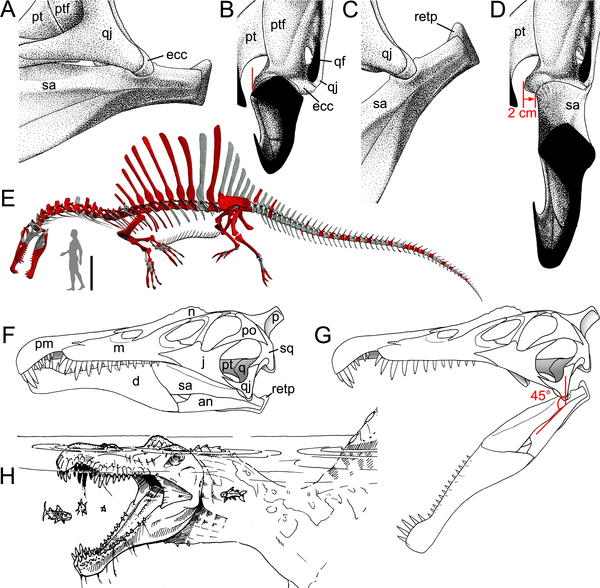
The latest paper on these animals is that of Christophe Hendrickx et al. (2016), a piece which provides another interpretation on Moroccan spinosaurine diversity based on isolated quadrate bones. These are elements from the back of the skull which, among other things, articulate with the lower jaw. I don't really want to go into the ins and outs of their primarily descriptive and systematic assessment as the paper is a) a bit of a beast and b) we've spoken a lot about spinosaurine taxonomy of late and I'm desiring fresh topics. It will suffice to summarise that Hendrickx et al. (2016) provide compelling evidence for at least two spinosaurines being present in the Moroccan Kem Kem Beds, one of which is Sigilmassasaurus brevicollis and the other is - in their interpretation - Spinosaurus aegyptiacus. These results are not exactly the same as those presented in the recent Evers et al. (2015) paper, as Hendrickx et al. shuffle and deal north African spinsosaurid fossils among named taxa in another unique way. However, it certainly adds further evidence against the concept of a single spinosaurine species ruling Late Cretaceous north Africa proposed by Ibrahim et al. (2014). And yes, for those interested in scientific responses to the famous quadrupedal Spinosaurus reconstruction publicised in 2014, Hendrickx et al. (2016) specifically comment on the likelihood of it being a chimera of animals from across time and space. There's lots more in the paper - spinosaur skull morphology, body size, ontogeny, loads of illustrations and it's 100% open access - interested parties should definitely check it out.

The pelican-like foraging anatomy of Spinosaurus, as illustrated in Hendricks et al. (2016).
Moving on to fresh, but still spinosaurine-filled waters, let's talk about something more fun - functional morphology that is*! One of the neater parts of the Hendrickx et al. analysis is that they pay a lot of attention to the jaw articulation of spinosaurines, providing detailed descriptions of how it may have influenced jaw operation and prey capture (above). Some readers may be aware that spinosaurids have 'helical' or 'asymmetric' jaw articulations, in which the quadrate condyles force the jaw somewhat outwards as it opens. Hendrickx et al. quantify this, noting that the lateral displacement is somewhere in the region of 20% of the quadrate width when the jaw is opened 45°. This equates to approximately 20 mm of motion on each side of the jaw in a c. 1 m long skull. As a rule, non-avian theropods do not have these helical joints, although they do occur in some pterodactyloid pterosaurs and, perhaps more famously, modern pelicans. Hendrickx et al. (2016) also note that the anterior connection between spinosaurid mandibular rami - the mandibular symphysis - has a fibrous texture indicative of being somewhat loose and flexible, enhancing the pelecanid comparisons further.

*It's OK, my shame about that pun is worse than any punishment you could deliver.

In both the paper and news outlets (example), these perceived similarities between spinosaurid and pelican jaws are being stated as evidence of spinosaurs feeding in a pelican-like fashion, splaying their jaws to enhance food capture and swallow larger prey. Regular readers may recall that Darren Naish and I published research on similar claims for pterosaurs in 2013 (although the paper was not 'officially' published until last year - Witton and Naish 2015), countering suggestions that some pterosaurs fed like pelicans because of their helical quadrate articulations (Averianov 2013). This background made me surprised that another group of fossil animals was being labelled as pelican-like, as much of our discussion on pterosaurs is applicable to non-avian theropods and we're even cited in the Hendrickx et al. paper! I thought it might be of interest to explain some of my reservations about this idea here**.

**I want to note that I feel a bit awkward writing this commentary in light of recent controversies on palaeontology blogs, so-called 'Post Publication Peer Review' and so on. I hope that it's clear that this article, as with all the writings here, are meant as constructive, well-meaning expressions of opinion from someone with an interest in these topics and experience in a similar research field. My disagreement with the functional analogy proposed by Hendrickx et al. and their PR work is a polite one, and doesn't mean I disrespect them as scientists or want to undermine the significance of their paper.

We should begin by familiarising ourselves with the jaws of some relevant modern birds. Quite a bit of research has been done into pelican jaw anatomy (Schreiber et al. 1975; Meyers and Myers 2005; Field et al. 2011), an unsurprising fact given how awesomely and specifically adapted their jaws are to their unusual foraging method. Researchers have identified a number of adaptations critical to pelicans being able to splay their jaws so widely. They include reduced mineralisation at the middle part of the lower jaw to make a long 'bending zone', and even further reduction of mineral content (down to 20%) adjacent to the mandibular symphysis. This makes a 'hinge' for the mandibular rami to swing outwards on despite the fact there is no articulation or joint in the jaw at this point. The mandibular symphyses are so short that virtually all the jaw length is permitted to splay. At the other end of the jaw, the tongue is similarly reduced so as not to get in the way when the mouth is opened. The connection between the dentary bone (forming the jaw anterior) and the complex of bones of the posterior jaw is long, loosely connected and obliquely oriented so as to aid motion when the mandible spreads outwards. Even the horny tissues of the beak are specialised, being very thin (described as 'skin-like' by some authors) so as not to impede jaw flexion.

Contrastingly, little mention is made of helical jaw joints when talking about pelican foraging strategies. Zusi (1993) mentions that jaw spreading at the joints may be important to this effect, but more recent literature states that the precise mechanic responsible for bowing pelican mandibles is not really understood (Meyers and Myers 2005). Three hypotheses are currently thought viable: forces and weight of water acting on the jaw (known to be only part of the solution, as pelicans can splay their jaws on land too), contraction of muscles in the gular pouch (pulling the chin backwards, pushing the jaw rami out) or twisting of the lower jaw by the pterygoideus jaw musculature (Meyers and Myers 2005 and references therein). I guess it's possible that lateral displacement of the jaws has some role too, but it's interesting that the pelican guys aren't championing it's role as essential to manibular bowing. It's always risky using negative evidence in this way, but it might be telling given how intensively studied pelican skulls are.

Mandibular bowing in modern birds, as illustrated by Zusi (1993). a, herring gull (Larus argentatus) with relaxed and bowed mandibles; b, common potoo (Nyctibius griseus) skull and mandible (arrows show zones of flexion; c, tawny frogmouth (Podargus strigoides), a potoo incapable of mandibular kinesis. Note contrasting morphology between the potoo mandibles - even as a fossil taxon, there would be no doubt that N. griseus was capable of mandibular flexion.
Perhaps a factor in ornithologists not paying much attention to pelican jaw joints is that helical quadrate articulations are not unique to them. In addition to pelicans, pterosaurs and spinosaurids, numerous bird groups are equipped with asymmetric quadrate condyles. These including herons, shoebills, certain hummingbirds and seed-eating songbirds, potoos and others. In all these species, the effect is the same - lateral displacement of the posterior jaws when the mouth is opened. Because these animals have very different diets, foraging strategies and lifestyles, their convergence on a similar jaw anatomy reflects a basic functional requirement: apprehending or swallowing large food (Zusi 1993). However, not all these species bow their anterior mandible regions in a significant way. To perform this trick, many non-pelecanid birds have mandibles with hinged regions (above). Some species, like certain potoos, are remarkable in this regard, perhaps surpassing pelicans in their ability to expand and even twist their throats into wide basins. It is not only specialised taxa which have remarkable lower jaws: the likes of seagulls can also bow their mandibles to an impressive extent. In these birds, a combination of the pull of the pterygoideus muscle and osteological specialisations allow the jaws to bulge sideways and large food items to enter the throat. The message here seems to be that helical jaw joints might have nothing to do with pelican-like jaw bowing, whereas other features - the development of pronounced mandibular hinges and specialised musculature - might be.

Modern birds give us a pretty good idea of what sort of features we're looking for in a pelican-like dinosaur. In doing so, as might already be obvious, they suggest major issues with the pelican-spinosaur analogy. Firstly, we need to acknowledge that helical jaw joints are not a special pelican feature. We could also call spinosaurid mandibular joints 'heron-like', 'potoo-like', or even 'hummingbird-like'. It seems more precise to suggest spinosaurid jaw joints are similar to those of several modern bird lineages and not over-emphasise anything to do with pelicans.


Our mandibular bowing experiments with pterosaurs and pelicans illustrated. Even when stretching the pterosaur jaws beyond the limits of their jaw joints, their area increase was negligible compared to that of a lazy pelican. From Witton and Naish 2015.
Secondly, given how ecologically variable modern birds with helical jaw joints are, and that there is no obvious correlation between asymmetric quadrate condyles and mandibular bowing, we need to treat them as part of a 'functional package' - a recipe of functional elements considered simultaneously to assess their overall effect on behaviour and lifestyle. The attempt here is to see the bigger picture of how such joints work with the rest of the jaw - do they function in a pelican-like fashion? It doesn't seem so. The amount of mandibular movement in spinosaurids is pretty negligible compared to what we see in modern birds. As noted above, quantification of of jaw motion by Hendrickx et al. suggests the lower jaws move only a tiny amount, each jaw splaying 20 mm from a skull approaching 1000 mm long. It's likely this motion would not even be noticeable in life. I'm reminded of the calculations Darren and I predicted for pterosaur jaw expansion (above) where we found pterosaur helical jaw joints boost jaw area, at most, by a few 10s of percent, but anterior jaw bowing in pelicans increases area by hundreds of percent (Witton and Naish 2015). These calculations seem to agree with current research that bowing of the anterior mandible is the most important agent in having widely distending jaws. No spinosaurid jaw yet known has adaptations for anterior mandible motion akin to those of pelicans, or even other birds capable of mandibular bowing. Many readers will know that we can, and have, assessed the kinetic potential of fossil animal skulls, including those of fossil pelicans (Louchart et al. 2011). we should be able to detect bowing mandibles in non-avian dinosaurs and other fossil reptiles, should they occur.

My points here might be countered by the observation that the mandibular symphyses of some spinosaurids are quite fibrous, perhaps indicating a loose and mobile connection between them (Hendrickx et al. 2016). This might be the case, but Hendrickx et al. also note that some spinosaurid symphyses are longer than those of other theropods, thus actually having a greater degree of anterior attachment between each lower jaw. Based on our understanding of modern bird jaws, surely this is the opposite of what we'd expect in an extinct pelican-analogue? Even if I'm wrong on that, a slightly spongy symphysis and helical jaw joints are several functional miles off the flexibility afforded by avian jaws - especially those with the most extreme adaptations for mandibular bowing, like pelicans.

In all, then, I'm not convinced on the idea that spinosaurids were pelican-like in their foraging habits. Rather, the adaptations outlined by Hendrickx et al. suggest a somewhat bird-like ability to increase gape for swallowing slightly larger food than usual. In actuality, spinosaurid jaw functionality contrasts so markedly with that of pelicans that it might be misleading to tout pelicans as spinosaur analogues. After all, the spinosaurid ability to bulge their jaws slightly is not especially pronounced or even rare, whereas what pelicans do is really both those things: an extreme and marked adaptation, and almost unique in nature. I come back to a point I've made about other instances of 'extreme' modern animals being used as analogues for extinct ones: we need to be as thorough as possible in our functional assessments before pointing to highly specialised and extremely adapted modern species as suitable analogues for long dead taxa.

Enjoyed this post? Support me on Pateon!

The artwork and words you see here are supported by Patreon, the service which allows you to directly support artists and authors with monthly payments. You can support this blog from $1 a month and, in exchange, get access to bonus content and rewards - the more you pledge, you more bonuses you receive. For this post, I'll be explaining the rationale behind the spinosaurine depicted at the top of this post - it's not Spinosaurus 2014, not a 'classic' reconstruction - what's going on?

Later this month (February 2016) I'll be sending out signed art prints to all those who pledge at least $5 a month - sign up now to get yourself on the receivership list!

References

  • Averianov, A. O. (2013). Reconstruction of the neck of Azhdarcho lancicollis and lifestyle of azhdarchids (Pterosauria, Azhdarchidae). Paleontological Journal, 47(2), 203-209.
  • Field, D. J., Lin, S. C., Ben‐Zvi, M., Goldbogen, J. A., & Shadwick, R. E. (2011). Convergent evolution driven by similar feeding mechanics in balaenopterid whales and pelicans. The Anatomical Record, 294(8), 1273-1282.
  • Hendrickx, C., Mateus, O., & Buffetaut, E. (2016). Morphofunctional Analysis of the Quadrate of Spinosauridae (Dinosauria: Theropoda) and the Presence of Spinosaurus and a Second Spinosaurine Taxon in the Cenomanian of North Africa. PloS one, 11(1), e0144695.
  • Ibrahim, N., Sereno, P. C., Dal Sasso, C., Maganuco, S., Fabbri, M., Martill, D. M., Zouhri, S. Myhrvold, N. & Iurino, D. A. (2014). Semiaquatic adaptations in a giant predatory dinosaur. Science, 1258750.
  • Louchart, A., Tourment, N., & Carrier, J. (2011). The earliest known pelican reveals 30 million years of evolutionary stasis in beak morphology. Journal of Ornithology, 152(1), 15-20.
  • Meyers, R. A., & Myers, R. P. (2005). Mandibular bowing and mineralization in brown pelicans. The Condor, 107(2), 445-449.
  • Schreiber, R. W., Woolfenden, G. E. & Curtsinger, W. E. (1975). Prey capture by the Brown Pelican. The Auk, 92(4), 649-654.
  • Witton, M. P. and Naish, D. (2015) Azhdarchid pterosaurs: water-trawling pelican mimics or "terrestrial stalkers"? Acta Palaeontologica Polonica 60, 651-660.
  • Zusi, R. L. (1993). Patterns of diversity in the avian skull. The skull, 2, 391-437.

Friday, 22 January 2016

Deinosuchus: the Dalek-backed alligatoroid that (sometimes) made chew toys of dinosaurs

Deinosuchus rugosus swallows the remains of a large Cretaceous sea turtle. Other archosaurs notice, decide to interrupt.
Any palaeontological geek worth their salt knows that several gigantic crocodyliform species - colloquially called 'supercrocs' - have appeared in the last 100 million years. They include the Moroccan, Cretaceous pholidosaurid Sarcosuchus imperator, several species of the South American Miocene caimanine Purusaurus, and the grandfather of them all, Deinosuchus, from the Late Cretaceous (Campanian) of North America. Deinosuchus is not the most 'extreme' of these giant crocodyliforms in terms of anatomy or size (but see below), but discovery of a partial skeleton in 1903 (and description six years later) was the first evidence for some croc-line archosaurs being very, very large. It is also perhaps the best publicly known giant crocodyliform, various reconstructions of its skull and skeleton appearing in museums all over the world, and being a semi-regular component of palaeoart.

Perhaps because Deinosuchus is 'only' a giant crocodylian and not a member of a completely extinct, weirdo lineage, coverage of its palaeobiology is often limited to factoids on its immense size and probable habits of eating dinosaurs. Our short attention span for this animal is not new: one of the key players in its discovery, John Bell Hatcher, lost interest in describing the first significant Deinosuchus remains once its crocodylian identity (rather than dinosaurian, as originally supposed) became apparent in 1903 (Schwimmer 2002). It took further persuasion and a number of years for palaeontologists to actually publish, name and describe this animal after Hatcher died in 1904 (Holland 1909). As we'll discover in this article, the scant attention paid to this animal is rather criminal: over the last century a detailed and fascinating picture of Deinosuchus has developed.

The Colbert and Bird (1954) reconstruction of Deinosuchus riograndensis, based on partial skull material collected from the late Campanian Aguja Formation, Texas. We now appreciate this reconstruction as being erroneous in a number of crucial ways, and it should not be considered representative of the appearance of this animal. Note the apertures in the snout tip alongside the actual nares. Images from Colbert and Bird (1954).
I'm going to start by sidestepping the confused history surrounding the discovery and naming of Deinosuchus material - interested parties can find a full summary in David Schwimmer's (2002) book Deinosuchus: King of the Crocodylians. It will suffice to state that fossils of this animal have been known since at least the mid-1800s and repeatedly hopped between species and genera during the last 150 years. Only one or two species are recognised nowadays. D. rugosus is the type species of the genus, first identified from two characteristically large, blunt teeth with wrinkled, thick enamel collected from the eastern US in the 1858 (examples below). Over time, these teeth were found to be linked with other Deinosuchus material including extremely thick, massive and deeply pitted osteoderms. These elements are highly characteristic even today, and permit even isolated teeth and osteoderms to be referred to this species (Schwimmer 2002). A possible second species is D. riograndensis, based on very large Deinosuchus fossils from Texas recovered in the 1940s (Colbert and Bird 1954). It's this riograndensis material that most of us think of when Deinosuchus is mentioned, it providing the basis of a famous, 2 m long and largely artistic Deinosuchus skull reconstruction unveiled at the AMNH in 1954 (above). The riograndensis skull was once thought characteristic because of unusual openings in the side of the snout tip (Colbert and Bird 1954), but these are now thought to be damage caused during preparation (Schwimmer 2002). As more and better Deinosuchus remains have been recovered in recent decades, some have argued riograndensis and rugosus are one and the same animal, the latter holding nomenclatural priority. Full agreement on this does not seem apparent from current literature, but on-going work on relatively complete Deinosuchus material will help clarify the taxonomy of this animal in future.

Deinosuchus is recognisable from its teeth alone. These specimens are from the posterior end of the jaws, and show the wrinkled enamel typical of the genus. Note the heavily worn and broken the tips. From Schwimmer (2010).
We now appreciate that Deinosuchus is one of the oldest members of Crocodylia, the crown group crocodile-line archosaurs. Features of its skull and jaws indicate it was specifically a member of Alligatoroidea, the lineage of Crocodylia represented today by alligators and caimen. It's not uncommon to see Deinosuchus referred to as a 'giant alligator', but this is not really accurate and I recommend avoiding such terminology, even for lay audiences. Alligators and Alligatoridae are a distinctive group of alligatoroids with particular habits and anatomy, and they are no more closely related to Deinosuchus than caimen. It must also be stressed that neither of our modern alligatoroid clades are especially closely related to Deinosuchus. I figure most people will intuitively grasp the rough meaning of 'giant alligatoroid', and suggest this term is used in preference of 'alligator' in outreach media about this animal.

The Deinosuchus fossil record is something of a mixed bag. There are hundreds of fossils of it, but most of them are isolated postcranial bones, broken bits of skull and, especially, those massive teeth and osteoderms. The state of many Deinosuchus fossils can be ascribed to its remains being reworked by storms after their initial burial. Some partial skeletons and more complete skulls escaped this treatment but are not yet described in detail. A silver lining to not having much in the way of complete material is that isolated Deinosuchus bones are distinctive enough to map its range across Campanian North America. Many of us might think of Deinosuchus as a Texan animal, but it actually enjoyed a wide distribution, and being most abundant in the southeastern United States. A clear palaeobiogeographical pattern can be gleaned from Deinosuchus fossils, a divide separating occurrences in Montana, Wyoming, Utah, Colorado, New Mexico, Texas, and Northern Mexico from remains on the eastern side of the United States - Mississippi, Alabama, Georgia, North Carolina, and New Jersey (Titus et al. 2008). This east-west distribution is no fluke of preservation but reflection of Deinosuchus populations being separated by the Western Interior Seaway, the continental sea which divided North America during the Cretaceous. Although apparently not a fully marine creature, it is thought Deinosuchus lived in the coastal waters and estuaries of this seaway as, to date, its fossils have not occurred in fully freshwater or terrestrial deposits. Further evidence of its preference for coastal waters is the recovery of more complete and associated remains from wholly marine deposits.

A modern depiction of the Deinosuchus rugosus skull and mandible. From Schwimmer (2002).
Our incomplete knowledge of Deinosuchus anatomy means we can only form a partial picture of what it looked like in life. We can say, however, that the famous 'Colbert and Bird' riograndensis skull sculpture from the 1950s is erroneous in several regards. Manufactured as a display for the American Museum of Natural History (and then reproduced for museums around the world), the Colbert and Bird skull is too large, the snout too narrow, the tooth morphology inexact and, as noted above, the openings in the snout tip are likely erroneous (Schwimmer 2002). This is not a dig at AMNH artists course: they did the best they had with material available to them, and it's only with the discovery of better fossils that we can now spot errors. Perhaps unfortunately, museums continue to display this reconstruction and artists continue to use it as a reference. A modern picture of Deinosuchus is rather different: a broad- and deep-snouted crocodylian with a skull known to be at least 1.3 m in length, and perhaps a little longer if very fragmentary remains are being correctly interpreted (Schwimmer 2002). Most of its cranial features are typically crocodylian, including the presence of huge spaces for jaw muscle attachment, development of a secondary palate and dorsally situated orbits and nares. Befittingly for such an enormous animal, the teeth are huge and consistently robust along the jaw, those at the front being conical and pointed, and those at the back being increasingly stunted and shortened. The toothrow is very long in stretching from the jaw tip to just behind the eye. All teeth have the distinctively thickened, wrinkled enamel mentioned above. Unlike modern alligatoroids, a notch in the side of the upper jaw acts as a receptacle for the fourth tooth of the lower jaw and presumably rendering it visible even when the jaw was closed. This is the 'primitive' condition for crocodylians, and means that although Deinosuchus is an alligatoroid, it likely had a crocodile's smile.

Less can be said about the body and limbs of Deinosuchus. Schwimmer (2002) reports that partial skeletons hint at a general form and proportion not unlike a modern alligator. However, some authors have noted discrepancies in scaling of Deinosuchus limb bones which might indicate reduced limbs in at least the largest specimens (Farlow et al. 2005, see below). One thing we can be sure of is that the body of Deinosuchus was covered in those aforementioned large, thickened osteoderms (below). The exact arrangement of these elements remains unknown, but we can predict that at least four rows of osteoderms extended along the body of Deinosuchus because of its affinities to modern crocodylians. These osteoderms become disproportionately massive and robust with growth, so that those of the largest individuals are distinctively chunky and have lost some definition of a keel found in smaller examples. Artists should take note of this: the dorsum of a big Deinosuchus would have looked more like a gnarly Dalek chassis than the back of any modern crocodylian. As is typical for crocodyliforms, these dermal bones might have reinforced the trunk skeleton as well as providing armour plating, forming a network of muscle, ligaments and bone which bound the torso together (Salisbury and Frey 2000). It is speculated that the presence of very large, robust osteoderms in the biggest Deinosuchus indicates the presence of a torso strong enough for terrestrial locomotion (Schwimmer 2002).


The huge, deeply pitted and bulbous scutes which characterise Deinosuchus, as illustrated by Holland (1909). This image is a composite of two scutes from Holland's work, put together by FanCollector for Wikipedia. Both show cervical osteoderms, the left being a particularly big one
The maximum size of Deinosuchus is the source of much fascination and discussion. The largest estimates based on reliably measured remains suggest body lengths of around 12 m (Schwimmer 2002), but - as usual with giant fossil animals - there are a number of factors and caveats worth considering here. The scant nature of Deinosuchus fossils dictates that we must extrapolate the size of large Deinosuchus from much smaller, better known individuals and modern crocodylians. The 12 m figure stems from scaling the largest Deinosuchus vertebrae to total body length estimates of smaller individuals (Schwimmer 2002). Skulls and mandible lengths, when compared to a dataset of modern alligator proportions, indicate the largest animals achieved 10 m in length (Schwimmer 2002; Farlow et al. 2005). Another approach, using femoral measurements, results in a maximum body length estimate of 6-8 m, this being estimated from big femora typically thought to indicate 10 m+ animals. The explanation for these differences will be familiar to anyone who's estimated the size of a big, extinct animal: uncertainty about the proportions of the animal in question, the need to extrapolate well beyond the size boundaries of modern analogues, and the lack of associated remains of the biggest individuals. Most workers seem happy with a 10 m length estimate for a big Deinosuchus, those lower estimates based on femoral size being explained as possible evidence of reduced limb proportions in the biggest Deinosuchus individuals (Farlow et al. 2005). As usual, we await the discovery of more complete and informative remains to tell us the full story here. It should be stressed that similar caveats apply to size estimates of other 'supercrocs': despite the media hype associated with some discoveries, it's quite difficult to know which crocodyliform species was largest based on our current material.

Regardless of what the actual maximum size of Deinosuchus was, we have good reason to think that many individuals were not true giants. No specimens indicative of 10 m body length have been found among the many hundreds of Deinosuchus remains from the eastern side of the US, it being instead thought that eastern Deinosuchus didn't grow longer than 8 m. That's still pretty big of course, but not too far off crocodylians that we're familiar with today (the biggest saltwater and Orinoco crocodiles on record are a little over 6.5 m - Grigg and Krishner 2015). The true giants only occur in the west, and are much rarer fossils than their eastern counterparts. These fossils are also slightly younger than the eastern specimens, perhaps indicating changes across time and geography were responsible for Deinosuchus becoming exceptionally large. Research into the growth rates of Deinosuchus indicate that there might be nothing unusual about it's growth trajectory despite its size. It seems to have grown with a similar strategy to other crocodylians - relatively fast at first, and progressively slower over time - but simply stretched out the growth duration to many decades (Erickson and Brochu 1999). Growth rings in osteoderms indicate that the largest animals were about around 50 years old (below).

Growth rates in living and extinct crocodylians (a) and growth rings in a Deinosuchus osteoderm (b). Note how the Deinosuchus growth trajectory is essentially a scaled up version of its smaller relatives. From Erickson and Brochu (1999).
For many, the main discussion to be had about Deinosuchus is the impact it had on local dinosaur populations: was this animal a dinosaur predator? Attempts to answer this question stem from two sources: biomechanics and fossil evidence of ancient faunal interactions. The first, biomechanics, includes a recent study of 'death rolling' (the crocodylian habit of rotating around the long axis of the body while gripping prey with their jaws, literally twisting it apart) and whether Deinosuchus could use this strategy to dismember large prey (Blanco et al. 2015). Snout strength can be correlated quite accurately to death rolling capabilities in modern crocodylians (Blanco et al. 2015) and, seeing as this can be inferred from upper jaw skeletons alone, we can obtain some insight into the death rolling capabilities of extinct crocodyliforms. Perhaps surprisingly, estimates of Deinosuchus jaw strength were approximately one third of the strength required for this behaviour (Blanco et al. 2015). Scaling factors have been used to explain this unexpected result and, despite the outcome of their experiments, Blanco et al. suggest that death rolling was possible in Deinosuchus. I must admit to thinking additional experimentation is needed to quantify those scaling factors before considering this matter closed. Moreover, in checking the Blanco et al. data for this article I noted that their study modelled the Deinosuchus skull as 1.8 m long, a figure noted as speculative by Schwimmer (2002) and almost 40% longer than the largest measured skull length reported by the same author (1.31 m). A 40% shorter skull would be less prone to the scaling effects outlined by Blanco et al. and may result in a jaw strength more suited to death rolling - it would be great to see this checked out in future.

Partial theropod hindlimb bone (tibia or metatarsal) post a one-on-one session with Deinosuchus jaws. This bone is meant to be subrounded in cross section. From Schwimmer (2010).
More positive and definitive answer about Deinosuchus dinosaur predation stems from fossil evidence. It seems that, yes, Deinosuchus did dine on dinosaurs, but not exclusively or maybe even often (Schwimmer 2010). A handful of Campanian dinosaur bones - including a theropod hindlimb element from Georgia (above) and hadrosaur vertebrae from Texas - possess bitemarks characteristic of crocodylians, albeit on a scale unseen in the modern day (Schwimmer 2002, 2010). The theropod bone can only be described as exceptionally chewed: numerous, overlapping circular potmarks show where the bone was repeatedly bitten and crushed by a very powerfully jawed animal. So pulverized is this bone that its once subrounded cross section has become quadrangular - Schwimmer (2002) summarises the state of this specimen as 'resembling a dog's worn chew toy' (p. 186). The crocodylian signature, bite mark size and provenance of both specimens point to Deinosuchus as a possible perpetrator, and evidence that it did eat dinosaurs on occasion. Of course, it cannot be easily established whether these animals were killed by Deinosuchus or merely scavenged by them - some reasoning for the former is discussed by Schwimmer (2010).

Deinosuchus bite marks in fragments of a turtle (Chedighaii barberi) plastron. The tooth marks are about 4-5 times larger than those made by 4 m long nile crocodiles. From Schwimmer (2010).

There are reasons to think dinosaur meat was not a mainstay of Deinosuchus diet, however. Whereas a few dinosaur bones have been linked to the jaws of this crocodylian, more than a dozen Campanian sea turtle specimens have been found with bite marks made by a giant crocodylian (Schwimmer 2010). A diet of turtles is not surprising when we consider that the skull and dentition of Deinosuchus is more adapted to crushing bone than piercing skin and flesh (Schwimmer 2002): those robust posterior teeth are especially reminiscent of teeth in modern, turtle-eating crocodylians. Many Deinosuchus teeth are considerably worn and broken too, a likely consequence of being smashed into hard, bony prey rather than soft, spongy dinosaur limbs. Healed turtle shells suggest that these animals were predated by Deinosuchus rather than just scavenged, and raking bites across some specimens may record less fortunate turtles being juggled about Deinosuchus jaws when being eaten (Schwimmer 2010). The coastal and estuarine environmental bias of Deinosuchus fossils is consistent with it being a serial turtle predator, this being ideal habitat to find sea-going prey. Curiously, other marine inhabitants of the Western Interior Seaway have yet to be associated with Deinosuchus bite marks: perhaps it really did have a preference for turtles, or perhaps other skeletons were simply pulverised beyond recognition by those massive jaws. Either way, our discussion of this animal's feeding habits would not be complete without mentioning the numerous, possible Deinosuchus coprolites which have recently been identified (Harrell and Schwimmer 2010). Sadly, these do not reveal much about diet or digestive anatomy, other than the obvious fact that Deinosuchus poop was on average a lot larger than that produced by other crocs. Several anomalous features of these coprolites have led some authors (e.g. Hunt and Lucas 2010) to be sceptical of their organic origins however, their alternative being that they are simply calcareous nodules.

The foraging habits of Deinosuchus brings us to new perspectives on where it fits into Mesozoic ecology. New evidence is eroding the uniqueness of Deinosuchus in Campanian North America, it no longer being the only very large or even giant crocodyliform species in some localities. These new finds include a currently poorly known, but obviously giant neosuchian from the Williams Fork Formation of Colorado (Foster and Hunt-Foster 2015) and a more completely known, 7 m long, undescribed neosuchian from Woodbine, Texas (Main 2012). The latter is currently being worked on, and early indications are that it might represent a late surviving goniopholidid - a much older branch of the crocodyliform lineage. Whatever they turn out to be, the Woodbine and Williams Fork animals suggest that very large crocodyliforms might not have been unusual in Campanian North America. Their presence in a timeframe deficient of large theropods has not gone unnoticed, it being speculated that these large crocodyliforms may have been doing work normally reserved for big predatory dinosaurs (e.g. Schwimmer 2002). Similar proposals have been made about other large bodied Late Cretaceous carnivores taking over typically theropodan roles (e.g. Witton and Naish 2015) - the notion of the Mesozoic as an all-dinosaur show is looking increasingly out of date.

As a closing thought, I find it interesting that we tend to portray Deinosuchus as something of a freak species, one of those rare forays of crocodylian evolution into gigantic size which never really seemed to last that long or lead anywhere. As might be apparent from this article, this view is somewhat misleading. Deinosuchus certainly represents an 'extreme' of crocodylian evolution, but it's at the end of a spectrum, not a weird outlier from the rest of the group. Much of what it did, how it did it, and what makes it a fascinating animal, is mirrored in its modern and fossil relatives. Contrary to some perspectives on this animal, the fact it represents an ancient member of a modern group does not make it tedious or dull. Quite the opposite is true: Deinosuchus reminds us that animals from Deep Time are part of a continuum with our own fauna, revealing the awesome things modern lineages have been capable of, the potential their anatomies have in the present, and what they might be up to in future. How anyone can find pondering an animal that gives such a raw perspective on evolution and adaptation boring or uninteresting is beyond me.

Now is a great time to sign up to my Patreon

The artwork and words you see here are supported by Patreon, the service which allows you to directly support artists and authors with monthly payments. You can support this blog from $1 a month and, in exchange, get access to bonus content and rewards - the more you pledge, you more bonuses you receive. In February be sending out signed art prints to all those who pledge at least $5 a month - sign up now to get yourself on the receivership list!

References

  • Blanco, R. E., Jones, W. W., & Villamil, J. (2015). The ‘death roll’of giant fossil crocodyliforms (Crocodylomorpha: Neosuchia): allometric and skull strength analysis. Historical Biology, 27(5), 514-524.
  • Colbert, E. H., Bird, R. T., & Brown, B. (1954). A gigantic crocodile from the Upper Cretaceous beds of Texas. American Museum Novitates; no. 1688.
  • Erickson, G. M., & Brochu, C. A. (1999). How the ‘terror crocodile’ grew so big. Nature, 398, 205-206.
  • Farlow, J. O., Hurlburt, G. R., Elsey, R. M., Britton, A. R., & Langston Jr, W. (2005). Femoral dimensions and body size of Alligator mississippiensis: estimating the size of extinct mesoeucrocodylians. Journal of Vertebrate Paleontology, 25(2), 354-369.
  • Foster, J. R., & Hunt-Foster, R. K. (2015). First report of a giant neosuchian (Crocodyliformes) in the Williams Fork Formation (Upper Cretaceous: Campanian) of Colorado. Cretaceous Research, 55, 66-73.
  • Grigg, G., & Kirshner, D. (2015). Biology and Evolution of Crocodylians. Csiro Publishing.
  • Harrell, S. D., & Schwimmer, D. R. (2010). Coprolites of Deinosuchus and other crocodylians from the Upper Cretaceous of western Georgia, USA. New Mexico Museum of Natural History and Science, Bulletin, 51, 209-213.
  • Holland, W. J. (1909) Deinosuchus hatcheri, a new genus and species of crocodile from the Judith River beds of Montana. Annals of the Carnegie Museum, 6, 281–294.
  • Main, D. J. (2012). Crocodiles of the Texas Cretaceous; the Campanian of Big Bend to the Cenomanian of North Texas, a comparison of great size, feeding behaviour and paleoecology. Geological Society of America Abstracts with Programs, 44, 3.
  • Schwimmer, D. R. (2002). King of the crocodylians: the paleobiology of Deinosuchus. Indiana University Press.
  • Schwimmer, D. R. (2010). Bite marks of the giant crocodylian Deinosuchus on Late Cretaceous (Campanian) bones. New Mexico Museum of Natural History and Science Bulletin, 51, 183-190.
  • Titus, A.L., Knell, M.J., Wiersma, J.P., Getty, M.A. (2008). First report of the hyper-giant Cretaceous crocodylian Deinosuchus from Utah. Geological Society of America Abstracts with Programs, 40, 58.
  • Witton, M. P. and Naish, D. (2015) Azhdarchid pterosaurs: water-trawling pelican mimics or "terrestrial stalkers"? Acta Palaeontologica Polonica 60, 651-660.