Thursday, 11 July 2013

Rhamphomummies and zombie skim-feeders

A 'mummified' Rhamphorhynchus muensteri entangled with the spear-like rostrum of Aspidorhynchus acutirostris, presumably reflecting a failed predation effort by the latter. Painting of a privately-held specimen, used with permission.
A few months ago, Frédéric Weber asked me to render two images of a spectacular, unpublished specimen from the famous Jurassic Solnhofen deposits of Germany. It showed a rare association between two animals: the non-pterodactyloid pterosaur Rhamphorhynchus muenesteri and a ganoid fish, Aspidorhynchus acutirostris. Associated fossils are not uncommon in some deposits, but they are extremely rare in the Solnhofen Limestone. Fred wanted images of this Rhamphorhynchus/Aspidorhynchus association to illustrate a recent article in Fossiles magazine devoted to pterosaur specimens from Solnhofen (Weber 2013), with this particular specimen being all the more important because the pterosaur's body outline has been preserved by growths of calcite crystals rather than decaying away. 'Mummified' pterosaurs like this aren't entirely unheard of, but they remain rare and are exciting for what they tell us about soft-tissue distribution. Making this specimen even more spectacular is the preserved wing tissues of the pterosaur and the perfect state of the neighbouring Aspidorhynchus. Fred wanted to show the exquisite preservation of the specimen but was asked not to reproduce photos by its owner, so he asked me to do my best at reproducing it in a few images. The article containing this image is only the latest in a series on pterosaurs produced by Fred and, even if you cannot read French, they're well worth tracking down for their awesome imagery.

Those of you with ears to the ground of pterosaur research will know that this specimen is not one of a kind. Another, WDC CSG 255, was described by Eberhard 'Dino' Frey and Helmut 'King of UV' Tischlinger back in 2010, and at least three others are known. Given how rare such associations are in Solnhofen desposits, the repeated association of these animals implies some common explanation for their co-preservation. The rationale provided by Frey and Tischlinger (2010) sounds pretty convincing to me. They suggest that Aspidorhynchus frequently predated Rhamphorhynchus but, because the pterosaur was a little too big and gangly for its mouth, it's wing membranes became entangled on the fish's rostral spar or teeth and could not be swallowed. In efforts to shake the pterosaur loose, some Aspidorhynchus accidentally entered the anoxic bottom waters of the Solnhofen lagoon and, well, the rest is pretty self explanatory. It's quite probable that these predatory events were accidental, which may explain why many Aspidorhynchus specimens preserve fishy gut content, but none show successfully ingested pterosaur bones.
The Rhamphomummy and it's attacker in full. Line drawing of a privately-held specimen, used with permission.
But that's not all
Remarkably, one of these associations provides some insight into what brought the Rhamphorhynchus into striking range of Aspidorhynchus. The throat region of the WDC CSG 255 Rhamphorhynchus is full of undigested fish bones (probably Leptolepides) which suggest it was foraging for food just before it was grabbed by an Aspidorhynchus(Frey and Tischlinger 2010). The fact that at least some Rhamphorhynchus were likely foraging in the immediate interim before being attacked has, of course, raised interest in the foraging method utilised by Rhamphorhynchus because it may be linked to the attacks from Aspidorhynchus. Frey and Tischlinger (2010) suggest two options here. Firstly, Rhamphorhynchus may have grabbed fish from the water surface by dip-feeding, and was then grabbed. Unlikely, they say, because this wouldn't give the Aspidorhynchus enough time to grab the pterosaur once it disturbed the water. So a more likely idea, they suggest, is skim-feeding.
"Skimming... took time and resulted in a significant signal of turbulence, when the mandibular rostrum ploughed through the silent water surface. Such turbulences attract all kinds of fishes and are also were easily detectable for an Aspidorhynchus. Furthermore, the vane at the terminus of the long tail of the pterosaur could have contacted the water surface too due to the extremely low surface approach with a flight altitude of no more than 50 mm. Large Aspidorhynchus thus could grab a skimming Rhamphorhynchus by just raising the head through the water surface. The specimen presented here strongly suggests that Aspidorhynchus actually did exactly this." Frey and Tischlinger 2010, p. 4. (my emphasis)
Skim-feeding, we meet again
Yes, skim-bloody-feeding. A number of pterosaur workers - myself included - view the skim-feeding pterosaur hypothesis as highly problematic, based on very superficial science, and a complete non-starter based on simple comparative anatomy. Despite this, this idea is incredibly tenacious within pterosaur literature. Skim-feeding was widely considered a viable forging method for pterosaurs up until the mid-2000s (e.g. Wellnhofer 1991; Hazlehurst and Rayner 1992, Kellner and Campos 2002; Unwin 2005) when, under a hail of scientific bullets, several authors suggested it was implausible for numerous reasons (Chatterjee and Templin 2004; Ősi et al. 2005; Humphries et al. 2007; Witton and Naish 2008). Humphries et al., the first (and only) dedicated study of skim-feeding in pterosaurs inflicted the deepest wounds, using biomechanical testing and comparative anatomy to conclude:
"Both modelling the energy requirements of skimming pterosaurs and analysing their osteology casts serious doubt on the ability of pterosaurs to habitually skim-feed. Although our physical modelling suggests that small pterosaurs may have been energetically capable of skimming, there is no anatomical evidence to assume that Rhamphorhynchus or any other small pterosaurs were skimmers." Humphries et al. (2007), p. 5
I was part of that study (my first publication, nonetheless) and thought that, with other authors suggesting similar misgivings about the idea, that skim-feeding had been stopped dead. Like the foraging hypothesis equivalent of a freakin' zombie, it has since risen again with more questionable science to prop it up (Stecher 2008; Frey and Tischlinger 2010; Averianov 2013). Even attempts to subtly downplay the likelihood of pterosaur skim-feeding in blogs ("Die you skim-feeding bastard, die!") haven't got the message through. What will it take to down this thing? Here's another go, then, at explaining why I, and others, think this hypothesis is a complete non-starter and should be abandoned.

Where's the beef?
Firstly, there's never been an in-depth, detailed study suggesting skim-feeding was likely in any pterosaurs. So far as I can tell, the link between skim-feeding and pterosaurs started with throwaway comments by Marsh (1876), who suggested the mandible of Pteranodon was reminiscent of the lower jaw of modern skimming birds. Since Marsh, nearly 20 articles have suggested pterosaurs may have skim fed, but none have really added much to his idea. Most simply suggest, with varying degrees of certainty that pterosaurs of all kinds (rhamphorhynchids, 'campylognathoidids', ornithocheirids, dsungaripterids, thalassodromids, azhdarchids are candidates) were skim-feeders based on very superficial anatomical comparisons with modern animals. Kellner and Campos (2002) did the most thorough job with Thalassodromeus, but even that was a fairly brief comparison between their new taxon and modern skimmers that was very restricted by it's publication in the short-piece journal, Science. There's certainly never been anything published with sufficient quantified or even illustrative evidence to support skim-feeding in pterosaurs. It really seems that  pterosaur skim-feeding has become an established concept not because of its scientific credibility, but because of its longevity and popularity. Similar comments could be made about many established, 'common knowledge' ideas about fossil animals.

The skull and mandible of Rynchops niger in lateral view (A) and mandible in dorsal view (B). Note the extremely derived anatomy on every facet of this thing, all of which reflect skim-feeding habits. From Witton (2013).
The rather superficial science behind skim-feeding could almost be excused if it weren't for the extensive documentation of the lifestyle and functional anatomy of modern skimming birds. The exhaustive work (essentially a whole book) produced by Richard Zusi (1962) is a key reference here. It's widely known that, in the modern day, skim-feeding is only practised by a couple of bird species, all of which belong to the genus Rynchops. Thanks to several generations of ornithologists researching this animal, we know that Rynchops is specialised six-ways-from-Sunday for it's unusual habits. Check out the Rynchops skull and mandible, above, for instance. Virtually every facet, every joint and feature reflects it's lifestyle. This specialisation extends to its neck and flight style. Zusi (1962) noted a whopping 26 obvious morphological adaptations to skim-feeding, which are detailed in a handy cut-out-n'-keep guide below.
The result of these is that when handling a skimmer skull, even if you'd never seen one foraging, there's no doubt whatsoever about it's preferred habits. These birds need to be so specialised because, frankly, skim-feeding is a ridiculous way to feed. Dragging your lower jaw through a relatively viscous, obstacle-filled fluid at 16-32 kph and hoping to hit something you can eat isn't a particularly sensible approach to foraging. Skimmers can't even see what they're trawling into (Martin et al. 2007), and they regularly run aground in shallow mud or blunder into vegetation. On occasion, these impacts are severe enough to cause crashes or snap off the tip of the mandibular rhamphotheca (Potter 1931). Of course, evolution has a wonderful disregard for sense and logic, and skim-feeding behaviour simply promoted the development of impact resistant necks and skulls, with reinforced jaw joints and powerful jaw muscles. These include enlargement of their secondary jaw joints (a common avian feature; labelled as 'medial processes' on the diagram above), considerable reinforcement of the mandible and a broad neck base to anchor powerful, impact resisting neck muscles. Because the forces acting on Rynchops jaws during skimming are so high, skim-feeding birds have to pull their jaw muscles tight when foraging: the upper jaw is 'opened' via kinetic hinges at the mid-length of the skull. Biomechanical modelling of skimmer flight suggests skim-feeding flight is energetically demanding (Humphries et al. 2007), necessitating extremely streamlined lower jaw tissues along with abradable, rapidly-growing beak tissues to replace those worn away in accidents. Because skim-feeding impacts - desired or otherwise - pull the head into the water, skimmer necks are also unusually long and flexible. We could go on: these birds are fascinating case studies of adaptation.

Rhamphorhynchus mummy skull detail. A dorsoventrally slender mandible and a mouthful of teeth probably aren't the best way to approach skim-feeding.
With the mechanics of skim-feeding so well understood and its adaptations so obvious on animal skeletons, there's really no excuse for skim-feeding in pterosaurs to be so superficially considered. There's only so many ways for a flying tetrapod to trawl a mandible into things it hopes are food after all, so we should expect common adaptations between pterosaurs and Rynchops. Compare the skull of Rhamphorhynchus in the painting above, with that of Rynchops. Even in that crude approximation of its anatomy we can see the lack of of cranial reinforcement, the wimpy areas for jaw muscle attachment, and the bloody-great teeth where a knife-like skimming jaw should be. And yes, there are specimens of Rhamphorhynchus that show the jaw tip was extended with soft-tissue, but nothing like that seen in Rynchops (see image, above). The same arguments can be levelled at all other proposed pterosaur skim-feeders, even the animal named after it's alleged skim-feeding habits, Thalassodromeus (Kellner and Campos 2002). There are no convincing anatomical correlates for skim-feeding habits in any known pterosaur (Humphries et al. 2007; Witton and Naish 2008). This is almost certainly why pterosaurs with wingspans over 2 m (which, of course, is about the size of large Rhamphrohynchus) lack sufficient power output for skim-feeding (Humphries et al. 2007): their jaw shapes were never adapted for efficiently cutting through water. Smaller pterosaurs may be able to plough a short length of toothless jaw tip through water, but they'll be aching with the muscular exertion on their jaws, and in huge pain if they hit anything. I feel it would be remiss here to ignore the story behind testing streamlining in the Thalassodromeus jaw tip, which was so violently stressful that it broke the testing rig of the Humprhries et al. (2007) study. Back in 2007, I shared my recollection of what became known as the 'Thalassodromeus Flume of Doom':

Rather old and silly presentation slide. Based on real events.
In all the press accompanying the publication of Thalassodromeus, one worker is recorded as saying it must’ve looked like a ‘vision of hell’. Well, hats off to him: he was right. There was something unerringly terrifying about the massive jaw tip of this thing hurtling towards you at great speed. Maybe it’s because there was water everywhere. The moment Thalassodromeus began to skim, the whole rig started shaking manically, throwing water about like a possessed jetski and drawing worried glances from the crew. Notching the speed higher, the rig became more unstable and, to everyone’s surprise, the aluminium bar was even bent on one run. This was replaced and, eventually, the time came to set max speed: 25 kmph. The catcher, a nervous looking PhD student, was braced and ready. At the other end of the flume, the pterosaur-cyborg beast glared at him, the water eerily calm before the violence that would follow. “You ready?” asked Stu, and I gulped my affirmative. The winch was pulled. Suddenly, the beast was roaring down the runway. The room echoed with the inhuman screaming of its wheels on the track. The jaw was convulsing madly. Water crashed over the tank walls. Then the screaming stopped with a loud bang: the Thalassodromeus was airborne; the whole rig arcing through the air and spiralling forward - only milliseconds separated it from a watery grave. My clothes ripping against the metal tank and the waves pounding my body like Achilles in the River Scamander, I leapt forward and grabbed the plummeting contraption moments before it hit the water. We rushed the wounded rig from the flume to check its health: the aluminium bar was totally twisted, the electronics shot. The little blinking lights on the mechoreceptor faded to black. The rig lay dead in Richard’s arms. Stu called to the Heavens in anger. Dave cried. I was soaking wet. It was about then that we started wondering if ‘ocean runner’ was a name slightly too optimistic about the skimming capabilities of its owner. With testing brought to a dramatic but premature end for the day, we retired for back massages and herbal treatments from attractive Scandinavians to recover from the ordeal. Such is the life of courageous university researchers. (link to original)
Put together, these three reasons - the lack of a good studies in favour of pterosaur skim-feeding, the fact we know so much about modern skim-feeders, and the overwhelming evidence against skim-feeding in pterosaurs - are why I find it a tiny bit irritating that this idea is still being discussed as plausible. It just seems, I dunno, that our ideas should be moving on or something.

Night of the living skim feeders
If skim-feeding in pterosaurs is so objectionably flawed, why won't the idea be politely resigned to history? I predict four causes.
  1. It's an established idea, even if it's not based on any particularly rigorous science. Established ideas take a long time to overturn even if evidence to the contrary is strong. 
  2. Pterosaurs were flying animals. For some palaeontologists, this equates to them doing everything in flight.
  3. There may be unawareness concerning how specialised Rynchops is for skim-feeding, and how unique its morphology is, even among birds. Anyone thinking of proposing skim-feeding habits for pterosaurs really should familiarise themselves with the work on Rynchops lifestyle first, and particularly Zusi's 1962 treatment.
  4. Life of the past is frequently considered to be outlandish and overly dynamic (also see discussion of animal poses in palaeoart, here and here). This is perhaps why, when Frey and Tischlinger (2010) considered how a pterosaur may have been attacked by a marine predator, boring ideas like the pterosaur swimming or floating weren't considered*.
*Before anyone asks, there is at least trackway evidence suggesting pterosaurs can swim (Lockley and Wright 2003) and new take off models suggesting water launches weren't difficult (Habib and Cunningham 2010), so let's not hear anything about waterlogging of wing membranes or whatever.

Of course, none of these are particularly defensible. We simply need to stop trotting skim-feeding pterosaurs out at what almost seems like any given opportunity. There's never really been anything to it, and until sufficient evidence - like a pterosaur fossil bristling with skim-feeding adaptions - comes to light, the idea's as dead in the water as the Aspidorhynchus and Rhamphorhynchus we discussed on the way in. I'll take that arriving at conversational full circle as a good place to stop.

Next time (possibly): Space Year 2013: The Golden Age of Palaeoart?

References
  • Averianov, A. O. 2013. Reconstruction of the neck of Azhdarcho lancicollis and lifestyle of azhdarchids (Pterosauria, Azhdarchidae). Paleontological Journal, 47, 203-209.
  • Chatterjee, S. and Templin, R. J. 2004.  Posture, Locomotion and Palaeoecology of Pterosaurs. Geological Society of America Special Publication, 376, 1-64.
  • Frey, E. and Tischlinger, H. 2012. The Late Jurassic pterosaur Rhamphorhynchus, a frequent victim of the ganoid fish Aspidorhynchus? PLoS ONE, 7, e31945.
  • Habib, M. B. and Cunningham, J. 2010. Capacity for water launch in Anhanguera and Quetzalcoatlus. Acta Geoscientica Sinica, 31, 24-25.
  • Hazlehurst, G. A. and Rayner, J. M. 1992. Flight characteristics of Triassic and Jurassic Pterosauria: an appraisal based on wing shape. Paleobiology, 447-463.
  • Humphries, S., Bonser, R. H. C., Witton, M. P. and Martill, D. M. 2007. Did pterosaurs feed by skimming? Physical modelling and anatomical evaluation of an unusual feeding method. PLoS Biology 5, No. 8, e204.
  • Kellner, A. W. A. and Campos, D. A. 2002. The function of the cranial crest and jaws of a unique pterosaur from the Early Cretaceous of Brazil. Science, 297, 389-392.
  • Martin, G. R., McNeil, R. and Rojas, L. M. 2007. Vision and the foraging technique of skimmers. (Rynchopidae). Ibis, 149, 750-757. 
  • Ősi, A., Weishampel, D. B. and Jianu, C. M. 2005. First evidence of azhdarchid pterosaurs from the Late Cretaceous of Hungary. Acta Palaeontologica Polonica, 50, 777-787.
  • Potter, J. K. 1932. Fishing ability of the black skimmer (Rynchops nigra nigra). The Auk, 49, 477.
  • Stecher, R. 2008. A new Triassic pterosaur from Switzerland (Central Austroalpine, Grisons), Raeticodactylus filisurensis gen. et sp. nov. Swiss Journal of Geosciences, 101, 185-201.
  • Unwin, D. M. 2005. The Pterosaurs from Deep Time. Pi Press, New York.
  • Weber, F. 2013. Paléoécologie des ptérosaures 3. Les reptiles volants de Solnhofen, Allemagne. Fossiles. 14. 50-59.
  • Wellnhofer, P. 1991. The Illustrated Encyclopaedia of Pterosaurs. Salamander Books Ltd., London.
  • Witton, M. P. 2013. Pterosaurs: Natural History, Evolution, Anatomy. Princeton University Press.
  • Witton, M. P., & Naish, D. 2008. A reappraisal of azhdarchid pterosaur functional morphology and paleoecology. PLoS One, 3, e2271.
  • Zusi, R. 1962. Structural adaptations of the head and neck in the black skimmer Rynchops nigra Linneaus. Publications of the Nuttall Ornithological Club 3, 1-101.

Tuesday, 2 July 2013

Praise for Pterosaurs: Natural History, Evolution, Anatomy

Before there were pterosaur fossils, there were rotting pterosaur corpses. This here is the rotting skull of Dsungaripterus weii, one of the largest dsungaripteroid pterosaurs known. His eye socket seems particularly interesting for some reason. Full, uncropped version of this painting, from Witton (2013).
Time's been a bit short for the last week, which means I'm falling behind my ideal blogging frequency. What better way to catch up, then, than to have some others write a post for me? Pterosaurs: Natural History, Evolution, Anatomy has been released in the wilds for several weeks now, which means that reviews are starting to trickle in. I'm happy to say that all legitimate reviews of the book have come up very well indeed, and there's praise all around. But you don't have to take my word for it: summary statements and links to reviews are provided below, along with some additional artwork from the book, just for fun. In case you missed it, an overview of Pterosaurs content is provided here and via the shiny new Pterosaurs widget on the top right of the page. The nice folks at Princeton have also recently released samples of 12 double-page spreads of the book, so be sure to check those out if you've not seen a copy yet. Kindle and dead-tree versions of the book can be ordered from Amazon. On to the review summaries!
Witton’s combination of style and substance makes Pterosaurs a true treasure and an absolute must for anyone curious about the extinct flyers... If you’re truly invested in learning about pterosaurs, Witton’s book is a wealth of information that will be of great use to both specialists and curious general readers.
Brian Switek, Laelaps (National Geographic Phenomena)
This really is the ultimate guide to pterosaurs, providing us with a richer view of pterosaur diversity and behaviour than allowed in the two previous great volumes on the group (Wellnhofer 1991, Unwin 2005) and containing a substantial amount of review and analysis of pterosaur ecology and functional morphology.
Darren Naish, Tetrapod Zoology (Scientific American blog network)
Whatever the intent of the author, the book does succeed at a number of levels. While probably a tricky read for those very unfamiliar with fossils, it should be easily accessible for anyone with a passing interest in palaeo as well as providing a solid review of the whole of the Pterosauria that’ll be genuinely useful for researchers for many years. I’m sure I’ll be typing “Witton, (2013) stated….” quite a lot in the future and that, if anything, should be a good measure of how I rate this as a scientific text. Now go buy a copy and read it, it really is very good. 
Dave Hone, Pterosaur.Net
This book is both academically interesting and truly fun to read. That is a difficult balance to reach, but Witton does an excellent job of it by using a lighthearted, informal writing style in combination with a well-referenced, serious scientific review. An invaluable reference.
Michael Habib, endorsement at Princeton University Press 
(Mike's summary response as referee to the book text)   

Thalassodromeus manufacturing pterosaur feeding traces, which are known from a number of pterosaur tracksites. Was Thalassodromeus always this placid? Maybe not, according to imagery at this post. From Witton (2013). 


This book does a good job of summarizing several of the diverse arguments that fly — pardon me — around ...Witton walks a fine line between presenting a technical review and providing an introductory text for students unfamiliar with the group in question or students unfamiliar with scientific discourse at all. ... Recommended? Yes, with kudos.
Jaime Headden, The Bite Stuff 
Mark... presents the uncertainties of science but never shies away from making his opinion clear. [He] respects the complexities [of scientific writing] without allowing them to clump up the text. ... Mark isn’t the craftiest of illustrators, but I wouldn’t change a single of his drawings for any pile of slickness. Mark understands illustration, and he illustrates. ...  I can wholeheartedly recommend the book already."
David Mass, DRIP 
PTEROSAURS would make an excellent addition to any reference collection and especially that of an advanced (adult or young adult) lay-reader.
Greg Leitich Smith, GSL BLog 
I can tell you that it is not only a fascinating bit of text, its illustrations will leave you gaping in awestruck amazement.
John E. Riutta, The Well-read Naturalist   
I thoroughly enjoyed this book. Witton's style is rather informal, but his coverage of the subject is academically rigorous, and his excellent illustrations convey both his knowledge of and passion for his subject. It tells a great story of the history of extraordinary animals, and should appeal to anyone interested in science, let alone palaeontology. It is worth its cover prices for the illustrations alone, many of which are the work of the author and presented with a quirky sense of humour.
Richard Forest,  Amazon.co.uk book review

Just how do you make a pterodactyloid pterosaur? Follow these instructions, bake for an undisclosed number of millions
of  years, and viola! Preondactylus, Darwinopterus and Pterodactylus skeletals from Witton (2013).

Thanks very much to those who've taken time to review Pterosaurs or sing its praises online in blog comments and social media. An additional big thanks to those who've personally written to me to express their satisfaction with the book. Hammy as it is to say, it's really great to hear that so many people like it.

Next time (hopefully very soon): mummified pterosaurs (promise number 3 for that one) and the most tenacious of all proposed pterosaur habits.

Reference
    • Witton, M. P. 2013. Pterosaurs: Natural History, Evolution, Anatomy. Princeton University Press.

    Sunday, 16 June 2013

    What Daleks, xenomorphs and slasher movies tell us about palaeoart

    A Mesozoic slope supporting a nesting Torvosaurus tanneri, one of the biggest and most distinctive predators of the Jurassic, and yet strangely under-represented in palaeoart compared to other theropods. I'm not sure why: we should be queueing up to draw this thing. Long body plan, a skull and teeth that go all the way up, and a maxilla that won't quit. What's not to like?
    Palaeoartists are obsessed with rendering fossil animals accurately. It's part of the job. The latest palaeontological research is grilled for data which can inform the appearance, posture and behaviour of their subject matter, allowing them to recreate ancient life in the most accurate manner currently available. Accordingly, the harshest scrutiny applied to any painting or sculpture of a fossil taxon concerns the anatomy of its creatures. Do their bone structure and proportions match the fossils? Are the muscles big enough and attaching in the right places? Does the integument match up to fossil data? Get those wrong, and the reconstruction isn't truly successful, because it doesn't accurately reflect reality.

    Beyond the animals themselves however, are other choices which are relevant to achieving a sense of realism in palaeoart: the basic composition of the image or sculpture itself. The landscape, the setting, the mise en scène. For all of the excellent palaeoart out there, I think virtually all of us are guilty of some stylistic choices which may work against making our images looking totally convincing. This isn't because of problems with  artistic ability or approach but instead, as All Yesterdays pointed out for animal reconstructions, some stylistic conventions have become so overused that they've become tropes and stereotypes. Once you notice them, it's hard to forget that you're basically looking at a product of imagination. In other instances, we perhaps unintentionally lean too heavily on pieces of influential but inaccurate artwork or have simply developed habits which, viewed from within the looking glass, are actually a little strange.

    It's these stylistic issues that I want to talk about here. There are lots of quirks and niggles we could cover - they become very numerous once you start thinking about them - but, in this post, we're going to pick on my personal top four stylistic points that jar my sense of disbelief. Before we get going, I think I should remind everyone that this is very much an opinion piece, and please feel free to tell me where to get off if you disagree with these points. Moreover, I count myself as guilty as anyone else in perpetuating some of the tropes and annoyances discussed here, and I'm certainly not having a pop at anyone in particular. The goal here is to get us thinking, that's all. Just for fun, I've assigned a five point 'Reality Crash Rating' to each, with scores of one meaning that I think something is in danger of becoming a negative stereotype eroding palaeoartistic credibility, and five being a habit that we should all snub and divorce immediately because it completely ruins the illusion of an ancient world. All set? OK, off we go.

    1. The Mesozoic, ripe for Dalek conquest
    It's a well known that the famous Doctor Who villains, the Daleks, were perceived to struggle with complex terrain and stairs for much of their televisual history. This became such a joke that the show itself had a few pokes at that obvious failing of their most famous antagonists. Of course, recent advances in Dalek technology (and er, BBC VFX) negate these problems for modern episodes, but even a roadside kerb would be a bit of an issue for an onscreen Dalek for much of the series history. What does this have to do with anything? Palaeoartistic work indicates Daleks would do a heck of a lot better if they just invaded the Mesozoic. Completely flat, horizontal ground stretching way off into the distance seem to occur in the overwhelming majority of palaeoart scenes. Go and Google some for yourself to check. See what I mean? Sure, there may be some highlands and forests as a far-off backdrops and even sometimes in the middle distance, but the animals themselves keep to flat stages without inclination or slope. What's more, as pointed out by Duane Nash at Antediluvian Salad, said animals often occupy patches of bare earth without vegetation. Frankly, I can't imagine a superior Dalek holiday spot.

    "Puny Earthlings: your mighty stairs cannot save you this time! Exterminate! Exterminate!"
    (Hasty composition thrown together with awesome sauropod artwork by Mark Hallett, borrowed from here, and Daleks borrowed from The Mind Robber).  


    It's obvious why our palaeoart landscapes are generally so flat. Most palaeoartists are interested in showing off as much of their animals as they can, and sometimes as many animals as they can, and a flat stage is a pretty good way to do that. And yes, many animals from terrestrial biomes are preserved in ancient floodplain deposits, so much of their local landscape probably was fairly flat. Interestingly, the most common alternative to flat ground is complex and tiered environments such as forests (with obligatory fallen trees) and rocky outcrops. It's either a flat stage, or backgrounds so awesome that they dwarf their animals. There's not much in the way of middle ground.

    Reality Crash Rating: 2/5
    We might ask ourselves if this matters or not. I mean, the images are about the animals, right? Who cares what the terrain is like? I think it does matter, though. Our planet isn't just comprised of flat, open space bordered by dramatic valleys, giant dunes and redwood forests. A lot of it is just a little bit hilly, with immature woodlands and, you know, little gullies and stuff. There's no reason to think the planet has had a significantly different landscape for much of its recent history, and I think we should try to reflect that in our artwork. Adding a few slopes and inclinations to an image gives the terrain a little bit of character and goes a long way to making a setting look like an actual location, one that we could stumble across ourselves on hikes and walks in our own countrysides. Überflat or superforested settings, but contrast, are more 'extreme' environments that certainly exist, but comprise considerably less of the Earth than palaeoart suggests (even correcting for anthropic factors). What's more, they're so commonplace now that they've become a bit generic: how many images of ceratopsids in dense forest are there? Or sauropods on open, flat ground? I'm amazed at how much more believable images look once a few slopes and inclines are added: check out John Conway's sauropod herds for the impact that adding some slight topography can have. I like that series of pictures so much because many of them have unusual topography, which makes it seem far more like John went out and painted some real sauropods from a real location.

    2. Franchisosaurs
    How many recreated extinct species owe significant aspects of their reconstruction to popular franchises? Regular readers may recall touching on this problem when considering Feather Resistance a few months ago. If animals are reconstructed memorably in film and literature they run a chance of being forever depicted in that same guise in popular media. Jurassic Park and the Walking with... series are probably the biggest modern focal points for these sort of homages, as the work of famous palaeoartists Charles Knight and Zdenek Burian were before them. The influence of these works is typically fairly muted among professional or, shall we say, 'dedicated' palaeoartists, but is rampant among toy and model manufacturers, book illustrators and more 'casual' palaeoartists. 

    Vladimir Bondar's Jurassic Park dromaeosaurs, recently given a baffling rebranding as Torvosaurus in a media release. Seriously, what happened there? Note the animal in the middle distance is directly mirrored in this still from Jurassic Park III.  Image borrowed from the Huffington Post
    Reality Crash Rating: 5/5
    Does a little bit of copying from other work matter? I mean, why not take a cool looking depiction of a fossil species and use it again if you like it? On the one hand, no. Taking an existing colour scheme or plumage pattern and tacking it to a new reconstruction may be unimaginative, but it's not the end of the world. All out copying of franchise animal anatomy is risky however, because many famous reconstructions of prehistoric species don't reflect modern thoughts on the appearance of fossil animals. The reason for this is not, as you may expect, just because they've fallen behind palaeontological science. Sometimes, they were never accurate in the first place. This applies to several modern franchises. The much-copied, cool-looking arches above the eyes of Jurassic Park Tyrannosaurus? Nothing like that on real Tyrannosaurus skulls. The ridges on the headcrest on the Walking with Dinosaurs Tupandactylus (called 'Tapejara' in the show)? Not sure why they're there, as the fossils show nothing like that. Of course, it goes without saying that virtually all famous maniraptoran dinosaur reconstructions are a million miles away from their extinct counterparts. And these are just the examples that first spring to mind.

    I guess the reasons for depicting 'incorrect' species in modern franchises are many. Sometimes the technology just isn't there to render anatomies convincingly (I believe this explains the general lack of feathers and other fuzz in the original Walking with Dinosaurs), and maybe some inaccuracies are just honest mistakes. Often, however, these anatomical discrepancies are often introduced in spite of technical guidance. It is extremely common for filmmakers to tweak designs or just plain ignore suggested changes from consultants, and sometimes they have no real regard for accuracy at all. For whatever reason, franchise reconstructions frequently only partly resemble actual fossils species despite their slick on screen rendering, and thus are moving towards being fantasy creatures (to greater and lesser extent, of course) than reconstructions of ancient realities. The obvious moral is to base reconstructions on up-to-date, scientifically rigorous skeletal reconstructions and fossils themselves, and take only inspiration from our favourite palaeo-themed media. No news at all to practised palaeoartists then, but clearly a lesson that other artists would do well to learn.

    3. The Slasher Pose
    The tension of many slasher movies is broken with a classic shot of an antagonist leaping directly at the camera from obscurity, arms agape and weapons ready to grab and hack whichever young starlet has just stumbled past their hiding place. It's what I'll term the Slasher pose. When used well, it's certain to burn that moment into the mind of the audience who've just spilt their popcorn in terror and, despite being clichéd and a cheap scare, it's featured in many of the best horror films of all time.

    A completely different medium has recently latched onto the Slasher Pose, also to reveal creatures to audiences from obscurity: palaeoart. How many press release images of new dinosaur species feature animals with their faces and hands careering towards the viewer, usually while running, jumping or doing something else dramatic at the same time? Classic Slasher Poses, every one of them. It's even better if said animal has some nasty teeth, claws or horns: get those in our faces to show us how weird and nasty this guy was. It's not just press releases where we see this concept either. If you want to 'refresh' the appearance of a familiar species, or else make things look bodacious for the kidz*, Slasher Poses are the Go To posture. Nothing says "X-TR3ME!" like a dinosaur posed so we can check out the content of its nostrils. A variant on this trope is to show a similarly posed animal without the distorting perspective. They still very much look like they wants to grab you or twat you around the face with some neon claws, but they aren't so close to the viewer.

    *I'm reassured that this is the sort of language kids are into nowadays. God forbid the idea that I'm one of those cats who's lost touch with modern youth. That'd be so square.


    The most ungodly and terrifying theizinosaur in the world. Seriously: look at it. Part Freddie Fruger, part jabberwock, all terror. Classic Slasher Pose action. Photograph from The Birds & The Peas.
    Reality Crash Rating: 3/5
    To an extent, the use of Slasher Poses is a purely stylistic choice that no-one can really moan about objectively. I'm sure plenty of fossil species adopted such postures on occasion and, who knows, maybe they also got in each others faces while doing so. I do have to admit not being a fan of Slasher Poses personally. For all of their conveyance of prehistoric animals as dynamic and exciting, Slasher Posed animals look a bit cartoony. This isn't a problem restricted to dinosaurs. Even fictitious creatures specifically designed to look menacing or cool can't pull off Slasher Poses in still images (below), and I personally don't think it's an effective way to reconstruct real species. I've speculated before that Slasher Poses may even be a factor in the lack of 'acceptance' of feathered dinosaurs by the general public. Such artwork was definitely in vogue when feathered dinosaurs were first being discovered en masse in China, so many of the first images we saw of these animals were improbably cartoony and somewhat weird-looking. They were certainly nowhere near as cool as their scaly forebears, and perhaps did little to warm people to the most significant discoveries in recent dinosaur palaeontology. In addition, Slasher Poses are of questionable use from a purely functional perspective. They actually don't tell us much about the anatomy of the animal because its either obscured by enormous, perspective-enlarged heads or is distorted by foreshortening.

    This scares the pants off me when it's a quick, rapid cut at the end of a tense scene. Freezeframed, it looks a lot less menacing, and almost a bit silly. If Geiger's xenomorphs can't pull off a Slasher Pose, despite being one of the coolest creature designs of all time, nothing can. Image borrowed from You've Got Red on You.
    Of course, the above is my entirely subjective view. There is perhaps one objective reason why Slasher Poses may be considered a bad habit for palaeoartists, however. Slasher Posed imagery is completely at odds with the way we observe modern animals (excluding those unfortunate few who get on the wrong end of a large, dangerous species). The postures and perspectives are so contrary to our own animal experiences that they can't fool viewers into thinking that the artist has drawn something real, but are clearly largely derived from imagination. If, as discussed above, a goal in palaeoart is convincing viewers that the artist has actually seen the worlds they're reconstructing, this is a problem. In addition, the frequency that we see Slasher Poses suggest extinct animals were pulling them all the time, but, if modern animals are anything to go by, they would have spent much of their time looking subdued and less dynamic. Paintings of calmer, more distant animals may not be as exciting as Slasher Pose works, but they're a heck of a lot more convincing (see below for more on animal posture in palaeoart). To me, Slasher Poses seem to be more about trying to make animals look awesome than they are about depicting reality. If the latter is our intended goal, Slasher Poses probably aren't the way to reach it.

    4. ROOOOAAAARRRR!!!
    If there's one thing extinct animals do well, it's roaring. Roaring, roaring, roaring. All the places, all the time. Some species are hardly ever depicted with their mouths shut because they're too busy bellowing their lungs out at absolutely anything. Alone or in groups, exerting themselves or just standing around, they're roaring at something. When combined with Slasher Poses - which frequently happens - it's us being roared at, but there's frequently nothing obviously on the end of all this noise. I assume said animals are just angry with passing clouds or having a sugar crash. The award for Most Tinnitus Inducing Prehistoric Species undeniably belongs to dinosaurs, and particularly to big theropods who are almost entirely incapable of quiet expression. It's like the entire world left Caps Lock on for 180 million years.

    Dinosaur social networking must have been a nightmare to read. 'Profile pictures' by John Sibbick, Luis Rey, Todd Marshall, Papo, Walking with Dinosaurs and Raul Martin.

    Reality Crash Rating: 4/5
    OK, I'll put my cards on the table now: the roaring trope really annoys me. I get why people want their dinosaurs and other prehistoric animals roaring and vocalisation all the time. It looks dramatic and suits some compositions well. The end of the first Jurassic Park movie would've been a let down if the Tyrannosaurus just killed the dromaeosaurs and then just quietly walked away, for instance. But do fossil animals have to be loudly vocalising so frequently? Take a look at the animals we see in every day life: they aren't forever making noise. Vocalising has a specific function, a time and place to be used. That time is not 'all the time', and the place is not 'everywhere'. We need to think harder about when fossil animals should be screaming and growling, and when they should being shutting the Hell up. For instance, why, dear Lord why, are there so many reconstructions of extinct predators and prey animals roaring at one another? Bear in mind that predatory acts are strenuous. The prey animals are running or fighting for their lives, while the predator is using precious energy to catch and kill them. Both are at extremely high risk of injury or death. Does it make sense to have these animals yelling at each other, using precious effort and concentration to do so, and sometimes even looking at each other while running to maximise the dramatic effect? Almost certainly not. Predators and prey should look focussed on the task at hand, not waving their heads around screaming like babies. Presumably, this focus is why modern animals keep quiet during crucial moments in predator/prey interactions: they're literally in a life and death situation, not an action movie.

    But it's not just choosing the right moment for depicting loud vocalisations that's important. When fossil species roar and vocalise, they should do in the same manner as their modern relatives. Dinosaurs and other fossil archosaurs are my big bug bear here. Unlike mammals, archosaurs don't need to open their mouths wide to make a heck of a lot of noise. For a cracking example, check out these bellowing alligators from Colorado Gators (some of the best examples occur after the 3 minute mark).


    Wonderful stuff, and all done without a single gaping mouth. All manner of hisses, squeaks and calls can come from archosaur throats without waving their jaws around agape. Sure, they do use their mouths to control the pitch and volume of their vocalisations in many cases, but they don't need to resemble Pavarotti to achieve some magnificent noises. We really need to consider that before we draw yet another screaming tyrannosaur with widely gaped jaws. I suppose an argument could be made against this point that, without open jaws, viewers won't know that the animal is meant to be making any sound. This isn't entirely true, however: the throat sacs of vocalising archosaurs are often inflated to assist with noise production and pitch, and dinosaur throats were almost certainly doing the same thing (notice the workings of the throat sacs on the bellowing crocodylians above, for instance). I think we're simply become so accustomed to seeing dinosaurs vocalise in a mammalian fashion that we haven't really bothered to explore the many other sonic alternatives for these animals.
    Aggressive snap display posture in the effectively mute marabou stork, where the body is lowered, the neck retracted  and the bill is clattered towards an attacker. One of many threat displays in this species, and quite unlike most aggressive postures shown in restored dinosaurs. Image from Kahl (1966).
    There's more to this trope. Why do so many of our depicted vocalising archosaurs have the same basic elevated head and torso posture? Body language is extremely diverse and important to modern archosaurs, and social signalling doesn't always involve simply rearing up and yelling. There's all sorts of elaborate head movements, neck postures, torso orientations, and even tool use in play there. We only really show reconstructions of animals fighting and flirting, but modern archosaurs have body postures to reflect feelings of agitation, attract attention, indicate distress, for begging and even distinct copulation postures. The number of these within a species is compounded by differences in social stature, age and the nature of the stimulus. There's a lot of this stuff that could be incorporated into palaeoart. With all this in mind, we have a great opportunity to turn the infernal racket made by restored archosaurs into intelligent communication between  the reconstructed animals, and more importantly, the viewer. There's a goldmine of  language in ethology papers that we could be translating into our palaeoart, rather than just depicting animals roaring and telling us how big they are. (For more on this topic, check out Tetrapod Zoology Podcast episode 6, and this post.)

    The end bit
    On that noisy bombshell, it's time to wrap up for the time being. Again, I want to emphasise that this piece is not about palaeoartists 'getting it wrong'. It's simply saying that we may be guilty of becoming to comfortable with certain conventions which, for whatever reason, may be detrimental to the goal of reconstructing extinct animals. There's certainly many more things to say on topics like these. At one point, this post was going to feature 10 points, complete with the theme tune from BBC's Pick of the Pops to count down with. Maybe I'll feature the other 6 if and when I get the time. Until then, feel free to make your own suggestions about compositional tropes or bad palaeoartistic habits in the comments below.

     Reference
    • Kahl, M. P. 1966. A contribution to the ecology and reproductive biology of the Marabou Stork (Leptoptilos crumeniferus) in East Africa. Journal of Zoology, 148, 289-311.

    Friday, 7 June 2013

    Pterosaurs: Natural History, Evolution, Anatomy: out at last

    Ornithocheirus and Anhanguera welcome you to Pterosaurs: Natural History, Evolution, Anatomy. Double spread from Witton (2013).
    So, a rather unexpected and heavy package arrived in my office this week holding copies of Pterosaurs: Natural History, Evolution, Anatomy. The Tweet on the Street is that preorders are already being dispatched. Given that I thought we wouldn't be handling actual copies of this thing until late June, these were pleasant surprises indeed. Slight slop with delivery dates around the world aside, I think it's about time to declare this thing as 'published', which I'm very excited about to say the least. I'm not alone in being happy with this development, however. The first review of Pterosaurs hit the web on Tuesday, courtesy of Brian Switek at Laelaps. I'm happy to report that Pterosaurs emerged rather well from it's first wash:
    "Witton’s new tribute to pterosaurs gives these fantastic fossil creatures a much-needed makeover... If you’re truly invested in learning about pterosaurs, Witton’s book is a wealth of information that will be of great use to both specialists and curious general readers."
    Nice words indeed, and hopefully a sign that the 2.5 years(!) spent on this project were not wasted. I've been deliberately cagey about many of the details of Pterosaurs. A breakdown of the book chapters was revealed a couple of years back, but many of my favourite bits of the book have been held back so as not to pre-empt it's publication. Now that the book is available, I guess it's time to tell people what to expect and, perhaps more importantly, why you should fork out £19.46 for a copy when you could track down, or may already own, Dave Unwin's (2005) The Pterosaurs From Deep Time or Peter Wellnhofer's (1991) Encyclopaedia of Pterosaurs

    What is a Pterosaurs?
    Pterosaurs is meant to provide an interesting read for researchers and diehard enthusiasts, while still being approachable for those who are yet to really acquaint themselves with flying reptiles. If you're familiar with the Unwin and Wellnhofer books, you know the tone I've aimed for. (Those interested in reading a sample of the text will want to download the first chapter from Princeton University Press, and check out an early draft [essentially unchanged in the published text] of Chapter 17.) Pterosaurs is, of course, more up to date than either of these books. Only seven years passing between this book and the last, but the differences are quite pronounced. Despite both Unwin's and Wellnhofer's books dating very well, whole groups of pterosaurs have been discovered since their publications (e.g. 'boreopterids', chaoyangopterids, wukongopterids, and many more in the case of Wellnhofer's tome) and ideas of pterosaur lifestyles and habits have changed considerably. It's of small significance in this field of three modern pterosaur books but, by default, Pterosaurs is the most up to date synthesis on these animals currently available.

    Thalassodromeus sethi, a pterosaur with a most unfortunate name, showing a baby Brazilian spinosaur that the food chain works both ways. One of my favourite paintings from Witton (2013).
    Pterosaurs is meant to combine the best aspects of preceding pterosaur books into one package, putting Unwin's terrific introduction to the group together with Wellnhofer's coverage of all pterosaur species and important fossils. This results in nine chapters covering the broad-strokes of pterosaur research: the history of their discovery, evolutionary origins, osteology, soft-tissues, locomotion (flight and terrestrial locomotion are discussed separately), palaeoecology and extinction. The other 16 chapters focus on specific pterosaur groups, each featuring a history of discovery, distribution maps, overviews of anatomy (including soft-tissues, where known) and discussions of palaeoecology. These latter chapters broadly follow the phylogenetic scheme of Lü et al. (2010) but, because that will not please everyone, alternative taxonomic proposals are mentioned and discussed where relevant (though hopefully not at expense of readability!). Attempts to present different sides to contentious issues are continual throughout the book. As readers will discover, there is still a lot to learn about these animals and it would be foolish to present only a single view as 'right' when pterosaur science continues to evolve and change. The drive to give everyone fair hearing resulted in a reference list of over 500 works and, hopefully, this will make the book a useful starting point for students new to pterosaurs and wanting to hit the primary literature. (Incidentally, Lü Junchang needs to take a bow as probably the most prolific modern pterosaur worker, his portion of the citation list dwarfing virtually everyone else's despite only beginning in the mid-nineties. Way to go, JC!)

    Shiny new things
    Pterosaurs is certainly not just a straight review of pterosaur literature, however. Some aspects of the book present wholly new information and ideas, or provide alternatives to existing hypotheses. This particularly applies to the 'palaeoecology' sections of the later chapters, as pterosaur lifestyles are frequently poorly researched. In the worst cases, no lifestyle hypotheses have ever been proposed or are half-sentence afterthoughts thrown onto the end of descriptive papers, so are of little scientific merit. In such instances, I've inserted my own ideas about what these animals may have done based on their gross anatomy and form (including, as depicted above, the proposal Thalassodromeus was a predator of moderately-sized terrestrial prey, following numerous lines of evidence that it's proposed skim-feeding habits are likely incorrect [see Humphries et al. 2007] and its unusually robust, peculiar skull).

    Old vs. New. What did pterosaur ancestors look like? We don't know, but the traditional view of them as generic flying reptiles (left, inspired by Wellnhofer 1991) has to go all the same. Right, a newly imagined pterosaur ancestor inspired by recent work into pterosaur origins, representing the third stage ('HyPtA C') of five proposed stages of pterosaur evolution. Both images from Witton (2013). 

    One of the highlights of these 'new proposals', for me at least, is a complete retooling of the 'protopterosaur' idea first proposed by Rupert Wild (1978 and others), and then popularised by Wellnhofer (1991) and Unwin (2005). Because of the ambiguity about pterosaur ancestry, Wild and his followers proposed a fairly-generic, lizard-like animal as a hypothetical pterosaur ancestor (above left), which doesn't really fit with modern notions of pterosaur evolution. Although there is still some mileage left in the controversy over pterosaur origins, the idea that pterosaurs were close relatives of dinosaurs is the current hypothesis to beat and, with that in mind, I reworked the likely form of their hypothetical ancestor. Indeed, I tried to imagine a whole series of ancestral species, the 'HyPtAs' (Hypothetical Pterosaur Ancestors), and descibe how they may have developed from a small, sprightly terrestrial reptile to the first actively flying vertebrate. The animal shown at right, above, is a 'stage C' HyPtA, 3 of 5 in this sequence.

    More than just words
    Part of the reason this book took 2.5 years to put together was because of the amount of new illustrations it warranted. The vast majority of diagrams and graphics - ranging from labelled anatomies (below), skeletal reconstructions, myologies for all major body parts and others - are new, but the book is also well stocked with photographs taken by myself and some very generous colleagues. Of course, the book also features a high number of life restorations of many pterosaur species, sometimes set in backgrounds (as per the painting of Thalassodromeus, above) or in more informative lateral views. Most of these were produced specifically for the book, so most should be new to readers. It's hoped that the abundance of skeletal diagrams and muscle reconstructions should be helpful to artists, and, indeed, some bits of text and imagery are almost provided with artists in mind (Fig. 7.6 may be particularly helpful). The paintings of this book could easily have dissolved into a series of images of pterosaurs flying, but efforts were made to render pterosaurs in never-seen-before guises. There's a bunch of Pteranodon diving several metres into water, Lacusovagus performing a mating dance, an azhdarchid struggling against the 'nuclear winter' of the K/T exinction, Dsungaripterus fighting with one another, and a couple of species just sitting the hell down (quite unintentionally, there's a spirit of All Yesterdays running through a lot of the paintings). The intention was to capture some of the possible diversity in landscape, habits and scale represented by these animals and represent them not just as scientific concepts, but as genuine individuals of real, once-existent species

    What fossils reveal about pterosaur wings. Note the differences in wing construction in non-pterodactyloids (left) and pterodactyloids. One of the most informative and detailed diagrams in Witton (2013).
    And if I say much more, you won't need to buy it
    So that's what to expect from Pterosaurs then, folks, available now in hardback and Kindle editions. I'm very pleased to hear from social media and elsewhere that numerous friends have copies already on order, and hope that you enjoy reading it once it arrives. This message particularly extends to those who've supported the project since I announced it back in August 2010. It was certainly a lot of fun, and very educational putting it together, and I look forward to hearing what everyone thinks once they see it.

    References
    • Humphries, S., Bonser, R. H., Witton, M. P. and Martill, D. M. 2007. Did pterosaurs feed by skimming? Physical modelling and anatomical evaluation of an unusual feeding method. PLoS biology, 5, e204.
    • Lü, J., Unwin, D. M., Jin, X., Liu, Y. and Ji, Q. 2010. Evidence for modular evolution in a long-tailed pterosaur with a pterodactyloid skull. Proceedings of the Royal Society B: Biological Sciences, 277, 383-389.
    • Unwin, D. M. 2005. The Pterosaurs from Deep Time. Pi Press, New York, 347 pp.
    • Wellnhofer, P. 1991. The Illustrated Encyclopaedia of Pterosaurs. Salamander Books Ltd., London. 192 pp.
    • Wild, R. 1978. Die Flugsaurier (Reptilia, Pterosauria) aus der Oberen Trias von Cene bei Bergamo, Italien. Bolletino della Societa Paleontologica Italiana, 17, 176-256.
    • Witton, M. P. 2013. Pterosaurs: Natural History, Evolution, Anatomy. Princeton University Press.

    Thursday, 30 May 2013

    Wesserpeton evansae: making 'albanerpetontid' a household name

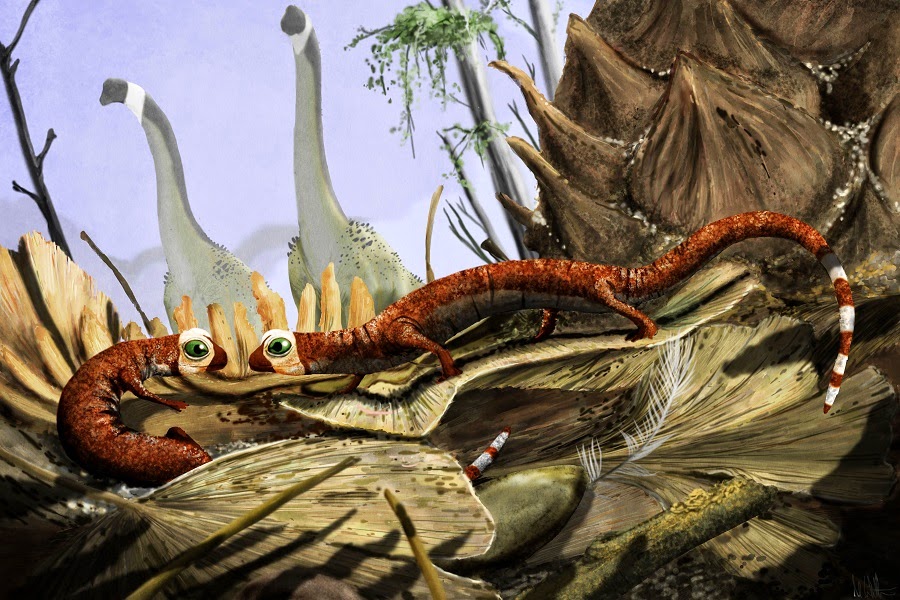
    Two Wesserpeton evansae get in each other's faces, because that's what albanerpetontids did. Note this is an updated version of the 2013 press release work referred to below. Prints of this image are available here.
    You could be forgiven for thinking otherwise, but the Mesozoic wasn't just the remit of dinosaurs, pterosaurs, marine reptiles and token cool crocodiles. Many other interesting animals shared the world with these famous species, including some that most of us have never heard of. Tuesday of this week saw the (open access) publication of one such animal, the Wessex Formation albanerpetontid Wesserpeton evansae by Steve Sweetman (University of Portsmouth) and James Gardner (Royal Tyrrell Museum of Palaeontology) (2013). Many readers will be familiar with the Wessex Formation or the larger geological unit it is part of, the Wealden Supergroup, because of its frequent mentions as Britain's top dinosaur-bearing deposit. I'm sure many of us are not overly familiar with albanerpetontids, however. This isn't too surprising. To my knowledge, albanerpetontids have never featured prominently in any palaeoart or publications geared towards popular audiences and their existence is largely known only to specialists. The world's naivety to these animals was broken yesterday when Steve and James, with a little help from my painting above, finally told the world why they should add albanerpetontids to their list of cool fossil animals.

    Alba-who?
    Albanerpetontids are small-bodied amphibians that were fairly common components of terrestrial environments until relatively recently. The youngest members of their clan perished at the end of the Pliocene - about 2.5 million years ago - after an evolutionary run of 160 million years and attaining a wide geographic distribution across North America, Europe, Africa and central Asia. Their general lack of mention in popular press would have you believe otherwise, but they can actually be relatively common fossils. Remains of Wesserpeton are, after crocodiles, the most abundant microvertebrate in the Wessex Formation. Despite their relative abundance, their relationships to other lissamphibians have been debated because many of their fossils are exceptionally scrappy. Traditionally, they have been thought of as caudatans (salamanders) or at least very close relatives. Recent discoveries of complete and articulated albanerpetontid fossils (below) have suggested otherwise however, proposing that they are closely related to a clade containing frogs and salamanders, but not members of any extant amphibian group (McGowan 2002). 

    LH 6020, holotype specimen of Celtedens ibericus, a complete albanerpetontid from Lower Cretaceous deposits of Las Hoyas, Spain. Note the 'halo' of scales around the fossil. Snout-vent length of this specimen is 59.5 mm. From McGowen (2002).
    The anatomy of albanerpetontids is fairly conservative. They look more-or-less like small salamanders with short limbs and long bodies, but also possess mandibles which interdigitate anteriorly, fused frontals (bones of the skull roof) and relatively flexible necks because of a mammal-like articulation between the skull and neck. They also had bony scales under their skin, a condition which contrasts with the typically thin and delicate skin of most other amphibians. It seems that they spent most of their time burrowing through leaf litter in search of small arthropod prey, with their scaly skin possibly preventing dessication and likely reducing the typical amphibian need for wet or moist environments (but see comments below by the good David Marjanović). Fossils suggest that scales stretched across most of their bodies (we went the whole hog in our reconstruction and covered our Wesserpeton entirely) and onto their eyelids. We thought about these eyelids a fair bit for our painting. The few available depictions of albanerpetontids show animals with eyes perpetually covered with scales, leaving only very small, beady eyes to see with. Steve and I noted that these animals actually have very large orbits however, suggesting that their eyes were probably reasonably sized. It seemed counter-intuitive to possess large eyes and then cover them in soft-tissue, so our reconstruction assumes that the eyelids only partially covered the eyeballs.

    Lower jaws of Wesserpeton evansae showing typical (A) and pathological (B) anatomies. From Sweetman and Gardner (2013). 
    Small man syndrome
    Initially, our plan for the press release painting was to show a single animal reclining in some leaf litter or something equally simple, but Steve suggested early on that we could work in an interesting component of Wesserpeton behaviour. Many Wesserpeton jaws show signs of trauma (above) after being broken during violent acts. The exact cause of this damage is still being looked into and will form the subject of a later paper, but a good preliminary explanation is that Wesserpeton was a vicious species which routinely fought among themselves. Modern salamanders, such as these giants, bite the heads of their opponents before wrestling with each other, twisting and somersaulting with one another to settle disputes over territory and mating access. It's not difficult to imagine such acts taking their toll on the jaws of Wesserpeton, and we thought it would be cool to show this in a press image. Preliminary attempts at rendering this struggled to show the general appearance of the animals however, as their bodies were twisted and their heads obscured by jaws. How could we show the aggressive nature of this animal without actually showing them fighting?

    Do you speak salamander? Common body postures used to communicate between individuals of the red-backed salamander Plethodon cinereus. We took panel B as our primary inspiration for the Wesserpeton evansae PR image. Figure and caption from Jaeger (1984).
    The solution came in the form of postural language borrowed from modern red-backed salamanders (Jaeger 1984, and above).Most animals will attempt to intimidate their rivals with ritualised postures which enhance their perceived size and strength before coming to physical blows, and there's no reason to think that little albanerpetontids were any different. We decided to use the postures of modern salamanders in our image, setting one of our animals as a dominant pose with a raised trunk and tail, and the other crouched and submissive. In doing so, we implicated the violent nature of this species (enhanced by the larger animal getting in the face of the smaller, just like most douches with attitude problems) but maintained the ability to show their anatomy. Entirely coincidentally, Darren Naish and John Conway recently spoke about incorporating animal postures into palaeoart in Tetrapodcats (sic) episode 6, which makes for interesting listening if you're thinking about making your restored extinct animals communicate more fluidly.

    Finally, a quick word on the body size of Wesserpeton. We've mentioned it was small, but how small? The answer is tiny. As in, 35 mm snout-vent length tiny. This thing really puts the 'micro' in 'micropalaeontology'. We prepared another set of press images to show what this means in real life (available in different colours to suit whatever occasion you're at where you want to discuss the size of Wesserpeton):

    The United Colours of Wesserpeton, which is dwarfed by the palm of your hand no matter what colour you are.  For some reason, this image makes me want to imagine a world without lawyers.
    I'm no expert on this sort of thing, but I'll wager that Wesserpeton is one of the smallest, if not the smallest tetrapod species known from the Wessex Formation, and probably one of the smallest tetrapods in the fossil record. It's fossils were only recovered through bulk sampling tonnes of plant debris bed from the Wessex Formation, horizons rich in plant and vertebrate remains deposited after sheetflood events, and would be almost impossible to find via surface prospecting. Those of you with excellent memories may recall that Steve's ongoing analyses of these beds have revolutionised our understanding of the Wessex palaeobiota, of which Wesserpeton is just one discovery among many. 

    And that will have to do for now. Next week: back to the world of pterosaurs with pterosaur mummies, as promised last week before Wesserpeton face-wrestled its way into centre stage. My plan from here on is to have some sort of run-up to the publication of my book, Pterosaurs: Natural History, Evolution, Anatomy on June 23rd, so be sure to stick around if wing membranes are your thing.

    References
    • Jaeger, R. G. 1984. Agonistic behavior of the red-backed salamander. Copeia, 309-314.
    • McGowan, G. J. 2002. Albanerpetontid amphibians from the Lower Cretaceous of Spain and Italy: a description and reconsideration of their systematics. Zoological Journal of the Linnean Society, 135(1), 1-32.
    • Sweetman, S. C., and Gardner, J. D. 2013. A new albanerpetontid amphibian from the Early Cretaceous (Barremian) Wessex Formation of the Isle of Wight, southern England. Acta Palaeontologica Polonica, 58, 295–324.

    Thursday, 23 May 2013

    Another Pterosaurs preview, and the soft bits of Tupandactylus

    Tupandactylus navigans reclining by sunset, pycnofibres a-glowing.
    Holy Toledo, the publication date of Pterosaurs: Natural History, Evolution, Anatomy is now only weeks away. In exactly one month, preordered copies of the book will be sent out and actual, physical copies of it will be in homes around the world. Forgive me if this sounds indulgent: it's not meant to. It's simply a little mind boggling to think of people paying hard-earned money for the book that, with help from Princeton University Press, I spent over two years writing and illustrating. (Don't forget to add the celebratory Pterosaurs party at the Natural History Museum, London, on September 10th, 2013, to your diary.)

    To celebrate this navel-gazing milestone, here's another preview image from the book. It shows the Brazilian tapejarid Tupandactylus navigans at sunset, it's fur-like pycnofibres glowing in the diminishing light. This painting is one of the large paintings that accompanies the start of each chapter and, specifically, it opens Chapter 5: "Soft bits". Each of these large paintings was designed to draw focus to the topic of its chapter. Deciding on the basic composition was easy enough for many chapters, but those focussing on soft-tissue anatomy and osteology proved to be a little bit of a head scratcher. How do you draw specific attention to tissues comprising pterosaur bodies rather than the pterosaur itself? The answer for "Soft bits" at leastseemed to lie in back lighting a pterosaur body so that most of the animal was obscured, save for a halo of illuminated fuzz. Tupandactylus navigans was chosen because it's enormous soft-tissue headcrest (below) contributed to the already unusual outline of a pterosaur body to make a more startling image. "Soft bits" takes on a variety of other soft tissues as well - brains, lungs, guts, skin, wing membranes and so forth - but these seemed harder to bring out without cutting a pterosaur open.

    Tupandactylus navigans holotype skull SMNK PAL 2344, showing the crazy headgear sported by some tapejarid species.  Remember that this crest is not the largest worn by a tapejarid pterosaur. From Witton (2013).
    In other news, today also saw Christopher DiPiazza post an online interview he conducted with me at Jersey Boys Hunt Dinosaurs. The post contains some exclusive artwork, comments on how to get into palaeontology and a frank reply to the question of "should I undertake postgraduate studies in palaeontology?" I'm not the only chap telling people to be cautious about choosing palaeontology as a career at the moment, and seriously recommend that prospective students thinking about joining the palaeo ladder give that choice some serious thought before taking the plunge. Read why here (question 7).

    That's all for this week. Next week: pterosaur mummies!

    P.S. 'Tupandactylus' navigans? Who he?
    Finally, a quick note on the nomenclature used in this post. Readers familiar with tapejarid taxonomy may notice that I'm treating navigans as part of the genus Tupandactylus, whereas it has typically been referred to Tapejara or "Tapejara" by other workers. The nomenclatural history of navigans is a little complicated. It was initially placed in the genus Tapejara (Frey et al. 2003) along with two other species, T. wellnhoferi and imperator. Two teams of authors independently revised the taxonomy of this genus in 2007, with Kellner and Campos (2007) moving imperator to a novel genus, Tupandactylus and Unwin and Martill (2007) creating another new genus, Ingridia, for navigans and imperator, with the latter as the type species. The work of Kellner and Campos was published just before Unwin and Martill and, because they both used imperator as the type taxon of their respective genera, Ingridia must be considered synonymous with Tupandactylus. Kellner and Campos (2007) hinted that navigans was also probably a member of Tupandactylus, but Darren Naish suggested that it may still warrant generic distinction from imperator in a 2008 Tetrapod Zoology article. navigans has been in taxonomic limbo since then, but recent phylogenetic work (e.g. Pinheiro et al. 2011 and my own studies, presented last year at SVPCA 2012 and hopefully being turned into a fully fledged paper when I get the time) has found support for a navigans + imperator clade which bears out earlier suggestions that these species are congeneric. These discussions about generic labels are fairly arbitrary and someone may eventually decide to generically split navigans from tupandactylus but, until then, it seems reasonable to house navigans within the Tupandactylus stable. 

    References
    • Frey, E., Martill, D. M., and Buchy, C. C. 2003.  A new species of tapejarid pterosaur with soft tissue head crest. In: Buffetaut, E. and Mazin, J. M. (eds.) Evolution and Palaeobiology of Pterosaurs, Geological Society Special Publication, 217, 65-72.
    • Kellner, A. W. A. and Campos, D. A. 2007. Short note on the ingroup relationships of the Tapejaridae (Pterosauria, Pterodactyloidea). Boletim do Museu Nacional, Nova Séroe, Rio de Janeiro - Brasil. Geologia, 75, 1-14.
    • Unwin, D. M. and Martill, D. M. 2007. Pterosaurs from the Crato Formation. In: Martill, D. M., Bechly, G. and Loveridge, R. F. (eds) Window into an ancient world: the Crato fossil beds of Brazil, Cambridge University Press, Cambridge, 624 pp.
    • Pinheiro, F. L., Fortier, D. C., Schultz, C. L., De Andrade, J. A. F., and Bantim, R. A. 2011. New information on the pterosaur Tupandactylus imperator, with comments on the relationships of Tapejaridae. Acta Palaeontologica Polonica, 56(3), 567-580.
    • Witton, M. P. 2013. Pterosaurs: Natural History, Evolution, Anatomy. Princeton University Press. [In press]