Showing posts with label Wessex Formation. Show all posts

Thursday, 12 December 2013

Shedding [no] light on dinosaur predation scenes

The carcharodontosaurian Neovenator salerii stalks a pair of rebbachisaurid sauropods in Lower Cretaceous Britain, using darkness as cover. Prints of this image are available here.
Finding time for Blogging has recently become quite difficult despite no shortage of topics to cover or new paintings to post. In the interest of keeping things alive, here's a quick painting I recently finished which tackles that most traditional subject of dinosaur palaeoart: predation. This is a rare topic for my work because the ferocity, speed and armaments of theropods and their prey are subjects of so many depictions that I almost find them artistically off-putting. For all their dynamism - gaping maws, slashing claws, wrestling limbs - they've become so common that they're (whisper it quietly) a bit boring. Even the most exciting experiences become dulled if overexposed, and we may have hit that mark with dinosaur predation scenes. Not to mention that a lot of the overly-done operatics associated with dinosaur predation art really start to grate after a fashion. Theropods roaring at their prey; 'slasher poses', animals wrestling in long, drawn out battles; completely mismatched combatant species which bear little resemblance to predator/prey interactions in modern times (seriously chaps: stop drawing a dromaeosaurs attacking animals hundreds of times their size - they're not freakin' superheroes!), and so forth. So yes, for the most part, I switch off when I see depictions of dinosaur predation in favour of things which I find more conceptually interesting. Like, er... animals standing around doing nothing, lying down, walking about or perhaps, if I'm feeling adventurous, chewing a leaf.*

*Bear in mind that, in being British, I'm allergic to excitement.

My interest in dinosaur predation art was piqued recently however thanks to re-watching the excellent BBC series Planet Earth and The Life of Mammals. Both feature copious amounts of footage filmed at night using infra-red lights, revealing how many animal species are as active nocturnally as they are during the day. Many species undertake complex nocturnal activities in spite of poor night vision, and it's obvious that this brings clear advantages to species with generally higher visual acuity or those with eyes specifically adapted to work well in dim conditions. Generally speaking, this means advantage: predators.

Did the same apply to Mesozoic ecosystems? Possibly. We can currently only speculate on the day-night activity cycles of ancient animals (and no, using sclerotic rings and orbit shape to infer nocturnality as proposed by Schmitz and Motani [2011] doesn't work: see Hall et al. [2011]), but given what we know of dinosaur physiology and palaeoecology, facultative nocturnal habits for some species do not seem out of the question. Theropod dinosaurs, like modern carnivores, often have more acutely developed senses than the herbivores they likely often preyed upon, and it isn't crazy to think that some would use this to their advantage by hunting at night. We may further speculate that - like some modern carnivores - nocturnally active theropods would punch above their weight, attacking unusually big or dangerous prey because their ability to remain undetected is that much greater (see, for a famous modern example, the lions and elephants in the BBC video below).


From here, it's easy to see how I came up with the image above. It shows the carcharodontosaurian Neovenator, one of the largest theropods known from the Lower Cretaceous Wessex Formation, creeping close to a couple of rebbachisaurid sauropods (a relatively recent addition to the Wessex dinosaur fauna, but currently not represented by any name-bearing material). The Neovenator can see the sauropods with much greater clarity than they can see it, although they are not completely oblivious to its presence. I've tried to instil a sense of agitation and nervousness about them, brought on by the proximity of something which sounds and smells like trouble. Despite its ocular advantage, the Neovenator is not charging in with blazing teeth in typical palaeoart fashion, instead biding its time, keeping low and quiet, and waiting for the right moment to launch an attack. The sauropods are, after all, a bit bigger than it is (estimated as 9 m long by Mannion 2009, compared to 7.5 m for Neovenator) and a lot heavier. I don't imagine Neovenator would normally take prey as large as this, and is only taking such a chance because the night has shifted odds slightly in its favour. Still, a clumsy move would not only ruin a successful stalk but also risk injury, so caution is the best policy. Maybe the copse behind the sauropods is part of the plan too, with Neovenator driving the sauropods into a setting where they're likely to encounter unseen obstacles and pitfalls. Hopefully, the dim nature of the painting helps convey some of the uncertainty and dread that the sauropods are experiencing. Like the sauropods, we can't see much, only just enough to be sure that the rebbachisaurids are in trouble, and that the game is currently Neovenator's to lose.

I've not had the time to check thoroughly, but it does seem that images of dinosaurs in near darkness are pretty rare, and maybe that's something worth thinking about changing. Palaeoart is primarily about showing off the anatomy and form of animals but, if we're trying to create mood, we may want to take bold steps away from clearly lit subjects shown in broad daylight. There's a lot of atmosphere to be found in the unseen or the murky and, as with adding atmosphere to any visual medium, less is often more. Using extremes of lighting or visually-limiting weather conditions may obscure some details of the animals we're aiming to show, but it can tell us a lot about the biology and 'character' of a particular species. An 'extreme' environment becomes a character in its own right, and the animals have to respond to their surroundings rather than simply existing within them. I enjoyed painting these Pelorosaurus in a rainstorm (below), for instance, because the picture seems to convey how tough these animals would have to be. There's no shelter large enough for sauropod-sized animals, so they simply must have endured any awful conditions thrown at them. This isn't a great picture for saying 'this is what Pelorosaurus looked like', but we get a good sense of the hardy nature of these animals, as well as the message that their physiology is capable of sustaining them through hard times. Hopefully, the barely-seen postures and positioning of the animals in the predation scene at the top of this post convey a similar sense of character, as well as throwing some new light (or removing it, I guess) from a familiar palaeoart subject. It would be remiss of me to talk about atmospheric palaeoart without mentioning Doug Henderson's new online gallery, a site the internet has sorely needed for some time and a veritable masterclass in using environments to create moody, character-filled palaeoart.

Pelorosaurus conyberi in the rain, looking all tough and moody. For more on this image, head to this post.
So that's my brief take on dinosaur predation then: a barely discernible scene of virtually immobile, quiet animals without a single tooth, claw or roar in sight. Coming next (probably): something more substantial on a boring old ornithopod that's on the lee slope of fame.


References
  • Hall, M. I., Kirk, E. C., Kamilar, J. M., & Carrano, M. T. (2011). Comment on “Nocturnality in dinosaurs inferred from scleral ring and orbit morphology”. Science, 334(6063), 1641-1641.
  • Mannion, P. D. (2009). A rebbachisaurid sauropod from the Lower Cretaceous of the Isle of Wight, England. Cretaceous Research, 30(3), 521-526.
  • Schmitz, L., & Motani, R. (2011). Nocturnality in dinosaurs inferred from scleral ring and orbit morphology. Science, 332(6030), 705-708.

Monday, 2 December 2013

Windows into Early Cretaceous Britain: the plant debris beds of the Wessex Formation

Some parts of Lower Cretaceous Britain was subject to regular, short-lived wildfires caused by lightning strikes after long dry seasons, phenomena which played an integral role in forming the fossil-rich plant debris beds of the Wessex Formation. Here, the early tyrannosauroid Eotyrannus lengi stalks the edge of such a wildfire. Note that this Eotyrannus is based on new skeletal reconstructions presented in recent papers (e.g. Naish 2011), not the better known, original reconstruction presented by Hutt et al. (2001). Prints of this image are available.
If you're into Mesozoic reptiles, you could find yourself in much worse places than southern England. Much of the exposed geology in the southern part of the UK belongs to a unit known as the Wealden Supergroup, a series of Lower Cretaceous rocks representing ancient alluvial fans, river channels and floodplains. Many of Britain's Cretaceous dinosaurs and pterosaurs stem from Wealden deposits, along with numerous other types of fossils including armoured dinosaurs, plesiosaurs, famous sauropods and weird, burrowing amphibians.

A slumped plant debris bed in the Wessex Formation, Brighstone Bay, Isle of Wight. Image borrowed from the UK Fossil Network forums, by one only known as 'Alan'.
Fossils occur found throughout Wealden rocks but, as is often the case in palaeontology, the majority are concentrated into narrow horizons. One type of Wealden fossil bed deserves special praise and attention: the plant debris beds of the Wessex Formation. Plant debris beds are narrow, green-grey bands of pebbles, mud and plant debris which comprise only a fraction of the Wessex strata, but represent a tremendous source of its fossils. Indeed, these beds provide the majority of Britain’s Cretaceous dinosaur species as well as many other fossil species, including many rare microvertebrates. Debris bed fossils range from small, badly preserved portions of plant and isolated, broken bones, teeth and scales, to substantial chunks of very large organisms - partial or near-complete animal skeletons and 3 m long logs (below). With continental deposits relatively rare in the Lower Cretaceous, the plant debris beds represent an important window into European faunas of this time, and studies into their palaeontology are ongoing (see below).

Enormous, pyrite-riddled chunks of fossil tree trunks, like these bits of the conifer Pseudofrenelopsis, litter the beaches beneath the Wessex Formation after weathering out of plant debris horizons. The ruler in this image is 150 mm long.
The story behind the plant debris beds has intrigued scientists for decades, leading to detailed research into their formation. Because the Wessex Formation represents a complex environment - an arid floodplain dominated by enormous, meandering rivers which were bordered by wooded highlands, and subjected to long summer months with temperatures well over 30°C but short, cool and rather wet winters - several different ideas about debris bed genesis have been proposed (best summarised and explored in Sweetman and Insole 2010). Plant debris bed sediments bear characteristics of debris flows; powerful, water-saturated sediment surges which ooze across landscapes to create poorly organised pools of mud and detritus. Such flows were clearly not regular events in the Wessex palaeoenvironment. Although many plant debris beds are known, they are relatively minor components of the Wessex Formation and are randomly distributed within Wessex strata. They were not, therefore, seasonal events and must reflect particularly unusual or extreme environmental conditions. Some have suggested that intense river flooding events and bank breaches account for these deposits, but plant debris beds are not associated with river sediments in a manner predicted for breached riverbanks deposits. Because the plant remains they contain are similar to leaf-litter found in modern forests, it is likely that they originated external to the Wessex floodplain, perhaps starting on nearby upland, wooded areas, not within the river channels. Indeed, debris flows generally start on slopes when water saturated soils and sediments become too heavy and unstable to resist gravity. The slopes required to begin plastic sediment flows are not large, and the relatively low upland areas surrounding the Wessex floodplain were likely sufficiently inclined to catalyse debris flows. Topographic highs on the floodplain itself may also have done the job. Presumably, the heavy rainfalls incurred during winter seasons was the water source which saturated Wessex soils to a critically unstable level.

The secret ingredient
This is only half the story, however. Sediment flows do not start after most heavy rainfalls because precipitation is mostly absorbed by leaf litter, intercepted by plant canopies, and soils are bound by vegetation. We know that the Wessex palaeoenvironment was fairly well-vegetated, and it is likely that its plants prevented Wessex slopes from collapsing. The secret ingredient required to make a debris flow, it seems, was fire (above). A common component of all plant debris beds is the abundance (about 50%) of burnt plant material, suggesting they were only formed after fires - likely caused by lightning strikes after long, dry summers- had swept through surrounding areas. An absence of burnt tree trunks suggests Wessex wildfires were not particularly intense, their main effect being removal of canopy cover, low-level vegetation and leaf-litter. This left the environment denuded enough for rainwaters to directly interact with soils and underlying sediments. Modern wildfires raise soil temperatures to hundreds of degrees and alter their physical properties, reducing water capacity and increasing erodibility. The result is a perfect recipe for debris flows: unprotected, easily transportable soils and sediments are left exposed to heavy precipitation, which likely arrived in earnest during winter storms.

Model of plant debris bed deposition on the Wessex Formation floodplain. Based on Sweetman and Insole (2010).
The range of sediment and fossil sizes within the plant debris beds indicate that they did not travel far, maybe a few kilometres at most, but they hoovered up any organic and sedimentary material they encountered. Large sediment flows can travel relatively quickly – up to 16 kph – and carry objects weighing many tonnes. Large dinosaur carcasses and tree trunks would be carried without hesitation by flowing oozes of debris moving across the Wessex floodplain. The surges finally lost momentum when they reached depressions such as ponds, oxbow lakes, abandoned river channels or simply topographic lows, creating the thin bands of sediment we can see today in Wessex Formation cliffs. The rarity of complete animal remains suggests that few animals were killed in the transportation process, and most vertebrate fossils probably represent bones or carcasses collected en route by the debris flow. This model for plant debris bed formation is, of course, rather generalised and may not apply to all beds. Each plant debris horizon is unique and, although this model likely accounts for at least some aspects of each, each has its own characteristic depositional history. Interestingly, no other fossil horizons match the sedimentological properties of the plant debris beds, making them important to not only palaeontologists, but also sedimentologists.

It is, of course, palaeontology which benefits most from these deposits however. Ongoing examination of the debris beds fossils, largely by renowned Wealden expert Steve Sweetman, continues to reveal new discoveries. Scientists now recognise the plant debris beds as key sources of Cretaceous microfossils as well as larger, macro-scale remains. These are extracted by sieving large quantities (literally tonnes) of plant debris bed sediment, followed by many hours hunched over microscopes to analyse and identify the new finds. This hard work has certainly paid off, adding significant detail to our understanding of the Wealden palaeobiota (below). We now know that dinosaurs were only a fraction of the tetrapod fauna in these environments, with lizards, amphibians and other small animals comprising the bulk of Wessex diversity. New discoveries are still being made, and it's an exciting time to work on Wealden fossils.

How plant debris beds changed the world. A, Wessex Formation tetrapod assemblage prior to bulk sampling and detailed study of plant debris bed fossils; B, the same assemblage after. Data from Sweetman and Insole (2010).

Plant debris beds conservation
The exciting fossil content and accessible nature of many plant debris beds has made them a favourite source of fossils to hobbyists, private collectors and professionals for centuries. This interest has undoubtedly contributed to our detailed understanding of the Wealden fossil assemblage and will continue to do so in future. It is essential, however, that plant debris beds and other Wealden exposures are treated with care and responsibility. All too often, a walk along Wessex Formation exposures reveals depressing signs of geological vandalism: holes bulldozed into slumped cliffs in vain efforts to seek fossil-bearing horizons; messages carved into soft sandstones; dinosaur footprint casts with smashed toes, and even trackways with individual prints removed using power tools. Plant debris beds are often more conspicuous by the smashed rocks surrounding them than their lithological features. While some geological vandalism clearly reflects activities of bored, idle individuals, other types - and particularly that associated with debris beds – reflects the desires of eager individuals to discover and excavate fossil remains. We have to keep this in check. Over-enthusiasm not only risks damaging important specimens but also the surrounding sediments and other, less desirable fossils, both of which offer essential details on the depositional context of a fossil specimen. Remember that hammer blows do not only remove overburden, but also smash whatever lies beneath the surface.

The point here is not, of course, that Wealden fossils should be the sole remit of trained collectors, but that we should all be conscientious about our geological heritage. It is often far wiser, for instance, to alert local museum or university staff about an exciting find before collecting it, rather than risking damaging the specimen and it’s geological context by taking it immediately. If nothing else, contacting local professionals can provide sound advice on an appropriate manner to collect and preserve fossils. As with any fossil discoveries, accurate records must be made about the location and horizon of a new find and, if the specimen looks like it may be important, collectors should strongly consider accessioning their finds to a museum. Collectors who work with museums and scientists are frequently involved in the science that can follow a new discovery, helping to analyse and document the find in scientific papers and books. I can vouch from personal experience that this can happen relatively quickly. A new Wealden fossil accessioned to Dinosaur Isle (the Museum of Isle of Wight Geology under any other name) or the Natural History Museum seems to always get local palaeontologists buzzing, and several Wealden experts are well known for analysing new specimens within weeks of their arrival. If they are important, they end up being written up into technical papers, may be further featured in other palaeontological books and media, and may even end up on public view in museums.

What you'll want to understand fossils from plant debris beds, or any other part of the Wealden, for that matter.
How do you know if a fossil is 'important' enough to bring it to the attention of expert? Fossil identification guides, such as the excellent and highly comprehensive English Wealden fossils (Batten 2011) and Dinosaurs of the Isle of Wight (Martill and Naish 2001) are a useful means to gauge not only the identification of a Wealden fossil find, but also how ‘significant’ it may be. Many Wealden vertebrates are especially poorly known and new data on them is highly sought after, so it may be worth getting any well-preserved vertebrate material checked out. Doing so ensures that the window into Lower Cretaceous Britain offered by these remarkable beds remains widely open to all, which seems only right considering the importance of of these beds to British palaeontology.

References

  • Batten, D. J. (ed.) (2011). English Wealden Fossils. The Palaeontological Association, London.
  • Hutt, S., Naish, D., Martill, D. M., Barker, M. J. & Newbery, P. (2001). A preliminary account of a new tyrannosauroid theropod from the Wessex Formation (Early Cretaceous) of southern England. Cretaceous Research 22, 227-242.
  • Martill, D. M. & Naish, D. (2001). Dinosaurs of the Isle of Wight. The Palaeontological Association, London.
  • Naish, D. (2011). Theropod dinosaurs. In: Batten, D. J. (ed.) English Wealden fossils. The Palaeontological Association (London), pp. 526-559.
  • Sweetman, S. C., & Insole, A. N. (2010). The plant debris beds of the Early Cretaceous (Barremian) Wessex Formation of the Isle of Wight, southern England: their genesis and palaeontological significance. Palaeogeography, Palaeoclimatology, Palaeoecology, 292(3), 409-424.

Thursday, 30 May 2013

Wesserpeton evansae: making 'albanerpetontid' a household name

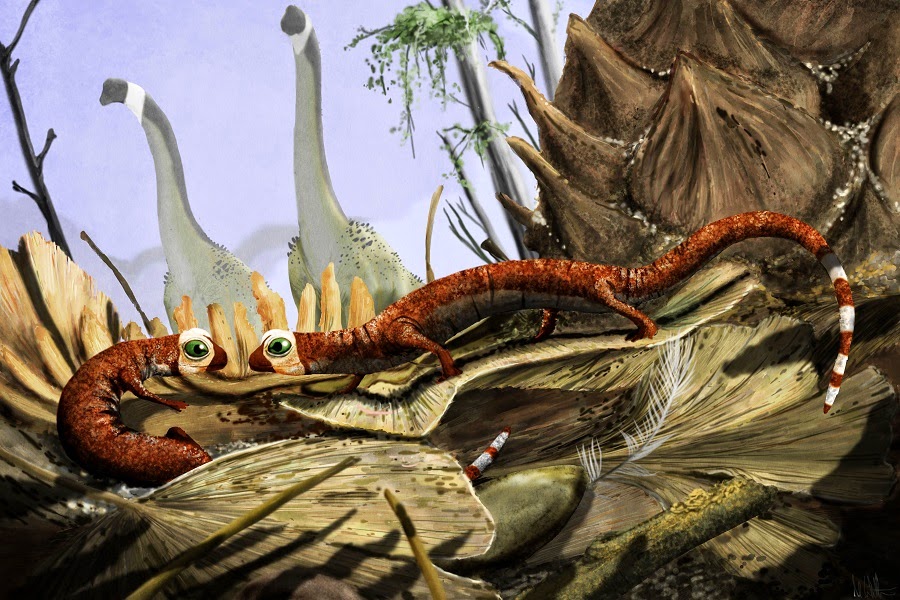
Two Wesserpeton evansae get in each other's faces, because that's what albanerpetontids did. Note this is an updated version of the 2013 press release work referred to below. Prints of this image are available here.
You could be forgiven for thinking otherwise, but the Mesozoic wasn't just the remit of dinosaurs, pterosaurs, marine reptiles and token cool crocodiles. Many other interesting animals shared the world with these famous species, including some that most of us have never heard of. Tuesday of this week saw the (open access) publication of one such animal, the Wessex Formation albanerpetontid Wesserpeton evansae by Steve Sweetman (University of Portsmouth) and James Gardner (Royal Tyrrell Museum of Palaeontology) (2013). Many readers will be familiar with the Wessex Formation or the larger geological unit it is part of, the Wealden Supergroup, because of its frequent mentions as Britain's top dinosaur-bearing deposit. I'm sure many of us are not overly familiar with albanerpetontids, however. This isn't too surprising. To my knowledge, albanerpetontids have never featured prominently in any palaeoart or publications geared towards popular audiences and their existence is largely known only to specialists. The world's naivety to these animals was broken yesterday when Steve and James, with a little help from my painting above, finally told the world why they should add albanerpetontids to their list of cool fossil animals.

Alba-who?
Albanerpetontids are small-bodied amphibians that were fairly common components of terrestrial environments until relatively recently. The youngest members of their clan perished at the end of the Pliocene - about 2.5 million years ago - after an evolutionary run of 160 million years and attaining a wide geographic distribution across North America, Europe, Africa and central Asia. Their general lack of mention in popular press would have you believe otherwise, but they can actually be relatively common fossils. Remains of Wesserpeton are, after crocodiles, the most abundant microvertebrate in the Wessex Formation. Despite their relative abundance, their relationships to other lissamphibians have been debated because many of their fossils are exceptionally scrappy. Traditionally, they have been thought of as caudatans (salamanders) or at least very close relatives. Recent discoveries of complete and articulated albanerpetontid fossils (below) have suggested otherwise however, proposing that they are closely related to a clade containing frogs and salamanders, but not members of any extant amphibian group (McGowan 2002). 

LH 6020, holotype specimen of Celtedens ibericus, a complete albanerpetontid from Lower Cretaceous deposits of Las Hoyas, Spain. Note the 'halo' of scales around the fossil. Snout-vent length of this specimen is 59.5 mm. From McGowen (2002).
The anatomy of albanerpetontids is fairly conservative. They look more-or-less like small salamanders with short limbs and long bodies, but also possess mandibles which interdigitate anteriorly, fused frontals (bones of the skull roof) and relatively flexible necks because of a mammal-like articulation between the skull and neck. They also had bony scales under their skin, a condition which contrasts with the typically thin and delicate skin of most other amphibians. It seems that they spent most of their time burrowing through leaf litter in search of small arthropod prey, with their scaly skin possibly preventing dessication and likely reducing the typical amphibian need for wet or moist environments (but see comments below by the good David Marjanović). Fossils suggest that scales stretched across most of their bodies (we went the whole hog in our reconstruction and covered our Wesserpeton entirely) and onto their eyelids. We thought about these eyelids a fair bit for our painting. The few available depictions of albanerpetontids show animals with eyes perpetually covered with scales, leaving only very small, beady eyes to see with. Steve and I noted that these animals actually have very large orbits however, suggesting that their eyes were probably reasonably sized. It seemed counter-intuitive to possess large eyes and then cover them in soft-tissue, so our reconstruction assumes that the eyelids only partially covered the eyeballs.

Lower jaws of Wesserpeton evansae showing typical (A) and pathological (B) anatomies. From Sweetman and Gardner (2013). 
Small man syndrome
Initially, our plan for the press release painting was to show a single animal reclining in some leaf litter or something equally simple, but Steve suggested early on that we could work in an interesting component of Wesserpeton behaviour. Many Wesserpeton jaws show signs of trauma (above) after being broken during violent acts. The exact cause of this damage is still being looked into and will form the subject of a later paper, but a good preliminary explanation is that Wesserpeton was a vicious species which routinely fought among themselves. Modern salamanders, such as these giants, bite the heads of their opponents before wrestling with each other, twisting and somersaulting with one another to settle disputes over territory and mating access. It's not difficult to imagine such acts taking their toll on the jaws of Wesserpeton, and we thought it would be cool to show this in a press image. Preliminary attempts at rendering this struggled to show the general appearance of the animals however, as their bodies were twisted and their heads obscured by jaws. How could we show the aggressive nature of this animal without actually showing them fighting?

Do you speak salamander? Common body postures used to communicate between individuals of the red-backed salamander Plethodon cinereus. We took panel B as our primary inspiration for the Wesserpeton evansae PR image. Figure and caption from Jaeger (1984).
The solution came in the form of postural language borrowed from modern red-backed salamanders (Jaeger 1984, and above).Most animals will attempt to intimidate their rivals with ritualised postures which enhance their perceived size and strength before coming to physical blows, and there's no reason to think that little albanerpetontids were any different. We decided to use the postures of modern salamanders in our image, setting one of our animals as a dominant pose with a raised trunk and tail, and the other crouched and submissive. In doing so, we implicated the violent nature of this species (enhanced by the larger animal getting in the face of the smaller, just like most douches with attitude problems) but maintained the ability to show their anatomy. Entirely coincidentally, Darren Naish and John Conway recently spoke about incorporating animal postures into palaeoart in Tetrapodcats (sic) episode 6, which makes for interesting listening if you're thinking about making your restored extinct animals communicate more fluidly.

Finally, a quick word on the body size of Wesserpeton. We've mentioned it was small, but how small? The answer is tiny. As in, 35 mm snout-vent length tiny. This thing really puts the 'micro' in 'micropalaeontology'. We prepared another set of press images to show what this means in real life (available in different colours to suit whatever occasion you're at where you want to discuss the size of Wesserpeton):

The United Colours of Wesserpeton, which is dwarfed by the palm of your hand no matter what colour you are.  For some reason, this image makes me want to imagine a world without lawyers.
I'm no expert on this sort of thing, but I'll wager that Wesserpeton is one of the smallest, if not the smallest tetrapod species known from the Wessex Formation, and probably one of the smallest tetrapods in the fossil record. It's fossils were only recovered through bulk sampling tonnes of plant debris bed from the Wessex Formation, horizons rich in plant and vertebrate remains deposited after sheetflood events, and would be almost impossible to find via surface prospecting. Those of you with excellent memories may recall that Steve's ongoing analyses of these beds have revolutionised our understanding of the Wessex palaeobiota, of which Wesserpeton is just one discovery among many. 

And that will have to do for now. Next week: back to the world of pterosaurs with pterosaur mummies, as promised last week before Wesserpeton face-wrestled its way into centre stage. My plan from here on is to have some sort of run-up to the publication of my book, Pterosaurs: Natural History, Evolution, Anatomy on June 23rd, so be sure to stick around if wing membranes are your thing.

References
  • Jaeger, R. G. 1984. Agonistic behavior of the red-backed salamander. Copeia, 309-314.
  • McGowan, G. J. 2002. Albanerpetontid amphibians from the Lower Cretaceous of Spain and Italy: a description and reconsideration of their systematics. Zoological Journal of the Linnean Society, 135(1), 1-32.
  • Sweetman, S. C., and Gardner, J. D. 2013. A new albanerpetontid amphibian from the Early Cretaceous (Barremian) Wessex Formation of the Isle of Wight, southern England. Acta Palaeontologica Polonica, 58, 295–324.