A couple of days ago, I played for time in my posting schedule by asking readers to identify the deliberately outdated reconstruction of a fossil species shown above. I'm relieved to say the event was not a complete washout, with several dozen suggestions made in the blog comment feed and on Facebook - thanks to those who made suggestions. Most proposed that this animal is an archaic view of a marine reptile, perhaps a placodont, mosasaur, pliosaur or, best of all, Edward Cope's famous backwards
Elasmosaurus. Others thought it may be an early interpretation of
Basilosaurus or a
Megalosaurus in its lizard-like 1820s guide.
None of these are quite on the money. I did try to leave a few hints in the image and article. The post title and keywords hinted at a reptilian identity; I mentioned that the interpretation is very, very old, and that the literature describing this animal was rather vague and open to a lot of interpretation. The marine reptiles in the top left are deliberate nods to the article describing the habits of the mystery animal, which proposed it 'might keep in check the Crocodilians and Plesiosauri'. Perhaps the biggest giveaway was the illustration caption, which read "An old, old sight, and yet somehow so young.", a quote from
Moby Dick. I'm sure a lot of you have already put these hints together but, in case it's not obvious, the image above shows my rendition of
Cetiosaurus as a gargantuan reptilian superpredator of Mesozoic seas, as described by Richard Owen in 1841. Of course, we also know
Ceitiosaurus, the 'whale lizard', as (pretty much) the first sauropod ever named, so another way to view this is as retropalaeoart of a sauropod. Congrats to Mike Traynor, Myungkeun Ryu and Tim Morris for guessing correctly. Please treat yourselves to an extra spoonful of peas for dinner.
How is that a sauropod?
It's widely known that sauropods were once thought to be marine animals, but I'm sure some of you are wondering just how I came to reconstruct this animal in this guise, perhaps even if you are familiar with Owen's (1841) description (you can download this, for free,
here). There's a lot of points to consider here, the most important of which is that this is entirely based on
the very first report of a sauropod, not any later considerations. My
Cetiosaurus is how it may have been imagined in 1841, perhaps after hearing the first public discussion on them (Owen's 1841 paper is actually a summary of this talk by an anonymous author, not a manuscript penned by the man himself). The illustration attempts to showcase the basic thrust of Owen's hypothetical animal along with a few nods to specific details he mentions in his description, along with some palaeoart trends of the mid-1800s.
 |
| How much of the world first met what would become sauropod dinosaurs: the title of Owen's 1841 lecture memoir. Seven pages of text, no specific names, no specimen numbers, no holotype, and no illustrations, and the beginning of a monstrously complex taxonomy which has only recently been revised into a useful format. |
The first sauropods, as with many dinosaurs, were not recovered from anything like complete remains.
Cetiosaurus was mostly described from caudal vertebrae and a few other bones, including limb elements and a partial shoulder girdle, and that was about all. These bones were mostly collected from Jurassic rocks of Oxfordshire, but others came from similarly-aged deposits from other locations in south east England. Owen's
Cetiosaurus was subsequently represented multiple individuals without overlapping components, hampering any hope of attaining a sense its relative proportions. As such, virtually none of the iconic aspects of sauropod appearance were apparent in 1841, save for one:
Cetiosaurus was clearly huge. Owen stressed how the fossils he had were much larger than those of an elephant or even
Megalosaurus, and that only
Iguanodon and 'full-sized whales' had bones of comparable size. Remember that many still considered
Iguanodon as a lizard-like animal of tremendous length in 1841, not the more sensibly proportioned, rhinoceros-like animal we think of as the 'Victorian
Iguanodon'. No size estimates for
Cetiosaurus were provided in the 1841 lecture, but it's clear that Owen thought it was seriously big.
It was not only the appearance of this animal which remained enigmatic: it's affinities among Reptilia were not immediately clear. It is often reported that Owen initially considered
Cetiosaurus to be a giant marine crocodile, but this is not apparent from his 1841 lecture (Taylor 2010).
Cetiosaurus was compared with a number of other animals, including whales, marine reptiles, crocodiles, lizards and several genera which would later be recognised as dinosaurs. The nature of the vertebrae and the presence of a claw were sure fire signs that
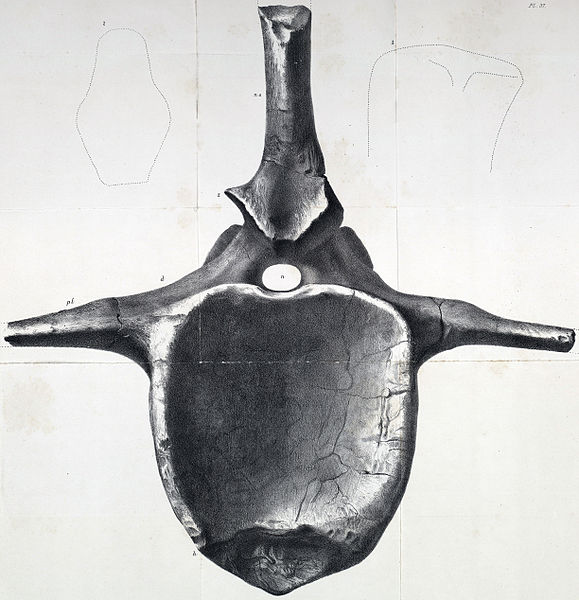
Cetiosaurus was of saurian origin and not, despite its size, an ancient cetacean. Owen did note that several aspects of its bone structure were reminiscent of whale bone however. We should recall here that Owen was primarily working from caudal vertebrae, which are far more whale-like in their guise than the complex, hollowed cervical vertebrae we may think of when we imagine sauropod vertebrae (below). Several favourable comparisons were made between
Cetiosaurus, dinosaurs and crocodiles, but Owen refrained from allocating
Cetiosaurus to a specific reptile group until 1842, when he referred it to Crocodilia (Owen 1842).
 |
| A caudal vertebra referred to Cetiosaurus by Owen in 1853, now referred to Pelorosaurus. It's not difficult to see why Owen considered vertebrae like this to be whale-like. From Wikipedia. |
What of its habits? Again, there's precious little to go on here from Owen's lecture. Owen suggested the animal had to be aquatic because its bones had a cancellous texture reminiscent of cetacean bones. The size of the animal suggested it was not likely to populate small rivers and streams and probably lived in larger aquatic settings - the marine realm. On diet, it's reported that "the surpassing bulk and strength of the
Cetiosaurus were probably assigned to it with carnivorous habit, that it might keep in check the Crocodilians and Plesiosauri" (Owen 1841, p. 462). Little other evidence for this predatory existence is provided, although fossils of "large conical teeth" were mentioned as possibly belonging to
Cetiosaurus.
The lost world of Cetiosaurs, superpredator
By now, we're starting to emerge with a picture - vague as it is - of Owen's
Cetiosaurus, c. 1841. A nondescript, gigantic, whale-like marine saurian which predated other marine reptiles is about as far as we can go but, hey, that's still pretty neat. Sadly, it seems no-one thought Owen's
Cetiosaurus was worth illustrating and we can't really be sure what Owen, or any of his contemporaries, thought about its life appearance. This is a weird fact in itself, because reconstructing extinct animals was becoming quite fashionable around 1840. Maybe
Cetiosaurus was just too poorly known to be professionally illustrated, or perhaps its relatively quick ushering into Crocodilia meant that, despite its size, it just wasn't exciting compared to the then newfangled dinosaurs and other more 'exotic' fossil species. But still, people
must have pondered the life appearance of
Cetiosaurus in 1841. It's not like a giant, whale-like killer reptile isn't sufficient fuel for the imagination. What must have Owen's lecture audience been thinking as they left his talk? The learned folks of the 1800s must have speculated and imagined ancient worlds as much as we do, and who knows what bizarre anatomies and behaviours they envisaged? Perhaps their speculations were even more elaborate than ours, their knowledge being far less constrained by data than our own.
My quick illustration here is an attempt to recapture some of this lost imaginary wonder, showing how someone in the 1840s may have imagined Owen's whale-lizard without any concept of what sauropods were actually like. Of course, given how little information we have to work with from the 1841 lecture, there's a lot of room for artistic manoeuvring here. I'll bet you could change almost every detail of this illustration and still call it
Cetiosaurus c. 1841. In fact, it'd be very interesting to see what others might come up with based on the same information - I'd gladly compile a compendium of superpredator
Cetiosaurus works for a blog post here if people send them in. In the meantime, I'll explain how my 1841
Cetiosaurus ended up as it did.
 |
| Material of Cetiosaurus oxonensis described by Philips (1871), the single species we now recognise within Cetiosaurus. These were the first sauropod remains which offered a significant glimpse into sauropod biology, and changed perceptions of Cetiosaurus forever. Image from Wikipedia. |
Overall, my
Cetiosaurus looks more like an oversized lizard than anything else, because many of the earliest renditions of fossil animals are very lizard-inspired. I guess the concept of 'reptiles' was quite restricted in the early 1800s. The tail is not shown in a crocodile-like guise because Owen noticed some differences in the cross-sectional structure of croc and
Cetiosaurus caudals, but it is rather long because the caudal vertebrae of
Cetiosaurus were reported as proportionally longer than those of
Megalosaurus. Reflecting the fact that the tail was one part of the body we had some knowledge of in 1841, I thought this should at least look a bit sauropod-like. I tried to emphasise the 'whale' aspect of the 'whale-lizard', making the body rather bulky but keeping the limbs rather reduced, a bit like early cetaceans. In keeping with the nods towards dinosaurs and crocodiles, I decided not to make the limbs into flippers, and maintained a healthy set of claws on the end of the digits. The integument is a mix of smooth, whale-like skin and crocodilian-like scales and scutes. As is typical of early prehistoric reptile restorations, the head is generically reptilian, looking a bit like those of lizards or short-faced crocodylomorphs. Making the head small was an attempt to emphasise the bulk of the body and lean towards 'generic' reptile proportions. The prey animals are, as mentioned above, a deliberate nod towards Owen's lecture and serve to show how enormous this
Cetiosaurusis meant to be.
What became of Owen's Cetiosaurus?
Unlike other early, erroneous reconstructions of dinosaurs, the idea of
Cetiosaurus as a marine superpredator is barely more than a footnote in stories of dinosaur discovery, despite this interpretation remaining unquestioned for several years. Perhaps history has largely forgotten this animal because it was not widely reconstructed. With retrospect, we might argue that Gideon Mantell (1850) first put forward an argument against this reconstruction when he proposed a terrestrial existence for his then new
Pelorosaurus - an animal based on the holotype for Owen's
Cetiosaurus brevis*. However, Mantell also argues that
Pelorosaurus is distinct from
Cetiosaurus because it
was a terrestrial creature: he didn't outright refute the concept of a reptilian superpredator itself. Perhaps John Phillips (1871) was the man who truly put Owen's aquatic superpredator to rest. He described much more complete
Cetiosaurus remains (above) which provided a new understanding of its anatomy and relationships. Although the long neck was still not known, Phillips (1871) was able to rationalise a semi-aquatic creature with well-developed limbs, a parasagittal gait and large body size. He was also the first to propose that
Cetiosaurus may have been a dinosaur. This represented a large stride towards the reality of sauropod dinosaurs, although these revelations were quickly superseded: the Bone Wars, and the American sauropod bounty they represent, were only a few short years away. The sauropod discoveries they brought rendered Owen's superpredatory marine
Cetiosaurus a completely obsolete, erroneous interpretation of sauropod palaeobiology, and one that Owen was probably very happy to forget about.
*Cetiosaurus has a hella confused taxonomic history which has only recently been sorted. Over a dozen Cetiosaurus species were named for fossils across Britain by Owen and other workers, spreading Cetiosaurus across time, space and sauropod phylogeny. We now only recognise one species of Cetiosaurus, C. oxoniensis. See Upchurch and Martin (2003) for a review of this taxonomic debacle.
And that's all I've got time to say for now. I'll leave you with another image of some waterlogged sauropods, this time of a more conventional variety. The animals here are
Pelorosaurus conybeari, a somphospondyl from Lower Cretaceous Britain.
P. conybeari, of course, is another aspect of the
Cetiosaurus story, being one species to come out of the
Cetiosaurus taxonomic complex. That's a whole other article however - check out Taylor and Naish (2007) and Naish and Martill (2007) if you want to know more. Thanks again for contributing to the 'guess the retrosaur' game if you commented!
 |
| Pelorosaurus conybeari, the nomenclatural destiny of some Cetiosaurus material, in what a great Alabamian philosopher once referred to as 'big ol' fat rain'. |
References
- Owen, R. (1841). A description of a portion of the skeleton of the Cetiosaurus, a gigantic extinct saurian reptile occurring in the oolitic formations of different portions of England. Proceedings of the Geological Society of London 3, 2: 457-462.
- Mantell, G. A. (1850). On the Pelorosaurus; An Undescribed Gigantic Terrestrial Reptile Whose Remains are Associated with Those of the Iguanodon and Other Saurians in the Strata of Tilgate Forest, in Sussex. Philosophical Transactions of the Royal Society of London, 140, 379-390.
- Naish, D., & Martill, D. M. (2007). Dinosaurs of Great Britain and the role of the Geological Society of London in their discovery: basal Dinosauria and Saurischia. Journal of the Geological Society, 164(3), 493-510.
- Owen, R. (1842). Report on British Fossil reptiles, Pt. II. Reports of the British Association for the Advancement of Science 11: 60–204.
- Phillips, J. (1871). Geology of Oxford and the valley of the Thames. Clarendon Press, Oxford, 529 pp.
- Taylor, M. P. (2010). Sauropod dinosaur research: a historical review. Geological Society, London, Special Publications, 343(1), 361-386.
- Taylor, M. P., & Naish, D. (2007). An unusual new neosauropod dinosaur from the lower cretaceous hastings beds group of East Sussex, England. Palaeontology, 50(6), 1547-1564.
- Upchurch, P., & Martin, J. (2003). The anatomy and taxonomy of Cetiosaurus (Saurischia, Sauropoda) from the Middle Jurassic of England. Journal of Vertebrate Paleontology, 23(1), 208-231.