Wednesday, 30 March 2022

Tyrannouroboros: how everything old is new again in recent proposals of Tyrannosaurus taxonomy

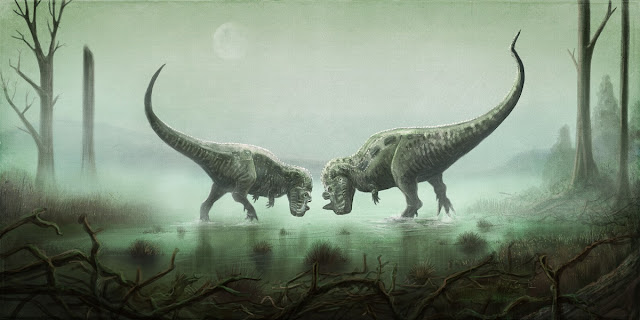
Tyrannosaurus engages in some closed-mouth vocalising, but which species of Tyrannosaurus is this? It might seem that, up until recently, there would be only one answer, but this is actually an old question dating back to at least the early 1970s. Hey, writing about this sounds like a fun idea for a blog post. Oh look, someone else thought so too - read on...

Even aliens living on the far side of the Moon are aware that, last month, independent researcher and palaeoartist Gregory S. Paul led a team of authors proposing that our traditional take on Tyrannosaurus rex was wrong. According to Paul et al. (2022), this classic genus does not contain just one species, but actually three: the stocky, geologically older T. imperator, and two descendant, coexisting younger species, T. rex and T. regina. As documented in the New York Times and elsewhere in numerous articles, the response from tyrant dinosaur experts was not enthusiastic; to the contrary, most workers concluded that the study was underwhelming and unlikely to change the status quo. It’s not my intention to provide a detailed breakdown on this paper as relevant experts have already done this in recent weeks on various news and social media sites. It'll suffice to say that, while some of the ideas floated by Paul et al. are certainly interesting, the vague, very short diagnoses of the three species, the failure to provide strong statistical support for “robust” and “gracile” morphotypes within our T. rex inventory, and the inability to assign several well-preserved partial skeletons to the new species will likely prove sufficiently problematic to prevent widespread adoption of this new scheme. I hear a response is already being written.

But one, perhaps surprising, reaction to Paul and colleagues’ (2022) research is that most experts really weren’t shocked by the idea of several species within the T. rex hypodigm, and several even remarked that the idea itself is plausible even if our data, for the time being, do not support it. While the exact geological longevity of Tyrannosaurus rex is open to question (Paul et al. 2022), it was at least around for close to one million years (Brusatte and Carr 2016) and existed in varying habitats across a wide spread of western North America, from southern Alberta to the Texas/Mexico border, and from Utah to the Dakotas (Sampson and Loewen 2005). Compared to other theropods, that’s a broad spatiotemporal spread and one that could conceivably contain hitherto unappreciated variation that requires close analysis to uncover.

And it’s this topic of looking closely at our T. rex sample that I want to discuss today. It might seem that Paul and colleagues’ proposal is a radical dismantling of a fossil icon, and, indeed, this status is emphasised by Paul et al. themselves, who remark in their supplementary data and press work that they are “likely to displease many who are enamoured with the tyrant lizard king Latin moniker”, but that their "mini-revolution" will “force people to face the issue”. But, viewed more broadly, their study is actually only the latest in a long line of research that has expanded or shrunk our inventory of T. rex fossils and toyed with the idea of multiple Tyrannosaurus species. Indeed, even the features said to characterise the T. regina, rex and imperator are familiar from older publications (e.g. Larson 2008a). The result is that, when reviewing older literature on Tyrannosaurus taxonomy in light of these recent discussions, it’s difficult to avoid a sense that these seemingly-new ideas are not only re-treading old ground, but maybe even tripping over it.

T. rex taxonomy: the early(ish) years

Graphic summary of the classification of Tyrannosaurus specimens (cranial material alone shown here) in the late 20th century. This illustration and those that follow do not represent the entirety of T. rex material known at any one time, but focus on named T. rex specimens that have been proposed as distinct taxa at one time or another. Note the comment below on the spelling of "stanwinstonorous", as some confusion surrounds this.

Despite the long-held celebrity of Tyrannosaurus and it being known to science for over a century, most of what we’ve learned about this animal has been discovered in the last 30 years. In fact, little of note was published on T. rex during the mid-20th century and only a few significant specimens were uncovered (Larson 2008b). This corresponds with little taxonomic work and means we can skip ahead to start this story around 1970. Tyrannosaurus fans will realise that this omits discussion of the historic taxa “Dynamosaurus” and “Manospondylus” but, given that they were satisfactorily dismissed by Osborn (1906, 1917) and have no chance of being revived today, we can gloss over the earliest history of T. rex studies with only one important note: rushed as it was, Henry Osborn’s (1905) naming and type designation for Tyrannosaurus rex were extremely solid. So remember that, in spite of everything that follows in this article, and whatever else future generations have to say about the number of Tyrannosaurus species, T. rex itself is not going anywhere.

Rushing through that earliest period of Tyrannosaurus research puts us in the mid-20th century when, following a world war-induced hiatus in North American palaeontology, collectors and researchers returned to the field during the 1960s and ‘70s to resume exploration of American fossil resources. Among many important discoveries were new specimens of Tyrannosaurus and, at this point in history, each one was significant because T. rex was still only represented by a few examples. As our sample size grew from a few to a handful, and then to a dozen and more, it became apparent that no two T. rex individuals were exactly alike: T. rex evidently held a large amount of intraspecific variation within its population (Carpenter 1990). With this observation came the question of how much difference could be permitted in these fossils before specimens could no longer be identified as T. rex. The first rumblings on this never made it to print but were included in an unpublished 1972 thesis by then-student Douglas “Quetzalcoatlus” Lawson, who named Tyrannosaurus “vannus” for a relatively small, seemingly unusual tyrannosaurid maxilla from the Texan Javelina Formation. T. “vannus” never became “official” in the eyes of zoological nomenclature because it was never formally published and, in any case, Lawson revised his interpretation soon after, referring the same bone to T. rex itself (Lawson 1976). But in a later, 1990 review of T. rex variation, Kenneth Carpenter independently opined that this maxilla might represent a distinct southern Tyrannosaurus species. Others (Brochu 2003; Carr 2020) have been less convinced that it represents a new species, with Brochu (2003) suggesting that if the Texan maxilla was not T. rex, it must still represent a very close relative.

FMNH PR2081, better known as "Sue", represents one extreme of Tyrannosaurus form in being an especially large and robust example of the genus. These features have seen this specimen (shown here in its older, more prominent place in the Field Museum of Natural History) at the centre of many discussions of T. rex diversity and disparity. Photo by Connie Ma, from Wikimedia, CC BY-SA 2.0.

This was only the start of the buzz circulating around the concept of Tyrannosaurus having multiple species, which gained further traction in the 1980s. Again, the amount of variation in T. rex specimens was generating conversation, and both Horner and Lessom (1993) and Larson (2008) give Robert Bakker credit for observing features in Tyrannosaurus skeletons that might distinguish certain morphotypes from others. It’s reported that Bakker was so confident in this that only a slightly increased T. rex sample size might have seen him formally propose more Tyrannosaurus species before the turn of the millennium. It was perhaps these rumours and conversations that prompted Paul (1988) to muse on multiple Tyrannosaurus species in his influential book Predatory Dinosaurs of the World. Despite acknowledging variation in T. rex dentition and limb structure, Paul concluded that no, the Tyrannosaurus specimens known in the late 1980s were not diverse enough to represent more than one species. But other researchers weren’t so sure. Molnar (1991) responded to Paul’s comments by questioning whether we had enough T. rex specimens to draw any firm conclusions about the number of species they really represented, and suggested that the question would remain open until we acquired more data. Others were more confident that Paul was wrong. Donald Glut (1997) recorded that researcher Stephen Pickering privately issued manuscripts in 1996 proposing that several T. rex specimens, including the famous “Sue” skeleton, represented a new species that he named Tyrannosaurus "stanwinstonorous"* after the special effects pioneer responsible for the animatronic dinosaurs in Jurassic Park and its sequels. Pickering argued that multiple features of the skull and the trait of adults being 6-7 % larger than Tarbosaurus or T. rex distinguished "stanwinstonorous" from other tyrannosaurs, but — as with Lawson’s T. “vannus” — lack of widespread publication prevented this name from entering scientific consideration.

*Added 31/03/2022: Pickering spelt this name "stanwinstonorum" in his original manuscripts, but Glut — which is where I obtained my information from — spelt it "stanwinstonorous". "stanwinstonorum" is thus the intended and "correct" spelling for this taxon, but the situation is confused by Glut's 1997 encyclopaedia being an ICZN-compliant publication, which Pickering's privately disseminated manuscripts are not. Ergo, "stanwinstonorous" is now mentioned in technical literature, while "stanwinstonorum" isn't. Given the informal status of stanwinstonorum/ous we probably don't need to worry about this too much, but this inconsistency is worth highlighting.

So, even as palaeontologists circled Tyrannosaurus looking for specimens to split from the T. rex hypodigm in the late 20th century, no formal proposals were published. But taxonomic acts relevant to T. rex were being carried out as smaller, often fragmentary North American tyrannosaurs that we’d eventually recognise as Tyrannosaurus were receiving names or reclassification. With some of these specimens having been found decades prior, fairly convoluted taxonomic histories are associated with them (see Carr and Williamson 2004 for a summary). Here, let’s just cut to the chase and list them with their final, accepted binomials: Dinotyrannus megagracilis (Paul 1988; Olshevsky and Ford 1995), Stygivenator molnari (Paul 1988; Olshevsky and Ford 1995) and — most famous of all — Nanotyrannus lancensis (Gilmore 1946; Bakker et al. 1988). Despite recognition that at least some of these species (D. megagracilis and S. molnari) were based on juvenile or subadult material, the idea that they may represent subadults of T. rex was not considered, and the validity of N. lancensis was hinged, to some extent, on it being a subadult or adult that reached maturity at a smaller size and lighter frame than T. rex itself (Paul 1988; Bakker et al. 1988). This thinking reflects, in part, a period in vertebrate palaeontology dominated by typological approaches where specimens were assigned to species based on morphology alone without factoring in the influences of growth or individual variation. Under such schemes, it was rare, though not unheard of (Rozhdestvensky 1965; Russel 1970), to ally juvenile theropod specimens with adult specimens.

A 21st century T. rex hypodigm

T. rex taxonomy made simple: everything is T. rex! There are, of course, dozens more specimens we could show here: this graphic only shows the skulls of specimens thought to represent different Tyrannosaurus species at one time or another.

A more holistic philosophy toward the classification of fossil species has, in the last few decades, replaced such thinking and allows us to realise that, for example, a young juvenile specimen might look very different to an old adult. This can make characterising fossil species more difficult, but the results are more rewarding as we get more detailed and realistic insights into the life histories and ecologies of ancient animals. Such practices have typified most recent taxonomic work on Tyrannosaurus, emphasising the need to investigate features of specimen growth stage (e.g. bone fusions, histological evidence of specific age etc.) alongside morphology when considering what is, and what isn’t, Tyrannosaurus rex (e.g. Carr 1999, 2020; Carr and Williamson 2004; Woodward et al. 2020).

These works have shown that Tyrannosaurus was even more variable than initially realised, not only being differentiated in build and size as an adult but also looking entirely different as a juvenile. As is now well-known to Tyrannophiles, T. rex grew from a dog-sized, slender-snouted hatchling to a supersized, gnarly-skulled adult with unprecedented robustness among theropods. Carr (2020) characterises T. rex growth as undergoing “secondary metamorphosis” at the onset of sexual maturity, in which it transformed from a slender, “bird-meets-horse” juvenile body plan to a robust, deep-snouted, massive-bodied adult form. The result is an interpretation of Tyrannosaurus rex that occupied a range of disparate anatomies throughout its lifespan, within which small tyrants like “D. megagracilis” and “S. molnari” can be absorbed into a well-substantiated growth sequence (Carr and Williamson 2004). And yes, while a minority favour Nanotyrannus as a distinct taxon (e.g. Larson 2013), it also plots neatly into this system without issue (Carr 1999, 2020; Currie 2003; Woodward et al. 2020).

It's strange to think that this fleet-footed predator is the same species as that 6-10 tonne tank we were recently discussed as a head-butter, but the evidence that T. rex underwent this radical transformation is very strong. This dramatic transformation is also surely one of the major complicating factors in our attempts to unravel Tyrannosaurus taxonomy.

This hypothesis does more than just tidy up T. rex taxonomy. It also establishes that Tyrannosaurus was probably not a “normal” theropod in terms of its ecological role, and that there may be a good reason why this one species occupied such an expanse of time and space in Maastrichtian North America. The 30-odd year lifespan of one Tyrannosaurus encapsulated the ecological potential of several grades of predatory dinosaurs (Holtz 2021), and we might expect such an adaptable animal to have a long evolutionary history and wide geographic range. We might also predict an unusual amount of variation in our T. rex samples because, if this one species was undergoing such a transformation across three decades of growth, it would have transitioned through a large number of “morphs”. Coupled with distortion caused by fossilisation and the dusting of individual variation we’d expect among a reasonable sample of biological entities and we're going to find a lot of variation among our Tyrannosaurus fossils. It’s an interesting idea that explains a lot of weirdness around our T. rex sample, perhaps more parsimoniously than greater taxonomic granularity or sexual dimorphism. But on those topics…

Larson’s Tyrannosaurus “x”

Graphic summary of select skulls referred to T. rex and T. "x" by Larson (2008). As above, this is not a comprehensive assessment, but shows where important, name-bearing specimens end up in Larson's scheme.

Developing in parallel to this “everything is Tyrannosaurus” interpretation were research projects that argued to split T. rex apart. The drip of new Tyrannosaurus specimens that started in the 1960s and ‘70s had turned into a relative torrent in the 1990s, such that researchers of the 2000s had dozens of T. rex specimens to examine. This was a large enough sample that we had some hope of teasing more obvious trends or patterns out from the statistical noise of individual variation and we might, finally, get some perspective on whether T. rex was one species or several.

In 2008, Pete Larson specifically addressed this issue (Larson 2008a). He noted that some adult Tyrannosaurus skeletons can be much stockier and more heavily built than others and ascribed this to sexual dimorphism for a variety of reasons, most of which are now doubted. But he also highlighted variation in cranial pneumatic features, tooth counts and the number of small "incisiform" teeth at the front of their lower jaw. These, Larson argued, were more likely to be taxonomic differences. Only a few specimens possessed a full suite of distinctive features that separated them from T. rex proper, including the giant skull MOR 008, the privately-owned “Sampson” skeleton, and the iconic AMNH 5027. Larson set these aside from the T. rex hypodigm but erred on the side of caution by not establishing a new taxon: instead, he gave this potential second Tyrannosaurus species a nickname: Tyrannosaurus “x”.

The holotype dentary of T. rex shows one small "incisiform" tooth in this photo presented by Larson (2008). The presence or absence of a second small tooth at the front of the lower jaw has been suggested to denote a distinct Tyrannosaurus species, but different authors disagree over the true variation of this feature.

The decade following Larson’s proposal has not provided much support for his suggested split in Tyrannosaurus specimens. In part, this reflects weak statistical support for the alleged taxonomic and sexual morphotypes. Joshua Smith’s (2005) assessment of T. rex dental characteristics and their utility in systematics can be seen as a blind test of size variation in the second dentary tooth, for instance, but failed to find significant characteristics of this in examined specimens. Mallon (2017) specifically looked for evidence of Tyrannosaurus sexual dimorphism along the parameters outlined by Larson but failed to find the sort of bimodal character distribution that would, in theory, result from differentiated sexes. More recently, Thomas Carr’s gigantic 2020 ontogenetic analysis of 44 T. rex specimens also found no taxonomic significance to Larson’s proposed dental and skull characters, nor did it recover evidence for sexual dimorphism. Moreover, it also failed to cluster the specimens ringfenced by Larson as T. "x". The size of Carr's analysis really has to be emphasised; by cataloguing up to 1850 features in 44 specimens, this investigation is, by far, the most in-depth analysis of anatomical variation within Tyrannosaurus (and maybe any dinosaur), and its failure to recover conclusions similar to those of Larson's 2008 study does not look good for the T. "x" hypothesis. Indeed, the scope and depth of Carr's investigation sets a high bar to clear for any different interpretation of T. rex variation, and that brings us to…

…Paul et al. (2022): the “mini-revolution for the dinosaur long universally called T. rex”

The suggested T. rex taxonomy of Paul and colleagues (2022) and its potential fallout from collisions with older schemes. Again, this is not a comprehensive breakdown of which T. rex specimens go where in this taxonomy, it only shows the treatment of key, named specimens.


As will now be clear, a finger has been hovering over the big red button marked “new Tyrannosaurus species” for decades now, and someone, somewhen, was going to push it eventually. In this context we can see Paul et al. (2022) as simply being the team that took the plunge, offering to give yet another interpretation of Tyrannosaurus ;taxonomy by splitting T. imperator and T. regina from T. rex. And as will also now be clear to anyone familiar with Paul and colleagues’ arguments, there is a certain historic familiarity to some of their ideas: the characters used are very similar to those used by Larson for characterising T. "x"; specifically, regina, rex and imperator are distinguished by features of skeletal robustness and the number of smaller incisiform teeth in the lower jaw. To be fair, how these are quantified and measured is slightly different in Paul et al., but there's undeniable conceptual overlap. I suspect this is one reason the paper has not received the most enthusiastic response among tyrant dinosaur experts, who will not only have experienced a sense of deja vu from the concept of new Tyrannosaurus species but also immediately thought of those analyses which have already investigated and dismissed the taxonomic potential of robustness and dentary incisiforms. And, OK, we need to be careful not to be arrogant or dismissive in these considerations: it’s really easy to say “other analyses didn’t find this result, so you’re probably wrong”, but if a new paper is essentially arguing points that have already been shown as doubtful, it’s fair to point to the same studies that dismantled those ideas the first time around.

And it’s not only in character choice that the past might catch up with the conclusions drawn by Paul et al. As outlined above, T. rex taxonomy has enough history and complications under its skin that it’s hard to create, as Paul et al. attempt, a totally fresh Tyrannosaurus classification without running into leftovers from older proposals. For instance, Paul et al. refer the holotype of Dinotyrannus megagracilis to their new species T. regina, arguing that the megagracilis type is an incomplete juvenile specimen and thus a nomen dubium, and therefore unsuited to be the holotype for their new species. But, unless my understanding of ICZN rules is totally wrong, I’m not sure that’s how nomenclatural rules will shake out. For megagracilis to be identified as regina it must show at least some of the features Paul et al. assert are unique to T. regina; this being the case, it (theoretically) has features distinguishing it from T. rex as well. If a specimen can be identified to species level it cannot be a nomen dubium, and this should would allow megagracilis to re-enter the field as a valid, non-T. rex species. And if megagracilis is the same species as regina, then megagracilis has nomenclatural priority by 34 years: the "Tyrant Queen" becomes… "Tyrant Big Skinny". Note that megagracilis is also a Paul (1988) taxon, so it’s regina’s own senior author complicating the attempted, and admittedly pretty neat, emperor-king-queen naming scheme.

The imperator name is potentially at risk from an older name too, as highlighted by tyrannosaur expert/palaeontology social media machine Thomas Holtz in the New York Times. The holotype of Nanotyrannus lancensis stems from the lower portion of the Hell Creek Formation where imperator, according to Paul et al., is said to have existed independently from rex and regina. Given that the lancensis type specimen is clearly a juvenile animal, and most probably Tyrannosaurus (Carr 1999; Woodward et al. 2020), parsimony suggests it should be the same species as T. imperator. Paul et al. (2022) are non-committal about Nanotyrannus as a separate genus, noting its questionable status but not coming down on either side of the debate around its validity. But whether we regard the generic name as warranted or not, if Nanotyrannus is the juvenile of a stratigraphically older species of Tyrannosaurus, lancensis would have nomenclatural priority over imperator. The Tyrant Emperor would become humdrum T. lancensis.

Variation within Tyrannosaurus as illustrated by Paul et al. (2022): how many species do you see? What's worth noting in this graphic is that two specimens (B, RSM 2523.8; and F, AMNH 5027) are not referred with confidence to any Tyrannosaurus species by Paul and colleagues, which seems remarkable given their relative completeness.

It’s also interesting to see how Paul and colleagues’ conclusions compare to those of previous workers. Of note are that specimens highlighted by others as potential new Tyrannosaurus taxa — such as AMNH 5027, the Texan maxilla — are considered indeterminable by Paul et al., and that Larson (2008a), despite utilising the same dentary tooth character, retained the holotypes of regina and imperator in T. rex. There’s nothing wrong with different projects drawing contrasting taxonomic conclusions, of course, but this shows that attributes as basic as specimen tooth size are being interpreted very differently by different authors. This demonstrates the difficulty, and perhaps the degree of subjectivity, associated with carving our Tyrannosaurus dataset into multiple species. Perhaps the clusters of specimens we're identifying as distinct "species" are strongly influenced by our own opinions on what features are taxonomically important, and also how we choose to measure and characterise those features? The discussion of Tyrannosaurus dentary incisiform size by Paul et al. is telling in this regard, highlighting the existence of “borderline” specimens that could be interpreted one way or another. Differing takes on such specimens probably account for the varied views proposed by different researchers.

The end? Probably not...

The take-home here is a simple one: T. rex is a tricky animal to split into multiple taxa, but the problem is not because researchers are wedded to the idea of there being one species of this animal. To the contrary, exactly the opposite is true: people have been trying to blow T. rex into smaller taxonomic units for half a century! Rather, it's because what seems like a straightforward job of naming a few new tyrannosaur species is complicated by the enormously variable nature of the T. rex dataset and also the lesser-known, but still important, taxonomic considerations of past workers. I admit to seeing Paul and colleagues’ work as less of a “mini-revolution” than the latest contribution in a decades-long conversation about the variation apparent in Tyrannosaurus specimens. Their work is distinguished, of course, by finally erecting new Tyrannosaurus species after 50 years of researchers tossing this idea around, and in this respect, Paul et al. have moved the conversation on. But in doing this, a greater spotlight is now shone on past attempts to investigate Tyrannosaurus variation, including the legitimacy of species previously sunk into T. rex as well as the value of anatomical characters already of doubtful value in dividing up the T. rex sample. It’s the response to these that will determine how far our understanding of Tyrannosaurus diversity has been moved by these new proposals.

Enjoyed this post? Support this blog for $1 a month and get free stuff!

This blog is sponsored through Patreon, the site where you can help artists and authors make a living. If you enjoy my content, please consider donating as little as $1 a month to help fund my work and, in return, you'll get access to my exclusive Patreon content: regular updates on upcoming books, papers, paintings and exhibitions. Plus, you get free stuff - prints, high-quality images for printing, books, competitions - as my way of thanking you for your support. As always, huge thanks to everyone who already sponsors my work!

References

  • Bakker, R. T., & Williams, M. (1988). Nanotyrannus, a new genus of pygmy tyrannosaur, from the latest Cretaceous of Montana. Hunteria, 1(5), 1.
  • Brochu, C. A. (2003). Osteology of Tyrannosaurus rex: insights from a nearly complete skeleton and high-resolution computed tomographic analysis of the skull. Journal of Vertebrate Paleontology, 22(sup4), 1-138.
  • Brusatte, S. L., & Carr, T. D. (2016). The phylogeny and evolutionary history of tyrannosauroid dinosaurs. Scientific Reports, 6(1), 1-8.
  • Carpenter, K. (1990). Variation in Tyrannosaurus rex. Dinosaur systematics: perspectives and approaches, 141-145.
  • Carr, T. D. (1999). Craniofacial ontogeny in tyrannosauridae (Dinosauria, Coelurosauria). Journal of vertebrate Paleontology, 19(3), 497-520.
  • Carr, T. D. (2020). A high-resolution growth series of Tyrannosaurus rex obtained from multiple lines of evidence. PeerJ, 8, e9192.
  • Carr, T. D., & Williamson, T. E. (2004). Diversity of late Maastrichtian Tyrannosauridae (Dinosauria: Theropoda) from western North America. Zoological Journal of the Linnean Society, 142(4), 479-523.
  • Currie, P. J. (2003). Allometric growth in tyrannosaurids (Dinosauria: Theropoda) from the upper Cretaceous of North America and Asia. Canadian Journal of Earth Sciences, 40(4), 651-665.
  • Gilmore, C. W. (1946). New carnivorous dinosaur from the Lance Formation of Montana. Smithsonian Miscellaneous Collections 106 (13), 1-19.
  • Glut, D. F. (1997). Dinosaurs: the Encyclopedia. McFarland and Company Inc.
  • Holtz Jr, T. R. (2021). Theropod guild structure and the tyrannosaurid niche assimilation hypothesis: implications for predatory dinosaur macroecology and ontogeny in later Late Cretaceous Asiamerica. Canadian Journal of Earth Sciences, 58(9), 778-795.
  • Larson, P. (2008a). Variation and sexual dimorphism in Tyrannosaurus rex. In: Larson, P. & Carpenter, K. (eds.) Tyrannosaurus rex: the Tyrant King. Indiana University Press, 103-130.
  • Larson, N. L., (2008b). One hundred years of Tyrannosaurus rex: the skeletons. In: Larson, P. & Carpenter, K. (eds.) Tyrannosaurus rex: the Tyrant King. Indiana University Press, 1-56.
  • Larson, P. (2013). The case for Nanotyrannus. In: Parrish, J. M., Molnar, R. E., Currie, P. J. and Koppelhus, E. B. Tyrannosaurid paleobiology. Indiana University Press, 15-53.
  • Lawson, D. A. (1976). Tyrannosaurus and Torosaurus, Masstrichtian dinosaurs from Trans-Pecos, Texas. Journal of Paleontology, 50 (1), 158-164.
  • Mallon, J. C. (2017). Recognizing sexual dimorphism in the fossil record: lessons from nonavian dinosaurs. Paleobiology, 43(3), 495-507.
  • Molnar, R. E. (1991). The cranial morphology of Tyrannosaurus rex. Palaeontographica Abteilung A, 137-176.
  • Olshevsky, G., & Ford, T. L. (1995). The origin and evolution of the Tyrannosauridae, part 1. Dino Frontline, 9: 92–119.
  • Osborn, H. (1905). Tyrannosaurus and other Cretaceous carnivorous dinosaurs. Bulletin of American Museum of Natural History, 21, 259-265.
  • Osborn, H. F. (1906). Tyrannosaurus, Upper Cretaceous carnivorous dinosaur (second communication). Bulletin of the American Museum of Natural History, 22, 281-296.
  • Osborn, H. F. (1917). Skeletal adaptations of Ornitholestes, Struthiomimus, Tyrannosaurus. Bulletin of the American Museum of Natural History, 35, 733-771.
  • Paul, G. S. (1988). Predatory dinosaurs of the world: a complete illustrated guide. Simon & Schuster.
  • Paul, G. S., Persons, W. S., & Van Raalte, J. (2022). The Tyrant Lizard King, Queen and Emperor: multiple lines of morphological and stratigraphic evidence support subtle evolution and probable speciation within the North American genus Tyrannosaurus. Evolutionary Biology, 1-24.
  • Rozhdestvensky, A. K. (1965). Growth changes in Asian dinosaurs and some problems of their taxonomy. Paleontologicheskii Zhurnal, 1965, 95-100.
  • Russell, D. A. (1970). Tyrannosaurs from the Late Cretaceous of western Canada. National Museum of Natural Sciences, Publications, in Paleontology, 1, 1-34.
  • Sampson, S. D., & Loewen, M. A. (2005). Tyrannosaurus rex from the Upper Cretaceous (Maastrichtian) North Horn Formation of Utah: biogeographic and paleoecologic implications. Journal of Vertebrate Paleontology, 25(2), 469-472.
  • Smith, J. B. (2005). Heterodonty in Tyrannosaurus rex: implications for the taxonomic and systematic utility of theropod dentitions. Journal of Vertebrate Paleontology, 25(4), 865-887.
  • Woodward, H. N., Tremaine, K., Williams, S. A., Zanno, L. E., Horner, J. R., & Myhrvold, N. (2020). Growing up Tyrannosaurus rex: Osteohistology refutes the pygmy “Nanotyrannus” and supports ontogenetic niche partitioning in juvenile Tyrannosaurus. Science Advances, 6(1), eaax6250.

Monday, 28 February 2022

Quetzalcoatlus 2021: a strange pterosaur, or just strangely interpreted?

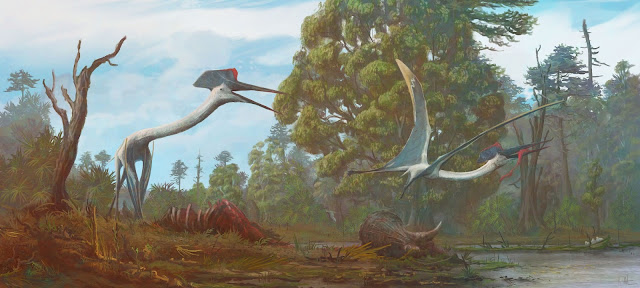
Quetzalcoatlus lawsoni scavenges a juvenile Torosaurus, recently killed (judging from the decapitation) by a large tyrannosaur. We've been waiting for ages to learn more about this pterosaur following a near-50 year delay in the description of its remains, but we're finally there! So what have we learned about Quetzalcoatlus proportions and anatomy from this glut of new information? Read on...
Almost a full half-century after its discovery, December 2021 finally saw the publication of a suite of technical papers on one of the most famous of all pterosaurs: Quetzalcoatlus. An entire themed collection of Quetzalcoatlus articles have been bound together in a special Journal of Vertebrate Palaeontology memoir, and they’re all — happy days — open access. This is great news for everyone with an interest in this animal or pterosaurs in general, and it represents a much-needed turnaround of a long-standing embargo on the Quetzalcoatlus material. Several authors have been attached and let go from The Big Quetzalcoatlus Project since the early 1970s and those of us without access to its fossils have done what we can to understand it from snippets of information published here and there. The memoir team — who tackle Quetzalcoatlus anatomy, systematics, palaeoenvironment and functional morphology — have thus ended a frustrating half-century-long wait for more information on this hugely popular, much-loved pterosaur. I have no doubt that these new papers — particularly Brian Andres and Wann Langston Jr.’s super-detailed and extensive osteology (Andres and Langston 2021) — will turn Quetzalcoatlus into a modern cornerstone of pterosaur research. Essentially overnight, the memoir team have turned Quetzalcoatlus from an almost non-entity in the scientific literature to an embarrassment of pterosaurian riches, and I look forward to the many new insights their work will foster.
There’s much to say about the entire volume and if you’d like a full run-down you should check out Darren Naish’s overview at Tetrapod Zoology. Here, I want to focus on one specific paper: the overview of functional morphology written by Kevin Padian et al. (2021). Many readers will have seen details on this paper in the media because it’s the one that turns our piles of Quetzalcoatlus fossils into a living, breathing animal, opining on what it looked like and how it walked, flew, and foraged. In other words, the kind of stuff that many people want to know most about these awesome animals. It's the paper that's drawn most of my attention because of my own research interests in azhdarchids: chiefly their palaeoecology, functional morphology and reconstruction (see Witton and Naish 2008, 2013; Witton and Habib 2010; Naish and Witton 2017 for examples).
And to cut straight to the chase, I want to talk about this because I suspect Padian et al.'s paper is destined to be the most controversial of the memoir’s contributions. It contains a lot of ideas and opinions that will be classed as unusual, non-mainstream takes on pterosaur palaeobiology and while some are novel, others are resurrected from papers written by the senior author decades ago (e.g. Padian 1983a, b, 1988, 2003, 2008). I say 'resurrected' because some of the ideas in question have since been rebutted or struggled to gain wider acceptance among pterosaur workers, such that reading Padian et al. (2021) has a distinctly vintage feel, like it's been beamed in from 20 or 30 years ago. I'm specifically interested in their handling of Quetzalcoatlus proportions, ground posture, wing folding and flight mechanics because Padian et al. make some genuinely strange suggestions around these topics; Quetzalcoatlus is restricted to crouching poses, might have flown with its legs tucked under its body, had its principal wing membrane attached to its hip, and potentially took to the air with a bipedal leap.
Proof that Padian et al. is destined to be controversial is found in the paper itself, where we find in-text admissions that the authorship team could not agree on matters of launch mechanic, flight posture and wing membrane configuration (in all instances, palaeontologist Kevin Padian is stated as disagreeing with his coauthors, biomechanicist Jim Cunningham and palaeoartist John “All Yesterdays” Conway). On top of this, some presented data conflict with other parts of the memoir, and there are a few potential errors that affect the reliability of the paper’s conclusions. It is, in detail, something of a wild read, and reaction to this paper is going to be mixed among pterosaur experts. Nevertheless, Padian et al. (2021) will also be a potential source for pterosaur reconstructions for the foreseeable future, and given that both the paper and associated press coverage are publicly accessible, I think it's right to have some responses from pterosaur workers online, too. In that vein, I want to point out which ideas should be considered unusual, which might jar with the rest of pterosaur research, and highlight a few issues I’ve identified when combing the paper. I hope the following is taken in the spirit it’s intended — an honest response to a paper on an animal I’m deeply interested in — especially because two of the authors (Jim and John) are good friends. John is also aware of some of my misgivings so the following won’t come as a complete shock. In any case, I hope it’s clear that the intention here is not to whale on new research, but to highlight areas I predict will be contentious or did not find compelling, on the chance that they are of interest to others who find Quetzalcoatlus fascinating.

Old vs. new: Quetzalcoatlus 2021 compared to older reconstructions

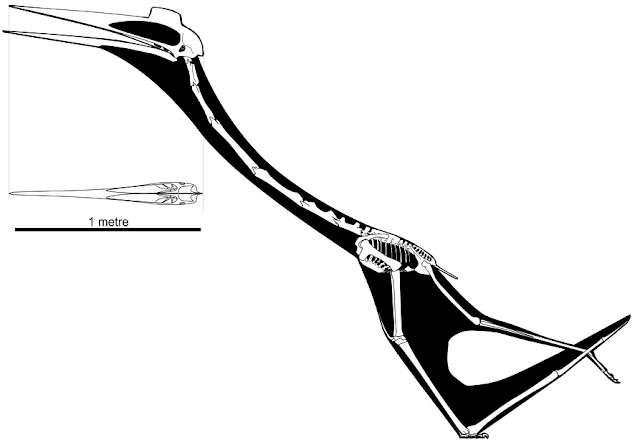
My 2016 skeletal reconstruction of Q. lawsoni (then known as 'Q. sp') is now consigned to history. How did this now-six-year-old reconstruction hold up to the might of The Memoir? Read on...
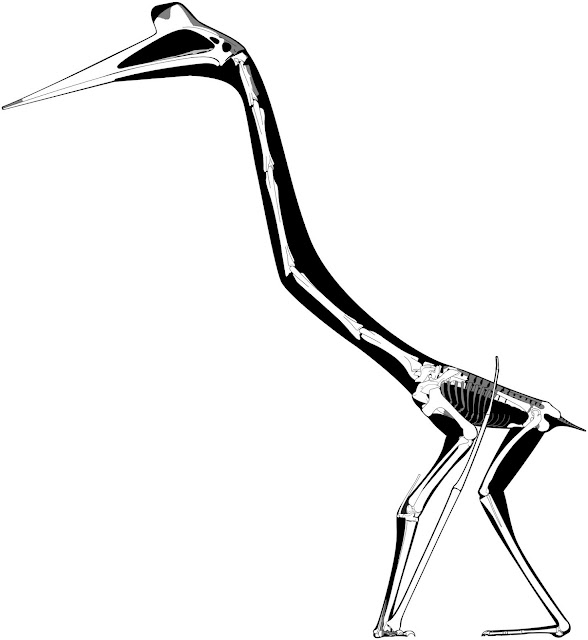
One of the things I was keenest to see in Padian et al. (2021) was how my various reconstructions of Quetzalcoatlus have fared against new data. I’ve designed a lot of azhdarchids, including Quetzalcoatlus, for film and TV and wanted to see how close I’d landed to the reality of this animal using scraps of information gleaned from other papers. The artwork in Padian et al. (2021) is both copious and all excellent, stemming — of course — from the hand of John Conway, and we’re treated to a lot of skeletal reconstructions in multiple views. The paper largely focuses on Q. lawsoni, the smaller of the two named Quetzalcoatlus species, because virtually the entire skeleton of this animal is represented across multiple, similarly-sized specimens. As we've known since the 1970s, the charismatic giant wing that represents the giant Q. northropi can only take you so far in understanding Quetzalcoatlus: Q. lawsoni is really where the action is. And one thing to point out straight away is that our Q. lawsoni material is from several similarly-sized animals, but that there’s a lot of variation in limb metrics across them. They all seem to reach 4.2-ish m wingspans through similar, but slightly different proportions (Andres and Langston 2021). This is interesting for all sorts of reasons, but also complicates any attempt at reconstruction. Probably the most obvious solution is to figure out what an ‘average’ Q. lawsoni looked like and work from that, although it would be neat to compare the extremes of proportion across the dataset too (something we're not doing here today).
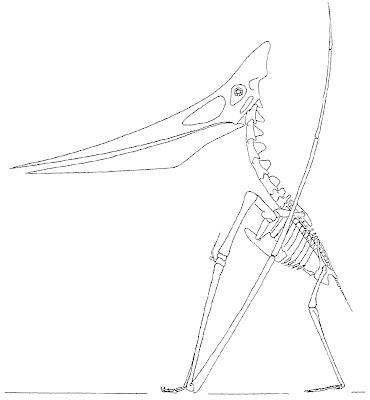
The Padian et al. (2021) reconstruction of Q. lawsoni "posed in quadrupedal terrestrial stance". The half-crouched limbs are not artistic whimsy, but tied into ideas of Q. lawsoni hindlimb motion. We're going to get into that in a moment.
Comparing my old reconstructions with the new data, I think (if I may say so) that my work stands up relatively well. In honesty, I was surprised by Padian et al.’s (2021) assertion that: “there has never been a justification for the proportions of the bones used in any [Quetzalcoatlus] illustration”. This simply isn’t true because, despite the embargo over Quetzalcoatlus material, a lot of information on Q. lawsoni has been published over the last 50 years. These include mostly accurate limb metrics (Unwin et al. 2000); a full skull description (Kellner and Langston 1996) and dimensions of the cervical vertebrae (Steel et al. 2007; Witton and Naish 2008). There have even been pretty decent skeletal reconstructions based on examination of the original fossils (Paul 2002). These data are why the skeletal reconstruction published by Padian et al. (2021) isn’t massively different to some carefully researched pre-2021 versions. Compared to my own work, the only major discrepancies I found concern some posterior cervical lengths, the length of the body, and the size of the wing metacarpal. On the latter, my skeletal used a 620 mm length derived from Unwin et at al. (2000), which it now appears is too long: actual Q. lawsoni WMC lengths were in the range of 420-470 mm. Overall, Quetzalcoatlus was a little shorter in the arm than I’m used to, and fractionally longer in the neck and body, but it’s not a total visual transformation. Other distinctions between my older work and John’s new skeletal are just matters of opinion. For instance, the Padian et al. Quetzalcoatlus has a very tapered posterior skull, which I think is unlikely given the general condition of azhdarchoid crania. Specifically, completely known skulls from the azhdarchid Zhejiangopterus linhaiensis and at least one member of the azhdarchid sister clade, Chaoyangopteridae, have tall, sheet-like frontoparietal bones extending over and beyond their braincases (Cai and Wei 1994; Lü et al. 2008), and we see similar conditions in thalassodromids/ines as well. I thus regard this condition as likely for Q. lawsoni, but this will remain nothing more than opinion until we find a more complete skull.

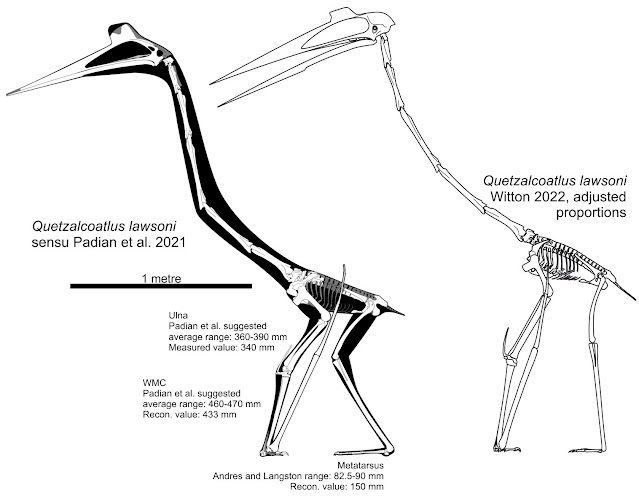
Is the crouching pose of the Padian et al. Q. lawsoni reconstruction necessary? Ignoring the hindlimb restoration philosophy (see below), there may be scaling issues with the forelimb affecting things too: an 'adjusted' skeletal to the right shows that Q. lawsoni could stand tall without issue.  
But in checking out the new reconstructions I also noted some less subjective differences. One of the more striking aspects of Quetzalcoatlus 2021 is the proposed habitual crouching pose. It reflects both assumptions about the hindlimb articulations (which we’ll discuss at length below) as well also the unexpected shortness of the forelimb. But even accounting for that short wing metacarpal, the wing looked strangely stunted to me. Upon investigation, I found that the wing skeleton is probably incorrectly scaled. Specifically, when compared to metrics given in Padian et al. (2021) and Andres and Langston (2021), the reconstructed radius/ulna and wing metacarpal lengths are 11 and 10% shorter (respectively) than an ‘average’ Q. lawsoni wing. This makes the arm quite a lot shorter than it should be and, when adjusted, there’s no problem making Quetzalcoatlus stand in a more typical, fully-upright posture. Indeed, the forelimb becomes long enough that the entire hindlimb can be extended vertically under the body without the arm looking over-extended (above).
The size of the foot also drew my attention. It’s been remarked that azhdarchids had small feet (Cai and Wei 1994; Hwang et al. 2002; Witton and Naish 2008; Andres and Langston 2021) and yet Padian et al. (2021) show Quetzalcoatlus as a relatively large-footed animal. The diminutive foot size of azhdarchids was one reason Darren Naish and I suggested they were terrestrial foragers back in 2008 (Witton and Naish 2008) and when I saw the big, flappy feet of 2021's Q. lawsoni I thought we’d got things wrong. But, again, there’s a measuring complication here. Padian et al. (2021) suggest the metatarsus (the shaft bones of the foot) was about 150 mm long, which is about 25% of the tibiotarsus length, and this is what's shown in the reconstruction. But Andres and Langston (2021) record the metatarsus as only 15% of the tibiotarsus, and 82.5-90 mm long. Andres and Langston further stress that Quetzalcoatlus had the third-shortest foot, relative to body size, of any known pterosaur, and this emphasis makes me think their measurements are more likely to be correct. If so, and we then assume — as suggested by Padian et al. — that the toes were a similar length to the metatarsals, Q. lawsoni would have had tiny feet of c. 160-180 mm long. This is a little over half of what's reconstructed for the Padian et al. restoration, but similar to the foot proportions of Zhejiangopterus.
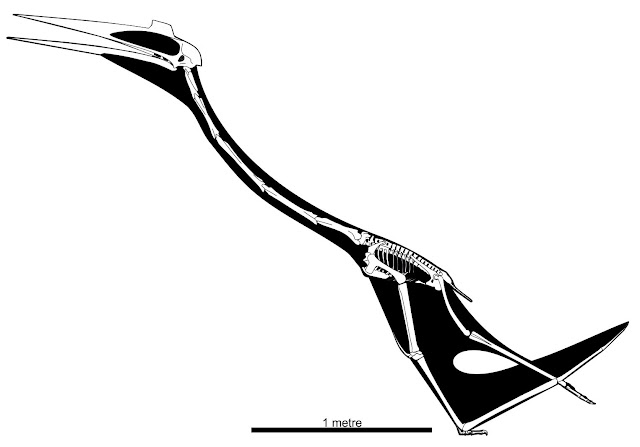
My 2022 skeletal reconstruction of Quetzalcoatlus lawsoni, incorporating the adjusted proportions outlined above. 
Once Quetzalcoatlus 2021 is adjusted to suit these adjusted measurements, it looks a lot less strange. You can get a sense of this from my own rebuilt skeletal reconstruction of Q. lawsoni, above. It should be stressed that there is a defence to these scaling issues: the aforementioned variation in limb metrics where specimen proportions can vary by over 10%. So perhaps Padian et al. haven’t reconstructed an ‘average’ Q. lawsoni, but they’ve still reconstructed something within the proportions of this species? There may be some validity to this, but comparing the presented reconstruction to the metrics of Andres and Langston (2021) suggests it's still something of a stretch. Nevertheless, the weird variation in Q. lawsoni proportions may be where all these issues originated.

Deja Qu, part I: crouching Quetz, hidden controversy

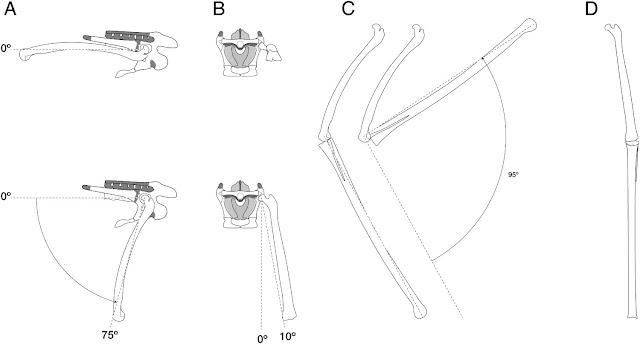
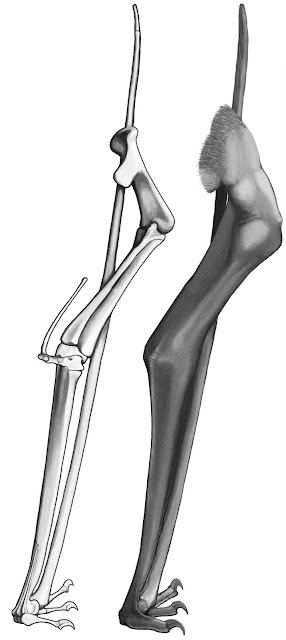
Let’s now look beyond proportions to functional morphology, starting with that strange crouching hindlimb. This reflects the idea that the Quetzalcoatlus femur was perpetually held subhorizontally with a maximum downward rotation of only 70-75𝆩 (Padian et al. 2021). This, it's said, prohibits the femur from swinging backwards under the pelvis as is widely interpreted and illustrated for pterosaurs across scientific literature and palaeoartworks, and it's not a new idea: it's taken straight from Padian papers published in the 1980s. The arguments are principally the same, too: that the articular surfaces of the pterosaur knee do not allow the leg to straighten, and that the femoral curvature of pterosaurs recalls that of birds, implying a subhorizontal orientation (see Padian 1983a, b; Padian et al. 2021). Padian et al. (2021) also mention that their proposed posture scores points for fitting Jurassic pterosaur tracks from Crayssac, France, an idea that further ties into classic Padian literature. Why fit Quetzalcoatlus into the tracks of relatively tiny Jurassic pterodactyloids and not the Haenamichnus tracks widely considered to have been made by a Korean azhdarchid (Hwang et al. 2002)? Because Kevin Padian (2003, 2008; Padian and Olsen 1984) has long been sceptical about the origins of pterosaur tracks, cumulating in the belief that only examples found in southern France are genuine pterosaur ichnites. Most or all others, he argues, were left by other reptiles; chiefly, crocodylian-like ones.

Suggested ranges of motion at the Q. lawsoni hip and knee, according to Padian et al. (2021). The precision drawings and figures suggest a lot of confidence in these data, but they contrast with several comments about the poor quality of the Q. lawsoni pelvis in the memoir, and the difficulty of reconstructing it accurately. The proposed range of knee articulation is also very restricted compared to analyses of this joint in other pterosaurs.
Understanding that Padian et al. (2021) has been written from this perspective explains why its discussion of hindlimb mechanics frequently jars against more recent studies. Padian et al. concede that the concept of subhorizontal pterosaurian femora contrasts with the conclusions of at least one team (Costa et al. 2014), but don't mention the heaps of other investigations it also conflicts with (e.g. Bennett 1990, 1997, 2001; Unwin 1996; Fastnacht 2005; Wilkinson 2008). While it would be incorrect to say that we understand everything about the motion of the pterosaur hindlimb, most researchers are pretty happy that the femur could swing into a subvertical pose. Indeed, some studies conclude that this is the optimal position for the pterosaur hindlimb when walking, providing the best mechanical advantage for the muscles that move the leg forward and back (Fastnacht 2005; Costa et al. 2014). It’s also generally observed that the articular surfaces of pterosaur knees extend to the tips of the limb bones, allowing them to adopt almost entirely straightened knee poses (e.g. Bennett 2001; Wilkinson 2008). Padian et al. (2021) provide the first assessment of this for azhdarchid knees, but I admit to wondering why they think the condyles are so limiting when azhdarchid hindlimb joints look pretty similar to those of other pterodactyloids (see Godfrey and Currie 2005; Averianov 2010, and Andres and Langson 2021 for images).
With the weight of opinion being that pterosaur hindlimbs were actually pretty different to bird legs, I'm surprised the Q. lawsoni functional analysis leads so strongly with its assessment of a bird-like subhorizontal femur. At very least, those other studies warrant discussion. And as for the seeming validation that a crouching Quetzalcoatlus can be made to fit Jurassic pterosaur trackways, this is a moot point: conventional, upright hindlimb postures fit these tracks too (Bennett 1997; Mazin et al. 2003). The take-home here is that the proposal of Quetzalcoatlus having a subhorizontal femur, and thus being limited to a strange, crouching pose, is both odd and not well substantiated against the consensus view of pterosaur research. It really needs bolstering with more data to be credible. 

Deja Qu, part II: Leg folding…

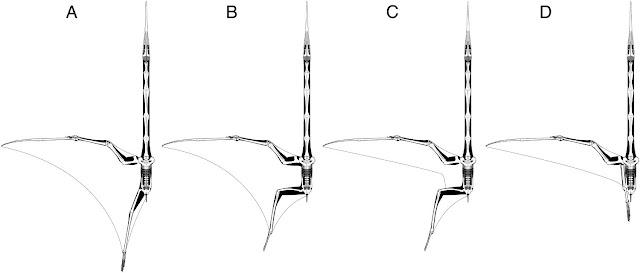
I mentioned above that some disagreement exists among the Padian et al. (2021) team on several topics, two of which concern flight pose and membrane shape. While Jim and John advocate something approximating the classic sprawled-leg flight pose and at least some degree of hindlimb membrane attachment, Padian prefers a bird-like configuration where the hindlimb is tucked underneath the body and the wing membrane anchors at the hip. Again, these latter ideas are Padian hypotheses that first aired 40 years ago (e.g. Padian 1983b; 1988). Predicting pterosaur membrane shapes remains a complex issue and is beyond our scope for discussion here: it’ll suffice to say that there is no evidence for a pelvic membrane attachment in any pterosaur, and that the handful of inboard membrane fossils we have collectively point to a distal hindlimb attachment across Pterosauria, including in Azhdarchoidea. This was well documented by Ross Elgin et al. (2011), a paper which Padian et al. cite and (probably unfairly) dismiss with just a few words. As for the question of flight pose: this boils down to whether Quetzalcoatlus was incapable of adopting the classic ‘sprawled-leg’ posture widely reconstructed for pterosaurs and, if not, did it have to adopt an unusual, avian-like one instead?

Q. lawsoni wing poses illustrated by Padian et al. (2021): which do you prefer? John Conway and Jim Cunningham are on record preferring model C, while Kevin Padian argues for D. My vote, given what fossils show of pterosaur wing membranes, would be for something between B and C (distal hindlimb membrane anchor, but a tighter trailing curve than B).
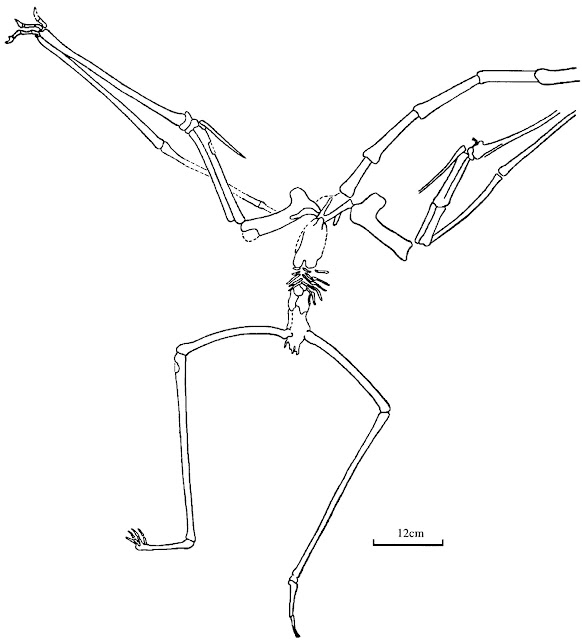
As alluded to above, discussions over pterosaur pelvis-hindlimb arthrology are nothing new. How far pterosaurs could move their femora around has been the subject of a large number of papers (e.g. Padian 1983a, b, 2003; Wellnhofer 1988; Bennett 1990, 1997, 2001; Unwin 1996; Wilkinson 2008; Costa et al. 2014; Frigot 2018) leading to a general consensus that most or all pterosaurs could move their hindlimb through a wide range of motion, walking and standing with a near-vertical femur but also swinging their legs out in flight. This conclusion is not just based on manually articulating bones but also on hundreds of articulated fossils showing pterosaurs preserved with both upright and splayed hindlimbs. These include at least two Zhejiangopterus specimens with butterflied hindlimbs (illustrated in Cai and Wei 1994 and Witton 2013) that show azhdarchids conforming to pterosaur norms. If Quetzalcoatlus was incapable of adopting a hindlimbs-out flight pose, it would have been highly aberrant and we’d need good evidence of such an interpretation: ideally, a well-preserved pelvis with an uncrushed acetabulum (hip socket) and a correspondingly well-preserved femur that allowed us to demonstrate, beyond doubt, limited capacity for hindlimb abduction.
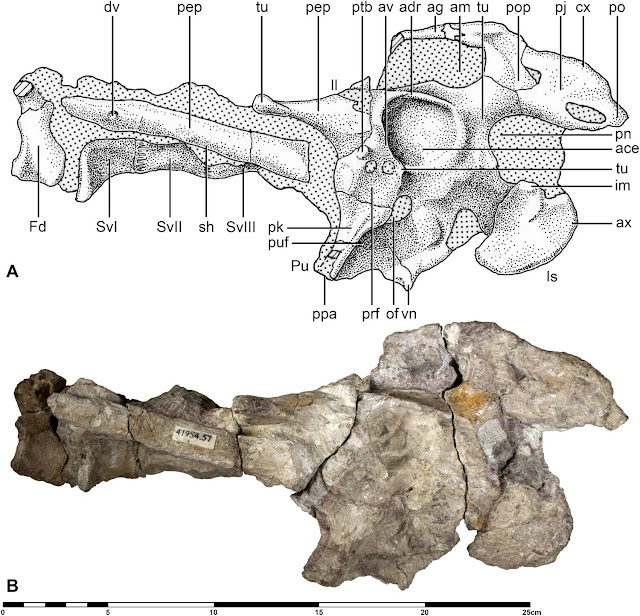
The Q. lawsoni pelvis as illustrated by Andres and Langston (2021): it's far from the best-preserved piece of our Q. lawsoni inventory. Are these the sort of pelvic remains we can use to substantiate a radical departure from our typical interpretations of pterosaur hindlimb arthrology? Probably not.
But, alas, here’s how Andres and Langston (2021) describe the only recovered pelvic material of Q. lawsoni: “fractured, heavily encrusted with concretionary material, and [with] matrix… often stained a similar color to the bone.” They conclude that “this pelvic plate is not preserved well enough to decisively determine its orientation with respect to the vertebral column” and that the angle of the acetabulum cannot be interpreted with certainty. Even Padian et al. (2021) concede that “the pelvis cannot be reconstructed in three dimensions with confidence”. There's an agreement, then, that we can't reconstruct the three-dimensionality of the Q. lawsoni pelvis without doubt, and this is a problem. We've learned from multiple studies that restoring pterosaur leg mobility is influenced by numerous factors including the shape and orientation of the hip socket, the precise angle of the pelvis with respect to the spinal column, the articulation of the pelvic bones themselves, and the inclination of the torso (e.g. Wellnhofer 1988; Bennett 1990; Fastnacht 2005; Wilkinson 2008; Costa et al. 2014). In other words, we need really, really excellent fossils to even start thinking about such investigations and if we can't reconstruct the Q. lawsoni pelvis, we cannot say much about the range of motion of the leg. 
It's for this reason that Padian et al. can only infer avian-like hindlimb mobility for Q. lawsoni, which they openly declare in their introduction to this topic: “Given the bird-like features of the entire hind limb, which not only bear anatomical resemblance but speak to functional similarity, it appears reasonable to begin with the kinds of postures and degrees of movements found in birds”. This is not the right approach and certainly undermines their abstract assertion that "In flight, it is most plausible that the hind limbs were drawn up bird-like, with the knee anterior to the acetabulum". Surely, if we can't model the hindlimb arthrology for Quetzalcoatlus, we have to fall back on what we're learned from other pterosaur species, not point to an anatomically distinct, phylogenetically distant pterosaur relative and made sweeping inferences? In all, I find nothing compelling about the concept of Quetzalcoatlus having to tuck its legs up like a bird, and I 100% agree with Jim and John in their endorsement of a more traditional, hindlimb-splayed flight configuration.

…and wing folding

Discussing flight brings us to another potentially contentious topic: the Q. lawsoni wing, or, rather, wing folding. We know a fair bit about how pterosaurs collapsed their wings for standing and walking (e.g. Wellnhofer 1988; Unwin 1996; Bennett 1997, 2001; Wilkinson 2008) and the general conclusion is that pterosaur forelimb articulation was complex. Their arm joints didn’t articulate uniaxially (i.e. in one plane); instead, the elbow and wrist deflected their distal limb bones medially and laterally as they opened and closed. We've found that, to get pterosaurs walking in their trackways, the pterosaur elbow needed to stick out from the body a little and that (like many dinosaurs) the palms of pterodactyloid hands faced inwards, as if the hands were ready to clap for a round of applause*. This is why pterodactyloid trackways show handprints with sideways projecting fingers: the digits have swung under the big knuckle of the wing digit to extend away from the body. The wing finger itself follows the same rules, so it folds up along the outside of the wing. A quirk of the wing metacarpal joint means that the wing digit is somewhat posteriorly deflected when it does this, stowing alongside the forearm during terrestrial progression. These basic findings are something that we’ve modelled from pterodactyloid bones and also witnessed in dozens, maybe hundreds, of well-preserved pterosaur fossils. Whenever we have an articulated, tightly folded pterosaur wing, the wing finger lies over the radius and ulna, not under it, and the palm of the hand faces inwards. We know this applies to azhdarchids too, thanks to articulated fossils of Zhejiangopterus (Cai and Wei 1994). We also have azhdarchid tracks, Haenamichnus, showing their hands were orientated in a typical, ‘palms inward’ pterosaur fashion when walking (Hwang et al. 2002). All expectations are, therefore, that Quetzalcoatlus would follow this familiar configuration.
*The situation is different in non-pterodactyloids, but that’s another story.
One of my favourite images for showing the complexity of pterosaur forelimb articulation, from Wilkinson (2008). The pose here can be regarded as 'extreme' as we have good data indicating that pterosaurs stood more upright than this, but the orthographic views show how the forearm and hand are deflected as the wing folds. Note how the wing finger and walking fingers rotate around an axis parallel to the midline of the body, allowing the fingers to project sideways while the wing finger folds against the outer arm.
Given these relatively well-established models, it’s something of a surprise to see Padian et al. (2021) showing Q. lawsoni doing something different. The wing is positioned so that the palm of the hand faces somewhat forward, allowing the wing digit to tuck under the elbow, despite the walking fingers still projecting laterally. The ability to draw the wing finger under the elbow is, apparently, a consequence of a slight downward deflection to the end of the wing metacarpal which changes the orientation of the joint, but I suspect it was also influenced by the methodology for modelling the standing pose. It’s reported that this was deduced by manually positioning casts of Q. lawsoni fossils in a plausible upright arrangement, an exercise which "began by placing the distal end of the wing metacarpal... with its distal condyles oriented posteriorly (so that the wing finger could be directed behind the elbow and close to the body wall)". It seems it was decided, a priori, that this is where the wing finger should go.

Proposed wing folding of Q. lawsoni, from Padian et al. (2021).
It’s a shame that no photos or diagrams of this work were published because, while those of us who have not handled the Quetzalcoatlus bones can’t really say that this interpretation is wrong, there are lots of legitimate questions about it that make me hesitant in accepting it outright. For example, Quetzalcoatlus is not unique for having that slight downturn at the end of the wing metacarpal: we see similar conditions in taxa like Pteranodon and Tapejara. In Pteranodon at least, they’ve been factored into arrangements of the folded pterosaur forelimb and do not result in the wing finger tucking under the elbow (Bennett 2001). I'm also not clear how the Q. lawsoni walking fingers are depicted as splaying out to the side when their respective metacarpals are positioned on the front of the wing: unless these joints were strangely bevelled, surely they should be facing more posteriorly? It's also strange to have the palm facing forward at all, as other studies exploring the impact of angling the pterosaur palm forward find that such poses are only possible if the forelimb adopted a crazy, implausible configuration (Bennett 2001).
Exploring how pterosaurs stood has taken us down some strange roads. In 2001, Chris Bennett attempted to pose Pteranodon in a once traditional configuration with a forward-facing hand: it didn't go well (note that the walking fingers are even upside down!).
And there are other issues, too. I wonder why the wing casts exercise was reconstructed with the wing finger joint facing posteriorly rather than laterally, as we'd expect from other pterodactyloids. If the wing finger joint faces backwards the wing spar is almost certainly going to tuck under the arm because the elbow has to bow out from the shoulder when a pterosaur stands: this seems like a foregone conclusion of positioning the wing elements to me, not an unexpected finding. Also of relevance here is that the Q. lawsoni wing metacarpals are, reportedly, poorly-preserved at the proximal (wrist) ends: as with our discussion of the hip bones, above, I wonder if the material is well-enough preserved to substantiate such bold claims? And what of Zhejiangopterus, with its well-behaved wing fingers? Why, again, is Q. lawsoni so different to other azhdarchoids?

Zhejiangopterus linhaiensis as illustrated by Cai and Wei (1994). OK, this is hardly the height of palaeontological visualisation (to be fair, the original fossil is barely more than an outline) but you can see lots of important functional features in this articulated azhdarchid specimen including splayed hindlimbs, medially-facing palms, and wing fingers that fold up against the outside of the wing. This is all good data that any interpretation of Q. lawsoni functionality needs to be considered against: it's our only direct insight into how azhdarchid skeletons fitted together.
In sum, I'm not saying that an elbow tucked interpretation is outright wrong. I am, however, very sceptical given the above points and would want to see further research — ideally informed by previous studies on pterosaur wing folding, and bringing in data from Zhejiangopterus and Haenamichnus as well — to substantiate an elbow-tucked wing finger. As you'll note in the art above, I've stuck to convention on this matter with my latest Q. lawsoni piece.

Bipedal launching: back on the table?

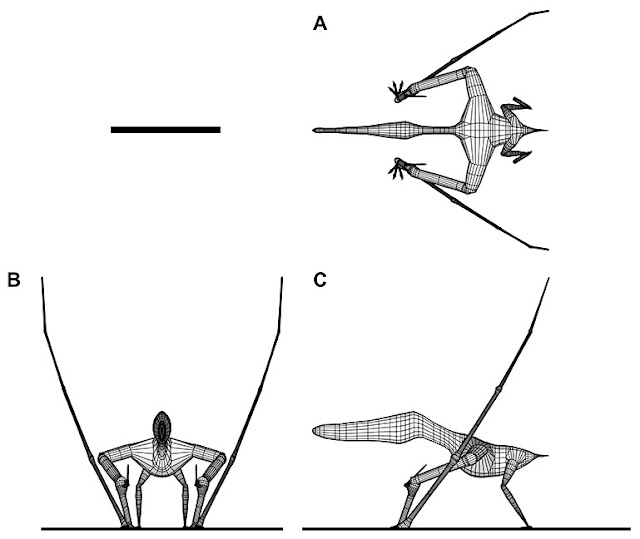
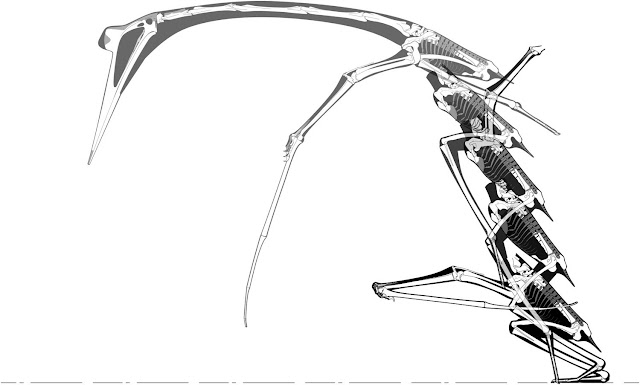
Finally, another area of contention between the authors of Padian et al. concerns launch strategy: how did Quetzalcoatlus become airborne? Here, the split is once again between Jim and John on one side, who advocate quadrupedal launch, and Kevin Padian on the other, who prefers a bipedal launch model. This split is not surprising because, some years ago, Jim independently drew the same conclusion about pterosaur launch as Mike Habib, who wrote the first paper on flying reptile quad-launch in 2008. Since then, this idea has become the pterosaur launch hypothesis to beat. As outlined at length in this post, it’s the only concept that explains (following substantial quantification and experimentation) everything we understand about pterosaur size, proportions and muscle volumes, while also fitting launch expectations from pterosaur trackways (i.e. that, among living animals, the gait used for terrestrial locomotion is the same gait used for take-off). It also avoids having to downsize pterosaurs to ridiculously small masses to achieve flight, as exemplified by Chatterjee and Templin’s (2004) conclusion that a giraffe-sized azhdarchid must mass 75 kg or less to facilitate take-off. Under quad-launch theory, giant pterosaurs can easily be 200 or 300 kg and still become airborne (Habib 2008, 2013; Witton and Habib 2010; Habib and Cunningham 2013).
A Q. lawsoni standing-start bipedal launch, illustrated in Padian et al. (2021). Is this a viable launch mechanic for a 4.2 m wingspan pterosaur? Opinion is split among the Padian et al. authorship.
It’s against this that Padian et al. refloat the idea of Quetzalcoatlus being a bipedal launcher, a concept also emphasised in press releases. The discussions of both bipedal and quadrupedal launch in Padian et al. (2021) are qualitative, mostly focusing on how the skeleton of Quetzalcoatlus can be moved into various launching postures, and there’s little engagement with what’s been said about pterosaur launch by recent workers. For example, Padian et al. suggest that Quetzalcoatlus might have lacked forelimb bending strength to sustain quad launch (i.e. that the forelimb would fail under such stress), ignoring the fact that Mike Habib and I demonstrated over a decade ago that the Q. lawsoni humerus was five times stronger under bending than the femur, and that even the neck bones of Quetzalcoatlus were stronger than its legs (Witton and Habib 2010). There is no explanation for why Quetzalcoatlus lacks the robust hindlimb anatomy of a large hindlimb launcher, when Mike has demonstrated that any flying animal above 500 g starts augmenting its launch limb anatomy to achieve sufficient power and reinforcement to sustain take-off (Habib 2008). And there’s no discussion of why previous calculations of bipedal launch, which have been universally hamstrung by having to lower pterosaur masses to ridiculous levels, went wrong. Padian et al. prefer a (relatively low) mass of 150 kg for a giant azhdarchid, but even this would be two- or three-times too heavy for any published bipedal launch mechanic. The fact bipedal launch proponents have consistently failed to get realistically-massed pterosaurs airborne isn't something we can just ignore: it's evidence against their hypothesis. There’s more we could say, but you're getting the idea: this attempted resurrection of bipedal launch as a viable take-off mechanic for even the small Quetzalcoatlus species has not, in my view, been well-argued, and does nothing to displace quad-launch as the superior pterosaur take-off hypothesis.

Conclusion: extraordinary claims... etc., etc...

And that, I think, is all I want to say on this for now. In short, I can't buy that Quetzalcoatlus is anywhere near as strange as the conclusions of Padian et al. (2021) imply: I strongly suspect it wasn't walking around half-crouched, wasn't flying with its legs tucked up like a bird, and wasn't leaping into the air using its legs alone. But, to be clear, there is nothing wrong with arguing that Quetzalcoatlus was aberrant. However, if you're going to make such assertions you need to present excellent, thorough and fully watertight analyses, and I just don't think Padian et al. do this. There are too many unaddressed complications, overlooked counterarguments and obvious questions raised around their more unusual hypotheses to take them as read. The fact that a lot of the proposals attempt to resurrect somewhat forgotten, decades-old hypotheses should not have been overlooked, either: if we've moved on from those ideas once, why are they suddenly viable now? What's changed to make hip-anchored membranes and bird-like knees plausible for pterosaurs in the 2020s? What are the problems with the consensus views that this paper conflicts with so often? It's this lack of consideration and engagement with modern pterosaur science that is at the core of my scepticism with so much of the paper. But this, of course, is only my take: it’ll be interesting to see what other researchers make of this now that Quetzalcoatlus is finally, and happily, available for unrestricted research access.

Enjoyed this post? Support this blog for $1 a month and get free stuff!

This blog is sponsored through Patreon, the site where you can help artists and authors make a living. If you enjoy my content, please consider donating as little as $1 a month to help fund my work and, in return, you'll get access to my exclusive Patreon content: regular updates on upcoming books, papers, paintings and exhibitions. Plus, you get free stuff - prints, high-quality images for printing, books, competitions - as my way of thanking you for your support. As always, huge thanks to everyone who already sponsors my work!

References

  • Andres, B., & Langston Jr, W. (2021). Morphology and taxonomy of Quetzalcoatlus Lawson 1975 (Pterodactyloidea: Azhdarchoidea). Journal of Vertebrate Paleontology, 41(sup1), 46-202.
  • Averianov, A. O. (2010). The osteology of Azhdarcho lancicollis Nessov, 1984 (Pterosauria, Azhdarchidae) from the late Cretaceous of Uzbekistan. Proceedings of the Zoological Institute RAS, 314(3), 264-317.
  • Bennett, S. C. (1990). A pterodactyloid pterosaur pelvis from the Santana Formation of Brazil: implications for terrestrial locomotion. Journal of Vertebrate Paleontology, 10(1), 80-85.
  • Bennett, S. C. (1997). Terrestrial locomotion of pterosaurs: a reconstruction based on Pteraichnus trackways. Journal of Vertebrate Paleontology, 17(1), 104-113.
  • Bennett, S. C. (2001). The osteology and functional morphology of the Late Cretaceous pterosaur Pteranodon Part II. Size and functional morphology. Palaeontographica Abteilung A, 113-153.
  • Cai, Z & Wei, F. (1994). On a new pterosaur (Zhejiangopterus linhaiensis gen. et sp. nov.) from Upper Cretaceous in Linhai, Zhejiang, China. Vertebrata PalAsiatica, 32(03), 181.
  • Chatterjee, S., & Templin, R. J. (2004). Posture, locomotion, and paleoecology of pterosaurs (Vol. 376). Geological Society of America.
  • Costa, F. R., Rocha-Barbosa, O., & Kellner, A. W. A. (2014). A biomechanical approach on the optimal stance of Anhanguera piscator (Pterodactyloidea) and its implications for pterosaur gait on land. Historical Biology, 26(5), 582-590.
  • Elgin, R. A., Hone, D. W., & Frey, E. (2011). The extent of the pterosaur flight membrane. Acta Palaeontologica Polonica, 56(1), 99-111.
  • Fastnacht, M. (2005). The first dsungaripterid pterosaur from the Kimmeridgian of Germany and the biomechanics of pterosaur long bones. Acta Palaeontologica Polonica, 50(2).
  • Frigot, R. A. (2018). Pelvic musculature of Vectidraco daisymorrisae and consequences for pterosaur locomotion. Geological Society, London, Special Publications, 455(1), 45-55.
  • Godfrey, S.J., & Currie, P.J. (2005). Pterosaurs. In: Currie, P.J., and Koppelhus, E.B. (eds), Dinosaur Provincial Park: A Spectacular Ancient Ecosystem Revealed. Indiana University Press: Bloomington and Indianapolis, p. 292-311.
  • Habib, M. B. (2008). Comparative evidence for quadrupedal launch in pterosaurs. Zitteliana, B28, 159-166.
  • Habib, M. (2013). Constraining the air giants: limits on size in flying animals as an example of constraint-based biomechanical theories of form. Biological Theory, 8(3), 245-252.
  • Habib, M. B., & Cunningham, J. (2010). Capacity for water launch in Anhanguera and Quetzalcoatlus. Acta Geoscientica Sinica, 31, 24-25.
  • Kellner, A. W., & Langston Jr, W. (1996). Cranial remains of Quetzalcoatlus (pterosauria, Azhdarchidae) from late cretaceous sediments of big bend national park, Texas. Journal of Vertebrate Paleontology, 16(2), 222-231.
  • Hwang, K. G., Huh, M. I. N., Lockley, M. G., Unwin, D. M., & Wright, J. L. (2002). New pterosaur tracks (Pteraichnidae) from the Late Cretaceous Uhangri formation, southwestern Korea. Geological Magazine, 139(4), 421-435.
  • Lü, J., Unwin, D. M., Xu, L., & Zhang, X. (2008). A new azhdarchoid pterosaur from the Lower Cretaceous of China and its implications for pterosaur phylogeny and evolution. Naturwissenschaften, 95(9), 891-897.
  • Mazin, J. M., Billon-Bruyat, J. P., Hantzpergue, P., & Lafaurie, G. (2003). Ichnological evidence for quadrupedal locomotion in pterodactyloid pterosaurs: trackways from the Late Jurassic of Crayssac (southwestern France). Geological Society, London, Special Publications, 217(1), 283-296.
  • Naish, D., & Witton, M. P. (2017). Neck biomechanics indicate that giant Transylvanian azhdarchid pterosaurs were short-necked arch predators. PeerJ, 5, e2908.
  • Padian, K. (1983a). Osteology and functional morphology of Dimorphodon macronyx (Buckland) (Pterosauria: Rhamphorhynchoidea) based on new material in the Yale Peabody Museum. Postilla, 189, 1-44.
  • Padian, K. (1983b). A functional analysis of flying and walking in pterosaurs. Paleobiology, 9(3), 218-239.
  • Padian, K. (1988). The flight of pterosaurs. Natural History, 12, 58-65.
  • Padian, K. (2003). Pterosaur stance and gait and the interpretation of trackways. Ichnos, 10(2-4), 115-126.
  • Padian, K. (2008). Were pterosaur ancestors bipedal or quadrupedal?: morphometric, functional, and phylogenetic considerations. Zitteliana, B28, 21-33.
  • Padian, K., Cunningham, J. R., Langston Jr, W., & Conway, J. (2021). Functional morphology of Quetzalcoatlus Lawson 1975 (Pterodactyloidea: Azhdarchoidea). Journal of Vertebrate Paleontology, 41(sup1), 218-251.
  • Padian, K., & Olsen, P. E. (1984). The fossil trackway Pteraichnus: not pterosaurian, but crocodilian. Journal of Paleontology, 178-184.
  • Paul, G. S. (2002). Dinosaurs of the air: the evolution and loss of flight in dinosaurs and birds. JHU Press.
  • Steel, L., Martill, D. M., Kirk, J. R. J., Anders, A., Loveridge, R. F., Frey, E., & Martin, J. G. (1997). Arambourgiania philadelphiae: giant wings in small halls. The Geological Curator, 6, 305-313.
  • Unwin, D. M. (1996). Pterosaur tracks and the terrestrial ability of pterosaurs. Lethaia, 29(4), 373-386.
  • Unwin, D. M., Lü, J., & Bakhurina, N. N. (2000). On the systematic and stratigraphic significance of pterosaurs from the Lower Cretaceous Yixian Formation (Jehol Group) of Liaoning, China. Fossil Record, 3(1), 181-206.
  • Wellnhofer, P. (1988). Terrestrial locomotion in pterosaurs. Historical biology, 1(1), 3-16.
  • Wilkinson, M. T. (2008). Three-dimensional geometry of a pterosaur wing skeleton, and its implications for aerial and terrestrial locomotion. Zoological Journal of the Linnean Society, 154(1), 27-69.
  • Witton, M. P. (2013). Pterosaurs: Natural History, Evolution, Anatomy. Princeton University Press.
  • Witton, M. P., & Habib, M. B. (2010). On the size and flight diversity of giant pterosaurs, the use of birds as pterosaur analogues and comments on pterosaur flightlessness. PloS one, 5(11), e13982.
  • Witton, M. P., & Naish, D. (2008). A reappraisal of azhdarchid pterosaur functional morphology and paleoecology. PLoS one, 3(5), e2271.
  • Witton, M. P., & Naish, D. (2013). Azhdarchid pterosaurs: water-trawling pelican mimics or “terrestrial stalkers”?. Acta Palaeontologica Polonica, 60(3), 651-660.

Monday, 31 January 2022

The silent dinosaur hypothesis

The story of how dinosaurs were resurrected for cinema in the early 20th century tends to focus on the visual components of these technical feats: the 2D animation and stop-motion technology that made long-extinct reptiles move again. But alongside making dinosaurs walk and run, cinematic dinosaurs also gave them a voice, imagining their snarls, barks, screeches and roars. Perhaps the first film to do this (or certainly the first mainstream, widely-seen film, at any rate) was 1933’s King Kong, where a charging Stegosaurus might take the title of first vocalising dinosaur in cinematic history:

The crew of the Venture encounter a Stegosaurus: a famous scene from 1933's King Kong and, potentially, the first dinosaur cinema audiences ever heard vocalise. From Youtube's Prehistoric Classics.

The same film would give us plenty of other prehistoric animal action and noise, but by far the most famous is surely the snarling, screeching Tyrannosaurus:

Tyrannosaurus takes on King Kong in er, King Kong (1933). We've all seen it a million times, but go on, watch it again: you know you want to. Note the screechy tyrannosaur noises, presumably to contrast with Kong's throaty roars. From Youtube's Movieclips.

Over the last century, cinematic dinosaur appearance and the technologies used to depict them have changed dramatically but one thing has remained the same: dinosaurs are as loud and noisy as ever. We’ve even seen the development of conventions and tropes around what dinosaurs sounded like. Sauropods are often given haunting, humpback whale-like songs and dromaeosaurs are frequently assigned aggressive, high-pitched snorts, snarls and crackles. And, of course, big theropods — especially Tyrannosaurus — invariably have deep, bellowing roars. It’s no exaggeration to say that the Jurassic Park Tyrannosaurus roar is as iconic and recognisable as its now-famous (maybe infamous?) design.

The desire to depict talkative, raucous dinosaurs has long transcended media capable of conveying sound. Even movie dinosaurs were noisy and boisterous before we had the technology to make them truly roar on screen. The 1925 silent film The Lost World features plenty of roaring, snarling and bellowing stop-motion dinosaurs framed by director Harry O. Hoyt in dramatic close-up. Even in silence, the intent of these shots is obvious, and we simply have to imagine their vocalisations ourselves. Fantasia’s famous 1940 Rite of Spring sequence performed a similar trick for artistic reasons, juxtaposing a roaring Tyrannosaurus against booming segments of Igor Stravinsky’s famous composition. Static, traditional palaeoart also has a strong emphasis on animal vocalisations. Peruse any gallery of prehistoric animal restorations (such as this, at my new website!) and we inevitably find heaps of artworks showing grunting, chirping, screaming dinosaurs. Viewed objectively, it is a little strange that we focus so much on this behaviour in our artwork. Why don’t we render more non-acoustic behaviours that are arguably better suited to a totally visual medium? And furthermore, why draw so much attention to an aspect of dinosaur behaviour we don't know much about? Subconsciously, we just can’t get away from the call — pun not intended — of depicting extinct animals vocalising.

An Archaeopteryx siemensii perches on driftwood, opens its mouth and calls out... what, exactly? We palaeoartists can't resist drawing animals posed mid-vocalisation, despite our lack of knowledge about extinct animal sound production.

Clearly, we've collectively decided that prehistoric reptiles were vocal, noisy species, and this is understandable. It is, after all, what we experience around us today. Our world is full of singing, calling birds and barking, bellowing mammals. Whales sing, lions roar, and frogs croak. It stands to reason, then, that dinosaurs would be just as vociferous, and that a Jurassic or Cretaceous dawn would be full of strange, wondrous hoots, bellows, chirrups and songs that we can only imagine. I am, of course, leading up to a weighty “however”. What if our assumption of noisy, vociferous dinosaurs is simply... wrong?

This is, of course, a very strong accusation, especially because we can say very little definitively about dinosaur vocalisation owing to our lack of fossilised dinosaur throat tissues and vocal organs. The preservation of such anatomies among Mesozoic dinosaurs is not impossible, these having been found in Vegavis iaai, a Mesozoic bird that lived in Antarctica 69-66 million years ago (Clarke et al. 2016); but this remains an exceptional occurrence: Vegavis is the only Mesozoic dinosaur known with preserved vocalisation anatomy. We can, however, use fossils and data from extant reptiles and birds to make predictions about dinosaur vocal ability, and several researchers have attempted this (e.g. Weishampel 1981; Senter 2008; Brazaitis and Watanabe 2011; Clarke et al. 2016; Reide et al. 2016). Among the more famous examples of such works is Phil Senter’s 2008 Voices of the past: a review of Paleozoic and Mesozoic animal sounds, a synthesis of what we know of sound production among ancient animals. In his section on birds and their ancestors, Senter makes the bold suggestion that non-avian dinosaurs may have been — yikes — entirely non-vocal (Senter 2008). In other words, this posits that dinosaurs may have not only been much quieter than their pop culture counterparts, but actually reliant on non-vocal acoustics when they wanted to communicate audibly. This notion — which I’m calling the "silent dinosaur hypothesis” — gained a fair bit of discussion online when first published and still crops up in modern conversations about dinosaur behaviour. But how does it hold up over a decade on, and did it ever have a sound basis to begin with?

Non-vocal (or, at least, closed-mouth) interaction between male and female Ceratosaurus nasicornis. Were dinosaurs limited to posturing and other means of display for their communication with one another? Some hypotheses suggest so.

To explore this further, it will help to outline what non-vocal animal acoustics are. We animals make noise all the time simply by existing and going about our lives. These ‘passive’ noises are classed as non-vocal acoustics. They include sounds that come from acts like breathing, forcing air around your throat tissues, and hitting or rubbing body parts against each other or external objects. Many animal species exploit these phenomena to make deliberate, structured sounds for communication. A hiss, for example, is little more than forcefully expelling air through our throats and mouths. A snort is much the same, except using our noses. We can also purposefully slap or rub body parts together or against the ground, water or vegetation to create loud noises. Some species have developed special anatomy purely to create non-vocal sounds, with the most obvious example being rattlesnake tails. Non-vocal acoustics are everywhere once we start noticing them, and Senter (2008) argued that they may have been the only sounds made by dinosaurs. It's incontrovertible that these are the only noises we can be confident that dinosaurs made because they can be generated regardless of vocal capability. Whatever other noises dinosaurs created, we know that they could hiss, snort, stamp their feet and so on, and living diapsids show that such behaviours are used as communication strategies among extant dinosaur relatives. Non-vocal acoustics are also perfectly compatible with the large noses and crests that may have acted as resonating chambers in certain dinosaurs, too (e.g. Weishempel 1981; Witmer and Ridgely 2009). We know, for instance, that some non-vocal snake species use resonating cavities in their throats to turn hisses into growls (Young 1991; see an example here of the slightly terrifying noises from of a king cobra).

So, yes, non-vocal acoustics make a lot of sense for dinosaurs — documentary makers, take note. But Senter's (2008) accusation is that dinosaurs could only make non-vocal sounds, and that requires us to consider 'true' vocalisations: the sounds animals make by forcing air through their vocal organs. Mammals, amphibians and non-avian reptiles use a larynx for this purpose, while birds have their own, unique voice organ: the syrinx. It’s the evolution of this structure that prompted Senter’s suggestion of non-vocal dinosaurs. Unlike the larynx, which is situated at the top of the throat, the syrinx is located at the base of the trachea where the airway forks into the lungs. It also works in a different way to a larynx. Rather than passing air over vocal folds, the syrinx generates sound from the airway walls themselves. Rushing air from the lungs flutters these membranes and associated cartilages in a manner that produces sound, and the location of the syrinx at the fork where the trachea becomes a pair of bronchial tubes allows for especially complex vocalisations: each bronchial component can vibrate asymmetrically, making two sounds at once. To keep their airways open, avian syrinxes are reinforced with well-mineralised cartilaginous rings. In modern birds, it seems that syrinxes can also only function with assistance from a clavicular air sac (Senter 2008), although experiments indicate vocalisation without this structure may be possible (Clarke et al. 2016).

Thanks to fossils of Vegavis, we can be confident that extinct duck and goose relatives like Conflicto antarcticus — a Palaeogene species from Antarctica shown here — were capable of making honking, goose-like sounds. But we have very little direct evidence for the sort of noises more rootward dinosaurs were able to make.

The reinforced structure of the syrinx and its possible association with an air sac means that, unlike larynxes, they have some geologically detectable elements. In theory, this allows us to gauge roughly when, and in which lineages, they evolved even if fossil syrinxes themselves are rare. We can search for evidence of the clavicular air sac pneumatising the bones of the pectoral girdle and forelimb, as well as fossils of those reinforcing, mineralised rings holding the syrinx open. Although soft-tissue in nature, these structures are found in Cenozoic bird fossils (Clarke et al. 2016), so they evidently have decent enough fossilisation potential in the right circumstances.

The results of such searches have come back without much to report, however. Even in well-preserved Mesozoic dinosaurs, we find no consistent evidence for clavicular air sacs outside of the ornithothoracines (the group of avialans that includes enantiornithines and crown birds, but see Senter 2008; Wedel 2009 for a few exceptions) and not a single mineralised airway has been discovered in a non-avian dinosaur (Senter 2008; Clarke et al. 2016). This suggests that the syrinx was developed very late in dinosaur evolution, perhaps not even being present in feathered, otherwise extremely-bird-like dinosaurs (Clarke et al. 2016; Kingsley et al. 2018). We should not assume, of course, that the avian syrinx sprang into existence fully-formed — surely it had to develop via intermediary ‘proto-syrinx’ structures first (Kingsley et al. 2018) — but we don’t know what that structure was nor what features might evidence its existence. With our present dataset, all we can say is that the avian syrinx as we know it probably wasn’t present in most non-bird dinosaurs. It follows that if dinosaurs did not have a syrinx, they were probably incapable of making the rich, complex noises of modern birds.

And this is where things get especially interesting. OK, so dinosaurs weren't singing like passerines, but most reptiles have a larynx, and we can be pretty certain that dinosaurs did too. So Senter must be wrong, right? Dinosaurs merely vocalised like modern reptiles: case closed. Well, not necessarily, because we don't know if the dinosaur larynx was functional. Many lizard larynxes lack vocal folds and thus cannot vocalise, and opinions differ on whether their vocal abilities were independently lost from a vocal reptilian ancestor (e.g. Kingsley et al. 2018) or convergently gained from a historically silent one (e.g. Russel and Bauer 2021). Furthermore, birds also have a larynx, but it's also non-functional. This leaves dinosaurs evolutionarily bracketed by crocodylians (with a functioning larynx) and birds (with a non-functioning larynx), creating ambiguity about the ancestral state of dinosaur vocal organs. The ancestral acoustic capabilities of other reptiles is thus very important to determining what the original state of archosaur vocalisation was. There are two possible models (Kingsley et al. 2018): perhaps archosaurs were ancestrally silent, with crocodylians and birds to developing functional vocal organs independently of one another; or they were vocal, with birds augmenting and/or replacing the larynx for an unknown reason late in dinosaur evolution. And this touches on another key question with bearing on dinosaur vocalisation: why did birds develop the syrinx at all? One possibility is that the syrinx evolved in response to having lost, or having never developed, a vocal organ in the first place (Kingsley et al. 2018), a scenario implying that at least some theropods, if not all dinosaurs, went through a silent phase in their evolutionary history. The bottom line is that there's still a lot to learn about the evolution of reptile vocalisation, and there are reasonable, entirely plausible models that align with Senter’s (2008) proposal that dinosaurs were non-vocal (below).

A handy graphic showing two competing models of syrinx evolution, from Kingsley et al. 2018. This assumes that reptiles were ancestrally vocal, but this doesn't change considerations of syrinx evolution too much. Essentially, we have two options: birds evolved a syrinx alongside a functioning larynx, or the dinosaur larynx wasn't functional, and the syrinx evolved as a novel structure to exploit vocal communication. The latter model, of course, implies at least some non-vocal dinosaurs.

These ideas are, of course, very difficult to test without appropriate fossil data. Senter (2008) noted some support from non-vocal lizards using visual communication instead of aural, thus placing extra significance on the often extravagant display structures of dinosaurs. Might all those crests, horns, frills, fancy scales and elaborate feathers have evolved because dinosaurs were essentially mute, primarily visual communicators (Senter 2008)? A counterargument to this is that lizards communicate visually without such crests, horns and so on, but the concept of some dinosaurs using display structures to compensate for a lack of vocal capability is still an interesting idea.

But before we get carried away with all this, we should note that the silent dinosaur hypothesis is not the only model of archosaur acoustic evolution on the table. A case can be made that, whatever weirdness was going on with syrinx evolution, dinosaurs were still capable of making laryngeal sounds. It has been noted that birds and crocodylians share several similar vocal behaviours that implies inheritance from a shared, vocal ancestor (e.g. Brazaitis and Watanabe 2011; Clarke et al. 2016) and some models of reptile evolution posit that all reptiles were ancestrally vocal, implying a functioning larynx in Dinosauria (Kingsley et al. 2018). Such concepts predict that dinosaurs vocalised at least in relation to matters of territory and courting, as well as to communicate between parents and offspring (Clarke et al. 2016). It’s difficult, of course, to know what specific sounds were made, and this isn't just because larynxes rarely fossilise: it's also because reptilian vocal anatomy is just not as well studied as that of birds and mammals (e.g. Rittenhouse et al. 1998; Reide et al. 2015; Russel and Bauer 2021). Recent work has shown that, although most reptile vocalisations are relatively simple compared to those of frogs, mammals and birds, there is a lot of variation in larynx structure across reptile species, and that their vocal tissues and acoustic capabilities can be very sophisticated, sometimes competing with mammals and birds in complexity (Brazaitis and Watanabe 2011; Reide et al. 2015; Russel and Bauer 2021). Among the most developed reptile vocal capabilities are those of crocodylians, which include a repertoire of behaviourally-specific hisses, grunts, bellows, snorts and chirps (Garrick et al. 1978), and those of geckoes, which use a range of single and repetitive chirps for advertising and alarm purposes (Russel and Bauer 2021). Perhaps, assuming dinosaurs did have functional larynxes, they made similar sounds.

I'll take any excuse to link to videos of bellowing alligators. American alligators typically bellow in water, but — as this video shows — they perform a similar behaviour on land, too. Note the closed mouth and inflating neck tissues here, and read on. From Youtuber JadeAtema.

We should clarify that the comparisons made by some researchers between reptilian and mammalian larynxes does not necessarily imply that dinosaurs vocalised like mammals. The throat tissues of reptiles and mammals are quite different in that reptiles can inflate their neck tissues with air from their lungs, whereas mammalian throat cartilage and muscles prohibit this action (Reide et al. 2016). This equips diapsids with a distinct mechanism for loud, deep sound production: closed-mouth vocalisation. By closing their mouths to prevent air escape and pumping air into their necks, reptiles and birds can create resonating chambers which allow for much deeper, lower-frequency vocalisations than could be achieved with a 'standard' open mouth call. We might intuitively think of crocodylians employing this behaviour to create loud, awesome bellows (especially the American alligator, which is the champion of crocodylian bellowing - see Garrick et al. 1978 and video above) but this tactic is not just used by big, exotic species: the cooing of pigeons and the ‘a-woo’ of eider ducks are also closed-mouth vocalisations. These acoustics have developed repeatedly throughout archosaur evolution and may have been practised by the dinosaur-crocodylian ancestor (Reide et al. 2016), so it seems reasonable to imagine this behaviour being used by dinosaurs making especially loud, deep and far-reaching noises. This may have been especially so among large species as, in birds at least, closed-mouth vocalisations have mostly evolved among bigger-bodied lineages (Reide et al. 2016). Predictions of archosaur voice evolution do not suggest that all dinosaur vocalisation would be closed-mouth (Reide et al. 2016), but those of us interested in depicting dinosaurs making their loudest, most intimidating noises should consider closed-mouth behaviours more likely than the usual stereotype of cat-like roaring (indeed, the roaring ability of Panthera species is associated with an unusual throat and laryngeal configuration (see Weissengruber et al. 2002), so we shouldn’t regard it as a ‘typical’ noise for any extinct animal to make, especially a reptile).

But we're getting a little off-topic now: we're here to talk about silent dinosaurs, not booming ones. So let's wrap things up. To summarise, there are a few take-homes here. The first is that the general assertion that we know nothing about dinosaur vocalisation isn’t really true: we certainly don’t know much, but we’re not entirely devoid of intelligent comment, either. A lot of the papers cited in this post are available online and are well-worth reading if you want to know more about the topics discussed above. The second is that the silent dinosaur hypothesis is far from a done-deal, but it has a more legitimacy than we might first expect. It's not, despite its unorthodoxy, a crazy idea and actually fits some interpretations of dinosaur vocal evolution, even if we can't really tell how right or wrong it is at the moment. There are huge caveats around any model of dinosaur vocal evolution, of course, the most important being that our models are so poorly informed by fossil data that one new discovery could turn everything we’ve predicted on its head. And that leads to a third main point: whatever ideas of dinosaur vocalisation we think are correct, we should appreciate that they’re not much more than personal preferences at the moment. But that’s fine, and it's even liberating for artists and filmmakers. This uncertainty gives us a huge playground for depicting dinosaur behaviour in ways we haven’t considered before. What does a non-vocal Tyrannosaurus do instead of roaring when it wants to look impressive? How do sauropods communicate without singing? What noises did Mesozoic birds make before they developed the syrinx? We don’t know, but it’s sure a heck of a lot of fun to think about.

Enjoyed this post? Support this blog for $1 a month and get free stuff!

This blog is sponsored through Patreon, the site where you can help artists and authors make a living. If you enjoy my content, please consider donating as little as $1 a month to help fund my work and, in return, you'll get access to my exclusive Patreon content: regular updates on upcoming books, papers, paintings and exhibitions. Plus, you get free stuff - prints, high-quality images for printing, books, competitions - as my way of thanking you for your support. As always, huge thanks to everyone who already sponsors my work!

References

  • Brazaitis, P., & Watanabe, M. E. (2011). Crocodilian behaviour: a window to dinosaur behaviour?. Historical Biology, 23(01), 73-90.
  • Clarke, J. A., Chatterjee, S., Li, Z., Riede, T., Agnolin, F., Goller, F., ... & Novas, F. E. (2016). Fossil evidence of the avian vocal organ from the Mesozoic. Nature, 538(7626), 502-505.
  • Garrick, L. D., Lang, J. W., & Herzog, H. A. (1978). Social signals of adult American alligators. Bulletin of the AMNH; v. 160, article 3.
  • Kingsley, E. P., Eliason, C. M., Riede, T., Li, Z., Hiscock, T. W., Farnsworth, M., ... & Clarke, J. A. (2018). Identity and novelty in the avian syrinx. Proceedings of the National Academy of Sciences, 115(41), 10209-10217.
  • Riede, T., Li, Z., Tokuda, I. T., & Farmer, C. G. (2015). Functional morphology of the Alligator mississippiensis larynx with implications for vocal production. The Journal of experimental biology, 218(7), 991-998.
  • Riede, T., Eliason, C. M., Miller, E. H., Goller, F., & Clarke, J. A. (2016). Coos, booms, and hoots: The evolution of closed‐mouth vocal behavior in birds. Evolution, 70(8), 1734-1746.
  • Russell, A. P., & Bauer, A. M. (2021). Vocalization by extant nonavian reptiles: a synthetic overview of phonation and the vocal apparatus. The Anatomical Record, 304(7), 1478-1528.
  • Senter, P. (2008). Voices of the past: a review of Paleozoic and Mesozoic animal sounds. Historical Biology, 20(4), 255-287.
  • Weishampel, D. B. (1981). Acoustic analyses of potential vocalization in lambeosaurine dinosaurs (Reptilia: Ornithischia). Paleobiology, 7(2), 252-261.
  • Weissengruber, G. E., Forstenpointner, G., Peters, G., Kübber‐Heiss, A., & Fitch, W. T. (2002). Hyoid apparatus and pharynx in the lion (Panthera leo), jaguar (Panthera onca), tiger (Panthera tigris), cheetah (Acinonyx jubatus) and domestic cat (Felis silvestris f. catus). Journal of anatomy, 201(3), 195-209.
  • Witmer, L. M., & Ridgely, R. C. (2009). New insights into the brain, braincase, and ear region of tyrannosaurs (Dinosauria, Theropoda), with implications for sensory organization and behavior. The Anatomical Record: Advances in Integrative Anatomy and Evolutionary Biology, 292(9), 1266-1296.