Monday, 15 February 2016
Friday, 12 February 2016
Jaw gaping in Spinosaurus hinges on modern birds
this, this and this for previous non-instalments). Rather, north African spinosaurs are simply 'in' right now, hard to miss on palaeontological social media and the topic of widespread conversation - the dinosaur equivalent of skinny jeans, adult colouring books or whatever ITV runs on a Saturday night nowadays.
The latest paper on these animals is that of Christophe Hendrickx et al. (2016), a piece which provides another interpretation on Moroccan spinosaurine diversity based on isolated quadrate bones. These are elements from the back of the skull which, among other things, articulate with the lower jaw. I don't really want to go into the ins and outs of their primarily descriptive and systematic assessment as the paper is a) a bit of a beast and b) we've spoken a lot about spinosaurine taxonomy of late and I'm desiring fresh topics. It will suffice to summarise that Hendrickx et al. (2016) provide compelling evidence for at least two spinosaurines being present in the Moroccan Kem Kem Beds, one of which is Sigilmassasaurus brevicollis and the other is - in their interpretation - Spinosaurus aegyptiacus. These results are not exactly the same as those presented in the recent Evers et al. (2015) paper, as Hendrickx et al. shuffle and deal north African spinsosaurid fossils among named taxa in another unique way. However, it certainly adds further evidence against the concept of a single spinosaurine species ruling Late Cretaceous north Africa proposed by Ibrahim et al. (2014). And yes, for those interested in scientific responses to the famous quadrupedal Spinosaurus reconstruction publicised in 2014, Hendrickx et al. (2016) specifically comment on the likelihood of it being a chimera of animals from across time and space. There's lots more in the paper - spinosaur skull morphology, body size, ontogeny, loads of illustrations and it's 100% open access - interested parties should definitely check it out.
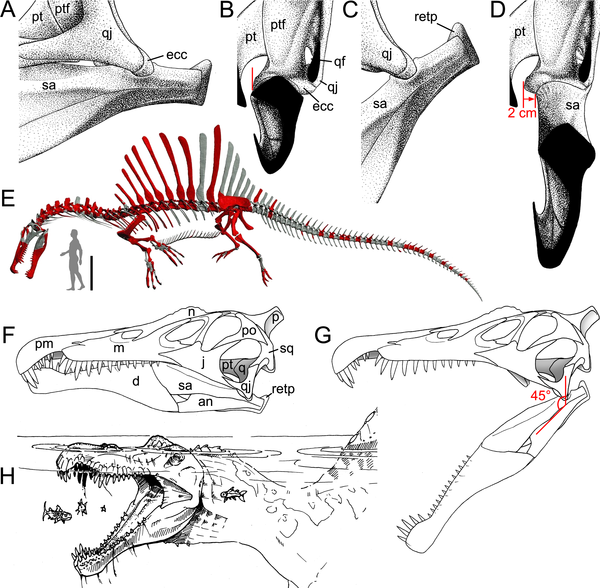
Moving on to fresh, but still spinosaurine-filled waters, let's talk about something more fun - functional morphology that is*! One of the neater parts of the Hendrickx et al. analysis is that they pay a lot of attention to the jaw articulation of spinosaurines, providing detailed descriptions of how it may have influenced jaw operation and prey capture (above). Some readers may be aware that spinosaurids have 'helical' or 'asymmetric' jaw articulations, in which the quadrate condyles force the jaw somewhat outwards as it opens. Hendrickx et al. quantify this, noting that the lateral displacement is somewhere in the region of 20% of the quadrate width when the jaw is opened 45°. This equates to approximately 20 mm of motion on each side of the jaw in a c. 1 m long skull. As a rule, non-avian theropods do not have these helical joints, although they do occur in some pterodactyloid pterosaurs and, perhaps more famously, modern pelicans. Hendrickx et al. (2016) also note that the anterior connection between spinosaurid mandibular rami - the mandibular symphysis - has a fibrous texture indicative of being somewhat loose and flexible, enhancing the pelecanid comparisons further.
*It's OK, my shame about that pun is worse than any punishment you could deliver.
In both the paper and news outlets (example), these perceived similarities between spinosaurid and pelican jaws are being stated as evidence of spinosaurs feeding in a pelican-like fashion, splaying their jaws to enhance food capture and swallow larger prey. Regular readers may recall that Darren Naish and I published research on similar claims for pterosaurs in 2013 (although the paper was not 'officially' published until last year - Witton and Naish 2015), countering suggestions that some pterosaurs fed like pelicans because of their helical quadrate articulations (Averianov 2013). This background made me surprised that another group of fossil animals was being labelled as pelican-like, as much of our discussion on pterosaurs is applicable to non-avian theropods and we're even cited in the Hendrickx et al. paper! I thought it might be of interest to explain some of my reservations about this idea here**.
**I want to note that I feel a bit awkward writing this commentary in light of recent controversies on palaeontology blogs, so-called 'Post Publication Peer Review' and so on. I hope that it's clear that this article, as with all the writings here, are meant as constructive, well-meaning expressions of opinion from someone with an interest in these topics and experience in a similar research field. My disagreement with the functional analogy proposed by Hendrickx et al. and their PR work is a polite one, and doesn't mean I disrespect them as scientists or want to undermine the significance of their paper.
We should begin by familiarising ourselves with the jaws of some relevant modern birds. Quite a bit of research has been done into pelican jaw anatomy (Schreiber et al. 1975; Meyers and Myers 2005; Field et al. 2011), an unsurprising fact given how awesomely and specifically adapted their jaws are to their unusual foraging method. Researchers have identified a number of adaptations critical to pelicans being able to splay their jaws so widely. They include reduced mineralisation at the middle part of the lower jaw to make a long 'bending zone', and even further reduction of mineral content (down to 20%) adjacent to the mandibular symphysis. This makes a 'hinge' for the mandibular rami to swing outwards on despite the fact there is no articulation or joint in the jaw at this point. The mandibular symphyses are so short that virtually all the jaw length is permitted to splay. At the other end of the jaw, the tongue is similarly reduced so as not to get in the way when the mouth is opened. The connection between the dentary bone (forming the jaw anterior) and the complex of bones of the posterior jaw is long, loosely connected and obliquely oriented so as to aid motion when the mandible spreads outwards. Even the horny tissues of the beak are specialised, being very thin (described as 'skin-like' by some authors) so as not to impede jaw flexion.
Contrastingly, little mention is made of helical jaw joints when talking about pelican foraging strategies. Zusi (1993) mentions that jaw spreading at the joints may be important to this effect, but more recent literature states that the precise mechanic responsible for bowing pelican mandibles is not really understood (Meyers and Myers 2005). Three hypotheses are currently thought viable: forces and weight of water acting on the jaw (known to be only part of the solution, as pelicans can splay their jaws on land too), contraction of muscles in the gular pouch (pulling the chin backwards, pushing the jaw rami out) or twisting of the lower jaw by the pterygoideus jaw musculature (Meyers and Myers 2005 and references therein). I guess it's possible that lateral displacement of the jaws has some role too, but it's interesting that the pelican guys aren't championing it's role as essential to manibular bowing. It's always risky using negative evidence in this way, but it might be telling given how intensively studied pelican skulls are.
Modern birds give us a pretty good idea of what sort of features we're looking for in a pelican-like dinosaur. In doing so, as might already be obvious, they suggest major issues with the pelican-spinosaur analogy. Firstly, we need to acknowledge that helical jaw joints are not a special pelican feature. We could also call spinosaurid mandibular joints 'heron-like', 'potoo-like', or even 'hummingbird-like'. It seems more precise to suggest spinosaurid jaw joints are similar to those of several modern bird lineages and not over-emphasise anything to do with pelicans.
My points here might be countered by the observation that the mandibular symphyses of some spinosaurids are quite fibrous, perhaps indicating a loose and mobile connection between them (Hendrickx et al. 2016). This might be the case, but Hendrickx et al. also note that some spinosaurid symphyses are longer than those of other theropods, thus actually having a greater degree of anterior attachment between each lower jaw. Based on our understanding of modern bird jaws, surely this is the opposite of what we'd expect in an extinct pelican-analogue? Even if I'm wrong on that, a slightly spongy symphysis and helical jaw joints are several functional miles off the flexibility afforded by avian jaws - especially those with the most extreme adaptations for mandibular bowing, like pelicans.
In all, then, I'm not convinced on the idea that spinosaurids were pelican-like in their foraging habits. Rather, the adaptations outlined by Hendrickx et al. suggest a somewhat bird-like ability to increase gape for swallowing slightly larger food than usual. In actuality, spinosaurid jaw functionality contrasts so markedly with that of pelicans that it might be misleading to tout pelicans as spinosaur analogues. After all, the spinosaurid ability to bulge their jaws slightly is not especially pronounced or even rare, whereas what pelicans do is really both those things: an extreme and marked adaptation, and almost unique in nature. I come back to a point I've made about other instances of 'extreme' modern animals being used as analogues for extinct ones: we need to be as thorough as possible in our functional assessments before pointing to highly specialised and extremely adapted modern species as suitable analogues for long dead taxa.
The latest paper on these animals is that of Christophe Hendrickx et al. (2016), a piece which provides another interpretation on Moroccan spinosaurine diversity based on isolated quadrate bones. These are elements from the back of the skull which, among other things, articulate with the lower jaw. I don't really want to go into the ins and outs of their primarily descriptive and systematic assessment as the paper is a) a bit of a beast and b) we've spoken a lot about spinosaurine taxonomy of late and I'm desiring fresh topics. It will suffice to summarise that Hendrickx et al. (2016) provide compelling evidence for at least two spinosaurines being present in the Moroccan Kem Kem Beds, one of which is Sigilmassasaurus brevicollis and the other is - in their interpretation - Spinosaurus aegyptiacus. These results are not exactly the same as those presented in the recent Evers et al. (2015) paper, as Hendrickx et al. shuffle and deal north African spinsosaurid fossils among named taxa in another unique way. However, it certainly adds further evidence against the concept of a single spinosaurine species ruling Late Cretaceous north Africa proposed by Ibrahim et al. (2014). And yes, for those interested in scientific responses to the famous quadrupedal Spinosaurus reconstruction publicised in 2014, Hendrickx et al. (2016) specifically comment on the likelihood of it being a chimera of animals from across time and space. There's lots more in the paper - spinosaur skull morphology, body size, ontogeny, loads of illustrations and it's 100% open access - interested parties should definitely check it out.
| The pelican-like foraging anatomy of Spinosaurus, as illustrated in Hendricks et al. (2016). |
*It's OK, my shame about that pun is worse than any punishment you could deliver.
In both the paper and news outlets (example), these perceived similarities between spinosaurid and pelican jaws are being stated as evidence of spinosaurs feeding in a pelican-like fashion, splaying their jaws to enhance food capture and swallow larger prey. Regular readers may recall that Darren Naish and I published research on similar claims for pterosaurs in 2013 (although the paper was not 'officially' published until last year - Witton and Naish 2015), countering suggestions that some pterosaurs fed like pelicans because of their helical quadrate articulations (Averianov 2013). This background made me surprised that another group of fossil animals was being labelled as pelican-like, as much of our discussion on pterosaurs is applicable to non-avian theropods and we're even cited in the Hendrickx et al. paper! I thought it might be of interest to explain some of my reservations about this idea here**.
**I want to note that I feel a bit awkward writing this commentary in light of recent controversies on palaeontology blogs, so-called 'Post Publication Peer Review' and so on. I hope that it's clear that this article, as with all the writings here, are meant as constructive, well-meaning expressions of opinion from someone with an interest in these topics and experience in a similar research field. My disagreement with the functional analogy proposed by Hendrickx et al. and their PR work is a polite one, and doesn't mean I disrespect them as scientists or want to undermine the significance of their paper.
We should begin by familiarising ourselves with the jaws of some relevant modern birds. Quite a bit of research has been done into pelican jaw anatomy (Schreiber et al. 1975; Meyers and Myers 2005; Field et al. 2011), an unsurprising fact given how awesomely and specifically adapted their jaws are to their unusual foraging method. Researchers have identified a number of adaptations critical to pelicans being able to splay their jaws so widely. They include reduced mineralisation at the middle part of the lower jaw to make a long 'bending zone', and even further reduction of mineral content (down to 20%) adjacent to the mandibular symphysis. This makes a 'hinge' for the mandibular rami to swing outwards on despite the fact there is no articulation or joint in the jaw at this point. The mandibular symphyses are so short that virtually all the jaw length is permitted to splay. At the other end of the jaw, the tongue is similarly reduced so as not to get in the way when the mouth is opened. The connection between the dentary bone (forming the jaw anterior) and the complex of bones of the posterior jaw is long, loosely connected and obliquely oriented so as to aid motion when the mandible spreads outwards. Even the horny tissues of the beak are specialised, being very thin (described as 'skin-like' by some authors) so as not to impede jaw flexion.
Contrastingly, little mention is made of helical jaw joints when talking about pelican foraging strategies. Zusi (1993) mentions that jaw spreading at the joints may be important to this effect, but more recent literature states that the precise mechanic responsible for bowing pelican mandibles is not really understood (Meyers and Myers 2005). Three hypotheses are currently thought viable: forces and weight of water acting on the jaw (known to be only part of the solution, as pelicans can splay their jaws on land too), contraction of muscles in the gular pouch (pulling the chin backwards, pushing the jaw rami out) or twisting of the lower jaw by the pterygoideus jaw musculature (Meyers and Myers 2005 and references therein). I guess it's possible that lateral displacement of the jaws has some role too, but it's interesting that the pelican guys aren't championing it's role as essential to manibular bowing. It's always risky using negative evidence in this way, but it might be telling given how intensively studied pelican skulls are.
Modern birds give us a pretty good idea of what sort of features we're looking for in a pelican-like dinosaur. In doing so, as might already be obvious, they suggest major issues with the pelican-spinosaur analogy. Firstly, we need to acknowledge that helical jaw joints are not a special pelican feature. We could also call spinosaurid mandibular joints 'heron-like', 'potoo-like', or even 'hummingbird-like'. It seems more precise to suggest spinosaurid jaw joints are similar to those of several modern bird lineages and not over-emphasise anything to do with pelicans.
My points here might be countered by the observation that the mandibular symphyses of some spinosaurids are quite fibrous, perhaps indicating a loose and mobile connection between them (Hendrickx et al. 2016). This might be the case, but Hendrickx et al. also note that some spinosaurid symphyses are longer than those of other theropods, thus actually having a greater degree of anterior attachment between each lower jaw. Based on our understanding of modern bird jaws, surely this is the opposite of what we'd expect in an extinct pelican-analogue? Even if I'm wrong on that, a slightly spongy symphysis and helical jaw joints are several functional miles off the flexibility afforded by avian jaws - especially those with the most extreme adaptations for mandibular bowing, like pelicans.
In all, then, I'm not convinced on the idea that spinosaurids were pelican-like in their foraging habits. Rather, the adaptations outlined by Hendrickx et al. suggest a somewhat bird-like ability to increase gape for swallowing slightly larger food than usual. In actuality, spinosaurid jaw functionality contrasts so markedly with that of pelicans that it might be misleading to tout pelicans as spinosaur analogues. After all, the spinosaurid ability to bulge their jaws slightly is not especially pronounced or even rare, whereas what pelicans do is really both those things: an extreme and marked adaptation, and almost unique in nature. I come back to a point I've made about other instances of 'extreme' modern animals being used as analogues for extinct ones: we need to be as thorough as possible in our functional assessments before pointing to highly specialised and extremely adapted modern species as suitable analogues for long dead taxa.
Enjoyed this post? Support me on Pateon!
The artwork and words you see here are supported by Patreon, the service which allows you to directly support artists and authors with monthly payments. You can support this blog from $1 a month and, in exchange, get access to bonus content and rewards - the more you pledge, you more bonuses you receive. For this post, I'll be explaining the rationale behind the spinosaurine depicted at the top of this post - it's not Spinosaurus 2014, not a 'classic' reconstruction - what's going on?
Later this month (February 2016) I'll be sending out signed art prints to all those who pledge at least $5 a month - sign up now to get yourself on the receivership list!
References
- Averianov, A. O. (2013). Reconstruction of the neck of Azhdarcho lancicollis and lifestyle of azhdarchids (Pterosauria, Azhdarchidae). Paleontological Journal, 47(2), 203-209.
- Field, D. J., Lin, S. C., Ben‐Zvi, M., Goldbogen, J. A., & Shadwick, R. E. (2011). Convergent evolution driven by similar feeding mechanics in balaenopterid whales and pelicans. The Anatomical Record, 294(8), 1273-1282.
- Hendrickx, C., Mateus, O., & Buffetaut, E. (2016). Morphofunctional Analysis of the Quadrate of Spinosauridae (Dinosauria: Theropoda) and the Presence of Spinosaurus and a Second Spinosaurine Taxon in the Cenomanian of North Africa. PloS one, 11(1), e0144695.
- Ibrahim, N., Sereno, P. C., Dal Sasso, C., Maganuco, S., Fabbri, M., Martill, D. M., Zouhri, S. Myhrvold, N. & Iurino, D. A. (2014). Semiaquatic adaptations in a giant predatory dinosaur. Science, 1258750.
- Louchart, A., Tourment, N., & Carrier, J. (2011). The earliest known pelican reveals 30 million years of evolutionary stasis in beak morphology. Journal of Ornithology, 152(1), 15-20.
- Meyers, R. A., & Myers, R. P. (2005). Mandibular bowing and mineralization in brown pelicans. The Condor, 107(2), 445-449.
- Schreiber, R. W., Woolfenden, G. E. & Curtsinger, W. E. (1975). Prey capture by the Brown Pelican. The Auk, 92(4), 649-654.
- Witton, M. P. and Naish, D. (2015) Azhdarchid pterosaurs: water-trawling pelican mimics or "terrestrial stalkers"? Acta Palaeontologica Polonica 60, 651-660.
- Zusi, R. L. (1993). Patterns of diversity in the avian skull. The skull, 2, 391-437.
Friday, 22 January 2016
Deinosuchus: the Dalek-backed alligatoroid that (sometimes) made chew toys of dinosaurs
![]() |
| Deinosuchus rugosus swallows the remains of a large Cretaceous sea turtle. Other archosaurs notice, decide to interrupt. |
Perhaps because Deinosuchus is 'only' a giant crocodylian and not a member of a completely extinct, weirdo lineage, coverage of its palaeobiology is often limited to factoids on its immense size and probable habits of eating dinosaurs. Our short attention span for this animal is not new: one of the key players in its discovery, John Bell Hatcher, lost interest in describing the first significant Deinosuchus remains once its crocodylian identity (rather than dinosaurian, as originally supposed) became apparent in 1903 (Schwimmer 2002). It took further persuasion and a number of years for palaeontologists to actually publish, name and describe this animal after Hatcher died in 1904 (Holland 1909). As we'll discover in this article, the scant attention paid to this animal is rather criminal: over the last century a detailed and fascinating picture of Deinosuchus has developed.
The Deinosuchus fossil record is something of a mixed bag. There are hundreds of fossils of it, but most of them are isolated postcranial bones, broken bits of skull and, especially, those massive teeth and osteoderms. The state of many Deinosuchus fossils can be ascribed to its remains being reworked by storms after their initial burial. Some partial skeletons and more complete skulls escaped this treatment but are not yet described in detail. A silver lining to not having much in the way of complete material is that isolated Deinosuchus bones are distinctive enough to map its range across Campanian North America. Many of us might think of Deinosuchus as a Texan animal, but it actually enjoyed a wide distribution, and being most abundant in the southeastern United States. A clear palaeobiogeographical pattern can be gleaned from Deinosuchus fossils, a divide separating occurrences in Montana, Wyoming, Utah, Colorado, New Mexico, Texas, and Northern Mexico from remains on the eastern side of the United States - Mississippi, Alabama, Georgia, North Carolina, and New Jersey (Titus et al. 2008). This east-west distribution is no fluke of preservation but reflection of Deinosuchus populations being separated by the Western Interior Seaway, the continental sea which divided North America during the Cretaceous. Although apparently not a fully marine creature, it is thought Deinosuchus lived in the coastal waters and estuaries of this seaway as, to date, its fossils have not occurred in fully freshwater or terrestrial deposits. Further evidence of its preference for coastal waters is the recovery of more complete and associated remains from wholly marine deposits.
![]() |
| A modern depiction of the Deinosuchus rugosus skull and mandible. From Schwimmer (2002). |
Less can be said about the body and limbs of Deinosuchus. Schwimmer (2002) reports that partial skeletons hint at a general form and proportion not unlike a modern alligator. However, some authors have noted discrepancies in scaling of Deinosuchus limb bones which might indicate reduced limbs in at least the largest specimens (Farlow et al. 2005, see below). One thing we can be sure of is that the body of Deinosuchus was covered in those aforementioned large, thickened osteoderms (below). The exact arrangement of these elements remains unknown, but we can predict that at least four rows of osteoderms extended along the body of Deinosuchus because of its affinities to modern crocodylians. These osteoderms become disproportionately massive and robust with growth, so that those of the largest individuals are distinctively chunky and have lost some definition of a keel found in smaller examples. Artists should take note of this: the dorsum of a big Deinosuchus would have looked more like a gnarly Dalek chassis than the back of any modern crocodylian. As is typical for crocodyliforms, these dermal bones might have reinforced the trunk skeleton as well as providing armour plating, forming a network of muscle, ligaments and bone which bound the torso together (Salisbury and Frey 2000). It is speculated that the presence of very large, robust osteoderms in the biggest Deinosuchus indicates the presence of a torso strong enough for terrestrial locomotion (Schwimmer 2002).
| The huge, deeply pitted and bulbous scutes which characterise Deinosuchus, as illustrated by Holland (1909). This image is a composite of two scutes from Holland's work, put together by FanCollector for Wikipedia. Both show cervical osteoderms, the left being a particularly big one |
Regardless of what the actual maximum size of Deinosuchus was, we have good reason to think that many individuals were not true giants. No specimens indicative of 10 m body length have been found among the many hundreds of Deinosuchus remains from the eastern side of the US, it being instead thought that eastern Deinosuchus didn't grow longer than 8 m. That's still pretty big of course, but not too far off crocodylians that we're familiar with today (the biggest saltwater and Orinoco crocodiles on record are a little over 6.5 m - Grigg and Krishner 2015). The true giants only occur in the west, and are much rarer fossils than their eastern counterparts. These fossils are also slightly younger than the eastern specimens, perhaps indicating changes across time and geography were responsible for Deinosuchus becoming exceptionally large. Research into the growth rates of Deinosuchus indicate that there might be nothing unusual about it's growth trajectory despite its size. It seems to have grown with a similar strategy to other crocodylians - relatively fast at first, and progressively slower over time - but simply stretched out the growth duration to many decades (Erickson and Brochu 1999). Growth rings in osteoderms indicate that the largest animals were about around 50 years old (below).
![]() |
| Partial theropod hindlimb bone (tibia or metatarsal) post a one-on-one session with Deinosuchus jaws. This bone is meant to be subrounded in cross section. From Schwimmer (2010). |
![]() | ||
| Deinosuchus bite marks in fragments of a turtle (Chedighaii barberi) plastron. The tooth marks are about 4-5 times larger than those made by 4 m long nile crocodiles. From Schwimmer (2010). |
The foraging habits of Deinosuchus brings us to new perspectives on where it fits into Mesozoic ecology. New evidence is eroding the uniqueness of Deinosuchus in Campanian North America, it no longer being the only very large or even giant crocodyliform species in some localities. These new finds include a currently poorly known, but obviously giant neosuchian from the Williams Fork Formation of Colorado (Foster and Hunt-Foster 2015) and a more completely known, 7 m long, undescribed neosuchian from Woodbine, Texas (Main 2012). The latter is currently being worked on, and early indications are that it might represent a late surviving goniopholidid - a much older branch of the crocodyliform lineage. Whatever they turn out to be, the Woodbine and Williams Fork animals suggest that very large crocodyliforms might not have been unusual in Campanian North America. Their presence in a timeframe deficient of large theropods has not gone unnoticed, it being speculated that these large crocodyliforms may have been doing work normally reserved for big predatory dinosaurs (e.g. Schwimmer 2002). Similar proposals have been made about other large bodied Late Cretaceous carnivores taking over typically theropodan roles (e.g. Witton and Naish 2015) - the notion of the Mesozoic as an all-dinosaur show is looking increasingly out of date.
As a closing thought, I find it interesting that we tend to portray Deinosuchus as something of a freak species, one of those rare forays of crocodylian evolution into gigantic size which never really seemed to last that long or lead anywhere. As might be apparent from this article, this view is somewhat misleading. Deinosuchus certainly represents an 'extreme' of crocodylian evolution, but it's at the end of a spectrum, not a weird outlier from the rest of the group. Much of what it did, how it did it, and what makes it a fascinating animal, is mirrored in its modern and fossil relatives. Contrary to some perspectives on this animal, the fact it represents an ancient member of a modern group does not make it tedious or dull. Quite the opposite is true: Deinosuchus reminds us that animals from Deep Time are part of a continuum with our own fauna, revealing the awesome things modern lineages have been capable of, the potential their anatomies have in the present, and what they might be up to in future. How anyone can find pondering an animal that gives such a raw perspective on evolution and adaptation boring or uninteresting is beyond me.
Now is a great time to sign up to my Patreon
The artwork and words you see here are supported by Patreon, the service which allows you to directly support artists and authors with monthly payments. You can support this blog from $1 a month and, in exchange, get access to bonus content and rewards - the more you pledge, you more bonuses you receive. In February be sending out signed art prints to all those who pledge at least $5 a month - sign up now to get yourself on the receivership list!References
- Blanco, R. E., Jones, W. W., & Villamil, J. (2015). The ‘death roll’of giant fossil crocodyliforms (Crocodylomorpha: Neosuchia): allometric and skull strength analysis. Historical Biology, 27(5), 514-524.
- Colbert, E. H., Bird, R. T., & Brown, B. (1954). A gigantic crocodile from the Upper Cretaceous beds of Texas. American Museum Novitates; no. 1688.
- Erickson, G. M., & Brochu, C. A. (1999). How the ‘terror crocodile’ grew so big. Nature, 398, 205-206.
- Farlow, J. O., Hurlburt, G. R., Elsey, R. M., Britton, A. R., & Langston Jr, W. (2005). Femoral dimensions and body size of Alligator mississippiensis: estimating the size of extinct mesoeucrocodylians. Journal of Vertebrate Paleontology, 25(2), 354-369.
- Foster, J. R., & Hunt-Foster, R. K. (2015). First report of a giant neosuchian (Crocodyliformes) in the Williams Fork Formation (Upper Cretaceous: Campanian) of Colorado. Cretaceous Research, 55, 66-73.
- Grigg, G., & Kirshner, D. (2015). Biology and Evolution of Crocodylians. Csiro Publishing.
- Harrell, S. D., & Schwimmer, D. R. (2010). Coprolites of Deinosuchus and other crocodylians from the Upper Cretaceous of western Georgia, USA. New Mexico Museum of Natural History and Science, Bulletin, 51, 209-213.
- Holland, W. J. (1909) Deinosuchus hatcheri, a new genus and species of crocodile from the Judith River beds of Montana. Annals of the Carnegie Museum, 6, 281–294.
- Main, D. J. (2012). Crocodiles of the Texas Cretaceous; the Campanian of Big Bend to the Cenomanian of North Texas, a comparison of great size, feeding behaviour and paleoecology. Geological Society of America Abstracts with Programs, 44, 3.
- Schwimmer, D. R. (2002). King of the crocodylians: the paleobiology of Deinosuchus. Indiana University Press.
- Schwimmer, D. R. (2010). Bite marks of the giant crocodylian Deinosuchus on Late Cretaceous (Campanian) bones. New Mexico Museum of Natural History and Science Bulletin, 51, 183-190.
- Titus, A.L., Knell, M.J., Wiersma, J.P., Getty, M.A. (2008). First report of the hyper-giant Cretaceous crocodylian Deinosuchus from Utah. Geological Society of America Abstracts with Programs, 40, 58.
- Witton, M. P. and Naish, D. (2015) Azhdarchid pterosaurs: water-trawling pelican mimics or "terrestrial stalkers"? Acta Palaeontologica Polonica 60, 651-660.
Thursday, 24 December 2015
Dinosaur scales: some thoughts for artists
The discovery that many Mesozoic dinosaurs were superfuzzyfilamentouspinyalidocious has been an major influence on contemporary Mesozoic palaeoart. This has affected more than just how we depict the gross appearance of dinosaurian subjects, but also our attitudes to their behaviour, demeanour and place in the Mesozoic world. I've written a fair bit about scientific and artistic attitudes to filamentous dinosaurs and joined choruses arguing that it's important to get these new depictions 'right': we want to see filaments of appropriate morphology, size and distribution in reconstructions of these animals.
In light of this, it's a little peculiar that we have slightly more lax attitudes to how we reconstruct scaly integuments in these animals. We have some truly spectacular skin impressions from scaly dinosaurs which provide a wealth of information about their detailed appearance, and yet many of our reconstructions incorporate little of this data. Instead, we often create 'generically' scaly or wholly speculative integuments. Common issues include rendering of scales of homogenous size and shape across an entire animal, showing little difference in scalation between species, and issues with the size, proportions and shape of individual tubercles. Other times, and most egregiously, some individuals understate just how good the records for scales in certain species are, this seemingly giving license to render a more speculative, but flamboyant body covering. It's not just amateurs making these mistakes and, in the interests of not being a hypocrite, I'll state early on that I'm guilty of some of these issues in my own work.
With this in mind, I want to see out 2015 with a fresh look at four exceptionally interesting samples of dinosaur scales, providing something of a refresher for myself and other about scaly dinosaur integument and food for thought on restoring these animals. The amount of scaly skin we have from dinosaurs means this list could easily comprise 10 or even 20 examples, but for the sake of brevity and detail I'm keeping the count low. The specimens here may be familiar to veterans of dinosaur literature, but I hope to cover them in sufficient detail that much of this information will be new to many readers.
The Carnotaurus holotype skin impressions
Outside of the feathered coelurosaurs, substantial remains of theropod dinosaur skin are pretty rare. There are lots of scraps, many of which are only cautiously referred to Theropoda, but large pieces of skin associated with specific skeletons are very thin on the ground. These circumstances make the extensive scaly skin impressions known from the Late Cretaceous Carnotaurus sasteri type specimen quite special. This specimen is already impressive: described in detail by Bonaparte et al. 1990, it comprises a near complete skeleton missing only parts of the legs and end of the tail. The fact this specimen also preserves a host of skin remains means Carnotaurus is an especially well represented large theropod. Many readers will know the skin remains associated with this specimen makes it quite integral to debates over the ancestral state of dinosaur and theropod skin. As one of the few relatively 'basal' theropods known with decent skin remains, Carnotaurus has quite a bit of sway in discussions about filament development in theropods.For artists, the Carnotaurus skin impressions enable us to 'connect the dots' as goes the appearance of this dinosaur's hide. It seems scales were present from skull to tail base, and it doesn't seem much of a stretch to assume most or all of the animal was scaly. There are a few reconstructions of extensively filamentous Carnotaurus out there but, sorry guys, this just doesn't jive with what we know of the skin of this animal. It also seems we shouldn't be drawing Carnotaurus with obvious differences in skin texture across the body - it looks pretty homogenous in the fossils. Also noteworthy is the size of most of the scales. It seems we'd only notice the larger, keeled tubercles and furrows on this animal unless we were standing very close. Those 5 mm tubercles might perhaps register as mottled colouration, but I doubt anyone without superhuman vision could distinguish each scale from afar. Note that Carnotaurus is not unusual in this respect - a lot of dinosaurs had much smaller scales than we show in our illustrations.
The Howe Quarry diplodocids
One of the most striking components of the 1999 Walking with Dinosaurs Diplodocus reconstruction was the tall dermal spines adorning the midline of the animal. These structures were not the idle fantasy of sculptors and artists, but actually based sauropod skin fossils from Howe Quarry, a famous Wyoming Jurassic locality. Described by the late palaeoartist Stephen Czerkas in 1992, these finds are frequently discussed by palaeoartists because sauropod skin impressions are extremely rare. The impressions are associated with incomplete skeletons representing animals from 2-3 to 14 m in length, with some skin pieces being exceptionally large at 25 x 75 cm. Unfortunately, Czerkas (1992) did not identify the remains of these animals. Howe Quarry yields at least one named diplodocid, the recently named Kaatedocus siberi, but it remains to be established if these scaled remains represent the same taxon.The Howe Quarry diplodocid skin can be described as tessellating hexagonal scales with a rough surface, each about 3 cm across. There is no sign of these scales being divided by differently sized scales to form a pattern like those seen in Carnotaurus. The roughened texture of each scale is formed by small (2-3 mm) tubercles dotted across each large scale. As noted by several authors, this morphology is reminiscent of other examples of sauropod hide and seems common to at least Neosauropoda (e.g. Foster and Hunt-Foster 2011; Upchurch et al. 2015). As a rule, sauropods must've been quite rough to the touch.
The detail and specificity of the Howe Quarry specimens give artists an atypically good insight into the appearance of these sauropods, and remain significant specimens or this reason. But as cool as this all is, the Howe Quarry skin specimens could be more useful. For instance, it is not clear how large each sauropod individual with associated skin remains was, and it's thus not clear how large those spines or scales were in comparison to each specific animal. The range of body lengths for the Howe Quarry specimens (2-3 -14 m) perhaps indicates that the scales of these animals (3 cm across) might be larger against body size than those of most other dinosaurs, but how visible they might be to observers is really dependent on knowing the sizes of the animals concerned. Likewise, the only published illustrations of these unique, interesting remains are pretty basic: it would be neat to get these specimens figured and described in a lot more detail. Hopefully, these details will be forthcoming soon.
The Sternberg/Osborn Edmontosaurus mummy
You can't discuss scaly dinosaurs without mentioning hadrosaurs. Research into hadrosaur skin is only second to that going into the fuzzballs at the other end of the dinosaur tree, there being so many skin impressions from these dinosaurs that we can gauge variation between species, see pathological skin tissues, and reconstruct virtually complete integuments for some taxa. This relative glut of data has spurned investigation into just why hadrosaur skin crops up so often. The exact cause remains elusive (it's seemingly unrelated to the rocks they occur in, nor their palaeoenvironmental or palaeoclimatic preferences), and it is suspected that there is something intrinsic to their skin anatomy which makes it more preservable (Davies 2012)."Trachodon mummy", discovered by George Sternberg (Charles Sternberg's son) in 1908 and described by Henry Fairfield Osborn in 1912. Osborn lavished attention on the integument of this near complete, fully articulated specimen, of which skin impressions covered the posterior jaws, neck, shoulders, chest, belly and forelimb. This specimen also revealed the presence of a low frill along at least the posterior part of the neck. Osborn's work on this animal stands out as a landmark document on extinct reptile integument, and interested parties really should download this article from the American Museum of Natural History here (NB. this is a 75 Mb download, it coming bundled with historic descriptions of the skulls of Tyrannosaurus and Allosaurus, whatever they are).
Osborn's description revealed details of dinosaur skin which were, at that time, poorly known from other animals. He remarked on how thin the skin layer was and the remarkably small size of the scaly tubercles covering the body (1-5 mm). The fineness of the skin resulted in perhaps a third of it being accidentally destroyed during collection - 'dinosaur mummies' were an unknown quantity before this specimen, and collectors had no idea such data was at risk when skeletons were being uncovered. Edmontosaurus skin was a mosaic of larger and smaller tubercles, but their size variation is more continuous the obviously bimodal configurations of other species. The smaller (1-3 mm) tubercles were rounded structures located between larger (5-10 mm) hexagonal ones. Osborn called these 'pavement scales', and noted that they occurred in small (5-10 cm wide) clusters in some areas, such as the neck, inner surface of the arm and belly, but covered entire other parts of the body, such as the side of the chest, lateral surface of the arm and above the hips. The largest pavement scales, about 10 mm wide, occur on the lateral surface of the arm and tail. Both large and small scales occur on the frill (below). Folds, creases and smaller tubercles seem to correspond with intervertebral spaces, likely reflecting where these tissues flexed and creased with neck movement. The actual height of the frill is unknown from this specimen, the free margin being damaged during collection.
![]() |
| Osborn's illustration of the frill of Edmontosaurus. From Osborn (1912). |
![]() |
| Left, Osborn's illustration of Edmontosaurus outlining the distribution of large scale clusters, with their size much enhanced for visibility; right, Charles Knight's iconic 1912 painting of the same taxon, an artwork produced in collaboration with Osborn and data from the "Trachodon mummy". From Osborn (1912) and The World of Charles R. Knight. |
So, other than the obvious take-home - that we know a heck of a lot about the skin of Edmontosaurus -are there any obvious pointers for artists here? As noted for Carnotaurus above, it's doubtful that we'd be able to define individual scales or the patchy distribution of pavement scales on this large bodied (12-13 m long) species unless we were right next to it. Secondly, of all dinosaurs, surely this is one species to consider off limits to extensive filamentation. I suppose you could argue that filaments filled the few parts of this animal's hide left unrepresented in the fossil record, but that fuzz is going to look like weeds growing through a pavement if you're paying attention to where we know scales were. I also think it's worth paying attention to what Osborn meant by 'frill' along the back of this species: it does not appear to be a narrow, fibrous structure as commonly depicted, but a scaly continuation of adjacent dermal tissues.
The (unpublished) Triceratops superscales
I've saved what I consider to be one of the most interesting and impressive set of scale impressions for last, even though they are represented by specimens which have only currently received only very superficial publication through online news articles. These specimens belong to one of the most familiar and famous dinosaurs of all, the ceratopsid Triceratops horridus, and yet they demonstrate a scale topography completely unlike that of any other dinosaur. Their discovery is a particularly fun curve-ball because we have skin samples from a number of other ceratopsians, none of which are particularly like those now known for Triceratops. I'm reminded about earlier discussions of 'one skin fitting all': it seems ancient dinosaurs really could be just as varied in skin morphology as modern animals.
![]() |
| Huge patch of Triceratops skin, preserved as an internal mould - look at the size of the individual scales! Borrowed from the Rapid City Journal. |
These extensive skin impressions were associated with one of the most complete Triceratops specimens ever found, a Wyoming individual known as 'Lane'. This specimen, including its skin, is now on display in the Houston Museum of Natural Science. Without a full description it's a little difficult to give much in the way of specifics about the skin, but published photographs reveal a network of very large (I'm estimating 50-60 mm wide based on the adjacent images) hexagonal tubercles dividing larger tubercles (perhaps c. 100 mm) with central, conical projections. These large scales are sometimes described being as 'nipple-like', for obvious reasons. Divisions between these tightly interlocked scales are marked, and we might have been able to distinguish individual scales on these animals from some distance away. The function of the larger tubercles with their prominences has been the source of much speculation in art - do these structures represent bosses and low spikes, or tubular supports for large, coarse filaments? I must admit to considering the latter unlikely as neither hair or scales in modern animals grow through scales, but instead around them. I'm happy to be wrong on this, though, and both interpretations could be easily tested by looking for apertures at the tip of each prominence. Hopefully these specimens will get a full write up soon, which might provide such details.
![]() |
| Detail of the large tubercles adorning the outside of Triceratops. Also borrowed from the Rapid City Journal. |
Lane's skin impressions suggest that the scales of Triceratops were characteristically coarser, certainly a lot larger and perhaps more sculpted than those of most other dinosaurs. Their overall appearance is very different to the hadrosaur and theropod skin mentioned here, contrasts markedly from the scales known from other ceratopsians, and is rather unexpectedly most similar to the scales of sauropods. It's difficult not to intuitively equate Triceratops skin with that rhinos and armadillos: there's something almost armour-like about those heavy scales and low, projecting bosses. Perhaps this chimes with the unusually solid, reinforced cranial frill we find in this species - was Triceratops something of a horned dinosaur tank? I reckon there's a lot of fun to be had with depicting this animal as looking particularly tough and grizzled, with big skin creases and heavy folds - such a depiction can be seen at the top of this article. It's perhaps worth noting that the actual appearance of Triceratops is not a million miles off the Charles Knight's famous painting of 'Agathaumas' (probably = Triceratops) with its speculative heavy scaling.
Summary time
I hope what's becoming clear here is that we can obtain quite a lot of information from dinosaur skin impressions, and that they show scaly dinosaur species have their own characteristic integuments in the same way that filamentous ones do. There really doesn't seem to be a 'standard' type of dinosaur scale, and even closely related species show some significant variation between them. We have to conclude that those of us hoping to restore these animals accurately really need to pay close attention to these data, considering variation in tubercle size, texture and distribution. I particularly emphasise this for artists who draw every scale: if that's the route you're taking, make sure you're drawing them correctly! Moreover, the specimens outlined here are good reasons to be inventive when skin impressions are lacking. It seems most relatively extensive skin impressions of scaly dinosaurs reveal things like spines, keeled scales, armour-like structures, frilled projections and so on. Mesozoic dinosaur skin must've been as interesting as that of modern reptiles, and we might expect many species to have elaborate structures of some kind.
And that's it for 2015
OK folks, we're done here for this year, but there's plenty more to come in 2016. Weird archosauromorphs, stem mammals, some retropalaeoart and the publication of Recreating an Age of Reptiles will be covered early on. Huge thanks to everyone who's been reading and supporting this blog throughout 2015 - I hope you've enjoyed what I considered to be one of my best blogging years so far. All the best to you all for the festive period, and see you all in 2016!
References
- Bonaparte, J. F., Novas, F. E., & Coria, R. A. (1990). Carnotaurus sastrei Bonaparte, the horned, lightly built carnosaur from the Middle Cretaceous of Patagonia. Contributions in Science. Natural History Museum of Los Angeles County, 416, 1-42.
- Czerkas, S. A. (1992). Discovery of dermal spines reveals a new look for sauropod dinosaurs. Geology, 20(12), 1068-1070.
- Davis, M. (2012). Census of dinosaur skin reveals lithology may not be the most important factor in increased preservation of hadrosaurid skin. Acta Palaeontologica Polonica, 59(3), 601-605.
- Osborn, H. F. (1912). Integument of the iguanodont dinosaur Trachodon. Memoirs of the American Museum of Natural History v. 1
Friday, 11 December 2015
The lifestyle of Tanystropheus, part 2: coastal fisher or first-day-on-the-job aquatic predator?
![]() |
| The new Tanystropheus cf. longobardicus skeletal reconstruction I presented in my last post. What the dickens did this crazy animal do? That's what we're discussing today. |
In this second discussion, I want to look at some finer aspects of Tanystropheus anatomy and palaeontology, how they've been interpreted, and what they might mean for its lifestyle. There are several areas which are relevant here: what we know of Tanystropheus diet, the palaeoenvironmental context of Tanystropheus fossils, aspects of tail and limb anatomy, and of course, the functionality of its neck. There's a lot to get through here, so let's not waste any more time on preamble.
Fossil record
An obvious line of inquiry about ancient animal habits is the palaeoenvironmental bias of its fossil remains, and the fossil organisms it is found with. We mentioned last time that Tanystropheus was a wide-ranging taxon, occurring across Europe, Israel and China in locations representing coasts and shallow waters around the ancient Tethys ocean. About half of Tanystropheus fossils come from shallow marine settings, the rest being derived from more coastal environments: river and estuarine environments, lagoons, intertidal settings and so forth (for a brief overview, check out the Fossilworks entry on this animal: there's a few localities missing, and the 'terrestrial' occurrence of Tanystropheus there is erroneous, but it gives a flavour of its depositional context). We often find marine fish and seagoing reptiles in the same beds as Tanystropheus, but it also occurs alongside terrestrial or freshwater species such as temnospondyls, terrestrial reptiles, stem mammals and plants in a number of locations. The link of Tanystropheus to these faunas seems complex: in one locality, Tanystropheus fossils only occur in horizons containing a mix of highly terrestrial and highly marine reptiles, without many 'intermediate' semi-aquatic species (Renesto 2005). Because Tanystropheus was likely not adapted for a truly seagoing lifestyle, this has been argued as evidence of it being part of a terrestrial community rather than a marine one (Renesto 2005).Collectively, it seems difficult to argue a strong terrestrial or marine bias in this record. Tanystropheus seems to have lived in or around aquatic environments, maybe with a bias to those under marine influences, but it does not seem a stranger to brackish or freshwater settings either. There is perhaps something of a skewed association with marine animals, but it occurs with enough 'terrestrial' forms to keep the idea of a coastal fishing lifestyle buoyant. It would be interesting to put some actual numbers on this and see how commonly associated with terrestrial influences Tanystropheus is, or whether a couple of sites are skewing our perception of data. Maybe that's a job for another blog post - until then, we probably need to look at other sources of information for clearer lifestyle indications.
Gut content
The idea that Tanystropheus ate swimming prey is verified by the association of digested fish remains and cephalopod hooks in the gut regions of articulated specimens (Wild 1973; Li 2007). The latter is sometimes considered smoking gun evidence for the swimming Tanystropheus lifestyle hypothesis, it being reasoned that cephalopods are exclusively marine animals, mostly found far out to sea, and unlikely to be eaten from land (e.g. Nosotti 2007).![]() |
| A number of heron species, including the globally distributed black-crowned night heron (Nycticorax nycticorax), are known squid-eaters. Image from Wikimedia (CC ), by Kuribo. |
Anatomy
![]() |
| One of the most famous and complete Tanystropheus longobardicus specimens known, MSNM BES SC 1018. This illustration is from Nosotti's huge (2007) monograph. |
The main points of contention about Tanystropheus functional anatomy concern its tail, limbs and neck. We might link these attributes to two principle functions: locomotion and foraging. Let's start with the former. Proponents of the aquatic Tanystropheus hypothesis suggest the tail was the likely propulsive organ, it being considered that the limbs are too long and gracile to function as effective paddles (Tschanz 1988; Nosotti 2007), even if the foot might have some aquatic adaptations (below; Kuhn-Schnyder 1959; Wild 1973). Near 'horizontal' articulations between the posterior trunk and tail vertebrae appear to have permitted this part of the body to undulate laterally, permitting a crocodile-like sculling approach to swimming.
Turning our attention to the limbs, I mentioned in the last post that I was surprised how 'leggy' Tanystropheus was when restored as walking rather than, as we're used to seeing it, squatting. The limb proportions and girdle sizes of Tanystropheus compare well with non-aquatic protorosaurs such as Macrocnemus and Langobardisaurus (e.g. Renesto 2005; Nosotti 2007) and, as alluded to above, it is immediately clear that these limbs are not flippers. Not only are they too long and gracile for effective use as hydrofoils, but their long bones are hollow - unexpected features of an aquatic animal. Another protorosaur - Dinocephalosaurus - gives an insight into how these reptiles could modify their limbs into efficient flippers (below), and, without going into detail, they're nothing like the limbs of Tanystropheus (see Renesto 2005 for a long discussion of this). Tanystropheus limb joints are mostly robust and well-defined (but see below), and its hands and feet are strongly built and compactly structured. Some differences between hand and foot proportions can be seen: the hands are short, the feet rather long, and the latter characterised by a peculiarly long first bone in the fifth toe. The limb girdles are well developed, looking proportionally comparable (speaking from pure eyeballing here, not precise measurements) to those of large monitor lizards and crocs. I find the shoulder blade of particular interest, as it is rather large and broad, subequal in proportions to the coracoid (the lower portion of the shoulder girdle). This contrasts with many aquatic animals, which tend to maximise the size of the coracoids while reducing the scapula.
Finally, we come to the neck. I've saved discussion of this for last because I consider much of its anatomy so significant to Tanystropheus habits that discussing it earlier might have rendered other points a bit superfluous. We make a lot of noise about how strange the neck of this animal is, but Tanystropheus neck anatomy frequently converges with those of other long necked reptiles - pterosaurs and sauropods - and even some long-necked mammals. That doesn't necessarily make it less weird - it's definitely still an 'extreme' biological structure - but does help us put its neck anatomy in perspective with other animals, as well as highlighting significant adaptive differences to neck elongation in aquatic and non-aquatic species.
As with pterosaurs and sauropods, Tanystropheus went to great lengths to lighten its neck. Firstly, its neck is comprised of relatively few (13), slender vertebrae rather than dozens of short ones (see Rieppel et al. 2010 for discussion of cervical vertebra counts in this animal). This is about half as many as some other protorosaurs had (Reippel et al. 2008), and a far cry from the vertebral counts of some dinosaurs (including birds). A low vertebral count reduces the number of heavy joints and muscle attachments in any part of the axial column, so this is a good basis to having a lightweight neck. More weight was lost through hollowing the bony core of each vertebra, a condition Tanystropheus took so far as to need bony struts supporting the interior cavities of each vertebra. Note that there is no evidence that these bones were pneumatised, seemingly lacking openings through which airsacs could penetrate the bone walls. However, simply removing bone - one of the densest, heaviest materials in our bodies - would still throw out a lot of weight. The neck was likely lightly muscled, the mid-series vertebrae being long tubes with highly reduced processes for muscle anchorage (below). In many respects, the vertebral bodies are similar to those of azhdarchid pterosaurs. The role of these tubular, slender mid-series neck vertebrae is confusing at first, but they make a bit more sense once we realise that most terrestrial animals control their necks via musculature anchoring to the top and base of the neck. This was likely true for Tanystropheus and azhdarchids because anterior and posteriormost neck vertebrae are the most complex parts of the neck skeleton, presumably reflecting attachment of more muscles in these regions. We might therefore assume their necks worked in a broadly similar to those of modern animals, weird as they are.
![]() |
| Three dimensionally preserved mid-series Tanystropheus vertebra described by Dalla Vecchia (2005). |
To me, this is all sounding quite sauropod- and azhdarchid-like: an economically constructed neck capable of somewhat limited, but sufficient motion to procure food in terrestrial habits, albeit food that doesn't put up too much of a fight. By contrast, the Tanystropheus neck compares poorly to those of long necked aquatic animals. For one, we expect a large number of short vertebrae in long-necked aquatic species, this permitting greater numbers of muscles working on the neck skeleton. Aquatic animal neck bones are frequently expanded to enlarge the size of muscles attaching to them, these being required to move any long appendage through water. This makes for a heavy neck, but perennial aquatic support renders this a moot issue. Indeed, weight is often a commodity in water rather than a problem, it providing ballast against air-filled lungs or positively buoyant tissues - it's widely known that swimming tetrapods often have entirely solid bones to increase their mass further. The neck of Tanystropheus doesn't really match any of these features. While the number of neck bones is somewhat increased compared to other protorosaurs, the aquatic Dinocephalosaurus has almost twice as many more - 25 - in a neck of similar proportions. Tanystropheus neck length is mainly achieved by stretching each vertebra tremendously, the addition of another three vertebrae perhaps merely being a secondary measure to boost neck length overall (birds and sauropods do the same thing - adding more neck vertebrae is not strictly an aquatic adaptation). Reduction of neck mass in Tanystropheus neck (and limb) bones is also at odds with expectations for an aquatic animal, the hollow cores, stiffened joints and posterior displacement of musculature being unnecessary and even disadvantageous in an aquatic setting. It's actually hard to imagine the neck of Tanystropheus being pulled through water efficiently at all, the reduced muscle profile and long vertebrae being quite problematic and under-powered for this task. It certainly does not seem well suited to chasing and grabbing fast moving aquatic prey such as squid and fish. To me, Tanystropheus neck anatomy just seems to make a lot more sense out of water and, given how much emphasis Tanystropheus put on its neck tissues, I think this is a pivotal consideration when attempting to understanding its lifestyle.
Summary time: a twist in the tale?
Let's sum up these three lines of discussion. The fossil record of Tanystropheus suggests we could find it in a variety of aquatic settings - we might average these out to say it was a denizen of coastal and nearshore environments. It clearly had a taste for seafood, although we need to be careful not to over-state what this might mean about its lifestyle. Anatomically, it seems its propulsor apparatus is best suited to non-aquatic settings and that strange neck finds overwhelmingly superior comparison to terrestrial tetrapods than it does aquatic ones. I therefore have to agree with pretty much everything said about Tanystreopheus anatomy reflecting a 'coastal fishing' habit rather than a strictly aquatic one (e.g. Renesto 2005). I actually really struggle to see how this animal can be argued as a swimming predator, and note that even proponents of this lifestyle acknowledge that Tanystropheus must have been a sluggish, ineffectual aquatic animal, limited to ambushing prey from darkness (e.g. Nosotti 2007). This brings us to a twist to our Tanystropheus story: acknowledging some big issues with the Tanystropheus swimming hypothesis, Nosotti (2007) proposed that it was a newcomer to the aquatic realm, still carrying a lot of anatomical baggage from terrestrial ancestors. It doesn't look much like an aquatic animal because, in evolutionary terms, it's Tanystropheus first day on the job and it's still learning the adaptive ropes for being a successful marine predator.OK, time to call it a day with Tanystropheus for now, although we're not done with weird Triassic taxa yet. I've definitely caught their bug, and I'm sure we'll be spending time with several more of these fascinating oddballs in the near future. Before then, the last post I have planned this year returns us to familiar dinosaur territory, featuring an especially obscure species none of you will be familiar with. I can barely remember what it's called... Threecerasaurus? Trihornedabottoms? Dang - I'm sure I'll remember by next time.
This overly-long article and its artwork are made possible by Patreon
Regular readers will know that this blog and artwork is sponsored by patrons who pledge support at my Patreon page. For as little as $1 a month you can help keep this blog going and, as a reward, you get to see a bunch of exclusive content such as prints, a discount at my art store, and bonus posts not seen anywhere else. Articles posted here also typically get some 'bonus content'. For this post, I'll be discussing the scientific and palaeoartistic reasoning behind the two Tanystropheus paintings seen accompanying my two articles on this animal. As always, I'm very grateful to everyone who signs up!
References
- Araújo, R., & Correia, F. (2015). Plesiosaur pectoral myology. Palaeontologia Electronica, 18(1), 1-32.
- Beja, P.R. (1991). Diet of otters (Lutra lutra) in closely associated freshwater, brackish and marine habitats in south-west Portugal. Journal of Zoology (London), 225: pp. 141-152
- Dalla Vecchia, F. M. (2005). Resti di Tanystropheus, saurotterigie e “rauisuchi”(Reptilia) nel Triassico Medio della Val Aupa (Moggio Udinese, Udine). Gortania, 27, 25-48.
- Denny, M. W., & Gaines, S. D. (2007). Encyclopedia of tidepools and rocky shores (No. 1). Univ of California Press.
- Hall, C. S., & Kress, S. W. (2008). Diet of nestling Black-crowned Night-herons in a mixed species colony: implications for tern conservation. The Wilson Journal of Ornithology, 120(3), 637-640.
- Hartwick, B. (1983). Octopus dofleini. In Cephalopod Life Cycles, Vol. I: Species Accounts, ed. P.R. Boyle, pp. 277-293. Academic Press, London
- Holliday, C. M., Ridgely, R. C., Sedlmayr, J. C., & Witmer, L. M. (2010). Cartilaginous epiphyses in extant archosaurs and their implications for reconstructing limb function in dinosaurs. PLoS One, 5(9), e13120.
- Kuhn-Schnyder, E. (1959). Hand und Fuss von Tanystropheus longobardicus (Bassani). Paläontologisches Institut der Universität Zürich. 921-941.
- Li, C. (2007). A juvenile Tanystropheus sp.(Protorosauria, Tanystropheidae) from the Middle Triassic of Guizhou, China. Vertebrata PalAsiatica, 45(1), 41.
- Molnar, J. L., Pierce, S. E., & Hutchinson, J. R. (2014). An experimental and morphometric test of the relationship between vertebral morphology and joint stiffness in Nile crocodiles (Crocodylus niloticus). The Journal of experimental biology, 217(5), 758-768.
- Nosotti, S. (2007). Tanystropheus longobardicus (Reptilia, Protorosauria): Re-interpretations of the Anatomy Based on New Specimens from the Middle Triassic of Besano (Lombardy, Northern Italy). Società Italiana di Scienze Naturali e Museo Civico di Storia Naturale.
- Renesto, S. (2005). A new specimen of Tanystropheus (Reptilia, Protorosauria) from the Middle Triassic of Switzerland and the ecology of the genus. Rivista Italiana di Paleontologia e Stratigrafia, 111(3), 377-394.
- Rieppel, O., Li, C., & Fraser, N. C. (2008). The skeletal anatomy of the Triassic protorosaur Dinocephalosaurus orientalis Li, from the Middle Triassic of Guizhou Province, southern China. Journal of Vertebrate Paleontology, 28(1), 95-110.
- Rieppel, O., Jiang, D. Y., Fraser, N. C., Hao, W. C., Motani, R., Sun, Y. L., & Sun, Z. Y. (2010). Tanystropheus cf. T. longobardicus from the early Late Triassic of Guizhou Province, southwestern China. Journal of Vertebrate Paleontology, 30(4), 1082-1089.
- Taylor, M. P., & Wedel, M. J. (2013). Why sauropods had long necks; and why giraffes have short necks. PeerJ, 1, e36.
- Tschanz, K. A. R. L. (1988). Allometry and heterochrony in the growth of the neck of Triassic prolacertiform reptiles. Palaeontology, 31(4), 997-1011.
- Wild, R., (1973). Tanystropheus longobardicus Bassani: neue Ergebnisse. In: Kuhn-Schnyder, E., & Peyer, B. (eds). Die Triasfauna der Tessiner Kalkalpen, XXIII. Schweizerische Paläontologische Gesellschaft 95, 1-162.
- Witton, M. P., & Naish, D. (2008). A reappraisal of azhdarchid pterosaur functional morphology and paleoecology. PLoS One, 3(5), e2271.
Subscribe to:
Posts (Atom)