Showing posts with label Arambourgiania philadelphiae. Show all posts

Thursday, 23 June 2016

Why the giant azhdarchid Arambourgiania philadelphiae needs a fanclub

Two giant azhdarchids, Arambourgiania philadelphiae, attempt to portion a troodontid. The troodontid objects.
When people talk about giant azhdarchid pterosaurs (odds are most readers of this blog don't need an introduction to azhdarchids, but if you do, click here) they typically mention two taxa. The first is Quetzalcoatlus northropi, a giant Texan pterosaur discovered in the 1970s and now one of the most famous pterosaurs of all (Lawson 1975, Langston 1981). The second is Hatzegopteryx thambema, a relatively robust giant discovered in the 1990s and initially - because of its size and reinforced bone construction - thought to be a giant predatory dinosaur (see Buffetaut et al. 2003). From internet forums to TV show producers, if you want to chat about giant pterosaurs, these species are your most likely subjects.

Many readers will be aware that these aren't the only giant azhdarchids, however. The record of these animals cannot be described as extensive, but it is sufficient to indicate that they were present across most of the world and probably not particularly rare in Late Cretaceous ecosystems. But most fossils of giant azhdarchids are unnameable on account of being too fragmentary, being represented by parts of undiagnostic anatomy, or being too poorly preserved. This makes it all the more surprising that the third named giant azhdarchid doesn't get much attention: the Maastrichtian species Arambourgiania philadelphiae, known from several bones from phosphate mines in Jordan.

I'm not sure why we generally overlook this giant. Perhaps it's because Arambourgiania - 'Arambourg's giant' - is one of those old-fashioned names which works better in translation than the original Greek. It certainly doesn't sound as evocative or exotic as Quetzalcoatlus or Hatzegopteryx. Moreover, it's the least known of the three named giants, being primarily represented by a long - 620 mm - cylindrical neck vertebra, and not much else. The other named giants are not well represented either, but we have more than a handful of bones for them, and they're represented by intuitively intriguing anatomies: giant wing skeletons, bits of skull and jaw and so on. But whatever the cause, there are reasons to consider our relative neglect of Arambourgiania as unwarranted. It may not be as well-known as Quetzalcoatlus, or as immediately intriguing as Hatzegopteryx, but if you're interested in giant azhdarchids (and, hey, who isn't?) you this animal deserves your attention just as much as the other species. Here are just three reasons why.


History has been unkind to Arambourgiania

We typically start the story of giant azhdarchid studies in the early 1970s and the discovery of Quetzalcoatlus, but Arambourgiania was found and described long before then. Indeed, it's among the first accounts of an azhdarchid in scientific literature. When exactly the first Arambourgiania material was unearthed remains mysterious - it was likely the late 1930s or early 1940s - but the holotype cervical vertebra emerged in a scientific paper in 1954 thanks to French palaeontologist Camille Arambourg. Five years later, he would name this bone Titanopteryx philadelphiae (Arambourg 1959), a title which would be modified to Arambourgiania in the 1980s once the preoccupation of Titanopteryx by a black fly became apparent.

Aramboug misidentified this vertebra as being wing metacarpal of a large pterosaur (below). This might seem surprising - how do you confuse a vertebra for a wing bone? - but this tubular bone must have been a bizarre object to him. Consider that no-one in the 1950s had a clue what an azhdarchid was; that no-one imagined pterosaurs could have the incredibly long necks now known for azhdarchids; and that there weren't any pterosaur specialists at this time (pterosaur researchers collectively took a breather in the early-mid part of the 20th century, only really returning to work from the 1970s onwards). The vertebra itself is near-devoid of features we would expect from an axial element, with only the lightest development of typical vertebral processes, and it has a near circular cross section, a condition at odds with a typical pterosaur vertebra but pretty typical of limb bones. In the context of the time, wing metacarpal was not a silly suggestion.

Despite his misidentification, Arambourg made one thing very clear in his reports: his animal was big. In both his 1954 and 1959 works he wrote that this bone, fragmentary as it was, clearly indicated an animal vastly superior in size to the 7 m wingspan Pteranodon, then considered the largest flying animal of all time. This is important: as early as the 1950s Arambourgiania was being interpreted as evidence that pterosaurs with wingspans rivalling small planes once existed.
Arambourg's (1954) illustration of the Arambourgiania vertebra as a wing metacarpal.
What Arambourg didn't do was elaborate on this point further: he made no fanfare about 'largest flying animal of all time' or whatever, though he might have been justified in doing so. I quite admire Arambourg's restraint in not running too far with the size of his giant: sometimes it's good to admit we don't have enough data to provide a full answer to certain questions, and given how bizarre this bone must have seemed he probably made the right call in being conservative. But his lack of excitement about his gigantic animal might explain why little fuss was made over Arambourgiania after the 1950s. The discovery of Quetzalcoatlus in the 1970s made the vertebral identification of the Arambourgiania holotype clear (Lawson 1975; Wellnhofer 1978), but no mention was made of its significant size compared to the then newly discovered Quetzalcoatlus vertebrae, nor its implication that giant azhdarchids were not only gigantic in wingspan, but must be enormous in neck proportions too.

Other authors missed the significance of Arambourgiania too. For instance, when writing about giant pterosaur flight in 1974, Cherrie Bramwell and G.R. Whitfield stated that Pteranodon was the largest flier ever. Ross Stein's (1975) work on a similar topic provided the same fact, and Wellnhofer's (1978) review of Pterosauria made no mention of the size of Arambourgiania. It wasn't until the 1980s and 1990s that Arambourg's interpretations finally penetrated the pterosaur research zeitgeist, but by this time a flurry of media and scientific attention had made Quetzalcoatlus 'the' giant pterosaur. Arambourgiania would eventually get more dedicated scientific treatment - including wingspan estimates - in the mid 1990s (Frey and Martill 1996; Steel 1997; Martill et al. 1998), but this did little to elevate the status of Arambourg's work and his giant in the story of giant azhdarchid research.

I have to admit that I'm as guilty as anyone in not been kind to Arambourgiania. In Witton (2010), a paper on the history of giant pterosaur discoveries, I didn't even feature it in this figure of 'world record' claims of pterosaur wingspans and equivalent standing heights. A, a 3 m span Andean condor (Vultur gryphus); B, 3 m span wandering albatross (Diomedea exulans); C, Marsh’s 1876 7.6 m span Pteranodon longiceps; D, Stoyanow’s 1936 (apocryphal, and never published in a peer reviewed journal) 10 m span Jurassic pterosaur; E, Harksen’s 1966 9.1 m span Pteranodon sternbergi (now considered too big - 6-7 m max is likely for Pteranodon); F, Lawson’s 1975 11 m span Quetzalcoatlus northropi; G, Buffetaut et al. (2002) 12 m span Hatzegopteryx thambema (probably a smidgen too large); H, another apocryphal giant, a 20 m wingspan form announced at the BA Festival of Science. I want to stress that this animal really, really doesn't exist. Humans used for scale are 1.75 m tall.
Of course, it's easy to see why the 1970s discovery ofQuetzalcoatlus had the impact it did: the fossil material was better, it was announced in Science, and the Texan team did a lot of work to promote their discovery (indeed, there might be more information about Quetzalcoatlus in popular articles than in scientific papers...). By contrast, Arambourg presented Arambourgiania in a couple of very dry articles, published all his work on this animal in French*, and without fanfare. Needless to say, history is more likely to record the bigger splashes than the ripples on the pond, and Quetzalcoatlus made a big splash. But with hindsight, I think we can say that the sidelining of Arambourg's work in historic accounts and our frequent omission of Arambourgiania in discussions of these animals is something we should address. Arambourg was saying decades before anyone else that Arambourgiania was significantly bigger than Pteranodon, and we have to recognise the concept of 'truly' giant pterosaurs as his creation. We might have put numbers to his animals with our 10 m wingspan estimates and 200-250 kg mass predictions, but he put the concept on paper first. The fact he did this from such scant material, and at a time when our knowledge of pterosaur palaeontology was rusty, is impressive, and it really doesn't matter that he got a few things wrong. So yeah, from now on I'm saying that Arambourgiania - not Quetzalcoatlus - was, and always has been, the original giant azhdarchid, and that Arambourg knew this decades before anyone else.

Predicted size and neckage of Arambourgiania next to a Masai giraffe and a human wife. Arambourg predicted this 20 years before anyone else, yet we rarely give him any credit for his insight.

Arambourgiania is more than just a neck bone

It's rarely mentioned that Arambourgiania is known from material other than just a gigantic neck bone: a smattering of other bones from the same Phosphate mines might - probably- pertain to the same species. These were re-discovered and outlined by Frey and Martill (1996), and comprise the proximal and distal end of first wing phalanx (below), and a heavily eroded bone interpreted as a second cervical vertebra. Given the uncertainty about their association with the holotype - remember that the circumstance of its collection are lost to history - Frey and Martill classified these as cf. Arambourgiania.

Line drawing and reconstruction of the lesser seen cf. Arambourgiania first wing phalanx fragment (a, c-d). That's the wing phalanx of Quetzalcoatlus sp. in panel b. Scale bars equal 20 mm, which shows the cf. Arambourgiania bone as pretty darned big. From Frey and Martill (1996).
There isn't that much which can be said about the additional cervical - it has some identifiable features, but it's a few flecks of broken bone and bumps of internal mould away from being a featureless tube. It's a little smaller in diameter than the big holotype vertebra, and much shorter. I'm not sure it should be considered as belonging to an animal of the same size as the holotype individual.

The wing phalanx elements however, are more interesting. For one, they're enormous, and look proportionate to the holotype vertebra when juxtaposed in a skeletal reconstruction (below). If they're not from the same individual, they must be from a very similarly sized one. Frustratingly, the wing phalanx ends are broken in a way that hints at the bone shaft bone surviving to the modern day as well, but being lost in recent times.
Arambourgiania (known elements in white, restored, hypothetical neck length of 2.6 m indicated by grey vertebrae) compared to Quetzalcoatlus sp. Note the chunky wing finger bones.

It might be difficult to understand why these scraps of a wing bone are exciting, but they inform us of some fundamental aspects of giant azhdarchid anatomy and wing structure. There aren't many giant pterosaurs where we have recognisable wing and neck material from the same species so, however scrappy it might be, this is already useful material for building a picture of their proportions and appearance. From a functional perspective, they are interesting in showing that wing finger of Arambourgiania articulated with the metacarpal in exactly the same way as it did in smaller pterosaurs. This is good to know, as it confirms the notion that understanding the smaller azhdarchid species is our best route to fathoming the bigger ones. And of further mechanical note is that these elements show the wing finger as proportionally robust, with a big articular surface for the metacarpal/phalanx joint and a wide space for insertion of ligaments pulling the wing open in flight. Increased robustness is a sign of greater resistance to stresses and strains, and a good indication that Arambourgiania had scaled its wing bones to be flightworthy. This is an important counterpoint to proposals from some researchers that the extreme size of giant azhdarchids rendered them flightless. Of course, these scraps of wing bone don't tell us much about flight performance or style, but they are a good indication that flight of some kind was happening in these forms.

The neck of Arambourgiania was a high point of tetrapod evolution, and we need to learn more about it

Of course, we can't talk about Arambourgiania without mentioning its long, tubular neck skeleton. To appreciate it fully, we should outline some generalities of azhdarchid neck anatomy. Proportionally speaking, azhdarchids have some of the longest necks of any tetrapod, a feat all the more remarkable given several aspects of their head and neck skeleton. While the idea of their necks being made of nothing more than simple, near-featureless tubes is overstated, we can't escape the fact that the majority of the azhdarchid neck skeleton had highly reduced features: no big processes, no elongate cervical ribs, no complicated corporeal geometry. This means they had atypically reduced opportunities for muscle attachment and soft-tissue neck support, and they must have been doing something clever to keep their necks aloft - exactly what that was remains a mystery. Like all pterosaurs, azhdarchids also only had seven 'true' cervicals (cervicals eight and nine are 'dorsalised') so that their neck length largely had to stem from just a few bones. This can be seen as peculiar as other long necked reptiles tend to increase their cervical counts to aid elongating their necks, but azhdarchids made do with their ancestral condition. The job of the azhdarchid neck was a significant one: most long necked animals have proportionally small heads, but azhdarchid heads were enormous (see Quetzalcoatlus skeletal restoration, above) and, even allowing for pneumaticity, they probably represented a good chunk of their body mass. Indeed, azhdarchid skulls are big for any tetrapod, their jaws being about about three times longer than their bodies, and those of the giants are predicted as being among the longest of any terrestrial animals, ever. The fact these huge heads were atop these long, skinny neck skeletons is pretty remarkable. In my view we should consider the azhdarchid neck as a real marvel of evolution: these animals did some pretty amazing things with an outwardly simple approach, and achieved some pretty extreme anatomy using a seemingly maladapted approach to enlarging neck tissues.

The 620 mm long holotype of Arambourgiania philadelphiae as illustrated by Martill et al. 1998. Top is ventral view, bottom is left lateral. Anterior is to the left of the image, scale bar is 100 mm. This bone is predicted to reach 770 mm when complete.
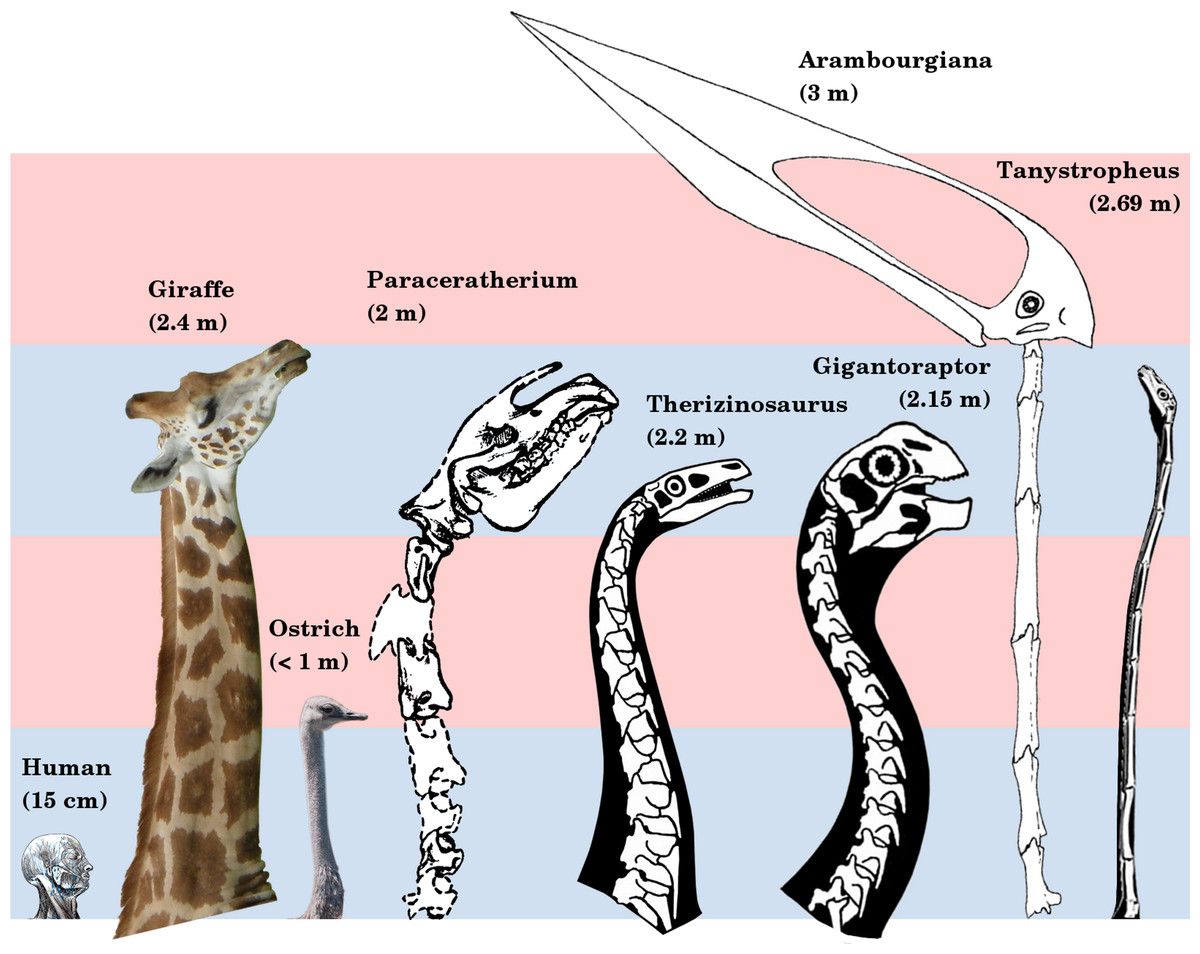
Taking all these points and multiplying them across the Arambourgiania holotype cervical suggests this tubular bone is a pretty fantastic piece of anatomy. We can reconstruct the length of the holotype cervical (presumed to be a fifth, the longest bone in the neck) as 770 mm, and this translates to a neck length estimates of 3 m using scaling based on Quetzalcoatlus (Frey and Martill 1996), or 2.6 m using a range of azhdarchid necks (specifically lengths of cervicals III-VII - this from an unpublished dataset). However you want to cut it, it's clear this was a very long-necked animal, perhaps up there with the longest necked of all non-sauropodan terrestrial animals (below). On top of this we have to put a big azhdarchid skull, which is going to be about 2-3 m long for a giant. If these estimates are correct, Arambourgiania would be loaded with 5 m of neck and head, and was supporting the whole lot with a small number of bones resembling packing tubes. It has to be regarded as one of the most 'extreme' tetrapod bodyplans known.

Mike Taylor and Matt Wedel's (2013) take on the non-sauropod contest for longest tetrapod neck. It's a close call in my mind as to who wins out of Arambourgiania and a large Tanystropheus, but the important point is that Arambourgiania has an extremely long neck.
So how did the neck of Arambourgiania work? How did a series of bony tubes support a 2-3 m long head? Where did the muscles attach to on the simple structure of cervical V? Full answers to these questions remain part of a broader mystery about the functionality of azhdarchid necks, and this is something that researchers are only just starting to address. But what we know of Arambourgiania is sufficient to give some provisional, partial insight here. The basic construction of the Arambourgiania cervical is basically similar to what we see in smaller azhdarchids, where large, stiffened joints between the neck bones helped support and reinforce the neck (artists: please stop drawing azhdarchids with S-shaped necks in flight!). But subtle modifications to its vertebrae likely enabled each element to grow to much greater lengths without failing. Most azhdarchid cervicals are dorsoventrally flattened, which makes them weakest against vertical loads. Most of the time, vertical loading is created by the weight of the neck and head, but it will also include any food being picked up. The Arambourgiania cervicals are expanded dorsoventrally to the extent that they are slightly taller than wide (Frey and Martill 1996), reinforcing them against vertical bending, and thus potentially able to support greater weights than their smaller cousins. Furthermore, in expanding the bone dimensions to a near circular cross section, and all the while retaining a characteristically thin pterosaurian bone wall, Arambourgiania likely had vertebrae more resistant to torsion and bending than those of the smaller forms.

So counter-intuitive as it seems, making a neck out of tubes is a good way to produce a strong, long, lightweight skeleton, especially if it has to support heavy loads like a huge head. Pterosaurs used the same tactic to enhance their wings, and it seems azhdarchids - especially Arambourgiania - transferred some of these mechanical properties to their vertebral column. While assessments like this are very basic and clearly only the tip of the iceberg as goes azhdarchid neck mechanics, they demonstrate that Arambourgiania is, and will continue to be, a critical species for understanding the neck proportions, mechanics and scaling of giant azhdarchids.

So, what I'm saying is...

These are just three reasons why we shouldn't be overlooking Arambourgiania when considering the largest pterosaurs. It might not have the sexiest name, and it might not be known from as many elements as the other named giants, but it has historic and anatomical significance that cannot, or should not, be eclipsed by other species. It's clearly an animal that needs to be brought back into the fold of popular science so, the next time giant azhdarchid pterosaurs come up in conversation, remember that there are three named giant species, not just those other two, and that forgotten, old-timer Arambourgiania still has plenty of things to tell us about giant azhdarchid palaeobiology.

Coming really, really soon: you guys like pterosaurs, right?


This bout of championing an old, somewhat forgotten dead reptile was sponsored by Patreon

The paintings and words featured here are sponsored by the best people on the planet, my Patreon backers. Supporting my blog from $1 a month helps me produce researched and detailed articles with paintings to accompany them, and in return you get access to bonus blog content: additional commentary, in-progress sneak-previews of paintings, high-resolution artwork, and even free prints. Accompanying this post is an animation and discussion of the production of my Arambourgiania painting at the top of the post. Sign up today to access it and other exclusive content!

References

  • Arambourg, C. (1954). Sur la presence dun pterosaurien gigantesque dans les phosphates de Joradanie. Comptes Rendus Hebdomadaires des Seances de l'Academie des Sciences, 238(1), 133-134.
  • Arambourg, C. (1959). Titanopteryx philadelphiae nov. gen., nov. sp., ptérosaurien géant. Notes et Mémoires sur le Moyen-Orient, 7, 229-234.
  • Bramwell, C. D., & Whitfield, G. R. (1974). Biomechanics of Pteranodon. Philosophical Transactions of the Royal Society B: Biological Sciences, 267(890), 503-581.
  • Buffetaut, E., Grigorescu, D., & Csiki, Z. (2002). A new giant pterosaur with a robust skull from the latest Cretaceous of Romania. Naturwissenschaften, 89(4), 180-184.
  • Buffetaut, E., Grigorescu, D., & Csiki, Z. (2003). Giant azhdarchid pterosaurs from the terminal Cretaceous of Transylvania (western Romania). Geological Society, London, Special Publications, 217(1), 91-104.
  • Frey, E., & Martill, D. M. (1996). A reappraisal of Arambourgiania (Pterosauria, Pterodactyloidea): One of the world's largest flying animals. Neues Jahrbuch fur Geologie und Palaontologie-Abhandlungen, 199(2), 221-248.
  • Langston, W. (1981). Pterosaurs. Scientific American, 244, 122-136.
  • Lawson, D. A. (1975). Pterosaur from the Latest Cretaceous of West Texas. Discovery of the Largest Flying Creature. Science, 187: 947-948.
  • Martill, D. M., Frey, E., Sadaqah, R. M., & Khoury, H. N. (1998). Discovery of the holotype of the giant pterosaur Titanopteryx philadelphiae ARAUBOURG 1959, and the status of Arambourgiania and Quetzalcoatlus. Neues Jahrbuch fur Geologie und Palaontologie-Abhandlungen, 207(1), 57-76.
  • Steel, L., Martill, D.M., Kirk, J., Anders, A., Loveridge, R.F., Frey, E. J.G. Martin (1997). Arambourgiania philadelphiae: giant wings in small halls. The Geological Curator, 6(8): 305-313
  • Stein, R. S. (1975). Dynamic analysis of Pteranodon ingens: a reptilian adaptation to flight. Journal of Paleontology, 534-548.
  • Taylor, M. P., & Wedel, M. J. (2013). Why sauropods had long necks; and why giraffes have short necks. PeerJ, 1, e36.
  • Wellnhofer, P. 1978. Handbuch der Paläoherpetologie. Teil 19: Pterosauria. Gustav Fischer Verlag, Stuttgart. 82 pp.
  • Witton, M. P. (2010). Pteranodon and beyond: the history of giant pterosaurs from 1870 onwards. Geological Society, London, Special Publications, 343(1), 313-323.

Tuesday, 20 January 2015

Pterosaur art you've never seen before! (sort of)

Later this week I’m travelling to the Netherlands to give a talk on pterosaurs at the Museon, The Hague. I’ll be part of a series of public talks on Mesozoic reptile lifestyles celebrating the opening of the Museon's new Dino Jaws exhibition, and it should be a blast. I’ve revisited some of my older pterosaur paintings to add more detail and depth when featuring them in my talk, and thought I’d share the results here. Some of these images aren’t that old really, but, thanks to beefing up my painting rig before Christmas, I find some of my work from even a few months ago can look a lot nicer with just a few hours work. As usual, prints are available of all images shown below.

Arambourgiania: remaining huge in artwork since 2013. See this page for the original.
First up is a tweaked version of my 2013 Arambourgiania, a giraffe, and a standard wife-unit scale bar. There’s not much to say here – I just wanted to put more detail into the pterosaur so it looks better in a close-up panning presentation animation. At some point, hopefully soon, a version of this image featuring two azhdarchids will be published.

An azhdarchid in high-altitude, long distance flight. Original here.
Second, the flying azhdarchid which made a debut at TetZooCon last year. I felt the initial image was a bit flat, so this has more depth added to the background. The depicted animal is a ‘generic’ azhdarchid, although obviously similar to the smaller Quetzalcoatlus species. It’s shown flying rather high – many thousands of feet in the air – on a long-distance flight. Mike Habib and I have droned on about the awesome flight capability of giant azhdarchids for years, and we expect the range and flight speed of smaller azhdarchids – with, say, 5 m wingspans – to be relatively impressive too. They may not have been capable of booming around the planet with the same gusto as their giant cousins, but continent hopping was certainly not beyond them.

The anurognathid Anurognathus ammoni, brought to you by evolutionary processes which wanted Muppets to rule the skies. 
The third reworking shows a species at the other end of the pterosaur size spectrum, the diminutive Anurognathus ammoni. Some readers may recognise this painting from my book. Anurognathids haven’t been covered in much detail at this blog, but that will likely change soon when Mike Habib and I publish a new study on their functional morphology in the near future. This painting alludes to something which we attempt to quantify in that study – prey size. Anurognathids are frequently depicted as hawking relatively large insects like dragonflies, but – based on prey proportions in modern avian insect hawkers, and the delicate build of anurognathid skulls – much smaller insects were probably pursued instead. Catching aerial insects is already difficult enough, so why chase relatively rare, enormous and feisty prey when abundant small midges can be scooped out of the sky with relatively little effort? Because anurognathids aren't big beasts - wingspans of less than 0.5 m are common - their likely prey was probably best measured in millimetres, as shown by the Target Midge in this picture. Other features to note in this painting include the tufted wing tips and completely fuzzy face, both of which are known from fossils and, for the time being at least, unique to anurognathids. The ‘cryptic’ colouration and nocturnality are nods to recent work on these pterosaurs suggesting these pterosaurs were shy, well-hidden creatures which were primarily active at dawn and dusk. More on these neat pterosaurs as time – and manuscript progress – permits.

To finish – because I can’t not post this – here’s a poster for the superhero movie the world deserves, but not the one it needs right now. Image by Jon Davies (@SovanJedi on Twitter – you may recall his equally excellent lampooning of in-your-face dinosaur art from last year).

That logo needs a T-shirt. Image manipulation by Jon Davies.

Friday, 11 April 2014

Palaeoartworks, the case studies, part 1: Giant pterosaurs

If you're heading to Lyme Regis this weekend, or indeed at any point until May 4th, you should stop by the Town Mill: a dedicated gallery of palaeoart lies within. It contains more than just a bunch of pictures however, as it also endeavours to explain how palaeoart is done. A good palaeoartist restores long vanished skeletomuscular systems; knows how to fill anatomical gaps; gives a sense of size to alien-looking creatures, and constantly adapts to changing science to render their subjects more accurately. If they do their job well, viewers won't see how much (often considerable!) paper palaeoartists pull across the patchy, cracked fossil record. But how, specifically, are these illusions pulled off? And can we really be that confident about the results?

Some of the answers lie at my Lyme Regis gallery. Along with the paintings you'll find 'Palaeoart Case Studies', short explanations outlining the path from fossil to reconstruction. In each case, relevant fossil material is also provided to demonstrate how much - or little - artists have to work with. There's six of these in total, and I'll be sharing most or all of them here over the next few weeks. First up are the crowd-pleasing giant azhdarchid pterosaurs, animals which are so commonly reconstructed that we must know buttloads about their anatomy and proportions. Or do we? Read on to find out how confident, or not, pterosaur palaeoartists really are about reconstructions of giants like Arambourgiania philadelphiae, below.

Giant azhdarchid pterosaurs: iconic, famous, mysterious


Reconstruction of the giraffe-sized monster pterosaur Arambourgiania philadelphiae. The dirty secret is that 95% of what you see here is extrapolated from other animals.
Restorations of giant azhdarchid pterosaurs like Arambourgiania, Quetzalcoatlus and Hatzegopteryx are understandably common. What captures the imagination more than a giraffe-sized animal with wings spanning 10 m and a 2 m long head? All pterosaurs have an unusual air about them, but giant azhdarchids also have a majesty which is hard for artists to resist. Despite the common nature of their reconstructions however, giant azhdarchid fossils are not only very rare but also extremely fragmentary. No complete, or even near complete, fossils of giant azhdarchid skeletons are known, and a standard family kitchen table could hold the entire inventory of giant azhdarchid bones from around the world. Arambourgiania, for instance, is known from little else than the giant, tubular neck vertebra shown below. It stands to reason that these reconstructions are based largely on inference and educated guesswork, but are they simply products of imagination, or is there more to it?

Arambourgiania philadelphiae holotype vertebra, UJA VF1. From Martill et al. 1998. Scale bar represents 100 mm.

When attempting to restore the appearance of a poorly known fossil species, the first port of call is the anatomy of more completely known, close relatives - the closer the better. The best known azhdarchid species have 3 and 5 m wingspans, so were only a fraction of the size of their bigger cousins. With such a size difference, it is not sensible to assume that the larger animals were perfectly scaled-up versions of these smaller ones. Organisms rarely evolve different sizes without changing proportion somewhere. Bones of larger animals are often more robustly built than those of smaller ones, for instance, because bigger animals have greater masses to support. This is certainly true for giant azhdarchids, as is an disproportionate increase their neck lengths which correlates with size. Paying attention to seemingly trivial scaling details like this can make a tremendous difference to the accuracy of a reconstruction, especially when a lot of extrapolation is involved.

However, this is only half of the story about restoring giant azhdarchids, because deciding which animals are closely related among this group can be difficult. Not all azhdarchids were alike, and the interrelationships between them is unclear. In these muddy taxonomic waters, palaeoartists have to make some educated guesses. Whereas palaeontologists can admit that their data has limitations or that the relevant studies have not been done, palaeoartists have to stretch current data to finish their work. Artists restoring animals with poorly determined taxonomy like giant azhdarchids have to decide which other animals serve as the best models for their reconstructions, and this often involves some degree of intuition and opinion. Such palaeoartworks are especially vulnerable to being proved inaccurate when new data becomes available. Until then, the best reconstructions of these animals are simply those which use the most careful extrapolations and guesswork, and this should be borne in mind when looking at any reconstruction of a giant azhdarchid or other, poorly known fossil species.

Come back soon for the next case study!

Reference

  • Martill, D. M., Frey, E., Sadaqah, R. M., & Khoury, H. N. (1998). Discovery of the holotype of the giant pterosaur Titanopteryx philadelphiae ARAMBOURG 1959, and the status of Arambourgiania and Quetzalcoatlas. Neues Jahrbuch fur Geologie und Palaontologie Abhandlungen, 207, 57-76.

Tuesday, 29 October 2013

Azhdarchid pterosaurs: 'terrestrial stalkers' or pelican-esque 'scoop-feeders'?

This week saw the pre-publication of a new paper by myself and Darren Naish on one of our favourite topics, azhdarchid pterosaur* feeding habits. The article is now available in proof format in the Open Access journal Acta Palaeontologica Polonica, with the final, fully typeset version following sometime next year. Darren and I are no strangers to the long-necked, frequently gigantic azhdarchids of course, having discussed azhdarchid foraging habits at length in a 2008 paper and concluding that previously proposed lifestyles - skim-feeding, sediment probing, obligate scavenging - were inconsistent with azhdarchid functional anatomy. Instead, we proposed a novel hypothesis, that azhdarchids were 'terrestrial stalkers', basically just a sexy way of saying 'they wandered around on the ground and ate whatever they could find'. Hey, half of selling an idea is a snappy name, baby.

*Surely no-one here needs to be told what an azhdarchid is? You do? Then check out this article for a primer.

Why do we think azhdarchids were 'terrestrial stalkers'? A handy infographic explaining our reasoning, from Witton and Naish (2013).  The greyed cervical vertebrae indicate the range of azhdarchid neck motion according to Averianov (2013), which we are pleased to see meeting our expectations of ground-reaching ability (see Witton and Naish 2008; Fig. 8 and caption).
We're not the only folks with opinions on azhdarchid palaeoecology of course. Although I think the terrestrial stalker idea has been generally well received, Alexander Averianov (2013) disagreed with the idea. Earlier this year, he proposed that the terrestrial stalker hypothesis is flawed for three major reasons, which can be summarised as:
  1. Azhdarchid remains are always found in ancient lake and river deposits, which indicates they were feeding there as well.
  2. Grounded azhdarchids were vulnerable to predation from theropod dinosaurs, being ill-suited to rapid takeoff or other means of quick escape.
  3. We overlooked the helical jaw joint of azhdarchids in our 2008 paper. Azhdarchids possess a skewed jaw joint which laterally displaces the mandibular rami when the jaw is opened, expanding the throat region marginally. According to Averianov (2013), this is a sign of expanding, pelican-like jaws, which permitted fish to be scooped from water in flight, which is a superior hypothesis to terrestrial stalking.
After some discussion between ourselves, Darren and I decided that we should respond formally to these points - Witton and Naish (2013) is the result. In doing so, we were able to explore some aspects of azhdarchid palaeobiology a little more, as well as put some comments into print on the way we interpret the lifestyles of fossil animals. Hopefully, a lot of the things we have to say on this will be of interest to readers here, so I thought I'd provide a quick summary.

Taphonomy is not destiny
Averanov's (2013) first 'flaw' is problematic for pretty elementary reasons. It's common knowledge that all manner of fossil terrestrial animals occur in aquatic environments because that's where the majority of continental sediments accumulate. Azhdarchids routinely occur in aquatic deposits with the likes of dinosaurs, reptiles, birds and so on, but we don't assume the latter are tied to water simply because their fossils are found in ancient rivers and lakes. Ergo, we shouldn't assume this for azhdarchids either. Taphonomy does not necessarily correlate with palaeobiology. Moreover, it's not true that all azhdarchids are found in remnants of aquatic settings: some occur in ancient deserts and ash beds. There's not much else to say on this fairly basic point (check out the paper if you want to read our full response), so we'll get onto the more interesting stuff.

Killer storks, giant pterosaurs, and the Age of MurderDeathReptiles
A number of folks have asked us about the vulnerability of grounded pterosaurs to predators, and Averianov (2013) specifically mentions the problems azhdarchids would have taking off when faced with attackers ("It is hardly probable that huge azhdarchids could take wing in one go and running for acceleration is difficult in marshland conditions” - Averianov 2013, p. 207). As we note in our new paper, palaeobehaviour is hard to discuss in a truly scientific manner and we are wary of just making bold, arm-wavy comments about ancient predator-prey interactions. There are some comments we can make, however, which do not rely on crass speculation.

Firstly, modern ideas of pterosaur takeoff (which regular pterosaurophiles will know means quadrupedal launching) suggest these animals could become airborne in seconds from a standing start (contra Averianov 2013). Thus, there is little reason to think that azhdarchids - or any other pterosaurs - would have to engage in panicked running to escape predators. Quad launches also permit greater acceleration and power than bipedal launches. This may make pterosaurs actually more adept at turning tail from predators than large modern birds, which do have to engage in a little taxiing before becoming airborne. We therefore do not envisage that grounded pterosaurs - even giant azhdarchids - would struggle to escape predators when startled.

According to some, this is pretty much what the Mesozoic looked like all the time. Background borrowed from here.
We also note that while terrestrial stalking is considered an unusual lifestyle for pterosaurs, comparable ecologies are actually pretty common among modern birds. Indeed, a lifestyle of walking around and eating stuff found on the ground seems to be the 'default' foraging strategy for many bird groups, and there's no indication that this makes them atypically vulnerable to predation. This even applies to large birds which live in predator-rich environments, where big cats, dogs, hyenas and other predatory species are real dangers. We have to ask why Mesozoic ecosystems would be any different? Is it because ancient reptiles are generally portrayed as aggressive monsters who're constantly pitched in battle (above)? Maybe, but this is almost certainly wrong. Darren communicates this very clearly in our new paper:
"...the idea of azhdarchids may have been highly vulnerable to terrestrial predation labours under several probably erroneous assumptions, including viewing theropods as unstoppable killing machines, immediately pouncing on and devouring any grounded pterosaur. In point of fact, the behaviour of living predators indicates that theropods large and small likely exploited easy prey (Hone and Rauhut 2010), ignored or avoided large or awkward prey, and were not a perpetual, 24-hour menace across all environments, worldwide." Witton and Naish 2013 (In Press)
I've discussed the over-statement of aggressive behaviour of Mesozoic animals several times before, and I'm sure I'm not alone in finding portrayal of dinosaurs as angry murder/death/kill machines irritating. It's frustrating enough when seen in popular media, but particularly irksome when it seemingly influences scientific discussions. I don't want to understate predation risks, but modern animals demonstrate that behaviours like extended bouts of foraging, resting and socialising can be performed without being ripped to pieces by passing predators. Assuming the Mesozoic operated under the same basic principles, it almost certainly wasn't the 190 million year bloodbath it's often made out to be.

A giant pterosaur compared to top theropod carnivores of giant azhdarchid-bearing Late Cretaceous ecosystems. A, Tyrannosaurus rex, representing the largest known predator in Maastrichtian North America; B, Balaur bondoc, largest predatory theropod of Maastrichtian Romania; C, Arambourgiania philadelphiae, standing in for the similarly-sized azhdarchids which lived alongside A and B, respectively; D, human sleuth for scale. From Witton and Naish (2013).

The composition of azhdarchid-bearing faunas is also of interest here (above). In some parts of time and space, enormous, 10 m wingspan azhdarchids lived alongside large predators like tyrannosaurids and spinosaurids. In others, the biggest theropods were turkey-sized. In fact, in latest Cretaceous European deposits, azhdarchids are the biggest predatory animals by a huge margin, and unlikely to be bothered by any theropods once they grew beyond a certain size. In these settings, azhdarchids weren't in perpetual trouble from theropods: they were perpetual trouble for theropods. Heck, the sheer size of an adult giant azhdarchid is impressive even alongside the very largest carnivores, and we wonder if this alone would dissuade less ambitious predators. Of course, there are plenty of small azhdarchid species which may be somewhat more easily subdued by theropods, and there are plenty of faunas were azhdarchids are not large, dominant species, but it's worth stressing that some azhdarchids lived in settings devoid of serious predator risk.

Of course, there were likely some occasions when azhdarchids were caught out by predators: would this spell instant doom for the pterosaur? Not necessarily. Again, this is hard to say with confidence, but we note that large modern storks - which resemble azhdarchids more than any other modern species - can be far more dangerous than most folks realise. These birds can inflict severe, sometimes fatal injuries with their beaks when panicked and cornered. Children are seriously wounded or even killed by marabou storks when trying to harvest soft white contour feathers from these usually calm birds (Mackay 1950). Zoo staff routinely arm themselves against attack from captive jabiru storks because attacks are so frequent and vicious (Shannon 1987). Indeed, even relatively large animals like tapirs are no match for angry jabirus. These storks are not armed with razor-sharp, hooked beaks: they deliver this damage with their simple, long, pointed bills. Whether this means azhdarchids used their jaws as similarly formidable weapons is anyone's guess, but it demonstrates that azhdarchid-like bills can be used as fearsome predator deterrents if wielded properly. Remember, of course, that some azhdarchids probably had beaks over 2 m long, 6-8 times longer than those of even the largest modern storks. An giant azhdarchid in a bad mood may be well worth avoiding.

We have some additional discussion on this point in our MS, but I think you get the gist of what we're saying. Our bottom line is not that azhdarchids could wander about Cretaceous plains without a care in the world, just that there is no reason to assume they were overtly vulnerable to predation risks. Indeed, there is evidence to quite the opposite in several cases, and there is no reason to think this is a flaw in the terrestrial stalker hypothesis.

The scoop-feeding pelican-mimic thing
This does not mean, of course, that azhdarchids had to be terrestrial stalkers just because they could walk around without being eaten immediately: water-trawling 'scoop feeding' could still be a viable alternative to terrestrial stalking. Citing the helical jaw joint of azhdarchids as evidence for a pelican-like expanding throat region, Averianov (2013)'s summation of his azhdarchid feeding hypothesis reads:
"...azhdarchids flied [sic] slowly above the water surface of large inland water bodies… looking out for fish or small fish shoals. As prey is detected, they opened the mouth, expanding the throat sac due to the spiral jaw joint, and captured fish in this scoop net, formed by the jaw rami and throat sac. Then, the head was thrown abruptly back by extension of the neck in the posterior region and prey was swallowed.” Averianov 2013, p. 209 
Although far from the first author to compare pterosaur and pelican jaws favourably, this is the first time (to my knowledge) that specifically pelican-like throat expansion has been proposed for pterosaurs and linked to a certain foraging strategy. The exact method of foraging suggested here - a mix of 'scoop' and skim-feeding - does not have a modern representative but is clearly an 'extreme' lifestyle, likely to incur considerable loading on azhdarchid skulls, jaws and neck. As with some other proposed 'extreme' azhdarchid lifestyles, like skim-feeding, we'd expect to see considerable specialisation in azhdarchid anatomy to reflect this but, unfortunately, we don't. Indeed, our assessment of this feeding mechanism suggests it is fraught with biomechanical and functional problems, in addition to failing tests offered by comparative anatomy.

Extending jaw area measurements of the brown pelican and select azhdarchid pterosaurs. Note the pelican is being rather lazy with it's jaw bowing, and yet still achieves much greater area increase than the azhdarchids. From Witton and Naish (2013).
We investigated the plausibility of 'scoop-feeding' in several ways. Firstly, we measured flexed and unflexed jaw areas of azhdarchids and pelicans to compare their range of jaw expansion (above). It turns out that azhdarchid jaws achieve pretty negligible amounts of jaw area increase even when an unrealistic amount of jaw flexion is permitted. By contrast, a bowed pelican jaw achieves an enormous area increase even when not trying very hard: we could only measure a partially bowed pelican jaw, but even this left pterosaur jaw expansion looking pretty pathetic. We utilised the same area measurements of azhdarchid jaws to calculate drag forces incurred on an azhdarchid neck during the 'scoop' phase of foraging, when the entire mandible has to be ploughed through the water. Unsurprisingly, the resultant drag forces were pretty huge, and are several hundreds times higher than the strain permissible by an azhdarchid fifth neck vertebra (hat tip to Mike Habib for suggesting using our jaw area data in this way). An azhdarchid that lowered its jaw into the water to try 'scoop feeding' would die a horrible, horrible death. This, of course, has further negative implications on the idea that azhdarchids were skim-feeders: even partial submersion of their mandibles was likely to snap their necks.

Brown pelican jaws in action. From Schreiber et al. (1975)
As if it didn't look bleak enough for 'scoop feeding', things took a turn for the worse when we compared azhdarchid and pelican jaw anatomy. Pelican mandibles and throats are amazingly freaky and specialised, and these adaptations directly relate to their manner of grabbing prey (above). Their foraging adaptations include differentially mineralised jaw bones which create distinct 'hinges' at points along the jaw; short mandibular symphyses; loosely-jointed posterior jaw bones; super-elastic throat tissues; reduction of the tongue, and skin-like beak tissues which permit jaw flexion. At least some of these features should be detectable in jaw fossils, but no indication of similar adaptations are found in azhdarchid jaws. In fact, directly opposing anatomies are seen in most instances. But what of the helical jaw joint? Isn't that functionally significant? Probably not, because helical jaw joints are far from unique to azhdarchids, being seen across all manner of archosaurs. Given the range of ecologies encapsulated by archosaurs with helical jaw joints, they're clearly of questionable, if any, significance to foraging strategies. It seems that the potential for azhdarchid jaws to perform expanding actions are limited at best, and we should stop referring to their gently-bowing mandibular rami as being 'pelican-like': they're really nothing of the sort. Indeed, the only animals we know of with even remotely pelican-like jaws are rorqual whales. I could go on (and we do in the paper), but I guess it's already clear that we don't consider 'scoop feeding' a viable alternative to terrestrial stalking at all.
Extreme lifestyles require extreme anatomies. Here's a summary of what you need to be a skim-feeding species, according to the modern skimming bird, Rynchops. From this post.
A closing point
In sum, we more-or-less go full circle in our new study, coming back to terrestrial stalking as the most likely current interpretation of azhdarchid palaeecology. Reflecting on this study, and the other studies into pterosaur palaeoecology I've been involved with (Humphries et al. 2007; Witton and Naish 2008, 2013; Witton 2012), it strikes me that proposed 'extreme' foraging methods are almost always inferred from a few anatomical characteristics rather than entire bauplans. This is certainly the case for 'scoop feeding' and skim-feeding (e.g. Kellner and Langston 1996; Martill 1997; Averianov 2013). Why do we keep doing this? It almost seems that our default assumption for pterosaurs is that they lived crazy, outlandish lives which we select evidence to verify. This is a completely backwards and unscientific way of assessing ancient animal habits. Modern animals with 'extreme' lifestyles wear their adaptations across their bodies, suggesting that we need to look at the entire picture of extinct species before we propose our palaeoecological interpretations (see details on skim-feeding adaptations, above). Folks like myself and Darren currently champion the terrestrial stalker hypothesis not because it's our 'pet idea', but because it's currently the only hypothesis which considers the entire azhdarchid bauplan (see our infographic at the top of the post), is consistent with biomechanical or functional parameters of azhdarchid anatomy and matches lifestyle predictions made through comparative anatomy. It may well not be the last word on this topic, but at least there's a foundation of science to it, which is more than can be said for a lot of proposed pterosaur lifestyles (see Witton 2013 for a review). If we're expecting to understand the palaeoecology of these animals in detail, we really have to move away from our rather basic, selective interpretations of their anatomy and provide more detailed, dedicated assessments.

I'll have to stop there for now. Be sure to check out the rest of Witton and Naish (2013) for further details on this study and, for more on pterosaur palaeoecology and azhdarchids in general, you may want to check my book (Witton 2013).

References
  • Averianov, A. O. (2013). Reconstruction of the neck of Azhdarcho lancicollis and lifestyle of azhdarchids (Pterosauria, Azhdarchidae). Paleontological Journal, 47(2), 203-209.
  • Humphries, S., Bonser, R. H., Witton, M. P., & Martill, D. M. (2007). Did pterosaurs feed by skimming? Physical modelling and anatomical evaluation of an unusual feeding method. PLoS biology, 5(8), e204.
  • Kellner, A. W., & Langston Jr, W. (1996). Cranial remains of Quetzalcoatlus (Pterosauria, Azhdarchidae) from Late Cretaceous sediments of Big Bend National Park, Texas. Journal of Vertebrate Paleontology, 16, 222-231.
  • Mackay, H. (1950). The quaint Marabou stork. Zoo Life 5, 91-92.
  • Martill, D. M. (1997). From hypothesis to fact in a flight of fancy: The responsibility of the popular scientific media. Geology Today, 13, 71-73.
  • Schreiber, R. W., Woolfenden, G. E. & Curtsinger, W. E. (1975). Prey capture by the Brown Pelican. The Auk, 92(4), 649-654.
  • Shannon, P. W. (1987) The Jabiru Stork (Jabiru mycteria) in zoo collections in the United States. Colonial Waterbirds 10, 242-250.
  • Witton, M. P. (2012). New insights into the skull of Istiodactylus latidens (Ornithocheiroidea, Pterodactyloidea). PloS One, 7(3), e33170.
  • Witton, M. P. (2013). Pterosaurs: Natural History, Evolution, Anatomy. Princeton University Press.
  • Witton, M. P., & Naish, D. (2008). A reappraisal of azhdarchid pterosaur functional morphology and paleoecology. PLoS One, 3(5), e2271.
  • Witton, M. P. & Naish, D. (2013) Azhdarchid pterosaurs: water-trawling pelican mimics or "terrestrial stalkers? Acta Palaeontologica Polonica (in press)

Wednesday, 21 August 2013

9 things you may not know about giant azhdarchid pterosaurs

The 2015 version of the giraffe vs. azhdarchid vs. person image, now in it's fifth iteration (see the general history of these images through the years: 200620072009). The giraffe is a big bull Masai individual, standing a healthy 5.6 m tall, close to the maximum known Masai giraffe height. The pterosaur is a 10 m wingspan Arambourgiania philadelphiae (for reasons I cannot go into now, it is not wise to consider the appearance of giant azhdarchid taxa interchangeable any more: this should not be considered Hatzegopteryx thambema or Quetzalcoatlus northropi). The Disaknowlegement provides the human touch. These characters will receive some additional company soon.
The splendid beasts that are giant azhdarchid pterosaurs have occupied my thoughts a lot of late, mostly thanks to three upcoming talks I'll be delivering about them at upcoming conferences and society meetings. Preparing that number of talks in a short space of time has given me a whole new interpretation of the term 'death by PowerPoint' so, to take a break from animating slides and producing diagrams, here's a quick run down of 10 factoids you may not know about giant azhdarchid pterosaurs (the likes of Quetzalcoatlus northropi, Hatzegopteryx thambema and Arambourgiania philadelphiae - as if they need introduction) and their smaller relatives. Even if these facts are familiar, please feel free to enjoy the new bits of artwork accompanying the post. Those of you really into the ever evolving depiction of these pterosaurs really should also pay a visit to this recent Tetrapod Zoology post: I'm clearly not the only one with giant pterosaurs on the brain.

They nearly weren't called 'azhdarchids'
'Azhdarchidae' is a terrific name. It's short but mysterious, relatively easy to spell, and PR friendly enough that even the British tabloid The Sun has used the term on at least two (I think) occasions. The name 'Azhdarchinae' was coined by the late Lev Alexandrovich Nesov in 1984 from the Uzbek word 'azhdarkho', a name for a mythical dragon, and also the nomenclatural basis for the medium-sized Uzbek azhdarchid Azhdarcho lancicollis. Nesov's name encompassed all three azhdarchid genera known at that time: Azhdarcho, Titanopteryx (now known as Armabourgiania) and Quetzalcoatlus. Almost simultaneously, however, the exact same set of taxa was being roped into another group by Kevin Padian, which he termed Titanopterygiidae after, obviously, Titanopteryx. Nesov's 'Azhdarchinae' pipped the far-less elegant Titanopterygiidae to the publishing punch by a matter of months, and took nomenclatural priority for the group. Padian elevated Azhdarchinae to 'family' level in a short note in 1986, giving us our now familiar term, 'Azhdarchidae'.

Lev Alexandrovich Nesov holds the fossil cervical vertebra, notarium and jaw tip of the azhdarchid Azhdarcho. Image from Unwin (2005).
Tiny bodies
Despite their giraffian proportions, giant azhdarchid torso were relatively tiny. Witton and Habib (2010) noted that, like many pterodactyloid pterosaurs, their torsos were probably only a third or so longer than their humeri, suggesting a shoulder-hip length of about 65-75 cm for an animal with a 10 m wingspan. That's a torso length not much larger than your own, although they were considerably more stocky and swamped with muscle. Azhdarchid shoulders, in particular, are well endowed with attachment sites for flight muscles, as are (for pterosaurs) their pelves and hindquarters.

Giant azhdarchids did not suffer from flight power shortages
Many internet commenters often roll out the idea that giant azhdarchids would struggle to take off from the ground, even allowing for new ideas like quadrupedal launching. These folks need to get out of their armchairs, however, and check out some classic work on animal flight and giant pterosaur takeoff. James Marden's 1994 work on animal takeoff found some surprisingly consistent scaling trends among animal flight power and takeoff ability, allowing us to predict the muscle power of even long extinct fliers like Meganeura, Archaeopteryx and a 10 m span azhdarchid. The resulting aerobic power output of azhdarchid flight muscles - all 60 kg of them (a fairly safe bet for a 250 kg azhdarchid given what we know of animal flight muscle fractions among modern fliers) - is a bit rubbish, only 4.52 N/kg of body weight. Animals need to be generating 9.8 N/kg to fight gravity, so this would seemingly ground our giants. Bear in mind, however, that swans, albatross, vultures and turkeys also have aerobic power outputs of around 4.5 N/kg from their flight muscles, and they can fly just fine. The secret to their takeoff lies in the great power of anaerobic muscle contraction, which provides twice the power achieved under aerobic regimes. Using anaerobic power, giant azhdarchid power outputs are 10.098 N/kg of body weight, a value surpassing the 9.8 N/kg and matching the anaerobic power outputs of a 10 kg swan or 1 kg vulture (see graph, below). In terms of power availability, then, giant azhdarchids would not have struggled to launch any more than a large bird, so all these suggestions about poor takeoff ability and whatnot can be put to bed.

Scaling of flight performance with body size under anaerobic power output. The dashed line is the minimum lift needed to overcome gravity. Anaerobic power is 225W/kg, the upper limit of avian anaerobic output. From Marden (1994).
An unsurpassed 80 million years of evolutionary history, and growing
Azhdarchids are undeniably best known from Upper Cretaceous rocks, but they also have a patchy and sometimes controversial Lower Cretaceous record. Recently, Gareth Dyke and colleagues (2011) demonstrated that the group were probably present at the very base of the Cretaceous, in Berriasian (c. 140-145 Ma) deposits of Romania. Given that azhdarchids are definitely present at the final stage of the Cretaceous, this gives the group a stratigraphic record spanning the entire Cretaceous: 80 million years in total. This is longer than any other pterosaur group. Two cervical vertebrae from the Late Jurassic of Africa may extend their temporal range another 5 million years, although the affinity of these specimens remains controversial.

A much improved skeletal reconstruction of the small azhdarchid Zhejiangotperus linhaeiensis over my oft-reproduced effort from Witton and Naish 2008. Note the use of pacing strides, a gait indicated by pterosaur trackways but seldom seen in pterosaur palaeoart.
More than just long necks
When we describe azhdarchids, we often use two qualifiers: 'toothless' and 'long-necked'. In fact, these pterosaurs are brimming with characterising features (above). Their rostra are particularly elongate compared to all other pterosaurs, their orbits are depressed well into the lower half of their skulls, their wing metacarpals and femora are atypically long, and their extremities are short and robust. Their mid-series cervical vertebrae are famously simplified into almost tube-like structures, and their humeri are deceptively derived from the pterodactyloid norm. The wing fingers of azhdarchids occupy a relatively small 47% of their wing lengths, a value only approximated by one other pterosaur group, the closely related thalassodromids. Artists, take note: grounded azhdarchids should not be reconstructed with their folded wing fingers stretching skywards over their backs: they couldn't reach that far.

But no, seriously, the long necks
The cervical vertebrae of giant azhdarchids are poorly known, with only a few specimens (and even fewer good ones) being recovered to date. These rare fossils do, however, clearly indicate substantial neck proportions in at least animals like Arambourgiania. The holotype cervical V of this animal is around 660 mm long, and is missing an estimated 100 mm from its posterior end. Steel et al. (1997) scaled this vertebra isometrically with relatively complete neck skeleton material from the 4.7 m wingspan azhdarchid Quetzalcoatlus sp. to predict a whopping 3071 mm length for cervicals III-IX in Arambourgiania. The use of isometry here is questionable (Witton and Habib 2010), but is defensible given the amount of azhdarchid neck material available to these authors in the mid-nineties. Ongoing work I'm involved with (which will hopefully be published before we're too much older) has attempted to apply allometry to calculations of giant azhdarchid neck lengths. The results are a little more conservative than the 3 m offered here, but we're still landing in the "seriously long neck" camp. Whether azhdarchids will retain the title of absolutely longest necks outside of Sauropoda (Taylor and Wedel 2013) remains to be seen however: I suspect they may ultimately just be pipped by the weirdo protorosaur Tanystropheus. Dammit.
The 'Big Necks Which Don't Belong to Sauropods Competition', won by the giant azhdarchid Arambourgiania. From Taylor and Wedel (2013).
Finally, some data on neck arthrology
The necks of azhdarchids are not just famous for their size, but are also renowned for their rather inflexible joints. These widely discussed features have been the bane of many azhdarchid lifestyle interpretations (see Witton and Naish 2008 for a review), but actual quantification of their arthrological range has been lacking until recently. This is, in part, because a complete 3D azhdarchid cervical series has been elusive for many years, but Alex Averianov (2013) recently produced a composite digital neck skeleton for Azhdarcho to figure out their range of motion. The results were more-or-less what we all expected: very limited range in the mid-series, with most of the mobility limited to the extremes. A surprising amount (but still fairly restricted) range of motion was afforded at the neck base, however. As may be expected, this study is very welcome to those of us interested in the biomechanics and functional anatomy of these animals, and I'm glad to see it.

Averianov's (2013) reconstructed neck arthrology of Azhdarcho lancicollis. That's one stiff neck.
Incidentally, some folks have asked me what I think of Averianov's suggestion that azhdarchids weren't what Darren Naish and I termed 'terrestrial stalkers' in our 2008 paper (generalised terrestrial foragers which spent much of their time wandering over Cretaceous plains in search of small animals and rich plant material like modern storks and ground hornbills). I won't say much now, but Darren and I don't agree with the alleged 'flaws' put forward against our hypothesis, and especially do not agree with the proposed 'aerial scoop feeding' counter hypothesis. Our formal reply has just been through peer review, and we hope to complete the minor tweaks needed to get it ready for publication very soon.

Swimming piscivores and aerial hawking: genuinely suggested azhdarchid lifestyles
It's well known that most recent 'serious' proposals of azhdarchid lifestyles are things like skim-feeding, terrestrial stalking and wading, but many other, frankly outlandish palaeoecological hypotheses have been thrown at azhdarchids over the years. Lev Nesov perhaps takes home the prize for the most bizarre ideas, proposing in his 1984 paper that azhdarchids could swim to find food (both along the surface and by diving) and pursue 'poorly flying' vertebrates through the air. In the same paper, he also advocates skim-feeding as a probably azhdarchid lifestyle. I remain unsure which part of azhdarchid anatomy indicated to Nesov that these animals had superhero-like abilities to acquire food.
Sauropods give a giant azhdarchid the evils. Seems they don't like being buzzed at close range
The awesomopower of giant pterosaur flight
Although azhdarchids are frequently discussed for their natty terrestrial capability nowadays, it's important to remember than any substantial travelling they had to do was probably performed in the air. Computations of the flight abilities of giant azhdarchids have returned seriously impressive results (Witton and Habib 2010). As mentioned above, azhdarchids likely employed anaerobic power for strenuous flight activities like takeoff and perhaps flapping bursts, and likely relied mostly on thermal soaring and flap-gliding like modern raptors to remain airborne for long periods. Their minimum sink and best glide speeds are steady cruises at 16.3 - 24.9 m/s (58.7 - 89.4 kph) but, if they were in a hurry (such as looking for a source of uplift), speeds of up to 48.3m/s (173 kph) were possible for short durations. We estimated that azhdarchids had about 90 - 120 seconds of anaerobic burst power before tiring, meaning these animals could go from a standing start to - literally - several kilometres away in the space of a few minutes. Yowsers. What's more, the size and bodily resources available to such large creatures permitted tremendous flight times: up to 16,000 km of travelling without resting or foraging were likely possible. That's the equivalent of an animal flying from London to Vegas non-stop, realising it forgot its passport, and then flying home again without touching the ground.

And that's your lot for now, folks. If you want to know more about azhdarchids, be sure to check out my book for a whole chapter about them, which is something like the second biggest entry in the entire thing. Things may go quiet over the next few weeks while I'm away at various conferences, but posting will resume when I get back.

References

  • Averianov, A. O. (2013). Reconstruction of the neck of Azhdarcho lancicollis and lifestyle of azhdarchids (Pterosauria, Azhdarchidae). Paleontological Journal, 47(2), 203-209.
  • Dyke, G. J., Benton, M. J., Posmosanu, E., & Naish, D. (2011). Early Cretaceous (Berriasian) birds and pterosaurs from the Cornet bauxite mine, Romania. Palaeontology, 54(1), 79-95.
  • Marden, J. H. (1994). From damselflies to pterosaurs: how burst and sustainable flight performance scale with size. American Journal of Physiology-Regulatory, Integrative and Comparative Physiology, 266(4), R1077-R1084.
  • Nesov, L. A. (1984). Pterosaurs and birds of the Late Cretaceous of Central Asia. Paläontologische Zeitschrift, 1, 47-57.
  • Padian, K. (1984). A large pterodactyloid pterosaur from the Two Medicine Formation (Campanian) of Montana. Journal of Vertebrate Paleontology, 4(4), 516-524.
  • Padian, K. (1986). A taxonomic note on two pterodactyloid families. Journal of Vertebrate Paleontology, 6(3), 289-289.
  • Steel, L., Martill, D. M., Kirk, J. R. J., Anders, A., Loveridge, R. F., Frey, E. & Martin, J. G. (1997). Arambourgiania philidelphiae: giant wings in small halls. The Geological Curator, 6, 305-313.
  • Taylor, M. P., & Wedel, M. J. (2013). Why sauropods had long necks; and why giraffes have short necks. PeerJ, 1, e36.
  • Unwin, D. M. (2005). The pterosaurs from deep time. Pi Press, New York.
  • Witton, M. P., & Habib, M. B. (2010). On the size and flight diversity of giant pterosaurs, the use of birds as pterosaur analogues and comments on pterosaur flightlessness. PloS one, 5(11), e13982.
  • Witton, M. P., & Naish, D. (2008). A reappraisal of azhdarchid pterosaur functional morphology and paleoecology. PLoS One, 3(5), e2271.