Showing posts with label Tyrannosaurus. Show all posts

Friday, 16 June 2017

Revenge of the scaly Tyrannosaurus

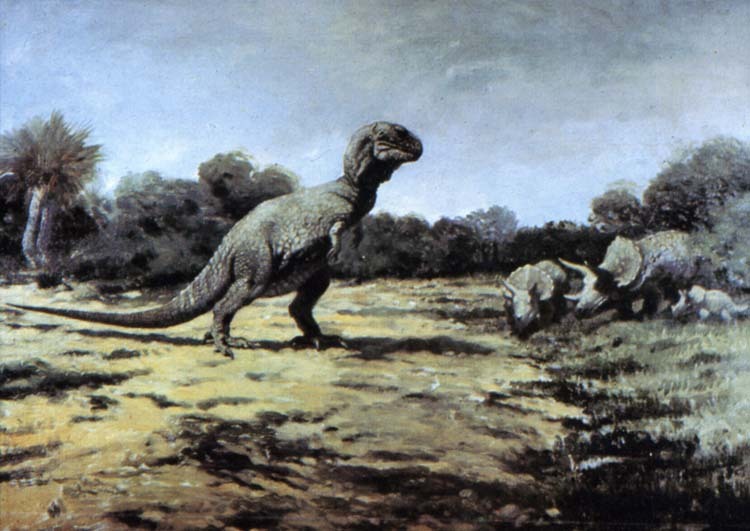
Reworked version of my 2012 Tyrannosaurus painting, now in it's third guise. There's something about this painting which recalls reconstructions from 1906 rather than those of 2016.
The skeletal anatomy of Tyrannosaurus rex is probably better known and studied than the skeletons of many living animals, but its soft-tissues - and thus much about its life appearance - are poorly represented by fossil remains. Thus, virtually all of our ideas about muscle bulk, soft-tissue body shape and integument have to be reconstructed by phylogenetic proxy and functional prediction. As with all dinosaurs, we've historically felt pretty confident that Tyrannosaurus was entirely scaly, but relatively recent discoveries of filamented tyrannosauroids in China (Xu et al. 2004, 2012), as well as a growing mountain of fuzzy coelurosaur fossils, point to a different conclusion: that Tyrannosaurus was adorned in simple filaments - hair-like equivalents of feathers. Skin impressions for more derived tyrant species - the tyrannosaurids - have proven rare in fossil record (Hone 2016) and, though rumours have circulated about some, they have largely escaped formal description and publication. In the absence of better evidence, the most parsimonious modern takes on everyone's favourite tyrant have involved a fuzzy covering.

In the recent months two papers have challenged this idea. The first, by Thomas Carr and colleagues (2017), purports to find osteological correlates of scales on the facial anatomy of the tyrannosaurid Daspleteosaurus, which they argue (along with other lines of evidence), to suggest crocodylian-like facial tissues and sensitivity. The second, by Phil Bell et al. (2017), describes scaly skin impressions from multiple postcranial regions of a Tyrannosaurus skeleton, and argues that the distribution of these impressions implies a uniform (or near uniform) covering of scales across the body, without much in the way of fuzz.

Because this is Tyrannosaurus, media sites and bloggers have spilled great amounts of ink over these stories. The scientific press has often been far from objective or unbiased. Popular articles have suggested Jurassic World fans might have 'won' the debate over scientists, that science fans are 'due' a return to scaly tyrants after 'losing' Pluto, and that the findings mean 'all is well in the dinosaur world'. The implication is a ridiculous one, like evidence of scalier tyrants is a moral victory rather than a test of a scientific hypothesis. But while the popular press has been celebrating the new papers, members of the palaeoblogosphere have been less enamoured with the findings. Trey the Explainer suggests that Bell et al.'s work doesn't really change what we already knew about tyrant integument, and thus does not invalidate many existing reconstructions. Andrea Cau posits that interpretations of scaly tyrants reflect our prejudices more than science, and that taphonomic factors may explain the absence of filaments. Brian Switek has concerns that the skin patches are too small and spread too widely to give a complete picture of the integument, and echoes concerns about taphonomic interference. The collective response seems to be a defensive one, protecting concepts of filamented tyrannosaurids from a resurgence of a more traditional, scaly model. Would any other dinosaur get this treatment? Perhaps not: as Brian explains in his recent post, this reaction is the T. rex celebrity effect at full bore.

Supermegafluffy Tyrannosaurus, from 2015. They were simpler times.
I've painted many fluffy Tyrannosaurus in the last few years (above) and quite like the idea of everyone's favourite 6 tonne dinosaur bonecrusher being a giant plush toy. However, we also have to concede that our ideas of Tyrannosaurus skin have been largely informed by prediction, not direct data, and that popular, long-held notions are as ripe for scientific revision as any other (lest we forget other famous examples of this - Brontosaurus and Ornithoscelida). Moreover, although some critics are suggesting the papers don't tell us anything new - rumours of scale impressions have been circulating for years - these recent studies give us the first rigorously documented, peer-reviewed glimpse into Tyrannosaurus skin anatomy. This is new, allowing us to form our own opinions on Tyrannosaurus appearance based on actual data, not hearsay. So, rather than putting our gloves up to defend our prior model, I wonder if we should be exploring how this new data might transform our perception of Tyrannosaurus life appearance. That these new studies present conflicting data to our expectations is not grounds to be upset, annoyed or defensive. To the contrary, they allow us to use real data - not predictions - to refine our ideas of tyrannosaurid appearance and evolution. For those of us interested in dinosaurs as real entities, and not movie monsters, that's a good thing.

What, exactly, has been argued about scaly tyrants?

A lot of the popular write ups of these recent papers include errors and misrepresentation, so let's recap what is actually being argued about Tyrannosaurus skin. A common social media reaction to Bell et al.'s work is that they've presented 'a patch' of skin, and are extrapolating from that. We need to debunk that right away: they've not described a single patch, but multiple small patches from the neck (alas, exactly where on the neck isn't reported), the top of the pelvis, and the base of the tail (below). All the samples stem from the 'Wyrex' specimen (HMNS 2006.1743.01). The most extensively represented area is the tail base, which has the largest single piece of fossil skin - 30 cm². The other skin samples are not as large, some being just a few centimetres across. Each patch shows the same skin type: uniform, tiny 'basement scales', each less than 1 mm across (Take note, artists: you would not see Tyrannosaurus scales until you were being eaten by their owner). Similar scale patches, also described by Bell et al. (2017), have been found on the torso and tail regions of other tyrannosaurid species, implying similarly scaled regions in these taxa.

Tyrannosaurus skin patches from the neck, pelvic area and tail of the 'Wyrex' specimen as illustrated by Bell et al. (2017). The scale bars for the scale imagery are 5 mm (b - e) and 10 mm (f-h). These things are tiny, and we can assume the skin of the animal would look smooth or leathery in life.
Some folks are suggesting that the size of these skin patches allows us to dismiss their scaly signal, or that even that they're anomalous, reflecting unusual taphonomic conditions that cloud their significance. I'm unsure about these ideas. Most skin impressions are small patches (even scaly skin gets a rough ride during fossilisation) and the fact they're small doesn't diminish the fact that each records a cluster of scales. We have to assume these are not unusual or 'special' areas on the body but generally indicative of surrounding skin fabrics. The fact that each patch is consistent with regard to scale size and texture hints at them being part of a continuous, unbroken integument, and not isolated scaly pockets in a sea of fluff.

But what about arguments that the scale patches are tissues stripped of filaments before preservation, like so many 'monster' carcasses? Filament/scale combos do have precedent in dinosaurs, being present on the tail of Juravenator and those scales of Kulindadromeus with fibre-like tassels (Chiappe and Göhlich 2010; Godefroit et al. 2014). We know from modern animals that fibrous epidermal structures are especially vulnerable to decay and physical weathering, but is there evidence that this has taken place on the Wyrex Tyannosaurus skin patches? At present, it's hard to say because we have no idea what tyrannosaur skin looks like as it decays. It might be significant, however, that the scale patches look very similar across the Wyrex specimen, and that they resemble other tyrannosaurid skin impressions closely. We might expect some variation if taphonomy was really distorting these specimens in a major way, and we're not seeing that. Moreover, the Wyrex skin impressions, though small, are pretty high-resolution. The scales, and their intervening areas, have sub-millimetre proportions and sharply defined edges. There's no tatty scale margins, no obvious spaces for filament attachment, or linear structures crossing the scales to imply a rogue filament impression. We'll remain uncertain if these are anomalous, taphonomically-altered samples until we find other examples of tyrannosaurid skin, but there's no reason to be unduly suspicious of the the samples we have.

Of course, the adage that 'absence of evidence is not evidence of absence' is always important when dealing with the fossil record, and it applies here as a sensible caveat. However, we shouldn't wield this phrase as a definitive counter-argument to reasonable interpretations of available evidence. Palaeontologists have to work with data, not suspicions or gut feelings, and the data we have does not include, or hint at, the presence of filaments. I'm not arguing that taphonomy isn't worthy of consideration here (indeed, the omission of details about 'Wyrex' taphonomic history is an issue with the Bell et al. 2017 paper) but we must beware the logical fallacies of appealing to probability (i.e. taphonomy could explain the lack of filaments, so it does explain the lack of filaments) or special pleading (excluding Tyrannosaurus from the same logic we would apply to other fossil animals when presented with this data).
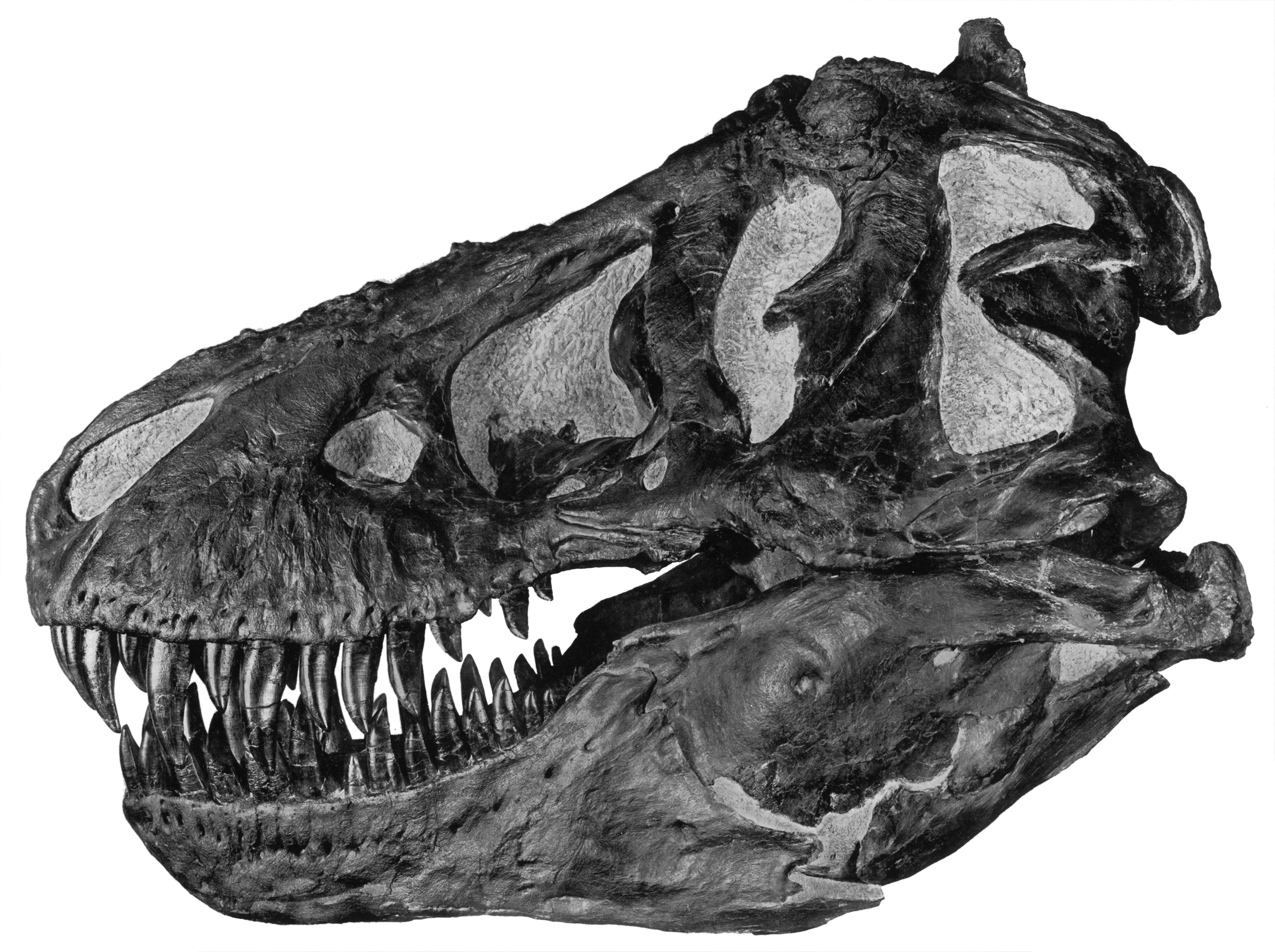
Tyrannosaurus skull AMNH 5027 - note the 'hummocky' textures on the side of the snout, above and below the orbit, and atop the rostrum, likely indications of scaly skin. Image in public domain, sourced from Wikipedia.
Carr et al. (2017) present a different form of evidence for scales: osteological correlates. I consider some aspects of their study problematic in that it only looks to crocodylians and birds for comparative tissues, despite the clear value other tetrapods have in deducing facial tissue types (Knoll 2008; Morhardt 2009; Hieronymus et al. 2010); it lacks illustrations of the bone textures correlated to scaly integuments; and the conclusion of tyrants bearing crocodile-like face scales is flawed: crocodylians do not have face scales, but a tight, highly cracked sheet of facial skin - Milinkovitch et al. (2013). Nonetheless, I think Carr et al. (2017) are right in concluding the bony textures of tyrannosaur skulls seem indicative of scaly skin. These findings echo previous interpretations of bosses and rugosities in tyrant skulls (e.g. Brusatte et al. 2012; Sullivan and Xu 2016) and aren't controversial. Scales closely associated with bone either leave a 'hummocky' surface texture, which is seen on tyrant snouts (specifically their maxillae and nasals) or small bosses and hornlets, which are found in all tyrannosaurid skulls above their orbits (lacrimal and postorbital bones) and on their 'cheeks' (jugal bones). Hornlets and bosses represent the locations of specific scales in living reptiles (Hieronymus et al. 2009) and can thus give especially good indications of life appearance (check out chameleon skulls for especially good correlation between skull and scale features). The presence of hummocky bone textures and hornlets is a strong correlate for scales, as they rule out coverings of naked or feathered skin. Such skin types do not alter the underlying bone surface (Hieronymus et al. 2009).

These osteological correlates combine with the skin impressions to collectively show Tyrannosaurus as scaly across much of its face, somewhere on its neck, over the pelvic region and along the tail base (below). So far as we can tell, this picture seems consistent with osteological correlates and skin sampling from wider Tyrannosauridae. That's pretty extensive coverage, ruling out the presence of fibres in places that we know other dinosaurs - including other tyrannosauroids - were fuzzy, and implies that tyrannosaurids were mostly scaly. I'm particularly startled at the scales over the hip region as they curb even the long 'fibre capes' we see in some modern tyrant reconstructions, like the famous Saurian Tyrannosaurus. The fact that the scales occur in places known to be ancestrally filamented for tyrants is also intriguing: Bell et al. (2017) speculate that they may be modified feathers - that is, the same as bird scales - rather than a reversion to lizard or croc scales. Hold that thought, we'll come back to it soon.

Everyone's doing maps of Tyrannosaurus with integument details nowadays, and I want in. Note that this is Tyrannosaurus specific, and does not feature scale data from other tryannosaurids.

What's in the gaps?

The million dollar question is what was present between these scaly regions: more scales, or fibres? This is a major point for many respondents to the Carr et al. and Bell et al. papers, as it decides whether we keep our interpretation of Tyrannosaurus as an - at least partly - fuzzy animal. With our scale distribution map as a starting point, several options are available. The first is that fuzz was present in regions not yet represented by skin remains or osteological correlates. This would mostly imply the top of the torso (Bell et al. 2017), but may also be parts of the back of the head, some aspects of the neck (depending on where the neck skin impression came from) and maybe the end of the tail. Over on Twitter, Patrick Murphy has presented a reconstruction which shows what this might look like. I must admit to finding it quite amusing, sort of like T. rex has put on a shawl to visit the opera.

But how dense could these fuzzy patches have been? Bell et al. (2017) suggest that dense fibrous coverings are doubtful, noting that large living mammals avoid patches of thick insulating fibres to aid heat loss. This has not gone down well with some critics, who cite studies of feathers preventing over-heating instead of facilitating it. An oft-cited study in this regard is Dawson and Maloney (2004), who found emu feathers block virtually all solar radiation from the skin, preventing them from overheating in solar exposure that causes similarly-sized hairy mammals to seek shelter.

Feathers: great at blocking solar radiation, also great at trapping body heat. Note how cooking hot these ostriches are on their necks, heads and legs, while the feathers are mostly ambient temperature. This isn't because the body isn't warm, but because the feathers block the heat signature entirely, trapping all that heat around the body. As surface area:volume ratios drop as animals get larger, it stands to reason that the benefits of blocking solar radiation give way to a need shed heat. Image from Wikipedia user Arno / Coen, CC BY-SA 3.0.
Feathers, however, are not magic structures that defy fundamental physical laws of insulation, nor do they liberate animals from the challenges of heat loss at reducing surface area:volume ratios. Beyond a certain size, shedding excess body heat is difficult for any terrestrial animal, and it gets tougher as they get larger. King and Farner (1961, p. 249) described feathers as having "an extremely high insulating value to the feathered surfaces" and a rich literature of studies on modern birds shows that feathers are as effective at trapping body heat as they are blocking solar rays (e.g. King and Farner 1961; Kahl 1963; Philips and Sandborn 1994; Dove et al. 2007). We can almost see them as a little too effective, leading many birds to develop heat-dumping adaptations to circumvent their own insulation, such as highly vascularised, non-feathery body parts as well as a repertoire of postures and behaviours (maximising exposure of unfeathered body parts; flapping wings; urinating on their legs) that aid cooling (e.g. Kahl 1963; Arad et al. 1989; Philips and Sandborn 1994). So yes, feathers are terrific at protecting birds from environmental heat, but that limits their ability to release metabolic heat from their own bodies.

If living birds find feathers a little warm, despite their relatively high surface area to volume ratios, we have to assume a theropod weighing anywhere between 6-14 tonnes is going to find big areas of dense filaments a challenge to thermoregulation too. It is not unreasonable to assume blankets of fibres could be a problem for big tyrants. The counterargument here is that Yutyrannus huali, a largish tyrannosauroid, does have dense fibres everywhere. But Yutyrannnus seems more lithe than Tyrannosaurus - perhaps just 10-25% of its mass, depending on the estimates (Bell et al. 2017) - and lived in a more vegetated, and thus shadier, habitat (Bell et al. 2017). A neat comparison Bell et al. (2017) make along this line uses living rhinos, where hairier species live in shadier settings than the virtually naked ones. In light of this, the reduction of filamented regions, and perhaps lessening their density, is a reasonable inference for animals of the size and habitat of Tyrannosaurus, and would reflect thermoregulatory responses to scaling and shade availability seen in living animals.

Large tyrannosauroids, like Yutyrannus huali, show that dinosaurs weighing perhaps 1.5 tonnes could be covered in feathers. But does this reflect the fact that this animal lived in shadier, vegetated habitats than the tyrannosaurids? This idea isn't silly: adaptation to specific circumstances has a major role to play in shaping animal skin anatomy, and could well explain why some tyrants are fuzzy, and others seem less so. (If you want to see the rest of this picture, check out this Patreon post)
Could Tyrannosaurus have had extremely fine, widely-distributed filaments - perhaps similar to something like elephant hair? This isn't entirely falsified by the new data, although the skin impressions we have show no evidence of such a covering despite preserving tiny integument details. Granted, animal filaments can be extremely fine, and they might be beyond the preservation potential and mechanics of even these high-res impressions. However, if we're arguing for filaments of this size and patchiness then - certainly for artistic purposes - we should concede that the animal would be essentially scaly, in the same way that most rhinos, elephants and hippos are essentially naked (below). From a thermoregulatory perspective, short, sparse filaments could make sense as these have the surprising ability to draw heat from the body in modern elephants, helping them stay cool (Myhrvold et al. 2012). Given the potential for overheating under dense filament coats in giant animals (Bell et al. 2017), I see this as more plausible than a 'cloak' of fibres between our scaly waypoints.

Scaly, minimally-filamented Tyrannosaurus. There's some tufts on the neck, but that's it. Is this model more consistent with the thermoregulatory requirements of a 6-14 tonne animal?
A last interpretation of this new data is that Tyrannosaurus was actually just scaly, with no fibres whatsoever. This is the most contested suggestion made by Bell et al. (2017), but it's not unreasonable with our current knowledge. Existing skin data, representing seven parts of the body if you pool all the distinct skull correlates and postcranial points (add several more if you want to extrapolate scale patches from other tyrants), shows enough scales and consistency in the scalation pattern that uniform scale coverage is not a ridiculous or indefensible concept. I appreciate that some folks will point to regional fuzziness of animals like Kulindadromeus in response, and its sharply defined areas of different integument types, and that's valid point. But we can also point to plenty of dinosaurs with extensive or entirely scaly hides and - if there's any value to linking body size and thermoregulatory regimes - they're a better match to Tyrannosaurus body mass than any known fuzzy species. For the time being, wholly scale models fit our existing data just as reasonably as partly fuzzy ones so, archaic and counter-intuitive as it seems - a scaly Tyrannosaurus is not an unreasonable interpretation for the life appearance of this animal, given our current data.

Beyond Tyrannosaurus: 'unlocking' dinosaur skin constraints

My take-home from these new papers is that our models of Tyrannosaurus skin have not crystallised, but we're a little more constrained in how we can imagine this animal, and have to concede a scalier appearance than many of us thought likely. But the implications of the Bell et al. study go beyond Tyrannosaurus in implying new ways to think about dinosaur skin evolution. With incontrovertibly fuzzy animals lining much of the the tyrannosauroid tree and its root, our scalier Tyrannosaurus gives us one of the best examples of a dinosaur replacing fuzz with scales. This is a far-reaching conclusion for those of us interested in dinosaur life appearance, complicating the already confusing evolutionary pattern of scale and fuzz distribution within the group. Ideas that some dinosaurs could be 'secondarily scaled' are supported by this discovery, and we have to wonder if classically fuzzy lineages - including many other theropod lines - are as tightly locked into fuzz, fibres and feathers as we once thought. Could large dromaeosaurs be a little lighter on fuzz than we imagine? Did Therizinosaurus look less like a giant pigeon and more like a walking Christmas dinner? We don't know, but now have reason to wonder.

Fluffy Tyrannosaurus juveniles, one of the possibilities created by the idea that tyrannosaurs might have avian-like 'dynamic' skin. The recovery of scales in non-scaly clades is not as simple as it might first appear!
Furthermore, the notion that Tyrannosaurus scales could be modified feathers (Bell et al. 2017) opens possibilities about mixes of filaments and scales. It's important to realise that not all scales are alike: 'reptile'' scales' are developmentally and genetically distinct from those we see in birds, which are actually secondarily modified feathers (Chang et al. 2000; Dhouailly 2009). Reptilian skin cannot be forced to grow feathers or filaments (Chang et al. 2000) and is developmentally static: once scales are formed, they're with them for life. Bird skin, however, is far more dynamic, and allows for all manner of ontogenetic and even seasonal variation in scale:feather ratios, changes to feather types, and modification of scale size (Lennerstedt 1975; Stettenheim 2000). If, as suspected, our tyrannosaurid skin samples represent fibrous integument masquerading as a scaly one, is this a sign of a bird-like 'unlocked' skin configuration where epidermal dynamism was possible? If so, Tyannosaurus could have changed appearance considerably with age (fluffy when small, scaly when big - above) or season (reflecting changes in climate or behaviour)? It must be stressed that we don't have any direct insight into these sorts of changes at the moment, and the hypothesis of tyrannosaurid scales being modified feathers needs testing. But the irony - we might have data indicating Tyrannosaurus could change its appearance readily, vindicating debaters on both sides of the scaly and fuzzy debate - is not lost on me. Maybe, just this once, everyone wins?

Summing up time

Let's tie this all together. A lot of ambiguity remains about the skin of Tyrannosaurus and its relatives, and it's not wise to hold any opinion about their life appearance too strongly at present. However, unduly downplaying the creep of scaly evidence into the tyrannosaurid fossil record isn't useful or logical. The skull skin correlates and fossil skin patches show that scales were present in numerous, widely-distributed parts of the body, and - until we see evidence to the contrary - this is good reason to assume scalier Tyrannosaurus than we might be used to. And yes, this does mean that some of our favourite, fluffier interpretations are now directly contradicted by fossil data, and consigned to our ever growing book of historic, discredited reconstructions. But this is always a possibility in palaeontology: our views of these animals are only ever hypotheses based on a sparse, biased fossil record, and every new discovery risks overturning someone's favourite concept. The fact we're able to move on from these reconstructions is positive, as it means we're a little less uncertain about the past, and a little closer to the truth.

Enjoy monthly insights into palaeoart and fossil animal biology? Support this blog for $1, see bonus content, and get free stuff!

This blog is sponsored through Patreon, the site where you can help online content creators make a living. If you enjoy my content, please consider donating $1 a month to help fund my work. $1 might seem a meaningless amount, but if every reader pitched that amount I could work on these articles and their artwork full time. In return, you get access to my exclusive Patreon content: regular updates on research papers, books and paintings, including numerous advance previews of two palaeoart-heavy books (one of which is the first ever comprehensive guide to palaeoart processes). Plus, you get free stuff - prints, high quality images for printing, books, competitions - as my way of thanking you for your support. As always, huge thanks to everyone who already sponsors my work!

References

    • Bell, P. R., Campione, N. E., Persons, W. S., Currie, P. J., Larson, P. L., Tanke, D. H., & Bakker, R. T. (2017). Tyrannosauroid integument reveals conflicting patterns of gigantism and feather evolution. Biology Letters, 13(6), 20170092.
    • Brusatte, S. L., Carr, T. D., & Norell, M. A. (2012). The osteology of Alioramus, a gracile and long-snouted tyrannosaurid (Dinosauria: Theropoda) from the Late Cretaceous of Mongolia.
    • Carr, T. D., Varricchio, D. J., Sedlmayr, J. C., Roberts, E. M., & Moore, J. R. (2017). A new tyrannosaur with evidence for anagenesis and crocodile-like facial sensory system. Scientific Reports, 7.
    • Chang, C., Wu, P., Baker, R. E., Maini, P. K., Alibardi, L., & Chuong, C. M. (2009). Reptile scale paradigm: Evo-Devo, pattern formation and regeneration. The International journal of developmental biology, 53(5-6), 813.
    • Chiappe, L. M., & Göhlich, U. B. (2010). Anatomy of Juravenator starki (Theropoda: Coelurosauria) from the Late Jurassic of Germany. Neues Jahrbuch für Geologie und Paläontologie-Abhandlungen, 258(3), 257-296.
    • Dawson, T. J., & Maloney, S. K. (2004). Fur versus feathers: the different roles of red kangaroo fur and emu feathers in thermoregulation in the Australian arid zone. Australian Mammalogy, 26(2), 145-151.
    • Dhouailly, D. (2009). A new scenario for the evolutionary origin of hair, feather, and avian scales. Journal of anatomy, 214(4), 587-606.
    • Dove, C. J., Rijke, A. M., Wang, X., & Andrews, L. S. (2007). Infrared analysis of contour feathers: the conservation of body heat radiation in birds. Journal of Thermal Biology, 32(1), 42-46.
    • Godefroit, P., Sinitsa, S. M., Dhouailly, D., Bolotsky, Y. L., Sizov, A. V., McNamara, M. E., ... & Spagna, P. (2014). A Jurassic ornithischian dinosaur from Siberia with both feathers and scales. Science, 345(6195), 451-455.
    • Hieronymus, T. L., Witmer, L. M., Tanke, D. H., & Currie, P. J. (2009). The facial integument of centrosaurine ceratopsids: morphological and histological correlates of novel skin structures. The Anatomical Record, 292(9), 1370-1396.
    • Hone, D. (2016). The Tyrannosaur Chronicles: The Biology of the Tyrant Dinosaurs. Bloomsbury Publishing.
    • Kahl Jr, M. P. (1963). Thermoregulation in the wood stork, with special reference to the role of the legs. Physiological Zoology, 36(2), 141-151.
    • King, J. R., & Farner, D. S. (1961). Energy metabolism, thermoregulation and body temperature. Biology and comparative physiology of birds, 2, 215-288.
    • Knoll, F. (2008). Buccal soft anatomy in Lesothosaurus (Dinosauria: Ornithischia). Neues Jahrbuch für Geologie und Paläontologie-Abhandlungen, 248(3), 355-364.
    • Lennerstedt, I. (1975). Seasonal variation in foot papillae of wood pigeon, pheasant and house sparrow. Comparative Biochemistry and Physiology Part A: Physiology, 51(3), 511-520.
    • Milinkovitch, M. C., Manukyan, L., Debry, A., Di-Poï, N., Martin, S., Singh, D., ... & Zwicker, M. (2013). Crocodile head scales are not developmental units but emerge from physical cracking. Science, 339(6115), 78-81.
    • Morhardt, A. C. (2009). Dinosaur smiles: Do the texture and morphology of the premaxilla, maxilla, and dentary bones of sauropsids provide osteological correlates for inferring extra-oral structures reliably in dinosaurs? (Doctoral dissertation, Western Illinois University).
    • Myhrvold, C. L., Stone, H. A., & Bou-Zeid, E. (2012). What is the use of elephant hair?. PloS one, 7(10), e47018.
    • Phillips, P. K., & Sanborn, A. F. (1994). An infrared, thermographic study of surface temperature in three ratites: ostrich, emu and double-wattled cassowary. Journal of Thermal Biology, 19(6), 423-430.
    • Stettenheim, P. R. (2000). The Integumentary Morphology of Modern Birds—An Overview 1. American Zoologist, 40(4), 461-477.
    • Sullivan, C., & Xu, X. (2017). Morphological diversity and evolution of the jugal in dinosaurs. The Anatomical Record, 300(1), 30-48.
    • Xu, X., Norell, M. A., Kuang, X., Wang, X., Zhao, Q., & Jia, C. (2004). Basal tyrannosauroids from China and evidence for protofeathers in tyrannosauroids. Nature, 431(7009), 680-684.
    • Xu, X., Wang, K., Zhang, K., Ma, Q., Xing, L., Sullivan, C., ... & Wang, S. (2012). A gigantic feathered dinosaur from the Lower Cretaceous of China. Nature, 484(7392), 92-95.

    Thursday, 23 July 2015

    A year of Tyrannosaurus rex artworks

    A minor milestone was reached this week at my print store - there's now 50 different bits of art in there. Given that I only started selling prints less than a year ago, I'm happy to see some substantial growth in my catalogue already (albeit with some cheating - many are 'reworked' older pieces, rather than entirely new bits). Lots more will be available in the near future - I'm holding several bits back for various reasons, including a project I'll elaborate more on soon. Working on these in relative secret is why things have been a bit quiet around her for the last month.

    Teasers of unreleased artwork: Troodon, Repenomamus, diminutive azhdarchid and Diplodocus. We'll revisit the reason for holding these back in due time.
    Scanning through my shop revealed an unexpected bias in my output this year. I make an effort to portray varying subjects and taxa, and find most interest in reconstructing lesser depicted species, scenarios and behaviour. I don't think I do too badly with this - at least within the context of Mesozoic reptiles - so was surprised to find 5 images dedicated to the same species, and one which has been painted, sculpted, animated and rendered to death: Tyrannosaurus rex. Two of these were commissions, but that still leaves three on my own head. I'm forced to concede that I must be a closet Tyrannosaurus fan - I had no idea.

    I thought it would be fun to show the last year's worth of king tyrant art: some of them may still be fresh in your memory, but two are new (well, reworked). I realise that I've almost got a growth series across these images, and I've ordered them according to this. As usual, you can grab high quality art prints of these from my store.

    Tyrant dinosaurs vs. bees. Bees are winning. Click here for prints.
    First up is my tyrants and bees, the image I created to raise money for various bee charity causes in February of this year. Auctioning a framed version and sales of prints raised £249 for the Bumblebee Conservation Trust and a £30 contribution for a new beehive at the Cumberland House Natural History Museum, who also received the image for use on a display board. As you may remember, it shows two infant tyrants checking out a honey bee nest, molecular data indicating that honey bee ancestors were alive in the Late Cretaceous. My favourite bit of the image remains the smaller animal on the right, losing the battle with tiny arthropods. I like the fact its arms aren't really long enough to cover its eyes.

    Resting rexes, and bonus moths. Click here for prints.
    Next is Chidumebi Browne's reclined teenage Tyrannosaurus commission, from November 2014. These animals are heavily based on BMRP 2002.4.1, the probable half-size Tyrannosaurus with proportions and facial structure quite different to large adults. Of course, some would argue that this makes this image feature Nanotyrannus, but I don't want to get into that here. Those wanting to open that can of worms may want to read Thomas Carr's blog post (and comments) on this topic, as well as Mark Wildman's take on the same debate. 

    Dating tip: romantic sunsets don't count for much when you're crushing your partner's skull. If you fancy a physical copy of this scene of violent tyrannosaur copulation, you might be a bit odd. Nevertheless, prints are here.
    Something new now - a reworked take on my mating, neck-biting tyrants. Those with long memories will recall the first guise of this image appeared in 2013 with my comments on All Your Yesterdays, the crowd-sourced follow up to All Yesterdays. As explained in that post, a number of tyrants show evidence of having been bitten around the jaws and head, with the area around the braincase of some specimens being badly damaged. I'd been looking at Savannah monitors shortly before rendering the original of this, and found their toughened neck skin - which apparently exists because of rough copulatory behaviour - of interest. I tend to have half my mind on prehistoric animals when looking at modern ones, and it wasn't long before I was wondering if some Tyrannosaurus injuries were the result of similarly violent nuptial encounters. This reworked version includes some very minor anatomical tweaks, slight colouration changes, and a vastly more detailed background.

    Triceratops and Tyrannosaurus: finally bro-dogs. Get printed up here.
    Another commission from Chidumebi Browne resulted one of the strangest pictures I know of featuring Tyrannosaurus - but hopefully one which is interesting and thought provoking. Alongside this big female (note the similar colour to the red teenage animal in Chidumebi's first commission - this is the grown up version of a female in that 'universe') is a baby Triceratops, the idea being that it's been interspecifically adopted by the tyrant. I provided a long commentary on this image and the likelihood of the scenario back in March, concluding that this image might not be as crazy as it first seems. Quite a few modern animals - including dinosaurs - are known to kidnap or inherit the offspring of other species, although there's not always clear explanations for why it happens. I tried to imply a bit of a story in Chidumebi's concept, those marauding adults in the distance taking clear, hungry interest in the Triceratops infant. I get the feeling this scene wouldn't stay peaceful for long.

    A Late Cretaceous evening, ruled by an especially robust tyrant. You can own a copy of him if you click here.  
    Finally, one more new image: a major overhaul of one of the first images posted at this blog (end 2012). Changes include anatomical tweaks, a revised pose (now trotting, not standing), new colouration (the cranial pattern is a nod to the judge helmets in Dredd, because scientists predict Tyrannosaurus are some of the few things in life more badass than that movie) and a heck of a lot more background detail. The depicted animal is a 'robust' Tyrannosaurus morph - note it seems the 'robust' and 'gracile' forms are extremes of anatomical variation rather than distinct categories. My goal here was to make the animal look big and heavy - appreciating that tyrants are relatively long-legged and gracile for their size, they're still absolutely huge. I thought of bears a lot when painting this chap - I wanted him to have that same imposing aspect without going all 'awesomebro' on it. Tyrannosaurs - especially big ones - should look like animals you'd instinctively keep a good distance from.

    OK, that's all for now. Soon, hopefully, some details on that project alluded to above. 

    Wednesday, 25 March 2015

    Tyrannosaurus and Triceratops - friends at last?

    Tyrannosaurus and Triceratops, not locked in mortal combat. Something must be wrong.  Cretaceous interspecies adoption concept, mimicking similar behaviours seen in modern mammals and birds, by Chidumebi Browne. Prints are available here.
    Is there a more iconic palaeontological scene than Tyrannosaurus facing down Triceratops? The artistic association of these taxa has existed since at least 1906 when the very first, highly influential restoration of Tyrannosaurus (by Charles Knight, of course) pictured these animals alongside each other (Glut 2008). This idea flowed into aspects the first dinosaur movies - The Ghost of Slumber Mountain (1918) and The Lost World (1925) (unsurprisingly, given how much these films are indebted to Knight) - and, by 1928, the year Knight completed the famous Field Museum mural of Tyrannosaurus and Triceratops, their adversarial relationship was truly cemented. Book illustrations, TV shows and films have so perpetually shown encounters between these species that it's difficult to think of a new angle on this scene. At least, that's what I thought until being contacted by Chidumebi Browne, who asked me about working up a second Tyrannosaurus picture for him, this time co-starring Triceratops. Instead of combat however, he wondered about likelihood of a juvenile Triceratops being 'adopted' by the tyrant, as some animals make the headlines for doing so today (see below). Clearly I liked the idea enough to carry out the commission (I try to avoid things I feel are too unreasonable), but is this pure speculation, playing on gaps in our knowledge, or is there something credible to this idea? Could Triceratops and Tyrannosaurus, after more than a century of conflict, learn to be friends?

    The literature on animal adoption is vast, with something like 270 species of mammal and bird known to adopt juveniles of their own species (via kidnapping, accidental inheritance or other means - Riedman 1982; Avital et al. 1998). Interspecific adoption is far rarer however, and most records pertain to animals housed in zoos or wildlife park. These adoptions can work both ways: juveniles can 'recruit' surrogate parents as readily as parents adopt surrogate offspring (for instance, the bond between Owen, a young hippo, and Mzee, a century-old giant Aldabran tortoise, seems to mostly reflect efforts of the hippo). There is relatively little documentation of interspecies adoption in wild animals, however. The example everyone knows is the Kenyan lioness Kamunyak, who has become something of a sensation for her habit of adopting young oryx. She adopted at least six calves before she was last sighted in 2004, defending them from others - including predators, humans seeking to intervene, and oyrx mothers - as if they were her own cubs. At least one species of monkey, as well as wading, raptorial and passerine birds have also adopted and reared the juveniles of other species (Izar et al. 2006; Literak and Mraz 2011; Oswald et al. 2013). Brood parasitism - the offloading of parental duties to other species - clearly exploits this behaviour (Riedman 1982), and famously occurs in cuckoos, certain ducks and geese, cowbirds, fish and bees.

    The significance and evolutionary purpose of these interspecific relationships remains mysterious in many cases. Of course, the internet is awash with suggestions that these species have become 'friends', typically accompanied by heavily-edited video footage showing two different species at their squeeful snugglywugilinest. If they feature predators engaging in joyful play or nurturing behaviour with usual prey species, all the better. According to those sagest of human beings - internet commenters - these examples of natural harmony show us - spiteful, war-making human beings - to be the real animals. Truly, we are awful.

    In the real world, the causes of these relationships are considerably less fluffy. The fact that most interspecies adoptions develop in captivity is not surprising, likely resulting from the close quarters contact between individuals and the deficient of conspecifics. Desires for parents, mates or group behaviours in some animals may be so strong in some species that they become blinded to the clear differences between themselves and the only other individuals they know. It's difficult to know whether these examples provide good models for interspecific adoption in natural circumstances.

    Pictured: trouble in the neighbourhood.
    The rarity of wild cases of interspecies adoption makes it hard to draw any firm conclusions about its adaptive significance, if it even has any (Izar et al. 2006). Although juvenile animals may receive some benefit from being adopted (especially if the alternative is not having parents at all), most biologists consider interspecific adoption a mistake - 'misdirected parenting' from confused adults. For some instances of bird adoption, this might reflect the similar appearance of chicks within certain lineages: adults simply can't tell them apart (Oswald et al. 2013). The circumstances surrounding some 'adoptions' are truly bizarre, where adoptees are ex-prey items which have become surrogate offspring. This has certainly happened with sea eagles where, having brought local buzzard chicks back to their own nest, presumably to eat, they started rearing them instead (Literak and Mraz 2011). It is assumed that the appearance of a raptor chick in their nest overrode any feeding impulses of these eagles, and they successfully reared several buzzards in this fashion (Literak and Mraz 2011). The idea that these parenting 'misfires' reflect recognition errors is supported by at least one instance where Caspian terns, rearing Ring-billed gulls, dropped their degree of parenting as juveniles outgrew resemblance to typical tern offspring (Oswald et al. 2013).

    It is less easy to explain adoption across taxonomic and ecological boundaries so wide that even passing resemblance is unlikely. It must be said here that peer reviewed literature on these cases is hard to find, at least in my experience, so much of what is reported online is found in documentaries and news stories - not the most ideal venues for discussing complex, unusual animal behaviour (this is not a sleight against the experts featured in such outlets, just that these things are highly-edited and narrative-hungry, which often leads to embellishment and distortion of facts). As an example of how highly selective these reports can be, some stories of lions 'adopting' prey animals result from 45 minutes of observation, receiving justified scepticism from biologists. 45 minutes of coexistence does not equal a clear case of adoption, especially in species renowned for toying with easily overpowered prey.

    Where these cases carry more reliability - such as the widely verified case of Kamunyak and her oryx calves - behavioural factors remain unclear. It seems unlikely that a lioness would visually confuse an oryx calf was her own, except for the possibility that her eyesight was very poor. I see explanations that possible recent, traumatic loss of her (genetic) offspring as premature on the available evidence, most likely spurred on by a desire to project human values into a simplified narrative. The fact that Kamunyak ended up eating the starved carcass of one of her adoptees, and became a serial adoptee suggests her condition might be more complex and deeper-seated than a response to one recent event. Moreover, if cub death is the catalyst for this behaviour, would it not be more common in other lions? As far as I'm aware, cub death is a pretty frequent occurrence. It also strikes me that lots of medical conditions - head trauma, brain tumours, organ malfunction leading to hormone imbalances, even certain diseases - can drastically alter animal behaviour. As far as I'm aware, no assessment of Kamunyak's health was made before she disappeared. I wonder if an illness of some kind is a more parsimonious explanation of Kamunyak's condition than complex, psychological trauma.

    Let's bring all this back to Chidumebi's concept: could extinct dinosaurs have engaged in inter-species adoption, especially species as different as Triceratops and Tyrannosaurus? We certainly know that modern animals can establish these weird relationships even between animals as different as large predators and tiny prey. We also know that dinosaurs are capable of inter-species adoption, because modern birds engage in this behaviour. On these analogies, a Tyrannosaurus adopting a Triceratops is not too far fetched. We might assume that their morphological distinctions are so great that the tyrant is not misidentifying the ceratopsid for offspring of its own, and thus must be a 'behaviourally abnormal' tyrannosaur: a Cretaceous Kamunyak, if you like. The background tyrants are meant to be behaviourally 'normal', and have sighted the Triceratops calf - I expect, as is reported for many of Kamunyak's adoptions, that the Triceratops infant would not last long.

    So... is this the first picture of an obviously slightly unhinged tyrannosaur?
    This exercise is hampered ultimately by a lack of knowledge about the parentage of fossil dinosaurs however, and particularly that of tyrannosaurs. Despite the relative wealth of knowledge on tyrant dinosaur palaeobiology (they are extremely well studied compared to other fossil groups), we still know very little, if anything, about tyrannosaur parental behaviour. Parenting is so varied among reptiles and birds that even phylogenetic brackets are of questionable use here. Strong parental instincts seem like a prerequisite for interspecific adoption, and the evidence is equivocal for such instincts in Tyrannosaurus. Until we know more about this, the likelihood of the scene above remains questionable. Of course, that doesn't mean the image composition is without merit: there are scenarios where predators and baby prey individuals coexist peacefully, such as when adult prey animals have run off and juveniles, being slower, have hidden instead. Indeed, such scenarios likely explain some hastily dubbed predator-prey 'adoptions' reported in the media. At least that provides a partial answer to our question, then: could Tyrannosaurus and baby Triceratops get along? Probably - at least until the former got hungry.

    References

    • Avital, E., Jablonka, E., & Lachmann, M. (1998). Adopting adoption. Animal Behaviour, 55(6), 1451-1459.
    • Glut, D. (2008). Tyrannosaurus rex: a century of celebrity. In: Larson, P. and Carpenter, K. (eds) Tyrannosaurus rex, the tyrant king. Indiana University Press. 398-427
    • Izar, P., Verderane, M. P., Visalberghi, E., Ottoni, E. B., Gomes De Oliveira, M., Shirley, J., & Fragaszy, D. (2006). Cross‐genus adoption of a marmoset (Callithrix jacchus) by wild capuchin monkeys (Cebus libidinosus): case report. American Journal of Primatology, 68(7), 692-700.
    • Literak I, & Mraz J. (2011). Adoptions of young Common Buzzards in White-tailed Sea Eagle nests. The Wilson Journal of Ornithology 123(1), 174-176.
    • Oswald, S. A., Wails, C. N., Morey, B. E., & Arnold, J. M. (2013). Caspian Terns (Hydroprogne caspia) Fledge a Ring-billed Gull (Larus delawarensis) Chick: Successful Waterbird Adoption Across Taxonomic Families. Waterbirds, 36(3), 385-389.
    • Riedman, M. L. (1982). The evolution of alloparental care and adoption in mammals and birds. Quarterly Review of Biology, 405-435.

    Monday, 2 February 2015

    Tyrannosaurus, Mesozoic bees, and bee-friendly palaeoart!

    The stem-birds and the bees - two juvenile Tyrannosaurus rex investigate a Cretaceous honey bee nest. Prints are available, and you'll be contributing to bee conservation if you buy one in February 2015. See below for details.
    Here's something you don't see every day - a depiction of a beehive in the Mesozoic. Bees rarely make it into Mesozoic palaeoart, but genuine bees were certainly contemporaneous with non-avian dinosaurs. The oldest bees have been found in Early Cretaceous amber inclusions (Poinar and Danforth 2006) and their fossils show that many traits of modern bees - including those related to collecting pollen - were already present by this time. Indeed, one of the oldest known bees is preserved with bits of pollen stuck to its hair. Trace fossils also suggest that many modern bee behaviours - nest building, burrowing etc. - were also taking place in the Mesozoic (e.g. Genise et al. 2002).

    Calibrating the Mesozoic diversification of bees is difficult because their fossils are exceedingly rare. However, the likelihood that early bees were pollinating early flowering plants means that their diversification is of interest to not only palaeoentomologists but also those trying to understand the establishment of modern ecosystems. The Mesozoic can seem like a time of weird and wonderful plants and animals, but this view is skewed by our interest in unusual Mesozoic megafauna. A lot of our modern biota and ecologies have their origins around these animals, so much so that time-travelling humans would probably find many Mesozoic settings quite familiar. It seems that Mesozoic bee diversity fits this idea, as studies of bee DNA suggests crown-group bees evolved in the Early Cretaceous and quickly diversified into groups we would recognise from the modern day (Cardinal and Danforth 2011, 2013). This radiation likely included the adoption of at least ancestral variants of complex social behaviour we associate with modern bees (Cardinal and Danforth 2011).

    One of my favourite implications of this work is the suggestion that the Apini were present in the Late Cretaceous (Cardinal and Danforth 2011, 2013). Apini are better known as honey bees, and, assuming their ability to make and store honey in nests was ancestral to the entire group, we may have seen Late Cretaceous reptiles raiding their colonies like modern animal rob their nests today. I find concepts like this really 'ground' the behaviour of fossil animals - the idea that a theropod or small ornithopod might partake in sting-filled nest vandalism to obtain energy-filled honeycomb seems like a very real, likely concept, and far more grounded than the gladiator matches we often see associated with dinosaur foraging. I've tried to capture some of that reality in the image above, showing dog-sized juvenile Tyrannosaurus rex taking on a colony of increasingly angry honey bees. Getting past the bee defenses is not proving easy, and the smaller Tyrannosaurus is close to adopting a full-on duck-and-cover defensive response to his aggressors. Videos of bears failing nest raids often show them hunkering down and covering their faces with their paws - I thought it would be fun to have Tyrannosaurus try that with it's proportionally small arms.

    Bee-friendly palaeoart. Yes, it's a thing now.

    My sudden interest in Mesozoic bees was catalysed by a donation request for an auction at Cumberland House, Portsmouth's Natural History Museum. The auction is raising money for a new beehive at the museum and, rather than just printing off some old work, I thought it would be fun to produce something new and relevant to the event. I'll be providing a framed version of the above work as a lot for sale - check out the Cumberland House Natural History Museum Friends Facebook page for the latest on the auction.


    The Cumberland House auction is not the only way to get a piece of palaeoart while helping bee-related causes - for the next month, any copy of this print I sell will directly help a leading UK bee charity. Yes, bees need charities now, being in trouble globally thanks to habitat loss, climate change and the wide use of insecticides (see, for instance, this, this, and this for a taster of this issue). Several national populations and species have gone extinct in recent years, and more are set to follow. This is not just a problem for the 'natural' world: we rely on bees to pollinate many of our crops. Food prices and availability are set to change for the worse as bee populations and diversity dwindle so, whether you consider conservation an issue or not, we need to do something about their decline. For this reason, all February 2015 sale proceeds of my Tyrannosaurus and bees print will be donated to the Bumblebee Conservation Trust, a UK charity devoted to restoring bee habitats, encouraging bee-friendly policies at local, national and European governmental level, and raising awareness of the bee conservation crisis. Prices for my prints start at £20 (+£5 shipping) - most of that will go straight to the bees, and you get a print out of the deal. Contact me at wittonprints@gmail.com if your want to know more.

    References

    • Cardinal, S., & Danforth, B. N. (2011). The antiquity and evolutionary history of social behavior in bees. PLoS One, 6(6), e21086.
    • Cardinal, S., & Danforth, B. N. (2013). Bees diversified in the age of eudicots. Proceedings of the Royal Society of London B: Biological Sciences, 280(1755), 20122686.
    • Genise, J. F., Sciutto, J. C., Laza, J. H., González, M. G., & Bellosi, E. S. (2002). Fossil bee nests, coleopteran pupal chambers and tuffaceous paleosols from the Late Cretaceous Laguna Palacios Formation, Central Patagonia (Argentina). Palaeogeography, Palaeoclimatology, Palaeoecology, 177(3), 215-235.
    • Poinar, G. O., & Danforth, B. N. (2006). A fossil bee from Early Cretaceous Burmese amber. Science, 314(5799), 614-614.

    Friday, 14 November 2014

    Of tiny tyrants and Triassic big-heads: Tyrannosaurus rex and Garjainia madiba

    This week sees two new pictures of mine being 'released' in one way or another. Much as I'd like to go into lots of detail about each, that realistically isn't going to happen anytime soon. I'm going to attempt a sort of 'picture[s] of the day'-style writing. I'm sure I can do it... right?

    Chidumebi Browne's resting Tyrannosaurus teens

    Two young adult old male (left) and female Tyrannosaurus on a break from pillaging and destroying the Cretaceous, distracted by a group of ruffian moths. Concept and animal colouration by Chidumebi Browne. Prints are available.
    First up is one of my '£100 palaeoart offers', painted for Chidumebi Browne. Featuring Tyrannosaurus, which needs no introduction as an dinosaur most famous for antisocial tendencies, Chidumebi wanted a more relaxed approach to tyrant dinosaur art. The concept called for Tyrannosaurus at the smaller end of their size scale, settling on individuals approximating the size of the 'Jane' specimen - about half the length of a fully-grown animal. There were also requests for contrasting blue and red colours on a male and female. I was happy to oblige, seeing as some degree of dimorphism is defensible for dinosaurs even at on half their full-grown size. Like mammals and non-avian reptiles, Mesozoic dinosaurs hit sexual maturity well before attaining fully ossified, completely grown skeletons and, for Tyrannosaurus, specimens in their early teens were probably reproductively active. In that sense, some features related to sexual behaviour might be expected in 'teenage' animals. Such individuals - better considered very young adults rather than large children - look rather different to their super-size contemporaries with their longer legs and more gracile build. Some of that is obscured here by the extensive feathering covering both animals (if you look very closely, you can just make out the arms of the sitting male), but their long legs at least show through.

    The concept called for a a series of moths catching the attention of the male tyrant: initially one was ordered but, even at half-size, Tyrannosaurus is pretty big, so a few more were added to make them more conspicuous. My initial thought was to use butterflies rather than moths for the role of the lepidopterans, but I was surprised to learn that butterflies don't appear in the fossil record until well after the K/Pg event. Moths have a fair, if not especially extensive Mesozoic record, so they seemed a safer bet. They certainly add an air of tranquility to the scene not featured in a lot of theropod art: well done to Chidumebi for an excellent idea.

    There'll be more output from the '£100 palaeoart offers' soon, although note that the offer is now full - over-full, in fact. There's some great ideas which I'm hoping to do justice to, so thanks to all who got their orders in - the offer sold out very quickly. If you didn't manage to get something to me on time, prints are still available - wittonprints@gmail.com is the address to contact for them.

    Gower et al.'s Garjainia madiba: yes, the head is that big 

    Gargainia madiba sp. nov., South Africa's newest erythrosuchid. From Gower et al. 2014.

    Art number 2 is a life restoration of a new species of Early Triassic stem-archosaur, the erythrosuchid Garjainia madiba, described by David Gower and colleagues in this week's PLoS ONE. Unearthed in South Africa and named for Nelson Mandela ("Mr Mandela was known affectionately as 'Madiba'" - Gower et al. 2014), G. madiba has been making surprising ripples on Twitter and Facebook because of its rather enormous head. I say surprising because, for an erythroshucid, G. madiba is fairly typically proportioned - so far as anyone can tell, anyway. We don't have anything like a complete skeleton for G. madiba, although many aspects of its anatomy are represented in fragmentary specimens. It is currently distinguished from its relatives by fine anatomical details, perhaps the most notable being its large postorbital and jugal bosses of unknown function (best seen in the reconstructed anterior aspect, above). The discovery of more substantial G. madiba fossils may reveal more obvious distinction from other erythrosuchids, but, for the time being, the best we can do reconstruction-wise is show G. prima with a madiba upgrade package. Still, given how similar the two Garjainia species seem to be, this does not seem unreasonable.

    Restoring Garjainia was a lot of fun because it forced a 'back to basics' approach to the artwork where David Gower, Richard Butler and I spent a lot of time discussing proportions, muscle distribution and posture. Many fossil animals - dinosaurs, pterosaurs, etc. - have been restored so often that the basic foundations of their anatomy are very well known, but this is not so for Garjainia and other erythrosuchids. A personal revelation to come from this process was evidence for enlarged areas of axial musculature on erythrosuchid skeletons, indicated by the rather tall neural spines of their necks and backs. This might give some insight into how their large heads were supported: a particularly well-developed, strong set of axial muscles. The posterior faces of their skulls are also wide and robust, providing space sufficient to anchor powerful neck muscles. But erythrosuchid anatomy was likely not held together only by brute strength: there's also some clever biological engineering at work. Like many archosauriforms with huge-looking heads, their skulls are more gracile and lightweight than they first appear, actually being fairly narrow for much of their length and riddled with fenestrae. We tried to show the former in our anterior aspect reconstruction: note how slender the snout of the animal is compared to the cheek region. The result is a head which is undeniably large, but probably much more manageable than it first seems.

    For a lot more on Garjainia and other erythrosuchids, including the life restoration in situ, full descriptions of G. madiba anatomy and revisions to the diagnosis of the group, Gower et al. (2014) can be read here (hurrah for open access!). Thanks to David and Richard for bringing me on board, and congrats to them on the paper.

    Coming soon: small, brown Mesozoic mammialiaforms! Yes, they are exciting. Really.

    Reference

    • Gower, D.J., Hancox, P.J., Botha-Brink, J., Sennikov, A.G., & Butler, R.J. (2014) A New Species of Garjainia Ochev, 1958 (Diapsida: Archosauriformes: Erythrosuchidae) from the Early Triassic of South Africa. PLoS ONE 9(11): e111154. doi:10.1371/journal.pone.0111154

    Tuesday, 29 October 2013

    Azhdarchid pterosaurs: 'terrestrial stalkers' or pelican-esque 'scoop-feeders'?

    This week saw the pre-publication of a new paper by myself and Darren Naish on one of our favourite topics, azhdarchid pterosaur* feeding habits. The article is now available in proof format in the Open Access journal Acta Palaeontologica Polonica, with the final, fully typeset version following sometime next year. Darren and I are no strangers to the long-necked, frequently gigantic azhdarchids of course, having discussed azhdarchid foraging habits at length in a 2008 paper and concluding that previously proposed lifestyles - skim-feeding, sediment probing, obligate scavenging - were inconsistent with azhdarchid functional anatomy. Instead, we proposed a novel hypothesis, that azhdarchids were 'terrestrial stalkers', basically just a sexy way of saying 'they wandered around on the ground and ate whatever they could find'. Hey, half of selling an idea is a snappy name, baby.

    *Surely no-one here needs to be told what an azhdarchid is? You do? Then check out this article for a primer.

    Why do we think azhdarchids were 'terrestrial stalkers'? A handy infographic explaining our reasoning, from Witton and Naish (2013).  The greyed cervical vertebrae indicate the range of azhdarchid neck motion according to Averianov (2013), which we are pleased to see meeting our expectations of ground-reaching ability (see Witton and Naish 2008; Fig. 8 and caption).
    We're not the only folks with opinions on azhdarchid palaeoecology of course. Although I think the terrestrial stalker idea has been generally well received, Alexander Averianov (2013) disagreed with the idea. Earlier this year, he proposed that the terrestrial stalker hypothesis is flawed for three major reasons, which can be summarised as:
    1. Azhdarchid remains are always found in ancient lake and river deposits, which indicates they were feeding there as well.
    2. Grounded azhdarchids were vulnerable to predation from theropod dinosaurs, being ill-suited to rapid takeoff or other means of quick escape.
    3. We overlooked the helical jaw joint of azhdarchids in our 2008 paper. Azhdarchids possess a skewed jaw joint which laterally displaces the mandibular rami when the jaw is opened, expanding the throat region marginally. According to Averianov (2013), this is a sign of expanding, pelican-like jaws, which permitted fish to be scooped from water in flight, which is a superior hypothesis to terrestrial stalking.
    After some discussion between ourselves, Darren and I decided that we should respond formally to these points - Witton and Naish (2013) is the result. In doing so, we were able to explore some aspects of azhdarchid palaeobiology a little more, as well as put some comments into print on the way we interpret the lifestyles of fossil animals. Hopefully, a lot of the things we have to say on this will be of interest to readers here, so I thought I'd provide a quick summary.

    Taphonomy is not destiny
    Averanov's (2013) first 'flaw' is problematic for pretty elementary reasons. It's common knowledge that all manner of fossil terrestrial animals occur in aquatic environments because that's where the majority of continental sediments accumulate. Azhdarchids routinely occur in aquatic deposits with the likes of dinosaurs, reptiles, birds and so on, but we don't assume the latter are tied to water simply because their fossils are found in ancient rivers and lakes. Ergo, we shouldn't assume this for azhdarchids either. Taphonomy does not necessarily correlate with palaeobiology. Moreover, it's not true that all azhdarchids are found in remnants of aquatic settings: some occur in ancient deserts and ash beds. There's not much else to say on this fairly basic point (check out the paper if you want to read our full response), so we'll get onto the more interesting stuff.

    Killer storks, giant pterosaurs, and the Age of MurderDeathReptiles
    A number of folks have asked us about the vulnerability of grounded pterosaurs to predators, and Averianov (2013) specifically mentions the problems azhdarchids would have taking off when faced with attackers ("It is hardly probable that huge azhdarchids could take wing in one go and running for acceleration is difficult in marshland conditions” - Averianov 2013, p. 207). As we note in our new paper, palaeobehaviour is hard to discuss in a truly scientific manner and we are wary of just making bold, arm-wavy comments about ancient predator-prey interactions. There are some comments we can make, however, which do not rely on crass speculation.

    Firstly, modern ideas of pterosaur takeoff (which regular pterosaurophiles will know means quadrupedal launching) suggest these animals could become airborne in seconds from a standing start (contra Averianov 2013). Thus, there is little reason to think that azhdarchids - or any other pterosaurs - would have to engage in panicked running to escape predators. Quad launches also permit greater acceleration and power than bipedal launches. This may make pterosaurs actually more adept at turning tail from predators than large modern birds, which do have to engage in a little taxiing before becoming airborne. We therefore do not envisage that grounded pterosaurs - even giant azhdarchids - would struggle to escape predators when startled.

    According to some, this is pretty much what the Mesozoic looked like all the time. Background borrowed from here.
    We also note that while terrestrial stalking is considered an unusual lifestyle for pterosaurs, comparable ecologies are actually pretty common among modern birds. Indeed, a lifestyle of walking around and eating stuff found on the ground seems to be the 'default' foraging strategy for many bird groups, and there's no indication that this makes them atypically vulnerable to predation. This even applies to large birds which live in predator-rich environments, where big cats, dogs, hyenas and other predatory species are real dangers. We have to ask why Mesozoic ecosystems would be any different? Is it because ancient reptiles are generally portrayed as aggressive monsters who're constantly pitched in battle (above)? Maybe, but this is almost certainly wrong. Darren communicates this very clearly in our new paper:
    "...the idea of azhdarchids may have been highly vulnerable to terrestrial predation labours under several probably erroneous assumptions, including viewing theropods as unstoppable killing machines, immediately pouncing on and devouring any grounded pterosaur. In point of fact, the behaviour of living predators indicates that theropods large and small likely exploited easy prey (Hone and Rauhut 2010), ignored or avoided large or awkward prey, and were not a perpetual, 24-hour menace across all environments, worldwide." Witton and Naish 2013 (In Press)
    I've discussed the over-statement of aggressive behaviour of Mesozoic animals several times before, and I'm sure I'm not alone in finding portrayal of dinosaurs as angry murder/death/kill machines irritating. It's frustrating enough when seen in popular media, but particularly irksome when it seemingly influences scientific discussions. I don't want to understate predation risks, but modern animals demonstrate that behaviours like extended bouts of foraging, resting and socialising can be performed without being ripped to pieces by passing predators. Assuming the Mesozoic operated under the same basic principles, it almost certainly wasn't the 190 million year bloodbath it's often made out to be.

    A giant pterosaur compared to top theropod carnivores of giant azhdarchid-bearing Late Cretaceous ecosystems. A, Tyrannosaurus rex, representing the largest known predator in Maastrichtian North America; B, Balaur bondoc, largest predatory theropod of Maastrichtian Romania; C, Arambourgiania philadelphiae, standing in for the similarly-sized azhdarchids which lived alongside A and B, respectively; D, human sleuth for scale. From Witton and Naish (2013).

    The composition of azhdarchid-bearing faunas is also of interest here (above). In some parts of time and space, enormous, 10 m wingspan azhdarchids lived alongside large predators like tyrannosaurids and spinosaurids. In others, the biggest theropods were turkey-sized. In fact, in latest Cretaceous European deposits, azhdarchids are the biggest predatory animals by a huge margin, and unlikely to be bothered by any theropods once they grew beyond a certain size. In these settings, azhdarchids weren't in perpetual trouble from theropods: they were perpetual trouble for theropods. Heck, the sheer size of an adult giant azhdarchid is impressive even alongside the very largest carnivores, and we wonder if this alone would dissuade less ambitious predators. Of course, there are plenty of small azhdarchid species which may be somewhat more easily subdued by theropods, and there are plenty of faunas were azhdarchids are not large, dominant species, but it's worth stressing that some azhdarchids lived in settings devoid of serious predator risk.

    Of course, there were likely some occasions when azhdarchids were caught out by predators: would this spell instant doom for the pterosaur? Not necessarily. Again, this is hard to say with confidence, but we note that large modern storks - which resemble azhdarchids more than any other modern species - can be far more dangerous than most folks realise. These birds can inflict severe, sometimes fatal injuries with their beaks when panicked and cornered. Children are seriously wounded or even killed by marabou storks when trying to harvest soft white contour feathers from these usually calm birds (Mackay 1950). Zoo staff routinely arm themselves against attack from captive jabiru storks because attacks are so frequent and vicious (Shannon 1987). Indeed, even relatively large animals like tapirs are no match for angry jabirus. These storks are not armed with razor-sharp, hooked beaks: they deliver this damage with their simple, long, pointed bills. Whether this means azhdarchids used their jaws as similarly formidable weapons is anyone's guess, but it demonstrates that azhdarchid-like bills can be used as fearsome predator deterrents if wielded properly. Remember, of course, that some azhdarchids probably had beaks over 2 m long, 6-8 times longer than those of even the largest modern storks. An giant azhdarchid in a bad mood may be well worth avoiding.

    We have some additional discussion on this point in our MS, but I think you get the gist of what we're saying. Our bottom line is not that azhdarchids could wander about Cretaceous plains without a care in the world, just that there is no reason to assume they were overtly vulnerable to predation risks. Indeed, there is evidence to quite the opposite in several cases, and there is no reason to think this is a flaw in the terrestrial stalker hypothesis.

    The scoop-feeding pelican-mimic thing
    This does not mean, of course, that azhdarchids had to be terrestrial stalkers just because they could walk around without being eaten immediately: water-trawling 'scoop feeding' could still be a viable alternative to terrestrial stalking. Citing the helical jaw joint of azhdarchids as evidence for a pelican-like expanding throat region, Averianov (2013)'s summation of his azhdarchid feeding hypothesis reads:
    "...azhdarchids flied [sic] slowly above the water surface of large inland water bodies… looking out for fish or small fish shoals. As prey is detected, they opened the mouth, expanding the throat sac due to the spiral jaw joint, and captured fish in this scoop net, formed by the jaw rami and throat sac. Then, the head was thrown abruptly back by extension of the neck in the posterior region and prey was swallowed.” Averianov 2013, p. 209 
    Although far from the first author to compare pterosaur and pelican jaws favourably, this is the first time (to my knowledge) that specifically pelican-like throat expansion has been proposed for pterosaurs and linked to a certain foraging strategy. The exact method of foraging suggested here - a mix of 'scoop' and skim-feeding - does not have a modern representative but is clearly an 'extreme' lifestyle, likely to incur considerable loading on azhdarchid skulls, jaws and neck. As with some other proposed 'extreme' azhdarchid lifestyles, like skim-feeding, we'd expect to see considerable specialisation in azhdarchid anatomy to reflect this but, unfortunately, we don't. Indeed, our assessment of this feeding mechanism suggests it is fraught with biomechanical and functional problems, in addition to failing tests offered by comparative anatomy.

    Extending jaw area measurements of the brown pelican and select azhdarchid pterosaurs. Note the pelican is being rather lazy with it's jaw bowing, and yet still achieves much greater area increase than the azhdarchids. From Witton and Naish (2013).
    We investigated the plausibility of 'scoop-feeding' in several ways. Firstly, we measured flexed and unflexed jaw areas of azhdarchids and pelicans to compare their range of jaw expansion (above). It turns out that azhdarchid jaws achieve pretty negligible amounts of jaw area increase even when an unrealistic amount of jaw flexion is permitted. By contrast, a bowed pelican jaw achieves an enormous area increase even when not trying very hard: we could only measure a partially bowed pelican jaw, but even this left pterosaur jaw expansion looking pretty pathetic. We utilised the same area measurements of azhdarchid jaws to calculate drag forces incurred on an azhdarchid neck during the 'scoop' phase of foraging, when the entire mandible has to be ploughed through the water. Unsurprisingly, the resultant drag forces were pretty huge, and are several hundreds times higher than the strain permissible by an azhdarchid fifth neck vertebra (hat tip to Mike Habib for suggesting using our jaw area data in this way). An azhdarchid that lowered its jaw into the water to try 'scoop feeding' would die a horrible, horrible death. This, of course, has further negative implications on the idea that azhdarchids were skim-feeders: even partial submersion of their mandibles was likely to snap their necks.

    Brown pelican jaws in action. From Schreiber et al. (1975)
    As if it didn't look bleak enough for 'scoop feeding', things took a turn for the worse when we compared azhdarchid and pelican jaw anatomy. Pelican mandibles and throats are amazingly freaky and specialised, and these adaptations directly relate to their manner of grabbing prey (above). Their foraging adaptations include differentially mineralised jaw bones which create distinct 'hinges' at points along the jaw; short mandibular symphyses; loosely-jointed posterior jaw bones; super-elastic throat tissues; reduction of the tongue, and skin-like beak tissues which permit jaw flexion. At least some of these features should be detectable in jaw fossils, but no indication of similar adaptations are found in azhdarchid jaws. In fact, directly opposing anatomies are seen in most instances. But what of the helical jaw joint? Isn't that functionally significant? Probably not, because helical jaw joints are far from unique to azhdarchids, being seen across all manner of archosaurs. Given the range of ecologies encapsulated by archosaurs with helical jaw joints, they're clearly of questionable, if any, significance to foraging strategies. It seems that the potential for azhdarchid jaws to perform expanding actions are limited at best, and we should stop referring to their gently-bowing mandibular rami as being 'pelican-like': they're really nothing of the sort. Indeed, the only animals we know of with even remotely pelican-like jaws are rorqual whales. I could go on (and we do in the paper), but I guess it's already clear that we don't consider 'scoop feeding' a viable alternative to terrestrial stalking at all.
    Extreme lifestyles require extreme anatomies. Here's a summary of what you need to be a skim-feeding species, according to the modern skimming bird, Rynchops. From this post.
    A closing point
    In sum, we more-or-less go full circle in our new study, coming back to terrestrial stalking as the most likely current interpretation of azhdarchid palaeecology. Reflecting on this study, and the other studies into pterosaur palaeoecology I've been involved with (Humphries et al. 2007; Witton and Naish 2008, 2013; Witton 2012), it strikes me that proposed 'extreme' foraging methods are almost always inferred from a few anatomical characteristics rather than entire bauplans. This is certainly the case for 'scoop feeding' and skim-feeding (e.g. Kellner and Langston 1996; Martill 1997; Averianov 2013). Why do we keep doing this? It almost seems that our default assumption for pterosaurs is that they lived crazy, outlandish lives which we select evidence to verify. This is a completely backwards and unscientific way of assessing ancient animal habits. Modern animals with 'extreme' lifestyles wear their adaptations across their bodies, suggesting that we need to look at the entire picture of extinct species before we propose our palaeoecological interpretations (see details on skim-feeding adaptations, above). Folks like myself and Darren currently champion the terrestrial stalker hypothesis not because it's our 'pet idea', but because it's currently the only hypothesis which considers the entire azhdarchid bauplan (see our infographic at the top of the post), is consistent with biomechanical or functional parameters of azhdarchid anatomy and matches lifestyle predictions made through comparative anatomy. It may well not be the last word on this topic, but at least there's a foundation of science to it, which is more than can be said for a lot of proposed pterosaur lifestyles (see Witton 2013 for a review). If we're expecting to understand the palaeoecology of these animals in detail, we really have to move away from our rather basic, selective interpretations of their anatomy and provide more detailed, dedicated assessments.

    I'll have to stop there for now. Be sure to check out the rest of Witton and Naish (2013) for further details on this study and, for more on pterosaur palaeoecology and azhdarchids in general, you may want to check my book (Witton 2013).

    References
    • Averianov, A. O. (2013). Reconstruction of the neck of Azhdarcho lancicollis and lifestyle of azhdarchids (Pterosauria, Azhdarchidae). Paleontological Journal, 47(2), 203-209.
    • Humphries, S., Bonser, R. H., Witton, M. P., & Martill, D. M. (2007). Did pterosaurs feed by skimming? Physical modelling and anatomical evaluation of an unusual feeding method. PLoS biology, 5(8), e204.
    • Kellner, A. W., & Langston Jr, W. (1996). Cranial remains of Quetzalcoatlus (Pterosauria, Azhdarchidae) from Late Cretaceous sediments of Big Bend National Park, Texas. Journal of Vertebrate Paleontology, 16, 222-231.
    • Mackay, H. (1950). The quaint Marabou stork. Zoo Life 5, 91-92.
    • Martill, D. M. (1997). From hypothesis to fact in a flight of fancy: The responsibility of the popular scientific media. Geology Today, 13, 71-73.
    • Schreiber, R. W., Woolfenden, G. E. & Curtsinger, W. E. (1975). Prey capture by the Brown Pelican. The Auk, 92(4), 649-654.
    • Shannon, P. W. (1987) The Jabiru Stork (Jabiru mycteria) in zoo collections in the United States. Colonial Waterbirds 10, 242-250.
    • Witton, M. P. (2012). New insights into the skull of Istiodactylus latidens (Ornithocheiroidea, Pterodactyloidea). PloS One, 7(3), e33170.
    • Witton, M. P. (2013). Pterosaurs: Natural History, Evolution, Anatomy. Princeton University Press.
    • Witton, M. P., & Naish, D. (2008). A reappraisal of azhdarchid pterosaur functional morphology and paleoecology. PLoS One, 3(5), e2271.
    • Witton, M. P. & Naish, D. (2013) Azhdarchid pterosaurs: water-trawling pelican mimics or "terrestrial stalkers? Acta Palaeontologica Polonica (in press)