Showing posts with label Palaeoart. Show all posts

Tuesday, 31 July 2018

Introducing The Palaeoartist's Handbook: Recreating Prehistoric Animals in Art: out next month!


In just under a month I have a new book out: The Palaeoartist's Handbook: Recreating Prehistoric Animals in Art, published by Crowood Press. This is a big (280 x 220 mm, 224 pages), full-colour, densely illustrated soft back entirely dedicated to the subject of palaeoartistry: its history, methods, execution and philosophy. It's going to be available internationally from the 27th of August in both physical and digital formats, and online retailers are already taking pre-orders for the cover cost of £22 or less (Amazon sale links: UK/US). I plan on having stock to sell signed copies from my website very soon, and a signing event is planned for TetZooCon 2018 - get your tickets for that here.

With the release impending, I figure it's time to start talking about the book to generate some buzz. The handbook is essentially a palaeoart textbook, containing a history of the genre, an overview of the process of reconstructing an extinct animal, notes on the life appearances of popular extinct taxa, discussions about the artistic and scientific requirements of the discipline and giving practical advice to aspiring palaeoartists. The goal of the book is to be accessible to newcomers while also interesting to veterans and enthusiasts. Sections demystifying geological and palaeontological jargon or introducing important concepts (finer divisions of geological time, phylogenetic bracketing etc.) should be useful to those just entering the discipline, while the detailed discussions, diagrams and citations should interest enthusiasts and professionals.

Emily Willboughby's Microraptor welcomes you to the first chapter of the handbook. I'm very happy with the overall look of the book: it has a good text/figure ratio, is suitably 'dense' without being cluttered, and has lots of nice details like the colour graded panels beneath the chapter openers. The designers have done a really good job.
The idea for the handbook came in January 2016 when I was reading Jackie Garner's excellent Wildlife Artist's Handbook (2013, Crowood Press). It occurred to me that, like conventional natural history art, palaeoart has a long history, its own theory and methods, good and bad practise, as well as a large body of practitioners, and yet we lack texts which discuss palaeoart as a learnable skill or discipline. Virtually all palaeoart books are collections of artwork, historic overviews or 'how to draw dinosaur' volumes, the latter often being of dubious scientific merit. The most detailed discussions of palaeoart theory are found in book chapters or articles, but they're limited in detail because of their lack of space. In writing this blog I've found that there's scope for long, detailed discourses on everything palaeoartistic: if even arcane topics such as extra-oral tissues or predicting horn shapes can justify a few thousand words a piece, then writing about the entire discipline would easily fill a book. Being impressed with the quality of The Wildlife Artist's Handbook, I contacted Crowood about creating a palaeoart equivalent and, 2.5 years later, we're almost at that August release date.

As you may expect from a book about artistry, the handbook is heavily illustrated. It has about 200 figures, photographs and paintings, as well as a large number of annotated diagrams. Not all the artworks are my own, however. Though happy to handle the diagrams and many of the paintings myself, I felt it would be inappropriate to illustrate the book exclusively with my own work - I fear giving the impression of putting my own work on a 'here's how to make palaeoart' pedestal. To that end, I reached out to eight of the most talented and interesting palaeoartists working today: Raven Amos, Julius Csotonyi, John Conway, Johan Egerkrans, Scott Hartman, Rebecca Groom, Bob Nicholls and Emily Willoughby, each of whom graciously donated several pieces of artwork. Their contribution not only makes the book a heck of a lot prettier but also demonstrates a broad stylistic range. The list of contributing artists could easily have been twice as long but, as I'm sure you can appreciate, finding content for this book was never a problem: fitting it all into a reasonably sized package was. Indeed, I had to request more words from the publishers midway through writing and the project ended up being 20,000 words longer than originally intended. This is not to say that the book is cluttered or over-stuffed - to the contrary, I actually find the layout quite comfortable to look at - but simply that we really pushed this one as far as we could go.

Contents page for The Palaeoartist's Handbook. Much of the book is devoted to the reconstruction process, but many other topics - history, composition, professional practise etc. - also feature.
Questions about the handbook's content are best answered with a tour through its chapters. The book opens with a chapter introducing the genre: its scope and depth, its bias towards charismatic fossil vertebrates and how we might distinguish palaeoart from other visual media pertaining to extinct animals. Much focus is given to the line between palaeoart and palaeontologically-inspired art. This subtle distinction is an important one, being the cause of much frustration and confusion among those of us who care about realistic depictions of the past and public education. Ultimately, we have to concede that the creative forces behind the prehistoric animals of movies and toys are rarely on the same page as us: they aren't making 'palaeoart', but 'palaeontologically-inspired art'. These are works that use preferred and marketable aspects of palaeontology to achieve a goal, but ignore components that conflict with their objective. A take home from this is that anyone seriously wanting to be considered a 'palaeoartist' needs to create art of extinct subjects based on evidence and data, not gut feelings, what the latest Jurassic movie is doing, or what we think looks cool.

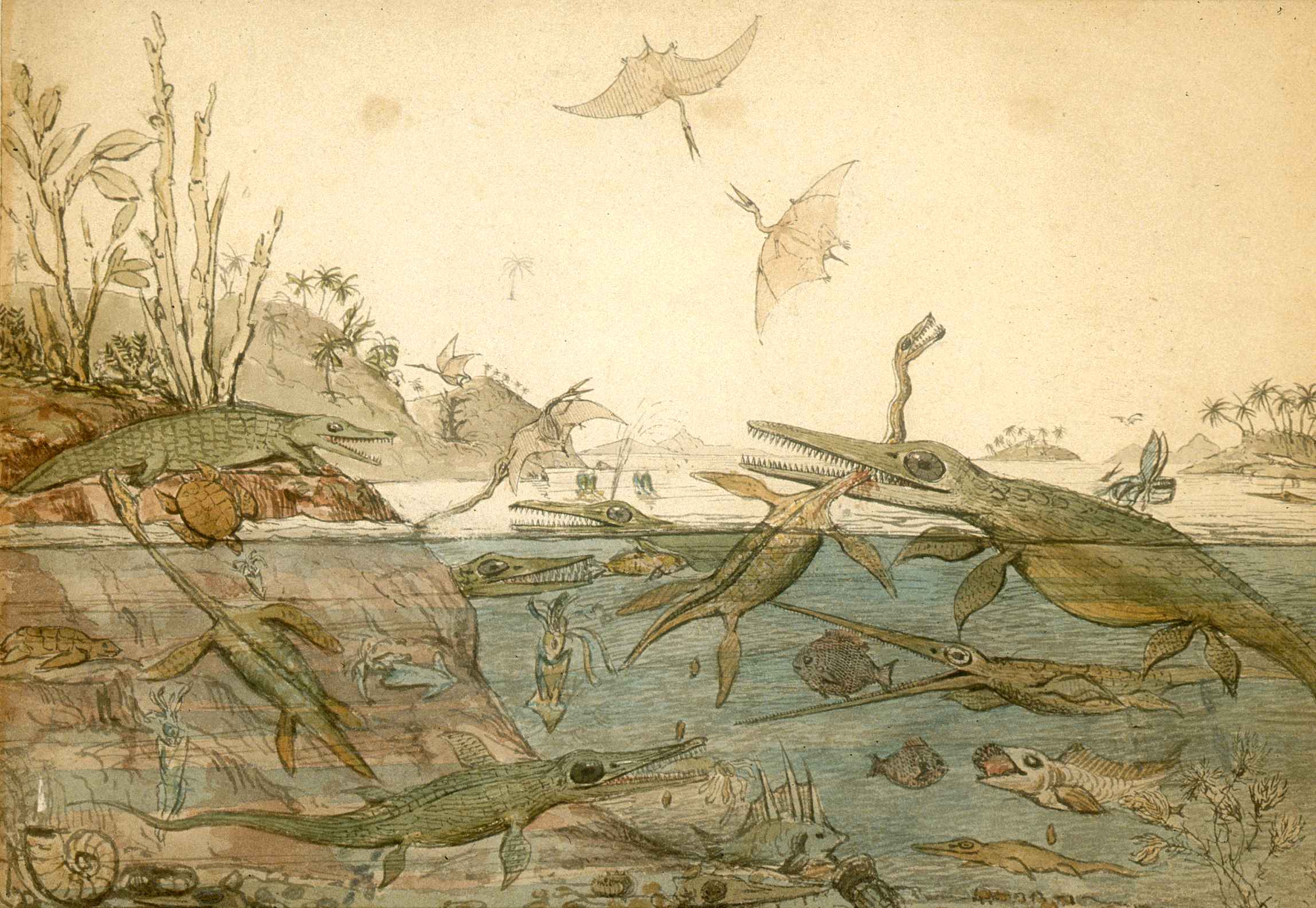
Chapter 2 is one of my favourite parts of the book: a history of palaeoart from the pre-scientific period right up to the modern day. So many histories of palaeoart are short and selective, often jumping from Duria Antiquior to Hawkins' Crystal Palace models, saying hello to Knight and Burian and then calling it a day. Such treatments omit many important details in the development of palaeoartistry - and I'm not just thinking about the reinvention of palaeoart inspired by the Dinosaur Renaissance. It should be more widely appreciated, for instance, that De la Beche's Duria Antiquior is not the oldest piece of palaeoart. It is widely labelled with this title but a number of works undeniably qualifying as palaeoart pre-date it by 30 years. De la Beche's painting broke new ground in some respects, but the terrain had already been cracked by several other scholars and artists. Another example: historic overviews often focus so much on Knight that they overlook other significant developments taking place in the early 20th century, such as the invention of hybrid 'scientist-palaeoartists' and their strong influence in the genre. While Knight was painting murals Harry Seeley was publishing Dragons of the Air (1901) and Gerhard Heilmann was producing The Origin of Birds (1926), books which contained very progressive takes on pterosaurs and dinosaurs and are clear precursors to the way we illustrate these animals today. I've tried to cram the handbook's overview of palaeoart history with as much information as possible and I feel it's a more comprehensive treatment than you'll find in many venues. It also features a brief section on palaeoart prior to science - my recent blog posts on griffins and cyclopes stemmed from research for this section.

Hendry De la Beche's 1830 artwork Duria Antiquior: A more Ancient Dorset: definitely a landmark illustration for palaeoartistry, but not the first piece of palaeoart. The pre-1830 history of palaeoart gets a lot of discussion in the handbook. Image in public domain.
The third chapter is a crash course in how to research palaeoart. This part of the book will hopefully benefit folks who're new to the discipline and struggling to make sense of the often technical information that informs a palaeoartwork, an especially daunting task for those lacking a background in geology or palaeontology. There's a lot of explanatory text in this chapter, explains (for example) what terms like 'functional morphology' and 'stratigraphy' are, giving advice on how to read a cladogram, and outlining why researching geology and fossil provenance are just as important as understanding anatomy. There are also discussions of where to find information relevant to palaeoart and how to verify it reliability. There's a lot of junk and erroneous information out there, especially online, and these tips should help you to sift some useful information from the detritus.

We talk a lot about epidermal correlates at this blog (see here and here for recent examples) but they aren't as widely used as they should be. They're best known in centrosaurine horned dinosaurs thanks to Hieronymus et al. (2009), but occur widely across tetrapods. We're probably getting a lot of reconstructions wrong by ignoring them. Image from Witton (2018).
Chapters 4-8 outline the process of reconstructing extinct vertebrates. Collectively, these chapters represent a major chunk of the book. They start with the prediction of missing anatomies, building skeletal reconstructions and determining plausible postures. Muscles and fatty tissues are then considered, followed by skin: how we can predict skin types when they aren't present in fossils as well as what we can determine from fossil skin itself. A whole chapter is devoted to facial tissues: extra-oral tissues (lips, cheeks etc.), eyes, ears and noses. Our precision for reconstructing animal faces is something of a mixed bag as some features are much easier to predict than others. We have robust means to predict how much eyeball tissue should be visible, the likely positions of reptile nostrils, and when trunks or proboscides were present, but ask about the shape of extinct mammal ears or what sauropod noses really looked like and we're less certain. Chapter eight deals with hot topics like shrink-wrapping and the role of speculation in soft-tissue reconstruction. Both have roles to play in palaeoart, but both can be 'overdone': the handbook has some food for thought about when, and when not, to make use of these conventions.

Chapter nine drills down into the specifics of restoring tetrapod taxa. I originally envisaged this section as being bigger and encompassing more animal types, but non-tetrapods had to be cut to save space. The alternative would have been to include very brief notes on more taxa, but I fear the sin of error through omission: more detail about popular palaeoart subjects seemed the best compromise. Most major tetrapod groups are included, with specific sections on dinosaurs, pterosaurs, marine reptiles, different 'grades' of synapsids, temnospondyls and others.

'Rictal plates' - the structures that cover the corner of tetrapod mouths - are among the topics discussed in the handbook. Though often mentioned in discussion of dinosaur 'cheeks', they also have relevance to suction feeders, such as the placodont Henodus chelyops. Understanding a subject's functional morphology can guide speculative reconstruction of unknown anatomies. Another image from Witton (2018)
The tenth chapter moves away from restoring animals to considering their environment. As with chapter three this section is aimed partly at newcomers, bringing them up to speed on how ancient environments are understood through sedimentology, stratigraphy and palaeoclimatology. This is not to say Chapter 10 is a geology lecture however: it's more a bluffers guide which explains useful terms and phrases to allow non-geologists to glean information from research papers on the palaeoenvironment of their subject species. Plants are also briefly covered in this chapter. I'm afraid the handbook is not the text that overturns palaeoartisty's general short shrift to palaeobotany, but there is guidance for how to research ancient floras as well as some need-to-know information about plant evolution.

Raven Amos' Nemegt Sunrise shows an entirely typical palaeoart topic - a foraging dinosaur (specifically, Conchoraptor) - but in awesome style. Palaeoart which is scientifically credible but strongly stylised is relatively new to the discipline. Will it become more widespread in future? Raven's excellent image features prominently in the book.
Chapter 11 addresses the 'art' in 'palaeoart', talking about the interplay between science, composition and style. Discussions of palaeoart rarely stray into these areas, but they're important: there's no point getting your scientific details spot on if your artwork is an uncompelling mess. This chapter covers how our ideas about animal behaviour, their arrangement in a scene and relationship to the viewer are critical to making effective artwork, it being argued that some common palaeoart practises - extremes of perspective, and unrealistic shoutyroaryfighty behaviours - can make artwork less credible. Through liberal use of art by the contributing artists, choices of style and the advantages of different approaches are discussed. I'm a big fan of artists who push the stylistic boundaries of palaeoart and, after two centuries of relatively conservative approaches, consider bold stylisation to the next frontier of the medium. The utility of such styles is discussed, including whether they may sometimes be more 'honest' than our default approach of photo-realism (or, at least, in the orbit thereof): when animals are poorly known, is it more representative of our knowledge to use simpler, or looser styles than to hone every scale or hair to precision? This is becoming more of an issue as some species become incredibly well known to scientists and artists. Do we risk 'diluting' the impact of discoveries where we can plot every scale and pigment cell with certainty if we restore every animal as if this were the case?

The final, concluding chapter takes a look at the professional world of palaeoartistry. This section is aimed at those who commission artworks as well as those who create it, tackling subjects like what information artists need to plan and price a commission, the importance of feedback, and that all important topic: how to make a living from palaeoart. I'm afraid this chapter doesn't have an easy answer for the latter: hard work, talent, luck and shameless promotion remain hurdles between us all and palaeoart success. What a jip.

A page from Chapter 9's mosasaur section. Diagrams or illustrations such as these appear on almost every page of the book. When I started the book I figured I'd mostly use 'off the shelf' art, but I ended up creating a lot of new images to illustrate points made in the text. This is why is took two years to write, folks.
And that probably tells you everything you need to know if you're wondering whether this is a book for you. My ultimate aim was to make a book comprehensive enough to cover most questions anyone could have about how palaeoart is made, or at least give some idea where the answer could be found in other literature. It is, of course, impossible to cover everything about a topic as broad as palaeoart in a single book, but by placing an emphasis on methods as well as raw information I figure readers should gain sufficient knowledge of the field to answer questions on their own. And that's probably the most important lesson in the handbook: palaeoart is reliant on an evolving, changing set of data, so what's considered 'accurate' in 2018 may not be in ten years time. Training yourself to think scientifically, and to check information no matter where it's from, is just as important as learning how to paint or sculpt in palaeoartistry. If that's the message you take home from this project, I'll consider my job done.

The Palaeoartist's Handbook: Recreating Prehistoric Animals in Art, will be available internationally on August 27th, published by Crowood Press. Pre-orders can now be made at Amazon (UK/US) and at other retailers.


Enjoy monthly insights into palaeoart and fossil animal biology? Consider supporting this blog with a monthly micropayment, see bonus content, and get free stuff!

My work - including the writing of educational books like the handbook - is supported through Patreon, the site where you can help online content creators make a living. If you enjoy my content, please consider checking out my Patreon site - subscriptions start at $1 a month. That might seem pretty trivial, but if every reader pitched that amount I could work on books, artwork and other educational content full time. In return, you'll get access to my exclusive Patreon content: regular updates on research papers, books and paintings, including previews of another upcoming book. Plus, you get free stuff - prints, high quality images for printing, books, competitions - as my way of thanking you for your support. As always, huge thanks to everyone who already sponsors my work - without your help, the Palaeoartist's Handbook may not exist.

References

  • Garner, J. (2013). Wildlife Artist's Handbook. Crowood Press.
  • Heilmann, Gerhard (1926). The Origin of Birds. London: Witherby.
  • Hieronymus, T. L., Witmer, L. M., Tanke, D. H., & Currie, P. J. (2009). The facial integument of centrosaurine ceratopsids: morphological and histological correlates of novel skin structures. The Anatomical Record, 292(9), 1370-1396.
  • Seeley, H. G. (1901). Dragons of the air: an account of extinct flying reptiles. Methuen & Company.
  • Witton, M. P. (2018). The palaeoartist's handbook: recreating prehistoric animals in art. Crowood Press.

Sunday, 24 June 2018

Ricardo Delgado's Age of Reptiles at 25: a palaeontological retrospective

With the 25th anniversary of Jurassic Park cascading through dinosaur social media you could be forgiven for overlooking another influential dinosaur franchise celebrating the same vintage this year. Unveiled in 1993, this long-running series stood out for showing dinosaurs as fast, agile and intelligent animals, and immersed us in an then-unparalleled expanded prehistoric narrative, rich in detail and huge in scale. I'm talking, of course, about Ricardo Delgado's Dark Horse comic series Age of Reptiles.

The award-winning Age of Reptiles series comprises multiple, unconnected stories published throughout the last 25 years, with a bit of a hiatus between its earliest and latest incarnations. The series comprises four serials (Tribal Warfare, 1993; The Hunt, 1994; The Journey, 2009; and Ancient Egyptians, 2015) and two shorter pieces (The Body, 2011; Baby Turtles, 2014 - regrettably, I haven't seen these in entirety). It has a number of fans among those of us who research and illustrate fossil reptiles, and judging from the calibre of movie makers who've contributed endorsements to the comics, it is well regarded in the movie industry, especially for its entirely 'silent', visual means of storytelling. Despite some relatively complex narratives, large casts and use of multiple locations, not a word of dialogue or descriptive text is used to explain plots or character motivations. The 2011 documentary Dinosaur Revolution and its 2012 spin-off Dinotasia were inspired by Age of Reptiles, with Delgado having director credits on two episodes of the former. It's fairly well known that, until late in production, Dinosaur Revolution was effectively meant to be Age of Reptiles: the TV show, but studio cold feet revised the programme into a more conventional documentary.

Cover art for various editions of the Ricardo Delgado's Age of Reptiles comic series, borrowed from Dark Horse Comics. Their website which has a full back catalogue of the series for your browsing and purchasing needs. Sorry for the low res images - I'm deliberately using officially released artwork in this post to avoid unintentional piracy of Age of Reptiles content. Entire sequences of the Age of Reptiles comics have been uploaded without authorisation to the web, and that's not cool, folks: it's stealing.
Age of Reptiles was an important influence on my childhood drawing and, with the series hitting the big two-five this year, I thought I'd share some of what I think makes the series special. It helps, I think, to set the stage in which I first met Age of Reptiles as an eight or nine-year old* dinosaur obsessive in the early 1990s. Though not so long ago, this was a different age for palaeontological media because rendering life-like prehistoric animals for TV or film was much harder than it is today. Making a realistic film or documentary chronicling the lives of prehistoric animals would not only have been very difficult, but also very expensive. Jurassic Park may have broken new ground for dinosaur animation in 1993, but it needed sophisticated animatronics, then-radical computer generated imagery and a Hollywood-grade budget to achieve its visuals. It took several years for this technology to become more widely affordable, with the the bridge between Jurassic Park and our living room viewing - Walking with Dinosaurs - not appearing until 1999. Thus, if I wanted to see 'living' dinosaurs, rather than just disconnected pictures in dinosaur books, I had to made do with the short vignettes with wobbly puppets on the A&E Dinosaur! series, or else hope to find a showing of a Harryhausen dinosaur film on TV.

*My birthday would have been around the time I first saw the comic, and I can't remember if I'd graduated to nine years old when I first saw it.

It was into this landscape that Age of Reptiles placed a weighty clawed foot. I first encountered the first story, Tribal Warfare, through the UK's take on the Jurassic Park comics. Coinciding with the movie release, the international branch of Dark Horse comics published a weekly Jurassic Park magazine that contained a comic story of the movie as well as two other series: Xenozoic Tales (a post-apocalyptic sci-fi story with minimal dinosaurs - I never really got on with it) and something called Age of Reptiles. Juxtaposed against the talky, high-tech worlds of Jurassic Park and Xenozoic Tales, Tribal Warfare immediately stood apart with its silent, patient and entirely immersive opening. Without a word of introduction, we see a sleepy Pteranodon wake up, spread its wings, and then launch over a huge, double-page vista of unspoilt trees and bluffs. The pterosaur sails past a foraging sauropod, which we soon learn is being stalked by a group of dromaeosaurs. We watch the sauropod flee and ultimately fall to its attackers, before a huge tyrannosaurid arrives to claim the carcass from the smaller predators. The animals were colourful, dynamic, imposing and vicious, and played out their drama without interruption from a narrator, talking head or visiting caveman. It was unlike anything I'd ever seen.

Sorry, Walter Cronkite: your A&E dinosaur puppets had nothing on this. Page from the opening comic of Age of Reptiles: Tribal Warfare, where a pack of Deinonychus bring down a titanosaur, while Pteranodon soars past. Anachronistic fauna be damned: for an early 1990s dinosaur fan, this was ambrosia from the loftiest peaks of Olympus. Borrowed from Dark Horse Comics.
Reading the comic in entirety, it was apparent that this was not a story about prehistoric animals living with humans, or anthropomorphic cuddly dinosaurs learning lessons about friendship. Age of Reptiles was the extended, unadulterated prehistoric drama every '80s kid wanted but film or TV had yet to produce. OK, it was in comic format rather than animated on screen, but Delgado's experience with storyboarding and film illustration gave our brains little work to do as we filled in the action between panels.

Age of Reptiles continued to resonate for years after I first encountered it. Much of the dinosaur art I drew for the next 5, 10... 25 years was influenced to a greater or lesser extent by Delgado's creation, to the extent that I rank him as one of my top artistic influences. It may not be as obvious in my modern work as it was 20 years ago, when I was a teenager liberally borrowing from his style (below), but it's still there. Every now and then a Delgadoesque waterfall or critter still sneaks into one of my paintings and I still have a lesson in composition and visual storytelling whenever I re-read his work. Those of you with eagle eyes may have noticed praise for Age of Reptiles in my 2017 book, Recreating an Age of Reptiles, the title of which was chosen as much for its relevance to the comic as it's palaeontological and paleoartistic connotations. Though I don't think Age of Reptiles can qualify as pure palaeoart on grounds of taking a few too many artistic liberties with palaeontological data, it contains many lessons about effective depiction of fossil animals and, 25 years on, I still regard it as some of the best 'palaeontologically-inspired art' (as opposed to entirely science-led palaeoart) out there.

Revisiting some of my 20 year old drawings (I would have been about 13 when I drew these) shows many Delgadoisms. These would all have been influenced by Tribal Warfare, I didn't have The Hunt. The tree outlines, cliffs, waterfalls with sharply defined mist, the hatched scalation, eye shapes and so on were my best attempts to execute an Age of Reptiles style.

Telling palaeostories

As noted above, some of the heaviest praise for Age of Reptiles stems from its ability to tell complex stories without any text. They are not conventional narratives about dinosaurs either, the Age of Reptiles stories recalling cinematic westerns, Mafia dramas and Mad Max-style journeys through post-apocalyptic wastelands. Essays penned by Delgado for some of the comics discuss these influences, often citing classic films as inspiration. It's quite a feat to make western where cowboy hats are traded for scales and, yes, the characters are somewhat anthropomorphised to achieve this, but it rarely feels overdone. Anthropomorphism also lessens as the series continues, just one of many aspects that seems to change - we might say 'mature' - as the series has continued. The animalistic behaviours of Age of Reptiles' characters are aided by Delgado not being afraid of making them real scumbags, as well as a dark sense of humour and regard for his their wellbeing that even Game of Thrones might consider a bit harsh. These attributes make Age of Reptiles a closer approximation of the natural world than other franchises where we see dinosaurs engaging in day-to-day behaviour, and brings a moral ambiguity to his characters. This makes it difficult to root for any one character entirely, but I think that's the point: these aren't comics with moral lessons about human values, but stories about animals that have to be strong and sometimes violent to survive. Executives wondering what to do with dinosaur narratives for documentaries or films could learn a lot from Delgado's work: dinosaurs can do more than just search for those far-flung lush valleys, folks.

Dark Horse's 2015 motion comic is slightly different from the original opening of Tribal Warfare, but it captures some of the arresting cinematic style and dinosaur behaviour of the very first Age of Reptiles comic. From Dark Horse Comics' official YouTube account.

The Age of Reptiles series has paid increasing attention to science since its 1993 debut. Tribal Warfare has anachronistic casting with a mix of dinosaurs and other reptiles from across time and space: Tyrannosaurus rubs shoulders with Deinonychus, Deinosuchus, shastosaurid ichthyosaurs, Saltosaurus, Pternanodon, Parasaurolophus, Carnotaurus and others - it's a grab bag of fan-favourite Mesozoic animals. Their behaviour is also among the most simplistic and anthropomorphised of the series too, with the tyrannosaurids and dromaeosaurids acting like rival gangs from some gritty, gory 70s exploitation film. But in later serials more attention has been paid to real species compositions and animal behaviour is more nuanced. This has been implemented most successfully in Ancient Egyptians, where efforts have been made to feature the correct fauna and palaeoenvironment of mid-Cretaceous Africa, and the depicted behaviours are relatively animalistic. The characterisation of some species also runs against stereotyped portrayals of dinosaurs in popular media, subverting tropes of 'harmless herbivores' and so on. The giant titanosaur Paralititan, for example, is the primary antagonist in the story, being an aggressive, violent species bristling with antagonism in every frame. Annoy these sauropods and you're in trouble, even at risk of being crushed to death under the massive tonnage of their forelimbs. This is a very different role for a sauropod dinosaur in popular media, even contrasting with prior Age of Reptiles stories where they are little more than background animals or prey species. The idea of large herbivores being badass mothertruckers isn't silly either, this being the case for many living herbivores like hippos, certain bovids, and some elephants.

Ancient EgyptiansParalititan in full angry mode. Note the blocky neck profile, distinctive facial tissue, correctly positioned nostrils and distinctive scarring - great stuff. From Dark Horse Comics.
Elsewhere, a male Spinosaurus - the anit-hero for the story - kills the offspring from another male before siring his own (in stark contrast to the nurturing parent-juvenile relationships of earlier Age of Reptiles) and sometimes communicates using rumbling vocalisations emitted from its throat rather than always using open mouth roaring. This is progressive stuff, and - particularly as someone who's experienced pushback against new ideas when working on dinosaur media projects - very refreshing to see in a popular dinosaur product. We can't pretend that Age of Reptiles is a documentary - if it were entirely true to life, 95% of the series would be dinosaurs chewing leaves and pooping - but Delgado deserves full kudos for pushing his creation towards more credible faunal compositions and not holding back when depicting new ideas about dinosaur behaviour. Hollywood, take note: thus far, we've seen no evidence that having half an eye on science has impacted his ability to tell great stories.

Evolving anatomy and Age of Reptiles

Delgado's animal designs have also crept towards realism and scientific credibility since 1993. His reptilian cast is 100% post-Dinosaur Renaissance, and thus has always been appropriately posed, agile, and dynamic, but his creative approach seems to have changed between 1990s and 21st century entries into the Age of Reptiles canon. The taxonomic identities of his animals have always been apparent and his animals look 'realistic', in the sense that they don't look anatomically implausible, but the creatures of Tribal Warfare and The Hunt have a certain 'augmented' quality that is not apparent in later serials. The theropods, for example, are always long-legged beasts with boxy, robust skulls and large, prominent teeth, as well as heavy scalation and exaggerated ornaments. They're recognisable as their real-life counterparts, but look like superpowered versions of the real species. Though not all the animals in the first Age of Reptiles serials received this treatment (most of the herbivorous species are pretty darned good approximations for our 1990s views of these animals, with minimal embellishment) the overwhelming impression is still one of prehistory on steroids. I'm reminded somewhat of William Stout's 1990s palaeoart: Stout's work is probably on the more credible side of the scientific fence, but shares an emphasis on gnarly, enhanced features with Delgado's creations. I wonder if Stout's work was referenced in those early comics.

The Journey and subsequent stories feature more scientifically credible restorations which seem more carefully modelled on their real-life counterparts. The tyrannosaurs in The Journey, for instance, have longer bodies and skulls, and stouter legs, than the 1993 versions and thus look much more like the real deal. The abelisaurs in Ancient Egyptians show the peculiar short arms and blunt heads particular to this group, unlike the fairly 'generic' Carnotaurus we met in 1993. I especially like the titanosaurs of both The Journey and Ancient Egyptians, their designs having robust, wide necks, rotund bodies and stout limbs, as they should. Smaller details are well captured too, with eyes, ears and nostrils being in the right places - not something to be sniffed at in any public-facing dinosaur art.

Cover of the first issue of Age of Reptiles: The Journey. Note the improved tyrannosaurid anatomy compared to that of Tribal Warfare, which you can see in the video above. Also, so many footprints! - another hallmark of later Age of Reptiles art. From Dark Horse Comics.
Additional positive trends include less shrink-wrapping on many species (the pterosaurs, in particular, have a lot more meat on their bones in later stories), closer attention to the anatomy of non-dinosaurian species, and more natural-looking colour schemes. I am curious to know if this reflects influence from broader palaeoart trends, or if Delgado has independently moved away from some of the retrospectively questionable reconstruction choices of early 90s palaeoart. Whatever the influence, though some liberties are taken to create recognisable individual characters or convey thoughts and actions, the tighter, more believable take on these animals is welcome. Within the constraints of creating a comic about prehistoric animals, I think Delgado is doing an increasingly good job of balancing the demands of narrative with science.

If I have one complaint about the accuracy of the animals, it's that several species have remained scaly even when their fossils now unequivocally show feathers or filaments. I hope this changes in future. To the series credit, feathers have crept in here and there (indeed, they've been in the series since 1993) but voluminous, bird-like feather shells have yet (to my knowledge) to feature in animals we know had them, such as maniraptorans and ornithomimosaurs. Still, I admit that I find this less irritating than I do the lack of feathers in that other major dinosaur franchise launched in 1993, mainly because Age of Reptiles doesn't employ consultants to give the prestige of scientific credibility, nor does it make lame excuses about why it's animals look like they do. It is what it is, and never made any claim for being 100% scientifically credible. Moreover, Age of Reptiles has spent the last 25 years trending in the right anatomical direction, whereas the modern Billy and the Cloneosaurus movies are stuck in the past, sometimes taking deliberate steps away from palaeontological science.

Page from Age of Reptiles: The Journey, featuring the unluckiest sauropod hatchling ever committed to print. Age of Reptiles often has a dark sense of humour and the plight of this little guy is both funny and tragic - you'll have to buy the comic to find out what happens. From Dark Horse Comics.

Worlds of space and detail

Moving away from science and into the art itself, there are also lots of subtle details in Delgado's illustrations which enhance the believability of his prehistoric landscapes and bring character to his actors. It's here where Age of Reptiles can teach conventional palaeoartists a few tricks, as reasoned speculation and imaginative concepts are used to bring Delgado's Mesozoic to life. I could list many examples, but one of my favourites is the association of a small preening pterosaur with a specific female tyrannosaurid in Tribal Warfare - a charming addition to a sometimes violent character. Elsewhere, small creatures - bugs, fish, birds, pterosaurs and so on - frequent most frames, sometimes playing out their own minor dramas against the backdrop of the main narrative. Variation in colour, injuries and integument between his animals give each different personalities, as well as unique visual identities. From The Journey onward we see sauropods sleeping in rings with their necks draped over one another, and in one of Age of Reptiles' rare visits to the marine realm, Delgado's giant mosasaurs are covered with parasitic fish. Plus - because why the heck not - the Araripesuchus in Ancient Egyptians are almost always relieving themselves. These small, sometimes inconsequential details really sell the richness of the Age of Reptiles universe and the individuality of each character.

Another page from Ancient Egyptians. The low angle and shading gives the Paralititan a terrific presence in this panel, leaving us in no doubt that a) it's absolutely huge, and b), that Spinosaurus is in trouble. Note the improved pterosaur anatomy vs those in Tribal Warfare (see images, above). Borrowed from Dark Horse Comics.
The composition and framing of Age of Reptiles is also excellent, creating a sense of atmosphere, scale and motion that rivals the greatest palaeoartworks. Delgado's experience in the world of movies and television brings a truly cinematic quality to some parts of Age of Reptiles, and I strongly recommend these comics just to see how varying viewpoints, animal poses and colouration influence the portrayal of ancient species. If Age of Reptiles was a movie, we could imagine it as one with particularly liberated camera motions that swoop, cut and jump between viewpoints and distance. Delgado is not afraid of placing subjects in the middle or even far distance, often at the expense of fine detail but working terrifically for conveying size, motion and character. My favourite images of the series are those with the viewpoint pulled right back to show enormous landscapes, his animals reduced to fractions of the frame (think Douglas Henderson palaeoart, in comic form). His liberal application of footprints - and their role in communicating information about the nature of a scene - becomes apparent in such views. Close-ups are variably used in more intimate, tense of energetic moments, and we see a lot of variation in light and setting to alter atmosphere and and tone. In all, Age of Reptiles is an excellent demonstration of how a strong eye for composition can enhance artwork of prehistoric animals, and how we can tell entire stories in single images.

Age of Reptiles is not, and is not meant to be, a scientifically rigorous take on Mesozoic life, but it skirts the edge of palaeoartistry and palaeontological science close enough that those interested in these topics should check it out. It's among the most creative and consistently interesting palaeontological products I'm aware of and, if you like dinosaur science, or dinosaur art, you're going to find something to like here. An omnibus of the first three serials is available, as is the collected issues of Ancient Egyptians - all are still in print and very affordable. Fans might also want to check out Ricardo Delgado's blog, which has a lot of 'behind the scenes' content from the series. CGI might have made it easier to create dinosaurs for film and TV since 1993, but the still-picture storytelling of Age of Reptiles competes with, and often outdoes, the best prehistoric drama that Hollywood can throw at us.

Enjoy monthly insights into palaeoart, fossil animal biology and occasional reviews of palaeo media? Support this blog for $1 a month and get free stuff!

This blog is sponsored through Patreon, the site where you can help online content creators make a living. If you enjoy my content, please consider donating $1 a month to help fund my work. $1 might seem a meaningless amount, but if every reader pitched that amount I could work on these articles and their artwork full time. In return, you'll get access to my exclusive Patreon content: regular updates on research papers, books and paintings, including numerous advance previews of two palaeoart-heavy books (one of which is the first ever comprehensive guide to palaeoart processes). Plus, you get free stuff - prints, high quality images for printing, books, competitions - as my way of thanking you for your support. As always, huge thanks to everyone who already sponsors my work!

EDIT (15/08/18): For some reason this blog post is attracting a deluge of spam comments, so I'm turning comments off. Apologies for the inconvenience!

Friday, 27 April 2018

Unicorns, dragons, monsters and giants: palaeoart before palaeontology

Quick painting of Polyphemus, the Homeric cyclops, taking very literal inspiration from elephant face anatomy in reference to the well-known idea that fossil elephant skulls inspired the cyclops myth. So, do ancient illustrations of cyclopes count as early palaeoart?
The genre of natural history art we call 'palaeoart' is not a modern invention: it is actually centuries old, emerging in Europe at the same time as palaeontological science. We often credit Henry De la Beche's 1830 painting Duria Antiquior as the original palaeoartwork, but several attempts to reconstruct fossil animals using modern scientific ideas were made beforehand, dating back to at least 1800 (Taquet and Padian 2004). They include relatively speculative paintings, satirical sketches, and detailed anatomical reconstructions (Rudwick 1992; Martill 2014). Duria Antiquior was a major milestone for palaeoart development, but not the origin of the genre itself.

A case can be made for palaeoart being even older than these oft-overlooked works, however. A small number of artworks created by historic, maybe even ancient peoples attempted to restore the life appearance of fossil animals in much the same way we do today, albeit outside of a true scientific context. Whether or not these artworks qualify as true palaeoart is questionable as adherence to scientific theory is a pretty major component of the genre. Scientific methodology as we understand it today was not developed until the 18th century, and this included many concepts essential to palaeoart, such as fossilisation, extinction and geological time. Can we truly define a work as palaeoart if it was made without knowledge of these cornerstones of palaeontological science? My take on this is that artworks attempting to rationalise fossils against contemporary understanding of natural phenomena (even if that rationale is pre-scientific and mythology-based) have the same intention as palaeoart produced today. We can probably consider these early artworks 'proto-palaeoart', the forerunner of the genuine, science-led article we developed in the 19th century.

I thought it might be of interest to run through some early artworks claimed to be among the oldest palaeoart. I won't pretend that this list is exhaustive, but I hope there may be some examples, or facts behind commonly given examples, that will be unfamiliar to most readers. In researching this article, I was surprised at how little data existed behind some claimed examples of historic palaeoart, including several widely 'known' examples. Other cases are more plausible, if missing smoking gun evidence, and a couple are undoubted facts of history. For those interested in the origins of palaeoart, the question is not 'does proto-palaeoart exist?', but 'how much proto-palaeoart is there?'

Of griffins and cyclopes

Archaeological data shows that humans have been interacting with fossils for thousands of years (McMenamin 2007; Mayor 2011). It is not unreasonable to assume that ancient peoples pondered the nature of fossils and perhaps drew or sculpted the creatures they were interpreted as. Othenio Abel (1914) and Adrienne Mayor (2011) have argued that fossil remains influenced or even wholly inspired famous mythical animals such as griffins and cyclopes. As previously discussed here at some length, some researchers propose that fossils of the Asian horned dinosaur Protceratops were subsumed into the mythology of the griffin (e.g. Mayor and Heany 1993; Mayor 2011), while the bones of elephantids – with their huge, eye-like central nasal openings in their skulls – spawned stories and artwork of the one-eyed cyclops (Abel 1914).

Line drawing of perhaps the oldest known image of a griffin, from Susa, 4th millennium BCE. From Frankfort (1937).
Superficially, both these claims seem reasonable. Griffins, if you squint a little, do somewhat resemble a Protoceratops with their four legs, beaks and cranial frills interpreted as wings. The skulls of elephants and their relatives look somewhat like the skulls of monstrous giant humans, too, mostly because of their short faces and partially-defined true eye sockets. But what's lacking from these claims is evidence beyond the circumstantial. The Protoceratops-griffin hypothesis is presented as having support from historic events, geographic details and ancient texts, with traders from far eastern lands bringing tales of their fossils to the Greeks in the first millennium BCE. Long term readers may remember I suggested a number of issues with this scenario in a previous article. I won't rehash the full argument here but, in brief: griffins appeared in Near East societies several millennia before they became popular in Ancient Greece, meaning the Orientalisation of Greece during the 8th-5th centuries BCE - when the Greeks adopted culture from Near Eastern and Eastern Mediterranean cultures - more than accounts for the sudden Grecian interest in griffins. Ancient texts said to refer to Protoceratops fossils seem to pertain to (probably fantastical) living species, not fossils, and provide no details of geography of environment that are specific to genuine Protoceratops localities. The trade routes and gold mines said to bring Asian cultures within viewing distance of Protoceratops remains are, in fact, several hundred miles west of all known Protoceratops sites, and there's nothing about griffin form - in any of its guises (griffins are a complex of creatures, not just one) - that necessitates influence from horned dinosaur anatomy: all griffin features are accounted for by living species. Citations and references for these points can be found in my article, so please check it out if you'd like more details. I've not encountered anything since writing that piece to change my opinion on the Protoceratops-griffin hypothesis, so I can't see any reason to consider griffins proto-palaeoart of horned dinosaurs.

Historic and biogeographic details align better with the idea that elephantid fossils may have begat cyclopes. Fossils of elephantids are found around the eastern Mediterranean and their bones were probably known to the Ancient Greeks (Massetti 2008; Mayor 2011). It's plausible that Greeks living several thousand years BCE would be ignorant of living elephants too, these animals dying out in Europe around 11,000 years ago. The nearest contemporary elephant populations were of the now extinct Syrian elephant, over 1000 km away in eastern Turkey. Elephant skulls are pretty odd, and without knowledge of living elephants it might be easy to misinterpret them. Homeric accounts of cyclopes - from the 7th-8th century BCE, among the earliest on record - cast them as cave dwellers, which matches the recovery of elephantid remains from Sicilian caves (Masseti 2008). The link between these bones and cyclopes has been noted for centuries, dating back to the first 'modern' archaeological exploration of Mediterranean islands in the 17th century (Masseti 2008).

A funerary urn showing the cyclops Polyphemus being blinded by Odysseus and his crew, c. 660 BCE. From Wikimedia user Napoleon Vier, CC BY-SA 3.0
These details put elephantid bones in the right place and time to inspire cyclopes but, as hardened sceptics, we must view this as circumstantial evidence only, and thus insufficient to support the elephantid-cyclopes link on its own. It's here where we hit a problem: beyond these details, there's not much else to support this idea. It's important to ask the right questions in sceptical inquiry and in this case it's not 'did elephants inspire cyclopes?, but 'do we need elephants to explain depictions of one-eyed giant humans?'. The answer is probably 'no'. Accounts of ancient cyclopes I'm aware of - both those in illustration and literature - are just giant men with unusual eye anatomy (example above), and without obvious elephantine facial features (tusks, steep-fronted rostra etc.). Citing elephant skulls as a source might complicate the myth more than explaining it - where's the rest of the elephant anatomy gone? An entirely human source - cyclopia, a fatal genetic condition sees human eye anatomy fail to divide fully - is an alternative origin of the cyclopean myth (Kalantzis et al. 2013) which does not require artists to cherry-pick elephant features. Cyclopia is rare among live human births (Kalantzis et al. 2013) but occurs in one of every 200 lost pregnancies - as sure as ancient Greeks saw fossil elephant bones, they also surely saw patients of cyclopia.

We must also consider that a real-world source was not needed at all. One-eyed men and other monocular creatures are ubiquitous throughout mythology all over the world, and it's unlikely they all developed after finding fossil elephant skulls. Eyes are a well established symbol of wisdom, clairvoyance and authority in many cultures, so the modification of eyes - reduction in number, blinding and so on - has clear symbolic value in many legends. It's entirely plausible that Grecian cyclopes had one eye simply because the ancient poets and storytellers thought it suited their characters. It's difficult to prove that fossil elephant skulls were not the basis for cyclopes but with only circumstantial evidence to support the idea, it's no better supported than any other interpretation outlined here or elsewhere.

The Monster of Troy

An artwork argued by Mayor (2011) as the oldest piece of genuine palaeoart adorns a Corinthian vase painted between 560-540 BCE. This image shows an unusual, skull-like face resting on a cliff acting as the Monster of Troy, the creature which fought Heracles as it terrorised Hesione at the outskirts of Troy. Though skeletal in nature, the interactions of the face with other figures on the vase implicates it as a living creature, not the remains of a dead animal. The skull is argued to match the basic anatomy of Miocene mammals known from the eastern Mediterranean region. The giraffid Samotherium is considered a most likely identity (Mayor 2000, 2011), though the artist may have also incorporated elements of fossil ostriches, lizards, whales or crocodiles (Mayor 2000, 2011). If this hypothesis is correct, it would easily be the oldest known palaeoart, and by a huge margin - about 2000 years. Mayor's interpretation has been discussed favourably by a number of authors (Papadopoulos and Ruscillo 2002; McMenamin 2007), though others consider it a matter of ongoing research (Oakley 2009) or pure conjecture (Kitchell 2014).

The Monster of Troy, as depicted on a Corynthian vase, 560-540 BCE. It definitely has a skull-like vibe, but is it the first piece of palaeoart? From Flickr user Lady Erin, CC BY-NC-ND 2.0.
The individualistic nature of the Monster of Troy complicates analysis of its origin, especially because it seems quite loosely drawn compared to other figures on the vase. How literally should we take its features? If we had other, perhaps more refined art of the same concept we might be able to pin down the accuracy of its rendition but, with only one example, we can't be sure if we're dealing with a crude drawing of a real skull or a more stylised, imaginative chimera.

If we take the face entirely literally, we find that some aspects compare well to mammals like Samotherium, particularly its size, the shape of the lower-jaw, the position of the jaw joint with respect to the orbit, and the low profile of the rostrum. However, it differs from Samotherium in a number of ways: a lack of horns; entirely procumbent dentition; long, sharp-looking teeth; a lack of a diastem; the (seeming) presence of a sclerotic ring; and the occurrence of a facial fossa (present in fossil horses and deer, but not Samotherium). The white colour is also not appropriate for Samotherium, fossils of these animals being of tan or brown hues. Some distinctions are potentially explainable within the Samotherium hypothesis: the shortened upper jaw could reflect a broken premaxilla - a common occurrence on large fossil mammal skulls - and the unusual detailing behind the eye could reflect details of the jaw joint and posterior skull anatomy. Others differences are less easily accounted for, leading to those suggestions that lizards, whales and other species might be referenced in the illustration too. This seems like special pleading to me, and a weakness in the idea that the artist was referencing specific fossil specimens. The only evidence for the Monster of Troy being a fossil is that it allegedly looks like one, and if we find differences between it and the fossils it's most likely to represent, they can't just be glossed over: they're counter-evidence to the hypothesis.

Samotherium boissieri.JPG
Samotherium boissieri skull - is this the 'real' Monster of Troy? By Wikimedia user Ghedoghedo, CC BY-SA 3.0.
Again, I wonder if we need to invoke fossils to explain this illustration. The basic anatomy might reflect some features of ungulate skulls, but it's so generalised that something like a living horse or camel would fit the bill as well as a fossil species. Indeed, some aspects - such as colour - are better matches for modern skulls. The fact it's perched on a cliff is perhaps the best reason to think it's a fossil, though other interpretations of the 'cliff' exist, such as it being the entrance to a cave (see Mayor 2000 for a brief summary of other interpretations).

All this considered, I'm not sure what to make of the Monster of Troy. I'm not convinced it's a compelling match to a specific fossil mammal skull nor that it even needs a fossil origin to explain it. Moreover, if it is a chimera, which even proponents of this idea concede it must be to some extent, then its significance to early palaeontology is diluted further as those other elements may not be of fossiliferous origin. If we had other illustrations of the same skull-like creature we might be able to make a clearer determination, but I don't know that there's enough evidence to determine if the Monster of Troy is anything to do with the history of palaeoart.

Here be Lindwurms

Moving on two thousand years to the 16th century, our next example is an artwork with a confirmed fossil basis. Our inquiries into artwork from this time onward are aided significantly by surviving texts from this interval. As we've already encountered, interpreting the origin of art is challenging without knowing the context of its creation, so the existence of well-documented artefacts and text allows for much more certainty in our pursuit of pre-science palaeoart. Much of the following stems from Abel's (1939) account of fossils and mythology.

The giant Lindwurm statue of Klagenfurt, Austria, built in 1590. It's said to be partly informed by woolly rhinoceros remains. The chap on the right, representing Hercules, was added in the 17th century. From Wikimedia user Johann Jaritz, CC BY-SA 3.0.
Though 16th century Europe heralded many major facets of our modern age, myth and fable were still major parts of culture, and giant fossils were still regarded as remains of fantastical animals. A vast, 6 tonne statue of a four-limbed, two-winged dragon known as the ‘Lindwurm’ is probably the oldest known incontrovertible piece of proto-palaeoart. Only part of the statue, which was erected in Klagenfurt, Austria in 1590, has a fossil basis however, its head being based on the skull of a woolly rhinoceros (Coelodonta antiquitatis) recovered from a gravel pit or mine near Klagenfurt in 1335. The Lindwurm has a prominent role in Klagenfurt lore as the town was said to be founded only after this creature was dispatched and the area became safe to live in. I'm not sure if the skull or the legend came first - the town was established in the 12th century, two centuries before the skull would be found - but we can be certain that Coelodonta fossils have longstanding historical significance in Klagenfurt, the skull residing in town council chambers for centuries before being put on public display, where it remains today. The statue was constructed by Ulrich Vogelsang, but it's evident that he only considered very basic elements of Coelodonta anatomy during the sculpting. Indeed, other than size, the Lindwurm head does not resemble Coelodonta at all, so it seems likely that the skull was more inspirational than referential. Still, at least we know the two objects were meant to represent the same entity, which is no mean feat in the pursuit of proto-palaeoart.

The giants and plesio-dragons of Mundus Subterraneus

Athanasius Kircher's 1678 German textbook Mundus Subterraneus - an early thesis on geography, biology, mineralogy and geology - contains several illustrations of animals which may have been informed by fossils. They include many types of giant human, which were said to be social, cave-dwelling species based on the bones of large animals found in caves - almost certainly remnants of Pleistocene mammals. Kircher also wrote about several types of dragon, many of which were of period-typical, worm-like form, but Abel (1939) noted one unusual dragon illustration that may have been influenced by a real giant reptile: a plesiosaur.

Is St. George fighting a plesiosaur-inspired dragon in this 1678 illustration from Mundus Subterraneus? Abel (1939, also the source of this image) thought so, noting the shift towards plesiosaur-like proportions and anatomy compared to more conventional European dragon depictions of the time.
The illustration is plesiosaur-like in many respects, with a barrel-like body, small head, long and slender neck, a true tail, and curiously small ‘paddle-like’ wings instead of broad, membranous wings typical of dragon depictions. It's not a perfect plesiosaur depiction by any means - it also has ears, a beak, and four legs - but Abel (1939) considered this reinvention of dragon form so dramatic that it could represent the arrival of a new source of inspiration for dragon anatomy, of which plesiosaurs are a possible contender. Marine reptiles, including plesiosaurs, were almost certainly uncovered during quarrying work in the historic Swabia region (now southern Germany) as rocks we now call the Posidonia Shale were exploited to build growing settlements. The Posidonia Shale is a site of exceptional preservation with abundant invertebrate fossils and rarer, but often complete and articulated, marine reptile skeletons. Posidonia quarrying dates back to at least the 16th century and, given that the quarrying was executed by hand, 17th century quarrymen would have seen fossils of many kinds, almost certainly including some well preserved plesiosaur remains. Had these discoveries caused a stir among local learned individuals, as well a giant reptile entombed in stone might have, it's not inconceivable to think they could have been identified as dragons, and ultimately influenced Mundus Subterraneus.

As with our discussion of cyclops art, these details are only circumstantial evidence and they do not prove beyond doubt that plesiosaurs were referenced in Kircher's dragon art. But I find this case a little more compelling because our records of the early modern period are better, so the correlation between historic events is tighter and the contrast to other dragon illustrations more obvious. Moreover, whereas ancient cyclops art doesn't really look like the fossils said to inspire it, I can see some obvious plesiosaur-like details in Kircher's illustration. It's difficult to be certain about the relevance of plesiosaurs fossils to the image but, for me, this is a possible, if unconfirmed, piece of proto-palaeoart.

The most awesome unicorn, ever

Our final example is surely one of the nuttiest attempts to restore ancient animal anatomy in all of history. Pleistocene mammoth and rhinoceros bones found in a cave near Quedlinberg, Germany, in 1663 were reassembled by an unknown artist into a skeletal reconstruction of a bipedal unicorn, christened unicornum verum ('true unicorn') or, sometimes, the Quedlinberg Monster. Doubtless this image is familiar to many readers already, but it's worth looking at again. Just how is that thing meant to work?
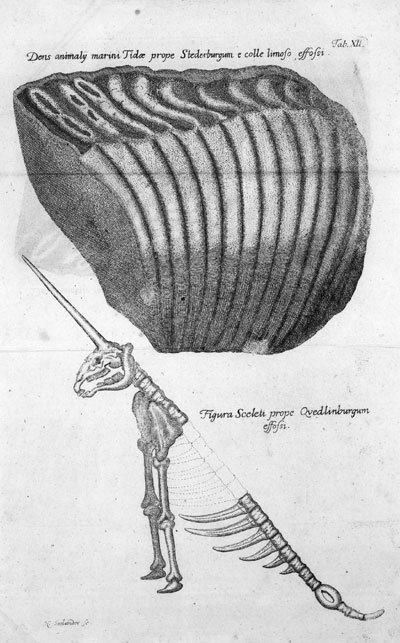

Reconstruction of the “unicornum verum” by Otto von Guericke (1678), and later used by German philosopher Gottfried Wilhelm Leibniz in his “Protogaea” (1749) (image in public domain).
History of Geology
Page from the 1749 book Prototagea showing unicornum verum, a truly bizarre composite of fossil rhinoceros and mammoth bones. The illustration above is clearly a mammoth molar, hinting at the true identity of the 'unicorn' bones.
The artistic history behind unicornum verum is somewhat mysterious (Ariew 1998). The illustration became widely known through Gottfried Wilhelm Leibniz's posthumously published 1749 book Protogaea, a scholarly account of geology and natural history. Leibniz's book printed a copy of one example of the illustration, but did not state where the images originated. The most famous example - above - is often credited to German naturalist Otto von Geuricke, the scholar who described the remains, or Leibniz himself. However, Geuricke was probably not the artist, and Leibniz definitely wasn’t (he explicitly states this in his written work). Another version of the skeleton, published in 1704, is said to be based on a third depiction by Johann Mäyern, a Quedlinberg counsellor. Whoever rendered the images, they represent the oldest known illustrations of restored fossil skeletons (we might quibble if skeletal reconstructions are true palaeoart or not - whatever your view, they're close enough for our purposes here, I think). Though some bones are fairly 'generic' and difficult to identify, mammoth teeth and scapulae, as well as rhino vertebrae with long neural spines (reversed to be ribs) are discernible. I am not sure what the ring-shaped structure at the end of the spine is - I assume it's a vestigial pelvis. Apparently the bones informing the skeletal were broken as they were excavated (Ariew 1998), which might account for some peculiarities of their appearance.

Unicornum verum in the flesh. It's a little undersized: Leibniz gave the length of the horn at five ells (an ell being the length of a man's forearm (typically about 450 mm, or 18"), which is over 2 m.
Leibniz indicates that narwharls were a major influence on unicorn mythology of this time, which might explain why unicornum verum resembles a swimming animal to some degree. The reconstruction is so unusual that some scholars have wondered if it was a joke or hoax. Ariew (1998) suggests Leibniz - a polymath of notable contribution to mathematics, physics, philosophy and other fields - was an unlikely hoaxer based on his other work. Indeed, Protogaea is by all accounts a straight, scholarly thesis on natural history which demythologises fossils and calls out fantastic interpretations - trickery and pranks would contrast markedly with the tone of the book. Leibniz also says he visited the caves housing the bones in question, providing details of how one enters them, and vouched for the size, manner of collection and anatomical details of the bones found therein. If he was hoaxing, he played a very straight game, and it's perhaps more probable that he considered unicornum verum a genuine animal, and the illustrations a reasonable take on its anatomy.

By the end of the 18th century the seeds of true palaeontological science and palaeoart were being sowed, ready to develop fully in the 19th century. Leibniz's apparent conviction for unicornun verom and its illustration might seem charmingly naive given what would emerge just decades after Protogaea was published, one of the last examples of mythology inspiring scientific thought and early palaeoart before hard science took over. But his illustration of a restored skeleton, rather than a fanciful creature, as well as his associated documentation of the discovery and locality of the 'unicorn' bones, shows how approaches to fossils and their illustration was maturing. This bizarre restoration is a link between two different eras in our artistic interpretations of fossils, taking a near-scientific approach to a mythological concept.

Enjoy monthly insights into palaeoart, fossil animal biology and occasional reviews of palaeo media? Support this blog for $1 a month and get free stuff!

This blog is sponsored through Patreon, the site where you can help online content creators make a living. If you enjoy my content, please consider donating $1 a month to help fund my work. $1 might seem a meaningless amount, but if every reader pitched that amount I could work on these articles and their artwork full time. In return, you'll get access to my exclusive Patreon content: regular updates on research papers, books and paintings, including numerous advance previews of two palaeoart-heavy books (one of which is the first ever comprehensive guide to palaeoart processes). Plus, you get free stuff - prints, high quality images for printing, books, competitions - as my way of thanking you for your support. As always, huge thanks to everyone who already sponsors my work!

References

  • Abel, O. (1914) Die Tiere der Vorwelt, Leipzig-Berlin, B.G. Teubner.
  • Abel, O. (1939). Vorzeitliche Tierreste im Deutschen Mythus, Brauchtum und Volksglauben. Jena (Gustav Fischer).
  • Ariew, R. (1998). Leibniz on the unicorn and various other curiosities. Early Science and Medicine, 3, 267-288.
  • Kalantzis, G. C., Tsiamis, C. B., & Poulakou-Rebelakou, E. L. (2013). Cyclopia: from Greek antiquity to medical genetics. Italian Journal of Anatomy and Embryology, 118(3), 256.
  • Kitchell Jr, K. F. (2014). Animals in the Ancient World from A to Z. Routledge.
  • Masseti, M. (2008). The most ancient explorations of the Mediterranean. Proceedings of the California Academy of Sciences, 59(1), 1-18.
  • Mayor, A. (2000). The ‘Monster of Troy’Vase: The Earliest Artistic Record of a Vertbrate Fossil Discovery?. Oxford journal of archaeology, 19(1), 57-63.
  • Mayor, A. (2011). The first fossil hunters: dinosaurs, mammoths, and myth in Greek and Roman times. Princeton University Press.
  • Mayor, A., & Heaney, M. (1993). Griffins and Arimaspeans. Folklore, 104, 40-66.
  • Martill, D. M. (2014). Dimorphodon and the Reverend George Howman's noctivagous flying dragon: the earliest restoration of a pterosaur in its natural habitat. Proceedings of the Geologists' Association, 125(1), 120-130.
  • McMenamin, M. A. (2007). Ammonite fossil portrayed on an ancient Greek countermarked coin. antiquity, 81(314), 944.
  • Oakley, J. H. (2009). Greek vase painting. American Journal of Archaeology, 599-627.
  • Papadopoulos, J. K., & Ruscillo, D. (2002). A Ketos in early Athens: an archaeology of whales and sea monsters in the Greek World. American Journal of Archaeology, 187-227.
  • Rudwick, M. J. (1992). Scenes from deep time: early pictorial representations of the prehistoric world. University of Chicago Press.
  • Taquet, P., & Padian, K. (2004). The earliest known restoration of a pterosaur and the philosophical origins of Cuvier’s Ossemens Fossiles. Comptes Rendus Palevol, 3(2), 157-175.

Sunday, 25 February 2018

A mural for Dippy: restoring a celebrity Diplodocus in art

My mural of a Diplodocus carnegii herd, currently keeping Dippy, the Natural History Museum's Diplodocus cast, company in Dorset County Museum. At 4 x 2 m, it's the third biggest picture I've ever done, and - as positioned at the museum - the most visible.
If you head to Dorset County Museum at some point before May 9th 2018 you'll be able to see a genuine dinosaur celebrity: the Natural History Museum's 'Dippy' Diplodocus skeleton, on the first stint of its 'Dippy On Tour' campaign of UK museums. The trip is well worth the visit even if you're familiar with the specimen from the NHM's Hintze Hall. A mezzanine around the skeleton, and the smaller size of the exhibition space, allows visitors to get closer to Dippy than ever before, and you can see the specimen from elevated positions unavailable at the NHM. If you're a sauropod fan in the UK, this might be your best chance to see this specimen up close and personal. It's free to see the skeleton, but you do need to book in advance - the tickets are flying off the shelves, so don't expect to just walk in.

A discerning audience checks out my prints at Naturally Curious. Say, some of those images look a little Life-through-the-Ages II-y...
Alongside Dippy is a collection of art entitled Naturally Curious, works by four different artists inspired by fossils and the natural world. My work is among them (above) and includes a 4 m wide mural based on the Dippy specimen and its palaeoenvironment - the same image that welcomed you to the post. It's not placed with the rest of my work but hanging right next to the Dippy skeleton itself - the first time a detailed artistic restoration has been associated with the specimen since the 1980s when a scale model stood next to its tail. This mural, commissioned by the Dorset County Council, was a great opportunity to bring Dippy's visitors up to speed on the latest ideas on sauropod dinosaur life appearance (as well as very flattering for me - it's not every day you're asked to display art next to one of the most famous dinosaurs in the world). The process involved learning a lot about the Dippy specimen, applying some new ideas about dinosaur anatomy to Diplodocus, and looking into the specifics of Dippy's palaeoenvironment. If that's not fodder for a blog post, I don't know what is.

Because production time on the mural was short, we decided to augment an existing picture rather than start from scratch. The image in question is below, and was created in 2009 to publicise work by Mike Taylor, Mathew Wedel and Darren Naish on sauropod neck posture (Taylor et al. 2009). The Dorset team liked the image and, though quite dated now, it gave an anatomical and compositional framework that had been approved by several sauropod experts, shaving a lot of time off the production schedule. The final artwork is different to the original in many respects but much of the 2009 DNA remains obvious, including our nod to Rudolph Zallinger's Age of Reptiles mural.

PR art for Taylor et al. (2009), showing D. carnegii with its neck held aloft rather than - as was fashionable at the time - held horizontally. 2009 was a long time ago for me, artistically speaking.

Working with Dippy, and establishing the scene

It's important to any palaeoartwork to know the nature of the actual fossil material behind a reconstruction, and it might come as a surprise to know that 'Dippy the NHM Diplodocus'* is a different entity to the specimen it's cast from. The 'real' Dippy is Carnegie Museum specimen 84 (CM 84 for short), the holotype of Diplodocus carnegii, unearthed from Jurassic sediments of Wyoming in 1899. It's a mostly-complete skeleton missing elements of the limbs, the end of the tail and the skull, and these elements were sculpted or casted from other animals to create the mounted Dippy skeletons in museums around the world. This makes Dippy mostly representative of a single individual, but still a composite of several Diplodocus. CM 84 has been extensively documented - especially in Hatcher's 1901 monograph - and this makes it an excellent specimen to base a palaeoartwork on. Scott 'Master of Dinosaur Bones' Hartman's 2013 Diplodocus skeletal restoration was used to fill in the proportional gaps, and Tschopp et. al (2015) provided some very useful data on diplodocid osteology, often up close and in clear detail.

*The NHM's CM 84 cast is not the only Diplodocus to bear this nickname: the actual CM 84 specimen was also christened 'Dippy' when discovered in 1899, and several museums around the world use this name for their casts. In this article, my use of 'Dippy' consistently refers to the NHM cast.


Where the Diplodocus roam: depositional settings of the Morrison Formation at the time when Dippy lived. The Dippy site itself is in southeast Wyoming, among the series of wetlands that line the eastern side of the Morrison basin. From Turner and Peterson (2004).
CM 84 stems from the centre of the Morrison Formation, a famous Late Jurassic unit that yields, in addition to Diplodocus, many famous dinosaurs: Allosaurus, Stegosaurus, Brontosaurus, Ceratosaurus and Camarasaurus, among others. The Morrison Formation is geographically extensive with major outcrops in Colorado and Wyoming, and additional exposures in 11 other states (above). Palaeoenvironmental studies show variation in climate and habitats across that range. We know that southern regions were drier, that a number of water bodies existed across the basin, and that water and sediment influxes were received from highlands to the west and, possibly, the east (Turner and Peterson 2004). The Wyoming quarry where CM 84 was recovered represents an ancient lake, part of a broader series of wetlands in the east of the Morrison depositional basin (Turner and Peterson 2004; Brezinski and Kollar 2008). It's been suggested that these relatively well-watered settings may have been important habitats for dinosaurs of all kinds, offering abundant plant material compared to the surrounding arid environments (Turner and Peterson 2004). I took these details on board for the mural, changing the backdrop of the 2009 image from a sparse lake margin to a well-vegetated, westward-facing gateway with distant hills. The result is hopefully something not too far off the environment that CM 84 was buried in, and maybe lived in.

Proportions, poses and pedes

Although some tweaks were made to the proportions of the animals from my 2009 image, the basic poses of each was maintained. Readers may question why the necks of the animals have remained aloft when some researchers and artists still use the horizontal neck poses popularised in the late 1990s. The primary basis for horizontal sauropod necks are the famous Dinomorph digital models (Stevens and Parish 1999 and subsequent works) and, though debates on these matters continue, a number of papers have found issues with these models, to the extent that I'm not sure they're reliable at present. Rather than summarise these issues here, I suggest you simply read Mike Taylor and Matt Wedel's blog series on sauropod neck posture over at SV:POW! - all the citations and discussion you need are there, and in much greater detail than I could cram into one paragraph.

This means that the postures used in my mural are still, almost 10 years on, based on the conclusions of Taylor et al. (2009). If you missed this paper (which you need miss no more, seeing as it's open access), it used x-ray data to show that all extant terrestrial amniotes habitually hold their necks with an elevated base during idle but alert behaviour. As summarised by Mike and colleagues in their abstract:
"Unless sauropods behaved differently from all extant amniote groups, they must have habitually held their necks extended and their heads flexed."
In other words, if sauropods didn't carry their necks at an upward angle, they would differ from all terrestrial tetrapods alive today, and there's really no compelling reason to think that was the case. I like this argument because it's based on a broad dataset of real, live animals, not a series of assumptions about how we think they work - when reconstructing animal poses, that's an important distinction. Articulated sauropod fossils show that such poses were attainable, and biomechanical studies suggest that strung-out, horizontal poses would be energetically demanding compared to more vertical poses, and that the necks of sauropods are frankly maladaptive if the neck was not capable of reaching up to gather food (e.g. Taylor et al. 2009; Christian 2010). More work needs to be done here, and it remains difficult to say exactly how sauropods carried their necks for a number of reasons, but data arguing for elevated neck postures seems more compelling than the alternative for the time being. With all this in mind, I am still happy with the neck poses from 2009, and only added some slight curvature to give a sense of motion.

Of course, no-one is saying that sauropods could only carry their necks aloft: we're talking about their default, habitual pose, not those employed during other behaviours like foraging or drinking. Here's artistic proof.
But while my sauropod necks remained mostly unchanged, tweaks were made to other anatomies. I missed papers regarding sauropod foot posture in my original work and gave my Diplodocus elephant-like feet, as if they were walking on the tips of their toes. It turns out that this was wrong: their feet were semi-plantigrade and we need to be restoring all sauropods with longer, flatter feet (Bonnan 2005). With sauropod hands having an unusual horseshoe-shaped profile (Paul 1987), it's long past time to bin elephant hands and feet as a model for sauropod appendages: any artists out there still using elephant legs as a model for sauropod limbs, take note. The overall proportions of the animals were modified too, with more muscle added to the neck base, torso and tail base; the cranial proportions corrected, and the torsos given more bulk. I didn't add too much, though: diplodocids were relatively slender as sauropods go, with deep, but not especially wide bodies. They're a world away from the likes of titanosaurs, which were much heftier throughout the trunk (below)

My PR art for the description of the titanosaur Shingopana songwensis, with another titanosaur - Rukwatitan bisepultus - in the distance. Notice the bulk in their torsos - the chests of diplodocids were a world away from these chunkers.

A very Dippy face-lift

Ideas about the facial anatomy of sauropods have been undergoing something of a quiet revolution in recent years (as explored in blog posts by Matt Wedel and Darren Naish), and good skull material of Diplodocus allows for artists to consider their craniofacial tissues in detail. Many readers will know that the long-held notion of sauropod nostrils being placed at the top of their skulls has been challenged through careful analysis of their bony nasal anatomy (Witmer 2001). It seems that the obvious nasal openings atop sauropod skulls are only the 'internal' apertures of a larger nasal complex which covered most of their snouts. These are especially obvious in some taxa, like Giraffatitan (below), but are also evident in diplodocids. Knowing this, we can move the position of the nostrils to the front of the snout, at the anterior limit of the nasal region. This isn't an arbitrary decision: virtually all reptile nostrils are located at the front of their nasal skeleton, so sauropods would be weird if they didn't do this (Witmer 2001).

Giraffatitan brancai shows us how extensive sauropod nasal skeletons really are - they actually extend right the way down the face (Witmer 2001). Illustration from Witton (in press).
But other than probable nostril placement, we don't know much about the soft-tissues inhabiting these expanded nasal regions. Were they relatively slender, only slightly modifying the shape of the skull contours, or where they expanded, drastically altering the shape of the face? We don't know, but the unusual noses of monitor lizards give one model for artists to follow. As with sauropods, monitor nasal cavities are large, complex basins occupying much of the snout. Within them sit bulbous cartilaginous nasal capsules, and it's these, rather than the bones of the skull, which create the swollen, sometimes 'boxy' appearance of monitor snouts. If the same was true for sauropods, their facial contours might have deviated markedly from the underlying skull. I used this model in my Dippy mural, adding a healthy bulge of tissue to the face over the entire nasal region. It changes the shape of the craniuim quite considerably, contrasting with the horse-like face so familiar to us in other Diplodocus restorations, but still - hopefully - being within the realm of scientifically credibility.

A tiny eye, big nose and Jaggeresque lips. This is not the Diplodocus I grew up with, but all three of these anatomies have a grounding in sound science. 
Regular readers will not be shocked to see covered teeth on my Diplodocus. The conversation about dinosaur lips and other extra-oral tissues is ongoing, but the presence of covered teeth in virtually all tetrapods suggests we should assume this condition for dinosaurs too, unless we have good reason to remove them (I've blogged on this a lot - see this, this and this). Sauropods meet most of our current, provisional criteria for having covered teeth: their snouts have low foramina counts, which seems to superficially correlate with lips in living species (Morhardt 2009); they lack evidence of sculpting typical of tight facial tissue around their their jaw margins (or anywhere else on their skulls, for that matter - sauropod skulls in general seem to lack obvious epidermal correlates), and their teeth are small enough that they would be easily covered by lips. New data on Camarasaurus teeth further supports the assertion of generous oral tissues in sauropods (Wiersma and Sander 2017) and, collectively, these lines of evidence suggest a set of (perhaps lizard-like?) lips around the mouth of Diplodocus is a reasonable inference, without providing any supporting evidence for a perpetual toothy grin.

Diplodocus sp. skull CM 11161 - note the well-preserved sclerotic ring in the orbit. It's quite large, but the internal aperture - which the eye peeps though - is pretty small. From Tschopp et al. (2015).
I was happy to find that we have some good data on eye size in Diplodocus. Many readers will know that sclerotic rings - small bony plates arranged in a ring that line the front of the eyes of many tetrapods - are great indicators of eye size in fossils. The diameter of the ring itself gives a minimum size for the eyeball, and the internal opening approximates the extent of the visible eye tissue. Tschopp et al. (2015) figure a terrific, only slightly distorted sclerotic ring in a Diplodocus skull which suggests a reasonably large eye considering the size of the animal, but the ring plates are quite thick, creating a relatively small internal opening. Thus, while the eyeball was large (perhaps indicating good eyesight?), the visible eye area was not huge. No giant eyes for my Diplodocus in the mural, then, and especially with the additional nasal and oral tissue on the face, they ended up looking quite beady-eyed.

Spines, skin and colour

We don't have any data on the skin for Diplodocus, but skin impressions from other sauropods - including other diplodocids - suggest non-overlapping scales are their most likely covering. I used the extensive skin impressions from the Howe Quarry diplodocid (possibly Kaatedocus?) as my main reference point for the mural: these show not only details of diplodocid scales (polygonal, each about 3 cm across) but also that a line of subconical spines was present along the top of the tail (Czerkas 1992). Some of these were relatively large - up to 18 cm tall - so would be conspicuous even from a distance. These structures were included in the 2009 work and I saw little reason to remove them for the mural, as they remain based on best insight into Diplodocus skin. We don't know how extensive the spine row was in the Howe Quarry animal, so I arbitrarily extended it along almost the entire animal, creating a look consistent the spiny backs of many lizards. The skin was topped of with a number of deep folds: these seem prominent in many living reptiles, but we don't often include them in dinosaur art.

Colour scheme for my Diplodocus. If you're a carnivorous dinosaur, the body says 'all you can eat', but the tail says 'you can't afford it'.
Colour and patterning remains a complete unknown for sauropods, so our only mechanism for restoring colour their colour involves looking for modern analogues and considering their likely pigmentation mechanisms. Very generally speaking, larger tetrapods show less striking patterning and duller colouration than smaller ones, and this trend seems common enough to assume it might have been true in fossil tetrapods too (and yes, I know there are plenty of exceptions, but we're looking for the wood here, not the trees). This may reflect, at least in part, the availability of carotenoids - pigments which create bright colours - in terrestrial settings. Animals cannot create carotenoids directly so must ingest them, and the bigger they are, the more they need to generate large patches of brilliant colouration. We know that many birds struggle to attain their maximum degree of pigmentation because terrestrial habitats offer variable, often limited carotenoid availability. If many of these relatively tiny animals struggle to find enough of pigment to colour themselves, it's hard to imagine the biggest terrestrial animals of all time faring any better. If so, sauropods would be reliant on melanin, which animals can synthesise, but only produces dull shades of grey, red, brown and black, and layers of structural colour on their scales. Reptiles employ structural colour frequently to create vivid colours, but mostly in concert with other pigments - green lizards, for instance, have scales with yellow pigment overlain by blue structural colour.

Pigmentation mechanics is not our only consideration, of course: we must also consider colour function. Colour has important roles in animal homeostasis and behaviour, and we have to give our reconstructions colour schemes which are appropriate to their lifestyle and biology. At such large size we might assume that camouflage was not important for Diplodocus, and we might also infer that too much dark pigment would be detrimental to its heat exchange. Dark pigments attract heat, and given that sauropods almost needed to lose heat more than gain it, darker skin have been disadvantageous in hot climates like those of the ancient Morrison. Putting all this together, I chose a fairly dull mottled pattern of browns, creams and greys, with some lighter ornamental scales and spines to break up the monotony. One area that I did elaborate was the tail: if, as long suspected, Diplodocus employed its whip-like tail defensively, it could have drawn attention to its weaponry with colouration and patterning. Eagle-eyed viewers might also note that the smaller Diplodocus has some more vivid patterning, echoing a common condition of reptiles where juveniles are more brilliantly coloured than their parents. I toyed with adding a strikingly coloured juvenile, but decided not to on grounds that tiny, precocial baby sauropods probably didn't hang out with adults, and because less can be more when it comes to composing paintings. Hopefully, the colour scheme is believable and consistent with our understanding of animal colouration, which - 99.9% of the time - is the best we can hope for in the palaeoart game.

The mural in situ, mere metres from Dippy's tail. This photo was taken at the opening night of the exhibition, hence the funky lighting. The museum is also entirely horizontal, not at a slight angle as shown here, but I'd been at the opening night wine by this point. Note the small panels next to the mural - they explain the science that went into it, effectively being a condensed version of this article.
That covers the majority of the major decisions that went into the mural, so I'll leave our discussion here. Remember that you have until May 9th to see the mural and other artworks in Dorset. They aren't an 'official' part of Dippy on Tour show so, when Dippy leaves Dorset, the mural and other art won't be following - book those tickets now if you want to see them. I'll be talking about palaeoart at the museum on March 14th - book tickets for that here and, if you're reading this and come along, please say hello.

Finally, if you'd like a copy of this mural for yourself, you can grab a good quality print from my online store, where it's available in a range of sizes. Alternatively, you can access a high quality printable file of the mural if you sponsor my work at Patreon - details below.

Enjoy monthly insights into palaeoart and fossil animal biology? Support this blog for $1 a month and get free stuff!

This blog is sponsored through Patreon, the site where you can help online content creators make a living. If you enjoy my content, please consider donating $1 a month to help fund my work. $1 might seem a meaningless amount, but if every reader pitched that amount I could work on these articles and their artwork full time. In return, you'll get access to my exclusive Patreon content: regular updates on research papers, books and paintings, including numerous advance previews of two palaeoart-heavy books (one of which is the first ever comprehensive guide to palaeoart processes). Plus, you get free stuff - prints, high quality images for printing, books, competitions - as my way of thanking you for your support. As always, huge thanks to everyone who already sponsors my work!

References

  • Bonnan, M. F. (2005). Pes anatomy in sauropod dinosaurs: implications for functional morphology, evolution, and phylogeny. In: Tidwell, V. & Carpenter, K (eds) Thunder-Lizards: The Sauropodomorph Dinosaurs. Indiana University Press, Bloomington, 346-380.
  • Brezinski, D. K., & Kollar, A. D. (2008). Geology of the Carnegie Museum dinosaur quarry site of Diplodocus carnegii, Sheep Creek, Wyoming. Annals of Carnegie Museum, 77(2), 243-252.
  • Christian, A. (2010). Some sauropods raised their necks—evidence for high browsing in Euhelopus zdanskyi. Biology Letters, 6(6), 823-825.
  • Czerkas, S. A. (1992). Discovery of dermal spines reveals a new look for sauropod dinosaurs. Geology, 20(12), 1068-1070.
  • Hatcher, J. B. (1901). Diplodocus (Marsh): its osteology, taxonomy, and probable habits, with a restoration of the skeleton (Vol. 1, No. 1-4). Carnegie institute.
  • Morhardt, A. C. (2009). Dinosaur smiles: Do the texture and morphology of the premaxilla, maxilla, and dentary bones of sauropsids provide osteological correlates for inferring extra-oral structures reliably in dinosaurs? Western Illinois University.
  • Paul, G. S. 1987. The science and art of restoring the life appearance of dinosaurs and their relatives - a rigorous how-to guide. In Czerkas, S. J. & Olson, E. C. (eds) Dinosaurs Past and Present Vol. II. Natural History Museum of Los Angeles County/University of Washington Press (Seattle and London), pp. 4-49.
  • Stevens, K. A., & Parrish, J. M. (1999). Neck posture and feeding habits of two Jurassic sauropod dinosaurs. Science, 284(5415), 798-800.
  • Taylor, M. P., Wedel, M. J., & Naish, D. (2009). Head and neck posture in sauropod dinosaurs inferred from extant animals. Acta Palaeontologica Polonica, 54(2), 213-220.
  • Tschopp, E., Mateus, O., & Benson, R. B. (2015). A specimen-level phylogenetic analysis and taxonomic revision of Diplodocidae (Dinosauria, Sauropoda). PeerJ, 3, e857.
  • Turner, C. E., & Peterson, F. (2004). Reconstruction of the Upper Jurassic Morrison Formation extinct ecosystem—a synthesis. Sedimentary Geology, 167(3-4), 309-355.
  • Wiersma, K., & Sander, P. M. (2017). The dentition of a well-preserved specimen of Camarasaurus sp.: implications for function, tooth replacement, soft part reconstruction, and food intake. PalZ, 91(1), 145-161.
  • Witmer, L. M. (2001). Nostril position in dinosaurs and other vertebrates and its significance for nasal function. Science, 293(5531), 850-853.
  • Witton, M. P. In Press. The Palaeoartist's Handbook. Crowood Press.