Sunday, 16 June 2013

What Daleks, xenomorphs and slasher movies tell us about palaeoart

A Mesozoic slope supporting a nesting Torvosaurus tanneri, one of the biggest and most distinctive predators of the Jurassic, and yet strangely under-represented in palaeoart compared to other theropods. I'm not sure why: we should be queueing up to draw this thing. Long body plan, a skull and teeth that go all the way up, and a maxilla that won't quit. What's not to like?
Palaeoartists are obsessed with rendering fossil animals accurately. It's part of the job. The latest palaeontological research is grilled for data which can inform the appearance, posture and behaviour of their subject matter, allowing them to recreate ancient life in the most accurate manner currently available. Accordingly, the harshest scrutiny applied to any painting or sculpture of a fossil taxon concerns the anatomy of its creatures. Do their bone structure and proportions match the fossils? Are the muscles big enough and attaching in the right places? Does the integument match up to fossil data? Get those wrong, and the reconstruction isn't truly successful, because it doesn't accurately reflect reality.

Beyond the animals themselves however, are other choices which are relevant to achieving a sense of realism in palaeoart: the basic composition of the image or sculpture itself. The landscape, the setting, the mise en scène. For all of the excellent palaeoart out there, I think virtually all of us are guilty of some stylistic choices which may work against making our images looking totally convincing. This isn't because of problems with  artistic ability or approach but instead, as All Yesterdays pointed out for animal reconstructions, some stylistic conventions have become so overused that they've become tropes and stereotypes. Once you notice them, it's hard to forget that you're basically looking at a product of imagination. In other instances, we perhaps unintentionally lean too heavily on pieces of influential but inaccurate artwork or have simply developed habits which, viewed from within the looking glass, are actually a little strange.

It's these stylistic issues that I want to talk about here. There are lots of quirks and niggles we could cover - they become very numerous once you start thinking about them - but, in this post, we're going to pick on my personal top four stylistic points that jar my sense of disbelief. Before we get going, I think I should remind everyone that this is very much an opinion piece, and please feel free to tell me where to get off if you disagree with these points. Moreover, I count myself as guilty as anyone else in perpetuating some of the tropes and annoyances discussed here, and I'm certainly not having a pop at anyone in particular. The goal here is to get us thinking, that's all. Just for fun, I've assigned a five point 'Reality Crash Rating' to each, with scores of one meaning that I think something is in danger of becoming a negative stereotype eroding palaeoartistic credibility, and five being a habit that we should all snub and divorce immediately because it completely ruins the illusion of an ancient world. All set? OK, off we go.

1. The Mesozoic, ripe for Dalek conquest
It's a well known that the famous Doctor Who villains, the Daleks, were perceived to struggle with complex terrain and stairs for much of their televisual history. This became such a joke that the show itself had a few pokes at that obvious failing of their most famous antagonists. Of course, recent advances in Dalek technology (and er, BBC VFX) negate these problems for modern episodes, but even a roadside kerb would be a bit of an issue for an onscreen Dalek for much of the series history. What does this have to do with anything? Palaeoartistic work indicates Daleks would do a heck of a lot better if they just invaded the Mesozoic. Completely flat, horizontal ground stretching way off into the distance seem to occur in the overwhelming majority of palaeoart scenes. Go and Google some for yourself to check. See what I mean? Sure, there may be some highlands and forests as a far-off backdrops and even sometimes in the middle distance, but the animals themselves keep to flat stages without inclination or slope. What's more, as pointed out by Duane Nash at Antediluvian Salad, said animals often occupy patches of bare earth without vegetation. Frankly, I can't imagine a superior Dalek holiday spot.

"Puny Earthlings: your mighty stairs cannot save you this time! Exterminate! Exterminate!"
(Hasty composition thrown together with awesome sauropod artwork by Mark Hallett, borrowed from here, and Daleks borrowed from The Mind Robber).  


It's obvious why our palaeoart landscapes are generally so flat. Most palaeoartists are interested in showing off as much of their animals as they can, and sometimes as many animals as they can, and a flat stage is a pretty good way to do that. And yes, many animals from terrestrial biomes are preserved in ancient floodplain deposits, so much of their local landscape probably was fairly flat. Interestingly, the most common alternative to flat ground is complex and tiered environments such as forests (with obligatory fallen trees) and rocky outcrops. It's either a flat stage, or backgrounds so awesome that they dwarf their animals. There's not much in the way of middle ground.

Reality Crash Rating: 2/5
We might ask ourselves if this matters or not. I mean, the images are about the animals, right? Who cares what the terrain is like? I think it does matter, though. Our planet isn't just comprised of flat, open space bordered by dramatic valleys, giant dunes and redwood forests. A lot of it is just a little bit hilly, with immature woodlands and, you know, little gullies and stuff. There's no reason to think the planet has had a significantly different landscape for much of its recent history, and I think we should try to reflect that in our artwork. Adding a few slopes and inclinations to an image gives the terrain a little bit of character and goes a long way to making a setting look like an actual location, one that we could stumble across ourselves on hikes and walks in our own countrysides. Überflat or superforested settings, but contrast, are more 'extreme' environments that certainly exist, but comprise considerably less of the Earth than palaeoart suggests (even correcting for anthropic factors). What's more, they're so commonplace now that they've become a bit generic: how many images of ceratopsids in dense forest are there? Or sauropods on open, flat ground? I'm amazed at how much more believable images look once a few slopes and inclines are added: check out John Conway's sauropod herds for the impact that adding some slight topography can have. I like that series of pictures so much because many of them have unusual topography, which makes it seem far more like John went out and painted some real sauropods from a real location.

2. Franchisosaurs
How many recreated extinct species owe significant aspects of their reconstruction to popular franchises? Regular readers may recall touching on this problem when considering Feather Resistance a few months ago. If animals are reconstructed memorably in film and literature they run a chance of being forever depicted in that same guise in popular media. Jurassic Park and the Walking with... series are probably the biggest modern focal points for these sort of homages, as the work of famous palaeoartists Charles Knight and Zdenek Burian were before them. The influence of these works is typically fairly muted among professional or, shall we say, 'dedicated' palaeoartists, but is rampant among toy and model manufacturers, book illustrators and more 'casual' palaeoartists. 

Vladimir Bondar's Jurassic Park dromaeosaurs, recently given a baffling rebranding as Torvosaurus in a media release. Seriously, what happened there? Note the animal in the middle distance is directly mirrored in this still from Jurassic Park III.  Image borrowed from the Huffington Post
Reality Crash Rating: 5/5
Does a little bit of copying from other work matter? I mean, why not take a cool looking depiction of a fossil species and use it again if you like it? On the one hand, no. Taking an existing colour scheme or plumage pattern and tacking it to a new reconstruction may be unimaginative, but it's not the end of the world. All out copying of franchise animal anatomy is risky however, because many famous reconstructions of prehistoric species don't reflect modern thoughts on the appearance of fossil animals. The reason for this is not, as you may expect, just because they've fallen behind palaeontological science. Sometimes, they were never accurate in the first place. This applies to several modern franchises. The much-copied, cool-looking arches above the eyes of Jurassic Park Tyrannosaurus? Nothing like that on real Tyrannosaurus skulls. The ridges on the headcrest on the Walking with Dinosaurs Tupandactylus (called 'Tapejara' in the show)? Not sure why they're there, as the fossils show nothing like that. Of course, it goes without saying that virtually all famous maniraptoran dinosaur reconstructions are a million miles away from their extinct counterparts. And these are just the examples that first spring to mind.

I guess the reasons for depicting 'incorrect' species in modern franchises are many. Sometimes the technology just isn't there to render anatomies convincingly (I believe this explains the general lack of feathers and other fuzz in the original Walking with Dinosaurs), and maybe some inaccuracies are just honest mistakes. Often, however, these anatomical discrepancies are often introduced in spite of technical guidance. It is extremely common for filmmakers to tweak designs or just plain ignore suggested changes from consultants, and sometimes they have no real regard for accuracy at all. For whatever reason, franchise reconstructions frequently only partly resemble actual fossils species despite their slick on screen rendering, and thus are moving towards being fantasy creatures (to greater and lesser extent, of course) than reconstructions of ancient realities. The obvious moral is to base reconstructions on up-to-date, scientifically rigorous skeletal reconstructions and fossils themselves, and take only inspiration from our favourite palaeo-themed media. No news at all to practised palaeoartists then, but clearly a lesson that other artists would do well to learn.

3. The Slasher Pose
The tension of many slasher movies is broken with a classic shot of an antagonist leaping directly at the camera from obscurity, arms agape and weapons ready to grab and hack whichever young starlet has just stumbled past their hiding place. It's what I'll term the Slasher pose. When used well, it's certain to burn that moment into the mind of the audience who've just spilt their popcorn in terror and, despite being clichéd and a cheap scare, it's featured in many of the best horror films of all time.

A completely different medium has recently latched onto the Slasher Pose, also to reveal creatures to audiences from obscurity: palaeoart. How many press release images of new dinosaur species feature animals with their faces and hands careering towards the viewer, usually while running, jumping or doing something else dramatic at the same time? Classic Slasher Poses, every one of them. It's even better if said animal has some nasty teeth, claws or horns: get those in our faces to show us how weird and nasty this guy was. It's not just press releases where we see this concept either. If you want to 'refresh' the appearance of a familiar species, or else make things look bodacious for the kidz*, Slasher Poses are the Go To posture. Nothing says "X-TR3ME!" like a dinosaur posed so we can check out the content of its nostrils. A variant on this trope is to show a similarly posed animal without the distorting perspective. They still very much look like they wants to grab you or twat you around the face with some neon claws, but they aren't so close to the viewer.

*I'm reassured that this is the sort of language kids are into nowadays. God forbid the idea that I'm one of those cats who's lost touch with modern youth. That'd be so square.


The most ungodly and terrifying theizinosaur in the world. Seriously: look at it. Part Freddie Fruger, part jabberwock, all terror. Classic Slasher Pose action. Photograph from The Birds & The Peas.
Reality Crash Rating: 3/5
To an extent, the use of Slasher Poses is a purely stylistic choice that no-one can really moan about objectively. I'm sure plenty of fossil species adopted such postures on occasion and, who knows, maybe they also got in each others faces while doing so. I do have to admit not being a fan of Slasher Poses personally. For all of their conveyance of prehistoric animals as dynamic and exciting, Slasher Posed animals look a bit cartoony. This isn't a problem restricted to dinosaurs. Even fictitious creatures specifically designed to look menacing or cool can't pull off Slasher Poses in still images (below), and I personally don't think it's an effective way to reconstruct real species. I've speculated before that Slasher Poses may even be a factor in the lack of 'acceptance' of feathered dinosaurs by the general public. Such artwork was definitely in vogue when feathered dinosaurs were first being discovered en masse in China, so many of the first images we saw of these animals were improbably cartoony and somewhat weird-looking. They were certainly nowhere near as cool as their scaly forebears, and perhaps did little to warm people to the most significant discoveries in recent dinosaur palaeontology. In addition, Slasher Poses are of questionable use from a purely functional perspective. They actually don't tell us much about the anatomy of the animal because its either obscured by enormous, perspective-enlarged heads or is distorted by foreshortening.

This scares the pants off me when it's a quick, rapid cut at the end of a tense scene. Freezeframed, it looks a lot less menacing, and almost a bit silly. If Geiger's xenomorphs can't pull off a Slasher Pose, despite being one of the coolest creature designs of all time, nothing can. Image borrowed from You've Got Red on You.
Of course, the above is my entirely subjective view. There is perhaps one objective reason why Slasher Poses may be considered a bad habit for palaeoartists, however. Slasher Posed imagery is completely at odds with the way we observe modern animals (excluding those unfortunate few who get on the wrong end of a large, dangerous species). The postures and perspectives are so contrary to our own animal experiences that they can't fool viewers into thinking that the artist has drawn something real, but are clearly largely derived from imagination. If, as discussed above, a goal in palaeoart is convincing viewers that the artist has actually seen the worlds they're reconstructing, this is a problem. In addition, the frequency that we see Slasher Poses suggest extinct animals were pulling them all the time, but, if modern animals are anything to go by, they would have spent much of their time looking subdued and less dynamic. Paintings of calmer, more distant animals may not be as exciting as Slasher Pose works, but they're a heck of a lot more convincing (see below for more on animal posture in palaeoart). To me, Slasher Poses seem to be more about trying to make animals look awesome than they are about depicting reality. If the latter is our intended goal, Slasher Poses probably aren't the way to reach it.

4. ROOOOAAAARRRR!!!
If there's one thing extinct animals do well, it's roaring. Roaring, roaring, roaring. All the places, all the time. Some species are hardly ever depicted with their mouths shut because they're too busy bellowing their lungs out at absolutely anything. Alone or in groups, exerting themselves or just standing around, they're roaring at something. When combined with Slasher Poses - which frequently happens - it's us being roared at, but there's frequently nothing obviously on the end of all this noise. I assume said animals are just angry with passing clouds or having a sugar crash. The award for Most Tinnitus Inducing Prehistoric Species undeniably belongs to dinosaurs, and particularly to big theropods who are almost entirely incapable of quiet expression. It's like the entire world left Caps Lock on for 180 million years.

Dinosaur social networking must have been a nightmare to read. 'Profile pictures' by John Sibbick, Luis Rey, Todd Marshall, Papo, Walking with Dinosaurs and Raul Martin.

Reality Crash Rating: 4/5
OK, I'll put my cards on the table now: the roaring trope really annoys me. I get why people want their dinosaurs and other prehistoric animals roaring and vocalisation all the time. It looks dramatic and suits some compositions well. The end of the first Jurassic Park movie would've been a let down if the Tyrannosaurus just killed the dromaeosaurs and then just quietly walked away, for instance. But do fossil animals have to be loudly vocalising so frequently? Take a look at the animals we see in every day life: they aren't forever making noise. Vocalising has a specific function, a time and place to be used. That time is not 'all the time', and the place is not 'everywhere'. We need to think harder about when fossil animals should be screaming and growling, and when they should being shutting the Hell up. For instance, why, dear Lord why, are there so many reconstructions of extinct predators and prey animals roaring at one another? Bear in mind that predatory acts are strenuous. The prey animals are running or fighting for their lives, while the predator is using precious energy to catch and kill them. Both are at extremely high risk of injury or death. Does it make sense to have these animals yelling at each other, using precious effort and concentration to do so, and sometimes even looking at each other while running to maximise the dramatic effect? Almost certainly not. Predators and prey should look focussed on the task at hand, not waving their heads around screaming like babies. Presumably, this focus is why modern animals keep quiet during crucial moments in predator/prey interactions: they're literally in a life and death situation, not an action movie.

But it's not just choosing the right moment for depicting loud vocalisations that's important. When fossil species roar and vocalise, they should do in the same manner as their modern relatives. Dinosaurs and other fossil archosaurs are my big bug bear here. Unlike mammals, archosaurs don't need to open their mouths wide to make a heck of a lot of noise. For a cracking example, check out these bellowing alligators from Colorado Gators (some of the best examples occur after the 3 minute mark).


Wonderful stuff, and all done without a single gaping mouth. All manner of hisses, squeaks and calls can come from archosaur throats without waving their jaws around agape. Sure, they do use their mouths to control the pitch and volume of their vocalisations in many cases, but they don't need to resemble Pavarotti to achieve some magnificent noises. We really need to consider that before we draw yet another screaming tyrannosaur with widely gaped jaws. I suppose an argument could be made against this point that, without open jaws, viewers won't know that the animal is meant to be making any sound. This isn't entirely true, however: the throat sacs of vocalising archosaurs are often inflated to assist with noise production and pitch, and dinosaur throats were almost certainly doing the same thing (notice the workings of the throat sacs on the bellowing crocodylians above, for instance). I think we're simply become so accustomed to seeing dinosaurs vocalise in a mammalian fashion that we haven't really bothered to explore the many other sonic alternatives for these animals.
Aggressive snap display posture in the effectively mute marabou stork, where the body is lowered, the neck retracted  and the bill is clattered towards an attacker. One of many threat displays in this species, and quite unlike most aggressive postures shown in restored dinosaurs. Image from Kahl (1966).
There's more to this trope. Why do so many of our depicted vocalising archosaurs have the same basic elevated head and torso posture? Body language is extremely diverse and important to modern archosaurs, and social signalling doesn't always involve simply rearing up and yelling. There's all sorts of elaborate head movements, neck postures, torso orientations, and even tool use in play there. We only really show reconstructions of animals fighting and flirting, but modern archosaurs have body postures to reflect feelings of agitation, attract attention, indicate distress, for begging and even distinct copulation postures. The number of these within a species is compounded by differences in social stature, age and the nature of the stimulus. There's a lot of this stuff that could be incorporated into palaeoart. With all this in mind, we have a great opportunity to turn the infernal racket made by restored archosaurs into intelligent communication between  the reconstructed animals, and more importantly, the viewer. There's a goldmine of  language in ethology papers that we could be translating into our palaeoart, rather than just depicting animals roaring and telling us how big they are. (For more on this topic, check out Tetrapod Zoology Podcast episode 6, and this post.)

The end bit
On that noisy bombshell, it's time to wrap up for the time being. Again, I want to emphasise that this piece is not about palaeoartists 'getting it wrong'. It's simply saying that we may be guilty of becoming to comfortable with certain conventions which, for whatever reason, may be detrimental to the goal of reconstructing extinct animals. There's certainly many more things to say on topics like these. At one point, this post was going to feature 10 points, complete with the theme tune from BBC's Pick of the Pops to count down with. Maybe I'll feature the other 6 if and when I get the time. Until then, feel free to make your own suggestions about compositional tropes or bad palaeoartistic habits in the comments below.

 Reference
  • Kahl, M. P. 1966. A contribution to the ecology and reproductive biology of the Marabou Stork (Leptoptilos crumeniferus) in East Africa. Journal of Zoology, 148, 289-311.

Friday, 7 June 2013

Pterosaurs: Natural History, Evolution, Anatomy: out at last

Ornithocheirus and Anhanguera welcome you to Pterosaurs: Natural History, Evolution, Anatomy. Double spread from Witton (2013).
So, a rather unexpected and heavy package arrived in my office this week holding copies of Pterosaurs: Natural History, Evolution, Anatomy. The Tweet on the Street is that preorders are already being dispatched. Given that I thought we wouldn't be handling actual copies of this thing until late June, these were pleasant surprises indeed. Slight slop with delivery dates around the world aside, I think it's about time to declare this thing as 'published', which I'm very excited about to say the least. I'm not alone in being happy with this development, however. The first review of Pterosaurs hit the web on Tuesday, courtesy of Brian Switek at Laelaps. I'm happy to report that Pterosaurs emerged rather well from it's first wash:
"Witton’s new tribute to pterosaurs gives these fantastic fossil creatures a much-needed makeover... If you’re truly invested in learning about pterosaurs, Witton’s book is a wealth of information that will be of great use to both specialists and curious general readers."
Nice words indeed, and hopefully a sign that the 2.5 years(!) spent on this project were not wasted. I've been deliberately cagey about many of the details of Pterosaurs. A breakdown of the book chapters was revealed a couple of years back, but many of my favourite bits of the book have been held back so as not to pre-empt it's publication. Now that the book is available, I guess it's time to tell people what to expect and, perhaps more importantly, why you should fork out £19.46 for a copy when you could track down, or may already own, Dave Unwin's (2005) The Pterosaurs From Deep Time or Peter Wellnhofer's (1991) Encyclopaedia of Pterosaurs

What is a Pterosaurs?
Pterosaurs is meant to provide an interesting read for researchers and diehard enthusiasts, while still being approachable for those who are yet to really acquaint themselves with flying reptiles. If you're familiar with the Unwin and Wellnhofer books, you know the tone I've aimed for. (Those interested in reading a sample of the text will want to download the first chapter from Princeton University Press, and check out an early draft [essentially unchanged in the published text] of Chapter 17.) Pterosaurs is, of course, more up to date than either of these books. Only seven years passing between this book and the last, but the differences are quite pronounced. Despite both Unwin's and Wellnhofer's books dating very well, whole groups of pterosaurs have been discovered since their publications (e.g. 'boreopterids', chaoyangopterids, wukongopterids, and many more in the case of Wellnhofer's tome) and ideas of pterosaur lifestyles and habits have changed considerably. It's of small significance in this field of three modern pterosaur books but, by default, Pterosaurs is the most up to date synthesis on these animals currently available.

Thalassodromeus sethi, a pterosaur with a most unfortunate name, showing a baby Brazilian spinosaur that the food chain works both ways. One of my favourite paintings from Witton (2013).
Pterosaurs is meant to combine the best aspects of preceding pterosaur books into one package, putting Unwin's terrific introduction to the group together with Wellnhofer's coverage of all pterosaur species and important fossils. This results in nine chapters covering the broad-strokes of pterosaur research: the history of their discovery, evolutionary origins, osteology, soft-tissues, locomotion (flight and terrestrial locomotion are discussed separately), palaeoecology and extinction. The other 16 chapters focus on specific pterosaur groups, each featuring a history of discovery, distribution maps, overviews of anatomy (including soft-tissues, where known) and discussions of palaeoecology. These latter chapters broadly follow the phylogenetic scheme of Lü et al. (2010) but, because that will not please everyone, alternative taxonomic proposals are mentioned and discussed where relevant (though hopefully not at expense of readability!). Attempts to present different sides to contentious issues are continual throughout the book. As readers will discover, there is still a lot to learn about these animals and it would be foolish to present only a single view as 'right' when pterosaur science continues to evolve and change. The drive to give everyone fair hearing resulted in a reference list of over 500 works and, hopefully, this will make the book a useful starting point for students new to pterosaurs and wanting to hit the primary literature. (Incidentally, Lü Junchang needs to take a bow as probably the most prolific modern pterosaur worker, his portion of the citation list dwarfing virtually everyone else's despite only beginning in the mid-nineties. Way to go, JC!)

Shiny new things
Pterosaurs is certainly not just a straight review of pterosaur literature, however. Some aspects of the book present wholly new information and ideas, or provide alternatives to existing hypotheses. This particularly applies to the 'palaeoecology' sections of the later chapters, as pterosaur lifestyles are frequently poorly researched. In the worst cases, no lifestyle hypotheses have ever been proposed or are half-sentence afterthoughts thrown onto the end of descriptive papers, so are of little scientific merit. In such instances, I've inserted my own ideas about what these animals may have done based on their gross anatomy and form (including, as depicted above, the proposal Thalassodromeus was a predator of moderately-sized terrestrial prey, following numerous lines of evidence that it's proposed skim-feeding habits are likely incorrect [see Humphries et al. 2007] and its unusually robust, peculiar skull).

Old vs. New. What did pterosaur ancestors look like? We don't know, but the traditional view of them as generic flying reptiles (left, inspired by Wellnhofer 1991) has to go all the same. Right, a newly imagined pterosaur ancestor inspired by recent work into pterosaur origins, representing the third stage ('HyPtA C') of five proposed stages of pterosaur evolution. Both images from Witton (2013). 

One of the highlights of these 'new proposals', for me at least, is a complete retooling of the 'protopterosaur' idea first proposed by Rupert Wild (1978 and others), and then popularised by Wellnhofer (1991) and Unwin (2005). Because of the ambiguity about pterosaur ancestry, Wild and his followers proposed a fairly-generic, lizard-like animal as a hypothetical pterosaur ancestor (above left), which doesn't really fit with modern notions of pterosaur evolution. Although there is still some mileage left in the controversy over pterosaur origins, the idea that pterosaurs were close relatives of dinosaurs is the current hypothesis to beat and, with that in mind, I reworked the likely form of their hypothetical ancestor. Indeed, I tried to imagine a whole series of ancestral species, the 'HyPtAs' (Hypothetical Pterosaur Ancestors), and descibe how they may have developed from a small, sprightly terrestrial reptile to the first actively flying vertebrate. The animal shown at right, above, is a 'stage C' HyPtA, 3 of 5 in this sequence.

More than just words
Part of the reason this book took 2.5 years to put together was because of the amount of new illustrations it warranted. The vast majority of diagrams and graphics - ranging from labelled anatomies (below), skeletal reconstructions, myologies for all major body parts and others - are new, but the book is also well stocked with photographs taken by myself and some very generous colleagues. Of course, the book also features a high number of life restorations of many pterosaur species, sometimes set in backgrounds (as per the painting of Thalassodromeus, above) or in more informative lateral views. Most of these were produced specifically for the book, so most should be new to readers. It's hoped that the abundance of skeletal diagrams and muscle reconstructions should be helpful to artists, and, indeed, some bits of text and imagery are almost provided with artists in mind (Fig. 7.6 may be particularly helpful). The paintings of this book could easily have dissolved into a series of images of pterosaurs flying, but efforts were made to render pterosaurs in never-seen-before guises. There's a bunch of Pteranodon diving several metres into water, Lacusovagus performing a mating dance, an azhdarchid struggling against the 'nuclear winter' of the K/T exinction, Dsungaripterus fighting with one another, and a couple of species just sitting the hell down (quite unintentionally, there's a spirit of All Yesterdays running through a lot of the paintings). The intention was to capture some of the possible diversity in landscape, habits and scale represented by these animals and represent them not just as scientific concepts, but as genuine individuals of real, once-existent species

What fossils reveal about pterosaur wings. Note the differences in wing construction in non-pterodactyloids (left) and pterodactyloids. One of the most informative and detailed diagrams in Witton (2013).
And if I say much more, you won't need to buy it
So that's what to expect from Pterosaurs then, folks, available now in hardback and Kindle editions. I'm very pleased to hear from social media and elsewhere that numerous friends have copies already on order, and hope that you enjoy reading it once it arrives. This message particularly extends to those who've supported the project since I announced it back in August 2010. It was certainly a lot of fun, and very educational putting it together, and I look forward to hearing what everyone thinks once they see it.

References
  • Humphries, S., Bonser, R. H., Witton, M. P. and Martill, D. M. 2007. Did pterosaurs feed by skimming? Physical modelling and anatomical evaluation of an unusual feeding method. PLoS biology, 5, e204.
  • Lü, J., Unwin, D. M., Jin, X., Liu, Y. and Ji, Q. 2010. Evidence for modular evolution in a long-tailed pterosaur with a pterodactyloid skull. Proceedings of the Royal Society B: Biological Sciences, 277, 383-389.
  • Unwin, D. M. 2005. The Pterosaurs from Deep Time. Pi Press, New York, 347 pp.
  • Wellnhofer, P. 1991. The Illustrated Encyclopaedia of Pterosaurs. Salamander Books Ltd., London. 192 pp.
  • Wild, R. 1978. Die Flugsaurier (Reptilia, Pterosauria) aus der Oberen Trias von Cene bei Bergamo, Italien. Bolletino della Societa Paleontologica Italiana, 17, 176-256.
  • Witton, M. P. 2013. Pterosaurs: Natural History, Evolution, Anatomy. Princeton University Press.

Thursday, 30 May 2013

Wesserpeton evansae: making 'albanerpetontid' a household name

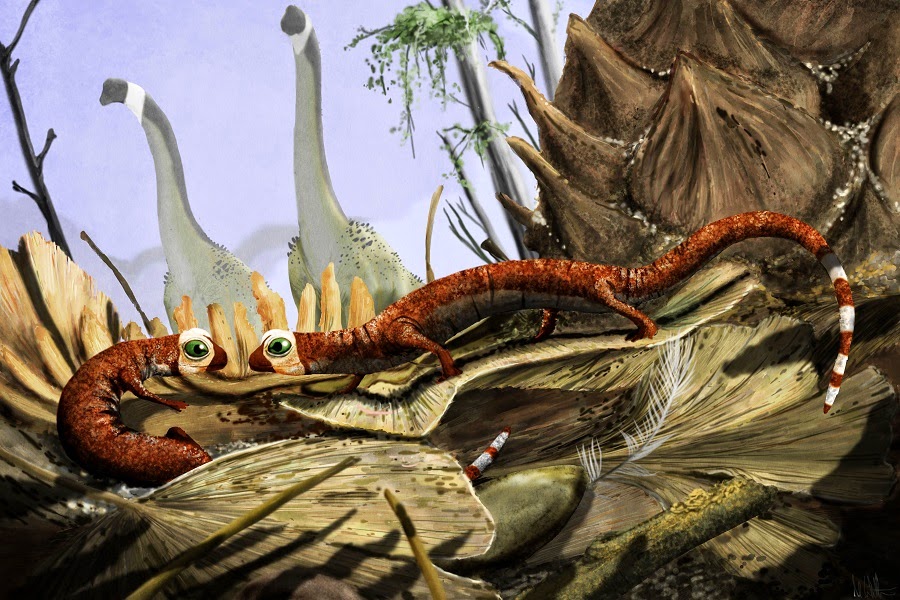
Two Wesserpeton evansae get in each other's faces, because that's what albanerpetontids did. Note this is an updated version of the 2013 press release work referred to below. Prints of this image are available here.
You could be forgiven for thinking otherwise, but the Mesozoic wasn't just the remit of dinosaurs, pterosaurs, marine reptiles and token cool crocodiles. Many other interesting animals shared the world with these famous species, including some that most of us have never heard of. Tuesday of this week saw the (open access) publication of one such animal, the Wessex Formation albanerpetontid Wesserpeton evansae by Steve Sweetman (University of Portsmouth) and James Gardner (Royal Tyrrell Museum of Palaeontology) (2013). Many readers will be familiar with the Wessex Formation or the larger geological unit it is part of, the Wealden Supergroup, because of its frequent mentions as Britain's top dinosaur-bearing deposit. I'm sure many of us are not overly familiar with albanerpetontids, however. This isn't too surprising. To my knowledge, albanerpetontids have never featured prominently in any palaeoart or publications geared towards popular audiences and their existence is largely known only to specialists. The world's naivety to these animals was broken yesterday when Steve and James, with a little help from my painting above, finally told the world why they should add albanerpetontids to their list of cool fossil animals.

Alba-who?
Albanerpetontids are small-bodied amphibians that were fairly common components of terrestrial environments until relatively recently. The youngest members of their clan perished at the end of the Pliocene - about 2.5 million years ago - after an evolutionary run of 160 million years and attaining a wide geographic distribution across North America, Europe, Africa and central Asia. Their general lack of mention in popular press would have you believe otherwise, but they can actually be relatively common fossils. Remains of Wesserpeton are, after crocodiles, the most abundant microvertebrate in the Wessex Formation. Despite their relative abundance, their relationships to other lissamphibians have been debated because many of their fossils are exceptionally scrappy. Traditionally, they have been thought of as caudatans (salamanders) or at least very close relatives. Recent discoveries of complete and articulated albanerpetontid fossils (below) have suggested otherwise however, proposing that they are closely related to a clade containing frogs and salamanders, but not members of any extant amphibian group (McGowan 2002). 

LH 6020, holotype specimen of Celtedens ibericus, a complete albanerpetontid from Lower Cretaceous deposits of Las Hoyas, Spain. Note the 'halo' of scales around the fossil. Snout-vent length of this specimen is 59.5 mm. From McGowen (2002).
The anatomy of albanerpetontids is fairly conservative. They look more-or-less like small salamanders with short limbs and long bodies, but also possess mandibles which interdigitate anteriorly, fused frontals (bones of the skull roof) and relatively flexible necks because of a mammal-like articulation between the skull and neck. They also had bony scales under their skin, a condition which contrasts with the typically thin and delicate skin of most other amphibians. It seems that they spent most of their time burrowing through leaf litter in search of small arthropod prey, with their scaly skin possibly preventing dessication and likely reducing the typical amphibian need for wet or moist environments (but see comments below by the good David Marjanović). Fossils suggest that scales stretched across most of their bodies (we went the whole hog in our reconstruction and covered our Wesserpeton entirely) and onto their eyelids. We thought about these eyelids a fair bit for our painting. The few available depictions of albanerpetontids show animals with eyes perpetually covered with scales, leaving only very small, beady eyes to see with. Steve and I noted that these animals actually have very large orbits however, suggesting that their eyes were probably reasonably sized. It seemed counter-intuitive to possess large eyes and then cover them in soft-tissue, so our reconstruction assumes that the eyelids only partially covered the eyeballs.

Lower jaws of Wesserpeton evansae showing typical (A) and pathological (B) anatomies. From Sweetman and Gardner (2013). 
Small man syndrome
Initially, our plan for the press release painting was to show a single animal reclining in some leaf litter or something equally simple, but Steve suggested early on that we could work in an interesting component of Wesserpeton behaviour. Many Wesserpeton jaws show signs of trauma (above) after being broken during violent acts. The exact cause of this damage is still being looked into and will form the subject of a later paper, but a good preliminary explanation is that Wesserpeton was a vicious species which routinely fought among themselves. Modern salamanders, such as these giants, bite the heads of their opponents before wrestling with each other, twisting and somersaulting with one another to settle disputes over territory and mating access. It's not difficult to imagine such acts taking their toll on the jaws of Wesserpeton, and we thought it would be cool to show this in a press image. Preliminary attempts at rendering this struggled to show the general appearance of the animals however, as their bodies were twisted and their heads obscured by jaws. How could we show the aggressive nature of this animal without actually showing them fighting?

Do you speak salamander? Common body postures used to communicate between individuals of the red-backed salamander Plethodon cinereus. We took panel B as our primary inspiration for the Wesserpeton evansae PR image. Figure and caption from Jaeger (1984).
The solution came in the form of postural language borrowed from modern red-backed salamanders (Jaeger 1984, and above).Most animals will attempt to intimidate their rivals with ritualised postures which enhance their perceived size and strength before coming to physical blows, and there's no reason to think that little albanerpetontids were any different. We decided to use the postures of modern salamanders in our image, setting one of our animals as a dominant pose with a raised trunk and tail, and the other crouched and submissive. In doing so, we implicated the violent nature of this species (enhanced by the larger animal getting in the face of the smaller, just like most douches with attitude problems) but maintained the ability to show their anatomy. Entirely coincidentally, Darren Naish and John Conway recently spoke about incorporating animal postures into palaeoart in Tetrapodcats (sic) episode 6, which makes for interesting listening if you're thinking about making your restored extinct animals communicate more fluidly.

Finally, a quick word on the body size of Wesserpeton. We've mentioned it was small, but how small? The answer is tiny. As in, 35 mm snout-vent length tiny. This thing really puts the 'micro' in 'micropalaeontology'. We prepared another set of press images to show what this means in real life (available in different colours to suit whatever occasion you're at where you want to discuss the size of Wesserpeton):

The United Colours of Wesserpeton, which is dwarfed by the palm of your hand no matter what colour you are.  For some reason, this image makes me want to imagine a world without lawyers.
I'm no expert on this sort of thing, but I'll wager that Wesserpeton is one of the smallest, if not the smallest tetrapod species known from the Wessex Formation, and probably one of the smallest tetrapods in the fossil record. It's fossils were only recovered through bulk sampling tonnes of plant debris bed from the Wessex Formation, horizons rich in plant and vertebrate remains deposited after sheetflood events, and would be almost impossible to find via surface prospecting. Those of you with excellent memories may recall that Steve's ongoing analyses of these beds have revolutionised our understanding of the Wessex palaeobiota, of which Wesserpeton is just one discovery among many. 

And that will have to do for now. Next week: back to the world of pterosaurs with pterosaur mummies, as promised last week before Wesserpeton face-wrestled its way into centre stage. My plan from here on is to have some sort of run-up to the publication of my book, Pterosaurs: Natural History, Evolution, Anatomy on June 23rd, so be sure to stick around if wing membranes are your thing.

References
  • Jaeger, R. G. 1984. Agonistic behavior of the red-backed salamander. Copeia, 309-314.
  • McGowan, G. J. 2002. Albanerpetontid amphibians from the Lower Cretaceous of Spain and Italy: a description and reconsideration of their systematics. Zoological Journal of the Linnean Society, 135(1), 1-32.
  • Sweetman, S. C., and Gardner, J. D. 2013. A new albanerpetontid amphibian from the Early Cretaceous (Barremian) Wessex Formation of the Isle of Wight, southern England. Acta Palaeontologica Polonica, 58, 295–324.

Thursday, 23 May 2013

Another Pterosaurs preview, and the soft bits of Tupandactylus

Tupandactylus navigans reclining by sunset, pycnofibres a-glowing.
Holy Toledo, the publication date of Pterosaurs: Natural History, Evolution, Anatomy is now only weeks away. In exactly one month, preordered copies of the book will be sent out and actual, physical copies of it will be in homes around the world. Forgive me if this sounds indulgent: it's not meant to. It's simply a little mind boggling to think of people paying hard-earned money for the book that, with help from Princeton University Press, I spent over two years writing and illustrating. (Don't forget to add the celebratory Pterosaurs party at the Natural History Museum, London, on September 10th, 2013, to your diary.)

To celebrate this navel-gazing milestone, here's another preview image from the book. It shows the Brazilian tapejarid Tupandactylus navigans at sunset, it's fur-like pycnofibres glowing in the diminishing light. This painting is one of the large paintings that accompanies the start of each chapter and, specifically, it opens Chapter 5: "Soft bits". Each of these large paintings was designed to draw focus to the topic of its chapter. Deciding on the basic composition was easy enough for many chapters, but those focussing on soft-tissue anatomy and osteology proved to be a little bit of a head scratcher. How do you draw specific attention to tissues comprising pterosaur bodies rather than the pterosaur itself? The answer for "Soft bits" at leastseemed to lie in back lighting a pterosaur body so that most of the animal was obscured, save for a halo of illuminated fuzz. Tupandactylus navigans was chosen because it's enormous soft-tissue headcrest (below) contributed to the already unusual outline of a pterosaur body to make a more startling image. "Soft bits" takes on a variety of other soft tissues as well - brains, lungs, guts, skin, wing membranes and so forth - but these seemed harder to bring out without cutting a pterosaur open.

Tupandactylus navigans holotype skull SMNK PAL 2344, showing the crazy headgear sported by some tapejarid species.  Remember that this crest is not the largest worn by a tapejarid pterosaur. From Witton (2013).
In other news, today also saw Christopher DiPiazza post an online interview he conducted with me at Jersey Boys Hunt Dinosaurs. The post contains some exclusive artwork, comments on how to get into palaeontology and a frank reply to the question of "should I undertake postgraduate studies in palaeontology?" I'm not the only chap telling people to be cautious about choosing palaeontology as a career at the moment, and seriously recommend that prospective students thinking about joining the palaeo ladder give that choice some serious thought before taking the plunge. Read why here (question 7).

That's all for this week. Next week: pterosaur mummies!

P.S. 'Tupandactylus' navigans? Who he?
Finally, a quick note on the nomenclature used in this post. Readers familiar with tapejarid taxonomy may notice that I'm treating navigans as part of the genus Tupandactylus, whereas it has typically been referred to Tapejara or "Tapejara" by other workers. The nomenclatural history of navigans is a little complicated. It was initially placed in the genus Tapejara (Frey et al. 2003) along with two other species, T. wellnhoferi and imperator. Two teams of authors independently revised the taxonomy of this genus in 2007, with Kellner and Campos (2007) moving imperator to a novel genus, Tupandactylus and Unwin and Martill (2007) creating another new genus, Ingridia, for navigans and imperator, with the latter as the type species. The work of Kellner and Campos was published just before Unwin and Martill and, because they both used imperator as the type taxon of their respective genera, Ingridia must be considered synonymous with Tupandactylus. Kellner and Campos (2007) hinted that navigans was also probably a member of Tupandactylus, but Darren Naish suggested that it may still warrant generic distinction from imperator in a 2008 Tetrapod Zoology article. navigans has been in taxonomic limbo since then, but recent phylogenetic work (e.g. Pinheiro et al. 2011 and my own studies, presented last year at SVPCA 2012 and hopefully being turned into a fully fledged paper when I get the time) has found support for a navigans + imperator clade which bears out earlier suggestions that these species are congeneric. These discussions about generic labels are fairly arbitrary and someone may eventually decide to generically split navigans from tupandactylus but, until then, it seems reasonable to house navigans within the Tupandactylus stable. 

References
  • Frey, E., Martill, D. M., and Buchy, C. C. 2003.  A new species of tapejarid pterosaur with soft tissue head crest. In: Buffetaut, E. and Mazin, J. M. (eds.) Evolution and Palaeobiology of Pterosaurs, Geological Society Special Publication, 217, 65-72.
  • Kellner, A. W. A. and Campos, D. A. 2007. Short note on the ingroup relationships of the Tapejaridae (Pterosauria, Pterodactyloidea). Boletim do Museu Nacional, Nova Séroe, Rio de Janeiro - Brasil. Geologia, 75, 1-14.
  • Unwin, D. M. and Martill, D. M. 2007. Pterosaurs from the Crato Formation. In: Martill, D. M., Bechly, G. and Loveridge, R. F. (eds) Window into an ancient world: the Crato fossil beds of Brazil, Cambridge University Press, Cambridge, 624 pp.
  • Pinheiro, F. L., Fortier, D. C., Schultz, C. L., De Andrade, J. A. F., and Bantim, R. A. 2011. New information on the pterosaur Tupandactylus imperator, with comments on the relationships of Tapejaridae. Acta Palaeontologica Polonica, 56(3), 567-580.
  • Witton, M. P. 2013. Pterosaurs: Natural History, Evolution, Anatomy. Princeton University Press. [In press]

Thursday, 16 May 2013

Another new Plateosaurus

A modern reconstruction of Plateosaurus engelhardti as a relatively bird-like, bipedal animal rather than a tubby, sprawling  quadruped
It turns out that you can teach an old dinosaur some new tricks. Remains of Plateosaurus engelhardti have been known since at least 1837 but, thanks to a flurry of recent research into its anatomy, posture and gait, we've learnt many surprising facts about this animal in the last few years. The restoration offered here is an attempt to portray this animal in its most recent, modern light and, in many details, it contrasts markedly with reconstructions even only a few years ago.

'New looks' for Plateosaurus are not rare, however. Our perceptions of this dinosaur have been rather changeable since its discovery, and few dinosaurs have been through as many iterations of posture, gait and general appearance. Since its discovery in the early 1800s, we've seen Plateosaurus reconstructed in numerous ways. Perhaps the oldest known reconstruction, by O. Jaekel, dates to 1913-1914 and depicts a very different animal to the one we know today. This frequently proportionally inaccurate image shows a very odd-looking bipedal dinosaur which almost has a therizinosaur-like appearance, but perhaps is better compared to Igor from an early Universal horror film. Later depictions of Plateosaurus were of a sprawling quadruped with a barrel-like chest; an erect biped with a dragging tail; a lithe quadruped capable of galloping; a very sauropod-like animal with straight, columnar limbs and a long, low biped with a heavy balancing tail. These interpretations, and others, have been compiled and thoroughly discussed by Heinrich Mallison, a man who clearly loves Plateosaurus as much as a man can love a fossil species (below, from Mallison 2010a).

The many faces of Plateosaurus, compiled by Mallison (2010a). Check out Heinrich's open-access publication for sources of the reconstructions.
This wealth of conflicting interpretations is odd when we consider that, among non-sauropodan sauropodomorphs and perhaps dinosaurs generally, the osteology Plateosaurus is very well known. Numerous articulated skeletons, some essentially preserved standing in miring muds, inform us about details of limb carriage and girdle configuration (see image, below), but it seems that much of this data was overlooked by scientists and artists restoring Plateosaurus for decades. Once the fine anatomy and taphonomic data of these animals was assessed in detail however, it became very apparent that most of our interpretations of Plateosaurus were simply plain wrong. The palms of the Plateosaurus hand were forever facing medially, like those of theropod dinosaurs and unlike many of the reconstructions shown above (Bonnan and Senter 2007). It's forelimbs had an extremely limited range of motion, which more-or-less only permitted movement beneath the body (Mallison 2010a). When the entire skeleton was reconstructed without disarticulated bones, the narrowness of the chest and shoulders became apparent, contrasting with the enormous bellies of many mounted skeletons and sculptures. The rigidity of its avian-like torso skeleton and disproportionate limbs were also brought to light (Mallison 2010a, b, and references therein).

SMNS F33, one of the most famous articulated fossils of Plateosaurus engelhardti. Note the narrowness of the chest and shoulders. Photograph by Heinrich Mallison, uploaded to Wikipedia Commons by FunkMonk.
In essence, it seemed that virtually all reconstructions of Plateosaurus prior to 2010 were committing some sort of major anatomical sin, requiring disarticulation of bones or over-flexed joints in order to achieve their portrayals. Perhaps most obviously, it seems that quadrupedal locomotion, be it a slight sprawl or a horse-like gallop, was not possible for Plateosaurus (and perhaps most other non-sauropodan sauropodomorphs). Rather, the reach, attitude and length of their forelimbs indicate that they were habitual bipeds, and their centre of gravity dictated that they held their backs subhorizontally. Gone too were the round, barrel-like chests: despite being a  6-10 m long herbivore, Plateosaurus was a surprisingly gracile animal that was perhaps even capable of moving relatively quickly on its powerful back legs. The contrast of this new appearance with some of the older, sprawling reconstructions of this animal is rather pronounced.

(Interesting bonus knowledge to stem from recent Plateosaurus studies include new insights into the suppleness of the Plateosaurus neck, which permitted 360° to their owners. Presumably, this reflects a need to keep an eye out for predatory archosaurs which, in the Late Triassic landscapes occupied by Plateosaurus, would not be predatory theropods but large rausuchians like Teratosaurus. [How come there's not many illustrations of predatory interactions between these species? Would probably make for a cool image]. Perhaps even more interestingly, the pedal claws of Plateosaurus show evidence of being used in scratch digging, which may reveal how these animals dug their nests. Neat stuff indeed.)

Junk about the trunk
But it's not just Plateosaurus specific topics that have fuelled the latest changes in its appearance. It's very likely that the tail of Plateosaurus was more massive and heavy than portrayed in most reconstructions because, along with many other dinosaur species, it bore substantial hindlimb musculature along the base of its tail. We can see how large the hindlimb retractor muscles of dinosaurs should have been by looking at homologous anatomies in lizard and crocodile tails (warning: that link is not for the squeamish), and the take-home message is that most dinosaurs had extremely beefy proximal tail regions (e.g. Persons and Currie 2011). As Heinrich covers here, we can see osteological evidence for expansive, tail-anchored hindlimb muscles in Plateosaurus as clearly as we can in nearly all other Mesozoic dinosaur species. The Plateosaurus anterior tail regions was effectively a big tube of meat bulging from a thread of vertebrae, which were themselves enlarged for the attachment of powerful muscles. In life, the hindlimb protractors would probably run continuously from the tail to the hindlimb, with no obvious 'join' between these two body sections. These bulging tails are a world away from the slender and compressed tails seen in many pieces of palaeoart. Furthermore, all this proximal tail muscle probably reduced the flexibility of the tail somewhat (Persons and Currie 2011) suggesting that another palaoart trope - dinosaurs with laterally wavy, sinuous tails - were probably impossible. The extensive muscles at the base of the tail can only be compressed so far by a wiggling tail. Thus, although the tail bones of Plateosaurus seem to offer a fair amount of lateral motion (below; also see Mallison 2010a), there probably wasn't anything close to that level of flexibility available in life. In the picture above, the tail is deliberately a little lifeless, acting purely as a site for hindlimb retractor muscle anchorage and a counterbalance to the heavy, gut-filled torso.
Digital model of Plateosaurus caudal vertebrae in dorsal view, showing 10° flexion between each joint. From Mallison (2010a).
Feathers? Really...?
So, new posture, new build, new tail, and now new integument? We're very used to seeing Plateosaurus and with virtually all other sauropodomorphs with scales, but this may not have been the case  (hat tip here to recent blog posts on this topic by the Internet's favourite sauropod workers, Matt Wedel and Mike Taylor). Sauropodomorphs may not have provided any fuzzy revelatory fossils over the last few years but, because lots of other dinosaur groups have, the landscape of dinosaurian integument has shifted considerably around their feet. Nowadays, it's a commonly known possibility that dinosaurs, and perhaps all ornithodirans, were ancestrally fuzzy. Although we have a few skin impressions from sauropods (Czerkas 1992; Coria and Czerkas 2007), they remain pretty rare across the group as a whole and, to my knowledge, we don't have any from non-sauropodan sauropodomorphs. Our few scraps of sauropod skin suggest they bore typically archosaurian, non-overlapping scales but, even if that's standard for the group (and, given what we know about modern animal integument, it may well not be), it isn't clear when this trait became a typical part of the sauropod bauplan. Thus, it is not inconceivable that some early sauropodomorphs were feathered and, until we have some direct evidence either way, it's probably just as parsimonious (and, arguably, speculative) to draw them with fuzzy hides as it is with scales. In the case of the picture here, I figured throwing an ostrich-like distribution of feathers over a modern Plateosaurus reconstruction added a suitably symbolic purpose to show how far interpretations of this animal have come since its first discovery.

And that may be enough novelties for one day: time to crack on with other things. Here's hoping that this reconstruction of Plateosaurus will stand the test of time, though I'm sure I'm merely tempting fate with those words. Next week, hopefully, we'll see something to do with animals bearing membranes, because this thing isn't very far from being released on the world any more.

References

  • Bonnan, M. F., and P. Senter. 2007. Were the basal sauropodomorph dinosaurs Plateosaurus and Massospondylus habitual quadrupeds? In: Barrett, P.M. and Batten, D.J. (eds.), Evolution and palaeobiology of early sauropodomorph dinosaurs. Special Papers in Palaeontology, 77, 139-155.
  • Coria, R. A. and Chiappe, L. M. 2007. Embryonic skin from Late Cretaceous sauropods (Dinosauria) of Auca Mahuevo, Patagonia, Argentina.  Journal of Paleontology, 81, 1528-1532.
  • Czerkas, S.  A. 1992. Discovery of dermal spines reveals a new look for sauropod dinosaurs. Geology 20, 1068-1070.
  • Mallison, H. 2010a. The digital Plateosaurus II: an assessment of the range of motion of the limbs and vertebral column and of previous reconstructions using a digital skeletal mount. Acta Palaeontologica Polonica, 55,433-458.
  • Mallison, H. 2010b. The digital Plateosaurus I: body mass, mass distribution and posture assessed using CAD and CAE on a digitally mounted complete skeleton. Palaeontologia Electronica 13.2.8A
  • Persons IV, W. Scott, and Philip J. Currie. 2011. The tail of Tyrannosaurus: reassessing the size and locomotive importance of the M. caudofemoralis in non‐avian theropods. The Anatomical Record: Advances in Integrative Anatomy and Evolutionary Biology, 294.1, 119-131.

Wednesday, 8 May 2013

Ray Harryhausen, 1920-2013

A prehistoric animal being lassoed by cowboys alongside ruined temples in a barren landscape? Sounds like a Harryhausen movie. Oh wait: it kinda was.
There aren't many people in the public eye who I admire, but the pioneering stop-motion artist Ray Harryhausen was one of them. Harryhausen didn't kick start my interest in palaeontology in the first place, but his animated dinosaur sequences were certainly one of the highlights of my dinosaur obsessed childhood. I still watch his films today, both dinosaur-themed and otherwise. In fact, I watched two of them just this weekend. Turns out this was strangely timely: as we all know by now, it was announced that Harryhausen passed away yesterday (7/5/2013) at the age of 92.

I'm not alone among palaeontologists in revering Harryhausen's work. Few other special effects artists in the 20th century could make dinosaurs and other prehistoric animals come alive quite like Harryhausen, and it was perhaps only the sophisticated animatronics and CG effects in 1993's Jurassic Park which clearly superseded his work. Indeed, to appreciate Harryhausen's work fully you had to live in pre-JP times, where movie dinosaurs were generally pretty poorly executed. Before Jurassic Park, most movies dinosaurs were modern lizards and crocs dressed up with horns and sails, shonky animatronics and puppets, or else men in oversize reptile costumes. None of these approaches were terribly convincing. Harryhausen's stop motion models, by contrast, looked and acted like the real thing, battling with people and other creatures as if they were present on set. With very few exceptions, there was simply nothing closer to seeing actual dinosaurs than Harryhausen's animations until 1993. It's hard to chose a favourite scene from his dinosaur works, but in terms of overall execution, I think his Allosaurus attack in the 1966 film One Million Years BC may be among his best (below, borrowed from Apollomovieguy). As with all Harryhausen's creations, the animal in this scene is full of character thanks to subtle movements of its head and body. At times the allosaur comes across as a genuine actor in the production, and one who thinks that the movie is below him. Some of his lazier snaps and turns suggest it's just walking the part rather than playing the ferocious animal it could be. You can almost see it thinking 'well, at least I'll be able to pay the rent this month' as it snaps, idly, at the cavefolk. It's only when it's allowed to run across the set and savage people that it really seems to surrender to the role. I don't mean these a criticisms: Harryhausen's careful animation that gives the animal these little flourishes of character that make his films a joy to watch. There are numerous other examples we could cite of this sort of thing: Talos staggering a little when climbing from his plinth, and is preferentially uses his right hand, in Clash of the Titans (1981); Gwangi tugging at the lasso ropes around his neck with his little arms in Valley of Gwangi (1969) and so forth.


Although we may automatically think of dinosaurs when Harryhausen is mentioned, he actually only made three movies which contain 'proper' Mesozoic dinosaurs: The Best from 20,000 Fathoms (1953), One Million Years BC (1966) and Valley of Gwangi. Indeed, we're only including Beast on a technicality. The plot suggests that the 'Rhedosaurus' creature is a dinosaur, but it looks more like a giant lizard than a theropod. I get the impression that Harryhausen would have liked to have worked with dinosaurs more,  apparently trying to drum up interest for further other dinosaur movies or crowbar them into other productions (Sinbad was meant to meet a ceratopsian in a fourth film in that series). He certainly seems to frequently mention dinosaurs in a favourable light in interviews, and some of his first stop-motion models - made when he was a young teenager, were of famous dinosaur species. He did, of course, animate a short sequence of dinosaurs for the 1956 documentary Animal World, which was his only attempt to show dinosaurs in a natural time and setting*. A few other Harryhausen movies - Mysterious Island (1961) and Clash of the Titans - featured avian dinosaurs, but, in all, he actually made relatively few productions featuring the 'classic' dinosaurs. Much of his filmography is comprised of other fantasy or science fiction fare, so his dinosaur movies are, in fact, a minority of his work. Clearly, his dinosaur scenes were well executed enough to remain prominent in our memories even if, when put together, they only comprise a few minutes of footage.

*Unlike his other dinosaur scenes, the models for Animal World were made from injection foam, a cheaper but inferior material to his preferred medium of layered latex, and the sequence features closeups of awkward looking robotic miniatures. For this and other reasons, Harryhausen was never really happy with his work on Animal World and, although the stop-motion still stands up, it's easy to see why he did not consider it as highly as his other projects.

I find it interesting that palaeontologists are so fond of Harryhausen's work considering his sometimes flippant regard for scientific accuracy. Palaeontologists can be real sticklers for such issues, and Harryhausen had a pretty loose concept of what dinosaurs were like (which may explain his 'dinosaur' in The Beast from 20,000 Fathoms). He frequently over-scaled his animals to make them more formidable, or hybridised different species for dramatic effect. The theropod Gwangi is well known as being a hybrid of Tyrannosaurus and Allosaurus, and he added bat-like wings and owl talons to pterosaurs (see his Pteranodon model, below, borrowed from my Pterosaur.Net post on this very topic). Harryhausen played loose with myths as well. His harpies, featured in the 1963 film Jason and the Argonauts, have bat-like wings instead of the feathered wings described in folklore, and his Medusa, from Clash of the Titans, sports a rattlesnake abdomen not mentioned in any literature on this creature.


Despite his loose interpretation of source material, Harryhausen rarely invented completely novel anatomies for his creatures, even when working with entirely novel concepts. His anatomies always had a source in the real world, and it was his combination of animal components which resulted in different models. It's for this reason that Harryhausen's creations share the same appearance, as some of his anatomical 'building blocks' have a signature style. The Kraken from Clash of the Titan, for instance, has the body resembling his JatA Talos model (down to the navel and nipples, which are curious features on a titan), the head is rather like Ymir from 20 Million Miles to Earth (1957) and the arms are clearly borrowed from the octopus in It Came from Beneath the Sea (1955). These characters all represent very different types of beast - mythological titans, aliens, and giant animals - but they all share Harryhausen's artistic DNA.

For all of his recycling of designs and body parts though, Harryhausen never tweaked his creations so far from their source material that they were unrecognisable. They were enhanced, sure, but never distorted. Palaeontologists watching his dinosaur flicks could feel satisfied that his animals more-or-less looked matched concepts of these animals fashionable in the 50s and 60s. Besides, his animations are too unapologetically focussed on entertainment to warrant harsh scrutiny. You can nitpick Gwangi's anatomy all you like, but you'll be missing the coolest dinosaur round up scene ever committed to film if you do. The plots of Harryhausen's films, which he was often a key producer of, are all about pulpy entertainment and nothing more. They appeal to the little boys and girls in all of us, and aren't asking for detailed critiques of their stories, scientific plausibility or even scripts and acting. Can anyone in touch with their inner child honestly say that they're not interested in watching cowboys round up a tyrannosaur, or a dinosaur destroying a lighthouse? Harryhausen's ideas are simply so charismatic that they're practically immune to scientific criticism.


Harryhausen's legacy is not just one a charismatic storyteller and skilled special effects artist, however. It's well known that Harryhausen was one of the signature stop-motion artists of the 20th century, but the fact that he saved stop-motion as an artform in the 1940s and 50s isn't common knowledge. Early stop-motion techniques pioneered in films like The Lost World (1925) and King Kong (1933) by Harryhausen's mentor, Willis O'Brian, were wonderfully executed but extremely time consuming and expensive, even by standards of stop-motion photography. O'Brian's techniques employed setting several painted landscapes on glass between his animated models and the camera, thus creating the impression that the creatures were set in middle distance. The process of painting these landscapes and compositing these shots, in addition to animating the models and other technical work, was so intensive that most studios were unwilling to invest the necessary time and money into stop motion work. Harryhausen's childhood interest in stop-motion animation, fired by multiple viewings of King Kong and some very supportive parents, allowed him to develop matting techniques which negated the need for painted glass landscapes, in which components of the filmed footage could be re-photographed on top of the animated scene. This cut the time and material costs of stop-motion processes drammatically, and he pioneered this technique, which he would eventually call 'dynamation', before he landed his first solo job on a motion picture. Dynamation was first put to the test on the low budget Beast from 20,000 Fathoms, and Harryhausen delivered his work for a fraction of the cost of traditional stop motion. Without this revolution in stop-motion, the artform as we know it may never have happened. That may not seem like a big deal to us now in a time of CG effects, but bear in mind that Jurassic Park was greenlit with a sophisticated form of stop-motion in mind.


In his career, Harryhausen more-or-less single handedly lent his dynamation craft, and other special effects wizardry, to something like 16 motion pictures (see compilation, above, by Vidar Solaas). If the testimonies of the numerous fans and film makers are accurate, the movie world would be a very different place without them. There's so much more we could say about Harryhausen: his abilities as an artist and sculptor, the vast numbers of films he designed that were never made (War of the Worlds with Harryhausen tripods!), the many, many stories he has shared about making his films, but there's simply not enough time to relate even a fraction of them here. If you want to know this sort of stuff, though, I thoroughly recommend you track down either his richly illustrated autobiography and collected artworks, or the recent critically acclaimed documentary Ray Harryhausen: Special Effects Titan.

On that note, it's time to get on with other things. Thanks then for everything, Ray, you will be missed.