Thursday, 13 February 2014

Episode 1: Diminutive, adaptable atoposaurids

There's only one rule in successful advertising: if you can't use sex, use Star Wars. Background borrowed from NASA, text generated by Fontmeme.
Welcome to The Wealden Crocodyliformes Trilogy! As in, three whole posts dedicated to the major types of Wealden Crocodyliformes! Yeah! Woot! Let's all have a pear!

Right, let's back up a bit. Hopefully, it’s well known that modern crocodilians represent only a tiny fraction of crocodile-line archosaur diversity. Crocodyliformes, the major group of crocodile-like archosaurs which ultimately begat our modern crocodile fauna, was ancestrally much more morphologically and ecologically diverse than its modern representatives. This is true to the point that the common labelling of crocodilians as ‘living fossils’ is only true in a very loose sense. Superficially crocodile-like Crocodyliformes have certainly been around for well over 100 million years, but even some of their close relatives were very different beasts. Despite this - hopefully – widely known fact, reconstructions of ancient Crocodyliformes, or even articles about them, are not exactly commonplace. Running through the major types of crocodyliform once found in Lower Cretaceous Britain, specifically those from the Wealden Supergroup, gives an opportunity to at least scratch the surface of Mesozoic crocodyliform diversity. Wealden Crocodyliformes are diverse, with 11 species identified in a recent review (Salisbury and Naish 2011). As with many Wealden groups, the long research history of these animals (Wealden crocodyliform teeth were first found in the 1820s) does not mean they have been 'done' by palaeontologists - there remains much to learn about Wealden crocodylomorph palaeobiology. Indeed, at some point in this trilogy, we'll cover a cool, new and in-press discovery - more on that later, as I've already said too much.

A key point to note in each of these articles is the major anatomical differences these animals have from modern crocodiles, meaning that not only their lifestyle but also appearance would contrast from anything we associate with Crocodyliformes today. This is despite the Wealden Crocodyliformes not, by any stretch of the imagination, representing the most 'extreme' bauplans offered up by the croc-line archosaurs. This message should ring particularly loudly for artists who simply place modern crocs in the Mesozoic (a crime I'm as guilty of as anyone). All right, enough preamble already – let’s meet our first subject, the resourceful, tiny atoposaurid crocodyliform, Theriosuchus.

Neat things come in small packages
Our fist Wealden crocodyliform is a far cry from the role of large, voracious apex predator we often think of when crocodiles are mentioned. At only 550 mm long, Theriosuchus was tiny compared to most Wealden Crocodyliformes and likely risked predation from even moderately-sized contemporary predators. Theriosuchus is a long lived genus known across Europe and Asia from Late Jurassic – Late Cretaceous deposits and several species are known. Wealden fossils of this animal – a partial skull from the Wessex Formation and isolated teeth from the Ashdown and Wadhurst Clay Formations of East Sussex – are too fragmentary to refer to any existing species, or permit identification of a Wealden-specific one. For the time being then, the Wealden Theriosuchus is simply referred to as Theriosuchus sp.
The Lower Cretaceous, Wealden atoposaurid, Theriosuchus sp., prancing about in pursuit of locusts. 
Theriosuchus belongs to Atoposauridae, a group of neosuchian Crocodyliformes which are seem closely related to the group containing modern crocs, Eusuchia. Atoposaurids possess several 'derived' eusuchian features in their nasal and vertebral regions, hinting at a possible close relationship with this group (fun fact: classic 'eusuchian' features actually evolve repeatedly in ancient Crocodyliformes, which can confound taxonomic assessments of fragmentary fossil crocodyliform material - more on this later). The most distinguishing feature of atoposaurids is their size. Even when fully grown, no atoposaur exceeds one metre in length. They are correspondingly sometimes labelled as 'dwarf’ species, but this label is not an entirely accurate. So-called ‘dwarf’ species are not uncommon (elephants, deer, many lizards and crocodilians are just some lineages containing 'famous' dwarfs) but - by definition - they must be descended from closely related, larger relatives. All currently known atoposaurs are small, so they cannot be said to have reduced their size from their ancestral condition. Thus, they are not true ‘dwarf’ Crocodyliformes, just small ones.

Although unquestionably crocodile-like, the life appearance of Theriosuchus probably wasn't strongly comparable with any modern animal. Broadly, atoposaurids recall attributes of crocodiles and long-legged lizards, but their relatively svelte skeletons and long limbs are also vaguely reminiscent of some small mammals. Their skulls are rather low and short, thanks to an unusually abbreviated and broad snout which tapers into a rounded muzzle. Unlike many Crocodyliformes, atoposaur nasal openings remain separated and placed on the lateral margins of the snout tip, rather than being combined into a single opening on the upper snout surface. Their eye sockets are proportionally large but an opening in the skull above and behind the eye, the upper temporal fenestra, is rather reduced. This suggests that at least some of their jaw muscles were not as large as the famously enormous jaw muscles of modern crocodiles. Atoposaurid body proportions are rather typical of Crocodyliformes with short necks, tubular trunks and a tail of moderate length, but the limbs of Theriosuchus and most other atoposaurids are rather longer and more gracile than we've come to expect from croc-line archosaurs (this is not universal across the group: other atoposaurids have rather squatter limb proportions). Two rows of square or rectangular, keeled osteoderms extended along the neck, back and tail, becoming slightly more prominent on the tail. Most are pretty flat, so atoposaurid backs would look considerably less ornate than those of modern crocodilians. In Theriosuchus at least, the dorsal osteoderms possess ‘peg and groove’ joints which locked each osteoderm into its neighbour, forming a relatively immobile bony sheet along the back. This feature is not common to all atoposaurids, but is found in some other Crocodyliformes - albeit not modern ones. It's thought that this locking mechanism provided more than just reinforcement of  the armour along the animals back, also helping to resist bending and twisting movements in the torso when the animal walked or ran. Additional osteoderms occur beneath the tail and neck.
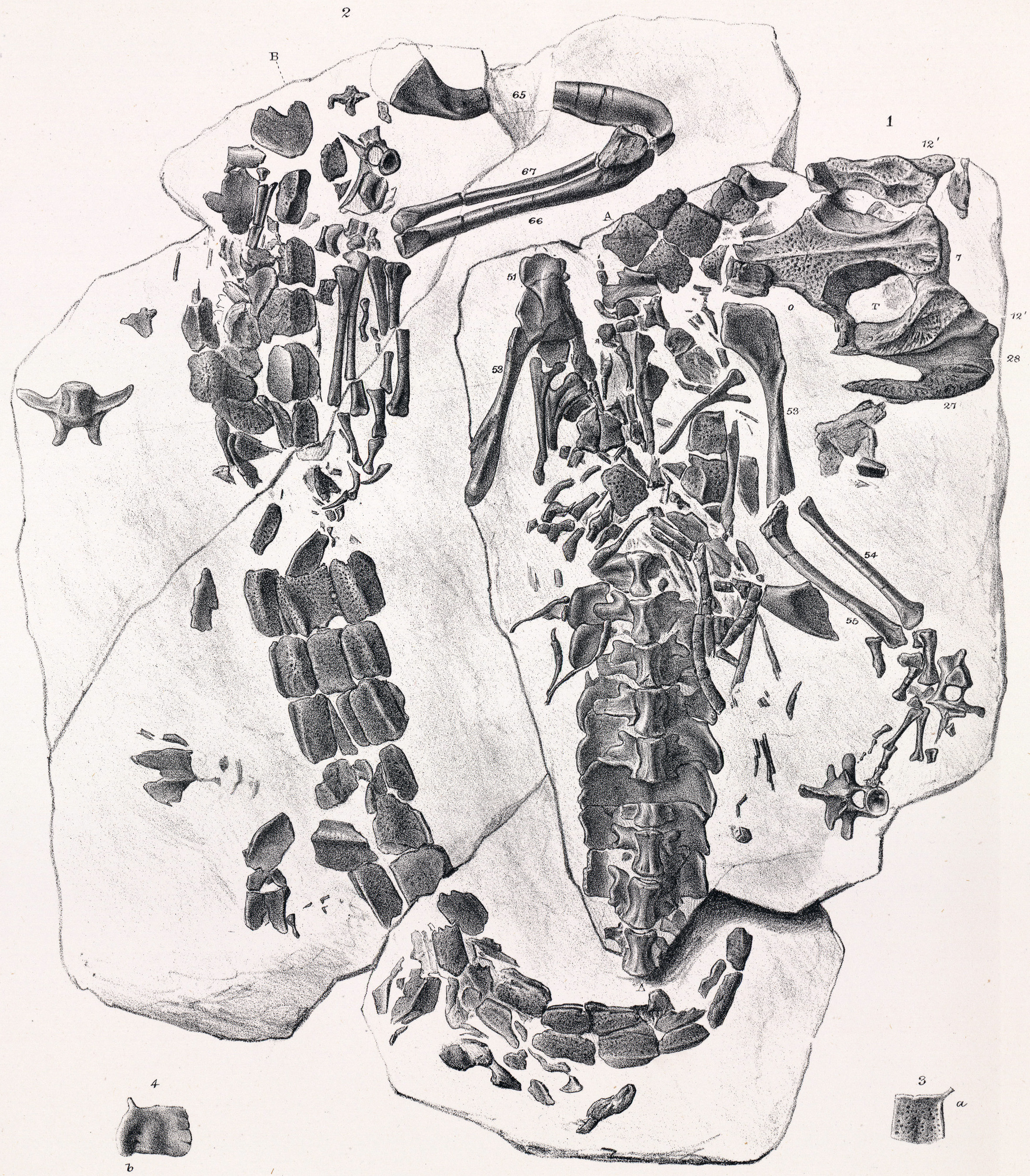
Theriosuchus pusillus, one of the best known members of this genus, from the lower Cretaceous Lulworth Formation, UK. Image from Owen (1878), borrowed from Wikimedia Commons.
Like many Crocodyliformes, the teeth of Theriosuchus are deceptively complex. The teeth lining the jaw tip are rather conical with slight striations and carinae, while those behind become rather lance-shaped - longer than wide, with a pointed apex. The carinae of these teeth are rather coarser than those at the jaw tip. In some Theriosuchus species, the teeth at the back of the mouth are compressed into blade-like structures with particularly coarse serrations. Two peaks in tooth size can be seen in atoposaurid jaws, the first occurring with a large conical tooth which forms a ‘psuedocanine’, and the second (smaller) peak among the anterior lance-like dentition. A notch in the side of the upper jaw means that the ‘pseudocanines’ were probably visible even when the mouth was closed. Put together, the dentition of Theriosuchus was multifunctional and ideally suited to processing soft prey items: the anterior teeth could pierce and stab; the lance-shaped teeth could crush and cut, and the blade-like teeth (if present) could shear and rip into soft-food.

Raccoon-crocs?
The dentition of Theriosuchus suggest that, like other atoposaurids, it may have been primarily carnivorous, likely foraging for small vertebrates, arthropods and carrion. As in modern crocodiles, their diverse teeth may have also permitted ingestion of nutritious plant matter. Unlike modern crocodiles however, several features of atoposaurid anatomy suggest they found much of their prey away from aquatic settings. Relatively long limbs increased their stride distances, allowing for potentially rapid locomotion, while their interlocked osteoderms likely reduced the strain of walking and running on the trunk skeleton. The latter is likely true of all Crocodyliformes with interlocking osteoderms, but Theriosuchus was also a small, lightweight creature, thus reducing strain on its trunk even further when walking. Put together, the combination of small body size and a reinforced back may have allowed Theriosuchus to sustain long periods of walking and running compared to other Crocodyliformes. The general rarity of atoposaurid fossils compared to those of other Crocodyliformes - both in the Wealden and elsewhere - lends some support to this idea: animals which spend a lot of time in water generally have a higher preservation potential than those which don’t, simply because their remains are that much closer to environments where sediments are likely to accumulate and bury them.

Aquatic behaviour for Theriosuchus cannot ruled out, however. While the osteoderm bracing system likely limited their torso flexibility - thus somewhat impeding the ability for rapid and manoeuvrable swimming - the retention of a powerful, flexible tail and low body shape probably still permitted fair swimming performance. Thus, it is quite possible that terrestrial food sources were supplemented with diminutive fish and other small aquatic prey from time to time. Atoposaurids like Theriosuchus may be best regarded as very adaptable, generalised species which, if we were forced to crowbar them into a modern niche, may be most equivalent to small, semiaquatic mammalian carnivorans – raccoons, otters and so forth. Their generalised diet means that Theriosuchus probably competed for food with lizards and amphibians more than their fellow Crocodyliformes, and perhaps their ability to forage on land and in water, in concert with low body sizes, gave Theriosuchus an edge in a crowded Wealden ecosystem filled with many aquatic and terrestrial predators. Thus, while many Wealden animals were probably relatively restricted to specific foraging habitats and prey types, Theriosuchus could forage freely in both settings, resourcefully enjoying whatever morsels it could wrap its tiny jaws around.

The crocodyliformes we'll meet in the next instalment of The Wealden Crocodyliformes Trilogy are not quite as ecologically generalised as Theriosuchus - aspects of their size, dentition or proportions dictate that they had to commit to at least some lifestyle specifics. To see what they are, and how they fit more broadly into Wealden palaeoecology, you'll have to come back for Episode 2...

References

  • Owen, R. (1879). Monograph on the fossil Reptilia of the Wealden and Purbeck Formations. Supplement IX, Crocodilia (Goniopholis, Brachydectes, Nannosuchus, Theriosuchus, and Nuthetes)". Palaeontographical Society of London Monograph 33: 1–19.
  • Salisbury, S. W. & Naish, D. (2011). Crocodilians. In: Batten, D. J. (ed.) English Wealden Fossils. The Palaeontological Association (London), pp. 305-369.

Wednesday, 15 January 2014

Baryonyx Begins

Baryonyx walkeri, the famous, much discussed spinosaur from Lower Cretaceous Britain. A number of goniopholidids skulk in the foreground. Prints of this image can be obtained from my print store.
I assume that most people want to read new stuff when they're browsing online, and I try to take the same attitude to my own blogging. I'd much rather offer fresh perspectives or cover rarely-discussed issues than simply rehashing the same tried and tested material that we've all picked up from elsewhere. This explains why the image above, showing the famous Lower Cretaceous British spinosaurid Baryonyx walkeri, has sat on my hard-drive since November. Drafted for a project which needed a picture of a theropod, it's been collecting dust for ages while I've been wondering what to say about it here. Problem is, we all know too much about Baryonyx. It's well known that the 1986 description of Baryonyx provided the first real look anyone had ever had into spinosaur anatomy; that spinosaurids have kinda weird, superficially-crocodile like skulls which permitted feeding on a variety of prey which included fish and other dinosaurs; that the forelimb anatomy of this group, formed of robust arms and large claws, is particularly interesting... The list of things we all know about Baryonyx goes on. Is there anything left to say about this animal which hasn't been poured over dozens of times before?

Hopefully, this
There may be one component of Baryonyx palaeontology which, while hardly unknown, at least doesn't get mentioned too often. When considering the discovery of Baryonyx, we imagine the story starting in 1986 or perhaps, in 1983, when the holotype specimen was found. Eric Buffetaut's (2010) research into early spinosaurid discoveries suggested this tale warrants a prequel however, one which started a whopping 160 years before Baryonyx was found. As with other British dinosaurs such as Iguanodon and Cetiosaurus, Baryonyx also has a long history which dates back to the first dinosaur discoveries, and it even stars A-list 19th century palaeontologist celebrities.

Our story begins around 1820, when Gideon Mantell recovered, or was given, a series of conical, sharp teeth from the same Tilgate Forest quarries which would later yield the first bones of Iguanodon. These teeth came in three flavours, all variations on a conical shape with differing degrees of slenderness and curvature. They all clearly belonged to carnivorous animals. Of interest here are teeth that Mantell characterised as being paritcularly slender, laterally compressed, with carinae on the anterior and posterior margins and distinct grooves on the lingual and labial surface. To Mantell, the teeth resembled those of long-snouted crocodiles or perhaps, at the suggestion of his mentor in comparative anatomy, William Clift, monitor lizards. Mantell first put these throughts into print in 1822 and in several other publications throughout the 1820s, favouring their crocodilian identification and making repeated positive comparisons to long-snouted Crocodyliformes such as gharials and the extinct teleosaurs.

Cuvier's (1824) illustration of Mantell's Wealden 'crocodile' tooth, left, compared to the actual specimen. From Buffetaut (2010). Image borrowed from here.
Mantell was not the first to illustrate these strange Wealden teeth however. This accolade belongs to Baron Georges Cuvier who, having been sent teeth for analysis by Mantell, proceeded to illustrate them in 1824 (above). Cuvier was not above illustrating unusual fossil specimens even when his peers had more claim to the prestige of publishing them first, having also done this with Iguanodon material. Cuvier's 1824 illustration and discussion of Mantell’s alleged crocodyliform teeth agreed with Mantell’s identification, also positively comparing them with the teeth of animals we would ultimately call teleosaurs. Far from being miffed with Cuvier partially scooping his discovery, Mantell seemed chuffed that he and Cuvier were in agreement in documents published in the late 1820s. Perhaps this came as a relief after Mantell's Iguanodon teeth were identified those of a rhinoceros by Cuvier: having one of the leading comparative anatomists in the world shoot your ideas down - even if he's wrong - can't do much for one's self esteem.

A few years later saw entry of Sir Richard Owen into discussions of Mantell’s alleged crocodyliform Wealden teeth. In Owen’s seminal Odontography, a major overview of animal teeth published from 1840-1845, he named them Crocodilius (Suchosaurus) cultridens. Like Cuvier and Mantell, Owen also made several favourable comparisons between the Wealden teeth and other fossil Crocodyliformes, including teleosaurs*. In a contemporary work, Report on British Fossil Reptiles (1842), Owen noted some subtle differences between the cross-sectional shape and carinae position of the Wealden teeth and those of crocodiles, although he maintained a crocodyliform referral for the teeth at this time. Later, Owen seemed less certain about this identification, noting in an 1878 publication that his subgenus Suchosaurus had a ‘nearer affinity or transition to the Dinosaurian order than does any of the Mesozoic Crocodilia’. This was the first clear indication that all was not as seemed with Mantell's early Wealden discovery. However, an 1884 Owen manuscript which basically rehashed his 1878 discussion of Suchosaurus, contained none of the doubt he expressed in 1878. Clearly, Owen had changed his mind about the similarity of the Mantell's 'crocodile' teeth to those of dinosaurs.

*The story becomes somewhat complicated here by the referral of a vertebra to Suchosaurus, which was suggested as early as 1888 to represent an iguanodont and remains that way today. However, this was not immediately accepted by 19th century naturalists and it is not is not always clear if they are discussing the vertebra or teeth when considering the affinities of Suchosaurus.

Most 19th century palaeontologists followed Owen’s lead in considering Suchosaurus a crocodile-like animal, but others were not convinced. Felix Plieninger (1846) and John Hulke (1979) both suggested that Suchosaurus had greater affinity with Dinosauria than other reptiles. Plieninger was definitely basing his discussion on the Suchosaurus teeth, although it's not clear whether Hulke is considering these or the vertebra also referred to this taxon. Other authors, such as Heinrich Georg Bronn (1849) considered Suchosaurus a reptile of uncertain identity, at least for a while (he later agreed with Owen). The mystery surrounding Suchosaurus was more-or-less left there however, as these were among the last discussions Suchosaurus was to receive in palaeontological literature. Although a second Suchosaurus species was named in 1897-1898 for a Portuguese tooth, the taxon fell out of regular use in discussions of Wealden animals – even its Crocodyliformes – in the 20th century.

Back to the future
Fast forward to the 1980s and, to everyone’s delight, Baryonyx walkeri was discovered and described from a fairly complete skeleton found in Surrey. Among the many surprises associated with its discovery were its slender, laterally compressed and grooved teeth, a distinctive dentition that saw any similar isolated tooth from the Wealden being allocated to Baryonyx (e.g. Martill and Hutt 1996 - see below). It didn’t take long the penny to drop: by 2003 it was realised that the teeth of Baryonyx were very, very similar to those of Suchosaurus (Milner 2003). After nearly 200 years, the real identity of Suchosaurus was revealed: a spinosaurid theropod. This meant that, far from being relatively new discoveries for the Wealden, spinosaurs were actually among the very first animals to be documented from the British Lower Cretaceous. Hats must be tipped to the likes of Plieninger and Hulke and, to a lesser extent, Owen and Bronn, for their insightful taxonomic comments on the very fragmentary material they had to work with. Each of them saw, to greater and lesser extents, past the crocodile-like appearance of the Suchosaurus teeth to suggest they may be crocodile-like dinosaurian reptiles. That's pretty good going considering what they had to work with.
Isolated teeth attributed to baryonychine theropods from the Wessex Formation, Isle of Wight. From Martill and Hutt (1996).
Unsurprisingly, several authors have mentioned the likelihood that Suchosaurus and Baryonyx are one and the same (e.g. Buffetaut 2010; Mateus et al. 2011). Although their teeth do differ in subtleties of carinae and groove development, it has long been noted (even by Mantell way back in the 1820s) that such particulars of dentition are readily worn away in life or taphonomy. It is therefore possible, maybe probable, that Suchosaurus and Baryonyx are synonyms, the teeth of the former simply being worn versions of the latter. If so, the animal we know as Baryonyx was actually one of the first dinosaurs ever found. But if it's likely that Baryonyx and Suchosaurus are the same animal, why are we still talking about Baryonyx instead of resurrecting Suchosaurus as the Wealden spinosaurid genus? There are several reasons. Firstly, the dentition of Baryonyx is not unique among baryonychines, creating the (admittedly unlikely) possibility of Suchosaurus being synonymous with another baryonynchine taxon. A second possibility, that Suchosaurus is a second Wealden baryonychine, presents another problem. But most important is our third reason: the type material of Suchosaurus possesses no real defining features, giving us nothing to diagnose this genus with. This echoes the situation of many ‘classic’ dinosaur species of course, and palaeontologists sometimes work taxonomic magic to transfer their name to other, diagnostic specimens. There seems little reason to do this for Suchosaurus however, it being a fairly obscure and under-discussed animal for much of the 20th century. Unlike Iguanodon or Allosaurus, which have received name transfer treatment in the past, Suchosaurus is not a familiar animal with a poor type specimen, so it isn’t too criminal to refer the type specimen to Spinosauridae indet. and let the name Suchosaurus slip into the nomen dubium realm of obscurity.

So there we have it, then: Baryonyx and Wealden spinosaurids have, from a certain point of view, been known for as long as any other dinosaur you care to mention, and some folks had an inkling of spinosaurid's superficially crocodile-like morphology even when they were only known from teeth. For more on this story and the early discoveries of spinosaurids, be sure to check out Buffetaut (2010), Mateus et al. (2011). To find out happened to the rest of the 'crocodile' teeth handled by Mantell in the 1820s, read Salisbury and Naish (2011). Further, exciting news on the developing science of Wealden spinosaurs can be found in this near-recent blog post over at Mark Wildman's Saurian.

References
  • Bronn, H. G. (1849). Index Palaeontologicus, 2. Abetheilung. Schweizerbart, Stuttgart.
  • Cuvier, G. (1824). Recherche sur les ossemens fossiles, tome V, 2ème partie. Dufour et E. d'Ocagne, Paris.
  • Hulke, J. W. (1879). Vectisaurus valdensis, a new Wealden dinosaur. Quarterly Journal of the Geological Society, 35(1-4), 421-424.
  • Mantell, G. A., & Mantell, M. A. (1822). The fossils of the South Downs; or illustrations of the geology of Sussex. Lupton Relfe, London.
  • Martill, D. M., & Hutt, S. (1996). Possible baryonychid dinosaur teeth from the Wessex Formation (Lower Cretaceous, Barremian) of the isle of Wight, England. Proceedings of the Geologists' Association, 107(2), 81-84.
  • Mateus, O., Araújo, R., Natário, C., & Castanhinha, R. (2011). A new specimen of the theropod dinosaur Baryonyx from the early Cretaceous of Portugal and taxonomic validity of Suchosaurus. Zootaxa, 2827, 54-68.
  • Milner, A. C. (2003). Fish-eating theropods: a short review of the systematics, biology and palaeobiology of spinosaurs. Journadas Internacionales sobre paleontologiá de Dinosaurios y su Entoro, 2, 129-138.
  • Owen, R. (1840–1845). Odontography. Hippolyte Bailliere, London.
  • Owen, R. (1842). Report on British fossil reptiles. Part II. Reports of the meetings of the British Association for the Advancement of Science, 11, 61-204.
  • Plieninger, T. (1846). Über ein neues Sauriergenus und die Einreihung der Saurier mit flachen, schneidenden Zähnen in eine Familie. Jahreshefte des Vereins für vaterländische Naturkunde in Württemberg, 2(1), 148-154.
  • Salisbury, S. W. & Naish, D. (2011). Crocodilians. In Batten, D. J. (ed.) English Wealden Fossils. The Palaeontological Association (London), pp. 305-369.

Friday, 10 January 2014

The abundant, apocalypse-surviving, rocket-propelled Valdosaurus: Britain's most interesting dinosaur?

Two Wealden dryosaurids Valdosaurus canaliculatus, argued below to be striking and exciting animals that we should all be enthused about, shown here milling about a Lower Cretaceous woodland, not doing very much. Prints of this image are available here.
The wide interest palaeontology receives is largely because many fossil animals are spectacularly charismatic, their popularity enhanced by large body size and terrific anatomical features. Not all fossil animals are well adorned with attention-grabbing anatomy, of course. Some animals, even those belonging to particularly famous groups like marine reptiles, pterosaurs or dinosaurs, are devoid of immediately-striking features and proportions, and may be so 'average' that they rarely receive dedicated attention outside of technical literature. Step forward the most middling, most average and downright beigest of all ornithopods, the dryosaurids.
Mounted skeleton of the Jurassic dryosaurid Dysalotosaurus lettowvorbecki in the Humboldt Museum's excellent dinosaur hall. Photo by Masur, from Wikimedia Commons. Beige.

The Jurassic-Cretaceous clade Dryosauridae contains animals which, at first glance, represent the mean of dinosaur extremes. Most of these animals, early offshoots of the ornithopod group Iguanodontia, are small or medium-sized, at 3-4 m long. They have fairly short, unremarkable ornithopod skulls and small grasping hands which are, well, quite a lot like those of other small-ish ornithopods. They possess no horns, claws or even particularly arresting teeth, their jaw tips being entirely toothless and cheek teeth, as with most ornithopods, being leaf-shaped and coarsely serrated. This restricted them to a diet of leaves and other herbage, and there's not even any strong hints of omnviory. In short, they aren't especially cute, aren't really spectacular, and, to look at one, it's hard to find a truly distinctive, memorable feature. Perhaps this is why the only time they're given decent palaeoartistic renditions is when they're being pursued by a more striking theropod, and are relegated to bit-parts and cameo roles in most dinosaur books and palaeodocumentaries.

You knew there was a 'but' coming
As usual, appearances can be deceiving. There's actually a lot more going on with these dinosaurian plain Janes than casual glances may suggest. If you stare at a skeleton of a dryosaurid long enough, the pronounced difference in their fore and aft proportions becomes inescapable. The head, neck, forelimbs and torso belong to much smaller dinosaurs than their legs and tail, which are proportionally much longer and more robust than we'd expect from their anterior skeleton. This enlarged posterior region does not seem to reflect expansion of the gut either, as it does in some other herbivorous dinosaur species. Rather, the pelvic bones betraying the depth of the belly are fairly shallow, suggesting the legs and tail are long for the sake of being long, not to accommodate increased body size or torso girth. Of further note are dryosaurid feet, which are not only surprisingly long and gracile but also possess a mere three toes, a contrast to the primitive ornithopod condition of four. Their femora have a very long, finger-like fourth trochanter (the variably shaped process on the posterior surface of dinosaur femora which anchored posterior hindlimb muscles) and a very large and prominent scar occurs where the famous caudofemoralis musculature anchored to the thigh. As in all dinosaurs, this muscle ran to the anterior portion of the tail (discussion here), the elongation and deepening of which permitted a great deal of room for its attachment.

Put together, these femoral and caudal features are clear indicators of large hindlimb retractor muscles and, along with the svelte body and long legs, betray the habit of very rapid running. Indeed, the cursorial features of dryosaurids are so marked that they were probably among the swiftest of all ornithischians, a trait which may explain their conspicuous lack of ornament, armour and weaponry compared to other dinosaurs. Such elaborations are not without use of course, but they are just extra weight for a running animal. Thus, rather than thinking of dryosaurid skeletons as boring, we should view them as the bones of lithe, streamlined, athletes. I wonder if we'd consider these animals dinosaurian Mr. Averages if we could see them in life, their running abilities likely making them very striking and conspicuous animals in many Jurassic and Cretaceous ecoystems.

Britain's Cretaceous dryosauid: Valdosaurus
Dryosauridae was a widespread group with fossils occurring in Africa, Europe, North America and New Zealand. One British dryosaurid, the Wealden Supergroup taxon Valdosaurus, has become particularly interesting in recent years. Bones ultimately referable to this genus were described from the Wessex Formation, Isle of Wight, as early as 1888 by Richard Lydekker. They were not recognised as being Dryosaurus-like until the 1970s however, the decade which also Valdosaurus canaliculatus receive its name (Galton 1977). A second Valdosaurus species was erected for Nigerian material by Galton and Taquet (1977), but has since been moved to its own genus, Elrhazosaurus. It took a while to appreciate that dryosaurids were a unique radiation of ornithopods rather than merely oversized versions of Hypsilophodon, with the first inclinations of this idea only appearing in the 1980s. Somewhat surprisingly, the monophyly of Dryosauridae was untested for many decades, but has recently been borne out under phylogenetic analysis (e.g. McDonald et al. 2010; Barrett et al. 2011). Alleged Valdosaurus material from Spain and Romania seemed to extend the range of this animal across Europe, but these referrals have not withstood scrutiny: Valdosaurus remains UK-only for the time-being.
Holotype femur of Valdosaurus compared to those of other small ornithopods. Note the size of the scar for M. caudofemoralis, 'p', in Valdosaurus. Figure and caption from Galton and Taquet 1977.
As usual for a Wealden dinosaur, Valdosaurus isn't known from a huge amount of material. Various bits and pieces have been referred to this taxon for decades but, like many other British dinosaurs, recent work has tightened up what can and cannot be referred to it (Barrett et al. 2011). We now consider Valdosaurus known primarily from hindlimb and pelvic remains, along with some vertebrae and portions of the pectoral girdle. These remains suggest Valdosaurus was a large dryosaurid with a body length of about 4 m, and a particularly well-distinguished, large caudofemoralis muscle scar on its femur (Barrett et al. 2011). Does this mean it had a particularly big set of hindlimb protractors and was especially fleet-footed? Maybe, but it's hard to say in the absence of more complete specimens. Still, assuming the rest of its proportions were like those of other dryosaurids, it was probably the fastest ground animal in the Wealden Supergroup and capable of outrunning any contemporary predator.

Valdosaurus: apocalypse survivor?
What makes Valdosaurus especially interesting and unique among Wealden dinosaurs is its longevity. The Wealden dinosaur fauna is essentially divided into two groups: a 'lower' and 'upper' assemblage. The 'upper' contains the most widely known taxa, animals such as Iguanodon, Polacanthus, Baryonyx, Hypsilophodon, Neovenator and the like. These animals occur in rocks dating to the Hauterivian and Barremian, about 133-125 Ma. The 'lower' fauna features slightly lesser known taxa: Barilium, Hylaeosaurus, Pelorosaurus and so on, all of which are of slightly older, late Berriasian-Valangian vintage (138-133 Ma). The transition between these faunas is not continuous, with a series of poorly-fossiliferous Hauterivian-aged strata - representing about 4 million years - occurring between more productive Wealden rocks. William Blows has proposed across several papers that this gap may not merely be an artefact of sampling (although this remains possible), but a low-level extinction event that wiped out the 'lower' fauna and allowed the 'upper' assemblage to repopulate (e.g. Blows 1998). Not all agree that this apocolyptic interpretation is the most likely explanation of the Hauterivian Wealden dinosaur gap - some argue that we just need to look harder for more bones. Whatever, something clearly caused a lot of upset for the Wealden dinosaur fauna in the Hauterivian, resulting in significant reorganisation of dinosaur faunas by late Hauterivian-Barremian stages: old taxa disappeared, and new ones - sometimes entirely different clades - replaced them.

How does Valdosaurus fit into this? Although classically part of the 'upper' Wealden assemblage, Valdosaurus is now known to occur in the 'lower' fauna (e.g. Blows 1998; Naish and Martill 2008; Barrett et al. 2011). This makes it the only dinosaur to span the Hauterivian gap, suggesting it lived through whatever turned out the older Wealden dinosaurs and brought in the new. It must be stressed that the older Valdosaurus remains are not terribly complete and may not be V. canaliculatus proper, but they are extremely similar to Valdosaurus remains from the 'upper' Wealden and at worst, they represent a very close relative, perhaps a direct ancestor. Of further interest here are recent reconsiderations of Valdosaurus/dryosaurid abundance within the Wealden. Dryosaurs were once considered rare in these deposits, but ongoing appraisals of British Lower Cretaceous dinosaurs suggest they were far more abundant than once realised, and populous enough to question the dominance of iguanodonts in Wealden herbivore palaeoecology (Barrett et al. 2011). Given that Valdosaurus represents a good chunk of the Wealden dryosaur material, we may take this as a sign that it was not only a long-lived taxon, but also one that had a strong foothold in Wealden habitats.

The longevity and abundance of Valdosaurus may see it being considered one of the greatest 'success stories' of Britain's Lower Cretaceous dinosaurs, and the implications of its success to Wealden palaeoecology undoubtedly make it one of the more interesting members of the assemblage. A key question - why did it persevere when all other species didn't? - now hangs over this unassuming animal's head. With work on the Wealden fauna constantly ongoing, it seems like a case of 'watch this space' to see just how our new perception of Wealden dryosaurids will influence broader interpretations of Britain's Lower Cretaceous dinosaurs. Exciting times indeed, then, and a far cry from the perception of Valdosaurus and dryosaurids as easily-forgotten, 'average' dinosaurs: at least one of them is, from a certain perspective, one of the most interesting dinosaurs in the UK.

References
  • Barrett, P. M., Butler, R. J., Twitchett, R. J., & Hutt, S. (2011). New material of Valdosaurus canaliculatus (Ornithischia: Ornithopoda) from the Lower Cretaceous of southern England. Special Papers in Palaeontology, 86: 131–163.
  • Blows, W. T. (1998). A review of Lower and Middle Cretaceous dinosaurs of England. New Mexico Museum of Natural History and Science Bulletin, 14, 29-38.
  • Galton, P. M., (1977). The Upper Jurassic dinosaur Dryosaurus and a Laurasia-Gondwana connection in the Upper Jurassic. Nature, 268(5617): 230-232
  • Galton, P. M., & Taquet, P. (1982). Valdosaurus, a hypsilophodontid dinosaur from the Lower Cretaceous of Europe and Africa. Geobios, 15(2), 147-159.
  • McDonald, A. T., Kirkland, J. I., DeBlieux, D. D., Madsen, S. K., Cavin, J., Milner, A. R., & Panzarin, L. (2010). New basal iguanodonts from the Cedar Mountain Formation of Utah and the evolution of thumb-spiked dinosaurs. PloS one, 5(11), e14075.
  • Naish, D., & Martill, D. M. (2008). Dinosaurs of Great Britain and the role of the Geological Society of London in their discovery: Ornithischia. Journal of the Geological Society, 165(3), 613-623.

Thursday, 2 January 2014

Remembering Iguanodon

Retrosaur Iguanodon, c. 1854. Based, of course, on the sublime work of Benjamin Waterhouse Hawkins.
Space year 2014 marks the 189th anniversary of the naming of a dinosaur icon, Iguanodon. The major beats of the discovery and research history of this Lower Cretaceous herbivore are so well-established within palaeontological lore that most readers will need little reminder of it here. We all know that Iguanodon was first known from large, iguana-like teeth found in southern England in 1822, supposedly by Gideon Mantell's wife, which we all also know is widely considered an embellished tale: the teeth were probably found by Mantell himself or quarrymen. Equally familiar is Mantell's naming of Iguanodon in 1825 with the first specific name given to this genus, anglicus, added by Friedrich Holl in 1829. As the second dinosaur to be named, Iguanodon was part of the trio of dinosaur genera used by Richard Owen to name Dinosauria in 1842 and was reconstructed alongside its cousins, Megalosaurus and Hylaeosaurus, by Richard Owen and Benjamin Waterhouse Hawkins as an awesome dinosaurian rhino in 1854. Discoveries of more complete Iguanodon remains, first in Britain and then in the coal mines of Bernissart, Belgium, led to a reconsideration of this bauplan. The most extensive work on this front was conducted by Louis Dollo in the 1880s, who took the complete Iguanodon skeletons from Bernissart - among the first complete dinosaurs known from anywhere in the world at that time - and created the famous 'kangaroo' posture for Iguanodon, broken tails and all, which dominated reconstructions of this animal for the next century. It was not until the 1980s that Iguanodon adopted the appearance of the facultatively bipedal, horizontally-backed ornithopod we know today. So far, so familiar.

Undoubtedly, Iguanodon is a 'classic' dinosaur, and has been a mainstay of popular dinosaur literature for decades. Other dinosaur species named in the early 1800s have not enjoyed the same treatment (Thecodontosaurus, Ceitiosaurus and Hylaeosaurus for instance, are not household names), so its popularity is not just a result of it being one of the first dinosaurs known. Most of us can probably remember a key Iguanodon depiction from our childhood dinosaur books, magazines or films - or from a Love in the Time of Chasmosaurs vintage palaeoart post if you're not yet through puberty - with it stood upright and, of course, giving an irrepressible thumbs-up with its famous thumb spike. These Mesozoic Fonzies, which diehards always knew came in big (I. bernissartensis) and small (I. atherfieldensis) flavours, wouldn't stop manually approving their surroundings even when being attacked by passing generic 'megalosaurs'. Final revisions to its anatomy - an aloft tail and quadrupedal stance - have been drifting into popular depictions for years now, replacing MesoFonz with a heavyset herbivore often depicted living in herds and browsing at different levels. While its lack or truly bizarre anatomy or ferocity may have prevented Iguanodon from ever being the most famous of dinosaur species, there's little doubt that it's held a long-term place in palaeo-pop culture.

All good things...
At least, until recently. If the internet palaeo scene is anything to go by, Iguanodon seems to be sliding down the popularity pole at the moment. It just doesn't seem to be the topic of much conversation any more, or even artwork. Feathered theropods, weird sauropods, horned dinosaurs and even hadrosaurs - boring old hadrosaurs - seem to have stolen the limelight. Perhaps this is because our taxonomic and palaeobiological perceptions of many prehistoric animals have radically changed in recent years whereas Iguanodon, frankly, has remained rather static. It's a bit too familiar. Dinosaur palaeontology has changed radically in the last few decades, but it's changed around Iguanodon, which has done little more than tip forward a little since the 1980s. Discussions about feathers, postures, weird soft-tissue details and whatnot have passed it by entirely, and even a relatively recent shake-up of its taxonomy, where the Cretaceous-straddling, globe-spanning monster-Iguanodon genus was carved up into multiple genera spread across time and space (see Darren Naish's Scientific American articles here, here and here for details) did little to revive public interest in one of our longest serving and best-known dinosaurs. Iguanodon seems to be a dinosaurian washed-up Golden Age movie star: once great, now rarely mentioned, and only wheeled for nostalgia.

The gossip magazines would have a field day.
Behind the scenes, however, Iguanodon or, more correctly, 'iguanodonts' are becoming more and more interesting. Far from large, bland and overly-familiar ornithopods, the modern concept of iguanodonts comprises several distinct Lower Cretaceous species with markedly different bauplans which created complex herbivore communities. Their anatomy varied in many aspects other than simply size - even their famous thumb spikes are actually quite disparate - and functionality must have been equally diverse. The very evolution of iguanodonts is also more complex than we thought: rather than forming a clear group of ornithopods, iguanodont taxa seemingly comprise a messy, not-fully-understood bush of species on the ornithopod branch trunk leading to true hadrosaurs (e.g. McDonald 2012a). Thus, there is no truly correct term for a group comprising Iguanodon and its close relatives: 'iguanodont' is used here in a vernacular sense. In short, it seems that iguanodonts have fallen off the popular radar just as they're getting more interesting and worthy of attention

Iguanodonts: the undiscovered country
At the heart of this newfound complexity is the aforementioned reappraisal of iguanodont diversity. It's worth stressing that the charge to slay the waste basket monstergenus Iguanodon, started by Norman and Barrett (2002) and followed by the likes of Paul (2008), Norman (2010), Carpenter and Ishida (2010), Naish and Martill (2008), McDonald et al. (2010), McDonald (2012a, b) and others, was not a case of splitting minor taxonomic hairs. Unlike the differences which separate many fossil animals, most taxa pulled from Iguanodon are characterised by radically different morphology which would be obvious even in life. In Britain alone, the handful of species recognised as various members of Iguanodon may now comprise as many as nine genera (not counting objective synonyms). It's well known that Iguanodon is now monospecific, containing only the giant species I. bernissartensis. In the UK at least, this is principally known from the Wessex Sub-basin of the Wealden Supergroup of the Isle of Wight, although it also occurs in the Weald Sub-basin of Surrey, Sussex and Kent (below). It was joined in both basins by Mantellisaurus, the smaller iguanodont once called Iguanodon atherfieldensis and, in the Wessex, by two other possible taxa: Proplanicoxa galtoni and Dollodon bampingi. All but Proplanicoxa galtoni are known from elsewhere in Europe, which cannot be said for other British iguanodonts Barilium dawsoni*, Hypselospinus fittoni, Sellacoxa pauli and Kukufeldia tilgatensis from the Weald Sub-basin, also of the Wealden Supergroup of Sussex and Surrey. These animals are geologically older than the more familiar Iguanodon and Mantellisaurus and, for now at least, do not seem to overlap stratigraphically. A further genus, Owenodon hoggi, has been named for "Iguanodon" material from the British Purbeck Group. A number of other Asian and North American genera have also been pulled from Iguanodon, but the British record seems unusually diverse and implies that multiple iguanodonts existed in the same basins. Admittedly, exactly how many European iguanodont taxa are valid remains uncertain - there are arguments for it being over-split and overly-conservative - but even a relatively cautious assessment suggests several iguanodont faunas evolved in ancient Britain.

*Fascinating aside: according to Norman (2011a, b) there's a good chance that the original Iguanodon teeth belong to Barilium. There's not much we can do about this now - after years of confusion over what Iguanodon is, the name has been irreversibly transferred to I. bernissartensis. While most agree this was one appropriate cause of action to take - most of us have always thought of this species as the 'classic' Iguanodon - there are lots of niggles and issues with the choice of bernissartensis as the surrogate type species of Iguanodon. The similarity of the original 'I. anglicus' teeth to Barilium is just another hangover from the excessive lumping that Iguanodon experienced in its first 180 years of recognition.
Simplified overview of British iguanodont distribution. The taxa listed here do not include recently named objective synonyms and includes several genera which some authors (e.g. Norman 2011a; McDonald 2012) would happily remove. I. anglicus, the original Iguanodon and nomen dubium, is included for interest only. Silhouettes provide very rough proxies for maximum taxon size to show the possible nature of iguanodont faunas, borrowed from Paul (2008). Hat tip to Bill Wimbledon for some pointers on Wealden chronostratigraphy.
Quite how these contemporary animals did not trip over each others ecological toes remains to be established. Some truth to the 'classic' view of Iguanodon species occurring in different size classes remains, with most newly recognised species equating to large- or medium-size dinosaurian herbivores. What is now very apparent, however, is that size is only one way in which these animals differ. The large iguanodont Barilium, for instance (below), is about the same length as I. bernissartensis (10-12 m) but is much more heavily built, with proportionally heavyset hips, shoulders, limb bones, a chunky anterior tail region and very tall neural spines along much of its back. While it's difficult to call I. bernissartensis a gracile creature, its bones are certainly more svelte than those of Barilium: its limbs are longer, its vertebrae lower, and its limb girdles less stocky. A similar story is echoed in the smaller iguanodonts which lived alongside the giants: Hypselospinus, contemporary of Barilium, was a relatively small (about 6 m long) but stocky species, with chunky limb bones and a thick shoulder girdle. By contrast, other 'small' iguanodonts - such as the 6- 7 m long Mantellisaurus and Dollodon - were rather gracile, with slender limbs and relatively delicate hands. Despite its robust body, Hypselospinus shared a relatively gracile jaw construction with other smaller iguanodonts. With many further differences in their fine anatomy, a clear message can be seen: iguanodonts were not merely resized variants of the same bauplan rolled out over the Lower Cretaceous. Quite how their different anatomies plugged into their palaeoecology and niche differentiation remains to be established, but its possible - maybe probable - that their anatomical differences reflect different foraging strategies, habitat preferences and routine predation responses. Perhaps the geologically younger, slender variants were quicker on their feet than their rotund forebears? Did the more robust species spent more time locomoting quadrupedally? No-one really knows at the moment, but there's clearly a lot of interesting things going on here and a lot of interesting research to be done.

Barilium dawsoni, a large and very robust iguanodont from the Valanginian of Sussex, caked in dried mud. This stunted pollex of this animal, which was probably quadrupedal most of the time, means it'd be hard-pressed to give a thumbs up even if it wanted to. A flock of 'Ashdown maniraptorans', tiny, poorly known theropods no larger than an Eurasian magpie, add scale (see Naish and Sweetman 2011 for details).
It would be remiss of us to not mention that the most famous iguanodont feature - their thumb spikes - are also far from uniform in size or construction. The function of the iguanodont pollex has long proved controversial, but a role in stabbing generic theropods in the neck is a common assumption. This long-held assumption is questioned by the range of morphologies associated with the pollex however. Most of us are familiar with the general construction of the iguanodont pollex thanks to oft-reproduced images of the Iguanodon hand, such as...

Left Iguanodon bernissartensis manus. Image from here.
Here, the pollex is conical and fairly large, but remains detached from the carpal block (iguanodont wrist bones fuse into a single unit with age). Thus, the pollex retains an ability to move somewhat. The pollex of Mantellisaurus is generally similar to that of Iguanodon, except that it is much, much smaller - probably far too small to be used as an effective predator deterrent. By contrast, the pollex of another small iguanodont, Hypselospinus, was proportionally large and robust, being about 40% as long as the forearm. Rather than being truly conical, the pollex of Hypselospinus was laterally compressed and tightly attached to the carpal block so little or no flexion was possible. The thumb of fatso Balirum was actually fused to the block itself, and is of further note for being incredibly short: Barilium would struggle to give a satisfactory 'thumbs up' to anyone. So again, we see evidence of diversity in these unassuming dinosaurs: pollex size, shape, flexion and reinforcement all vary across iguanodont taxa. We may take this as a sign that thumb spike function was also variable across iguanodonts, so there may not be one single explanation for their existence. The tight pollex articulations of some species seemingly make the pollex part of the antebrachial functional unit than the hand, and are strangely reminiscent of the carpometacarpal knobs and spurs of many birds (see - again - a TetZoo series on this topic, starting here). Alas, the function of many bird hand spurs are not well researched, but the general consensus - supported by direct evidence in many cases - is that they're primarily used in combat and aggressive behaviours, much of it intraspecific. In some cases, they may even be used to make noise when slapped against the flanks of their owners. Who knows: perhaps iguanodonts with tightly welded, inflexible thumb spikes used their pollices in a similar way. But what of species with flexible thumb spikes? Could they be used as weapons too? If so, how come the large pollex of Iguanodon was not fused to the carpus when the large thumb of Hypselospinus is? Did that make it a less effective weapon? And what was Mantellisaurus using that piddling little thumb spike for, if anything? Questions, questions, questions...

The bit where I stop writing
In sum, while it would be silly to say that iguanodont science is undergoing anything like a revolution or renaissance, there's certainly a lot of tinkering going on and the results are exciting whatever your specific taste in palaeontology - taxonomic, functional, or palaeoecological. Granted, the outcome of these ongoing studies are not going to make newspaper headlines, but if you're interested in dinosaur palaeobiology - and you are if you've read this far - then this should be very cool, interesting stuff. If the apparent decline in public interest for iguanodonts is because many of us consider them overly-familiar, then we need to think about changing that attitude. Far from being 'done to death', after many decades of fairly static interpretation, iguanodont science is becoming more interesting than ever.

For an easy to access, relatively up to date and inexpensive look at a bunch of iguanodonts, you could do a lot worse than checking out Dave Norman's chapter on ornithopods in English Wealden Fossils (Norman, 2011b)Further brief musings on the decline of a dinosaur celebrity are provided in this post on Stegosaurus.

References
  • Carpenter, K., & Ishida, Y. (2010). Early and “Middle” Cretaceous iguanodonts in time and space. Journal of Iberian Geology, 36(2), 145-164.
  • Paul, G. S. (2008). A revised taxonomy of the iguanodont dinosaur genera and species. Cretaceous Research, 29(2), 192-216.
  • McDonald, A. T. (2012a). Phylogeny of basal iguanodonts (Dinosauria: Ornithischia): an update. PloS one, 7(5), e36745.
  • McDonald, A. T. (2012b). The status of Dollodon and other basal iguanodonts (Dinosauria: Ornithischia) from the Lower Cretaceous of Europe. Cretaceous Research, 33(1), 1-6.
  • McDonald, A. T., Barrett, P. M., & Chapman, S. D. (2010). A new basal iguanodont (Dinosauria: Ornithischia) from the Wealden (Lower Cretaceous) of England. Zootaxa, 2569, 1-43.
  • Naish, D., & Martill, D. M. (2008). Dinosaurs of Great Britain and the role of the Geological Society of London in their discovery: Ornithischia. Journal of the Geological Society, 165(3), 613-623.
  • Naish, D., & Sweetman, S. C. (2011). A tiny maniraptoran dinosaur in the Lower Cretaceous Hastings Group: evidence from a new vertebrate-bearing locality in south-east England. Cretaceous Research, 32(4), 464-471.
  • Norman, D. B. (2010). A taxonomy of iguanodontians (Dinosauria: Ornithopoda) from the lower Wealden Group (Cretaceous: Valanginian) of southern England. Zootaxa, (2489), 47-66.
  • Norman, D. B. (2011a). On the osteology of the lower Wealden (Valanginian) ornithopod Barilium dawsoni (Iguanodontia: Styracosterna). Special Papers in Palaeontology, 86, 165-194.
  • Norman, D. B. (2011b). Ornithopod dinosaurs. In: Batten, D. J. (ed.) English Wealden fossils. The Palaeontological Association (London), pp. 407-475.
  • Norman, D. B., & Barrett, P. M. (2002). Ornithischian dinosaurs from the lower Cretaceous (Berriasian) of England. Special Papers in Palaeontology, 68, 161-190.

Thursday, 12 December 2013

Shedding [no] light on dinosaur predation scenes

The carcharodontosaurian Neovenator salerii stalks a pair of rebbachisaurid sauropods in Lower Cretaceous Britain, using darkness as cover. Prints of this image are available here.
Finding time for Blogging has recently become quite difficult despite no shortage of topics to cover or new paintings to post. In the interest of keeping things alive, here's a quick painting I recently finished which tackles that most traditional subject of dinosaur palaeoart: predation. This is a rare topic for my work because the ferocity, speed and armaments of theropods and their prey are subjects of so many depictions that I almost find them artistically off-putting. For all their dynamism - gaping maws, slashing claws, wrestling limbs - they've become so common that they're (whisper it quietly) a bit boring. Even the most exciting experiences become dulled if overexposed, and we may have hit that mark with dinosaur predation scenes. Not to mention that a lot of the overly-done operatics associated with dinosaur predation art really start to grate after a fashion. Theropods roaring at their prey; 'slasher poses', animals wrestling in long, drawn out battles; completely mismatched combatant species which bear little resemblance to predator/prey interactions in modern times (seriously chaps: stop drawing a dromaeosaurs attacking animals hundreds of times their size - they're not freakin' superheroes!), and so forth. So yes, for the most part, I switch off when I see depictions of dinosaur predation in favour of things which I find more conceptually interesting. Like, er... animals standing around doing nothing, lying down, walking about or perhaps, if I'm feeling adventurous, chewing a leaf.*

*Bear in mind that, in being British, I'm allergic to excitement.

My interest in dinosaur predation art was piqued recently however thanks to re-watching the excellent BBC series Planet Earth and The Life of Mammals. Both feature copious amounts of footage filmed at night using infra-red lights, revealing how many animal species are as active nocturnally as they are during the day. Many species undertake complex nocturnal activities in spite of poor night vision, and it's obvious that this brings clear advantages to species with generally higher visual acuity or those with eyes specifically adapted to work well in dim conditions. Generally speaking, this means advantage: predators.

Did the same apply to Mesozoic ecosystems? Possibly. We can currently only speculate on the day-night activity cycles of ancient animals (and no, using sclerotic rings and orbit shape to infer nocturnality as proposed by Schmitz and Motani [2011] doesn't work: see Hall et al. [2011]), but given what we know of dinosaur physiology and palaeoecology, facultative nocturnal habits for some species do not seem out of the question. Theropod dinosaurs, like modern carnivores, often have more acutely developed senses than the herbivores they likely often preyed upon, and it isn't crazy to think that some would use this to their advantage by hunting at night. We may further speculate that - like some modern carnivores - nocturnally active theropods would punch above their weight, attacking unusually big or dangerous prey because their ability to remain undetected is that much greater (see, for a famous modern example, the lions and elephants in the BBC video below).


From here, it's easy to see how I came up with the image above. It shows the carcharodontosaurian Neovenator, one of the largest theropods known from the Lower Cretaceous Wessex Formation, creeping close to a couple of rebbachisaurid sauropods (a relatively recent addition to the Wessex dinosaur fauna, but currently not represented by any name-bearing material). The Neovenator can see the sauropods with much greater clarity than they can see it, although they are not completely oblivious to its presence. I've tried to instil a sense of agitation and nervousness about them, brought on by the proximity of something which sounds and smells like trouble. Despite its ocular advantage, the Neovenator is not charging in with blazing teeth in typical palaeoart fashion, instead biding its time, keeping low and quiet, and waiting for the right moment to launch an attack. The sauropods are, after all, a bit bigger than it is (estimated as 9 m long by Mannion 2009, compared to 7.5 m for Neovenator) and a lot heavier. I don't imagine Neovenator would normally take prey as large as this, and is only taking such a chance because the night has shifted odds slightly in its favour. Still, a clumsy move would not only ruin a successful stalk but also risk injury, so caution is the best policy. Maybe the copse behind the sauropods is part of the plan too, with Neovenator driving the sauropods into a setting where they're likely to encounter unseen obstacles and pitfalls. Hopefully, the dim nature of the painting helps convey some of the uncertainty and dread that the sauropods are experiencing. Like the sauropods, we can't see much, only just enough to be sure that the rebbachisaurids are in trouble, and that the game is currently Neovenator's to lose.

I've not had the time to check thoroughly, but it does seem that images of dinosaurs in near darkness are pretty rare, and maybe that's something worth thinking about changing. Palaeoart is primarily about showing off the anatomy and form of animals but, if we're trying to create mood, we may want to take bold steps away from clearly lit subjects shown in broad daylight. There's a lot of atmosphere to be found in the unseen or the murky and, as with adding atmosphere to any visual medium, less is often more. Using extremes of lighting or visually-limiting weather conditions may obscure some details of the animals we're aiming to show, but it can tell us a lot about the biology and 'character' of a particular species. An 'extreme' environment becomes a character in its own right, and the animals have to respond to their surroundings rather than simply existing within them. I enjoyed painting these Pelorosaurus in a rainstorm (below), for instance, because the picture seems to convey how tough these animals would have to be. There's no shelter large enough for sauropod-sized animals, so they simply must have endured any awful conditions thrown at them. This isn't a great picture for saying 'this is what Pelorosaurus looked like', but we get a good sense of the hardy nature of these animals, as well as the message that their physiology is capable of sustaining them through hard times. Hopefully, the barely-seen postures and positioning of the animals in the predation scene at the top of this post convey a similar sense of character, as well as throwing some new light (or removing it, I guess) from a familiar palaeoart subject. It would be remiss of me to talk about atmospheric palaeoart without mentioning Doug Henderson's new online gallery, a site the internet has sorely needed for some time and a veritable masterclass in using environments to create moody, character-filled palaeoart.

Pelorosaurus conyberi in the rain, looking all tough and moody. For more on this image, head to this post.
So that's my brief take on dinosaur predation then: a barely discernible scene of virtually immobile, quiet animals without a single tooth, claw or roar in sight. Coming next (probably): something more substantial on a boring old ornithopod that's on the lee slope of fame.


References
  • Hall, M. I., Kirk, E. C., Kamilar, J. M., & Carrano, M. T. (2011). Comment on “Nocturnality in dinosaurs inferred from scleral ring and orbit morphology”. Science, 334(6063), 1641-1641.
  • Mannion, P. D. (2009). A rebbachisaurid sauropod from the Lower Cretaceous of the Isle of Wight, England. Cretaceous Research, 30(3), 521-526.
  • Schmitz, L., & Motani, R. (2011). Nocturnality in dinosaurs inferred from scleral ring and orbit morphology. Science, 332(6030), 705-708.

Monday, 2 December 2013

Windows into Early Cretaceous Britain: the plant debris beds of the Wessex Formation

Some parts of Lower Cretaceous Britain was subject to regular, short-lived wildfires caused by lightning strikes after long dry seasons, phenomena which played an integral role in forming the fossil-rich plant debris beds of the Wessex Formation. Here, the early tyrannosauroid Eotyrannus lengi stalks the edge of such a wildfire. Note that this Eotyrannus is based on new skeletal reconstructions presented in recent papers (e.g. Naish 2011), not the better known, original reconstruction presented by Hutt et al. (2001). Prints of this image are available.
If you're into Mesozoic reptiles, you could find yourself in much worse places than southern England. Much of the exposed geology in the southern part of the UK belongs to a unit known as the Wealden Supergroup, a series of Lower Cretaceous rocks representing ancient alluvial fans, river channels and floodplains. Many of Britain's Cretaceous dinosaurs and pterosaurs stem from Wealden deposits, along with numerous other types of fossils including armoured dinosaurs, plesiosaurs, famous sauropods and weird, burrowing amphibians.

A slumped plant debris bed in the Wessex Formation, Brighstone Bay, Isle of Wight. Image borrowed from the UK Fossil Network forums, by one only known as 'Alan'.
Fossils occur found throughout Wealden rocks but, as is often the case in palaeontology, the majority are concentrated into narrow horizons. One type of Wealden fossil bed deserves special praise and attention: the plant debris beds of the Wessex Formation. Plant debris beds are narrow, green-grey bands of pebbles, mud and plant debris which comprise only a fraction of the Wessex strata, but represent a tremendous source of its fossils. Indeed, these beds provide the majority of Britain’s Cretaceous dinosaur species as well as many other fossil species, including many rare microvertebrates. Debris bed fossils range from small, badly preserved portions of plant and isolated, broken bones, teeth and scales, to substantial chunks of very large organisms - partial or near-complete animal skeletons and 3 m long logs (below). With continental deposits relatively rare in the Lower Cretaceous, the plant debris beds represent an important window into European faunas of this time, and studies into their palaeontology are ongoing (see below).

Enormous, pyrite-riddled chunks of fossil tree trunks, like these bits of the conifer Pseudofrenelopsis, litter the beaches beneath the Wessex Formation after weathering out of plant debris horizons. The ruler in this image is 150 mm long.
The story behind the plant debris beds has intrigued scientists for decades, leading to detailed research into their formation. Because the Wessex Formation represents a complex environment - an arid floodplain dominated by enormous, meandering rivers which were bordered by wooded highlands, and subjected to long summer months with temperatures well over 30°C but short, cool and rather wet winters - several different ideas about debris bed genesis have been proposed (best summarised and explored in Sweetman and Insole 2010). Plant debris bed sediments bear characteristics of debris flows; powerful, water-saturated sediment surges which ooze across landscapes to create poorly organised pools of mud and detritus. Such flows were clearly not regular events in the Wessex palaeoenvironment. Although many plant debris beds are known, they are relatively minor components of the Wessex Formation and are randomly distributed within Wessex strata. They were not, therefore, seasonal events and must reflect particularly unusual or extreme environmental conditions. Some have suggested that intense river flooding events and bank breaches account for these deposits, but plant debris beds are not associated with river sediments in a manner predicted for breached riverbanks deposits. Because the plant remains they contain are similar to leaf-litter found in modern forests, it is likely that they originated external to the Wessex floodplain, perhaps starting on nearby upland, wooded areas, not within the river channels. Indeed, debris flows generally start on slopes when water saturated soils and sediments become too heavy and unstable to resist gravity. The slopes required to begin plastic sediment flows are not large, and the relatively low upland areas surrounding the Wessex floodplain were likely sufficiently inclined to catalyse debris flows. Topographic highs on the floodplain itself may also have done the job. Presumably, the heavy rainfalls incurred during winter seasons was the water source which saturated Wessex soils to a critically unstable level.

The secret ingredient
This is only half the story, however. Sediment flows do not start after most heavy rainfalls because precipitation is mostly absorbed by leaf litter, intercepted by plant canopies, and soils are bound by vegetation. We know that the Wessex palaeoenvironment was fairly well-vegetated, and it is likely that its plants prevented Wessex slopes from collapsing. The secret ingredient required to make a debris flow, it seems, was fire (above). A common component of all plant debris beds is the abundance (about 50%) of burnt plant material, suggesting they were only formed after fires - likely caused by lightning strikes after long, dry summers- had swept through surrounding areas. An absence of burnt tree trunks suggests Wessex wildfires were not particularly intense, their main effect being removal of canopy cover, low-level vegetation and leaf-litter. This left the environment denuded enough for rainwaters to directly interact with soils and underlying sediments. Modern wildfires raise soil temperatures to hundreds of degrees and alter their physical properties, reducing water capacity and increasing erodibility. The result is a perfect recipe for debris flows: unprotected, easily transportable soils and sediments are left exposed to heavy precipitation, which likely arrived in earnest during winter storms.

Model of plant debris bed deposition on the Wessex Formation floodplain. Based on Sweetman and Insole (2010).
The range of sediment and fossil sizes within the plant debris beds indicate that they did not travel far, maybe a few kilometres at most, but they hoovered up any organic and sedimentary material they encountered. Large sediment flows can travel relatively quickly – up to 16 kph – and carry objects weighing many tonnes. Large dinosaur carcasses and tree trunks would be carried without hesitation by flowing oozes of debris moving across the Wessex floodplain. The surges finally lost momentum when they reached depressions such as ponds, oxbow lakes, abandoned river channels or simply topographic lows, creating the thin bands of sediment we can see today in Wessex Formation cliffs. The rarity of complete animal remains suggests that few animals were killed in the transportation process, and most vertebrate fossils probably represent bones or carcasses collected en route by the debris flow. This model for plant debris bed formation is, of course, rather generalised and may not apply to all beds. Each plant debris horizon is unique and, although this model likely accounts for at least some aspects of each, each has its own characteristic depositional history. Interestingly, no other fossil horizons match the sedimentological properties of the plant debris beds, making them important to not only palaeontologists, but also sedimentologists.

It is, of course, palaeontology which benefits most from these deposits however. Ongoing examination of the debris beds fossils, largely by renowned Wealden expert Steve Sweetman, continues to reveal new discoveries. Scientists now recognise the plant debris beds as key sources of Cretaceous microfossils as well as larger, macro-scale remains. These are extracted by sieving large quantities (literally tonnes) of plant debris bed sediment, followed by many hours hunched over microscopes to analyse and identify the new finds. This hard work has certainly paid off, adding significant detail to our understanding of the Wealden palaeobiota (below). We now know that dinosaurs were only a fraction of the tetrapod fauna in these environments, with lizards, amphibians and other small animals comprising the bulk of Wessex diversity. New discoveries are still being made, and it's an exciting time to work on Wealden fossils.

How plant debris beds changed the world. A, Wessex Formation tetrapod assemblage prior to bulk sampling and detailed study of plant debris bed fossils; B, the same assemblage after. Data from Sweetman and Insole (2010).

Plant debris beds conservation
The exciting fossil content and accessible nature of many plant debris beds has made them a favourite source of fossils to hobbyists, private collectors and professionals for centuries. This interest has undoubtedly contributed to our detailed understanding of the Wealden fossil assemblage and will continue to do so in future. It is essential, however, that plant debris beds and other Wealden exposures are treated with care and responsibility. All too often, a walk along Wessex Formation exposures reveals depressing signs of geological vandalism: holes bulldozed into slumped cliffs in vain efforts to seek fossil-bearing horizons; messages carved into soft sandstones; dinosaur footprint casts with smashed toes, and even trackways with individual prints removed using power tools. Plant debris beds are often more conspicuous by the smashed rocks surrounding them than their lithological features. While some geological vandalism clearly reflects activities of bored, idle individuals, other types - and particularly that associated with debris beds – reflects the desires of eager individuals to discover and excavate fossil remains. We have to keep this in check. Over-enthusiasm not only risks damaging important specimens but also the surrounding sediments and other, less desirable fossils, both of which offer essential details on the depositional context of a fossil specimen. Remember that hammer blows do not only remove overburden, but also smash whatever lies beneath the surface.

The point here is not, of course, that Wealden fossils should be the sole remit of trained collectors, but that we should all be conscientious about our geological heritage. It is often far wiser, for instance, to alert local museum or university staff about an exciting find before collecting it, rather than risking damaging the specimen and it’s geological context by taking it immediately. If nothing else, contacting local professionals can provide sound advice on an appropriate manner to collect and preserve fossils. As with any fossil discoveries, accurate records must be made about the location and horizon of a new find and, if the specimen looks like it may be important, collectors should strongly consider accessioning their finds to a museum. Collectors who work with museums and scientists are frequently involved in the science that can follow a new discovery, helping to analyse and document the find in scientific papers and books. I can vouch from personal experience that this can happen relatively quickly. A new Wealden fossil accessioned to Dinosaur Isle (the Museum of Isle of Wight Geology under any other name) or the Natural History Museum seems to always get local palaeontologists buzzing, and several Wealden experts are well known for analysing new specimens within weeks of their arrival. If they are important, they end up being written up into technical papers, may be further featured in other palaeontological books and media, and may even end up on public view in museums.

What you'll want to understand fossils from plant debris beds, or any other part of the Wealden, for that matter.
How do you know if a fossil is 'important' enough to bring it to the attention of expert? Fossil identification guides, such as the excellent and highly comprehensive English Wealden fossils (Batten 2011) and Dinosaurs of the Isle of Wight (Martill and Naish 2001) are a useful means to gauge not only the identification of a Wealden fossil find, but also how ‘significant’ it may be. Many Wealden vertebrates are especially poorly known and new data on them is highly sought after, so it may be worth getting any well-preserved vertebrate material checked out. Doing so ensures that the window into Lower Cretaceous Britain offered by these remarkable beds remains widely open to all, which seems only right considering the importance of of these beds to British palaeontology.

References

  • Batten, D. J. (ed.) (2011). English Wealden Fossils. The Palaeontological Association, London.
  • Hutt, S., Naish, D., Martill, D. M., Barker, M. J. & Newbery, P. (2001). A preliminary account of a new tyrannosauroid theropod from the Wessex Formation (Early Cretaceous) of southern England. Cretaceous Research 22, 227-242.
  • Martill, D. M. & Naish, D. (2001). Dinosaurs of the Isle of Wight. The Palaeontological Association, London.
  • Naish, D. (2011). Theropod dinosaurs. In: Batten, D. J. (ed.) English Wealden fossils. The Palaeontological Association (London), pp. 526-559.
  • Sweetman, S. C., & Insole, A. N. (2010). The plant debris beds of the Early Cretaceous (Barremian) Wessex Formation of the Isle of Wight, southern England: their genesis and palaeontological significance. Palaeogeography, Palaeoclimatology, Palaeoecology, 292(3), 409-424.