Tuesday, 29 October 2013

Azhdarchid pterosaurs: 'terrestrial stalkers' or pelican-esque 'scoop-feeders'?

This week saw the pre-publication of a new paper by myself and Darren Naish on one of our favourite topics, azhdarchid pterosaur* feeding habits. The article is now available in proof format in the Open Access journal Acta Palaeontologica Polonica, with the final, fully typeset version following sometime next year. Darren and I are no strangers to the long-necked, frequently gigantic azhdarchids of course, having discussed azhdarchid foraging habits at length in a 2008 paper and concluding that previously proposed lifestyles - skim-feeding, sediment probing, obligate scavenging - were inconsistent with azhdarchid functional anatomy. Instead, we proposed a novel hypothesis, that azhdarchids were 'terrestrial stalkers', basically just a sexy way of saying 'they wandered around on the ground and ate whatever they could find'. Hey, half of selling an idea is a snappy name, baby.

*Surely no-one here needs to be told what an azhdarchid is? You do? Then check out this article for a primer.

Why do we think azhdarchids were 'terrestrial stalkers'? A handy infographic explaining our reasoning, from Witton and Naish (2013).  The greyed cervical vertebrae indicate the range of azhdarchid neck motion according to Averianov (2013), which we are pleased to see meeting our expectations of ground-reaching ability (see Witton and Naish 2008; Fig. 8 and caption).
We're not the only folks with opinions on azhdarchid palaeoecology of course. Although I think the terrestrial stalker idea has been generally well received, Alexander Averianov (2013) disagreed with the idea. Earlier this year, he proposed that the terrestrial stalker hypothesis is flawed for three major reasons, which can be summarised as:
  1. Azhdarchid remains are always found in ancient lake and river deposits, which indicates they were feeding there as well.
  2. Grounded azhdarchids were vulnerable to predation from theropod dinosaurs, being ill-suited to rapid takeoff or other means of quick escape.
  3. We overlooked the helical jaw joint of azhdarchids in our 2008 paper. Azhdarchids possess a skewed jaw joint which laterally displaces the mandibular rami when the jaw is opened, expanding the throat region marginally. According to Averianov (2013), this is a sign of expanding, pelican-like jaws, which permitted fish to be scooped from water in flight, which is a superior hypothesis to terrestrial stalking.
After some discussion between ourselves, Darren and I decided that we should respond formally to these points - Witton and Naish (2013) is the result. In doing so, we were able to explore some aspects of azhdarchid palaeobiology a little more, as well as put some comments into print on the way we interpret the lifestyles of fossil animals. Hopefully, a lot of the things we have to say on this will be of interest to readers here, so I thought I'd provide a quick summary.

Taphonomy is not destiny
Averanov's (2013) first 'flaw' is problematic for pretty elementary reasons. It's common knowledge that all manner of fossil terrestrial animals occur in aquatic environments because that's where the majority of continental sediments accumulate. Azhdarchids routinely occur in aquatic deposits with the likes of dinosaurs, reptiles, birds and so on, but we don't assume the latter are tied to water simply because their fossils are found in ancient rivers and lakes. Ergo, we shouldn't assume this for azhdarchids either. Taphonomy does not necessarily correlate with palaeobiology. Moreover, it's not true that all azhdarchids are found in remnants of aquatic settings: some occur in ancient deserts and ash beds. There's not much else to say on this fairly basic point (check out the paper if you want to read our full response), so we'll get onto the more interesting stuff.

Killer storks, giant pterosaurs, and the Age of MurderDeathReptiles
A number of folks have asked us about the vulnerability of grounded pterosaurs to predators, and Averianov (2013) specifically mentions the problems azhdarchids would have taking off when faced with attackers ("It is hardly probable that huge azhdarchids could take wing in one go and running for acceleration is difficult in marshland conditions” - Averianov 2013, p. 207). As we note in our new paper, palaeobehaviour is hard to discuss in a truly scientific manner and we are wary of just making bold, arm-wavy comments about ancient predator-prey interactions. There are some comments we can make, however, which do not rely on crass speculation.

Firstly, modern ideas of pterosaur takeoff (which regular pterosaurophiles will know means quadrupedal launching) suggest these animals could become airborne in seconds from a standing start (contra Averianov 2013). Thus, there is little reason to think that azhdarchids - or any other pterosaurs - would have to engage in panicked running to escape predators. Quad launches also permit greater acceleration and power than bipedal launches. This may make pterosaurs actually more adept at turning tail from predators than large modern birds, which do have to engage in a little taxiing before becoming airborne. We therefore do not envisage that grounded pterosaurs - even giant azhdarchids - would struggle to escape predators when startled.

According to some, this is pretty much what the Mesozoic looked like all the time. Background borrowed from here.
We also note that while terrestrial stalking is considered an unusual lifestyle for pterosaurs, comparable ecologies are actually pretty common among modern birds. Indeed, a lifestyle of walking around and eating stuff found on the ground seems to be the 'default' foraging strategy for many bird groups, and there's no indication that this makes them atypically vulnerable to predation. This even applies to large birds which live in predator-rich environments, where big cats, dogs, hyenas and other predatory species are real dangers. We have to ask why Mesozoic ecosystems would be any different? Is it because ancient reptiles are generally portrayed as aggressive monsters who're constantly pitched in battle (above)? Maybe, but this is almost certainly wrong. Darren communicates this very clearly in our new paper:
"...the idea of azhdarchids may have been highly vulnerable to terrestrial predation labours under several probably erroneous assumptions, including viewing theropods as unstoppable killing machines, immediately pouncing on and devouring any grounded pterosaur. In point of fact, the behaviour of living predators indicates that theropods large and small likely exploited easy prey (Hone and Rauhut 2010), ignored or avoided large or awkward prey, and were not a perpetual, 24-hour menace across all environments, worldwide." Witton and Naish 2013 (In Press)
I've discussed the over-statement of aggressive behaviour of Mesozoic animals several times before, and I'm sure I'm not alone in finding portrayal of dinosaurs as angry murder/death/kill machines irritating. It's frustrating enough when seen in popular media, but particularly irksome when it seemingly influences scientific discussions. I don't want to understate predation risks, but modern animals demonstrate that behaviours like extended bouts of foraging, resting and socialising can be performed without being ripped to pieces by passing predators. Assuming the Mesozoic operated under the same basic principles, it almost certainly wasn't the 190 million year bloodbath it's often made out to be.

A giant pterosaur compared to top theropod carnivores of giant azhdarchid-bearing Late Cretaceous ecosystems. A, Tyrannosaurus rex, representing the largest known predator in Maastrichtian North America; B, Balaur bondoc, largest predatory theropod of Maastrichtian Romania; C, Arambourgiania philadelphiae, standing in for the similarly-sized azhdarchids which lived alongside A and B, respectively; D, human sleuth for scale. From Witton and Naish (2013).

The composition of azhdarchid-bearing faunas is also of interest here (above). In some parts of time and space, enormous, 10 m wingspan azhdarchids lived alongside large predators like tyrannosaurids and spinosaurids. In others, the biggest theropods were turkey-sized. In fact, in latest Cretaceous European deposits, azhdarchids are the biggest predatory animals by a huge margin, and unlikely to be bothered by any theropods once they grew beyond a certain size. In these settings, azhdarchids weren't in perpetual trouble from theropods: they were perpetual trouble for theropods. Heck, the sheer size of an adult giant azhdarchid is impressive even alongside the very largest carnivores, and we wonder if this alone would dissuade less ambitious predators. Of course, there are plenty of small azhdarchid species which may be somewhat more easily subdued by theropods, and there are plenty of faunas were azhdarchids are not large, dominant species, but it's worth stressing that some azhdarchids lived in settings devoid of serious predator risk.

Of course, there were likely some occasions when azhdarchids were caught out by predators: would this spell instant doom for the pterosaur? Not necessarily. Again, this is hard to say with confidence, but we note that large modern storks - which resemble azhdarchids more than any other modern species - can be far more dangerous than most folks realise. These birds can inflict severe, sometimes fatal injuries with their beaks when panicked and cornered. Children are seriously wounded or even killed by marabou storks when trying to harvest soft white contour feathers from these usually calm birds (Mackay 1950). Zoo staff routinely arm themselves against attack from captive jabiru storks because attacks are so frequent and vicious (Shannon 1987). Indeed, even relatively large animals like tapirs are no match for angry jabirus. These storks are not armed with razor-sharp, hooked beaks: they deliver this damage with their simple, long, pointed bills. Whether this means azhdarchids used their jaws as similarly formidable weapons is anyone's guess, but it demonstrates that azhdarchid-like bills can be used as fearsome predator deterrents if wielded properly. Remember, of course, that some azhdarchids probably had beaks over 2 m long, 6-8 times longer than those of even the largest modern storks. An giant azhdarchid in a bad mood may be well worth avoiding.

We have some additional discussion on this point in our MS, but I think you get the gist of what we're saying. Our bottom line is not that azhdarchids could wander about Cretaceous plains without a care in the world, just that there is no reason to assume they were overtly vulnerable to predation risks. Indeed, there is evidence to quite the opposite in several cases, and there is no reason to think this is a flaw in the terrestrial stalker hypothesis.

The scoop-feeding pelican-mimic thing
This does not mean, of course, that azhdarchids had to be terrestrial stalkers just because they could walk around without being eaten immediately: water-trawling 'scoop feeding' could still be a viable alternative to terrestrial stalking. Citing the helical jaw joint of azhdarchids as evidence for a pelican-like expanding throat region, Averianov (2013)'s summation of his azhdarchid feeding hypothesis reads:
"...azhdarchids flied [sic] slowly above the water surface of large inland water bodies… looking out for fish or small fish shoals. As prey is detected, they opened the mouth, expanding the throat sac due to the spiral jaw joint, and captured fish in this scoop net, formed by the jaw rami and throat sac. Then, the head was thrown abruptly back by extension of the neck in the posterior region and prey was swallowed.” Averianov 2013, p. 209 
Although far from the first author to compare pterosaur and pelican jaws favourably, this is the first time (to my knowledge) that specifically pelican-like throat expansion has been proposed for pterosaurs and linked to a certain foraging strategy. The exact method of foraging suggested here - a mix of 'scoop' and skim-feeding - does not have a modern representative but is clearly an 'extreme' lifestyle, likely to incur considerable loading on azhdarchid skulls, jaws and neck. As with some other proposed 'extreme' azhdarchid lifestyles, like skim-feeding, we'd expect to see considerable specialisation in azhdarchid anatomy to reflect this but, unfortunately, we don't. Indeed, our assessment of this feeding mechanism suggests it is fraught with biomechanical and functional problems, in addition to failing tests offered by comparative anatomy.

Extending jaw area measurements of the brown pelican and select azhdarchid pterosaurs. Note the pelican is being rather lazy with it's jaw bowing, and yet still achieves much greater area increase than the azhdarchids. From Witton and Naish (2013).
We investigated the plausibility of 'scoop-feeding' in several ways. Firstly, we measured flexed and unflexed jaw areas of azhdarchids and pelicans to compare their range of jaw expansion (above). It turns out that azhdarchid jaws achieve pretty negligible amounts of jaw area increase even when an unrealistic amount of jaw flexion is permitted. By contrast, a bowed pelican jaw achieves an enormous area increase even when not trying very hard: we could only measure a partially bowed pelican jaw, but even this left pterosaur jaw expansion looking pretty pathetic. We utilised the same area measurements of azhdarchid jaws to calculate drag forces incurred on an azhdarchid neck during the 'scoop' phase of foraging, when the entire mandible has to be ploughed through the water. Unsurprisingly, the resultant drag forces were pretty huge, and are several hundreds times higher than the strain permissible by an azhdarchid fifth neck vertebra (hat tip to Mike Habib for suggesting using our jaw area data in this way). An azhdarchid that lowered its jaw into the water to try 'scoop feeding' would die a horrible, horrible death. This, of course, has further negative implications on the idea that azhdarchids were skim-feeders: even partial submersion of their mandibles was likely to snap their necks.

Brown pelican jaws in action. From Schreiber et al. (1975)
As if it didn't look bleak enough for 'scoop feeding', things took a turn for the worse when we compared azhdarchid and pelican jaw anatomy. Pelican mandibles and throats are amazingly freaky and specialised, and these adaptations directly relate to their manner of grabbing prey (above). Their foraging adaptations include differentially mineralised jaw bones which create distinct 'hinges' at points along the jaw; short mandibular symphyses; loosely-jointed posterior jaw bones; super-elastic throat tissues; reduction of the tongue, and skin-like beak tissues which permit jaw flexion. At least some of these features should be detectable in jaw fossils, but no indication of similar adaptations are found in azhdarchid jaws. In fact, directly opposing anatomies are seen in most instances. But what of the helical jaw joint? Isn't that functionally significant? Probably not, because helical jaw joints are far from unique to azhdarchids, being seen across all manner of archosaurs. Given the range of ecologies encapsulated by archosaurs with helical jaw joints, they're clearly of questionable, if any, significance to foraging strategies. It seems that the potential for azhdarchid jaws to perform expanding actions are limited at best, and we should stop referring to their gently-bowing mandibular rami as being 'pelican-like': they're really nothing of the sort. Indeed, the only animals we know of with even remotely pelican-like jaws are rorqual whales. I could go on (and we do in the paper), but I guess it's already clear that we don't consider 'scoop feeding' a viable alternative to terrestrial stalking at all.
Extreme lifestyles require extreme anatomies. Here's a summary of what you need to be a skim-feeding species, according to the modern skimming bird, Rynchops. From this post.
A closing point
In sum, we more-or-less go full circle in our new study, coming back to terrestrial stalking as the most likely current interpretation of azhdarchid palaeecology. Reflecting on this study, and the other studies into pterosaur palaeoecology I've been involved with (Humphries et al. 2007; Witton and Naish 2008, 2013; Witton 2012), it strikes me that proposed 'extreme' foraging methods are almost always inferred from a few anatomical characteristics rather than entire bauplans. This is certainly the case for 'scoop feeding' and skim-feeding (e.g. Kellner and Langston 1996; Martill 1997; Averianov 2013). Why do we keep doing this? It almost seems that our default assumption for pterosaurs is that they lived crazy, outlandish lives which we select evidence to verify. This is a completely backwards and unscientific way of assessing ancient animal habits. Modern animals with 'extreme' lifestyles wear their adaptations across their bodies, suggesting that we need to look at the entire picture of extinct species before we propose our palaeoecological interpretations (see details on skim-feeding adaptations, above). Folks like myself and Darren currently champion the terrestrial stalker hypothesis not because it's our 'pet idea', but because it's currently the only hypothesis which considers the entire azhdarchid bauplan (see our infographic at the top of the post), is consistent with biomechanical or functional parameters of azhdarchid anatomy and matches lifestyle predictions made through comparative anatomy. It may well not be the last word on this topic, but at least there's a foundation of science to it, which is more than can be said for a lot of proposed pterosaur lifestyles (see Witton 2013 for a review). If we're expecting to understand the palaeoecology of these animals in detail, we really have to move away from our rather basic, selective interpretations of their anatomy and provide more detailed, dedicated assessments.

I'll have to stop there for now. Be sure to check out the rest of Witton and Naish (2013) for further details on this study and, for more on pterosaur palaeoecology and azhdarchids in general, you may want to check my book (Witton 2013).

References
  • Averianov, A. O. (2013). Reconstruction of the neck of Azhdarcho lancicollis and lifestyle of azhdarchids (Pterosauria, Azhdarchidae). Paleontological Journal, 47(2), 203-209.
  • Humphries, S., Bonser, R. H., Witton, M. P., & Martill, D. M. (2007). Did pterosaurs feed by skimming? Physical modelling and anatomical evaluation of an unusual feeding method. PLoS biology, 5(8), e204.
  • Kellner, A. W., & Langston Jr, W. (1996). Cranial remains of Quetzalcoatlus (Pterosauria, Azhdarchidae) from Late Cretaceous sediments of Big Bend National Park, Texas. Journal of Vertebrate Paleontology, 16, 222-231.
  • Mackay, H. (1950). The quaint Marabou stork. Zoo Life 5, 91-92.
  • Martill, D. M. (1997). From hypothesis to fact in a flight of fancy: The responsibility of the popular scientific media. Geology Today, 13, 71-73.
  • Schreiber, R. W., Woolfenden, G. E. & Curtsinger, W. E. (1975). Prey capture by the Brown Pelican. The Auk, 92(4), 649-654.
  • Shannon, P. W. (1987) The Jabiru Stork (Jabiru mycteria) in zoo collections in the United States. Colonial Waterbirds 10, 242-250.
  • Witton, M. P. (2012). New insights into the skull of Istiodactylus latidens (Ornithocheiroidea, Pterodactyloidea). PloS One, 7(3), e33170.
  • Witton, M. P. (2013). Pterosaurs: Natural History, Evolution, Anatomy. Princeton University Press.
  • Witton, M. P., & Naish, D. (2008). A reappraisal of azhdarchid pterosaur functional morphology and paleoecology. PLoS One, 3(5), e2271.
  • Witton, M. P. & Naish, D. (2013) Azhdarchid pterosaurs: water-trawling pelican mimics or "terrestrial stalkers? Acta Palaeontologica Polonica (in press)

Monday, 14 October 2013

Marine reptiles behaving badly: freshwater(ish) Wealden plesiosaurs

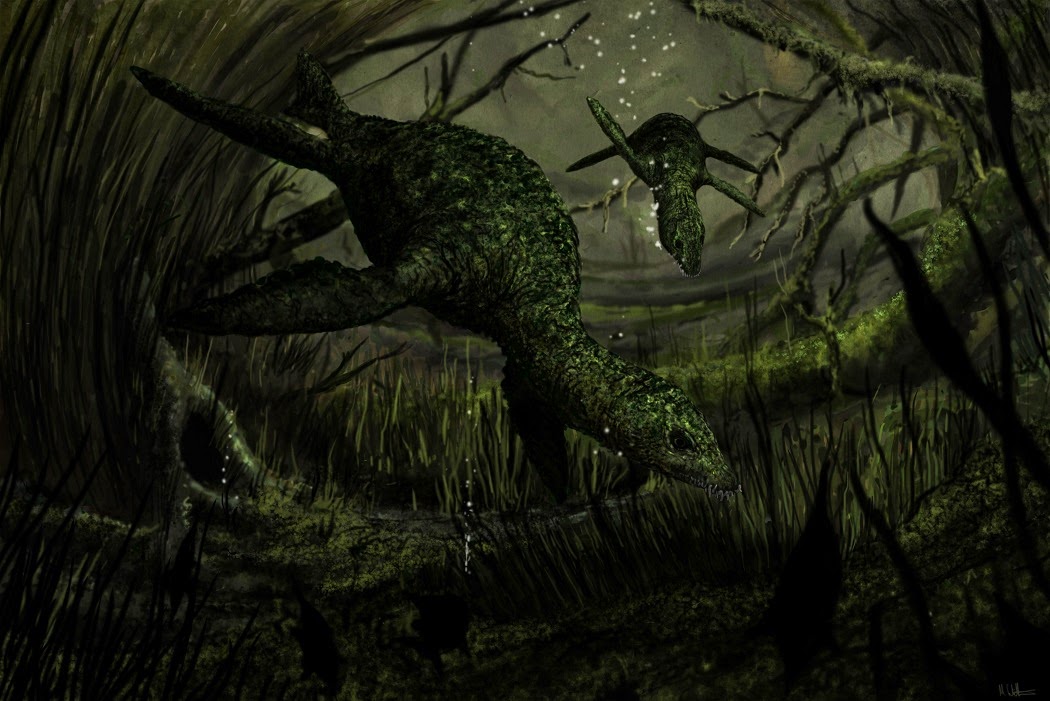
Mother and calf Leptocleidus superstes, a freshwater leptocleidid plesiosaur, explore a swampy river inlet in Lower Cretaeceous Sussex. Of course, a real swampy scene should probably be drawn showing an impenetrable amount of suspended sediment and goo with, possibly, some plesiosaur-shaped silhouettes, but that would make for a lousy image. Prints of this image are available.
For various reasons, I've recently taken an interest in the plesiosaurs of the Wealden Supergroup. The latter will need no introduction to many readers here, being a very famous succession of Lower Cretaceous sediments which provide one of the best known dinosaur faunas in Europe, along with a diverse array of pterosaurs, crocodilians, amphibians, fish and, well, all sorts of things. The big deal about Wealden plesiosaurs is that they represent - gasp! - freshwater and brackish species rather than the marine variants we're more familiar with. Reading into these animals has been pretty fascinating and resulted in the generation of the following text and images presented here. My hope is that these will one day have a 'proper' home, but they'll have to sit here and wait for the meanwhile. The text below has been targeted at a fairly general audience and may not contain anything new for some readers, and doesn't contain citations. If, however, you're after more Wealden plesiosaurs (and who isn't?) with an authoritative twist, you'll want to be sure to check out this Tetrapod Zoology post and, of course, Adam Stuart Smith's Golden Trilobite Web Award winning-Plesiosaur Directory. If Mesozoic marine animals are your thing, you may also want to check out these posts on Ophthalmosaurus and the Oxford Clay fauna.

--

Plesiosaurs are well-known aquatic Mesozoic reptiles characterised by their four large flippers and variably developed necks and heads. Their anatomy is completely unlike that of any other swimming animal, with barrel-shaped bodies tightly locked together by large, plate-like limb girdles which bore robust, powerfully muscled paddles. These flippers, highly modified limbs which are of no use on land, were entirely responsible for propelling plesiosaurs through water, their tails being relatively short and of apparent little assistance in underwater propulsion. This group, more correctly termed 'Plesiosauria’, has long been recognised as falling into two lineages: the pliosauroids and plesiosauroids. Some pliosauroids were super-predators like Liopleurodon and Pliosaurus, animals with likely stretched between 7 - 10 m in length with enormous skulls and jaws. These animals were likely top predators of many marine settings, hunting other large swimming vertebrates. Most pliosauroids bore relatively short necks but, in contrast, several plesiosauroid lineages – including famous species like Elasmosaurus, Cryptoclidus, and Plesiosaurus – developed long necks and small heads, ideal for foraging on relatively small fish and squid. Neck and skull proportions were once taken as a clear indicator of which group a given plesiosaur would belong to, but this idea has fallen from favour as the complexity of plesiosaur evolution has become apparent.

We mostly imagine these reptiles as sea- and ocean-going animals, making their occurrence in freshwater and brackish facies like those of the Wealden seem unexpected. Plesiosauria was a successful and adaptable group however, with a complex evolution that ran for 135 million years from the Late Triassic (c. 200 Ma) to the end Cretaceous (66 Ma) and included acclimatising to waters across the entire planet. Although plesiosaurs are undoubtedly mostly marine, they can be found in freshwater and brackish habitats throughout much of their history. Indeed, it seems that plesiosaurs invaded near-shore and freshwater habits on multiple occasions, although the catalyst of these invasions remains unknown. Did they thrive in environments free of large aquatic predators? Were they exploiting untapped niches and food sources? More data is required to answer these questions.

Skull reconstruction of Leptocleidus capensis, an Early Cretaceous leptocleidid from South Africa. The skull of L. superstes was probably pretty similar to this. Based on illustrations in Cruickshank (1997).
Wealden plesiosaur fossils are not particularly common. Most are isolated vertebrae, fragmentary limb bones and teeth, with only a handful of partial articulated skeletons and skulls known. These remains are important to palaeontologists because the Lower Cretaceous record of plesiosaurs is rather sparse, so Wealden plesiosaurs – rare as they are - provide an important window into this phase of plesiosaur evolution. Plesiosaur remains are span the entire Wealden stratigraphy and occur in both sub-basins, suggesting that they were long-term denizens of Wealden ecosystems. Three species of Wealden plesiosaur are currently recognised, each known by incomplete skeletons: Leptocleidus superstes (Upper Weald Clay Formation, East Sussex; also see the image above), Vectocleidus pastorum (Vectis Formation, Isle of Wight) and Hastanectes valdensis (Wadhurst Clay Formation, Hastings). Some fragmentary Wealden plesiosaur fossils clearly differ from these animals and likely represent additional, poorly known species.

Leptocleidus and Vectocleidus belong to a plesiosaur group known as Leptocleididae, an unusual lineage of Late Jurassic – Early Cretaceous plesiosaurs with necks of short or moderate length and relatively small skulls. This anatomy represents an ‘intermediate’ grade between the short-necked pliosauroids and long-necked plesiosauroids, which has caused some confusion about their relationships to other plesiosaurs. Some suggest they are a ‘relict’ lineage of early, generalised pliosauroids, but other proposal consider them derived plesiosaurids which abandoned long-necked morphologies in favour of a more generalised body plan. Whatever they are, it is noteworthy that all known leptocleidid fossils are known from freshwater, brackish or near-shore environments, suggesting they abandoned the more typical plesiosaur existence of life in open waters and spent much of their time in lakes, rivers and coastlines. This would make leptocleidids comparable to some modern seals (including Baikal seals, several types of ringed seal and harbour seals) and dolphins (such as the Irrawaddy dolphins; Baiji, Chinese river dolphin, and Tucuxi, Amazonian river dolphins) which have abandoned pelagic lifestyles or, at least, make considerable incursions up estuaries and rivers in search of food. Indeed, seals and river dolphins may be the best modern ecological analogues to Wealden leptocleidids. The skulls and jaws of these plesiosaurs were equipped with large jaw muscles and conical, partially serrated teeth, ideally suited to feeding on a small bodied prey. Their diet probably mostly comprised fish, supplemented by opportunistic taking of other, small swimming animals. The four-flippered propulsion system of plesiosaurs may have been ideally suited to navigating complex and tight underwater habits in pursuit of cryptic prey, permitting for excellent manoeuvrability as well as bursts of speed.

Skeletal reconstructions of mother and foetal Polycotylus latippinus, polycotylid plesiosaurs which are not a million miles away, phylogenetically speaking, from leptocleidids. Was this strategy of birthing solitary, large calves found in leptocleidids - and other plesiosaurs for that matter - as well? From O'Keefe and Chiappe 2011; image from here.
At least Leptocleidus was a fairly large animal for the Wealden waterways, attaining body lengths of around 3 m. This size may have dissuaded attacks from even the largest Wealden aquatic and semiaquatic predators, but the same cannot be said for their calves. ‘Calves’ is an appropriate word here: fossils of Late Cretaceous plesiosaurs (which happen to be closely related to leptocleidids) show that at least some plesiosaurs did not lay eggs like many other reptiles, but instead gave birth to a solitary, large and very well developed baby. This reproductive strategy is extremely similar to that of large mammals but is virtually unheard of in reptiles. Although live births are known in many modern lizards and snakes, only a few modern reptiles (various types of skinks) are known to produce a single, large and highly developed offspring. The development of such reproductive strategies in plesiosaurs is therefore rather remarkable (though we must be mindful that we do not know how common this strategy was across Plesiosauria). Both mammals and reptiles that invest heavily in a single offspring are highly social and engage in maternal care, which may indicate that adult plesiosaurs did the same. Perhaps Wealden leptocleidids protected their young from predators, warding off attacks from marauding goniopholidids crocodilians and other plesiosaurs until they were large enough to look after themselves.
Hastanectes valdensis: a possible pliosaur which, even at only 2 m long, is good reason not to paddle in Wealden waterways. Especially if you're a small crocodile.
Such predatory attempts may have been attempted by our third Wealden plesiosaur, Hastanectes (above). Some have suggested that Hastanectes is a pliosaurid rather than a leptocleidid, and closely related to the large, powerful members of this lineage with short-necks and large skulls armed with tusk-like teeth. If so, Hastanectes may represent a small (2 m long) version of these predators. Interestingly, no Hastanectes specimens currently known represent fully-grown animals, suggesting it may have grown somewhat larger. Even at 2 m in length, such a pliosaur would be keen predator of small and medium-sized swimming creatures in Wealden waters, perhaps taking not only fish but also regularly hunting other reptiles. This interpretation of Hastanectes has not gone unchallenged, however: some very recent studies have suggested it represents another Wealden leptocleidid.

A fourth, and largely mysterious type of Wealden plesiosaur is represented by very scant remains indeed. A solitary vertebra from the Hastings Group hints at the presence of a long-necked plesiosauroid within the Wealden. Exactly what sort of plesiosaur this represents however, and how it may have functioned within the Wealden palaeoecosystem, is unknown at present.

References
  • Cruickshank, A. R. I. (1997). A lower Cretaceous pliosauroid from South Africa. Annals of the South African Museum 105, 207–226.
  • O’Keefe, F. R. & Chiappe, L. M. (2011). Viviparity and K-selected life history in a Mesozoic marine plesiosaur (Reptilia, Sauropterygia). Science 333, 870-873.

Wednesday, 2 October 2013

What neck-biting Tyrannosaurus sex tells us about speculation in palaeoart

Head and neck biting sexual behaviour in Tyrannosaurus rex. A novel, brutal and undeniably speculative reconstruction for tyrannosaurs, sure, but is it the result of pure, unbridled palaeoartistic license, or is there something more to it?
It seems that "speculation" is the current word on everyone's lips in palaeoartistic circles. Thanks largely to the enormous success of All Yesterdays, and the recent unveiling of its sequel, All Your Yesterdays, palaeoartists across the internet have been buzzing with excitement over the possibilities opened by speculative leaps of logic. This is undoubtedly a Good Thing. I wrote almost a year ago about why I thought All Yesterdays and the ideas it embodied were great, and a must-see for anyone interested in vertebrate palaeontology or palaeoart. I stand by that, and am certain that many of us in the palaeoart community have be positively influenced by this project in the way we recreate extinct species. All Yesterdays revelled in speculation about prehistory, arguing that we were not being open-minded enough about our depictions of animal appearance and behaviour. The crux, as anyone reading this probably knows, is that many 'traditional' palaeoart concepts are likely erroneous by being overly conservative, and thus 'fail' at both restoring ancient life and producing convincing looking animals. In addition, All Yesterdays highlighted a number of conventions which had become tropes within palaeoart, and argued palaeoartists produce far more accurate studies of extinct life when these clichés are broken, not to mention more interesting ones. What gave All Yesterdays such a strong message was that it, for the most part, was scientifically sound, cleverly turning conventions on their head or showing us logical, plausible ancient phenomena that we'd not imagined before.

For the All Yesterdays sequel, All Your Yesterdays, we see a minority of palaeoartists reaching further than it's predecessor dared, showing some very elaborate anatomies and lifestyles which may, in my opinion, go further than reasonable inference, even enhanced with speculation, may allow. Before we get any further, I want to stress that this post is not a review of All Your Yesterdays. I enjoyed the book, and think it's well worth seeking out for a look at for some excellent and thought provoking imagery. But yes, it does contain a few images which made me question this newfound speculative approach to palaeoart. We have to bear in mind that All Your Yesterdays was crowdsourced, the result of a contest for "original, creative concepts that are at least partially in-line with our current understanding of extinct animals" from Irregular Books. This is naturally going to draw a range of knowledge bases, some of which may be more comprehensive than others, and it may be that some of the more eyebrow-raising images therein are simple mistakes. I'm not going to name names here, because I gather the artists behind All Your Yesterdays were not aware that their work was going to be showcased as a 'significant' addition to the All Yesterdays canon, but I'll hint that molluscan salinity tolerances, the nesting habits in pterosaurs, the soft-tissues of spinosaurids, hadrosaurs and thyreophorans, and the evolution of viviparity were just some things which prompted this post. It's important to stress that problematic 'overspeculations' are not confined to a few pieces in All Your Yesterdays, but a small but noticeable chunk of post-All Yesterdays palaeoartworks which, arguably, jump the palaeoart shark. It's these artworks I want to focus on here.

Getting introspective with speculation
Chiefly, some artwork inspired by All Yesterdays seems to take license for increased palaeoartistic speculation as a sign that 'anything is possible in nature', without any real consideration for how likely some possibilities are. Other pieces showcase strange anatomies for the sole purpose of contrasting with more traditional standard depictions, without considering why such reconstructions are common in the first place. These works, presented as part of a movement that I think I understand and agree with, have gone beyond the science which has to underpin any recreation of an extinct being. The question is, how much speculation we can use before our work stops being palaeoart and starts being fantasy images starring extinct species?

Detail of neck biting Tyrannosaurus. I'm sure he's got a great personality.
Of course, I'm not the first person to ponder this. Indeed, the inspiration for this post, All Your Yesterdays, muses on this same issue:
"In short, speculation in palaeoart should be seen as a sliding scale. At which point does a speculation render itself too extreme? And is it even possible to reach said extreme given the ridiculous soft tissue structures and absurd behaviours present in the modern world? It is, in fact, surprisingly difficult to come up with a speculative piece of palaeoart that is unconditionally ridiculous (at least, so long as the basic rules of anatomy, biology and physics are applied, as they are in science-based reconstructions)."
All Your Yesterdays, p. 7  

These words contrast with a few comments online. Amid the near-universal acclaim for All Yesterdays, one or two (and three, four, five) folks have made about palaeoartistic speculation running away with itself, a far cry from the suggestion that palaeoart can never, so long as basic science is followed, be too ridiculous. It seems there's some need, then, for discussion about the appropriateness of speculation in palaeoart: how it should inform our work, how far we can take it, and whether all speculations are equal. After ruminating on this for a couple of days, it seems that the best way to tackle this is by dividing palaeoartistic speculation into three categories (as with any classification of an organic, creative process, are best perhaps viewed as major points a continuum), which I'll call primary, secondary and tertiary. These distinctions effectively denote how far depicted ideas stray from actual data. We'll outline these types of speculation first, and then discuss their use below.

Primary speculations
Speculations directly based on fossil data, whereby the evidence for a behaviour, event or anatomical feature is reasonable, but details may be murky and require some imagination to restore. Gut content, pathological bones and complex track sites are good examples of evidence which can be used to inspire palaeoart using primary speculation. We may not know the entire truth behind these fossils, but we can whittle it down to a few very likely possibilities. Basic elaboration of predicted integument of an animal - making fluffy integuments long or short, altering distribution and so forth - would be an example of primary speculation on anatomy, as would adding things like wattles, skin-folds and other likely anatomical details to reconstructions. With primary speculations, we can be more-or-less entirely confident that we're displaying a degree of truth in our work.

Secondary speculations
Speculations not directly supported by fossil data, but operate within our spectrum of knowledge to maintain a degree of plausibility. This may include extrapolation of common behaviours and, to a limited extent, elaborate anatomies from closely related animals to reconstructed species. Extrapolating some behaviours from or close ecological, anatomical or biomechanical analogues may fall into this camp too. Ritualised behaviours (below), unusual ways of dying and foraging on unexpected food sources are good examples. Depicted behaviours may serve to show the function of prominent anatomies. Slightly unusual interpretations of integument and other body tissues (perhaps as responses to climate, seasons, sexual selection etc.) probably fall into this category, so long as they are consistent with the integuments known within a 'reasonable' phylogenetic bracket. In short: speculations which adorn fossil species with features so fundamental to animal existence that, even in the absence of fossil data, we can be confident they occurred in deep time.

Ritualised courting chaoyangopterid pterosaurs, Lacusovagus magnificens. Did pterosaurs do this? There's no direct fossil evidence for it, but the abundance of ritualised mating behaviour in modern animals suggests we can be relatively confident that they, and other fossil species, used complex ritualised behaviour. This undoubted speculation gains indirect support from the broad array of sociosexual devices we see on many fossil species, and hints of ancient sexual dimorphism, both of which indicate sexual behaviours were as complex and sophisticated in prehistory as they are today. Image from Witton (2013).
Tertiary speculations
Speculations operating completely outside, and sometimes contradicting, fossil data. May rely entirely on application of very specific modern animal behaviours and anatomies to fossil species, often transferring rare, sometimes highly specialised lifestyles to fossil animals. There is no particular logic or reason behind these applications: they are entirely arbitrary. In other cases, complex biologies and life histories are invented for fossil taxa. Creation of soft-tissue anatomies without, or in spite of, consideration of underlying musculoskeletal system and/or soft-tissue fossil data. Reliant on the absence of data concerning fossil species, because 'anything is possible'. Hypothetical examples of such speculations are things like lactating dinosaurs, notosuchians with trunks, an egg-laying Deinotherium, hadrosaurs with antler-like structures growing atop their crests. Jaime Headden's woolly ankylosaur, his cautionary 'mess of speculation', is a knowing graphic example of tertiary speculations gone mad.

Speculations, what are they good for?
If these are the tools of the speculative palaeoartist, what are their application? Anyone familiar with palaeoartistic practises will recognise that the former two grades of speculation are standard tenets of palaeoart. Such speculations provide our leaps of logic into prehistory and, without them, palaeoart would be an pretty limited endeavour, probably entirely formed of musculoskeletal reconstructions. It's important to recognise that such speculations were not originated by All Yesterdays, as primary and secondary speculations have always been used in palaeoart. The masterstroke of All Yesterdays was to show how primary and secondary speculations could be bolder and more imaginative than most mainstream palaeoart suggested. The result is artwork which is both interesting, unique and supported by actual data.

The image at the top of this post is the result of such an inference. It's well known that many large theropods engaged in head-biting behaviour, and some specimens of Tyrannosaurus (including BHI 3033, better known as the common T. rex museum mount 'Stan') bear particularly extensive damage to their posterior skulls. The inference made here is that Tyrannosaurus engaged in aggressive head and neck biting during copulation, a widely seen behaviour among vertebrates that can often involve substantial damage to the head and neck of the female, sometimes leading to death. I'm not the first to envision this behaviour for tyrannosaurids. Tanke and Currie (1998) suggested nuptial biting as a cause of tyrannosaurid head pathologies but suggested it was refuted by the apparent small size (50% of full size) of many tyrannosaurids with head wounds. Of course, it now seems that dinosaurs became sexually mature when only half grown (Erickson et al. 2007), so this hypothesis may be back on the table. The resultant image is a radical and speculative depiction of Tyrannosaurus behaviour, but one that has a foot firmly set in science.

Cast of the skull of Tyrannosaurus 'Stan', BHI 3033, at in the Oxford University Museum. Stan's skeleton is particularly damaged around the posterior head and neck region, with a probable tooth wound penetrating it's braincase, a smashed postorbital bar (a dorsal projection of tyrannosaur skulls which anchored neck muscles) and broken neck vertebrae. Photograph by Marc Vincent, from Love in the Time of Chasmosaurs.
The same cannot be said for tertiary speculations. Some inferences made at this level are so far removed from actual data that they have little or no evidence to support them, and thus abandon the scientific basis which should underpin any palaeoart. Others may disagree, but I think good palaeoart, like good science, is led primarily by evidence, not speculation. This most obviously impacts tertiary speculations which arise, it seems, for the sole purpose of overturning convention. "This animal is always shown like/doing this... what if it looked like/did THIS SHOCKING THING?!??" While there's nothing wrong with trying to keep palaeoart fresh, we should remind ourselves that not everything common in palaeoart is a trope or meme, or the product of unimaginative artists. Sometimes, that's just how animals were, and conventions are based in very sound evidence. Deviating from these conventions is a move away from data, which is the exact opposite of what we want to be doing here.

Other tertiary speculations apply highly unusual behaviours borrowed from modern animals, or those which are entirely made up, to fossil species for no clear reason. This can be effective on occasion, presenting a fossil species in a radical light which may make us reconsider our preconceived notions of that species, but I'm generally not a fan. Why, of all the behaviours that we can imagine or observe in in the modern day, should we chose that specific animal as a model? And do we really expect the rarest, most elaborate and weirdest behaviours to be present in specific fossil animals? Are we actually predicting that extinct animals behaved (often adorned with the same colour schemes and patterns) exactly like these aberrant modern animals? We'll score far more science points if we apply more widespread behavioural phenomena to our palaeoart. This doesn't mean we have to confine ourselves to dull behaviours like travelling and foraging, because we can also rely on primary and secondary-level speculations to give us behaviours like resting, taking care of personal hygiene, reproducing, interacting with one another and so on. Likewise, lots of interesting anatomies can be extrapolated from the fossil record itself. In sum, while we should take inspiration from modern taxa, arbitrarily 'transforming' fossil animals into ancient versions of modern species stretches credibility quite far, and is perhaps a rather unscientific approach to our work (this point echoes one made earlier, also in response to some art in All Your Yesterdays, at Laelaps).

A counterargument could be made that tertiary speculations allow us to imagine how sophisticated and complex ancient worlds were but, again, I question this. Like any guesswork, they're of questionable significance. Unknowns are unknowns. Tertiary-grade restorations are as likely to be incorrect as accurate. These depictions may fire the imagination briefly, but the flames are tiny compared to those fuelled by cool ancient behaviour derived from actual evidence. It's one thing to see a shocking piece of palaeoart, but quite another to realise that there's actually tangible evidence behind it. Rather than pondering the great unknowns of deep time when confronted with a tertiary speculation, I frequently react with the opposite approach, thinking about what we can actually deduce about a given issue, and what a more likely interpretation may be.

Why I find tertiary speculations frustrating. The fossil record is full of interesting animals with known interesting behaviours, like these burrowing Oryctodromeus, and yet they are frequently overlooked in palaeoart for entirely speculative renditions of familiar taxa. Check out this post for more on this animal and it's need for a PR campaign.
This brings us to a more pragmatic bugbear about tertiary speculations. Extremely speculative palaeoartworks are actually fairly common, at least online, while innumerable cool palaeontological topics with a significant factual basis are completely ignored. Why use art to make rather hollow points about unknown topics when there's plenty of art to be made concerning subjects we do know about? Even familiar animals have unusual, rarely-depicted behaviours which we can infer from fossils with minimal amounts of speculation (such as the tyrannosaurs above), not to mention the shedloads of fossil species which are wholly unrepresented in art (and yes, I'm well aware of the hypocrisy of saying this in a post featuring Tyrannosaurus), many of which are also known to have interesting and unusual behaviours. Heck, it's common knowledge that palaeoart is heavily biased towards a few taxa, so just showing some of these rarely seen animals would be a thought-provoking, cliché-busting achievement in itself. Is it not better, as scientific illustrators, to base our work on what we know rather than what we don't?

Which leads to...
So, yes, despite being an advocate of using speculation in palaeoart, I'm not a huge fan of the extreme and uncontrolled speculation we're seeing creeping into modern portfolios. This may sound like I'm jumping off the All Yesterdays bandwagon, but I don't think I am. Most of our best palaeoartists - including those behind All Yesterdays - use speculation of primary or secondary grade, and are more notable for avoiding clichés and artistic conventions than they are for presenting highly speculative lifestyles and anatomies in fossil species. They elaborate existing knowledge to create more convincing depictions of fossil animals, and apply detailed research of the fossil record to show us sights we've never seen before. Some of their work may seem outlandish and brash, but it's actually far more measured than it looks.

I'm sum my point up as this. While we should be using speculation to push palaeoart to its limits, we need to know both which bits we can push, and when to stop before our speculations get the better of our work. This doesn't deny us licence to make our reconstructed ancient worlds amazing and interesting and, in fact, it may make our work more striking. It's one thing to see an outlandish reconstruction of the past, but all the more poignant when we realise the weird, strange or even shocking visage before us is based on truths, and not just imagination.

References
  • Erickson, G. M., Rogers, K. C., Varricchio, D. J., Norell, M. A., & Xu, X. (2007). Growth patterns in brooding dinosaurs reveals the timing of sexual maturity in non-avian dinosaurs and genesis of the avian condition. Biology Letters, 3(5), 558-561.
  • Tanke, D. H., & Currie, P. J. (1998). Head-biting behavior in theropod dinosaurs: paleopathological evidence. Gaia, 15, 167-184.
  • Witton, M. P. (2013). Pterosaurs: Natural History, Evolution, Anatomy. Princeton University Press.

Thursday, 26 September 2013

The solution to everything: under the (Jurassic) sea, part 2

In the last post, I mentioned that I was currently working on a Oxford Clay Formation and ichthyosaur display for the University of Portsmouth. Most of that post was dedicated to the various graphics and text generated for the ichthyosaur end of things (specifically, Ophthalmosaurus), so we'll now turn attention to the other half of the display: the Oxford Clay Formation itself, its palaeoenvironment and fauna. The words below are a very brief introduction to one of Britain's most stellar fossil units, complete with some of the artwork and graphics which will soon be adorning the walls of UoP. If you want to know more about the Oxford Clay, you may also want to check out Mark Wildman's Saurian, which has discussed the Oxford Clay and its fossils at length across many posts. Baring a quick nod to Dave Martill for his help with shaping the words here, I'll hand you over to the display text.

--

One-hundred and sixty million years ago, most of Europe - including the British Isles – was underwater, flooded by a warm, shallow sea populated by astonishing marine reptiles, gigantic fish and a diverse invertebrate fauna. The Oxford Clay Formation, one of the UK's most famous fossil-bearing rock units, provides an extensively researched window into this Jurassic marine ecosystem.
Extent of the Oxford Clay across the UK, with major localities. Whittlesey, the source of the marine reptile skeleton behind this and the preceding blog post, is highlighted in red. 
The Oxford Clay: geology, geography, economic geology
The Oxford Clay Formation is an extensive succession of dark mudrocks with intermittent limestones which crop out  almost continuously from Dorset to Yorkshire. Further exposures are found on the seabed of the English Channel and in Normandy, France. The entire Oxford Clay sequence is of late Middle Jurassic to lower Upper Jurassic age (164-159 Ma) and fossils occur throughout, although most vertebrate fossils occur in the Peterborough Member, a unit of organic-rich rocks which represent the lowest part of the formation. Considerable commercial interests in the Peterborough Member date to the 1870s when excavation of its clays began for brick making. The high organic content of these clays meant that they fired quickly at low temperatures, allowing for production of high-quality bricks at low cost. The Oxford Clay brick pits are now mostly closed, but the tremendous economic interest in the Oxford Clay has ensured that multitudes of fossils were continually excavated from quarries on an industrial scale for nearly 100 years, permitting a detailed view of the Oxford Clay palaeobiota.

Palaeoenvironment and palaeoecology
The Oxford Clay sea was a warm (water column temperatures of 20°C) and shallow (tens of metres) marine environment, with a rich supply of nutrients from local land sources. The abundance of light and nutrients supported a rich and complex ecosystem (below). Planktonic organisms, including numerous types of algae and zooplankton, were abundant in the Oxford Clay sea and likely formed the basis of its food web. Plankton was the food source for small invertebrates and juvenile fish, which in turn were preyed on by the larger fish, ammonites, belemnites, squid and reptiles that comprise the majority of Oxford Clay fossils. Ammonites are particularly common components of the Oxford Clay, being represented by some 78 species. The community of bony fishes and sharks was almost as rich as that of the ammonites, with 32 species adapted to exist in a variety of ecological niches. The Oxford Clay fauna contains one of the most spectacular bony fish to ever evolve, the 12-15 m long pachycormid Leedichthys problematicus. This animal was not a predator however, but instead filtered plankton from the water column using enormous gill apparatus.
Schematic reconstruction of the Peterborough Member fauna, palaeoenvironment and nutrient cycling. Animals are not to scale, unless you wish to invoke the Father Dougal sense of size. Based on data from Martill and Hudson (1991) and Martill et al. (1994).
The most famous Oxford Clay animals are the marine reptiles (below), which including ichthyosaurs (the 'fish lizards'), plesiosaurs (four-flippered reptiles with variably sized heads and necks, some of which – the pliosaurs - were the dominant predators of Jurassic seas) and thalassosuchians (marine crocodiles). Dinosaurs are also known from the Oxford Clay, likely representing animals washed in from the hinterland or individuals that died swimming between islands. Small flying reptiles, pterosaurs, were also present, but are very rare fossils.

Composition and abundances of the Peterborough Member reptile fauna. Based on Martill and Hudson 1991.
The sea floor was not as vibrant with life as the water column. Because the sea floor sediments and bottom waters had relatively low oxygen levels, the diversity of benthic species was restricted compared to the waters above. Bivalves, gastropods, arthropods and foraminifera comprise the majority of fossils from these communities, as well as the burrows of organisms which lived within the soft sea floor sediments. Sediment stability was an issue for some benthic organisms, leading to colonisation of decaying animal skeletons as substitutes for firm substrates by some species..

Micro- and macroconchs (male and female, respectively) of the ammonite Erymnoceras coronatum, hanging around the Oxford Clay seaway. The macroconch is 40-50 cm across, while the microconch, as is typical of ammonites, is about 20-25% of that size.
Ammonites: floating clocks and palaeontological enigmas
Ammonites, nektonic cephalopods with chambered external shells, form the backbone of biostratigraphy for Mesozoic rocks. Ammonite faunas evolved rapidly enough to permit identification of one million year intervals of Mesozoic time, allowing for very precise dating of ammonite-bearing rocks. The Erymnoceras coronatum ammonites shown above are one of the index fossils for the Peterborough Member, placing it firmly in the middle Callovian stage of the Jurassic.

Oxford Clay ammonites provide key data on the evolution of ammonites, and were integral in identifying male (small, elaborately ornamented ‘microconchs’) and female (much larger, less ornamented ‘macroconchs’) morphs. Despite the abundance and familiarity of ammonite fossils however, many aspects of their anatomy and lifestyles remain mysterious. Questions such as what they ate, where they lived in the water column, their floating orientation, as well as the exact nature of the squid-like creature living within the shell, remain unanswered.

Bonus fun: the assembled board
As a way of signing off these two linked posts, I thought it might be fun to show off the entire display board itself, just so anyone interested can see how all the text and images here will hang together. The entire thing is well over 3 m long, so should look fairly imposing when it's finally printed.
UoP's Oxford Clay and Ophthalmosaurus display text, coming soon to a display cabinet near me.
And that's our time in the Oxford Clay seaway done for the time being, folks. I'm hoping to get back to fairly regular posting over the next few weeks, because things have been a bit quiet about here of late thanks to a particularly busy conference season. Coming soon, hopefully: some comments on the All Yesterday's sequel, All Your Yesterdays.

References

  • Martill, D. M. and Hudson, J. D. (1991). Fossils of the Oxford Clay (Field Guides to Fossils) (No. 4). The Palaeontological Association, London.
  • Martill, D. M., Taylor, M. A., Duff, K. L., Riding, J. B., & Bown, P. R. (1994). The trophic structure of the biota of the Peterborough Member, Oxford Clay Formation (Jurassic), UK. Journal of the Geological Society, 151(1), 173-194.

Saturday, 14 September 2013

The solution to everything: under the (Jurassic) sea, part 1

It's been very quiet around these parts of late as my August and September transformed into a minor tour around Western Europe for talks and conferences. SVPCA in Edinburgh, the VIth International Symposium of Dinosaurs and their Environment in Burgos, Spain, a talk about my book in London and - next week - the Jehol/Wealden biotas conference in Southampton. Busy times indeed, leaving little room for blogging, painting or, well, anything at all, really.

In the interests of posting something, I thought I'd share two halves of a project I've was working on before I set off on my travels. Some months ago I was asked by the University of Portsmouth to spruce up a display featuring a partial skeleton of the ichthyosaur Ophthalmosaurus icenicus from the Oxford Clay Formation, a famous unit of Jurassic sediments deposited 162 - 158 Ma. Being the well organised professional that I am, I can't show you any photos of the specimen or display here*, but I can share some of the artwork and text which will, in the coming weeks, be plastered all up in our geology department. The display is divided into two broad components, one part being about the rich palaeontology of the Oxford Clay Formation itself - depositional setting, palaeobiota and the like - and the other dedicated to Ophthalmosaurus. It's worked out that the ichthyosaur section is far more complete than the other, so we'll start with that today, and have the sister portion following shortly. Maybe I'll even get my act together and show photographs of the specimen itself, because it's pretty neat.

*Is this the result of another batch of sticky palaeontological politics? Heck no: I just haven't taken any photos yet.

Ophthalmosaurus icenicus skeleton in lateral view. From McGowan and Motani (2003).
The painting at the top of this post is of O. icenicus and, as may be expected, is one component of the new display. It's one of my first efforts at a detailed painting of a marine animal and my first ever real attempt at rendering an ichthyosaur. Both were a lot of fun to do, and I wouldn't be surprised if we don't see more ichthyosaurs around these parts in future. The reconstruction benefited enormously from conversations with University of Bristol PhD student Ben Moon who, among other things, is redescribing O. icenicus for his thesis. Ben not only provided suggestions and comments about an earlier version of the image but also supplied me with a heap of literature concerning Ophthalmosaurus and ichthyosaurs in general. Ben blogs about his work and ichthyosaur science over at Ichthyosaurs: a day in the life…, so be sure to head over there if fish lizards float your boat.

Before I hand you over to the other components of our display, I'll say a few things about the reconstruction which, for reasons of space, couldn't be included in the exhibit. I set the scene in a shallow, coastal setting rather than the infinite blue seas we often see marine reptiles in. I completely understand why such compositions dominate marine reptile art, but I figured it would be nice to try something a little different. Plus, setting the animal closer to the shore meant I could make the water a little stiller, as if this chap had swum into a quiet, shallow lagoon or bay. Having relatively still water was important here because of the point of view. Again, just to be different, I thought a somewhat dorsal view of the animal may be interesting, but choppy waters would mean having to obscure or distort its proportions with waves and ripples, which didn't seem like a sensible thing to do in an educational display piece.

A dorsal view also allows for showcasing the dimensions of this animal. Rather than lithe and slender, as we often imagine aquatic animals are, Ophthalmosaurus was a broad and rotund animal with powerful shoulders, a barrel-shaped body, and a wide posterior skull region (below). Scale is always difficult to convey in images with no familiar objects to relate to (the seagull-sized floating pterosaur is the best I've got for scale here), but I tried to give an impression of the large size of this animal, too. Ichthyosaurs are often depicted resembling small dolphins or porpoises, but even mid-sized, 4-5 m long ichthyosaurs like Ophthalmosaurus were a lot bigger. I wondered if this size, not to mention the jaws brimming with 160 conical teeth (the original Walking with Dinosaurs, which likely introduced many of us to O. icenicus, erred on this front: see below for details), would allow O. icenicus to predate fairly large squid along with smaller fish and cephalopods. Reflecting this, I riddled it's hide with scars from battles with relatively mighty teuthids. Not all these scars may have been made by big squid, however, as ichthyosaurs were not above inflicting serious injury on each other, either. The colours of the animal were, again, an attempt at injecting a little originality into depictions of this animal. Although a lot of oceanic creatures are undeniably shades of grey, black and white, the superb visual acuity of Ophthalmosaurus suggests that visual signalling and recognition of individuals may have been important to these ichthyosaurs (Humphries and Ruxton 2001). I thought a complex pattern of ocean-penetrating reds, browns and whites may reflect this idea nicely.

Ophthalmosaurus icenicus in anterior view. Far from being lithe and slim, O. icenicus was almost as wide as it was tall. This is one of the many adaptations O. icenicus bears to fast swimming, and has also prompted the controversial hypothesis that the Antrhopocene joke 'yo' momma so fat...' had origins in Upper Jurassic marine settings. Image from McGowan and Motani (2003).

I'll stop there - this was meant to be a short, 'picture of the day' type post - and hand you over to the display text about this species. A lot of the information is quite basic, but it may still prove somewhat interesting. We've yet to print any of these images and text out for our display by the way, so be sure to leave any constructive comments you may have in the comment field below. Tune in soon for some details of the Oxford Clay seaway which housed O. icenicus, not to mention a plethora of other fascinating animals. Over to the display text...

--


Only one species of ichthyosaur is currently recognised from the Oxford Clay, Ophthalmosaurus icenicus. O. icenicus has a wide distribution across Europe and Asia, a 20 million year stratigraphic range, and is famous for bearing some of the largest eyes of any animal known. Ophthalmosaurus and its opthalmosaurid relatives were a diverse and important group of Jurassic and Cretaceous ichthyosaurs, dominating the Cretaceous chapter of ichthyosaur evolution until the group became extinct at the end of the Cenomanian (Late Cretaceous, 94 Ma).

Although a complete skeleton of O. icenicus has never been found in the Oxford Clay, a full knowledge of its skeletal anatomy has been assembled from multiple incomplete skeletons. Unlike many other ichthyosaur specimens, Oxford Clay O. icenicus material is frequently preserved in three dimensions, making it an important species for understanding the anatomical complexities and functional anatomy of these reptiles. Since its recognition in 1874, O. icenicus has become one of the most completely known of all ichthyosaurs and a common component of studies into ichthyosaur taxonomy and functionality. Ophthalmosaurus perhaps attained the pinnacle of its fame in 1999 when it featured prominently in the classic BBC documentary Walking with Dinosaurs.

Anatomy
Like all ichthyosaurs, O. icenicus is supremely adapted to life in the marine realm. It possesses a full complement of ‘thunniform’ (Greek, ‘tuna-like’) features common to Jurassic and Cretaceous ichthyosaurs including reduced hindlimbs, a well-developed caudal (tail) fin, and a short, inflexible trunk region. O. icenicus was a moderately sized ichthyosaur, attaining body lengths of 4-5 m when fully grown.

Not so toothless after all: the fierce jaws of Ophthalmosaurus icenicus. From Kirton (1983).
The skull of O. icenicus has attracted much research interest because of its peculiar anatomy. The bones supporting the eyeball, the sclerotic rings, are enormous at 220 mm across. Among living animals, only giant squids have larger eyes but, for its body size, O. icenicus has the largest eyes known of any animal, alive or extinct. These eyes sit above a long set of jaws which have long been considered entirely, or almost entirely toothless. This interpretation is erroneous, however, as well-preserved O. icenicus and closely related ophthalmosaurid species clearly show small, slender and pointed teeth in each jaw. It seems that these teeth were weakly anchored into their dental grooves (like many ichthyosaurs, O. icenicus mostly lacks individual tooth sockets), and fell away readily once their owners began decomposing.

Lifestyle
The enormous eyes of O. icenicus have prompted much discussion among palaeontologists. It is generally considered that these eyes allowed O. icenicus to dive to great depths to find food, with their 90 mm wide pupils able to gather light beyond the perception of most other marine animals. Despite their size however, the eyes of Ophthalmosaurus would only permit vision at 40 m greater depth than those of marine animals with 'typically-sized' eyes, and only 50 m more than our own. The giant eyes of O. icenicus were considerably more capable of detecting shape and other visual details in low light conditions however. In environments where we could only see grainy outlines of other animals, Ophthalmosaurus could see in high definition. Possible confirmation that O. icenicus dived to great depth stems from evidence of decompression trauma (‘the bends’) in several specimens, a harmful condition caused by development of gas bubbles in the bloodstream of animals rapidly ascending from deep water.

The slender jaws and tightly packed, simple teeth of O. icenicus suggest it primarily ate squid and small fish, a diet confirmed in part by preserved stomach content of closely related, North American ophthalmosaurids. Propulsion for swimming was generated by the large, lunate caudal fin. Like other advanced ichthyosaurs, O. icenicus swam like a modern shark or whale, with a largely immobile trunk skeleton minimising undulations along the body when swimming, maximising the propulsive effects of the tail fin. This made O. icenicus one of the fastest reptiles, for its body size, in the Oxford Clay palaeoenvironment. The large, powerfully muscled shoulder girdle and forelimb paddle of O. icenicus betray an ability to rapidly steer and manoeuvre during pursuit of its prey. It is likely that O. icenicus used its powerful swimming ability to roam across several Jurassic seas, a habit which may explain its occurrence in numerous, geographically distant locations.

References
  • Humphries, S., & Ruxton, G. D. (2002). Why did some ichthyosaurs have such large eyes?  Journal of Experimental Biology, 205, 439-441.
  • Kirton, A. M. (1983). A review of British Upper Jurassic ichthyosaurs. Unpublished PhD Thesis, University of Newcastle-upon-Tyne. 239 pp.
  • McGowan, C. & Motani, R. (2003). Part 8 Ichthyopterygia. Sues H–D (ed.) Handbook of Paleoherpetology. Munchen: Verlag Dr. Friedrich Pfeil. 175 p.

Wednesday, 21 August 2013

9 things you may not know about giant azhdarchid pterosaurs

The 2015 version of the giraffe vs. azhdarchid vs. person image, now in it's fifth iteration (see the general history of these images through the years: 200620072009). The giraffe is a big bull Masai individual, standing a healthy 5.6 m tall, close to the maximum known Masai giraffe height. The pterosaur is a 10 m wingspan Arambourgiania philadelphiae (for reasons I cannot go into now, it is not wise to consider the appearance of giant azhdarchid taxa interchangeable any more: this should not be considered Hatzegopteryx thambema or Quetzalcoatlus northropi). The Disaknowlegement provides the human touch. These characters will receive some additional company soon.
The splendid beasts that are giant azhdarchid pterosaurs have occupied my thoughts a lot of late, mostly thanks to three upcoming talks I'll be delivering about them at upcoming conferences and society meetings. Preparing that number of talks in a short space of time has given me a whole new interpretation of the term 'death by PowerPoint' so, to take a break from animating slides and producing diagrams, here's a quick run down of 10 factoids you may not know about giant azhdarchid pterosaurs (the likes of Quetzalcoatlus northropi, Hatzegopteryx thambema and Arambourgiania philadelphiae - as if they need introduction) and their smaller relatives. Even if these facts are familiar, please feel free to enjoy the new bits of artwork accompanying the post. Those of you really into the ever evolving depiction of these pterosaurs really should also pay a visit to this recent Tetrapod Zoology post: I'm clearly not the only one with giant pterosaurs on the brain.

They nearly weren't called 'azhdarchids'
'Azhdarchidae' is a terrific name. It's short but mysterious, relatively easy to spell, and PR friendly enough that even the British tabloid The Sun has used the term on at least two (I think) occasions. The name 'Azhdarchinae' was coined by the late Lev Alexandrovich Nesov in 1984 from the Uzbek word 'azhdarkho', a name for a mythical dragon, and also the nomenclatural basis for the medium-sized Uzbek azhdarchid Azhdarcho lancicollis. Nesov's name encompassed all three azhdarchid genera known at that time: Azhdarcho, Titanopteryx (now known as Armabourgiania) and Quetzalcoatlus. Almost simultaneously, however, the exact same set of taxa was being roped into another group by Kevin Padian, which he termed Titanopterygiidae after, obviously, Titanopteryx. Nesov's 'Azhdarchinae' pipped the far-less elegant Titanopterygiidae to the publishing punch by a matter of months, and took nomenclatural priority for the group. Padian elevated Azhdarchinae to 'family' level in a short note in 1986, giving us our now familiar term, 'Azhdarchidae'.

Lev Alexandrovich Nesov holds the fossil cervical vertebra, notarium and jaw tip of the azhdarchid Azhdarcho. Image from Unwin (2005).
Tiny bodies
Despite their giraffian proportions, giant azhdarchid torso were relatively tiny. Witton and Habib (2010) noted that, like many pterodactyloid pterosaurs, their torsos were probably only a third or so longer than their humeri, suggesting a shoulder-hip length of about 65-75 cm for an animal with a 10 m wingspan. That's a torso length not much larger than your own, although they were considerably more stocky and swamped with muscle. Azhdarchid shoulders, in particular, are well endowed with attachment sites for flight muscles, as are (for pterosaurs) their pelves and hindquarters.

Giant azhdarchids did not suffer from flight power shortages
Many internet commenters often roll out the idea that giant azhdarchids would struggle to take off from the ground, even allowing for new ideas like quadrupedal launching. These folks need to get out of their armchairs, however, and check out some classic work on animal flight and giant pterosaur takeoff. James Marden's 1994 work on animal takeoff found some surprisingly consistent scaling trends among animal flight power and takeoff ability, allowing us to predict the muscle power of even long extinct fliers like Meganeura, Archaeopteryx and a 10 m span azhdarchid. The resulting aerobic power output of azhdarchid flight muscles - all 60 kg of them (a fairly safe bet for a 250 kg azhdarchid given what we know of animal flight muscle fractions among modern fliers) - is a bit rubbish, only 4.52 N/kg of body weight. Animals need to be generating 9.8 N/kg to fight gravity, so this would seemingly ground our giants. Bear in mind, however, that swans, albatross, vultures and turkeys also have aerobic power outputs of around 4.5 N/kg from their flight muscles, and they can fly just fine. The secret to their takeoff lies in the great power of anaerobic muscle contraction, which provides twice the power achieved under aerobic regimes. Using anaerobic power, giant azhdarchid power outputs are 10.098 N/kg of body weight, a value surpassing the 9.8 N/kg and matching the anaerobic power outputs of a 10 kg swan or 1 kg vulture (see graph, below). In terms of power availability, then, giant azhdarchids would not have struggled to launch any more than a large bird, so all these suggestions about poor takeoff ability and whatnot can be put to bed.

Scaling of flight performance with body size under anaerobic power output. The dashed line is the minimum lift needed to overcome gravity. Anaerobic power is 225W/kg, the upper limit of avian anaerobic output. From Marden (1994).
An unsurpassed 80 million years of evolutionary history, and growing
Azhdarchids are undeniably best known from Upper Cretaceous rocks, but they also have a patchy and sometimes controversial Lower Cretaceous record. Recently, Gareth Dyke and colleagues (2011) demonstrated that the group were probably present at the very base of the Cretaceous, in Berriasian (c. 140-145 Ma) deposits of Romania. Given that azhdarchids are definitely present at the final stage of the Cretaceous, this gives the group a stratigraphic record spanning the entire Cretaceous: 80 million years in total. This is longer than any other pterosaur group. Two cervical vertebrae from the Late Jurassic of Africa may extend their temporal range another 5 million years, although the affinity of these specimens remains controversial.

A much improved skeletal reconstruction of the small azhdarchid Zhejiangotperus linhaeiensis over my oft-reproduced effort from Witton and Naish 2008. Note the use of pacing strides, a gait indicated by pterosaur trackways but seldom seen in pterosaur palaeoart.
More than just long necks
When we describe azhdarchids, we often use two qualifiers: 'toothless' and 'long-necked'. In fact, these pterosaurs are brimming with characterising features (above). Their rostra are particularly elongate compared to all other pterosaurs, their orbits are depressed well into the lower half of their skulls, their wing metacarpals and femora are atypically long, and their extremities are short and robust. Their mid-series cervical vertebrae are famously simplified into almost tube-like structures, and their humeri are deceptively derived from the pterodactyloid norm. The wing fingers of azhdarchids occupy a relatively small 47% of their wing lengths, a value only approximated by one other pterosaur group, the closely related thalassodromids. Artists, take note: grounded azhdarchids should not be reconstructed with their folded wing fingers stretching skywards over their backs: they couldn't reach that far.

But no, seriously, the long necks
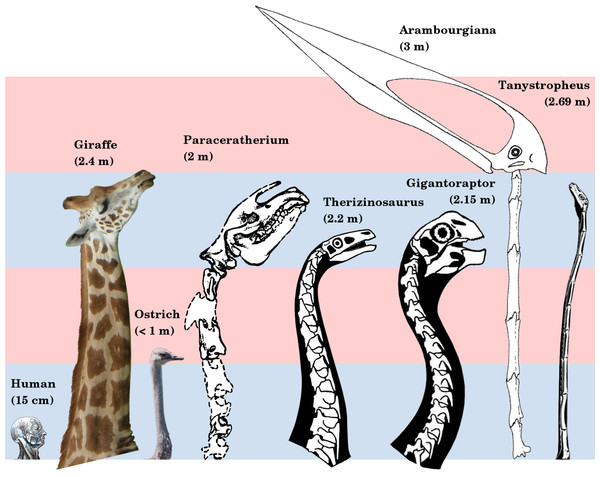
The cervical vertebrae of giant azhdarchids are poorly known, with only a few specimens (and even fewer good ones) being recovered to date. These rare fossils do, however, clearly indicate substantial neck proportions in at least animals like Arambourgiania. The holotype cervical V of this animal is around 660 mm long, and is missing an estimated 100 mm from its posterior end. Steel et al. (1997) scaled this vertebra isometrically with relatively complete neck skeleton material from the 4.7 m wingspan azhdarchid Quetzalcoatlus sp. to predict a whopping 3071 mm length for cervicals III-IX in Arambourgiania. The use of isometry here is questionable (Witton and Habib 2010), but is defensible given the amount of azhdarchid neck material available to these authors in the mid-nineties. Ongoing work I'm involved with (which will hopefully be published before we're too much older) has attempted to apply allometry to calculations of giant azhdarchid neck lengths. The results are a little more conservative than the 3 m offered here, but we're still landing in the "seriously long neck" camp. Whether azhdarchids will retain the title of absolutely longest necks outside of Sauropoda (Taylor and Wedel 2013) remains to be seen however: I suspect they may ultimately just be pipped by the weirdo protorosaur Tanystropheus. Dammit.
The 'Big Necks Which Don't Belong to Sauropods Competition', won by the giant azhdarchid Arambourgiania. From Taylor and Wedel (2013).
Finally, some data on neck arthrology
The necks of azhdarchids are not just famous for their size, but are also renowned for their rather inflexible joints. These widely discussed features have been the bane of many azhdarchid lifestyle interpretations (see Witton and Naish 2008 for a review), but actual quantification of their arthrological range has been lacking until recently. This is, in part, because a complete 3D azhdarchid cervical series has been elusive for many years, but Alex Averianov (2013) recently produced a composite digital neck skeleton for Azhdarcho to figure out their range of motion. The results were more-or-less what we all expected: very limited range in the mid-series, with most of the mobility limited to the extremes. A surprising amount (but still fairly restricted) range of motion was afforded at the neck base, however. As may be expected, this study is very welcome to those of us interested in the biomechanics and functional anatomy of these animals, and I'm glad to see it.

Averianov's (2013) reconstructed neck arthrology of Azhdarcho lancicollis. That's one stiff neck.
Incidentally, some folks have asked me what I think of Averianov's suggestion that azhdarchids weren't what Darren Naish and I termed 'terrestrial stalkers' in our 2008 paper (generalised terrestrial foragers which spent much of their time wandering over Cretaceous plains in search of small animals and rich plant material like modern storks and ground hornbills). I won't say much now, but Darren and I don't agree with the alleged 'flaws' put forward against our hypothesis, and especially do not agree with the proposed 'aerial scoop feeding' counter hypothesis. Our formal reply has just been through peer review, and we hope to complete the minor tweaks needed to get it ready for publication very soon.

Swimming piscivores and aerial hawking: genuinely suggested azhdarchid lifestyles
It's well known that most recent 'serious' proposals of azhdarchid lifestyles are things like skim-feeding, terrestrial stalking and wading, but many other, frankly outlandish palaeoecological hypotheses have been thrown at azhdarchids over the years. Lev Nesov perhaps takes home the prize for the most bizarre ideas, proposing in his 1984 paper that azhdarchids could swim to find food (both along the surface and by diving) and pursue 'poorly flying' vertebrates through the air. In the same paper, he also advocates skim-feeding as a probably azhdarchid lifestyle. I remain unsure which part of azhdarchid anatomy indicated to Nesov that these animals had superhero-like abilities to acquire food.
Sauropods give a giant azhdarchid the evils. Seems they don't like being buzzed at close range
The awesomopower of giant pterosaur flight
Although azhdarchids are frequently discussed for their natty terrestrial capability nowadays, it's important to remember than any substantial travelling they had to do was probably performed in the air. Computations of the flight abilities of giant azhdarchids have returned seriously impressive results (Witton and Habib 2010). As mentioned above, azhdarchids likely employed anaerobic power for strenuous flight activities like takeoff and perhaps flapping bursts, and likely relied mostly on thermal soaring and flap-gliding like modern raptors to remain airborne for long periods. Their minimum sink and best glide speeds are steady cruises at 16.3 - 24.9 m/s (58.7 - 89.4 kph) but, if they were in a hurry (such as looking for a source of uplift), speeds of up to 48.3m/s (173 kph) were possible for short durations. We estimated that azhdarchids had about 90 - 120 seconds of anaerobic burst power before tiring, meaning these animals could go from a standing start to - literally - several kilometres away in the space of a few minutes. Yowsers. What's more, the size and bodily resources available to such large creatures permitted tremendous flight times: up to 16,000 km of travelling without resting or foraging were likely possible. That's the equivalent of an animal flying from London to Vegas non-stop, realising it forgot its passport, and then flying home again without touching the ground.

And that's your lot for now, folks. If you want to know more about azhdarchids, be sure to check out my book for a whole chapter about them, which is something like the second biggest entry in the entire thing. Things may go quiet over the next few weeks while I'm away at various conferences, but posting will resume when I get back.

References

  • Averianov, A. O. (2013). Reconstruction of the neck of Azhdarcho lancicollis and lifestyle of azhdarchids (Pterosauria, Azhdarchidae). Paleontological Journal, 47(2), 203-209.
  • Dyke, G. J., Benton, M. J., Posmosanu, E., & Naish, D. (2011). Early Cretaceous (Berriasian) birds and pterosaurs from the Cornet bauxite mine, Romania. Palaeontology, 54(1), 79-95.
  • Marden, J. H. (1994). From damselflies to pterosaurs: how burst and sustainable flight performance scale with size. American Journal of Physiology-Regulatory, Integrative and Comparative Physiology, 266(4), R1077-R1084.
  • Nesov, L. A. (1984). Pterosaurs and birds of the Late Cretaceous of Central Asia. Paläontologische Zeitschrift, 1, 47-57.
  • Padian, K. (1984). A large pterodactyloid pterosaur from the Two Medicine Formation (Campanian) of Montana. Journal of Vertebrate Paleontology, 4(4), 516-524.
  • Padian, K. (1986). A taxonomic note on two pterodactyloid families. Journal of Vertebrate Paleontology, 6(3), 289-289.
  • Steel, L., Martill, D. M., Kirk, J. R. J., Anders, A., Loveridge, R. F., Frey, E. & Martin, J. G. (1997). Arambourgiania philidelphiae: giant wings in small halls. The Geological Curator, 6, 305-313.
  • Taylor, M. P., & Wedel, M. J. (2013). Why sauropods had long necks; and why giraffes have short necks. PeerJ, 1, e36.
  • Unwin, D. M. (2005). The pterosaurs from deep time. Pi Press, New York.
  • Witton, M. P., & Habib, M. B. (2010). On the size and flight diversity of giant pterosaurs, the use of birds as pterosaur analogues and comments on pterosaur flightlessness. PloS one, 5(11), e13982.
  • Witton, M. P., & Naish, D. (2008). A reappraisal of azhdarchid pterosaur functional morphology and paleoecology. PLoS One, 3(5), e2271.