Showing posts with label Albanerpetontids. Show all posts

Wednesday, 27 May 2015

New takes on the Wealden Supergroup palaeobiota, part 1: Iguanodon, Neovenator, Eotyrannus and others

Regular readers will know that I'm prone to dabbling in palaeoart depicting the environments and animals of the Wealden Supergroup, the 18 million year stretch of Early Cretaceous time represented by mud-and sandstone deposits across the southern UK. Recently, I've been updating some existing Wealden work as well as producing some new stuff of other Wealden species. With no time to produce a new post of substance, here's a bumper 'picture of the day'-type post. Initially, I was going to chuck something like ten images on here, but time has run short and I'll have to split it in two.

If you like anything here, remember that you can buy prints of them all from my shop (there's now a Wealden section, too), which is now also browsable from the comfort of Facebook. OK, enough preamble: into the Wealden once again...

Iguanodon bernissartensis: thumb wars

Two Iguanodon bernissartensis, the quintessential Wealden iguanodont, decide to settle their differences, while members of their herd watch on.
Poor old Iguanodon doesn't get the attention it used to, and a lot palaeoart we do see of it tends to focus on tried and tested behaviours: lots of standing about and eating, but not much else. In this new painting, I've attempted to show two big Iguanodon individuals settling an intra-specific dispute via use of thumb spikes. Long-term readers may recall that we've covered iguanodont thumb spikes before, and that I. bernissartensis has especially big ones. Here, they've been swinging their thumbs at each other's soft bits, causing deep, bloody wounds. This might seem extreme, but there are plenty of modern animals which take intraspecific fights to similarly gory levels - elephant seals were a key inspiration here. I imagine battling Iguanodon would look like an armed sumo-wrestling match, albeit with longer tails and less rice. Note that you can see the breath of several animals here: Wealden winters are not meant to be especially warm.

Rebbachisaurids vs. Neovenator salerii redux

Carcharodontosaurian Neovenator salerii stalks a pair of rebbachisaurid sauropods, using darkness as cover.
A while back I posted about dinosaur predation, noting that modern animal predator acts are often far less gladiatorial and epic than we might imagine. It's this slow, considered approach to predation which I'm attempting to show here, as the carcharodontosaur Neovenator stalks two rebbachisaurid sauropods in the dead of night. The idea is that the Neovenator has much better eyesight than the sauropods, who know they're in trouble, but can't really respond adequately. Note the rain: some recent models of Wealden palaeoclimates suggest it was wetter than previously modelled (albeit with very high evaporation rates for much of the year).

Anteophthalmosuchus hooleyi vs. Hypsilophodon foxii, redux

Large goniopholidid Anteophthalmosuchus hooleyi takes advantage of a flooding river to hunt two stranded Hypsilophodon foxii.
Speaking of rain, we know that some parts of the Wealden were prone to flooding following particularly intense downpours. That's good news for animals adapted for powerful swimming, but less welcome to species which prefer dry land. Here, in this reworked painting, the large Wealden goniopholidid Anteophthalmosuchus hooleyi has found a stranded pair of adult and juvenile Hypsilophodon foxii, and is taking full advantage of the situation. Goniopholodids are a group of almost-crocodiles characterised by long forelimbs, interlocking scutes and overbitten jaws - you can read more about them here.

Eotyrannus lengi: firestarter, redux 

Early tyrannosauroid Eotyrannus lengi stalks the edge of such a wildfire. 
What else does rain bring? Sometimes, lightning. When introduced to a parched Wealden landscape, lightning strikes caused short-lived canopy fires which, ultimately, created conditions ideal for fossil preservation. In this reworked painting, a fully-feathered tyrannosauroid Eotyrannus lengi is prowling the periphery of a Wealden canopy fire to grab any animals flushed out by the flames.

The tiny wars of Wesserpeton evansae, redux 

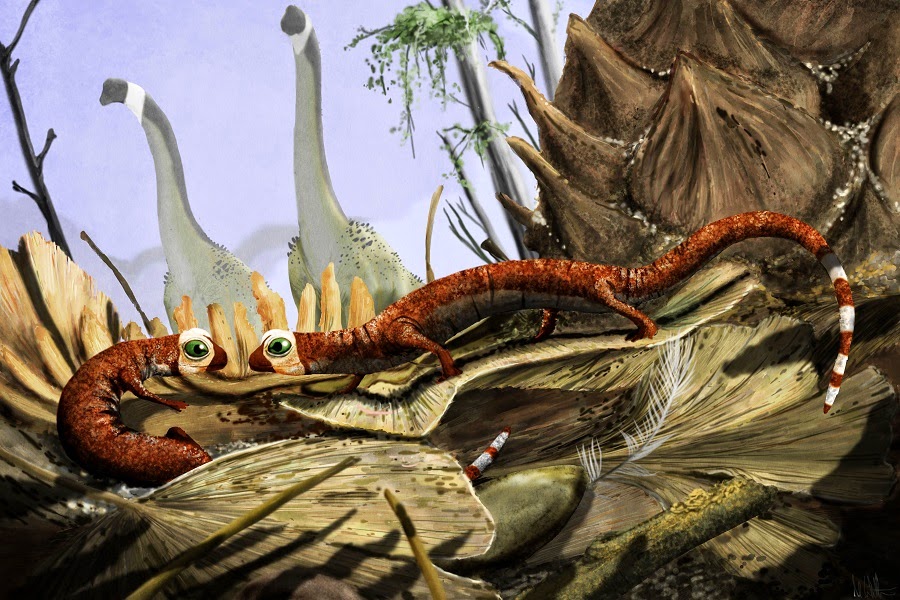
Two Wesserpeton evansae get in each other's faces, because some animals are just jerks.
OK, enough about Wealden weather. Here's a reworked version of two of the Wealden's tiniest tetrapods - indeed, some of the smallest fossil tetrapods of all - facing off in leaf litter. Recently named Wesserpeton evansae, these are albanerpetontids, very small amphibians which only died out a few million years ago. The 35 mm snout-vent length of these animals did nothing to temper their ferocity, and numerous jaws of Wesserpeton have healed fractures and breaks from intraspecific tussles. The animals in this picture are speaking the aggressive body language of modern salamanders as a prelude to their conflict. Two sauropods hang around in the background because, hey, it's called the Age of Dinosaurs for a reason. Some people have suggested this image borders on the trippy and surreal. Stay off the shrooms, kids. 

Rebbachisaurids and chums

Lower Cretaceous rebbachisaurids and giant sauropod 'Angloposeidon' look for water in this desiccating Wealden lake.
I do like rebbachisaurids, that group of sauropods who didn't get the memo about long necks. They're only represented by scrappy remains in the Wealden (a scapula) which is enough to tell us they were there, but not substantial enough to carry a name. Here, a few individuals are digging around a rapidly drying lake-bed to find a substantial source of water: digging elephants were the inspiration for this scene. In the background, probable brachiosaurid 'Angloposeidon' struts its stuff. It's meant to be walking particularly tall - I like the idea that fossil animals would carry themselves in different, characteristic ways, just as modern animals do. A pink gnathosaurine pterosaur has snuck into the foreground, just because. 

A lesser-seen Wealden scene: the Hastings Beds palaeobiota


Finally for now, here's one more new painting. This is a reconstruction of a swollen river representing part of the Hastings Beds, the oldest deposits of the Wealden, complete with local reptile fauna. The animals shown here are really poorly known: titanosaur 'Pelorosaurus' becklesii (bits of forelimb), possible carcharodontosaurian Becklespinax altispinax (three dorsal vertebrae), eucryptodiran turtle Hylaeochelys belli (a shell), and the possible azhdarchoid previously known as 'Palaeornis cliftii' (humerus). So yes, take the 'restorations' of these animals with an evaporite mine of salt: they're really just better known, fairly 'generic' representatives of groups represented by these Wealden taxa, air-dropped into a Wealden setting. Becklespinax is obviously modelled closely on Concavenator, as they seem to be pretty closely related and have a similar taste in dorsal ornamentation. I gave Becklespinax a more vertical anterior sail margin however, as indicated by the fossil. There's an article waiting to be written on palaeoart like this - should we even bother 'reconstructing' poorly known scenes and species? I clearly think we should, but we'll have to discuss the reasons why another time. 

I'm just now realising that there's a lot of confrontation in these images. Come back soon for a more placid, relaxed set of pictures in part 2...

Thursday, 30 May 2013

Wesserpeton evansae: making 'albanerpetontid' a household name

Two Wesserpeton evansae get in each other's faces, because that's what albanerpetontids did. Note this is an updated version of the 2013 press release work referred to below. Prints of this image are available here.
You could be forgiven for thinking otherwise, but the Mesozoic wasn't just the remit of dinosaurs, pterosaurs, marine reptiles and token cool crocodiles. Many other interesting animals shared the world with these famous species, including some that most of us have never heard of. Tuesday of this week saw the (open access) publication of one such animal, the Wessex Formation albanerpetontid Wesserpeton evansae by Steve Sweetman (University of Portsmouth) and James Gardner (Royal Tyrrell Museum of Palaeontology) (2013). Many readers will be familiar with the Wessex Formation or the larger geological unit it is part of, the Wealden Supergroup, because of its frequent mentions as Britain's top dinosaur-bearing deposit. I'm sure many of us are not overly familiar with albanerpetontids, however. This isn't too surprising. To my knowledge, albanerpetontids have never featured prominently in any palaeoart or publications geared towards popular audiences and their existence is largely known only to specialists. The world's naivety to these animals was broken yesterday when Steve and James, with a little help from my painting above, finally told the world why they should add albanerpetontids to their list of cool fossil animals.

Alba-who?
Albanerpetontids are small-bodied amphibians that were fairly common components of terrestrial environments until relatively recently. The youngest members of their clan perished at the end of the Pliocene - about 2.5 million years ago - after an evolutionary run of 160 million years and attaining a wide geographic distribution across North America, Europe, Africa and central Asia. Their general lack of mention in popular press would have you believe otherwise, but they can actually be relatively common fossils. Remains of Wesserpeton are, after crocodiles, the most abundant microvertebrate in the Wessex Formation. Despite their relative abundance, their relationships to other lissamphibians have been debated because many of their fossils are exceptionally scrappy. Traditionally, they have been thought of as caudatans (salamanders) or at least very close relatives. Recent discoveries of complete and articulated albanerpetontid fossils (below) have suggested otherwise however, proposing that they are closely related to a clade containing frogs and salamanders, but not members of any extant amphibian group (McGowan 2002). 

LH 6020, holotype specimen of Celtedens ibericus, a complete albanerpetontid from Lower Cretaceous deposits of Las Hoyas, Spain. Note the 'halo' of scales around the fossil. Snout-vent length of this specimen is 59.5 mm. From McGowen (2002).
The anatomy of albanerpetontids is fairly conservative. They look more-or-less like small salamanders with short limbs and long bodies, but also possess mandibles which interdigitate anteriorly, fused frontals (bones of the skull roof) and relatively flexible necks because of a mammal-like articulation between the skull and neck. They also had bony scales under their skin, a condition which contrasts with the typically thin and delicate skin of most other amphibians. It seems that they spent most of their time burrowing through leaf litter in search of small arthropod prey, with their scaly skin possibly preventing dessication and likely reducing the typical amphibian need for wet or moist environments (but see comments below by the good David Marjanović). Fossils suggest that scales stretched across most of their bodies (we went the whole hog in our reconstruction and covered our Wesserpeton entirely) and onto their eyelids. We thought about these eyelids a fair bit for our painting. The few available depictions of albanerpetontids show animals with eyes perpetually covered with scales, leaving only very small, beady eyes to see with. Steve and I noted that these animals actually have very large orbits however, suggesting that their eyes were probably reasonably sized. It seemed counter-intuitive to possess large eyes and then cover them in soft-tissue, so our reconstruction assumes that the eyelids only partially covered the eyeballs.

Lower jaws of Wesserpeton evansae showing typical (A) and pathological (B) anatomies. From Sweetman and Gardner (2013). 
Small man syndrome
Initially, our plan for the press release painting was to show a single animal reclining in some leaf litter or something equally simple, but Steve suggested early on that we could work in an interesting component of Wesserpeton behaviour. Many Wesserpeton jaws show signs of trauma (above) after being broken during violent acts. The exact cause of this damage is still being looked into and will form the subject of a later paper, but a good preliminary explanation is that Wesserpeton was a vicious species which routinely fought among themselves. Modern salamanders, such as these giants, bite the heads of their opponents before wrestling with each other, twisting and somersaulting with one another to settle disputes over territory and mating access. It's not difficult to imagine such acts taking their toll on the jaws of Wesserpeton, and we thought it would be cool to show this in a press image. Preliminary attempts at rendering this struggled to show the general appearance of the animals however, as their bodies were twisted and their heads obscured by jaws. How could we show the aggressive nature of this animal without actually showing them fighting?

Do you speak salamander? Common body postures used to communicate between individuals of the red-backed salamander Plethodon cinereus. We took panel B as our primary inspiration for the Wesserpeton evansae PR image. Figure and caption from Jaeger (1984).
The solution came in the form of postural language borrowed from modern red-backed salamanders (Jaeger 1984, and above).Most animals will attempt to intimidate their rivals with ritualised postures which enhance their perceived size and strength before coming to physical blows, and there's no reason to think that little albanerpetontids were any different. We decided to use the postures of modern salamanders in our image, setting one of our animals as a dominant pose with a raised trunk and tail, and the other crouched and submissive. In doing so, we implicated the violent nature of this species (enhanced by the larger animal getting in the face of the smaller, just like most douches with attitude problems) but maintained the ability to show their anatomy. Entirely coincidentally, Darren Naish and John Conway recently spoke about incorporating animal postures into palaeoart in Tetrapodcats (sic) episode 6, which makes for interesting listening if you're thinking about making your restored extinct animals communicate more fluidly.

Finally, a quick word on the body size of Wesserpeton. We've mentioned it was small, but how small? The answer is tiny. As in, 35 mm snout-vent length tiny. This thing really puts the 'micro' in 'micropalaeontology'. We prepared another set of press images to show what this means in real life (available in different colours to suit whatever occasion you're at where you want to discuss the size of Wesserpeton):

The United Colours of Wesserpeton, which is dwarfed by the palm of your hand no matter what colour you are.  For some reason, this image makes me want to imagine a world without lawyers.
I'm no expert on this sort of thing, but I'll wager that Wesserpeton is one of the smallest, if not the smallest tetrapod species known from the Wessex Formation, and probably one of the smallest tetrapods in the fossil record. It's fossils were only recovered through bulk sampling tonnes of plant debris bed from the Wessex Formation, horizons rich in plant and vertebrate remains deposited after sheetflood events, and would be almost impossible to find via surface prospecting. Those of you with excellent memories may recall that Steve's ongoing analyses of these beds have revolutionised our understanding of the Wessex palaeobiota, of which Wesserpeton is just one discovery among many. 

And that will have to do for now. Next week: back to the world of pterosaurs with pterosaur mummies, as promised last week before Wesserpeton face-wrestled its way into centre stage. My plan from here on is to have some sort of run-up to the publication of my book, Pterosaurs: Natural History, Evolution, Anatomy on June 23rd, so be sure to stick around if wing membranes are your thing.

References
  • Jaeger, R. G. 1984. Agonistic behavior of the red-backed salamander. Copeia, 309-314.
  • McGowan, G. J. 2002. Albanerpetontid amphibians from the Lower Cretaceous of Spain and Italy: a description and reconsideration of their systematics. Zoological Journal of the Linnean Society, 135(1), 1-32.
  • Sweetman, S. C., and Gardner, J. D. 2013. A new albanerpetontid amphibian from the Early Cretaceous (Barremian) Wessex Formation of the Isle of Wight, southern England. Acta Palaeontologica Polonica, 58, 295–324.