Showing posts with label Dinosaur. Show all posts

Friday, 16 June 2017

Revenge of the scaly Tyrannosaurus

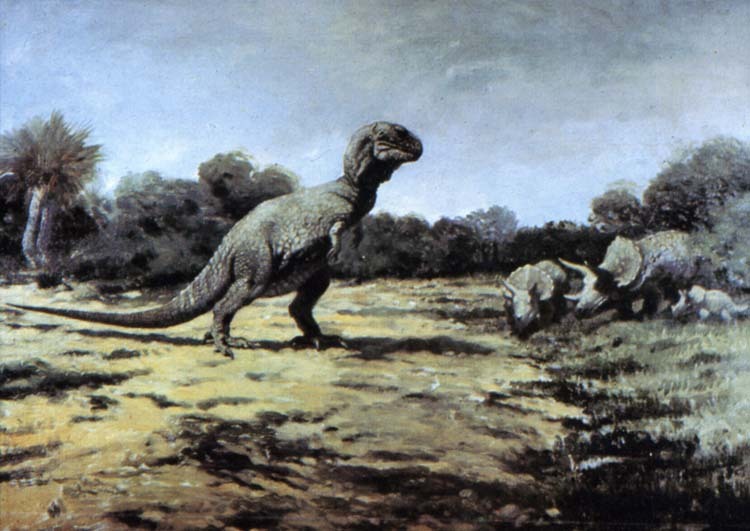
Reworked version of my 2012 Tyrannosaurus painting, now in it's third guise. There's something about this painting which recalls reconstructions from 1906 rather than those of 2016.
The skeletal anatomy of Tyrannosaurus rex is probably better known and studied than the skeletons of many living animals, but its soft-tissues - and thus much about its life appearance - are poorly represented by fossil remains. Thus, virtually all of our ideas about muscle bulk, soft-tissue body shape and integument have to be reconstructed by phylogenetic proxy and functional prediction. As with all dinosaurs, we've historically felt pretty confident that Tyrannosaurus was entirely scaly, but relatively recent discoveries of filamented tyrannosauroids in China (Xu et al. 2004, 2012), as well as a growing mountain of fuzzy coelurosaur fossils, point to a different conclusion: that Tyrannosaurus was adorned in simple filaments - hair-like equivalents of feathers. Skin impressions for more derived tyrant species - the tyrannosaurids - have proven rare in fossil record (Hone 2016) and, though rumours have circulated about some, they have largely escaped formal description and publication. In the absence of better evidence, the most parsimonious modern takes on everyone's favourite tyrant have involved a fuzzy covering.

In the recent months two papers have challenged this idea. The first, by Thomas Carr and colleagues (2017), purports to find osteological correlates of scales on the facial anatomy of the tyrannosaurid Daspleteosaurus, which they argue (along with other lines of evidence), to suggest crocodylian-like facial tissues and sensitivity. The second, by Phil Bell et al. (2017), describes scaly skin impressions from multiple postcranial regions of a Tyrannosaurus skeleton, and argues that the distribution of these impressions implies a uniform (or near uniform) covering of scales across the body, without much in the way of fuzz.

Because this is Tyrannosaurus, media sites and bloggers have spilled great amounts of ink over these stories. The scientific press has often been far from objective or unbiased. Popular articles have suggested Jurassic World fans might have 'won' the debate over scientists, that science fans are 'due' a return to scaly tyrants after 'losing' Pluto, and that the findings mean 'all is well in the dinosaur world'. The implication is a ridiculous one, like evidence of scalier tyrants is a moral victory rather than a test of a scientific hypothesis. But while the popular press has been celebrating the new papers, members of the palaeoblogosphere have been less enamoured with the findings. Trey the Explainer suggests that Bell et al.'s work doesn't really change what we already knew about tyrant integument, and thus does not invalidate many existing reconstructions. Andrea Cau posits that interpretations of scaly tyrants reflect our prejudices more than science, and that taphonomic factors may explain the absence of filaments. Brian Switek has concerns that the skin patches are too small and spread too widely to give a complete picture of the integument, and echoes concerns about taphonomic interference. The collective response seems to be a defensive one, protecting concepts of filamented tyrannosaurids from a resurgence of a more traditional, scaly model. Would any other dinosaur get this treatment? Perhaps not: as Brian explains in his recent post, this reaction is the T. rex celebrity effect at full bore.

Supermegafluffy Tyrannosaurus, from 2015. They were simpler times.
I've painted many fluffy Tyrannosaurus in the last few years (above) and quite like the idea of everyone's favourite 6 tonne dinosaur bonecrusher being a giant plush toy. However, we also have to concede that our ideas of Tyrannosaurus skin have been largely informed by prediction, not direct data, and that popular, long-held notions are as ripe for scientific revision as any other (lest we forget other famous examples of this - Brontosaurus and Ornithoscelida). Moreover, although some critics are suggesting the papers don't tell us anything new - rumours of scale impressions have been circulating for years - these recent studies give us the first rigorously documented, peer-reviewed glimpse into Tyrannosaurus skin anatomy. This is new, allowing us to form our own opinions on Tyrannosaurus appearance based on actual data, not hearsay. So, rather than putting our gloves up to defend our prior model, I wonder if we should be exploring how this new data might transform our perception of Tyrannosaurus life appearance. That these new studies present conflicting data to our expectations is not grounds to be upset, annoyed or defensive. To the contrary, they allow us to use real data - not predictions - to refine our ideas of tyrannosaurid appearance and evolution. For those of us interested in dinosaurs as real entities, and not movie monsters, that's a good thing.

What, exactly, has been argued about scaly tyrants?

A lot of the popular write ups of these recent papers include errors and misrepresentation, so let's recap what is actually being argued about Tyrannosaurus skin. A common social media reaction to Bell et al.'s work is that they've presented 'a patch' of skin, and are extrapolating from that. We need to debunk that right away: they've not described a single patch, but multiple small patches from the neck (alas, exactly where on the neck isn't reported), the top of the pelvis, and the base of the tail (below). All the samples stem from the 'Wyrex' specimen (HMNS 2006.1743.01). The most extensively represented area is the tail base, which has the largest single piece of fossil skin - 30 cm². The other skin samples are not as large, some being just a few centimetres across. Each patch shows the same skin type: uniform, tiny 'basement scales', each less than 1 mm across (Take note, artists: you would not see Tyrannosaurus scales until you were being eaten by their owner). Similar scale patches, also described by Bell et al. (2017), have been found on the torso and tail regions of other tyrannosaurid species, implying similarly scaled regions in these taxa.

Tyrannosaurus skin patches from the neck, pelvic area and tail of the 'Wyrex' specimen as illustrated by Bell et al. (2017). The scale bars for the scale imagery are 5 mm (b - e) and 10 mm (f-h). These things are tiny, and we can assume the skin of the animal would look smooth or leathery in life.
Some folks are suggesting that the size of these skin patches allows us to dismiss their scaly signal, or that even that they're anomalous, reflecting unusual taphonomic conditions that cloud their significance. I'm unsure about these ideas. Most skin impressions are small patches (even scaly skin gets a rough ride during fossilisation) and the fact they're small doesn't diminish the fact that each records a cluster of scales. We have to assume these are not unusual or 'special' areas on the body but generally indicative of surrounding skin fabrics. The fact that each patch is consistent with regard to scale size and texture hints at them being part of a continuous, unbroken integument, and not isolated scaly pockets in a sea of fluff.

But what about arguments that the scale patches are tissues stripped of filaments before preservation, like so many 'monster' carcasses? Filament/scale combos do have precedent in dinosaurs, being present on the tail of Juravenator and those scales of Kulindadromeus with fibre-like tassels (Chiappe and Göhlich 2010; Godefroit et al. 2014). We know from modern animals that fibrous epidermal structures are especially vulnerable to decay and physical weathering, but is there evidence that this has taken place on the Wyrex Tyannosaurus skin patches? At present, it's hard to say because we have no idea what tyrannosaur skin looks like as it decays. It might be significant, however, that the scale patches look very similar across the Wyrex specimen, and that they resemble other tyrannosaurid skin impressions closely. We might expect some variation if taphonomy was really distorting these specimens in a major way, and we're not seeing that. Moreover, the Wyrex skin impressions, though small, are pretty high-resolution. The scales, and their intervening areas, have sub-millimetre proportions and sharply defined edges. There's no tatty scale margins, no obvious spaces for filament attachment, or linear structures crossing the scales to imply a rogue filament impression. We'll remain uncertain if these are anomalous, taphonomically-altered samples until we find other examples of tyrannosaurid skin, but there's no reason to be unduly suspicious of the the samples we have.

Of course, the adage that 'absence of evidence is not evidence of absence' is always important when dealing with the fossil record, and it applies here as a sensible caveat. However, we shouldn't wield this phrase as a definitive counter-argument to reasonable interpretations of available evidence. Palaeontologists have to work with data, not suspicions or gut feelings, and the data we have does not include, or hint at, the presence of filaments. I'm not arguing that taphonomy isn't worthy of consideration here (indeed, the omission of details about 'Wyrex' taphonomic history is an issue with the Bell et al. 2017 paper) but we must beware the logical fallacies of appealing to probability (i.e. taphonomy could explain the lack of filaments, so it does explain the lack of filaments) or special pleading (excluding Tyrannosaurus from the same logic we would apply to other fossil animals when presented with this data).
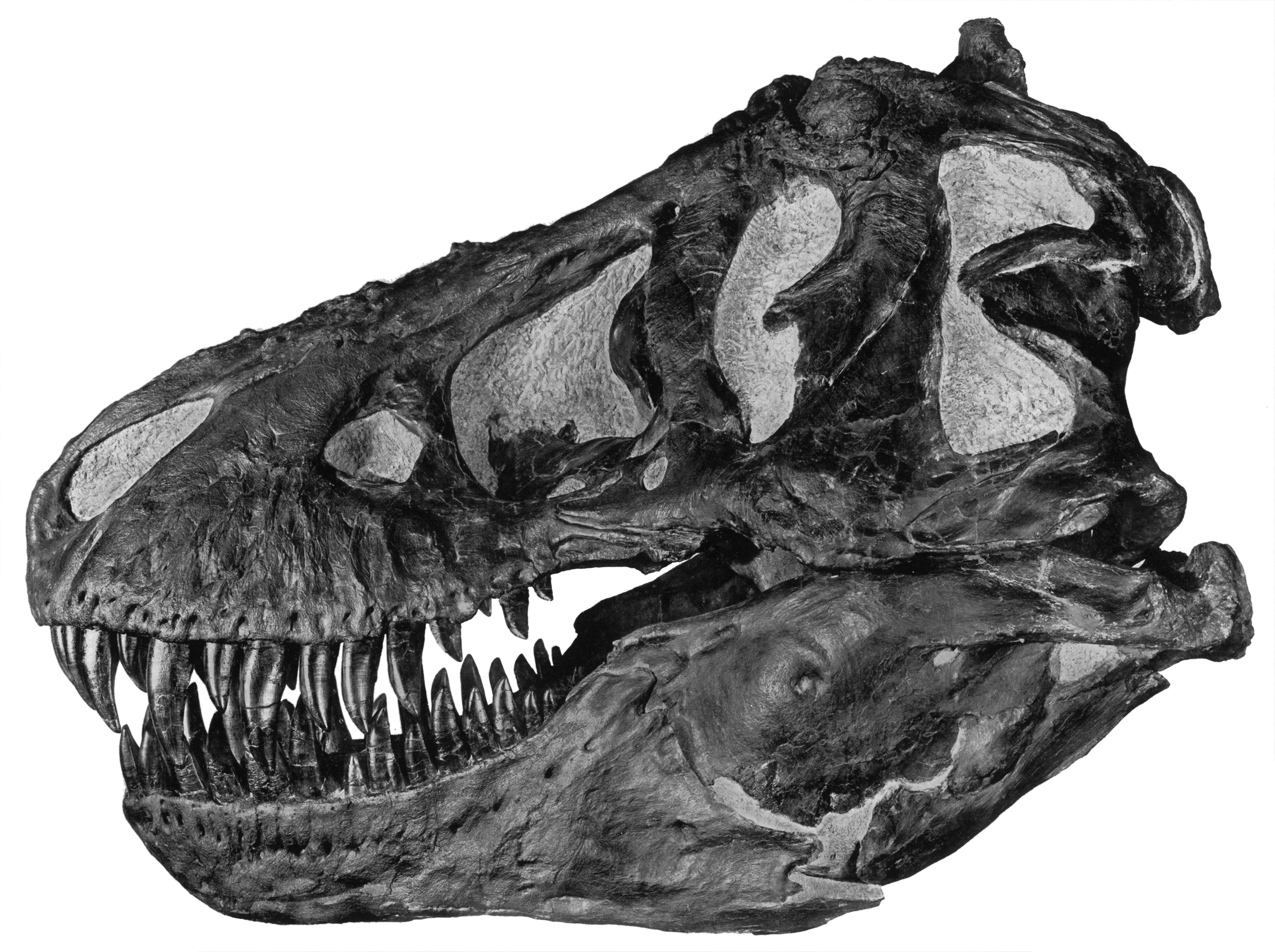
Tyrannosaurus skull AMNH 5027 - note the 'hummocky' textures on the side of the snout, above and below the orbit, and atop the rostrum, likely indications of scaly skin. Image in public domain, sourced from Wikipedia.
Carr et al. (2017) present a different form of evidence for scales: osteological correlates. I consider some aspects of their study problematic in that it only looks to crocodylians and birds for comparative tissues, despite the clear value other tetrapods have in deducing facial tissue types (Knoll 2008; Morhardt 2009; Hieronymus et al. 2010); it lacks illustrations of the bone textures correlated to scaly integuments; and the conclusion of tyrants bearing crocodile-like face scales is flawed: crocodylians do not have face scales, but a tight, highly cracked sheet of facial skin - Milinkovitch et al. (2013). Nonetheless, I think Carr et al. (2017) are right in concluding the bony textures of tyrannosaur skulls seem indicative of scaly skin. These findings echo previous interpretations of bosses and rugosities in tyrant skulls (e.g. Brusatte et al. 2012; Sullivan and Xu 2016) and aren't controversial. Scales closely associated with bone either leave a 'hummocky' surface texture, which is seen on tyrant snouts (specifically their maxillae and nasals) or small bosses and hornlets, which are found in all tyrannosaurid skulls above their orbits (lacrimal and postorbital bones) and on their 'cheeks' (jugal bones). Hornlets and bosses represent the locations of specific scales in living reptiles (Hieronymus et al. 2009) and can thus give especially good indications of life appearance (check out chameleon skulls for especially good correlation between skull and scale features). The presence of hummocky bone textures and hornlets is a strong correlate for scales, as they rule out coverings of naked or feathered skin. Such skin types do not alter the underlying bone surface (Hieronymus et al. 2009).

These osteological correlates combine with the skin impressions to collectively show Tyrannosaurus as scaly across much of its face, somewhere on its neck, over the pelvic region and along the tail base (below). So far as we can tell, this picture seems consistent with osteological correlates and skin sampling from wider Tyrannosauridae. That's pretty extensive coverage, ruling out the presence of fibres in places that we know other dinosaurs - including other tyrannosauroids - were fuzzy, and implies that tyrannosaurids were mostly scaly. I'm particularly startled at the scales over the hip region as they curb even the long 'fibre capes' we see in some modern tyrant reconstructions, like the famous Saurian Tyrannosaurus. The fact that the scales occur in places known to be ancestrally filamented for tyrants is also intriguing: Bell et al. (2017) speculate that they may be modified feathers - that is, the same as bird scales - rather than a reversion to lizard or croc scales. Hold that thought, we'll come back to it soon.

Everyone's doing maps of Tyrannosaurus with integument details nowadays, and I want in. Note that this is Tyrannosaurus specific, and does not feature scale data from other tryannosaurids.

What's in the gaps?

The million dollar question is what was present between these scaly regions: more scales, or fibres? This is a major point for many respondents to the Carr et al. and Bell et al. papers, as it decides whether we keep our interpretation of Tyrannosaurus as an - at least partly - fuzzy animal. With our scale distribution map as a starting point, several options are available. The first is that fuzz was present in regions not yet represented by skin remains or osteological correlates. This would mostly imply the top of the torso (Bell et al. 2017), but may also be parts of the back of the head, some aspects of the neck (depending on where the neck skin impression came from) and maybe the end of the tail. Over on Twitter, Patrick Murphy has presented a reconstruction which shows what this might look like. I must admit to finding it quite amusing, sort of like T. rex has put on a shawl to visit the opera.

But how dense could these fuzzy patches have been? Bell et al. (2017) suggest that dense fibrous coverings are doubtful, noting that large living mammals avoid patches of thick insulating fibres to aid heat loss. This has not gone down well with some critics, who cite studies of feathers preventing over-heating instead of facilitating it. An oft-cited study in this regard is Dawson and Maloney (2004), who found emu feathers block virtually all solar radiation from the skin, preventing them from overheating in solar exposure that causes similarly-sized hairy mammals to seek shelter.

Feathers: great at blocking solar radiation, also great at trapping body heat. Note how cooking hot these ostriches are on their necks, heads and legs, while the feathers are mostly ambient temperature. This isn't because the body isn't warm, but because the feathers block the heat signature entirely, trapping all that heat around the body. As surface area:volume ratios drop as animals get larger, it stands to reason that the benefits of blocking solar radiation give way to a need shed heat. Image from Wikipedia user Arno / Coen, CC BY-SA 3.0.
Feathers, however, are not magic structures that defy fundamental physical laws of insulation, nor do they liberate animals from the challenges of heat loss at reducing surface area:volume ratios. Beyond a certain size, shedding excess body heat is difficult for any terrestrial animal, and it gets tougher as they get larger. King and Farner (1961, p. 249) described feathers as having "an extremely high insulating value to the feathered surfaces" and a rich literature of studies on modern birds shows that feathers are as effective at trapping body heat as they are blocking solar rays (e.g. King and Farner 1961; Kahl 1963; Philips and Sandborn 1994; Dove et al. 2007). We can almost see them as a little too effective, leading many birds to develop heat-dumping adaptations to circumvent their own insulation, such as highly vascularised, non-feathery body parts as well as a repertoire of postures and behaviours (maximising exposure of unfeathered body parts; flapping wings; urinating on their legs) that aid cooling (e.g. Kahl 1963; Arad et al. 1989; Philips and Sandborn 1994). So yes, feathers are terrific at protecting birds from environmental heat, but that limits their ability to release metabolic heat from their own bodies.

If living birds find feathers a little warm, despite their relatively high surface area to volume ratios, we have to assume a theropod weighing anywhere between 6-14 tonnes is going to find big areas of dense filaments a challenge to thermoregulation too. It is not unreasonable to assume blankets of fibres could be a problem for big tyrants. The counterargument here is that Yutyrannus huali, a largish tyrannosauroid, does have dense fibres everywhere. But Yutyrannnus seems more lithe than Tyrannosaurus - perhaps just 10-25% of its mass, depending on the estimates (Bell et al. 2017) - and lived in a more vegetated, and thus shadier, habitat (Bell et al. 2017). A neat comparison Bell et al. (2017) make along this line uses living rhinos, where hairier species live in shadier settings than the virtually naked ones. In light of this, the reduction of filamented regions, and perhaps lessening their density, is a reasonable inference for animals of the size and habitat of Tyrannosaurus, and would reflect thermoregulatory responses to scaling and shade availability seen in living animals.

Large tyrannosauroids, like Yutyrannus huali, show that dinosaurs weighing perhaps 1.5 tonnes could be covered in feathers. But does this reflect the fact that this animal lived in shadier, vegetated habitats than the tyrannosaurids? This idea isn't silly: adaptation to specific circumstances has a major role to play in shaping animal skin anatomy, and could well explain why some tyrants are fuzzy, and others seem less so. (If you want to see the rest of this picture, check out this Patreon post)
Could Tyrannosaurus have had extremely fine, widely-distributed filaments - perhaps similar to something like elephant hair? This isn't entirely falsified by the new data, although the skin impressions we have show no evidence of such a covering despite preserving tiny integument details. Granted, animal filaments can be extremely fine, and they might be beyond the preservation potential and mechanics of even these high-res impressions. However, if we're arguing for filaments of this size and patchiness then - certainly for artistic purposes - we should concede that the animal would be essentially scaly, in the same way that most rhinos, elephants and hippos are essentially naked (below). From a thermoregulatory perspective, short, sparse filaments could make sense as these have the surprising ability to draw heat from the body in modern elephants, helping them stay cool (Myhrvold et al. 2012). Given the potential for overheating under dense filament coats in giant animals (Bell et al. 2017), I see this as more plausible than a 'cloak' of fibres between our scaly waypoints.

Scaly, minimally-filamented Tyrannosaurus. There's some tufts on the neck, but that's it. Is this model more consistent with the thermoregulatory requirements of a 6-14 tonne animal?
A last interpretation of this new data is that Tyrannosaurus was actually just scaly, with no fibres whatsoever. This is the most contested suggestion made by Bell et al. (2017), but it's not unreasonable with our current knowledge. Existing skin data, representing seven parts of the body if you pool all the distinct skull correlates and postcranial points (add several more if you want to extrapolate scale patches from other tyrants), shows enough scales and consistency in the scalation pattern that uniform scale coverage is not a ridiculous or indefensible concept. I appreciate that some folks will point to regional fuzziness of animals like Kulindadromeus in response, and its sharply defined areas of different integument types, and that's valid point. But we can also point to plenty of dinosaurs with extensive or entirely scaly hides and - if there's any value to linking body size and thermoregulatory regimes - they're a better match to Tyrannosaurus body mass than any known fuzzy species. For the time being, wholly scale models fit our existing data just as reasonably as partly fuzzy ones so, archaic and counter-intuitive as it seems - a scaly Tyrannosaurus is not an unreasonable interpretation for the life appearance of this animal, given our current data.

Beyond Tyrannosaurus: 'unlocking' dinosaur skin constraints

My take-home from these new papers is that our models of Tyrannosaurus skin have not crystallised, but we're a little more constrained in how we can imagine this animal, and have to concede a scalier appearance than many of us thought likely. But the implications of the Bell et al. study go beyond Tyrannosaurus in implying new ways to think about dinosaur skin evolution. With incontrovertibly fuzzy animals lining much of the the tyrannosauroid tree and its root, our scalier Tyrannosaurus gives us one of the best examples of a dinosaur replacing fuzz with scales. This is a far-reaching conclusion for those of us interested in dinosaur life appearance, complicating the already confusing evolutionary pattern of scale and fuzz distribution within the group. Ideas that some dinosaurs could be 'secondarily scaled' are supported by this discovery, and we have to wonder if classically fuzzy lineages - including many other theropod lines - are as tightly locked into fuzz, fibres and feathers as we once thought. Could large dromaeosaurs be a little lighter on fuzz than we imagine? Did Therizinosaurus look less like a giant pigeon and more like a walking Christmas dinner? We don't know, but now have reason to wonder.

Fluffy Tyrannosaurus juveniles, one of the possibilities created by the idea that tyrannosaurs might have avian-like 'dynamic' skin. The recovery of scales in non-scaly clades is not as simple as it might first appear!
Furthermore, the notion that Tyrannosaurus scales could be modified feathers (Bell et al. 2017) opens possibilities about mixes of filaments and scales. It's important to realise that not all scales are alike: 'reptile'' scales' are developmentally and genetically distinct from those we see in birds, which are actually secondarily modified feathers (Chang et al. 2000; Dhouailly 2009). Reptilian skin cannot be forced to grow feathers or filaments (Chang et al. 2000) and is developmentally static: once scales are formed, they're with them for life. Bird skin, however, is far more dynamic, and allows for all manner of ontogenetic and even seasonal variation in scale:feather ratios, changes to feather types, and modification of scale size (Lennerstedt 1975; Stettenheim 2000). If, as suspected, our tyrannosaurid skin samples represent fibrous integument masquerading as a scaly one, is this a sign of a bird-like 'unlocked' skin configuration where epidermal dynamism was possible? If so, Tyannosaurus could have changed appearance considerably with age (fluffy when small, scaly when big - above) or season (reflecting changes in climate or behaviour)? It must be stressed that we don't have any direct insight into these sorts of changes at the moment, and the hypothesis of tyrannosaurid scales being modified feathers needs testing. But the irony - we might have data indicating Tyrannosaurus could change its appearance readily, vindicating debaters on both sides of the scaly and fuzzy debate - is not lost on me. Maybe, just this once, everyone wins?

Summing up time

Let's tie this all together. A lot of ambiguity remains about the skin of Tyrannosaurus and its relatives, and it's not wise to hold any opinion about their life appearance too strongly at present. However, unduly downplaying the creep of scaly evidence into the tyrannosaurid fossil record isn't useful or logical. The skull skin correlates and fossil skin patches show that scales were present in numerous, widely-distributed parts of the body, and - until we see evidence to the contrary - this is good reason to assume scalier Tyrannosaurus than we might be used to. And yes, this does mean that some of our favourite, fluffier interpretations are now directly contradicted by fossil data, and consigned to our ever growing book of historic, discredited reconstructions. But this is always a possibility in palaeontology: our views of these animals are only ever hypotheses based on a sparse, biased fossil record, and every new discovery risks overturning someone's favourite concept. The fact we're able to move on from these reconstructions is positive, as it means we're a little less uncertain about the past, and a little closer to the truth.

Enjoy monthly insights into palaeoart and fossil animal biology? Support this blog for $1, see bonus content, and get free stuff!

This blog is sponsored through Patreon, the site where you can help online content creators make a living. If you enjoy my content, please consider donating $1 a month to help fund my work. $1 might seem a meaningless amount, but if every reader pitched that amount I could work on these articles and their artwork full time. In return, you get access to my exclusive Patreon content: regular updates on research papers, books and paintings, including numerous advance previews of two palaeoart-heavy books (one of which is the first ever comprehensive guide to palaeoart processes). Plus, you get free stuff - prints, high quality images for printing, books, competitions - as my way of thanking you for your support. As always, huge thanks to everyone who already sponsors my work!

References

    • Bell, P. R., Campione, N. E., Persons, W. S., Currie, P. J., Larson, P. L., Tanke, D. H., & Bakker, R. T. (2017). Tyrannosauroid integument reveals conflicting patterns of gigantism and feather evolution. Biology Letters, 13(6), 20170092.
    • Brusatte, S. L., Carr, T. D., & Norell, M. A. (2012). The osteology of Alioramus, a gracile and long-snouted tyrannosaurid (Dinosauria: Theropoda) from the Late Cretaceous of Mongolia.
    • Carr, T. D., Varricchio, D. J., Sedlmayr, J. C., Roberts, E. M., & Moore, J. R. (2017). A new tyrannosaur with evidence for anagenesis and crocodile-like facial sensory system. Scientific Reports, 7.
    • Chang, C., Wu, P., Baker, R. E., Maini, P. K., Alibardi, L., & Chuong, C. M. (2009). Reptile scale paradigm: Evo-Devo, pattern formation and regeneration. The International journal of developmental biology, 53(5-6), 813.
    • Chiappe, L. M., & Göhlich, U. B. (2010). Anatomy of Juravenator starki (Theropoda: Coelurosauria) from the Late Jurassic of Germany. Neues Jahrbuch für Geologie und Paläontologie-Abhandlungen, 258(3), 257-296.
    • Dawson, T. J., & Maloney, S. K. (2004). Fur versus feathers: the different roles of red kangaroo fur and emu feathers in thermoregulation in the Australian arid zone. Australian Mammalogy, 26(2), 145-151.
    • Dhouailly, D. (2009). A new scenario for the evolutionary origin of hair, feather, and avian scales. Journal of anatomy, 214(4), 587-606.
    • Dove, C. J., Rijke, A. M., Wang, X., & Andrews, L. S. (2007). Infrared analysis of contour feathers: the conservation of body heat radiation in birds. Journal of Thermal Biology, 32(1), 42-46.
    • Godefroit, P., Sinitsa, S. M., Dhouailly, D., Bolotsky, Y. L., Sizov, A. V., McNamara, M. E., ... & Spagna, P. (2014). A Jurassic ornithischian dinosaur from Siberia with both feathers and scales. Science, 345(6195), 451-455.
    • Hieronymus, T. L., Witmer, L. M., Tanke, D. H., & Currie, P. J. (2009). The facial integument of centrosaurine ceratopsids: morphological and histological correlates of novel skin structures. The Anatomical Record, 292(9), 1370-1396.
    • Hone, D. (2016). The Tyrannosaur Chronicles: The Biology of the Tyrant Dinosaurs. Bloomsbury Publishing.
    • Kahl Jr, M. P. (1963). Thermoregulation in the wood stork, with special reference to the role of the legs. Physiological Zoology, 36(2), 141-151.
    • King, J. R., & Farner, D. S. (1961). Energy metabolism, thermoregulation and body temperature. Biology and comparative physiology of birds, 2, 215-288.
    • Knoll, F. (2008). Buccal soft anatomy in Lesothosaurus (Dinosauria: Ornithischia). Neues Jahrbuch für Geologie und Paläontologie-Abhandlungen, 248(3), 355-364.
    • Lennerstedt, I. (1975). Seasonal variation in foot papillae of wood pigeon, pheasant and house sparrow. Comparative Biochemistry and Physiology Part A: Physiology, 51(3), 511-520.
    • Milinkovitch, M. C., Manukyan, L., Debry, A., Di-Poï, N., Martin, S., Singh, D., ... & Zwicker, M. (2013). Crocodile head scales are not developmental units but emerge from physical cracking. Science, 339(6115), 78-81.
    • Morhardt, A. C. (2009). Dinosaur smiles: Do the texture and morphology of the premaxilla, maxilla, and dentary bones of sauropsids provide osteological correlates for inferring extra-oral structures reliably in dinosaurs? (Doctoral dissertation, Western Illinois University).
    • Myhrvold, C. L., Stone, H. A., & Bou-Zeid, E. (2012). What is the use of elephant hair?. PloS one, 7(10), e47018.
    • Phillips, P. K., & Sanborn, A. F. (1994). An infrared, thermographic study of surface temperature in three ratites: ostrich, emu and double-wattled cassowary. Journal of Thermal Biology, 19(6), 423-430.
    • Stettenheim, P. R. (2000). The Integumentary Morphology of Modern Birds—An Overview 1. American Zoologist, 40(4), 461-477.
    • Sullivan, C., & Xu, X. (2017). Morphological diversity and evolution of the jugal in dinosaurs. The Anatomical Record, 300(1), 30-48.
    • Xu, X., Norell, M. A., Kuang, X., Wang, X., Zhao, Q., & Jia, C. (2004). Basal tyrannosauroids from China and evidence for protofeathers in tyrannosauroids. Nature, 431(7009), 680-684.
    • Xu, X., Wang, K., Zhang, K., Ma, Q., Xing, L., Sullivan, C., ... & Wang, S. (2012). A gigantic feathered dinosaur from the Lower Cretaceous of China. Nature, 484(7392), 92-95.

    Thursday, 16 May 2013

    Another new Plateosaurus

    A modern reconstruction of Plateosaurus engelhardti as a relatively bird-like, bipedal animal rather than a tubby, sprawling  quadruped
    It turns out that you can teach an old dinosaur some new tricks. Remains of Plateosaurus engelhardti have been known since at least 1837 but, thanks to a flurry of recent research into its anatomy, posture and gait, we've learnt many surprising facts about this animal in the last few years. The restoration offered here is an attempt to portray this animal in its most recent, modern light and, in many details, it contrasts markedly with reconstructions even only a few years ago.

    'New looks' for Plateosaurus are not rare, however. Our perceptions of this dinosaur have been rather changeable since its discovery, and few dinosaurs have been through as many iterations of posture, gait and general appearance. Since its discovery in the early 1800s, we've seen Plateosaurus reconstructed in numerous ways. Perhaps the oldest known reconstruction, by O. Jaekel, dates to 1913-1914 and depicts a very different animal to the one we know today. This frequently proportionally inaccurate image shows a very odd-looking bipedal dinosaur which almost has a therizinosaur-like appearance, but perhaps is better compared to Igor from an early Universal horror film. Later depictions of Plateosaurus were of a sprawling quadruped with a barrel-like chest; an erect biped with a dragging tail; a lithe quadruped capable of galloping; a very sauropod-like animal with straight, columnar limbs and a long, low biped with a heavy balancing tail. These interpretations, and others, have been compiled and thoroughly discussed by Heinrich Mallison, a man who clearly loves Plateosaurus as much as a man can love a fossil species (below, from Mallison 2010a).

    The many faces of Plateosaurus, compiled by Mallison (2010a). Check out Heinrich's open-access publication for sources of the reconstructions.
    This wealth of conflicting interpretations is odd when we consider that, among non-sauropodan sauropodomorphs and perhaps dinosaurs generally, the osteology Plateosaurus is very well known. Numerous articulated skeletons, some essentially preserved standing in miring muds, inform us about details of limb carriage and girdle configuration (see image, below), but it seems that much of this data was overlooked by scientists and artists restoring Plateosaurus for decades. Once the fine anatomy and taphonomic data of these animals was assessed in detail however, it became very apparent that most of our interpretations of Plateosaurus were simply plain wrong. The palms of the Plateosaurus hand were forever facing medially, like those of theropod dinosaurs and unlike many of the reconstructions shown above (Bonnan and Senter 2007). It's forelimbs had an extremely limited range of motion, which more-or-less only permitted movement beneath the body (Mallison 2010a). When the entire skeleton was reconstructed without disarticulated bones, the narrowness of the chest and shoulders became apparent, contrasting with the enormous bellies of many mounted skeletons and sculptures. The rigidity of its avian-like torso skeleton and disproportionate limbs were also brought to light (Mallison 2010a, b, and references therein).

    SMNS F33, one of the most famous articulated fossils of Plateosaurus engelhardti. Note the narrowness of the chest and shoulders. Photograph by Heinrich Mallison, uploaded to Wikipedia Commons by FunkMonk.
    In essence, it seemed that virtually all reconstructions of Plateosaurus prior to 2010 were committing some sort of major anatomical sin, requiring disarticulation of bones or over-flexed joints in order to achieve their portrayals. Perhaps most obviously, it seems that quadrupedal locomotion, be it a slight sprawl or a horse-like gallop, was not possible for Plateosaurus (and perhaps most other non-sauropodan sauropodomorphs). Rather, the reach, attitude and length of their forelimbs indicate that they were habitual bipeds, and their centre of gravity dictated that they held their backs subhorizontally. Gone too were the round, barrel-like chests: despite being a  6-10 m long herbivore, Plateosaurus was a surprisingly gracile animal that was perhaps even capable of moving relatively quickly on its powerful back legs. The contrast of this new appearance with some of the older, sprawling reconstructions of this animal is rather pronounced.

    (Interesting bonus knowledge to stem from recent Plateosaurus studies include new insights into the suppleness of the Plateosaurus neck, which permitted 360° to their owners. Presumably, this reflects a need to keep an eye out for predatory archosaurs which, in the Late Triassic landscapes occupied by Plateosaurus, would not be predatory theropods but large rausuchians like Teratosaurus. [How come there's not many illustrations of predatory interactions between these species? Would probably make for a cool image]. Perhaps even more interestingly, the pedal claws of Plateosaurus show evidence of being used in scratch digging, which may reveal how these animals dug their nests. Neat stuff indeed.)

    Junk about the trunk
    But it's not just Plateosaurus specific topics that have fuelled the latest changes in its appearance. It's very likely that the tail of Plateosaurus was more massive and heavy than portrayed in most reconstructions because, along with many other dinosaur species, it bore substantial hindlimb musculature along the base of its tail. We can see how large the hindlimb retractor muscles of dinosaurs should have been by looking at homologous anatomies in lizard and crocodile tails (warning: that link is not for the squeamish), and the take-home message is that most dinosaurs had extremely beefy proximal tail regions (e.g. Persons and Currie 2011). As Heinrich covers here, we can see osteological evidence for expansive, tail-anchored hindlimb muscles in Plateosaurus as clearly as we can in nearly all other Mesozoic dinosaur species. The Plateosaurus anterior tail regions was effectively a big tube of meat bulging from a thread of vertebrae, which were themselves enlarged for the attachment of powerful muscles. In life, the hindlimb protractors would probably run continuously from the tail to the hindlimb, with no obvious 'join' between these two body sections. These bulging tails are a world away from the slender and compressed tails seen in many pieces of palaeoart. Furthermore, all this proximal tail muscle probably reduced the flexibility of the tail somewhat (Persons and Currie 2011) suggesting that another palaoart trope - dinosaurs with laterally wavy, sinuous tails - were probably impossible. The extensive muscles at the base of the tail can only be compressed so far by a wiggling tail. Thus, although the tail bones of Plateosaurus seem to offer a fair amount of lateral motion (below; also see Mallison 2010a), there probably wasn't anything close to that level of flexibility available in life. In the picture above, the tail is deliberately a little lifeless, acting purely as a site for hindlimb retractor muscle anchorage and a counterbalance to the heavy, gut-filled torso.
    Digital model of Plateosaurus caudal vertebrae in dorsal view, showing 10° flexion between each joint. From Mallison (2010a).
    Feathers? Really...?
    So, new posture, new build, new tail, and now new integument? We're very used to seeing Plateosaurus and with virtually all other sauropodomorphs with scales, but this may not have been the case  (hat tip here to recent blog posts on this topic by the Internet's favourite sauropod workers, Matt Wedel and Mike Taylor). Sauropodomorphs may not have provided any fuzzy revelatory fossils over the last few years but, because lots of other dinosaur groups have, the landscape of dinosaurian integument has shifted considerably around their feet. Nowadays, it's a commonly known possibility that dinosaurs, and perhaps all ornithodirans, were ancestrally fuzzy. Although we have a few skin impressions from sauropods (Czerkas 1992; Coria and Czerkas 2007), they remain pretty rare across the group as a whole and, to my knowledge, we don't have any from non-sauropodan sauropodomorphs. Our few scraps of sauropod skin suggest they bore typically archosaurian, non-overlapping scales but, even if that's standard for the group (and, given what we know about modern animal integument, it may well not be), it isn't clear when this trait became a typical part of the sauropod bauplan. Thus, it is not inconceivable that some early sauropodomorphs were feathered and, until we have some direct evidence either way, it's probably just as parsimonious (and, arguably, speculative) to draw them with fuzzy hides as it is with scales. In the case of the picture here, I figured throwing an ostrich-like distribution of feathers over a modern Plateosaurus reconstruction added a suitably symbolic purpose to show how far interpretations of this animal have come since its first discovery.

    And that may be enough novelties for one day: time to crack on with other things. Here's hoping that this reconstruction of Plateosaurus will stand the test of time, though I'm sure I'm merely tempting fate with those words. Next week, hopefully, we'll see something to do with animals bearing membranes, because this thing isn't very far from being released on the world any more.

    References

    • Bonnan, M. F., and P. Senter. 2007. Were the basal sauropodomorph dinosaurs Plateosaurus and Massospondylus habitual quadrupeds? In: Barrett, P.M. and Batten, D.J. (eds.), Evolution and palaeobiology of early sauropodomorph dinosaurs. Special Papers in Palaeontology, 77, 139-155.
    • Coria, R. A. and Chiappe, L. M. 2007. Embryonic skin from Late Cretaceous sauropods (Dinosauria) of Auca Mahuevo, Patagonia, Argentina.  Journal of Paleontology, 81, 1528-1532.
    • Czerkas, S.  A. 1992. Discovery of dermal spines reveals a new look for sauropod dinosaurs. Geology 20, 1068-1070.
    • Mallison, H. 2010a. The digital Plateosaurus II: an assessment of the range of motion of the limbs and vertebral column and of previous reconstructions using a digital skeletal mount. Acta Palaeontologica Polonica, 55,433-458.
    • Mallison, H. 2010b. The digital Plateosaurus I: body mass, mass distribution and posture assessed using CAD and CAE on a digitally mounted complete skeleton. Palaeontologia Electronica 13.2.8A
    • Persons IV, W. Scott, and Philip J. Currie. 2011. The tail of Tyrannosaurus: reassessing the size and locomotive importance of the M. caudofemoralis in non‐avian theropods. The Anatomical Record: Advances in Integrative Anatomy and Evolutionary Biology, 294.1, 119-131.

    Tuesday, 12 March 2013

    Rexperiments in black and white

    Another black and white sketch, another awful pun...


    After last week's moody Dsungaripterus, here's a stylistically similar image with a pair of tyrannosaurs. This was thrown together quickly yesterday following a numbing Powerpoint preparation marathon, so please excuse any inaccuracies. My intention was to make each animal look distinctive despite the monochromatic colour scheme and their morphological similarity, and think it's been fairly successful. It's already been suggested that they need names, so they must look like distinct individuals. Suggestions for names are welcome, but they must be better than 'Speckles'. That shouldn't be hard.

    I've been having a whale of a time with this concept and have received a lot of positive feedback from chums and Facebook friends. So much so, in fact, that I'm starting to give serious thought to putting them to use in a more substantial project. Still, no time for that now: best get back to something that will actually pay the bills.

    For more tyrannosaur goodness, and some colour, head here.

    Sunday, 3 February 2013

    Overexposure of Stegosaurus, but in a good way

    Is it just me, or are stegosaurs not quite as popular as they used to be? Stegosaurs are iconic dinosaur species that, like tyrannosaurs and ceratopsids, have been drawn to death by generations of palaeoartists eager to capture their freakishly weird anatomy, but they don't seem to be quite the mainstay of dinosaur pop culture that they used to be. I could be wrong, but it seems that other dinosaur taxa, primarily feathery, near-birdy things, have take a share of the stegosaur limelight. Perhaps stegosaurs, and particularly Stegosaurus, are just a so  familiar now that we've become a bit blasé about them. I know I certainly have, so I've not sketched or painted one in years. It was only in revisiting them for this piece that it struck me how freakin' weird stegosaurs are, even in this world of therizinosaurs, mononykosaurs and four-winged microraptors. The front of their bodies clearly belong to relatively small or medium-sized animals, but evolution thought it would be fun to give them hindquarters borrowed from an large elephant or small sauropod. Supporting the dainty head and neck is a set of seemingly well-engineered but overly-short forelimbs, which force their spinal columns into high, curving arches to span the height discrepancy between each limb set. And then there's the osteoderms, shaped into broad plates or spikes, which sit along their backs and may turn the distal end of the tail into a morning star. Stegosaurs make feathery maniraptorans look positively boring.

    For this painting, I wanted to show a stegosaur - specifically the Upper Jurassic Morrison Formation species Stegosaurus stenops - with some real character, looking like it had lived a hard life in an unforgiving climate and surrounded by extreme and frequently dangerous animals. For this reason, I chose a rarely depicted, more or less head on aspect for the painting, thus bringing its tiny head to the fore, allowing us to see its face without forgetting that the body behind it was large and powerful. I imagine that standing next to a big stegosaurs should be like standing next to any big, unfamiliar animal. It may not eat you, but the feeling that we're a small, inferior species, and that the 6 tonne animal next to us has absolute right of way, will never disappear. There also seemed to be a lot that could be done with its appearance. Stegosaurus was a large enough animal that they were probably fairly long-lived, and would accumulate decades of wear-and-tear on their hides. Thus, I depicted his very imperfect skin with an extremely washed-out but high contrast colour scheme, in efforts to enhance his battered appearance. Fossil evidence also came into play with creating a history for this animal, as we have good evidence that stegosaur osteoderms were occasionally subject to extreme damage in life, perhaps because they were bitten by predators or, in the case of their defensive tail spines, winged into the side of assailants with enough force to break their tips (Carpenter et al. 2005). With this in mind, my stegosaur has a number of broken plates along its back, this animal having seen off its fair share of aggressors. At one point, he was also going to be depicted drooling long strands of spittle through heat-stress, but the effect wasn't quite in keeping with his posture, so I took a napkin to his beak and tidied him up (see detail, below).


    I also thought it might be fun to play with the scaly depiction of stegosaurs a bit, decking the thagomizer out with a set of long, bright filaments. Excellent skin impressions from Morrison stegosaurs (possibly even from Stegosaurus itself, if the assessment of stegosaur taxonomy by Maidment et al. [2008] is correct) reveal that their bodies were covered, probably mostly, in typically archosaurian pebbly scales (Christiansen and Tschopp 2010). This integument is exactly what we would expect from a large ornithischian in a warm climate. As with many dinosaurs, their scales are of variable size across the body, with long rows of large (20 mm wide) scales stretching across the dorsal regions and smaller scales lining the belly (see image, below). By analogy with modern 'naked' mammals however, I wondered if some scaly dinosaurs would retain small regions of fuzziness from their ancestors for specific functions. The bushy tails, ear tufts and eyelashes of naked mammals are good analogues here. In this case, my stegosaur's thagomizer isn't bristly to swat flies as are the hairy tail tips of mammals, but to advertise its spikes to marauding predators, and make them think twice about attempting an attack. Further analogy can be made here with the striking colours of many poisonous or otherwise well defended animals: camouflage is thrown to the wind in favour of making themselves unmistakeable to predators, letting them know to think twice about attacking them. Additional uses for fuzzy thagomizers may be sociosexual display, dusting hard to reach shelves and corners or, perhaps for defensively tickling they way out of hairy situations (hat tip to Spike Ekins and Simon Clabby for the latter).

    Stegosaur skin impressions, probably from Stegosaurus, from Christiansen and Tschopp (2010). Top, belly scales, bottom, large scale surrounded by smaller, satellite scales. Scale bars represent 20 mm (top) and 10 mm (bottom).
    And speaking of patchy filament distribution, I also gave this guy eyelashes, but you can't really see them in all the shadow I then layered over the top. Eyelashes may seem very odd things to put on dinosaurs, but they are common features of animals that have fuzzy ancestors. Numerous bird species have specially adapted feathers which are functionally analogous to mammal eyelashes, for instance. At least hornbills, secretary birds, seriemas, parrots, roadrunners and ostriches bear them, which serve to  trigger blinking when touched (as in mammals) and, in some species, shade the eye. Eyelashes are also frequently retained in mammals that have mostly or entirely lost their fur: elephants, rhinos, hippos, you, and others. Thus, it seems quite plausible that many dinosaurs and other ornithodirans had eyelash-like filaments, and that some scaly dinosaurs will have held onto them.

    Right, that's a reasonably concise post for these parts, and will have to do for now: I need to get going with a big palaeoart project that will, coincidentally, also require some consideration of ornithodiran eyelashes. If I'm allowed, there may even be some bits of it being posted here before any of us are too much older.

    References
    • Carpenter, K., Sanders, F., McWhinney, L., and Wood, L. 2005. Evidence for predator-prey relationships: Examples for Allosaurus and Stegosaurus. In Carpenter, K. (Ed). The Carnivorous Dinosaurs. Indiana University Press. pp. 325–50.
    • Christiansen, N. A., and Tschopp, E. 2010. Exceptional stegosaur integument impressions from the Upper Jurassic Morrison Formation of Wyoming. Swiss Journal of Geosciences, 103, 163-171.
    • Maidment, S. C., Norman, D. B., Barrett, P. M., and Upchurch, P. 2008. Systematics and phylogeny of Stegosauria (Dinosauria: Ornithischia). Journal of Systematic Palaeontology, 6, 367-407.

    Saturday, 19 January 2013

    Burrowing dinosaurs are also cool. Honest.

    I figured that the internet would be awash with palaeoart of Oryctodromeus cubicularis, the small, Blackleaf Formation hypsilophodontid famous for living in family groups within burrows of their own creation (Varricchio et al. 2007). A quick Google image search, thought I, would reveal dozens of images of Oryctodromeus sitting in dens, digging, hanging out in family groups and all that sort of stuff. I was even expecting to make some sharp comments about minor clichés and tropes in the way Oryctodromeus was depicted. Turns out, however, that there aren't many pictures of this dinosaur at all. On reflection, I guess I Oryctodromeus doesn't meet the three Big Criteria for Palaeoartistic Attention: a) it doesn't really have anything to do with bird evolution; b) it doesn't bear any fancy teeth, claws or spikes and c) it wasn't very big. But I still think this is crazy. It was found in a fickin' burrow of its own making. Palaeonerds, artistic and otherwise, spend hours speculating about what sort of interesting behaviour dinosaurs may have got up to, and then one with incontrovertible interesting behaviour is discovered and... we - myself included - don't do much with it, really. Even the PR associated with its discovery favoured a straightforward illustration of an Oryctodromeus head rather than something more exciting, like a depiction of one digging a hole or drowning in its burrow. How odd.


    With that in mind, here's a set of Oryctodromeus to help their much needed PR campaign. Rather than showing an Oryctodromeus burrow in section, as is common to the few depictions of this animal that exist, I wanted to draw them as we may see them in life, hanging out at their burrow entrance in a Lower Cretaceous woodland. The burrowing adaptations of the animals, which are clear and obvious across much of the Oryctodromeus skeleton, are not really discernible here, save for their broad, shovelling snouts which I've adorned with thickened scales to resist shovelling abrasion. This is deliberate, however. Much of the burrowing anatomy of Oryctodromeus reflects relatively minor changes to the hypsilophodontid bauplan and they probably didn't look radically different from other hypsilophodontids with their skin and (possibly) fuzz obscuring their skeletons. In addition to their reinforced snouts, we may have noticed that Oryctodromeus had slightly bulkier forelimb anatomy compared to other hypsilophodontids, as these seem to have been their digging limbs (instead of the hindlimbs, as with the rhynchosaurs we met here). Their hindquarters may also have been a little chunkier, as they seem reinforced to provide a stable digging platform. Otherwise, they probably looked much like other members of their clan. Indeed, the overall similarity of Oryctodromeus to other hypsilophodontids suggested to Varricchio et al. (2007) that burrowing behaviours may not be unique to this member of the group.

    Much was made of the assemblage of bones found within the Blackleaf Oryctodromeus burrow. The incomplete skeletons, presumably reflecting animals that died within a burrow shortly before or during a flood, represent two juvenile and one adult individual, and additional discoveries of this species (sadly, not in burrows) hint at even larger Oryctodromeus communities of mixed maturity (Krumenacker et al. 2011). I wanted to bring this out in the painting, so have drawn an entire family, with  two adults and two juveniles perched atop the head of one parent (did dinosaurs carry their children? Perhaps, seeing as many reptiles and mammals  ferry their offspring about when they're especially small). I realised that I'd accidentally made the adults rather different in size rather late in painting the image, but I decided to run with this mistake rather than correct it. First thoughts may be that this could be written off as sexual dimorphism, but I thought it may be better explained though another means: teenage mothers. The early development of reproductive bone histologies in dinosaurs suggests that they, like reptiles, became sexually mature well before they reached their maximum size (generally, no later than halfway to their maximum proportions - Lee and Werning 2008) so it doesn't seem unlikely that some dinosaur couples would be rather mismatched in terms of size if young and old formed breeding partnerships.

    Details of an Oryctodromeus burrow; from Varricchio et al. 2007
    The upper part of the Blackleaf Formation, which contains the only known Oryctodromeus burrowrepresents a well-drained, inland floodplain dotted with lakes and small river channels, set in a relatively warm, seasonal climate. The Blackleaf Oryctodromeus burrow is a fairly large structure that exceeds 2 m in length, and thus extended beneath well into the underlying floodplain muds (see Oryctodromeus burrow details, above, from Varricchio et al. 2007). These clays contain evidence that the floodplain was once fairly well vegetated, with their mottled colouring reflecting variable intrasoil microenvironments associated with root activity and layers of carbonate nodules reflecting dessication of soil layers. I figured our burrowers could make use of these plants, using them to conceal their burrows rather than setting their burrow entrance exposed in a wide, open space. Accordingly, the actual entrance to the Oryctodromeus burrow is not seen here, instead being obscured by the roots of a tree. It's not entirely inconspicuous however, as heaps of sediments below the burrow opening mark material ejected by the tunnellers as they expanded and maintained their dwelling (as seen with badger sets). Because the burrow is long enough to extend through several layers of varicoloured clays, the ejected clays are of a rather different colour to the surrounding soils. Setting Oryctodromeus in such a more vegetated setting also helps to break a palaeoart trope noted at Antediluvian Salad: the "dinosaur conveniently framed by vegetation on an empty patch of dirt" meme. This manner of showing extinct animals certainly makes their anatomy clear, but is comically frequent in palaeoart once you start looking for it. I've certainly added a list of images to this trope, and figure it's time to move my animals off their dirty catwalks and behind the mud, vegetation and shadows of real life.

    Finally, and on a related note: it seems I've fallen victim to a most foul palaeoart clichés: A Volcano! Behind Dinosaurs!!1! Volcanoes and dinosaurs seem to walk hand-in-hand in some circles, and the dinosaur imagery I was familiar with in my childhood always seemed to have a volcano bubbling away in the background. It seems that the association of angry mountains and dinosaurs is more of a 'popular' notion than a real palaeoart meme however, presumably because most people with genuine interests in palaeontology and geology know that Mesozoic landscapes were not perpetually exploding. I suppose the popular link between volcanoes and dinosaurs stems from ideas that non-avian dinosaur extinction was likely influenced by the extensive volcanism of the Deccan Traps. Or maybe it's because dinosaur fossils are intertwined with geology, of which volcanoes are the flagship popular topic. Or maybe it's simply pandering to the Lava Adds Awesome and Climatic Volcano Backdrop tropes. Whatever the reason for their prevalence in popular palaeoart, the inclusion of a volcano alongside Oryctodromeus is fairly sound: the Blackleaf Oryctodromeus burrow was made in a landscape that was occasionally inundated by volcanic detritus and tuffaceous sediments, blown in from volcanism occurring to the south west in contemporary Idaho. I'm not sure whether the types of volcano shown here - a classic 'cone' volcano - is appropriate, but the temptation to draw a big mountain belching smoke behind some dinosaurs was too much to resist.

    Oh, and finally finally, a big thanks to all the people who've stopped by here thus far before I go. This blog is not even two months old, and I've already been visited over 5,500 times. It's very encouraging and flattering to have this taking off so quickly, so thanks for all the visits, comments and linking that must be happening to make this a minor success already.

    References
    • Krumenacker, L. J., Britt, B. Varricchio, D. J., Scheetz, R. and  Robison, S. 2011. Idaho's first dinosaur identifiable to genus level, Oryctodromeus sp., from the mid-Cretaceous Wayan Formation, and the geological and paleontological setting. Geological Society of America Abstracts with Programs, Vol. 43, No. 4, p. 16
    • Lee, A. H. and Werning, S. 2008. Sexual maturity in growing dinosaurs does not fit reptilian growth models. PNAS, 105, 582–587.
    • Varricchio, D.  J.,  Martin, A. J., and Katsura, Y. 2007. First trace and body fossil evidence of a burrowing, denning dinosaur. Proceedings of the Royal Society B, 274, 1361–1368.

    Thursday, 10 January 2013

    Skin-deep: the 'One Skin Fits All' approach to integument reconstruction in palaeoart

    The snowy, chilly plains of Maastrichtian Alaska, where Pachyrhinosaurus perotorum roamed. But were they scaly like other ceratopsids, or covered in protofeathers, as shown here?
    So... no pressure here, then. I innocently replaced my festive Facebook profile picture with some detail from the painting above last Sunday (07/01/13) and quickly found a storm (well, gusty conditions) of discussion, 'likings' and shares, with several folks mentioning their anticipation of this post to see what all the fuss is about. The Facebook responses have been interesting and mixed: nods of approval, some head-slapping 'why didn't I think of that', a revelation that Tom Hopp already did this last year and, perhaps more predictably, scepticism from a number of individuals who consider the whole concept very silly indeed. In short, there seems to be a certain amount of expectation in the air about this image, and I wouldn't be surprised if some virtual beer bottles are hurled at me across the Internet should this explanation not prove convincing. Here's hoping I've done my homework properly, then.

    The painting in question shows a family of the Alaskan centrosaurine Pachyrhinosaurus perotorum, a species notable for its existence in rather chilly, latest Cretaceous climates at palaeolatitudes of 80-90°. It differs from other pictures of this species by having its Muskox Quotient upped by 500%, replacing the scaly hides of more traditional Pachyrhinosaurus reconstructions with a blanket of fuzz analogous to the fuzzy, unkempt feathers of modern ratites. Fuzzy polar dinosaurs are not unusual in palaeoart nowadays and they result in animals that look immediately more at home in icy, subfreezing climates than their scaly brethren. This image, however, directly contradicts what most folks will say we know about horned dinosaur integument. Some comments on Facebook have already wheeled this argument out: known ceratopsian integuments were predominately scaly, so the concept of a shaggy pachyrhinosaur is nonsense, right? Well, I'm going to argue here that it's not, or at least not a concept that is easily dismissed. Before we go any further, it's worth stressing that I'm not presenting this image as the new 'standard' for Pachyrhinosaurus perotorum: I don't know of any new evidence that confirms the shaggy hides shown here, be it soft-tissue remains of ceratopsids or a new interpretation of dinosaur evolution that suggests super-fuzzy ornithischians were common. Nor, for that matter, do I have the heads up on research indicating that latest Cretaceous Alaskan palaeoclimates were much lower than expected. Instead, across four points, I'm going to argue that, based on what we know of dinosaur evolution, the responses of modern animals to their environments, and - importantly - the vast gulf of unknown data regarding dinosaur appearance, that this concept is as plausible as our scaly variants and, in some respects, may be more plausible. On the way, I'm going to suggest that, as with some other considerations in palaeoart, we may be too conservative when it comes to depicting animal integuments, because we focus too much on their evolutionary relationships without considering their likely adaptations to habitats and lifestyles. Hmm... this is all starting to sound very All Yesterdays, isn't it? That's not a coincidence.

    1) Ornithischians were fuzzy, and some were probably fuzzier than others.
    First up, the least controversial pin in this case. Thanks to Tianyulong and the early ceratopsian Psittacosaurus, we know that ornithischians were covered in more than just scales, the former being covered in filamentous structures akin to early feathers and the latter possessing long quills (Mayr et al. 2002; Zheng et al. 2009) Accordingly, it's now fairly fashionable, and by no means unreasonable, to restore even large ceratopsids with at least a smattering of quills across their bodies like those seen on Psittacosaurus, reflecting a relict integument from an earlier phase of their evolutionary history. It naturally follows that we should expect some taxa to have been more densely adorned with filaments and quills than others, just as fur and feathers are of variable densities in modern species. Accordingly, while a shaggy pachyrhinosaur is certainly at the 'extreme' end of our predictions for an ornithischian integument, it does not directly contradict anything we know regarding dinosaur evolution. Ceratopsids probably had the appropriate genetic blueprints to produce a shaggy animal, so long as the right conditions promoted its expression. There is a question of how appropriate it is to cover a ceratopsid in shaggy integumentary structures however, in light of preserved skin impressions of other ceratopsids. How likely is it that any horned dinosaurs were fuzzy?

    
    Fossil integument of Chasmosaurus belli. From Sternberg 1925.
    2) Is the extrapolation of preserved integuments to other species that reliable, really?
    Skin impressions and the remains of other integumentary structures are Holy Grails to palaeoartists, and we use them extensively in restoring extinct animals. Through phylogenetic bracketing, or use of their basic phylogenetic proxy when less data is available, we stretch these remains over entire clades so that the known integument of one species becomes the norm for an entire group - what I'll call 'One Skin Fits All' approach. Thus, because we have scaly skin impressions for three ceratopsids - Centrosaurus, Triceratops and Chasmosaurus (see image, above, of the latter. From Sternberg 1925), it's assumed that scales were common to the entire clade. There's nothing necessarily wrong with this assessment and, one may argue, it's the most parsimonious way to interpret this data. A stick in the mud, however, is that another dataset, the diversity of integuments in modern animals, suggests that integuments can vary wildly within groups, and that we could be vastly underestimating the integumentary variation in extinct animals.

    Consider the different varieties of fluff, fur, feathers, hair, bristles and other fuzzes in a group of modern animals and then think how a future palaeoartist would reconstruct all varieties of that group if they only had access to only one or two examples of integument. Perhaps all reconstructions of bovids would have woolly coats like those of sheep, or, conversely, the sparse, almost naked skin like a water buffalo? We may deck all primates out in the long capes of colobus monkeys, all pigs with boar-like fur, or cover every inch of birds with feathers. We know such approaches are wrong because these groups demonstrably show variation in the distribution, length and structure of their varying integuments, and yet we maintain a One Skin Fits All' approach to fossil clades. We can't even play the 'extremely close relationship card' in this game as the likes of woolly mammoths, and the fuzzy Sumatran and woolly rhinos, show vastly different integuments to their closest, naked relatives.

    One could counter this point by arguing that the relative abundance of scaly remains in certain dinosaur lineages suggest that most, if not all members of that clan were scaly. Perhaps, but we should consider both the sample sizes here and the taphonomic window through which fossils are passed to the modern day. We have, at best, skin impressions from a handful of species compared to the group diversity, so statistical support for the 'One Skin Fits All' approach is low. Moreover, which types of skin are more likely to be preserved? Taphonomic observations on modern animals suggest that fur and feathers are easily removed from carcasses by biological or physical processes, so their preservation potential in ancient animals is low outside of fossil Lagerstätten. Is it a coincidence that the only skin impressions we find outside of Lagerstätten are scaly, leathery hides? I don't have the answer to that question, but it's worth chewing over.

    With all this in mind, I wonder if applying the fossil integuments of one species to all its relatives, even close ones, is a questionable practise. I'm not saying that skin impressions are useless and that we should pay them no attention, but we should remember that they only highlight possibilities and perhaps some degree of probability for integumentary structures in a related species. They may well also have no bearing whatsoever on the appearance of their relatives. We're dealing with a great amount of unknown data when reconstructing ancient integuments, and we know how complex this issue is through modern species. When applying this thought to horned dinosaurs, we can say that the scaly skin impressions we have for a few species demonstrate that some bore scales, but we cannot rule out the possibility that others were covered in entirely different structures, like the quills and fuzz that seem deeply rooted in dinosaur ancestry. It does seem likely that many centrosaurines heads, including Pachyrhinosaurus, bore heavily keratinised scales and pads (Hieronymus et al. 2009), but, of course, this doesn't tell us much about the rest of the body. The majority of skin in Pachyrhinosaurus could be scaly, fuzzy, or anywhere inbetween. Without skin impressions to directly tell us the integument of specific species, there's no way to be sure. We need to be careful that we do not afflict ourselves with palaeoartistic phyloblindness here, by only considering these animals as denizens of cladograms and evolutionary hypotheses. Phylogenies may tell us what is possible for integument reconstructions, but other factors may help us decide is more probable.

    3) Phylogeny is far from the only factor controlling integument, and can be readily overruled
    It's funny to think that, for all the time we spend looking at the phylogenies of extinct animals, we're often missing much about the raw power that drove their evolution: adaptation. This is probably because we're lacking so much anatomical detail in their fossils that their responses to even broad environmental changes are largely undetectable, so understanding why they change through time is not always as certain as how. Nevertheless, we can be sure that different environments drove modification to the anatomy of extinct lineages on small and large scales, and integuments were likely to be one of the most affected tissues. Animal integuments are critical interfaces between body and environment, and have to be appropriately adapted for given habitats. This is a readily observable phenomenon in modern animals, because their integuments reflect all sorts of environmental factors including sun exposure, temperature, local vegetation types, water availability, parasite prevalence, and their local predators. Presumably, this is why such variation in integument exists in even closely related species. But we frequently reconstruct fossil species as if they all live in the same place. Sedimentological and isotope data reveals that closely related ancient species sometimes lived in starkly contrasting settings, but because we frequently take the 'One Skin Fits All' approach, our animals look very similar, irrespective of the requirements of their habitats.

    Hot Fuzz: a reference to the condensing breath of the animal, the controversial concept depicted here, or just an excuse for a bad pun? Whatever: it's an excuse to link to this clip from Hot Fuzz: Best. Granny. Kick. Ever.
    Behaviour may also have an effect on integument. Sun-shy, non-aggressive and cursorial animals may well bear thinner integuments than slower, frequently exposed or bad-tempered species, for instance. Morphology, too, will have an influence, with larger animals having lessened needs for insulation or being capable of carrying heavier, armoured hides. These are all things palaeoartists should be considering when reconstructing extinct animals: they should look adapted to the lifestyles we predict for them, rather than being based on phylogenetic hypotheses alone. Perhaps some desert-living dinosaurs had elephant-like, deeply wrinkled skin to help heat dissipation, while smaller desert-dwellers had extremely short feathers, or none at all, to prevent overheating. Maybe large theropods had heavy scales on their faces to defend themselves during bouts of head biting. We don't know for sure, but we can be certain that these species had to be appropriately adapted for wherever and however they lived. In short, we need to be wary reconstructing our ancient species by cladogram alone, and realise that integuments, and soft-tissue anatomies in general, should reflect a combination of phylogenetic data and possible adaptations to habitats and lifestyles. This, undoubtedly, involves some of the 'informed speculation' that has been discussed so much with All Yesterdays, but the results are more consistent with our knowledge of modern animals and evolution generally, and arguably producing a more convincing look into the ancient world ('convincing' is the right word here: I'm not sure we're ever going to get 'accurate' results in this game). In fact, after mulling this over for some time, I find the typical and conservative, 'One Skin Fits All' approach much harder to defend than the more open minded, environmentally-influenced reconstructions argued for here.

    Bringing this back to our fuzzy pachyrhinosaurs, we again have to question the how applicable the currently available ceratopsid skin impressions are to this Alaskan species. The scaly hides of Chasmosaurus, Centrosaurus and Triceratops represent animals living in more southerly regions than Pachyrhinosaurus, which were at least temperate to subtropical in climate. The former two taxa also lived somewhat before Pachyrhinosaurus, when global temperatures were, on average, a little warmer. These sub-arctic coastal plains encountered by Pachyrhinosaurus perotorum, by contrast, were much cooler, and sometimes genuinely cold. Accordingly, the selection pressures on integument may have been very different for P. perotorum compared to these warm-climate ceratopsids, and we have to wonder how suitable the skin impressions of Chasmosaurus et al. are for reconstructions of Pachyrhinosaurus. We wouldn't, after all, expect the integument of a yak to resemble that of a African buffalo, or consider the fur of a lithe gazelle a suitable model for mountain goat fur. With this philosophy in mind, the question of shaggy pachyrhinosaurs shifts focus from arguments about the cladograms and the skin impressions of their relatives, and on to whether or not Late Cretaceous Alaska was cold enough to promote the development of an extreme integument adaptation in a large dinosaur species.

    4) Late Cretaceous Alaska: a struggle for any tourist board
    Although nowhere near as bleak as our modern Alaska, the dinosaur faunas inhabiting the northern reaches of latest Cretaceous Alaska would have experienced fairly grim weather for much of the time, perhaps akin to that experienced by modern animals living on the northwest coast of Canada or the more depressing parts of Scotland. In a recent review based on palaeobotanical data from the Cretaceous Arctic, Spicer and Herman (2010) suggested that uppermost Cretaceous Alaska experienced mean average temperatures around 6°C, with summer months attaining a comfortable 14.5°C, but winter months dropping to an average of -2°C. The Pachyrhinosaurus perotorum-bearing Prince Creek Formation may have been a little cooler than other parts of the Late Cretaceous arctic circle, with a mean average temperature between 2.5-5°C. Winter lasts a long time at 80-90° latitude, with 5 of darkness bracketed by 2 months of twilight. A permanent cloud cap over the Late Cretaceous Arctic (detected by the oversize nature of the fossil plant leaves from Cretaceous Alaskan localities) acted as a atmospheric blanket for the region, prohibiting temperatures from plummeting below freezing low for long period. The lowest temperatures - perhaps -10°C - may not have lasted more than a few weeks. Evidence for deep freezes is absent however, with neither the sedimentological or palaeobotanical record indicating nothing more severe than week-long frosts and light freezes. Despite this, rain and snow were probably common, with relative humidity averaging about 80% and even the driest months of the year experiencing over 180 mm of rain. The collective three wettest months, by contrast, collected almost 800 mm. (To put this in perspective, rain-soaked England has an average annual rainfall of 854 mm, according to the UK Met Office [via Wikipedia]). Such a climate was capable of supporting a rich array of plantlife, and evergreen taiga-like forests were common, as were swamps, rivers and other bodies of water. Such conditions seem fairly common right the way through Late Cretaceous Alaska, with conditions a full 8° south of the Prince Creek Formation seeming similarly cold and wet. I should add that this consideration of ancient Alaska  isn't particularly controversial, the palaeobotanical data mentioned here matching palaeoclimate models based on isotope records, animal distribution and sedimentology.

    So the Prince Creek palaeoenviroment wasn't exactly an ideal holiday spot, but was it 'extreme' enough to promote the evolution of an fuzzy coat in a 1.5-2 tonne dinosaur species? Given the dense furs we see in large mammals found in similar climates, I think it's certainly a possibility. It would certainly be far weirder if polar dinosaurs of the Late Cretaceous didn't respond to their climate somehow, and a thick coat of protofeathers is one possible adaptation to their cool, wet habitat. A layer of insulating fat would be another (cue an image of some tubby pachyrhinosaurs). Of course, the picture may be different if these animals hibernated or migrated in and out of Alaska annually, enjoying the brief mild period before heading south to escape the winter. The latter is perhaps the most widely discussed concept, but direct evidence for such migrations in Alaskan dinosaurs is as sparse as evidence for their fluffy integuments or fat layers. In the concept proposed here, the protofeather coat may have acted as an insulator against the cold, prevented wind, rain and snow from hitting the naked skin of the animal, or both. The latter function would benefit from the coat being thick and fluffy, but this may not have lead to overheating even in a big animal like Pachyrhinosaurus: the ragged, loose coats of hot-climate adapted ratites appear similarly thick and massive without overheating their owners. Perhaps the concept of shaggy coats in these Alaskan dinosaurs doesn't seem so as implausible as it may first appear, then.

    To bring this more-mammoth-than-intended essay to a close, then, I again stress that I'm not saying 'this is what Pachyrhinosaurus looked like!', but attempting to present it as a product of both its phylogenetic history, its environment and habits, and not simply reconstructed via a cladogram. I think there's a lot of scope for these sorts of palaeoartistic renditions, even it does mean more reliance on the 'informed speculation' principle of All Yesterdays. Of course, this whole argument flows back to the core idea behind the All Yesterdays movement: the conservative, 'One Skin Fits All' approach to integument reconstruction is just as likely to be wrong as our more speculative concepts, but at least the use of informed speculation lines the reconstruction up with our knowledge of modern animal diversity.

    References
    • Hieronymus, T. L., Witmer, L. M., Tanke, D. H. and Currie, P. J. 2009. The facial integument of centrosaurine ceratopsids: morphological and histological correlates of novel skin structures. Anatomical Record, 292, 1370–1396.
    • Mayr, G., Peters, D. S., Plodowski, G. and Vogel, O. 2002. Bristle-like integumentary structures at the tail of the horned dinosaur Psittacosaurus. Naturwissenschaften 89, 361–365.
    • Spicer, R. A. and Herman, A. B. 2010. The Late Cretaceous environment of the Arctic: A quantitative reassessment based on plant fossils. Palaeogeography, Palaeoclimatology, Palaeoecology, 295, 423–442.
    • Sternberg, C. 1925. Integument of Chasmosaurus belli. The Canadian Field-Naturalist, 39, 108-1 10.
    • Zheng, X., You, H., Xu, X. and Dong, Z. 2009. An Early Cretaceous heterodontosaurid dinosaur with filamentous integumentary structures. Nature, 458, 333–336.