Showing posts with label Frivolous nonsense. Show all posts

Tuesday, 25 October 2016

The markwitton.com H. P. Lovecraft Halloween Special


The best holiday of the year is just around the corner: Halloween! It's the season to celebrate the macabre, the weird, the dark and the terrifying. It's the best excuse to watch all your favourite horror movies. And it's the time to spend hours making costumes that you can't really see out of or eat or drink in, but that's OK because you're doing this for the art, not the practicality. Yes, it's Halloween: king of the holidays.

This year, an impending honeymoon and my attendance at Dinosaur Days 2016 (a palaeontology/palaeoart event being held at the WWT Wetland Centre, London, 28-29th October - it's going to be awesome, and you should come along) means I can't celebrate Halloween as normal. But dammit, I'm going to do something, even if that means just celebrating a little here by sharing some off-topic art.

Sometimes, very rarely, I take a break from painting and writing about palaeontology and turn my attention to vintage science fiction, producing paintings of some of my favourite stories, characters or monsters, and the creatures of H. P. Lovecraft are a frequent subject. With Halloween being just around the corner and Lovecraft's tales of sinister cults, strange creatures and other-worldly horrors being pretty note-perfect fodder for this time of year, I'm going to take the blog off-road with a short gallery of my Lovecraft paintings. Although we're going to be pretty palaeontology-lite for this post (folks here for coverage of extinct creatures may be pleased to know we'll be back to normal very soon) we're not abandoning the concepts of biology and evolution altogether. One of the things I find appealing about Lovecraft's work is the frequent nods to biology, geology and evolution, and creating biologically plausible(ish) versions of his creatures was a primary goal of the work shared here. We're not quite in the territory of full-on speculative evolution with this post, but I've tried to make my discussion at least a little informed. Right, enough preamble, let's get stuck in. (Oh, and a major SPOILER WARNING for those of you who haven't read Lovecraft's most famous stories and books.)

Friday, 31 July 2015

Where next for the Jurassic Park movies?

Which creative direction would you take one of the most successful movie franchises of all time? Apparently, I would start by desaturating it of all colour. Read on to find out more.
To the surprise of no-one, the mega-successful, $1.5 billion box office juggernaut Jurassic World is getting a sequel. If you’re part of the broader contingent who thought the film was silly fun, that’s probably good news. If, like me, you thought the film was lacking in some areas, you may be less excited. Regardless, speculation is now rife about what the film will cover, and where it will pick up the sequel-bait left dangling at the end of the last film. Despite being less than bowled over with the Jurassic World, 22 years of investment in the franchise and obvious interest in the palaeo-theme of the series means I’m still curious about where this franchise goes. I’ve been involved in a lot of Jurassic World dissections online as well as with real human beings, throwing ideas around for what might work in another Jurassic instalment, as well as what could be maintained or improved on from the other films. The process has led to a lot of ideas and even some rough pictures which I thought I’d share here. Note this post contains mild spoilers for Jurassic World. 

Where the series stands

Any opinion about the future of a series is reliant on opinions of the existing products. Hence, it seems sensible to provide some context on where I think the Jurassic films stand before delving into ideas for new films. From conversations with others and reading lots of reviews, I get the feeling that my view is similar to many others: the Jurassic films are very samey, the sequels aren’t especially well structured, and the franchise needs fresh ideas. 

Let’s unpack that a bit. All four films have the same setting (tropical island theme parks which go wrong, or tropical islands where things have already gone wrong), similar characters (kids, a grumpy/cynical lead, a corporate scumbag, a romantic couple of two headstrong individuals) and the same major scenes (the ‘giant dinosaur vs. vehicle attack, which strands victims from civilisation’ scene, a Velociraptor chase, a panning shot of glorious dinosaurs in harmony with nature, exploring abandoned/ruined buildings etc.). Similarly, by at most the 50% run time mark, each film becomes the same 'chased by dinosaurs' skit. Even the new elements brought in for Jurassic World – dinosaur hybrids (we’ll get to those in a moment) – didn’t alter this: the role Indominus was interchangeable with that of the Tyrannosaurus or Spinosaurus from the previous movies. 

This repetition might stem from knowing what has pleased audiences in the past, but perhaps also the limited narrative scope available to the Jurassic films. Those elements more-or-less define the franchise, and jettisoning them risks losing much of what we identify with the brand. This is probably why the original Jurassic sequels were just the first film without the theme park-backdrop, and why Jurassic World was basically a ‘reimagined’ version of the original. All three follow-ups are extremely conservative from a creative perspective, mostly trading on nostalgia for the first film. It might be argued that this inability to move out of the shadow of the original might indicate Jurassic Park was better left as a contained, single story. I think there's some truth to that, but, whatever, the sequels are happening. It’s clear that avoiding/escaping (chose your own words there) sequel mediocrity is reliant on creativity being shot into the franchise in the form of a new direction or focus, or maybe even a genre transition. I'd wager that the success of the franchise relies on the next film pulling this off.

The right plot, and right level of complexity, is also important for the next film, because the last three movies have each had real issues with these. The first two sequels were seemingly bored and uninterested in their own story (The Lost World) or so underwritten that they seemed to just run out of ideas (Jurassic Park III). Jurassic World, by contrast, had enough going on to fill two or three films. The result was the same as being underwritten: poor characterisation, a loss of atmosphere and tension, and plot devices straining to get the story running. As an example, look at how brief and daft the release of hyper-dangerous Indominus was: folks who’ve watched this animal grow up are shocked they can no longer see her (so she waited years to do her camouflage tricks?); trained experts don’t check for basic equipment faults before waltzing into her pen without any concern or protection; trained experts get scared; trained experts open her cage door, allowing her to escape. Compare that to the original, where the very threat dangerous animals escaping is a key issue, built up over a long period of time. There's discussion from characters, establishment of the level of security across the island, introduction of important location, the animals are teased, and their escape is revealed via tense, iconic scenes. Jurassic World raced through this important, potentially dramatic story point so quickly and nonsensically that it had no weight or impact, as it did for virtually all other potentially interesting scenes, because there was so much else to cram in. Jurassic sequel plots are either too simple, or too crowded. 

There is evidence that the Jurassic series recognises that it has issues with repetition, Jurassic World effectively rebooting the series to take the story off elsewhere. I must admit to not liking the direction being hinted at now - militarised dinosaurs, weaponised hybrids and so on – and hope they abandon them for the next film. To me, this is the least interesting direction this franchise can take, it being both a recognised story cliché as well as promising little more than extended CGI dinosaur battle sequences no more interesting than watching someone play a video game. 

And we already have lots of palaeoart which does that for us.
We're already at saturation point for movies like that, and despite their box office success, their appeal is not universal. I find it odd that we were all laughing at those abandoned human-dinosaur hybrid concepts for the fourth Jurassic film – but what Jurassic World hinted at isn’t a million miles off that. I'm sure there are lots of interesting ideas that could be explored without turning this franchise into live action Dino Riders.
All that said, if that's where I think we stand with this franchise, where do we go next?

Introduce a genuinely new fossil species: our own ancestors

Movie algebra dictates that primitive humans + dinosaurs + modern day setting = vehicular mayhem. 
The last two Jurassic movies have tried to add novelty by introducing new dinosaurs. The problem with this is that dinosaurs, as antagonists, only offer slight variations on a theme. So how about introducing something really different: put fossil human species into the films. I’m thinking specifically of early Homo species here: things with obvious anatomical differences to modern humans, but also similar enough that they could be played equally for eeriness or sympathy. This seems like such ripe ground for storytelling, and could be framed as a publicity seeking exercise in a park setting (museum exhibitions of our own fossil history are pretty popular after all, and apes are often 'star animals' of zoos) or as a nefarious means to have human-like subjects for commercial or scientific exploitation.

The social and ethical issues of creating, caging and exploiting very human-like species make for numerous interesting points of discussion and impetus for plot developments. Where is the line between caging an animal and a person? What rights do stem-humans have? What rights do artificially-created stem humans have? How would people react to seeing their own recent ancestry behind glass and fences? Is it right to use our close relatives for entertainment, and if not, where is the line between them and other animals? What I like about this concept is that strong messages can be implied with subtlety – even the design of human enclosures would be meaningful - allowing for an adventure story to play out with layers of subtext beneath. Our ancestors would also add a whole new dynamic to the franchise as antagonists, being resourceful, tool-using, intelligent and emotional adversaries. It’s easy to imagine how an escaped ‘movieised’ stem-human could really put a spanner in the works any smoothly running facility. From a filmmaking perspective, we could see this as bringing classic components of classic dinosaur b-movies (cavemen) to modern audiences, and minus the cheesiness associated with those characters: fur bikinis, grunting language and so forth. 

Do the ‘hybrid species’ thing properly

It was almost a given that the lacklustre design of the Jurassic World hybrid species will be brought up here, but for good reason: it was a huge missed opportunity. I know Indominus has defenders, but the design is just so uninspired and the potential wasted. For anyone familiar with palaeoart, Indominus is just an animated version of John Sibbick’s 1985 Allosaurus restoration, whitened and with spikes. For movie goers, the hyped abilities of the animal were pointless outside of two scenes, and pretty redundant even there. As is well known by now, artist Brian Engh launched the #BuildaBetterFakeTheropod Twitter campaign as a response to the dull design of Indominus, encouraging artists to upload more interesting concepts for a genetically modified dinosaur. What a treasure trove of ideas that turned out to be! There’s several images there which could be key drawings to launch whole movies. If you've not checked it out yet, go and take a look now. I can wait.

A 25 m long, pseudotoothed beastie with prehensile feet. It kills SUVs for sport.
What is readily apparent from these works is that there's real horror potential in the Jurassic films: it’s actually pretty easy to make a creepy, scary dinosaur antagonist, even if you just blend elements of modern and fossil theropods. Keep those guys off camera for as long as possible, shoot them in the dark and shadows, and we could have a movie full of scares akin to tenser scenes from the first Jurassic movie. If we’re after a genre shift, a Jurassic film akin to Aliens (which the last film already nods to) might be neat: a siege movie where the hybrid creatures are scary, rarely glimpsed, powerful and barely understood by the film’s characters. Or a film where human characters, lost in some wilderness, simply have to survive being followed and hunted by weird, dinosaur-like creatures while they search for rescue. There’s potential for some interesting character-led films there, the protagonists stewing in an increasingly tense, hopeless situation as strange-looking animals close in. Push that 12A/PG-13 rating to its limit!

"Say, did you remember to flick the gene for determinate growth?" "...whoops."
If not horror, then why not use the hybrids is to enter ‘classic’ monster movie territory? Make the creatures really outlandish and huge, ala those of 50s B-movies, and more like unleashing a natural disaster than a rouge animal. This was the idea behind the #BuildaBetterFakeTheropod entry above, which is a play on hyperbole already associated with dinosaurs as the 'biggest animals ever'. Well, this hybrid is quite literally the biggest animal ever: it makes blue whales look as impressive as tinned sardines. There’s enough movies out there about giant creatures aggressively attacking cities and towns however, so my suggestion would be to make such a creature sympathetic, more King Kong than Pacific Rim. Make it a freak loner, very much an animal in behaviour and attitudes, and persecuted for causing problems by simply existing: eating other dinosaurs to sustain itself (sauropods seem like ideal snacks for this thing) and causing masses of damage whenever it travels across built up areas. In doing so, there’s fun to be had with other species escaping just because this thing trod on an enclosure fence. A tragic ending is, of course, a must for this creature. 

I like the potential for exploring accountability from the Jurassic scientists with this one, real old-school ‘man has gone too far’ stuff, especially given the commercial drive underlying hybrid production in the last film. Some of this was alluded to in Jurassic World when the keeping of Indominus in isolation was discussed: the undercurrent was that scientists made an animal, then made a monster by treating it terribly. This theme was rapidly forgotten (and, indeed, contradicted later on: for an animal supposedly brought up in isolation and with no idea of its own identity, it could identify and communicate with Velociraptor pretty instantaneously…) but, as a seed of an idea, it’s a good one, and may warrant exploration in another film. Needless to say, there's plenty of scope here for spectacle as a giant theropod smashes its way around, as well as for exploration of themes about exploitation of science and nature in pursuit of profit.

Give some dinosaurs actual character, other than roary videogame protagonists

It's a bit like Born Free, but with more Awesomebro potential.
Another new element of Jurassic World was that some dinosaurs were actual characters, with names, motives and everything. Well, I say ‘motives’: like all characters in Jurassic World, their actions were dictated more by plot contrivances than personality. Still, though I expected to dislike all the Velociraptor wrangling stuff, the first few scenes of it showed more potential than I anticipated. I disliked the stuff later on because it just got silly – the motorcycle thing, the Velociraptor/Tyrannosaurus tag team – but a movie which explored that relationship in more depth, and then tested it in a way other than just fighting other dinosaurs, could be interesting. 

Such a story would need to spend more time establishing the dynamics of human/dinosaur interactions than the latest movie, but that needn’t be done in a boring way: Rise of the Planet of the Apes showed how summer blockbusters can work cross-species sci-fi dramas into fast moving stories with big climaxes. We’d need to show Velociraptor as more than just a perpetually roaring, biting machine, and see evidence of intelligence other than that pertaining to finding and killing. We’d also need to feel that it was vulnerable, and thus unlike the other Jurassic films where there’s no consistency to animal mortality (i.e. we see the same injuries happening to different animals, but only some are hurt because of plot demands). I can’t see this forming the focus of a whole movie, but as a concept, I think more could be done with it. Bonus points to the filmmakers if they make a sympathetic, believable dinosaur character, and then have it die at the end, perhaps when rescuing a small boy from a well or barn fire. We could call it Velassieraptors.

Finally, Hollywood knows de-extinction is a real thing, right?

Jurassic World 2: sauropods vs. ecological destabilisation. "The race is ON."
One of the questions commonly asked of palaeontologists is whether cloning extinct animals is ever going to happen. Since the original film, the answer to that has gone from a straight ‘no’ to a ‘well, actually people are genuinely trying to resurrect some recently extinct species’. The core sci-fi concept of the Jurassic films is now reality in the form of de-extinction, and the related idea of rewilding (recreating extinct ecosystems using extant animals, or clones of extinct animals, typically for the purpose of stabilising dynamics of ecosystem or certain habitats). Both are genuine areas of research and discussion, as well as no small amount of controversy. 

A lot of discussions around de-extinction involve the nitty-gritty of reconstructing genetic material (it seems to be extremely difficult to do, even with recently-extinct species), which probably wouldn't transfer that well to film. But both de-extinction and rewilding have pragmatic and ethical issues which are relevant to the Jurassic films. What do you actually do with a resurrected species, other than keep it in a zoo? Let it roam wild somewhere? How many individuals should you make? Who, or what, raises them to adulthood and teaches them how to be whatever they’re meant to be? Who is accountable for the wellbeing of an ‘artificial’ animal? Shouldn’t we be putting these efforts into saving extant species more than resurrected ones? What impact will releasing cloned animals have on existing ecosystems? How precisely do we control and manage these artificial ecosystems?

Bringing some of these to the fore might make for an interesting movie. What do you do with islands overrun with long extinct species? Odds are, most of them will die in the absence of artificially-supplied food sources, so who’s going to step in to sort that out? Should some animals be moved elsewhere to balance out their populations? Could animals be grown and engineered to rewild parts of the world in need of ecologically-stabilising, long-extinct large animals? (That's not hypothetical: such schemes are being proposed and trialled, for real, in many places across the Northern Hemisphere.) Again, there seems to be a wealth of scenarios and stories in those questions, and lots of scope for adventure: rounding up and figuring out what to do with free-roaming dinosaurs, the creation of a ‘Jurassic nature reserve’, moving and introducing dinosaurs into new places and habitats, protecting them from evil poaching types, keeping fledging ecosystems in balance… Lots of cool stuff.

Most importantly, it's not lost on me that this concept lends itself well to another touchstone of dinosaur fiction and film - freakin' dinosaur-wrangling cowboys. A film which gets to introduce the complexity of cutting edge, controversial conservation issues and features people rounding up dinosaurs on horseback? There’s not a single part of my brain that doesn’t like the sound of that. It could be like Valley of Gwangi but, you know… good when the dinosaurs aren’t on screen. 


OK, that’s my lot. Hollywood, I’m waiting by the phone. Any Jurassic movie ideas of your own? The comment field is below...

Tuesday, 20 January 2015

Pterosaur art you've never seen before! (sort of)

Later this week I’m travelling to the Netherlands to give a talk on pterosaurs at the Museon, The Hague. I’ll be part of a series of public talks on Mesozoic reptile lifestyles celebrating the opening of the Museon's new Dino Jaws exhibition, and it should be a blast. I’ve revisited some of my older pterosaur paintings to add more detail and depth when featuring them in my talk, and thought I’d share the results here. Some of these images aren’t that old really, but, thanks to beefing up my painting rig before Christmas, I find some of my work from even a few months ago can look a lot nicer with just a few hours work. As usual, prints are available of all images shown below.

Arambourgiania: remaining huge in artwork since 2013. See this page for the original.
First up is a tweaked version of my 2013 Arambourgiania, a giraffe, and a standard wife-unit scale bar. There’s not much to say here – I just wanted to put more detail into the pterosaur so it looks better in a close-up panning presentation animation. At some point, hopefully soon, a version of this image featuring two azhdarchids will be published.

An azhdarchid in high-altitude, long distance flight. Original here.
Second, the flying azhdarchid which made a debut at TetZooCon last year. I felt the initial image was a bit flat, so this has more depth added to the background. The depicted animal is a ‘generic’ azhdarchid, although obviously similar to the smaller Quetzalcoatlus species. It’s shown flying rather high – many thousands of feet in the air – on a long-distance flight. Mike Habib and I have droned on about the awesome flight capability of giant azhdarchids for years, and we expect the range and flight speed of smaller azhdarchids – with, say, 5 m wingspans – to be relatively impressive too. They may not have been capable of booming around the planet with the same gusto as their giant cousins, but continent hopping was certainly not beyond them.

The anurognathid Anurognathus ammoni, brought to you by evolutionary processes which wanted Muppets to rule the skies. 
The third reworking shows a species at the other end of the pterosaur size spectrum, the diminutive Anurognathus ammoni. Some readers may recognise this painting from my book. Anurognathids haven’t been covered in much detail at this blog, but that will likely change soon when Mike Habib and I publish a new study on their functional morphology in the near future. This painting alludes to something which we attempt to quantify in that study – prey size. Anurognathids are frequently depicted as hawking relatively large insects like dragonflies, but – based on prey proportions in modern avian insect hawkers, and the delicate build of anurognathid skulls – much smaller insects were probably pursued instead. Catching aerial insects is already difficult enough, so why chase relatively rare, enormous and feisty prey when abundant small midges can be scooped out of the sky with relatively little effort? Because anurognathids aren't big beasts - wingspans of less than 0.5 m are common - their likely prey was probably best measured in millimetres, as shown by the Target Midge in this picture. Other features to note in this painting include the tufted wing tips and completely fuzzy face, both of which are known from fossils and, for the time being at least, unique to anurognathids. The ‘cryptic’ colouration and nocturnality are nods to recent work on these pterosaurs suggesting these pterosaurs were shy, well-hidden creatures which were primarily active at dawn and dusk. More on these neat pterosaurs as time – and manuscript progress – permits.

To finish – because I can’t not post this – here’s a poster for the superhero movie the world deserves, but not the one it needs right now. Image by Jon Davies (@SovanJedi on Twitter – you may recall his equally excellent lampooning of in-your-face dinosaur art from last year).

That logo needs a T-shirt. Image manipulation by Jon Davies.

Saturday, 24 May 2014

Godzilla and MUTOs vs. birds and newts: reasons why the creatures in Godzilla (2014) are (sort of) plausible

Inside every 29 year and 11 month year-old man is a 5 year old who only watches monster movies so he can produce little doodles of them afterwards.
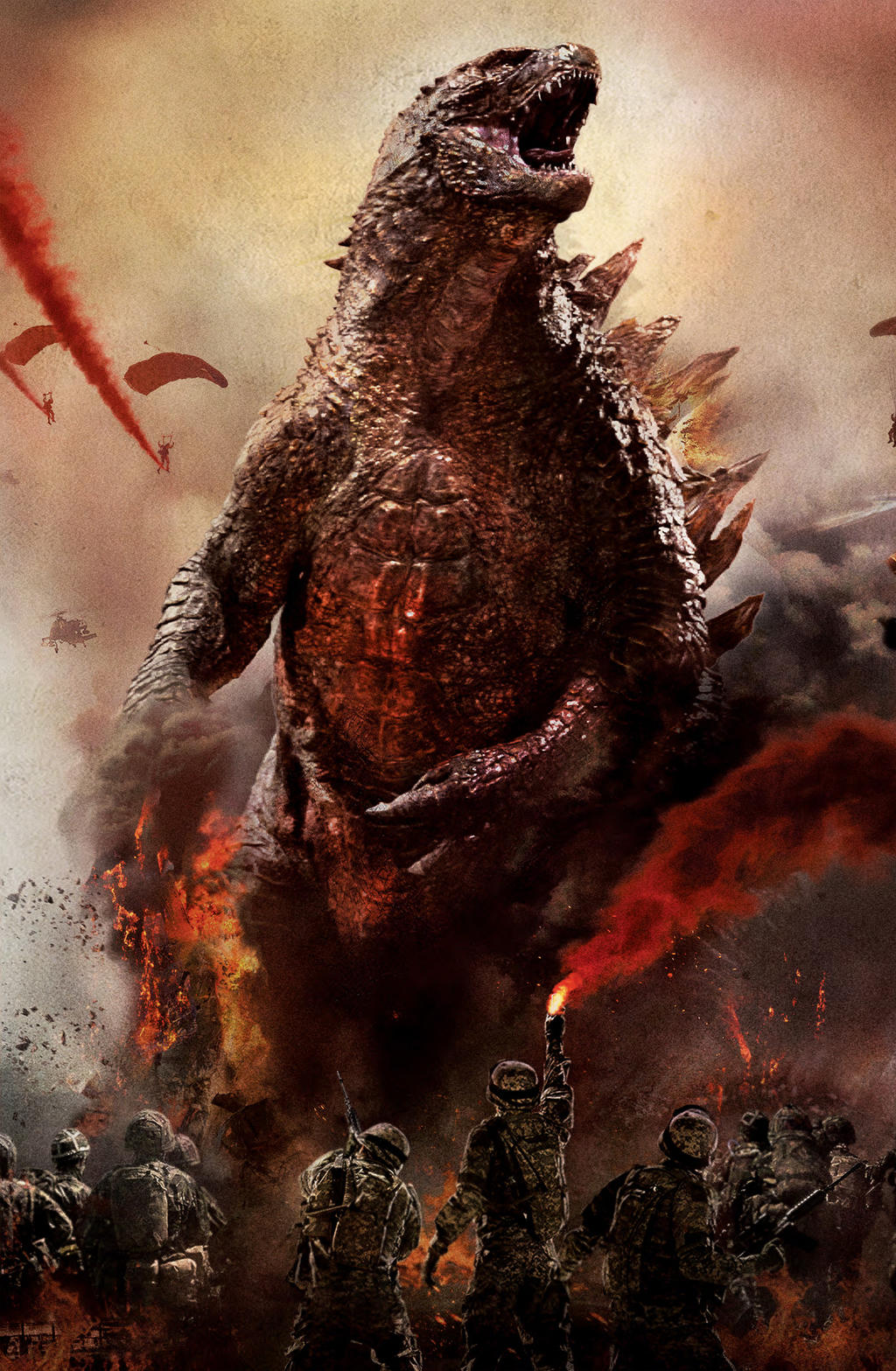
After much hype, Godzilla (2014) has finally stomped into cinemas around the world. It seems to have been a divisive monster movie, with some taking its slow pacing and focus on human characters as a breath of fresh air in a stale genre, and others wishing it had the wham-bam-thank-you-mam approach of Pacific Rim. Personally, I'm in the former camp, and am especially glad the new Godzilla franchise has not started with two hours of giant monster wrestling. While Godzilla (2014) is not flawless, it takes a lot of risks and feels like a modernised 'classic' monster movie, and not the focus-grouped, merchandise-led fanboy service it could have been. I should add that I'm not especially keen on the last 59 years of Godzilla movies, much preferring the genuine drama and symbolism of the original 1954 movie to the decades of monster fights which followed. Because Godzilla (2014) is tonally closer to the original than the later escapades, I'm not surprised that people just wanting two hours of skyscraper-sized wrestling are feeling a bit disappointed. Anyway, there's a lot we could say about this, but that's not quite what I want to write about  here.

A big part of updating Godzilla has been the overhaul of Big G himself, as well as bringing new creatures to this franchise. These are exciting times for monster film fans because, for only the second time in its 60 year history, one of the most famous movie monsters of all is in for a complete redesign (we all know what happened the first time) and, of course, is now free of the constraint of 'suitmation' effects - the fancy term applied to the 'guy-in-latex-suit' approach Godzilla movies are (in?)famous for. A fun fact about the original 1954 Godzilla is that the now-inconic chap-in-suit technology was a compromise, the studio initially desiring stop-motion effects like those of American-made films King Kong or The Beast from 20,000 Fathoms. Toho, the studio which created Godzilla, had neither the money or expertise to execute stop motion effectively, so opted for using costumes instead. Despite using their second choice, the Japanese trailer for Godzilla triumphantly declares their special effects superior to anything the American movie machine was making at the time! And it certainly worked out for Toho: after a difficult teething process, the 'suitmation' approach worked well for the franchise and wasn't tinkered with outside of the much maligned 1998 Tristar Godzilla.

For 2014, Godzilla is a fully digital and, as we all know, relatively faithful to the original designs. It has, however, been altered in ways which would be difficult to execute if we were still watching a man in a suit. A lot of these changes, as well as the design of Godzilla's adversaries, were pretty neat because they tie into what we know about animal biology, scaling and functionality, and I get the impression that the guys behind this latest Godzilla - Legendary Pictures - put a lot of effort into making half-sensible creatures which biologists, biomechanicists and functional anatomists can be relatively happy with. And yes, yes yes: there's a buttload of stuff which is clearly nonsense: there's no way these animals could be the size they are, or firing beams of nuclear fire from their throats and so forth. But that's just par for the course for a Godzilla movie, and I'm not going to jump on boring old bandwagon of highlighting how impossible the whole lot is. What's far more interesting, and what I want to focus on here, is how Legendary built their animals around standard movie monster tenets to produce creatures which are not only intriguing and cool-looking, but also chime with real animal biology and functionality.

Twinkle toes

Godzilla's stubby, new-look foot, as seen from an airport terminal. Image from the Godzilla movie forum.

One of the most striking aspects of Godzilla’s redesign is its short, stubby feet instead of the long, plantigrade feet we’re familiar with from the suitmation costumes (above). This is easily one of the best changes to make in the entire redesign. Not only does it move away from Godzilla looking like he’s wearing a pair of comedy slippers, but it makes a lot of sense from a functional perspective. Long, plantigrade feet of bipedal animals (like our own, as well as those of chaps in Godzilla suits) lift our entire body weight with every step, our metatarsals and ankles both supporting and propelling us forward. This works fine for lightweight animals like ourselves, but comparable foot anatomy in a skyscraper-sized animal would need to be immense to avoid buckling under thousands of tonnes of bending force. The superficially sauropod-, tortoise- or elephant-like foot of the new Godzilla negates this risk however, creating a more columnar distal limb structure which is not employed in lift and propulsion but instead ideal for supporting terrific weight. This has several effects on limb structure and locomotion. The foot musculature (anchored to the shin) is reduced, keeping the weight of the limb down overall, thus making movement more efficient. However, it also decreases the foot mobility, limits stride length and overall gracility. Some of these effects are countered, however, by the elongate thigh region common to all Godzilla designs, which can swing the shortened distal-leg over great distances with every step. This increased length of the proximal limb region and shortening of distal is a trend we commonly associate with larger animals, even in species which are quite active and sprightly, and descended from cursorial ancestors (e.g. rhinos). Godzilla’s enormous thighs also fit with observations that proximal hindlimb musculature becomes relatively huge in larger bipeds - see the pelves of large bipedal dinosaurs for examples - providing the powerhouses necessary to move its huge bulk around. The result is a limb which isn’t going to win Godzilla any prizes for sprinting but, more importantly, is much more suited to the animal itself than the older designs. And let’s face it, when you can take strides measured in hundreds of metres, moving relatively quickly isn’t a problem.

Godgilla

Gills ahoy, on the lower portion of Godzilla's neck. Image from Detroit News.

A clear departure from all other Godzilla movies is that new version can breathe underwater. They’re easy to miss, but look closely and you can spot a series of fish-like gills on the side of its neck. At certain points in the movie, you can see them opening and closing as the big chap respires. Apparently, these were added not only because Big G spends a lot of its time swimming from location to location in the movie, but also to explain how an animal as large as Godzilla could keep a relatively low profile for so long. Air breathing animals of such size would surely be better known to the world at large if they were routinely surfacing to take breaths. These are all that's left of fish-inspired designs for the new Godzilla, which also featured fins instead of rows of bony plates; fish-like scales instead of reptilian skin and so forth.

Gills on a big, adult tetrapod sound a bit crazy, and I will admit - the fish-like (bony?) gills of the new Godzilla are difficult to rationalise entirely among real animals. If we’re willing to stretch belief a bit (I assume we are, what with a fictitious 100 m tall reptile being the subject of discussion here), we can find saving grace from early tetrapods and their descendants, modern amphibians. The latter have internal and external gills in at least their larval stages with most species losing them as they become adults. These gills are supported by a series of bones behind the skull which lead to openings in the body wall which allow swallowed water to escape - these are known known as gill clefts. Some amphibians - specifically select caudatans (salamanders, axylotyls, newts etc. - see below) - famously retain gill structures into adulthood, including their elaborate external gills. We know from exquisitely preserved fossils that such gills were present in the ancestors of all modern tetrapods, some of which also retained these gills in adulthood, and others which at least maintained their gill clefts (Schoch 2009). It seems likely, then, that the possession of gills, and possibly retention of gill structures into adult life* is the ancestral condition for all early tetrapods - including, presumably - Godzilla. Amniotes, which also presumably includes Godzilla, have obviously abandoned these structures and co-opted the gill apparatus for other purposes.

An axolotl with its external gills. © Kevin Schafer / www.photoshot.com, linked from ARKive.

Could Godzilla or other creatures ever get their gills back? Well, maybe. For a long time it was thought that evolution was irreversible ('Dollo's Law of Irreversibility') and, under this concept, loss of gills would be a one way street: Godzilla would have to evolve an entirely new set of gills, which is entirely possible. However, it's now appreciated that Dollo's Law is not really a law at all, and that organisms frequently do reverse their evolution, including backtracking on complex aspects of their anatomy and life history: digits, dentitions, wings, larval stages, reproductive strategies are all examples of things which have been lost and then recovered in animals. What once seemed like a law is likely more statistical improbability: a lineage can evolve in many ways at any point in time, and the likelihood that it will directly reverse along a familiar path is relatively low. However, in theory, there's no real reason why this shouldn't happen, so long as the selection pressures are correct. It would take some hefty tinkering with genes and mountains of heterochrony, and it's difficult to think of conditions which would promote the development of early-stage gill anatomy, but I guess it's not impossible for an amphibious creature to regain its ancestral gill condition under the right circumstances. My guess is that they would look more like the gills of caudatans than they would the scale-like fishy apparatus of Newzilla, but, let's face it, big feathery gills would look incredibly silly on a city-smashing monster.

See? Less "Godzilla, King of the Monsters", more "Preszilla, Queen of the Desert". Both are scary, but in very different ways.

Has Godzilla put on weight? No, it's just in it's head

One of the key comments made about the new Godzilla design is that it’s a bit of a heffer compared to other versions. This is debatable (they’ve always been pretty chunky if you ask me), but Legendary’s Godzilla design probably appears fatter than the rest because of its proportionally small head. There are good design reasons for this move: the smaller head gives a natural taper towards the top of the animal, distorting its perceived perspective and size, and it helps avoid the comically oversized, googly-eyed heads of previous versions. It's also in keeping with the natural world. Animals show a disproportionate reduction in skull length with respect to body mass - that is to say, larger animals generally have proportionally smaller heads than smaller ones. Note that this applies to carnivores as well as herbivores (Van Valkenburgh 1990; Christansen 1999). Godzilla represents a real extreme of animal gigantism, so it makes sense that its skull and head is going to carry this allometric trend to an unprecedented limit. What’s more, whatever Godzilla actually is (the new movie, thankfully, doesn’t really concern itself with this), it’s clearly on the reptile branch of the animal tree. Reptile cranial musculature is generally less developed than that of mammals, so their skulls and heads are relatively smaller at a given body mass than equivalently sized mammals (Christansen 1999). Again, this fits neatly with the small cranium of our new-look Godzilla. Of course, making the head look even smaller are the big legs and counterbalancing tail but, as mentioned above, this is also to be expected. Bottom line: far from being fat, 2014's Godzilla is just showing the extremes of proportion that we would expect if an animal ever grew to the ridiculous sizes we see on screen, and my feeling is that we're looking at a far more 'realistically' proportioned version that we've seen before.

"I'm not fat, I just have a head of predictably small proportion based on typical animal scaling allometries which distorts your overall perception of my size!" Whatever, buddy. Image from Godzilla Movies

MUTO: Finally, a convincing giant, flying movie creature

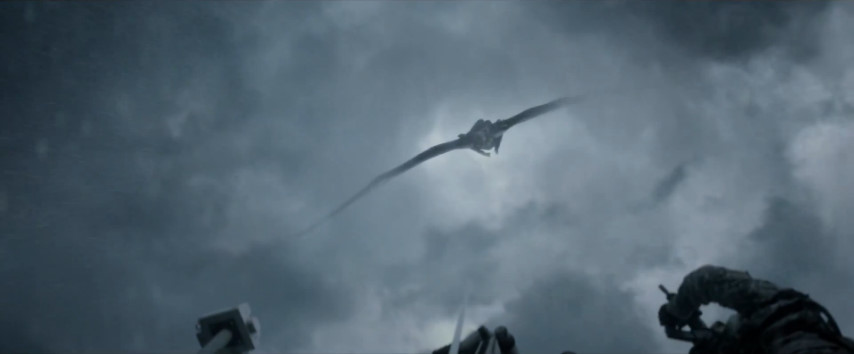
Moving away from the main attraction: Godzilla vies for attention in the 2014 movie with another species of giant critter, termed ‘MUTO’ (below). The design for the MUTO(s) is very cool: gigantic, eight limbed, insect-ungulate-pterosaur beasts which defy easy classification. We’re shown pronounced dimorphism in adult MUTOs, the females being larger and more robust than the males, and devoting all limb sets to either terrestrial locomotion or gripping. The males, however, allocate one set of limbs to flight, bearing a spectacular pair of enormous membranous wings which recall monowing plane designs of the early 20th century (this isn't a coincidence: male MUTO wings are actually based on stealth bombers). These wings are largely unfoldable and situated on the dorsal surface of the torso so, when grounded, they extend behind the MUTO like a huge cape. Despite being the smallest creature in the film, male MUTO is still huge, so there’s little risk of it clipping its flowing wings on any structures when locomoting terrestrially.

MUTO in flight, from the Godzilla trailer.
There’s a lot to like about the male MUTO’s wing anatomy and flight mechanics. Firstly, the wings of this animal are simply enormous, as they should be for a creature of its size. Not only do they dwarf the body of the animal, but we could measure their span in metric villages. All too often, flying movie creatures are equipped with wings far too small for their body size, but - running off intuition here - these look ‘right’ for its size. As demonstrated by the birds below, wings increase in length and area disproportionately with body size because of standard rules of scaling: any linear size increases equates to a cubed increase in mass, which gives more for gravity to pull against and greater wing area requirements to achieve lift. If we are ever to expect a several-hundred tonne flying creature to become become and stay airborne, it would need significant wingage: MUTO delivers on this front.

A rule of thumb for designing flying animals: as mass increases, wing length increases faster. Demonstrated here by various bird planforms from Rayner (1988).
But it’s not just wing size that’s cool about the male MUTO: it’s flapping, or lack thereof, was also neat. Flapping amplitude - the degree of movement of a full wing stoke - decreases with wingspan in all flying creatures. The larger an animal is, the less movement is required in its wings to produce an effective flap cycle. A familiar example of this is the wing motions of flapping geese compared to pigeons: both flap their wings nearly constantly while flying, but the former move their wings around the horizontal, while pigeons swing them in great arcs. All too often, giant flying movie creatures (including several giant pterosaurs) show whopping huge flapping amplitudes well beyond necessity for flight and, probably, aerial stability. Godzilla’s male MUTO moves his wings just a little, however: he definitely flaps, but his wings move just a few degrees around the horizontal, not in huge arcs (watch the clip, below, for an example. Skip to 0:24 if you're a particularly impatient type). He also largely soars, as would be expected for any uber-large flier: flapping those wings would take a lot of effort, so soaring is the way to go. It would be loads of fun to get some basic wing size and mass data for this guy to work out some basic flight parameters - cruising speed, travelling distance etc. Given that giant pterosaurs seem capable of cruising at 100kph (Witton and Habib 2010), and yet are mere pipsqueeks at 10 m wingspans compared to the male MUTO, I reckon we’re looking at cruising speeds of several hundred kph. And that’s if he’s not in a hurry.


Finally, we get to see the MUTO launch a couple of times in the film, and each time we see something reminiscent of quad-launching. Pterosaur fans will know this trick as the best hypothesis on the table for explaining how flying reptiles became airborne, and a core factor explaining their attainment of gigantic proportions (Habib 2008). The kimeatics of MUTOs takeoff aren't quite the same - which is to be expected seeing as the limbs of pterosaurs are quite different to those of MUTOs - but it's neat to see the same basic components - a standing start, the rocking back crouch, forward thrust, upward push and leaping phase - incorporated into MUTOs takeoff. These actions are all performed with the four walking limbs rather than the wings themselves, as in pterosaurs and bats, but this also chimes well: MUTOs would need all the power they could to become airborne, so using every available limb is logical. Note that insects are an unlikely model for MUTO takeoff because, while seemingly comparable with MUTO because of their similar limb and wing configuration, at least some insects only use one pair of limbs (the mesothoracic) to launch (Trimarchi and Schneiderman 1995). This is probably because insects enjoy much better power/weight ratios than large vertebrates/skycraper-sized-monsters. 2-4 mm long fruit flies can jump up to 15x their own body lengths - about 30 mm - using their middle limbs only (Zumstein et al. 2004). This sets them apart from bats and pterosaurs, which use all their limbs in launching, and makes these the best candidates for MUTO launch models. It would be neat to know how much attention the animators and designers have been paying to bat and pterosaur research or if they came up with this launch strategy on their own. My experience of explaining quad-launch is that a lot of folks find it counter-intuitive at first, probably because we don't see many animals routinely taking off in this way, so I do wonder if the similarity between these takeoff strategies reflects research into animal takeoff.

And that's it for now. If you want to know more about how the animals of Godzilla (2014) were constructed, you should check out the concept art book which accompanies the film: Godzilla: the Art of Destruction (Cotta Vaz 2014). Closer to home, more fun with famous fictitious monsters can be found here, and for more on movie creatures - specifically those of special effects legend Ray Harryhausen, check out this.

References

  • Christiansen, P. (1999). On the head size of sauropodomorph dinosaurs: implications for ecology and physiology. Historical Biology, 13(4), 269-297.
  • Cotta Vaz, M. (2014). Godzilla: the Art of Destruction. Titan Books.
  • Habib, M. B. (2008). Comparative evidence for quadrupedal launch in pterosaurs. Zitteliana, 159-166.
  • Rayner, J. M. (1988). Form and function in avian flight. In Current ornithology (pp. 1-66). Springer US.
  • Schoch, R. R. (2009). Evolution of life cycles in early amphibians. Annual Review of Earth and Planetary Sciences, 37, 135-162.
  • Trimarchi, J. R., & Schneiderman, A. M. (1995). Initiation of flight in the unrestrained fly, Drosophila melanogaster. Journal of Zoology, 235(2), 211-222.
  • Van Valkenburgh, B. (1990). Skeletal and dental predictors of body mass in carnivores. In: Damuth, J. and MacFadden, B. (eds). Body size in mammalian paleobiology: estimation and biological implications, 18, 1-205.
  • Witton, M. P., & Habib, M. B. (2010). On the size and flight diversity of giant pterosaurs, the use of birds as pterosaur analogues and comments on pterosaur flightlessness. PLoS One, 5(11), e13982.
  • Zumstein, N., Forman, O., Nongthomba, U., Sparrow, J. C., & Elliott, C. J. (2004). Distance and force production during jumping in wild-type and mutant Drosophila melanogaster. Journal of experimental biology, 207(20), 3515-3522.

Thursday, 2 January 2014

Remembering Iguanodon

Retrosaur Iguanodon, c. 1854. Based, of course, on the sublime work of Benjamin Waterhouse Hawkins.
Space year 2014 marks the 189th anniversary of the naming of a dinosaur icon, Iguanodon. The major beats of the discovery and research history of this Lower Cretaceous herbivore are so well-established within palaeontological lore that most readers will need little reminder of it here. We all know that Iguanodon was first known from large, iguana-like teeth found in southern England in 1822, supposedly by Gideon Mantell's wife, which we all also know is widely considered an embellished tale: the teeth were probably found by Mantell himself or quarrymen. Equally familiar is Mantell's naming of Iguanodon in 1825 with the first specific name given to this genus, anglicus, added by Friedrich Holl in 1829. As the second dinosaur to be named, Iguanodon was part of the trio of dinosaur genera used by Richard Owen to name Dinosauria in 1842 and was reconstructed alongside its cousins, Megalosaurus and Hylaeosaurus, by Richard Owen and Benjamin Waterhouse Hawkins as an awesome dinosaurian rhino in 1854. Discoveries of more complete Iguanodon remains, first in Britain and then in the coal mines of Bernissart, Belgium, led to a reconsideration of this bauplan. The most extensive work on this front was conducted by Louis Dollo in the 1880s, who took the complete Iguanodon skeletons from Bernissart - among the first complete dinosaurs known from anywhere in the world at that time - and created the famous 'kangaroo' posture for Iguanodon, broken tails and all, which dominated reconstructions of this animal for the next century. It was not until the 1980s that Iguanodon adopted the appearance of the facultatively bipedal, horizontally-backed ornithopod we know today. So far, so familiar.

Undoubtedly, Iguanodon is a 'classic' dinosaur, and has been a mainstay of popular dinosaur literature for decades. Other dinosaur species named in the early 1800s have not enjoyed the same treatment (Thecodontosaurus, Ceitiosaurus and Hylaeosaurus for instance, are not household names), so its popularity is not just a result of it being one of the first dinosaurs known. Most of us can probably remember a key Iguanodon depiction from our childhood dinosaur books, magazines or films - or from a Love in the Time of Chasmosaurs vintage palaeoart post if you're not yet through puberty - with it stood upright and, of course, giving an irrepressible thumbs-up with its famous thumb spike. These Mesozoic Fonzies, which diehards always knew came in big (I. bernissartensis) and small (I. atherfieldensis) flavours, wouldn't stop manually approving their surroundings even when being attacked by passing generic 'megalosaurs'. Final revisions to its anatomy - an aloft tail and quadrupedal stance - have been drifting into popular depictions for years now, replacing MesoFonz with a heavyset herbivore often depicted living in herds and browsing at different levels. While its lack or truly bizarre anatomy or ferocity may have prevented Iguanodon from ever being the most famous of dinosaur species, there's little doubt that it's held a long-term place in palaeo-pop culture.

All good things...
At least, until recently. If the internet palaeo scene is anything to go by, Iguanodon seems to be sliding down the popularity pole at the moment. It just doesn't seem to be the topic of much conversation any more, or even artwork. Feathered theropods, weird sauropods, horned dinosaurs and even hadrosaurs - boring old hadrosaurs - seem to have stolen the limelight. Perhaps this is because our taxonomic and palaeobiological perceptions of many prehistoric animals have radically changed in recent years whereas Iguanodon, frankly, has remained rather static. It's a bit too familiar. Dinosaur palaeontology has changed radically in the last few decades, but it's changed around Iguanodon, which has done little more than tip forward a little since the 1980s. Discussions about feathers, postures, weird soft-tissue details and whatnot have passed it by entirely, and even a relatively recent shake-up of its taxonomy, where the Cretaceous-straddling, globe-spanning monster-Iguanodon genus was carved up into multiple genera spread across time and space (see Darren Naish's Scientific American articles here, here and here for details) did little to revive public interest in one of our longest serving and best-known dinosaurs. Iguanodon seems to be a dinosaurian washed-up Golden Age movie star: once great, now rarely mentioned, and only wheeled for nostalgia.

The gossip magazines would have a field day.
Behind the scenes, however, Iguanodon or, more correctly, 'iguanodonts' are becoming more and more interesting. Far from large, bland and overly-familiar ornithopods, the modern concept of iguanodonts comprises several distinct Lower Cretaceous species with markedly different bauplans which created complex herbivore communities. Their anatomy varied in many aspects other than simply size - even their famous thumb spikes are actually quite disparate - and functionality must have been equally diverse. The very evolution of iguanodonts is also more complex than we thought: rather than forming a clear group of ornithopods, iguanodont taxa seemingly comprise a messy, not-fully-understood bush of species on the ornithopod branch trunk leading to true hadrosaurs (e.g. McDonald 2012a). Thus, there is no truly correct term for a group comprising Iguanodon and its close relatives: 'iguanodont' is used here in a vernacular sense. In short, it seems that iguanodonts have fallen off the popular radar just as they're getting more interesting and worthy of attention

Iguanodonts: the undiscovered country
At the heart of this newfound complexity is the aforementioned reappraisal of iguanodont diversity. It's worth stressing that the charge to slay the waste basket monstergenus Iguanodon, started by Norman and Barrett (2002) and followed by the likes of Paul (2008), Norman (2010), Carpenter and Ishida (2010), Naish and Martill (2008), McDonald et al. (2010), McDonald (2012a, b) and others, was not a case of splitting minor taxonomic hairs. Unlike the differences which separate many fossil animals, most taxa pulled from Iguanodon are characterised by radically different morphology which would be obvious even in life. In Britain alone, the handful of species recognised as various members of Iguanodon may now comprise as many as nine genera (not counting objective synonyms). It's well known that Iguanodon is now monospecific, containing only the giant species I. bernissartensis. In the UK at least, this is principally known from the Wessex Sub-basin of the Wealden Supergroup of the Isle of Wight, although it also occurs in the Weald Sub-basin of Surrey, Sussex and Kent (below). It was joined in both basins by Mantellisaurus, the smaller iguanodont once called Iguanodon atherfieldensis and, in the Wessex, by two other possible taxa: Proplanicoxa galtoni and Dollodon bampingi. All but Proplanicoxa galtoni are known from elsewhere in Europe, which cannot be said for other British iguanodonts Barilium dawsoni*, Hypselospinus fittoni, Sellacoxa pauli and Kukufeldia tilgatensis from the Weald Sub-basin, also of the Wealden Supergroup of Sussex and Surrey. These animals are geologically older than the more familiar Iguanodon and Mantellisaurus and, for now at least, do not seem to overlap stratigraphically. A further genus, Owenodon hoggi, has been named for "Iguanodon" material from the British Purbeck Group. A number of other Asian and North American genera have also been pulled from Iguanodon, but the British record seems unusually diverse and implies that multiple iguanodonts existed in the same basins. Admittedly, exactly how many European iguanodont taxa are valid remains uncertain - there are arguments for it being over-split and overly-conservative - but even a relatively cautious assessment suggests several iguanodont faunas evolved in ancient Britain.

*Fascinating aside: according to Norman (2011a, b) there's a good chance that the original Iguanodon teeth belong to Barilium. There's not much we can do about this now - after years of confusion over what Iguanodon is, the name has been irreversibly transferred to I. bernissartensis. While most agree this was one appropriate cause of action to take - most of us have always thought of this species as the 'classic' Iguanodon - there are lots of niggles and issues with the choice of bernissartensis as the surrogate type species of Iguanodon. The similarity of the original 'I. anglicus' teeth to Barilium is just another hangover from the excessive lumping that Iguanodon experienced in its first 180 years of recognition.
Simplified overview of British iguanodont distribution. The taxa listed here do not include recently named objective synonyms and includes several genera which some authors (e.g. Norman 2011a; McDonald 2012) would happily remove. I. anglicus, the original Iguanodon and nomen dubium, is included for interest only. Silhouettes provide very rough proxies for maximum taxon size to show the possible nature of iguanodont faunas, borrowed from Paul (2008). Hat tip to Bill Wimbledon for some pointers on Wealden chronostratigraphy.
Quite how these contemporary animals did not trip over each others ecological toes remains to be established. Some truth to the 'classic' view of Iguanodon species occurring in different size classes remains, with most newly recognised species equating to large- or medium-size dinosaurian herbivores. What is now very apparent, however, is that size is only one way in which these animals differ. The large iguanodont Barilium, for instance (below), is about the same length as I. bernissartensis (10-12 m) but is much more heavily built, with proportionally heavyset hips, shoulders, limb bones, a chunky anterior tail region and very tall neural spines along much of its back. While it's difficult to call I. bernissartensis a gracile creature, its bones are certainly more svelte than those of Barilium: its limbs are longer, its vertebrae lower, and its limb girdles less stocky. A similar story is echoed in the smaller iguanodonts which lived alongside the giants: Hypselospinus, contemporary of Barilium, was a relatively small (about 6 m long) but stocky species, with chunky limb bones and a thick shoulder girdle. By contrast, other 'small' iguanodonts - such as the 6- 7 m long Mantellisaurus and Dollodon - were rather gracile, with slender limbs and relatively delicate hands. Despite its robust body, Hypselospinus shared a relatively gracile jaw construction with other smaller iguanodonts. With many further differences in their fine anatomy, a clear message can be seen: iguanodonts were not merely resized variants of the same bauplan rolled out over the Lower Cretaceous. Quite how their different anatomies plugged into their palaeoecology and niche differentiation remains to be established, but its possible - maybe probable - that their anatomical differences reflect different foraging strategies, habitat preferences and routine predation responses. Perhaps the geologically younger, slender variants were quicker on their feet than their rotund forebears? Did the more robust species spent more time locomoting quadrupedally? No-one really knows at the moment, but there's clearly a lot of interesting things going on here and a lot of interesting research to be done.

Barilium dawsoni, a large and very robust iguanodont from the Valanginian of Sussex, caked in dried mud. This stunted pollex of this animal, which was probably quadrupedal most of the time, means it'd be hard-pressed to give a thumbs up even if it wanted to. A flock of 'Ashdown maniraptorans', tiny, poorly known theropods no larger than an Eurasian magpie, add scale (see Naish and Sweetman 2011 for details).
It would be remiss of us to not mention that the most famous iguanodont feature - their thumb spikes - are also far from uniform in size or construction. The function of the iguanodont pollex has long proved controversial, but a role in stabbing generic theropods in the neck is a common assumption. This long-held assumption is questioned by the range of morphologies associated with the pollex however. Most of us are familiar with the general construction of the iguanodont pollex thanks to oft-reproduced images of the Iguanodon hand, such as...

Left Iguanodon bernissartensis manus. Image from here.
Here, the pollex is conical and fairly large, but remains detached from the carpal block (iguanodont wrist bones fuse into a single unit with age). Thus, the pollex retains an ability to move somewhat. The pollex of Mantellisaurus is generally similar to that of Iguanodon, except that it is much, much smaller - probably far too small to be used as an effective predator deterrent. By contrast, the pollex of another small iguanodont, Hypselospinus, was proportionally large and robust, being about 40% as long as the forearm. Rather than being truly conical, the pollex of Hypselospinus was laterally compressed and tightly attached to the carpal block so little or no flexion was possible. The thumb of fatso Balirum was actually fused to the block itself, and is of further note for being incredibly short: Barilium would struggle to give a satisfactory 'thumbs up' to anyone. So again, we see evidence of diversity in these unassuming dinosaurs: pollex size, shape, flexion and reinforcement all vary across iguanodont taxa. We may take this as a sign that thumb spike function was also variable across iguanodonts, so there may not be one single explanation for their existence. The tight pollex articulations of some species seemingly make the pollex part of the antebrachial functional unit than the hand, and are strangely reminiscent of the carpometacarpal knobs and spurs of many birds (see - again - a TetZoo series on this topic, starting here). Alas, the function of many bird hand spurs are not well researched, but the general consensus - supported by direct evidence in many cases - is that they're primarily used in combat and aggressive behaviours, much of it intraspecific. In some cases, they may even be used to make noise when slapped against the flanks of their owners. Who knows: perhaps iguanodonts with tightly welded, inflexible thumb spikes used their pollices in a similar way. But what of species with flexible thumb spikes? Could they be used as weapons too? If so, how come the large pollex of Iguanodon was not fused to the carpus when the large thumb of Hypselospinus is? Did that make it a less effective weapon? And what was Mantellisaurus using that piddling little thumb spike for, if anything? Questions, questions, questions...

The bit where I stop writing
In sum, while it would be silly to say that iguanodont science is undergoing anything like a revolution or renaissance, there's certainly a lot of tinkering going on and the results are exciting whatever your specific taste in palaeontology - taxonomic, functional, or palaeoecological. Granted, the outcome of these ongoing studies are not going to make newspaper headlines, but if you're interested in dinosaur palaeobiology - and you are if you've read this far - then this should be very cool, interesting stuff. If the apparent decline in public interest for iguanodonts is because many of us consider them overly-familiar, then we need to think about changing that attitude. Far from being 'done to death', after many decades of fairly static interpretation, iguanodont science is becoming more interesting than ever.

For an easy to access, relatively up to date and inexpensive look at a bunch of iguanodonts, you could do a lot worse than checking out Dave Norman's chapter on ornithopods in English Wealden Fossils (Norman, 2011b)Further brief musings on the decline of a dinosaur celebrity are provided in this post on Stegosaurus.

References
  • Carpenter, K., & Ishida, Y. (2010). Early and “Middle” Cretaceous iguanodonts in time and space. Journal of Iberian Geology, 36(2), 145-164.
  • Paul, G. S. (2008). A revised taxonomy of the iguanodont dinosaur genera and species. Cretaceous Research, 29(2), 192-216.
  • McDonald, A. T. (2012a). Phylogeny of basal iguanodonts (Dinosauria: Ornithischia): an update. PloS one, 7(5), e36745.
  • McDonald, A. T. (2012b). The status of Dollodon and other basal iguanodonts (Dinosauria: Ornithischia) from the Lower Cretaceous of Europe. Cretaceous Research, 33(1), 1-6.
  • McDonald, A. T., Barrett, P. M., & Chapman, S. D. (2010). A new basal iguanodont (Dinosauria: Ornithischia) from the Wealden (Lower Cretaceous) of England. Zootaxa, 2569, 1-43.
  • Naish, D., & Martill, D. M. (2008). Dinosaurs of Great Britain and the role of the Geological Society of London in their discovery: Ornithischia. Journal of the Geological Society, 165(3), 613-623.
  • Naish, D., & Sweetman, S. C. (2011). A tiny maniraptoran dinosaur in the Lower Cretaceous Hastings Group: evidence from a new vertebrate-bearing locality in south-east England. Cretaceous Research, 32(4), 464-471.
  • Norman, D. B. (2010). A taxonomy of iguanodontians (Dinosauria: Ornithopoda) from the lower Wealden Group (Cretaceous: Valanginian) of southern England. Zootaxa, (2489), 47-66.
  • Norman, D. B. (2011a). On the osteology of the lower Wealden (Valanginian) ornithopod Barilium dawsoni (Iguanodontia: Styracosterna). Special Papers in Palaeontology, 86, 165-194.
  • Norman, D. B. (2011b). Ornithopod dinosaurs. In: Batten, D. J. (ed.) English Wealden fossils. The Palaeontological Association (London), pp. 407-475.
  • Norman, D. B., & Barrett, P. M. (2002). Ornithischian dinosaurs from the lower Cretaceous (Berriasian) of England. Special Papers in Palaeontology, 68, 161-190.

Saturday, 13 July 2013

Something R'lyeh different

Detail of "Mark Witton's greasy, flowing mass", for Matt Wedel's Collect Call of Cthulhu
If my Facebook and Twitter feed tell me anything, it's that folks with interests in palaeontology are also very interested in science fiction. Chaps who liberally discuss bird origins and tyrannosaur feeding palaeobiology are likely to also discuss how many tribbles you can stuff into a Jefferies tube or which Imperial Walker would be best for car-pooling to work. Given that a lot of modern science fiction teeters under the weight of ideas borrowed from early science fiction authors, I'm going to take a wild guess that a lot of palaeofiends have, at one time or another, traced these sources back to one of the cornerstones of modern sci-fi: the nightmarish, slimy and tentacle-rich mythos of H. P. Lovecraft.

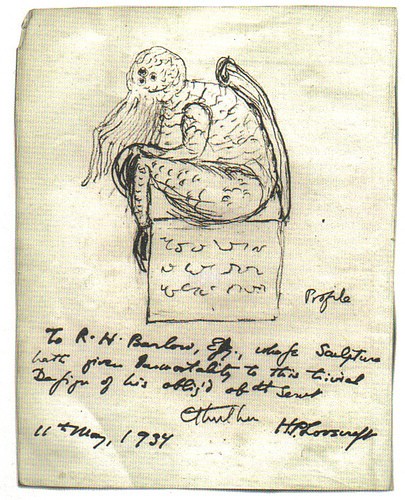
Matt Wedel, best known in palaeontological circles as a crusader of sauropod vertebrae, certainly has. Over at Echo Station 5-7 he's been musing on the nature of Lovecraft's seminal creation, Cthulhu, and inviting submissions of artwork rendering his hideous visage. A keen emphasis has been made on entrants avoiding the traditional representation of Cthulhu as a guy with squid head through either style or biological interpretations, which I agree with 100%. Lovecraft's descriptions of Cthulhu are undeniably vague, but his suggestion of a greasy, dripping, and ambiguous being is a million miles away from the beefy, green anthropoids we see striding around all too often. Indeed, even Lovecraft's own sketches of Cthulhu seem quite wide of his text:
Cthulhu takes five in this sketch by H. P. Lovecraft himself. Borrowed from the Lovecraft EZine.
Given that I'm not adverse to dipping my toes in Cthulhu mythos myself, I couldn't resist joining the fun. I've had an old, half-finished painting of Cthulhu lying dormant, dreaming, on my hard drive for well over two years, so saw Matt's open invitation as the impetus to wake him up, finish him off, and send him in. The results can be seen in part at the top of this post, but you need to head to Echo Station 5-7 to see the rest. Because I was apparently cursed to write at length about pretty much anything I create in a past life, there's also a typically lengthy explanation for the decisions I made in the rendering process.

If Lovecraftian things are up your street, you also owe it to yourself to read the comments from regular palaeoblog contributors on what they think makes a good Cthulhu, here, here and here. They're not only great demonstrations of how diverse the interpretations of vaguely-understood literary beings can be, but offer some great speculative biology because of the informed scientific backgrounds of each commenter. The discussions at Matt's blog have also spawned an interesting essay on the ecological strategies used by Lovecraft's beings, based on vernal pools, penned by Heteromeles at Putting the Life Back in Science Fiction.

All good stuff, and I've thoroughly enjoyed being part of it. Regular programming - art of old dead things - will be resumed shortly.