Showing posts with label Troodontidae. Show all posts

Friday, 10 June 2016

The dinosaur resting pose debate: some thoughts for artists

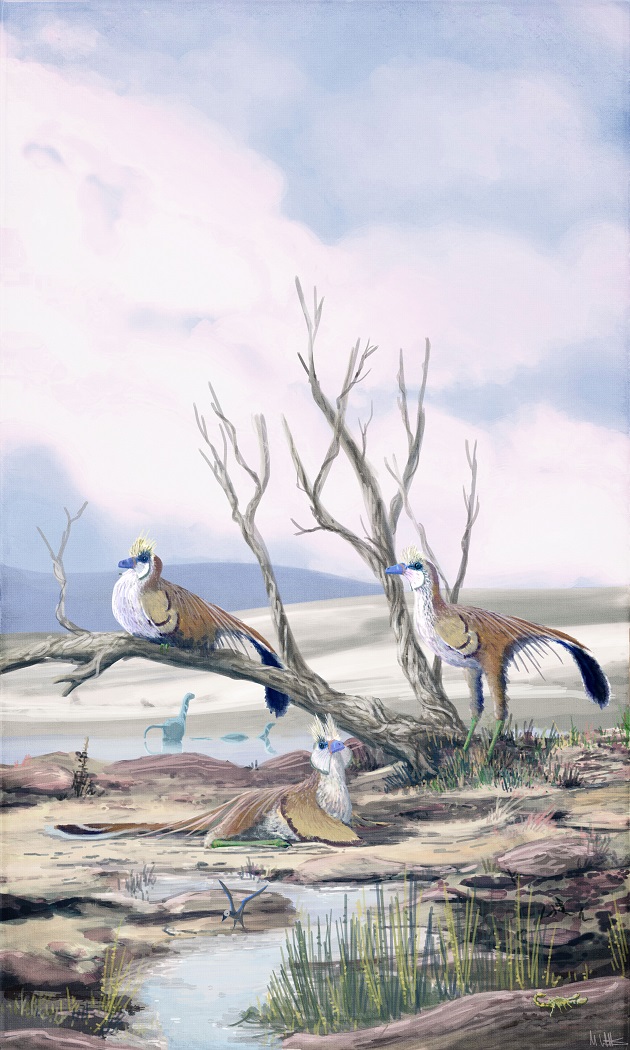
Three Sinornithoides youngi, one standing, one sitting, one sunbathing. But would these animals really have adopted resting poses like those of modern birds, as shown here, or would they have relaxed in completely different postures?
A recurrent topic of conversation among palaeoartists concerns how non-avialan dinosaurs rested. Specifically, were they constrained to crouching down and lying on their bellies like modern birds (above), or could they lounge on their sides, rest with limbs beneath their bodies, and generally adopt more varied resting poses? I've always thought that there's no reason to confine depictions of reposed dinosaurs to avian-like squatting poses and, based mostly on personal experiences of modern animals, it has never seemed outlandish to depict a theropod resting on its side, or a horned dinosaur sitting on its legs or whatever. This is evidenced by some of the art I've posted here in the last few years, some of which is reproduced below. But reasonably frequent mention of this topic on social media suggests that not everyone has this attitude, so I thought it might be of interest to discuss this in more depth. What do Mesozoic dinosaur skeletons, trace fossils, and modern animals tell us about Mesozoic dinosaur resting poses, and how might we approach this topic as artists?

A necessary caveat

Asking general questions about how extinct dinosaurs did anything is increasingly difficult to answer in a succinct, concise manner. Dinosauria is an enormous group of animals with huge diversity in body size, gait, proportions, soft-tissue anatomies and so on. These are all things which impact the way an animal might sit or lie down, and in all likelihood there is no one answer to this inquiry. What works for a troodontid may not work for an ankylosaurid, and what works for these may not apply to a sauropod. While there's some merit to taking a general approach to this discussion (and that's what we'll be doing here), this point is something to bear in mind as we go through. The actual answer to this question will be multifaceted, and found through dedicated study of specific dinosaur groups.

What the fossil record tells us

Crouching dinosaur traces attributed to bipedal theropods and ornithopods are known from the track record (e.g. Lockley et al. 2003; Milner et al. 2009 and references therein), and these are often used as evidence for dinosaurs generally adopting bird-like, crouched resting postures. Such impressions cannot be regarded as common, but are easily identified by the elongate footprint impressions where the long metatarsal bones and ankle are impressed into the ground behind the toe prints. That at least some of these crouching traces show stationary behaviours, and not crawling or stooping, is evidenced by the symmetrical position of the footprints and impressions of an ischial callosity (the soft-tissue covering the posterior prong of the dinosaur pelvis). These pelvic traces show that the body was in contact with the ground when these traces were made, and that it was not being dragged forwards. Clearly, these animals were, at least partly, letting the ground take some of their weight.

We don't just have to look to trace fossils for evidence of crouching behaviour. On rare occasions, remains of dinosaurs are found that were more-or-less entombed alive in ash or sediment, revealing details of their postures at time of death. Famous examples of such occurrences include several troodontids (Russell and Dong 1993; Xu and Norell 2004; Gao et al. 2012) and protoceratopsids (Fastovsky et al. 1997). These also consistently show dinosaurs resting on their bellies in crouched postures, legs folded up either side of their bodies in a very avian manner.

Protoceratops (P. hellenikorhinus shown here) is among the dinosaurs known from skeletons that are thought to reflect near-life position at death. The pose depicted in this painting, with the animal leaning on its left leg, is at odds with the poses of such skeletons.
This is starting to seem like we've already solved the debate, but we might want to think about what these data are actually telling us. Our footprint data, and much of our crouching-death-pose skeletons, pertains to smaller bipedal dinosaurs, and we don't have any comparable data for the other bauplans. I don't know about you, but my chief interest in this discussion isn't really the small bipeds: it's the stegosaurs, the sauropods, the ceratopsids etc: those big animals that are different enough from modern species that their day-to-day behaviours are not obvious. And there's certainly enough strange stuff going on in their anatomy to caution against simply applying what we see in small bipedal dinosaurs across the entire group.

Secondly, it's interesting that we only sometimes see hand prints associated with crouching traces (Milner et al. 2009). When we do, we tend to see evidence of the palms and digits, not of whole forearms, as we might expect from a fully resting, lying animal. So are these animals actually lying down, or just sitting? Have they crouched down to truly rest, or are they performing some other behaviour (e.g. foraging, preening etc.)? I find it interesting that crouching traces can occur multiple times within trackways (Lockley et al. 2003), and that others show evidence of animals shifting weight and changing direction. Such instances seem to record sitting, but still 'active' individuals. Studies of modern animal behaviour are relevant here. When researching bird sleeping postures, I found Almaner and Ball (1983) had similar misgivings about the idea of immobile birds being 'inactive' or merely 'resting'. Based on their observations, they divided avian 'loafing' behaviour (that is, behaviour adopted when the bird is generally immobile) into multiple types of activity, of which only one is resting. Looking through their categories of loafing behaviour (below), none seem outlandish when applied to dinosaurs and I wonder what those prints made by stationary, crouched dinosaurs really represent: resting is really only one option. It may be that further examination of 'resting' traces can turn up more information. That said, I'm aware of slightly frustrating experiments with modern emus where even optimal substrates for track formation do not record additional trace evidence of activities like feeding from crouched positions (Milàn 2006). But, hey, we can still be optimistic that more data and insights will come in time.

What it means to be a stationary bird. Clearly, being crouched and immobile does not always mean 'resting'. From Almaner and Ball (1983).
Those skeletons preserved in life position are also worthy of further comment. Generally speaking, these represent animals caught in catastrophic events - volcanic eruptions, sandstorms and so forth - and we probably should not assume that these animals were just 'resting' when they were entombed in sediment. Indeed, the orientation of Protoceratops skeletons in Mongolian bone beds is non-random, and sedimentological data indicates they were facing into strong sandstorms when they died (Fastovsky et al. 1997). They were certainly crouched, but in all likelihood they were not relaxed and taking it easy: quite contrarily, it seems reasonable to assume they died during attempts to weather a storm, doing their best to hunker down against flying sand, collapsing dunes and all manner of other terrible events. An apt analogy here might be reading the Pompeii ash mummies as representing stereotypical human resting postures: some were found lying down, but that doesn't mean they were relaxing when they died.

On a related note, I also wonder how we would identify a dinosaur that died deliberately resting on its side rather than being moved into that pose by taphonomic processes. Most animals require effort to remain vertical, be it crouched or otherwise, and it's obvious when we find crouching dinosaurs that their pose reflects something of their final behaviours. But how do we distinguish a dinosaur preserved having a nap on its side from one that simply died and fell over, or was washed up on a riverbank or whatever?

All this considered, my point here is not that these data are meaningless when it comes to discussions of dinosaur resting postures. They clearly show that many Mesozoic dinosaurs did naturally crouch in an avian-like manner, and there's no problem with assuming this has some bearing on resting poses. But I do not think this data is without complications, nor that it is complete enough to tell us the whole story here. We probably need to look elsewhere for additional information.

The search for modern analogues

Torvosaurus tanneri in controversial 'reclining on a recline' pose.
Another approach we can take to this problem is to look at how modern animals sit and rest. Birds are often hailed as the best insight here, and for obvious reasons. But are birds good models for Mesozoic dinosaurs? Modern birds represent an extremely derived group of dinosaurs, and their anatomy has been heavily influenced by the development of flight adaptations. That means that many anatomical aspects we should consider here - body shape, flexibility of vertebrae and limb joints, muscle mass and so on - are quite far removed from their Mesozoic cousins. Their torsos, for instance, are proportionally short and broad, and rendered inflexible by osteological fusions and large flight muscle masses. Their hips are similarly broad, thanks to reconfiguration of their internal organs and their hindlimb musculature is immense - a consequence of their launch strategy as well as reconfiguration of the leg to primarily flex at the knee, rather than the hip, during terrestrial locomotion. Their necks and heads are also extremely lightweight, and capable of being withdrawn over the body to rest on the chest. All these things considered, it's not surprising that birds almost always (see below) rest in crouching postures. Some parts of their anatomy are well suited to it, and others almost dictate it. Despite these derivations, some dinosaurs - theropods and small bipedal ornithischians - are certainly closer to this morphology than any other living groups, and birds probably are their best analogue for resting behaviours.

But what about other species? We might look to other reptiles for further insight here. Lizards, turtles and crocodylians are like birds in that they rest on their bellies, although they tend to be less fussy about the placement of their limbs (I often find my own pet reptiles looking like they just flopped down mid-step, legs and arms at all sorts of angles. It doesn't look comfortable, but I guess it must be). But do these animals really have an alternative? Their bodies are very broad but shallow, and their limbs project laterally from the torso. It's hard to imagine them achieving a stable resting posture by doing anything other than lying on their bellies.

The body shapes of living reptiles are pretty distinct from those of sauropods or many ornithischians, and I don't think these animals provide much assistance with our inquiry. For these groups, a case can be made for their basic form being more akin to those of modern mammals than any living reptile. Like mammals, they tend to have deep, narrow chests, (see illustrations in Paul 2010 and Goldfinger 2005), and many lack the rigid structural bracing and expansive chest muscles that we see in birds. For some dinosaur groups, the limbs of large land mammals are better models than the light, flexible limbs of birds, and the fact many mammals are quadrupedal is also of utility here. The relative weight of mammalian heads, and flexibility of their necks, may be more comparable to some dinosaurian bauplans than avian ones too, and mammals are also our best (and only) modern analogue of larger Mesozoic dinosaur body masses. The latter is important to this discussion as shifting weight around between standing and reclining, as well as considering weight bearing during the rest phase, are factors here.

All these points considered, maybe the body shapes and masses of mammals offer some of the most useful analogues for non-bipedal dinosaur resting poses and related mechanics? Mammals are, of course, far more flexible in their approach to resting than reptiles. Even large mammals like elephants, hippos, rhinos and large bovids are capable of crouching and lounging on their sides, and even modest-sized species will sometimes rest on their backs. I imagine this is because deep-chested large animals are top-heavy when crouched, so flopping over to one side is likely to be far more relaxing and stable. The fact that our largest land animals can spend hours on their sides without dying of asphyxiation is a good indication that this may not have been a concern for large dinosaurs, either. A big elephant is going to weigh as much as many big dinosaurs and, while the biggest hadrosaurs and sauropods were likely heavier, it's useful to have confirmation that 5-6 tonne creatures can lie down for extended periods without problem. I often wonder if the idea of animals crushing their lungs and other organs when lying down is a bit of a myth, or at least overstated. Even large stranded whales, weighing many times more than our largest elephants, can survive for days on land before dying. The fact is most beached whales die of complications related to the injuries and diseases that led to their stranding in the first place, and this generally happens long before their lungs or other organs are crushed.

To cheer everyone up after all that talk of dead whales, here's a male Asian elephant napping. D'aw. Photo by Wikimedia user Fruggo.
So maybe our best models are birds for bipeds, and mammals for everything else? Perhaps, but for all this talk of typical resting postures and so on, we should mention that some animals lie down in ways that would not be expected from their anatomy or taxonomic associations. This includes modern dinosaurs. For example, resting ratites (particularly young individuals) will sometimes sit with their legs completely stretched out behind them (Amlaner and Ball 1983). Sleeping ratites, and some other birds, do not tuck their beaks under their wings, or rest them on their chests, but rest their entire neck on the ground (Amlaner and Ball 1983). Sunbathing gamebirds (including poultry) are known to roll on their sides and back, both feet clearly visible on one side of the body, and will fall asleep in that posture if undisturbed (example). As is usual in biology, there are enough complications in our nice, neat rules to make us question whether we can ever predict anything with more than shaky confidence.
Resting postures of the Greater Rhea, depicted by Amlaner and Ball 1983. I recall seeing a rhea using the upper posture at Edinburgh zoo. It's... weird seeing a bird sitting like this in real life.

Functional studies of dinosaur anatomy

We've looked at direct evidence of reposed dinosaurs and their modern analogues, which leaves functional considerations of dinosaur skeletons as our last main area of consideration for this topic: is there anything about their anatomy to suggest resting on their sides or using other postures might be prohibited? The fusion of some dinosaur vertebrae is often mentioned as a problem here, particularly the ossified tendons common to many ornithischian dinosaur groups. These are suggested to have limited the motion of the vertebral column and limited dinosaurian abilities to shift their mass/wiggle out of lounging postures. Such suggestions are probably overstating the stiffening effect of ossified tendons. As a general point, it should be mentioned that ossified tendons are common across animals of all kinds, and occur in many places in their bodies. For example, they occur in the bodies of fish, in bird and human legs, along bird backs, in sauropod necks and in pterosaur forearms (e.g. Bennett 2003; Organ 2006; Organ and Adams 2010; Klein et al. 2012). Moreover, they are not necessarily anything to do with restricting skeletal motion. Sometimes the opposite seems true: they may be something to do with storing and releasing energy to increase arthrological efficiency, or simply reduce strain on musculature. Their functional roles are still being worked out, but it seems well grounded that their role varies with their position in the skeleton and their associated musculature. We also know that their histological composition varies, and this likely affects their mechanical properties too (Organ and Adams 2010).

In dinosaurs, ossified tendon distribution along the vertebral column is quite varied. As a general rule, ossified tendons occur around the hip and tail base, but they can cover many of the torso vertebrae in things like hadrosaurs. Studies suggest that their effect is to reduce vertebral motion in some planes, but they do not eliminate movement altogether (Organ 2006). The vertebrae can still move in all directions, and even relatively freely in some axes of motion, and that's likely all that was needed to enable animals to lift themselves from a non-crouching resting posture. We only need a few degrees of motion here and there to liberate a limb, or to gain better purchase on the ground, before the limb skeleton can take over in levering the body into a standing pose. For the sake of completeness, it's worth mentioning that the trunks of other dinosaurs - those without ossified tendons - were probably mobile enough for this job, too (e.g. Mallison 2010a, 2010b).

Finally, a practical consideration

From the new ITV show "Abelisaurs do the Darnedest Things".
One final point to make on this issue is a relatively pragmatic one. The idea that dinosaurs only adopted crouched resting poses implies a certain rigidity to their form, and one that would compromise their ability get into, or out of, anything other than deliberately chosen, specific poses. Against this I cite the general clumsiness of animals everywhere. Much as we like to glamourise and romanticise nature - beautiful in its savagery, red in tooth and claw, survival of the fittest and all that - the truth is that animals are as clumsy as we are. You don't have to be a dedicated wildlife observer to see animals slip, trip or fall. These things happen routinely, and they almost certainly did in the Mesozoic, too. Fighting and jostling animals would also almost certainly find themselves forced in compromised, awkward positions from time to time, too. We can be confident that Mesozoic dinosaurs fell on their sides, rolled onto their backs and got into other mischief by accident even if not by intent, and it seems unrealistic to assume they would not have recovered from these accidents as effectively as modern animals. If we assume they could escape such poses in emergencies, why should they not be able to rise from them at other times as well?

So, in summary...

Putting all these lines of evidence together - the limited direct fossil data, our ability to interpret that fossil data, the anatomy and behaviour of modern animals, and what we know of dinosaur anatomy - I still don't see any reason to think Mesozoic dinosaurs were constrained to crouched resting poses. I stress my use of the word 'constrained' there: as mentioned above, there is good reason to think crouching was utilised by dinosaurs for a variety of reasons, and I'm sure many of them rested in this way. Moreover, we can probably assume that most dinosaurs entering or rising from repose would have assumed a crouched position during that process. This seems fairly true of modern animals, after all. But there seems no reason to think they were incapable of other resting in other attitudes as well, such as reclining in classically 'mammalian' poses, using some of those strange ratite or galliform postures mentioned above, or doing something else entirely. It seems almost certain that different dinosaurs were suited to different poses, and different ranges of poses, when resting: maybe this is something to explore in future art.

Coming next: this:

I don't need to rest much myself, because this blog is sponsored by Patreon

The paintings and words featured here are sponsored by the best people on the planet, my Patreon backers. Supporting my blog from $1 a month helps me produce researched and detailed articles with paintings to accompany them, and in return you get access to bonus blog content: additional commentary, in-progress sneak-previews of paintings, high-resolution artwork, and even free prints. Accompanying this post will be a glimpse at the upcoming adverts for my upcoming art book, Recreating an Age of Reptiles. Sign up today to access it and other exclusive content!

References

  • Amlaner, C. J., & Ball, N. J. (1983). A synthesis of sleep in wild birds. Behaviour, 87(1), 85-119. 
  • Bennett, S. C. (2003). New crested specimens of the Late Cretaceous pterosaur Nyctosaurus. Paläontologische Zeitschrift, 77(1), 61-75. 
  • Fastovsky, D. E., Badamgarav, D., Ishimoto, H., Watabe, M., & Weishampel, D. B. (1997). The paleoenvironments of Tugrikin-Shireh (Gobi Desert, Mongolia) and aspects of the taphonomy and paleoecology of Protoceratops (Dinosauria: Ornithishichia). Palaios, 59-70. 
  • Gao, C., Morschhauser, E. M., Varricchio, D. J., Liu, J., & Zhao, B. (2012). A second soundly sleeping dragon: new anatomical details of the Chinese troodontid Mei long with implications for phylogeny and taphonomy. PloS one, 7(9), e45203. 
  • Goldfinger, E. (2004). Animal Anatomy for Artists: The Elements of Form: The Elements of Form. Oxford University Press.
  • Klein, N., Christian, A., & Sander, P. M. (2012). Histology shows that elongated neck ribs in sauropod dinosaurs are ossified tendons. Biology letters, rsbl20120778. 
  • Lockley, M., Matsukawa, M., & Jianjun, L. (2003). Crouching theropods in taxonomic jungles: ichnological and ichnotaxonomic investigations of footprints with metatarsal and ischial impressions. Ichnos, 10(2-4), 169-177. 
  • Mallison, H. (2010a). The digital Plateosaurus II: an assessment of the range of motion of the limbs and vertebral column and of previous reconstructions using a digital skeletal mount. Acta Palaeontologica Polonica, 55(3), 433-458. 
  • Mallison, H. (2010). CAD assessment of the posture and range of motion of Kentrosaurus aethiopicus Hennig 1915. Swiss Journal of Geosciences, 103(2), 211-233. 
  • Milàn, J. (2006). Variations in the morphology of emu (Dromaius novaehollandiae) tracks reflecting differences in walking pattern and substrate consistency: ichnotaxonomic implications. Palaeontology, 49(2), 405-420.
  • Organ, C. L. (2006). Biomechanics of ossified tendons in ornithopod dinosaurs. Paleobiology, 32(04), 652-665. 
  • Organ, C. L., & Adams, J. (2005). The histology of ossified tendon in dinosaurs. Journal of Vertebrate Paleontology, 25(3), 602-613.
  • Paul, G. S. (2010). The Princeton field guide to dinosaurs. Princeton University Press. 
  • Russell, D. A., & Dong, Z. M. (1993). A nearly complete skeleton of a new troodontid dinosaur from the Early Cretaceous of the Ordos Basin, Inner Mongolia, People's Republic of China. Canadian Journal of Earth Sciences, 30(10), 2163-2173. 
  • Xu, X., & Norell, M. A. (2004). A new troodontid dinosaur from China with avian-like sleeping posture. Nature, 431(7010), 838-841.

Thursday, 8 August 2013

Childhood dinomania: the greatest of all palaeontological mysteries?

Sinornithoides youngi, a long-legged, gracile troodontid from China. But why are he and his contemporaries so darned popular, and particularly with children?
Perhaps the greatest question that surrounds prehistoric animals is nothing to do with their palaeobiology or evolution at all. An enormous question, and one that perhaps continues to defy satisfactory answer, concerns their endless cultural appeal. Why are these long-dead animals so darned fascinating to us? Internationally, vast sums of money are spent on research into them, the care of their fossils and the educating of others about them. We put their remains on display in vast, elaborate museums, write no-end of books and articles on them. But why? Why are we do dedicated and passionate about these animals, to the point of near obsession in some individuals? I can understand that a few components of palaeontology have clear rewards. Palaeontologists specialising in invertebrates and microfossils are essential components of any team hoping to find hydrocarbon reserves, giving their research obvious application and financial implications. Such studies may also shed light on rates and mechanisms of evolution, which has bearing for the conservation and preservation of our modern biota. Most fossil vertebrate lineages, however, are of little use for, well anything. They may be interesting, but the scant nature of their fossil record doesn't allow their use in any applied studies. Our interest in them is purely academic. Knowledge for the sake of knowledge, I guess we could say.

Minor interests
Of course, interest in fossil vertebrates is not confined to academics and, in fact, the largest audiences for prehistorically-themed topics is under 10 years old. Of all fossil animals, the appeal of Mesozoic reptiles to young individuals is particularly well known, and encouraged by adults for good reason. Mesozoic reptiles introduce children to important concepts of science and the natural world, provide wonderful material to teach mathematics, literary and drawing skills, and, unlike many other things kids are interested in, they represent reality. Learned information about Mesozoic reptiles are learned facts about things that actually happened, not some silliness about Pokémon, ThunderCats, or... blast, who the devil do children like?... Or Morgan Freeman.

Young interests in palaeontology aren't really questioned, they're just accepted and ran with. Discussions as to why young people are so interested in Mesozoic reptiles aren't uncommon, but they're of secondary concern to nurturing childhood interests in the topic. As Dave Hone wrote about this topic at his Lost Worlds, " I won't pretend to know why, but kids really do love dinosaurs and the important thing is that they do." There's certainly nothing wrong with this attitude, but the why of this question has been on my mind of late. My second cousin is as dinosaur-obsessed as any young boy should be and I'll be spending the day with him next week. I'll also be gaining a nephew before too long. Between these two small members of my family clan, I'm expecting to have to play the cool, 'dinosaur'-researching relative for a while yet. All of which makes me wonder why, why why are small people so interested in these animals?

Proof that I liked 'safe monsters' as much as anyone when I was small. What's a 'safe monster'? Read on! (image by me, age 7[ish]. My younger self bore amazing powers of prediction for my own future with the pterosaur attacking dinosaur).
Standard responses
The most common explanation I've heard to this question is stressed in this article and others like it. Mesozoic reptiles are monstrous, and kids like monsters. They like these even more however, because they're long dead, and therefore 'safe'. Unlike real monsters, like the bogeyman, things that live under the bed and recent Discovery Communications documentaries, Mesozoic reptiles can't hurt us any more. Under this logic, extinction is the key agent here. Kids like the security that extinction offers between themselves and the monsters they're reading about.

Jurassic Park author Michael Crichton offered a completely different explanation, linking dinosaurs with authority figures, like parents. He wrote in his 1993 novel:
"...he mused on what it was about Dinosaurs that appealed to kids. He decided that dinosaurs represented a sort of symbolic authority to kids, a sort of surrogate parent. Just like a parent, they were simultaneously frightening yet accessible, and they presented an authority figure they could love. He also thought that children found satisfaction in saying the names of the animals, as that represented a sort of power of the vanished giants, showing a form of control."
Here, it would seem, it's not extinction at all that's key: it's the perception of authority and accessibility that Mesozoic animals seemingly offer children, and their own desire to master and control their expression. Other common explanations include an escapist quality to learning about the distant past, being able to express our childhood selves through acting out dinosaur fantasies, and because dinosaurs are strange, and yet real beings.

I've got to admit that I cannot really reconcile any of these explanations with what I know about being interested in Mesozoic animals, either as an adult or a child. They - particularly the first two suggestions - seem to complicated, too 'psychological'. I cannot ever remember associating Tyrannosaurus with my parents, or disliking other monstrous creatures because they weren't long extinct. I don't think the 'distance' between myself and dinosaurs, or any other monsters, really mattered. The fact that Mesozoic animals once existed was kinda cool I guess, but clearly not a deal-clincher: I was interested in plenty of make-believe things when I was small. And while kids are undoubtedly irrational sometimes, I don't think their grasp of what is a tangible, 'real' threat and slightly scary but fantastic beast isn't as blurred as the above explanations suggest. I note that many of the suggested points are rather anthropocentric, explaining that our childhood selves are interested in these animals because they reflect our own lives somehow, but that also doesn't seem right. My childhood interest in dinosaurs and the like seemed more innocent than that: I just wanted to know more about them and play within their universe. These ideas don't even seem like explanations which, in hindsight, chime with a deeply buried feeling associated with my childhood obsession with all things Mesozoic. Conversations with friends and colleagues suggest these explanations are similarly unfamiliar to them.

This makes me wonder if we're thinking about this the wrong way. We seem to expect that the appeal of Mesozoic reptiles to children is a unique trait, an X-factor, something inherently mystical about these animals which mean most children will be under their spell at some point. There may be, but I wonder if we're over-thinking this. Perhaps there is no unique factor behind the popularity of Mesozoic reptiles with young humans, and they're popular with kids for the same reasons that a lot of things are. Maybe the reason children like Mesozoic reptiles is very simple: they're just really cool.

The Anatomy of Cool
Let's run with this idea for just a moment. Mesozoic reptiles certainly tick all the boxes for Cool Things That Kids Like. Starting with the most obvious: they look awesome. Innumerable cartoons and comics featuring appealing characters and creatures are testament to the power awesome-looking beings have over children. The muscular bodies, dynamic postures, horns, frills, teeth and claws of many Mesozoic reptiles are clear signs of badassery, and kids of all ages respond positively to that. Perhaps the consistent choice of favourite dinosaurs in youngsters reflects this. Although most children's dinosaur books introduce a wide selection of species, it's the most anatomically extreme and charismatic species that are picked out by generation after generation as Top Dino. Triceratops, TyrannosaurusBaryonyx, VelociraptorAnkylosaurus, Brachiosaurus and so forth are consistent favourites. Some kids - especially cootie-ridden girls, because they're rubbish and smelly - might like prefer cuter, baby versions of dinosaurs,  but they still pick babies of the most immediately interesting taxa. By contrast, no kid has ever said that their favourite dinosaur is Iguanodon or Hypsilophodon, because they're freakin' boring to a sub-10 year old. This is despite them being among the 'safest' dinosaurs, bearing no real offensive equipment and having no interest in eating children. Kids dig awesome, even if it's a little scary, and their favourite dinosaurs are full of it.

Do kids like Sinornithoides? I don't know that they do, but it would definitely score Cute Points when they realised that the holotype was found in a Mei-like sleeping posture. Of course, Sinornithoides was described by Russell and Dong way back in 1993, including discussion of its sleeping posture, meaning it pre-dates the announcement of sleepy Mei by over a decade. This fact seems mostly overlooked nowadays, however.
Mesozoic animals are also immediately characterisable. A cursory glance at a menagerie of Mesozoic animals reveals which ones are 'good' - the plant and fish eaters - and which are 'bad' - the carnivores. Universes designed with young people in mind go to great lengths to give their characters similarly recognisable traits of good and bad. They also, as with Mesozoic reptiles, make their characters wear their lifestyles on their sleeves. It's immediately clear that they spend their time doing interesting things because their appearance (clothing, physical characteristics, objects they carry) consistently reflects their habits. When do we see warrior characters in children's shows put their weapons down, or adventurers leave their backpacks and hats behind? Never, because it's part of who they are. The same is true of Mesozoic reptiles: their lifestyles are clear from their anatomy, and their habits are obviously interesting. As with invented universes, this allows even young children to have a fairly immediate, if very basic understanding of the dynamics of the Mesozoic world, and that makes it fun to play with and think about. I've written before about how some Mesozoic creatures even come with pre-conceived ideas of 'character': the frills and horns of some dinosaurs recall the armaments of knights, the powerful jaws and teeth of tyrannosaurs make them obvious threats, and so on. These perceived anthropomorphisms may tie into the choice of favourite species among children, perhaps reflecting elements of wish-fulfilment and reflection of individual  personalities, but the same applies to their selection of a favourite Transformer or mutated ninja turtle.

What about complicated Latin and Greek names? Surely they must have some unique appeal? It's perhaps no coincidence that many favourite Mesozoic animals are also those with the coolest names. Animals with undoubtedly disastrous (Futalognkosaurus) or boring (the infinite numbers of Placename-osaurus we now have) names are unlikely candidates for being any child's favourite. The strong, weighty names of DeinonynchusPteranodonPlesiosaurus and Diplodocus are where it's at. Really, they aren't actually too different or more difficult to say than invented names of child-approved fantasy universes. A of extinct animal names are no trickier or less familiar to children than the names of Star Wars or Lord of the Rings characters, for instance. There may be no more psychological significance to a child saying the word 'Gallimimus' than there is them saying 'Legolas' or 'Dagobah'.

The stats and factoids associated with Mesozoic reptiles are perhaps also factors in childhood palaeo cool. Any juvenile palaeo nut worth their salt knows the size, mass, biogeography, geological period, lineage, and diet of a hundred extinct species. Our brains are sponges for that kind of stuff when we're small, but not only for Mesozoic animals. Kids get obsessive about all manner of data, hence the success of all these newfangled Japanese card playing games with weird animals and, before them, things like Top Trumps, complex board and video games and RPGs. It seems that, if children like a topic, and the information is there to be learned, they'll take it in whether it has a dinosaur stamped on it or not.

Sinornithoides again, acting as end-of-post wallpaper
We've now also created a rich array of Mesozoic reptile merchandise for children to enjoy - toys, games, books, films and TV shows and so on - which, again, mirrors the development of universes invented for child consumption. These are food in the purest form for the imaginations of small children, enhancing their ability to play out their own interpretations of the Mesozoic in the same way that the merchandise of invented franchises allows kids to play within other universes. Unlike many franchises aimed at children, however, Mesozoic reptiles rarely disappear from fashion, and their merchandise is always easy to obtain. Indeed, I wonder if the perpetual availability of Mesozoic reptile merchandise and media has made it almost certain that child interests in these animals will never go away. Given the ripeness of childhood minds for the awesomeness of Mesozoic reptiles and the associated financial gain from making Mesozoic merchandise, we may be creating a self-fulfilling prophecy that children will always be introduced to and inspired to learn more about these animals.

The discussion at the end
With all these things considered, I really wonder if Mesozoic reptiles have, or indeed need a mysterious 'X-factor' to explain their appeal. I don't think it's been an intended goal of palaeontologists or merchandisers, but these two contrasting industries have created a window into the Mesozoic that children can enjoy on many levels, developing a world which couldn't be more child-friendly if someone designed it. The many parallels we see between childhood palaeo culture and industries designing universes to interest children are surely a reflection of this. Cool, identifiable creatures with interesting lives, awesome names and stats, and a wealth of merchandise. That description could describe how children will interpret palaeontology, or it could describe the way they'll interpret Doctor Who.

As a final point to chew on, I think it's interesting that we don't really feel a need to explain the childhood appeal of superheroes, spaceships and giant robots by means of an X-factor', but we do for Mesozoic reptiles. Adults just accept that kids find these more anthropocentric topics inherently awesome and interesting, and that's good enough. Why doesn't that work for palaeontological topics? Is it a little worrying that we think like this? That the raw appeal of the natural world, which kids seem to intuitively grasp as interesting and awesome, isn't a strong enough draw on it's own, and requires rationalising into a more a anthropocentric model to explain it's childhood appeal? Maybe there's something to be learned from that. General knowledge and understanding of the natural world is critically poor, biological education is consistently being attacked by anti-scientific groups, and media groups increasingly think that the natural world needs sexing up with human interaction and made-up science. Maybe if we just remembered that it's OK to find the natural world fascinating and awesome because it is, and that we don't need to make ourselves the centre of everything, these issues wouldn't be anywhere near as big and worrying as they are.

Reference

  • Russell, D. A., and Dong, Z. M. 1993. A nearly complete skeleton of a new troodontid dinosaur from the Early Cretaceous of the Ordos Basin, Inner Mongolia, People's Republic of China. Canadian Journal of Earth Sciences, 30, 2163-2173.