Showing posts with label Rhamphorhynchus. Show all posts

Friday, 29 April 2016

The lives and times of flying reptiles as told by the fossil record, part 2: Rhamphorhynchus muensteri

Juvenile, subadult and a big, old adult Rhamphorhynchus muensteri forage in a Jurassic lagoon. We know more about the position of this pterosaur in Mesozoic food webs than any other thanks to its excellent fossil record. The floating posture here is based on data from Hone and Henderson (2014).
The Late Jurassic, Solnhofen Formation pterosaur Rhamphorhynchus muensteri is an exceptional flying reptile. We tend to overlook it a bit now - it's been known for almost two centuries, which is long enough to temper enthusiasm for any fossil species - but it's a remarkable animal for a number of reasons. Far from a typical example of the rhamphorhynchid lineage, it's the rhamphorhynchiest of all pterosaurs with a jaw full of large, conical teeth, elongate extensions to its jaw tips, exceptionally long and slender wings, delicate hindlimbs and walking digits, and a long, stiff tail famously adorned with a diamond or triangular shaped vane*. It also arguably has the best fossil record of any pterosaur. It's known from over 100 specimens, many of them being complete, articulated skeletons with at least some three-dimensionality, as well as providing excellent soft-tissues remains. Excepting embryos, we have complete growth series from tiny juveniles to chunky adults with 1.8 m wingspans, and its preservation is such that fine details of bones can be gleaned through careful mechanical or acid preparation. Its osteology is subsequently better known that any other pterosaur. The Cretaceous pterodactyloid Pteranodon might be known from more fossils (>1400), but these flattened, disarticulated remains are nowhere close to the fossil quality of Rhamphorhynchus.

*We see these restored for numerous long tailed pterosaurs, but only Rhamphorhynchus is known, for fact, to have this 'classic' tail vane morphology.

On top of all this, Rhamphorhynchus also provides greater direct insight into its daily behaviour than any other pterosaur. Multiple examples of gut content, coprolites, predator-prey associations and its inclusion in a ball of vomited spittle provide us with insight into what this pterosaur ate, where it was feeding, and what was eating it. In this, a second and concluding foray into the pterosaur palaeoecological record (click here for the first), let's take a look into how this animal slotted into Jurassic ecosystems.

Snap my fish up

What did Rhamphorhynchus eat? At least three specimens suggest that it foraged for fish of various sizes. The most famous example of such a fossil is sometimes referred to as the 'greedy guts Rhamphorhynchus', an animal which swallowed a fish almost as long as its own torso. This specimen represents a smallish individual, first described by Wellnhofer (1975), with a partly articulated, partly digested fish fossil preserved inside the posterior 60% of the rib cage (below). The orientation of the fish tail fin suggests the fish was swallowed head first, and we have to assume that some major distension of the throat occurred when doing so. That pterosaurs were capable of doing this isn't that surprising considering that extant pterosaur relatives - crocodylians and birds - have mobile throats which aid swallowing of big food items. The relative proportions of these gut contents suggests this animal must've bolted its food like these modern archosaurs, a behaviour rare among mammals but known to occur in at least one large, yellow, bipedal primate. This specimen also presents several elongate elements which defy easy explanation: they're suggested as other food items or even bits of preserved gut tissue by various authors (dark grey in the line drawing below).

The fossil, interpretive drawing, and restored reality of Jurassic table manners. Disgraceful.
Line drawing after Wellnhofer (1975).
Fish dietary remains have been reported from two other Rhamphorhynchus specimens. A complete, relatively small fish has been found in the throat region of one specimen, also swallowed head-first, and various scales and bones occur within the rib cage of another (Frey and Tischlinger 2012; Hone et al. 2013). These three specimens do not represent the limit of Rhamphorhynchus gut content, but they are the limit of identifiable examples: some specimens are known with indeterminate bones or massive, disorganised crystal growths in their stomach regions which represent poorly preserved gut matter, but they aren't of much use to us here.

The one, the only, pterosaur coprolite

Of the many questions that keep pterosaur experts up at night - what are they related to? how did they work as functional organisms? how are they related to each other? - none has been greater than what their poop was like. Expelled waste is a common form of fossils in some localities, but remained entirely elusive for flying reptiles until last year when Dave Hone and colleagues (2015) identified the first pterosaur coprolite dropping out of a complete Rhamphorhynchus specimen. Finally, pterosaur workers can sleep easy.
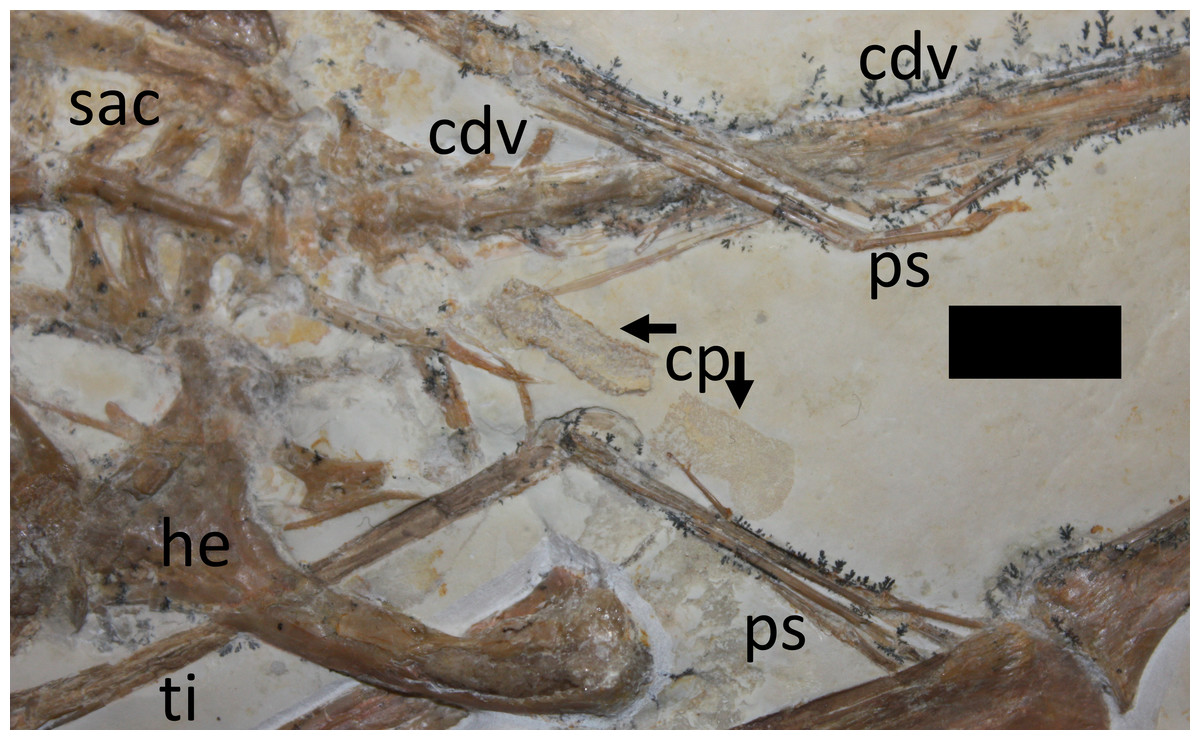
Rhamphorhynchus muensteri specimen with coprolite (cp). From Hone et al. (2015).
The compact shape of these remains and their proximity to the pelvic region suggest that they were expelled from the pterosaur shortly after it settled on the seabed of the Solnhofen lagoon. Some of the coprolite content is pretty indistinct, but one portion preserves thousands of tiny spines, likely indigestible bits of a recent meal. Exactly what they are is difficult to say - you can get a good look here if you'd like to figure them out - but a number of alternatives were considered by Hone et al. (2015). The tentative, albeit still problematic, suggestion is that they represent cephalopod hooklets. This situation is somewhat frustrating, as this coprolite shows that Rhamphorhynchus was not just a fish eater, but doesn't really tell us much else. Still, now that we know what we're looking for, perhaps more pterosaur coprolites might start coming to light.

Fossilised food chains

Several Rhamphorhynchus specimens reveal it was prey to other Jurassic animals. Among the least commonly discussed is a small pellet produced by something like a fish or crocodylomorph which contains several Rhamphorhynchus wing bones (Schweigert et al. 2001). This is a rare example of Rhamphorhynchus from the Nusplingen Limestone, a unit lithologically similar to Solnhofen but slightly older. As is so often the case with such fossils, the identity of the pellet maker remains elusive. My own suspicions are of a piscine origin, as modern crocodylians don't tend to spit out bones (they digest them, only regurgitating hair, feathers and other keratinous tissues that are difficult to break down). That may not have been true for fossil crocs, of course.

Rhamphorhynchus vs. Aspidorhynchus. I guess we should call this one a draw? From Frey and Tischlinger (2012).

Among the most remarkable Rhamphorhynchus fossils are five instances where it is preserved alongside the predatory fish Aspidorhynchus acutirostris, a long-bodied species that is often much larger than its Rhamphorhynhus prey (Frey and Tischlinger 2012; Weber 2013). These fossils are palaeoecologically notable for three reasons. Firstly, large Solnhofen vertebrates are hardly ever associated, and yet we have five instances of this same pterosaur and fish species being found in touching, or near touching, proximity. Secondly, all five are exquisitely preserved - one example includes a 'mummified' pterosaur with wing membranes, and all are completely articulated. Thirdly, the Rhamphorhynchus are invariably positioned around the skull of the fish, as if a specific, repeated behaviour saw these animals preserved together. These particulars make chance association of these animals unlikely and imply Aspidorhynchus sought out Rhamphorhynchus as food, probably hunting live specimens rather than scavenging floating corpses (as indicated by the excellent preservation of the individual pterosaurs). Frey and Tischlinger (2012) provide a plausible scenario for the deaths of these animals: they reason the Aspidorhynchus tackled prey that became entangled in their jaws before accidentally entering the toxic bottom waters of the Solnhofen waterways. In these anoxic depths the tangled pair would die pretty quickly (if the pterosaur wasn't already dead, of course), leaving us with perfectly preserved bungled predatory acts. The icing on the cake of these specimens is that one of these Rhamphorhynchus specimens has already been mentioned here - that individual with a fish in its throat (Frey and Tischlinger 2012). In this specimen at least, we can assume the pterosaur ate a fish shortly before being attacked itself: a rare instance of a fossil food chain.

The bigger picture of Rhamphorhynchus palaeoecology

Collectively, we have 10 specimens of Rhamphorhynchus telling us something about its position in Mesozoic food webs. That's not bad going for a pterosaur, a famously rare type of fossil, and is actually a pretty good palaeoecological record for any fossil vertebrate. 10 specimens is not enough to tell us everything about the lifestyle of a fossil animal, but does allow us to paint a general picture. They show us that Rhamphorhynchus was adapted to foraging on pelagic prey - often small, probably live fish - and that it must have spent a good amount of time in or around water, as it was clearly an attractant to aquatic predators. These specimens gel neatly with general models of Rhamphorhynchus lifestyle interpreted from their functional anatomy. It's generally thought that Rhamphorhynchus was adapted for life along shorelines - basically a Mesozoic gull. It's not uncommon to be suspicious of such claims nowadays, it being realised that the 'Mesozoic seabird equivalent' almost became a trope, or at least a tremendous over-generalisation, of pre-21st century pterosaur science. But in this case, a gull-like lifestyle is a cogent hypothesis based on studies of wing shape, flight style, tooth and jaw apparatus, and limb function (e.g. Wellnhofer 1975; Hazlehurst and Rayner 1992; Witton 2008, 2015; Ösi 2011). Perhaps research on Rhamphorhynchus was involved in creating the stereotype of pterosaurs as Mesozoic seabirds, but we should not regard it as a victims of this stereotyping itself.

But we should ask ourselves why Rhamphorhynchus palaeoecology is comparably well-represented in the fossil record. It might be something as simple as preservational conditions, but there are plenty of pterosaur Lagerstätten, some of them containing close relatives of Rhamphorhynchus in reasonable abundance, which provide no information about dietary preferences or interactions with predatory species. Is there something intrinsic to Rhamphorhynchus which makes it special? I find several reasons to wonder if Rhamphorhynchus was an atypically aquatic species, not only flying and feeding above water but actually routinely entering it. Firstly, Rhamphorhynchus has a hatchet-shaped deltopectoral crest (the process on the humerus which anchors the flight muscles), a small (or at least narrow) torso and short legs: these are features which Habib and Cunningham (2010) link to routine and efficient aquatic takeoff. Secondly, tests of pterosaur swimming suggest that Rhamphorhynchus had a pretty stable floating posture - not something that can be said for all pterosaurs (Hone and Henderson 2014). Thirdly, it also has comparably large but delicately constructed feet, which might suit paddling, as well as a slender set of forelimb bones (Witton 2015) which recall the streamlined arm bones of swimming and diving birds (Habib and Ruff 2008). Prolonged bouts of swimming might also account for its general abundance, excellent preservation and all-round good fossil record: being immersed in water puts it a step closer to being preserved than other, less aquatic species. Who knows: perhaps it even dived into Solnhofen's toxic bottom waters on occasion, explaining why so many specimens are excellently preserved? Hmmm.... perhaps this warrants further investigation.

Coming soon: could dinosaurs - gasp - lie down on their sides? My take on the greatest of palaeoart debates.

Rhamphorhynchus is supported by fish; this blog is supported by Patreon

The paintings and words featured here are sponsored by the finest human beings on the planet, those folks who support me at Patreon. Backing my blog for as little as $1 a month helps me churn out researched and detailed articles and paintings to accompany them, and in return you get access to bonus blog content: additional commentary, in-progress views and high-resolution artwork, and even free prints. Accompanying this post, we're going to look at the bigger picture of pterosaur palaeoecology: azhdarchids and Rhamphorhynchus are just two lineages with palaeoecological records - what about the rest of Pterosauria? Sign up to Patreon to join that discussion!

References

  • Frey, E., & Tischlinger, H. (2012). The Late Jurassic pterosaur Rhamphorhynchus, a frequent victim of the ganoid fish Aspidorhynchus?. PloS one, 7(3), e31945.
  • Habib, M. & Cunningham, J. 2010. Capacity for Water Launch in Anhanguera and Quetzalcoatlus. Acta Geoscientica Sinica. 31, 24-25
  • Habib, M. B., & Ruff, C. B. (2008). The effects of locomotion on the structural characteristics of avian limb bones. Zoological Journal of the Linnean Society, 153(3), 601-624.
  • Hazlehurst, G. A., & Rayner, J. M. (1992). Flight characteristics of Triassic and Jurassic Pterosauria: an appraisal based on wing shape. Paleobiology, 18(04), 447-463.
  • Hone, D. W., Habib, M. B., & Lamanna, M. C. (2013). An annotated and illustrated catalogue of Solnhofen (Upper Jurassic, Germany) pterosaur specimens at Carnegie Museum of Natural History. Annals of Carnegie Museum, 82(2), 165-191.
  • Hone, D. W., & Henderson, D. M. (2014). The posture of floating pterosaurs: Ecological implications for inhabiting marine and freshwater habitats. Palaeogeography, Palaeoclimatology, Palaeoecology, 394, 89-98.
  • Hone, D., Henderson, D. M., Therrien, F., & Habib, M. B. (2015). A specimen of Rhamphorhynchus with soft tissue preservation, stomach contents and a putative coprolite. PeerJ, 3, e1191.
  • Ősi, A. (2011). Feeding‐related characters in basal pterosaurs: implications for jaw mechanism, dental function and diet. Lethaia, 44(2), 136-152.
  • Schweigert, G., Dietl, G. & Wild, R. (2001). Miscellanea aus dem Nusplinger Plattenkalk (Ober-Kimmeridgium, Schwäbische Alb) 3. Ein Speiballen mit Flugsaurierresten. Jahresberichte und Mitteilungen des Oberrheinischen Geologischen Vereines, 83, 357-364
  • Weber, F. (2013). Paléoécologie des ptérosaures 3. Les reptiles volants de Solnhofen, Allemagne. Fossiles. 14. 50-59.
  • Wellnhofer, P. 1975. Die Rhamphorhynchoidea (Pterosauria) der Oberjura-Plattenkalke Süddeutschlands. Palaeontoographica A, 149, 1-30.
  • Witton, M. P. (2008). A new approach to determining pterosaur body mass and its implications for pterosaur flight. Zitteliana, 28, 143-159. 
  • Witton, M. P. (2015). Were early pterosaurs inept terrestrial locomotors? PeerJ, 3, e1018.

Thursday, 11 July 2013

Rhamphomummies and zombie skim-feeders

A 'mummified' Rhamphorhynchus muensteri entangled with the spear-like rostrum of Aspidorhynchus acutirostris, presumably reflecting a failed predation effort by the latter. Painting of a privately-held specimen, used with permission.
A few months ago, Frédéric Weber asked me to render two images of a spectacular, unpublished specimen from the famous Jurassic Solnhofen deposits of Germany. It showed a rare association between two animals: the non-pterodactyloid pterosaur Rhamphorhynchus muenesteri and a ganoid fish, Aspidorhynchus acutirostris. Associated fossils are not uncommon in some deposits, but they are extremely rare in the Solnhofen Limestone. Fred wanted images of this Rhamphorhynchus/Aspidorhynchus association to illustrate a recent article in Fossiles magazine devoted to pterosaur specimens from Solnhofen (Weber 2013), with this particular specimen being all the more important because the pterosaur's body outline has been preserved by growths of calcite crystals rather than decaying away. 'Mummified' pterosaurs like this aren't entirely unheard of, but they remain rare and are exciting for what they tell us about soft-tissue distribution. Making this specimen even more spectacular is the preserved wing tissues of the pterosaur and the perfect state of the neighbouring Aspidorhynchus. Fred wanted to show the exquisite preservation of the specimen but was asked not to reproduce photos by its owner, so he asked me to do my best at reproducing it in a few images. The article containing this image is only the latest in a series on pterosaurs produced by Fred and, even if you cannot read French, they're well worth tracking down for their awesome imagery.

Those of you with ears to the ground of pterosaur research will know that this specimen is not one of a kind. Another, WDC CSG 255, was described by Eberhard 'Dino' Frey and Helmut 'King of UV' Tischlinger back in 2010, and at least three others are known. Given how rare such associations are in Solnhofen desposits, the repeated association of these animals implies some common explanation for their co-preservation. The rationale provided by Frey and Tischlinger (2010) sounds pretty convincing to me. They suggest that Aspidorhynchus frequently predated Rhamphorhynchus but, because the pterosaur was a little too big and gangly for its mouth, it's wing membranes became entangled on the fish's rostral spar or teeth and could not be swallowed. In efforts to shake the pterosaur loose, some Aspidorhynchus accidentally entered the anoxic bottom waters of the Solnhofen lagoon and, well, the rest is pretty self explanatory. It's quite probable that these predatory events were accidental, which may explain why many Aspidorhynchus specimens preserve fishy gut content, but none show successfully ingested pterosaur bones.
The Rhamphomummy and it's attacker in full. Line drawing of a privately-held specimen, used with permission.
But that's not all
Remarkably, one of these associations provides some insight into what brought the Rhamphorhynchus into striking range of Aspidorhynchus. The throat region of the WDC CSG 255 Rhamphorhynchus is full of undigested fish bones (probably Leptolepides) which suggest it was foraging for food just before it was grabbed by an Aspidorhynchus(Frey and Tischlinger 2010). The fact that at least some Rhamphorhynchus were likely foraging in the immediate interim before being attacked has, of course, raised interest in the foraging method utilised by Rhamphorhynchus because it may be linked to the attacks from Aspidorhynchus. Frey and Tischlinger (2010) suggest two options here. Firstly, Rhamphorhynchus may have grabbed fish from the water surface by dip-feeding, and was then grabbed. Unlikely, they say, because this wouldn't give the Aspidorhynchus enough time to grab the pterosaur once it disturbed the water. So a more likely idea, they suggest, is skim-feeding.
"Skimming... took time and resulted in a significant signal of turbulence, when the mandibular rostrum ploughed through the silent water surface. Such turbulences attract all kinds of fishes and are also were easily detectable for an Aspidorhynchus. Furthermore, the vane at the terminus of the long tail of the pterosaur could have contacted the water surface too due to the extremely low surface approach with a flight altitude of no more than 50 mm. Large Aspidorhynchus thus could grab a skimming Rhamphorhynchus by just raising the head through the water surface. The specimen presented here strongly suggests that Aspidorhynchus actually did exactly this." Frey and Tischlinger 2010, p. 4. (my emphasis)
Skim-feeding, we meet again
Yes, skim-bloody-feeding. A number of pterosaur workers - myself included - view the skim-feeding pterosaur hypothesis as highly problematic, based on very superficial science, and a complete non-starter based on simple comparative anatomy. Despite this, this idea is incredibly tenacious within pterosaur literature. Skim-feeding was widely considered a viable forging method for pterosaurs up until the mid-2000s (e.g. Wellnhofer 1991; Hazlehurst and Rayner 1992, Kellner and Campos 2002; Unwin 2005) when, under a hail of scientific bullets, several authors suggested it was implausible for numerous reasons (Chatterjee and Templin 2004; Ősi et al. 2005; Humphries et al. 2007; Witton and Naish 2008). Humphries et al., the first (and only) dedicated study of skim-feeding in pterosaurs inflicted the deepest wounds, using biomechanical testing and comparative anatomy to conclude:
"Both modelling the energy requirements of skimming pterosaurs and analysing their osteology casts serious doubt on the ability of pterosaurs to habitually skim-feed. Although our physical modelling suggests that small pterosaurs may have been energetically capable of skimming, there is no anatomical evidence to assume that Rhamphorhynchus or any other small pterosaurs were skimmers." Humphries et al. (2007), p. 5
I was part of that study (my first publication, nonetheless) and thought that, with other authors suggesting similar misgivings about the idea, that skim-feeding had been stopped dead. Like the foraging hypothesis equivalent of a freakin' zombie, it has since risen again with more questionable science to prop it up (Stecher 2008; Frey and Tischlinger 2010; Averianov 2013). Even attempts to subtly downplay the likelihood of pterosaur skim-feeding in blogs ("Die you skim-feeding bastard, die!") haven't got the message through. What will it take to down this thing? Here's another go, then, at explaining why I, and others, think this hypothesis is a complete non-starter and should be abandoned.

Where's the beef?
Firstly, there's never been an in-depth, detailed study suggesting skim-feeding was likely in any pterosaurs. So far as I can tell, the link between skim-feeding and pterosaurs started with throwaway comments by Marsh (1876), who suggested the mandible of Pteranodon was reminiscent of the lower jaw of modern skimming birds. Since Marsh, nearly 20 articles have suggested pterosaurs may have skim fed, but none have really added much to his idea. Most simply suggest, with varying degrees of certainty that pterosaurs of all kinds (rhamphorhynchids, 'campylognathoidids', ornithocheirids, dsungaripterids, thalassodromids, azhdarchids are candidates) were skim-feeders based on very superficial anatomical comparisons with modern animals. Kellner and Campos (2002) did the most thorough job with Thalassodromeus, but even that was a fairly brief comparison between their new taxon and modern skimmers that was very restricted by it's publication in the short-piece journal, Science. There's certainly never been anything published with sufficient quantified or even illustrative evidence to support skim-feeding in pterosaurs. It really seems that  pterosaur skim-feeding has become an established concept not because of its scientific credibility, but because of its longevity and popularity. Similar comments could be made about many established, 'common knowledge' ideas about fossil animals.

The skull and mandible of Rynchops niger in lateral view (A) and mandible in dorsal view (B). Note the extremely derived anatomy on every facet of this thing, all of which reflect skim-feeding habits. From Witton (2013).
The rather superficial science behind skim-feeding could almost be excused if it weren't for the extensive documentation of the lifestyle and functional anatomy of modern skimming birds. The exhaustive work (essentially a whole book) produced by Richard Zusi (1962) is a key reference here. It's widely known that, in the modern day, skim-feeding is only practised by a couple of bird species, all of which belong to the genus Rynchops. Thanks to several generations of ornithologists researching this animal, we know that Rynchops is specialised six-ways-from-Sunday for it's unusual habits. Check out the Rynchops skull and mandible, above, for instance. Virtually every facet, every joint and feature reflects it's lifestyle. This specialisation extends to its neck and flight style. Zusi (1962) noted a whopping 26 obvious morphological adaptations to skim-feeding, which are detailed in a handy cut-out-n'-keep guide below.
The result of these is that when handling a skimmer skull, even if you'd never seen one foraging, there's no doubt whatsoever about it's preferred habits. These birds need to be so specialised because, frankly, skim-feeding is a ridiculous way to feed. Dragging your lower jaw through a relatively viscous, obstacle-filled fluid at 16-32 kph and hoping to hit something you can eat isn't a particularly sensible approach to foraging. Skimmers can't even see what they're trawling into (Martin et al. 2007), and they regularly run aground in shallow mud or blunder into vegetation. On occasion, these impacts are severe enough to cause crashes or snap off the tip of the mandibular rhamphotheca (Potter 1931). Of course, evolution has a wonderful disregard for sense and logic, and skim-feeding behaviour simply promoted the development of impact resistant necks and skulls, with reinforced jaw joints and powerful jaw muscles. These include enlargement of their secondary jaw joints (a common avian feature; labelled as 'medial processes' on the diagram above), considerable reinforcement of the mandible and a broad neck base to anchor powerful, impact resisting neck muscles. Because the forces acting on Rynchops jaws during skimming are so high, skim-feeding birds have to pull their jaw muscles tight when foraging: the upper jaw is 'opened' via kinetic hinges at the mid-length of the skull. Biomechanical modelling of skimmer flight suggests skim-feeding flight is energetically demanding (Humphries et al. 2007), necessitating extremely streamlined lower jaw tissues along with abradable, rapidly-growing beak tissues to replace those worn away in accidents. Because skim-feeding impacts - desired or otherwise - pull the head into the water, skimmer necks are also unusually long and flexible. We could go on: these birds are fascinating case studies of adaptation.

Rhamphorhynchus mummy skull detail. A dorsoventrally slender mandible and a mouthful of teeth probably aren't the best way to approach skim-feeding.
With the mechanics of skim-feeding so well understood and its adaptations so obvious on animal skeletons, there's really no excuse for skim-feeding in pterosaurs to be so superficially considered. There's only so many ways for a flying tetrapod to trawl a mandible into things it hopes are food after all, so we should expect common adaptations between pterosaurs and Rynchops. Compare the skull of Rhamphorhynchus in the painting above, with that of Rynchops. Even in that crude approximation of its anatomy we can see the lack of of cranial reinforcement, the wimpy areas for jaw muscle attachment, and the bloody-great teeth where a knife-like skimming jaw should be. And yes, there are specimens of Rhamphorhynchus that show the jaw tip was extended with soft-tissue, but nothing like that seen in Rynchops (see image, above). The same arguments can be levelled at all other proposed pterosaur skim-feeders, even the animal named after it's alleged skim-feeding habits, Thalassodromeus (Kellner and Campos 2002). There are no convincing anatomical correlates for skim-feeding habits in any known pterosaur (Humphries et al. 2007; Witton and Naish 2008). This is almost certainly why pterosaurs with wingspans over 2 m (which, of course, is about the size of large Rhamphrohynchus) lack sufficient power output for skim-feeding (Humphries et al. 2007): their jaw shapes were never adapted for efficiently cutting through water. Smaller pterosaurs may be able to plough a short length of toothless jaw tip through water, but they'll be aching with the muscular exertion on their jaws, and in huge pain if they hit anything. I feel it would be remiss here to ignore the story behind testing streamlining in the Thalassodromeus jaw tip, which was so violently stressful that it broke the testing rig of the Humprhries et al. (2007) study. Back in 2007, I shared my recollection of what became known as the 'Thalassodromeus Flume of Doom':

Rather old and silly presentation slide. Based on real events.
In all the press accompanying the publication of Thalassodromeus, one worker is recorded as saying it must’ve looked like a ‘vision of hell’. Well, hats off to him: he was right. There was something unerringly terrifying about the massive jaw tip of this thing hurtling towards you at great speed. Maybe it’s because there was water everywhere. The moment Thalassodromeus began to skim, the whole rig started shaking manically, throwing water about like a possessed jetski and drawing worried glances from the crew. Notching the speed higher, the rig became more unstable and, to everyone’s surprise, the aluminium bar was even bent on one run. This was replaced and, eventually, the time came to set max speed: 25 kmph. The catcher, a nervous looking PhD student, was braced and ready. At the other end of the flume, the pterosaur-cyborg beast glared at him, the water eerily calm before the violence that would follow. “You ready?” asked Stu, and I gulped my affirmative. The winch was pulled. Suddenly, the beast was roaring down the runway. The room echoed with the inhuman screaming of its wheels on the track. The jaw was convulsing madly. Water crashed over the tank walls. Then the screaming stopped with a loud bang: the Thalassodromeus was airborne; the whole rig arcing through the air and spiralling forward - only milliseconds separated it from a watery grave. My clothes ripping against the metal tank and the waves pounding my body like Achilles in the River Scamander, I leapt forward and grabbed the plummeting contraption moments before it hit the water. We rushed the wounded rig from the flume to check its health: the aluminium bar was totally twisted, the electronics shot. The little blinking lights on the mechoreceptor faded to black. The rig lay dead in Richard’s arms. Stu called to the Heavens in anger. Dave cried. I was soaking wet. It was about then that we started wondering if ‘ocean runner’ was a name slightly too optimistic about the skimming capabilities of its owner. With testing brought to a dramatic but premature end for the day, we retired for back massages and herbal treatments from attractive Scandinavians to recover from the ordeal. Such is the life of courageous university researchers. (link to original)
Put together, these three reasons - the lack of a good studies in favour of pterosaur skim-feeding, the fact we know so much about modern skim-feeders, and the overwhelming evidence against skim-feeding in pterosaurs - are why I find it a tiny bit irritating that this idea is still being discussed as plausible. It just seems, I dunno, that our ideas should be moving on or something.

Night of the living skim feeders
If skim-feeding in pterosaurs is so objectionably flawed, why won't the idea be politely resigned to history? I predict four causes.
  1. It's an established idea, even if it's not based on any particularly rigorous science. Established ideas take a long time to overturn even if evidence to the contrary is strong. 
  2. Pterosaurs were flying animals. For some palaeontologists, this equates to them doing everything in flight.
  3. There may be unawareness concerning how specialised Rynchops is for skim-feeding, and how unique its morphology is, even among birds. Anyone thinking of proposing skim-feeding habits for pterosaurs really should familiarise themselves with the work on Rynchops lifestyle first, and particularly Zusi's 1962 treatment.
  4. Life of the past is frequently considered to be outlandish and overly dynamic (also see discussion of animal poses in palaeoart, here and here). This is perhaps why, when Frey and Tischlinger (2010) considered how a pterosaur may have been attacked by a marine predator, boring ideas like the pterosaur swimming or floating weren't considered*.
*Before anyone asks, there is at least trackway evidence suggesting pterosaurs can swim (Lockley and Wright 2003) and new take off models suggesting water launches weren't difficult (Habib and Cunningham 2010), so let's not hear anything about waterlogging of wing membranes or whatever.

Of course, none of these are particularly defensible. We simply need to stop trotting skim-feeding pterosaurs out at what almost seems like any given opportunity. There's never really been anything to it, and until sufficient evidence - like a pterosaur fossil bristling with skim-feeding adaptions - comes to light, the idea's as dead in the water as the Aspidorhynchus and Rhamphorhynchus we discussed on the way in. I'll take that arriving at conversational full circle as a good place to stop.

Next time (possibly): Space Year 2013: The Golden Age of Palaeoart?

References
  • Averianov, A. O. 2013. Reconstruction of the neck of Azhdarcho lancicollis and lifestyle of azhdarchids (Pterosauria, Azhdarchidae). Paleontological Journal, 47, 203-209.
  • Chatterjee, S. and Templin, R. J. 2004.  Posture, Locomotion and Palaeoecology of Pterosaurs. Geological Society of America Special Publication, 376, 1-64.
  • Frey, E. and Tischlinger, H. 2012. The Late Jurassic pterosaur Rhamphorhynchus, a frequent victim of the ganoid fish Aspidorhynchus? PLoS ONE, 7, e31945.
  • Habib, M. B. and Cunningham, J. 2010. Capacity for water launch in Anhanguera and Quetzalcoatlus. Acta Geoscientica Sinica, 31, 24-25.
  • Hazlehurst, G. A. and Rayner, J. M. 1992. Flight characteristics of Triassic and Jurassic Pterosauria: an appraisal based on wing shape. Paleobiology, 447-463.
  • Humphries, S., Bonser, R. H. C., Witton, M. P. and Martill, D. M. 2007. Did pterosaurs feed by skimming? Physical modelling and anatomical evaluation of an unusual feeding method. PLoS Biology 5, No. 8, e204.
  • Kellner, A. W. A. and Campos, D. A. 2002. The function of the cranial crest and jaws of a unique pterosaur from the Early Cretaceous of Brazil. Science, 297, 389-392.
  • Martin, G. R., McNeil, R. and Rojas, L. M. 2007. Vision and the foraging technique of skimmers. (Rynchopidae). Ibis, 149, 750-757. 
  • Ősi, A., Weishampel, D. B. and Jianu, C. M. 2005. First evidence of azhdarchid pterosaurs from the Late Cretaceous of Hungary. Acta Palaeontologica Polonica, 50, 777-787.
  • Potter, J. K. 1932. Fishing ability of the black skimmer (Rynchops nigra nigra). The Auk, 49, 477.
  • Stecher, R. 2008. A new Triassic pterosaur from Switzerland (Central Austroalpine, Grisons), Raeticodactylus filisurensis gen. et sp. nov. Swiss Journal of Geosciences, 101, 185-201.
  • Unwin, D. M. 2005. The Pterosaurs from Deep Time. Pi Press, New York.
  • Weber, F. 2013. Paléoécologie des ptérosaures 3. Les reptiles volants de Solnhofen, Allemagne. Fossiles. 14. 50-59.
  • Wellnhofer, P. 1991. The Illustrated Encyclopaedia of Pterosaurs. Salamander Books Ltd., London.
  • Witton, M. P. 2013. Pterosaurs: Natural History, Evolution, Anatomy. Princeton University Press.
  • Witton, M. P., & Naish, D. 2008. A reappraisal of azhdarchid pterosaur functional morphology and paleoecology. PLoS One, 3, e2271.
  • Zusi, R. 1962. Structural adaptations of the head and neck in the black skimmer Rynchops nigra Linneaus. Publications of the Nuttall Ornithological Club 3, 1-101.

Thursday, 29 November 2012

You've come a long way, baby


Way back at the end of 2009 I illustrated the image above, showing the size range of everyone's favourite rhamphorhynchine pterosaur, Rhamphorhynchus. This animal was first discoverd in the 1830s and is now represented by over 100 specimens, making it one of the best known pterosaurs, and probably the best known non-pterodactyloid pterosaur, of all. Being represented by specimens with wingspans ranging from 290 mm (in very young juveniles) to 1850 mm in large (probable) adults means that we have a better idea of Rhamphorhynchus growth allometries than we do for most pterosaurs (Bennett 1995; though also see Prondvai et al. 2012 for a contrary opinion), and this includes a detailed picture of the proportional changes taking place in the skull. These are the focus of this image here, which shows a portrait of a particularly tiny Rhamphorhynchus specimen with a 30 mm long skull (NHMUK R37012), alongside the biggest with its 192 mm skull length (NHMUK R38077). Unusually among reptiles, Rhamphorhynchus does not seem to gain more teeth with age, despite the elongation of its jaw presenting space for additional teeth. Instead, the teeth become more robust, transforming from fine, needle-like structures to relatively short, tusk-like forms. The shape of the mandible also becomes more pronounced with age, developing a curving, pointed keel. The  orbits - predictably - decrease in relative size, but adult Rhamphorhynchus retain proportionally large eye sockets even as adults, which probably hint at their predatory leanings.

This image was the first time I largely excluded showing details of the cranial fenestra in my reconstructed animals. They're still visible, but I recall making a very conscious decision to mute their appearance. Nowadays, my illustrations don't show them at all. Those interested in palaeoart will be aware that there is  currently a real push against the classic 'shrink-wrapped' appearance of animals in palaeoart, defying generations of artists who have applied minimal amounts of soft-tissue to their reconstructions to show their osteological details (check out Matt Wedel's festive plea for healthy-looking sauropods for an example. From this SV:POW! post). The observation that most skeletal anatomy is hidden behind soft-tissue is the rationale behind this movement, and it may be one of the most significant paradigm shifts to the palaeoart of Mesozoic and Palaeozoic reptiles since palaeontologists of the late 1960s and 1970s told artists to lift their dinosaur tails off the floor. More on this movement another time, perhaps: this is meant to be a word-light blog, after all.

References
  • Bennett, S. C. 1995. A statistical study of Rhamphorhynchus from the Solnhofen Limestone of Germany: year-classes of a single large species. Journal of Paleontology, 69, 569-580.
  • Prondvai, E., Stein, K., Ősi, A. and Sander, M. P. 2012. Life history of Rhamphorhynchus inferred from bone histology and the diversity of pterosaurian growth strategies. PLoS ONE, 7, e31392.