|
| A 'mummified' Rhamphorhynchus muensteri entangled with the spear-like rostrum of Aspidorhynchus acutirostris, presumably reflecting a failed predation effort by the latter. Painting of a privately-held specimen, used with permission. |
A few months ago, Frédéric Weber asked me to render two images of a spectacular, unpublished specimen from the famous Jurassic Solnhofen deposits of Germany. It showed a rare association between two animals: the non-pterodactyloid pterosaur
Rhamphorhynchus muenesteri and a ganoid fish,
Aspidorhynchus acutirostris. Associated fossils are not uncommon in some deposits, but they are extremely rare in the Solnhofen Limestone. Fred wanted images of this
Rhamphorhynchus/
Aspidorhynchus association to illustrate a recent article in
Fossiles magazine devoted to pterosaur specimens from Solnhofen (Weber 2013), with this particular specimen being all the more important because the pterosaur's body outline has been preserved by growths of calcite crystals rather than decaying away. 'Mummified' pterosaurs like this aren't entirely unheard of, but they remain rare and are exciting for what they tell us about soft-tissue distribution. Making this specimen even more spectacular is the preserved wing tissues of the pterosaur and the perfect state of the neighbouring
Aspidorhynchus. Fred wanted to show the exquisite preservation of the specimen but was asked not to reproduce photos by its owner, so he asked me to do my best at reproducing it in a few images. The article containing this image is only the latest in a series on pterosaurs produced by Fred and, even if you cannot read French, they're well worth tracking down for their awesome imagery.
Those of you with ears to the ground of pterosaur research will know that this specimen is not one of a kind. Another, WDC CSG 255, was described by Eberhard 'Dino' Frey and Helmut 'King of UV' Tischlinger
back in 2010, and at least three others are known. Given how rare such associations are in Solnhofen desposits, the repeated association of these animals implies some common explanation for their co-preservation. The rationale provided by Frey and Tischlinger (2010) sounds pretty convincing to me. They suggest that
Aspidorhynchus frequently predated
Rhamphorhynchus but, because the pterosaur was a little too big and gangly for its mouth, it's wing membranes became entangled on the fish's rostral spar or teeth and could not be swallowed. In efforts to shake the pterosaur loose, some
Aspidorhynchus accidentally entered the anoxic bottom waters of the Solnhofen lagoon and, well, the rest is pretty self explanatory. It's quite probable that these predatory events were accidental, which may explain why many
Aspidorhynchus specimens preserve fishy gut content, but none show successfully ingested pterosaur bones.
 |
| The Rhamphomummy and it's attacker in full. Line drawing of a privately-held specimen, used with permission. |
But that's not all
Remarkably, one of these associations provides some insight into what brought the
Rhamphorhynchus into striking range of
Aspidorhynchus. The throat region of the WDC CSG 255
Rhamphorhynchus is full of undigested fish bones (probably
Leptolepides) which suggest it was foraging for food just before it was grabbed by an
Aspidorhynchus(Frey and Tischlinger 2010). The fact that at least some
Rhamphorhynchus were likely foraging in the immediate interim before being attacked has, of course, raised interest in the foraging method utilised by
Rhamphorhynchus because it may be linked to the attacks from
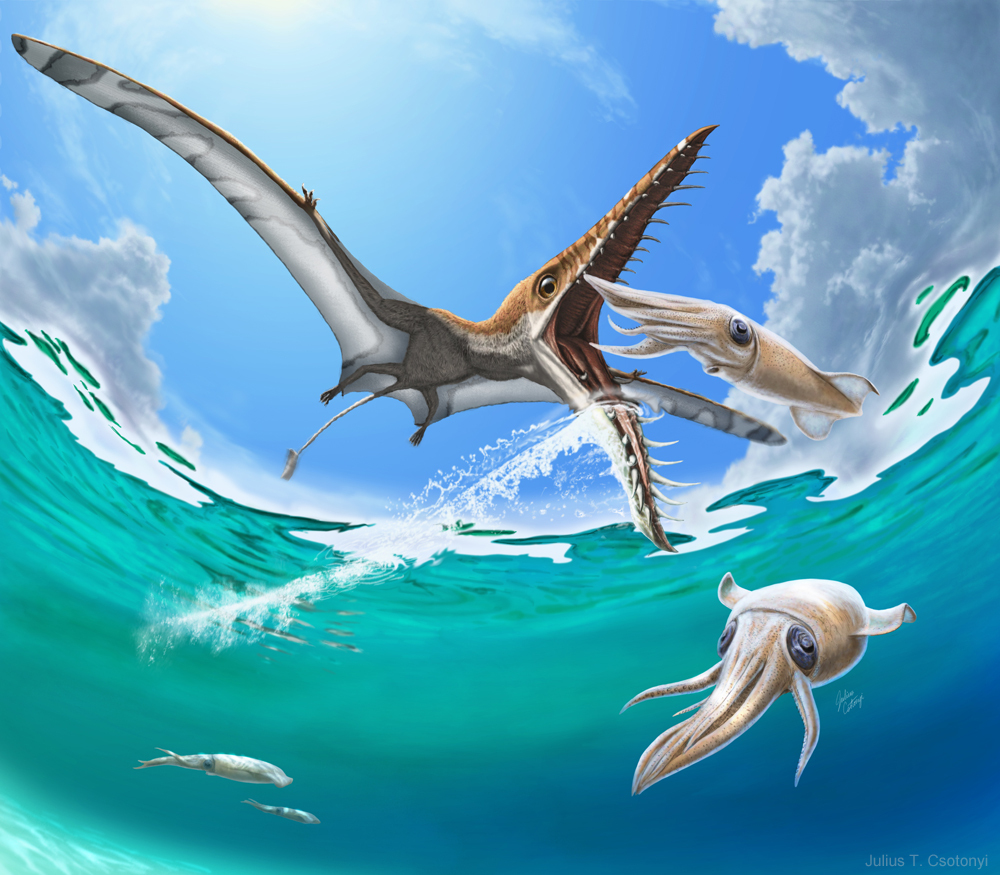
Aspidorhynchus. Frey and Tischlinger (2010) suggest two options here. Firstly,
Rhamphorhynchus may have grabbed fish from the water surface by dip-feeding, and was then grabbed. Unlikely, they say, because this wouldn't give the
Aspidorhynchus enough time to grab the pterosaur once it disturbed the water. So a more likely idea, they suggest, is skim-feeding.
"Skimming... took time and resulted in a significant signal of turbulence, when the mandibular rostrum ploughed through the silent water surface. Such turbulences attract all kinds of fishes and are also were easily detectable for an Aspidorhynchus. Furthermore, the vane at the terminus of the long tail of the pterosaur could have contacted the water surface too due to the extremely low surface approach with a flight altitude of no more than 50 mm. Large Aspidorhynchus thus could grab a skimming Rhamphorhynchus by just raising the head through the water surface. The specimen presented here strongly suggests that Aspidorhynchus actually did exactly this." Frey and Tischlinger 2010, p. 4. (my emphasis)
Skim-feeding, we meet again
Yes,
skim-bloody-feeding. A number of pterosaur workers - myself included - view the skim-feeding pterosaur hypothesis as highly problematic, based on very superficial science, and a complete non-starter based on simple comparative anatomy. Despite this, this idea is incredibly tenacious within pterosaur literature. Skim-feeding was widely considered a viable forging method for pterosaurs up until the mid-2000s (e.g. Wellnhofer 1991; Hazlehurst and Rayner 1992, Kellner and Campos 2002; Unwin 2005) when, under a hail of scientific bullets, several authors suggested it was implausible for numerous reasons (Chatterjee and Templin 2004; Ősi et al. 2005;
Humphries et al. 2007;
Witton and Naish 2008). Humphries et al., the first (and only) dedicated study of skim-feeding in pterosaurs inflicted the deepest wounds, using biomechanical testing and comparative anatomy to conclude:
"Both modelling the energy requirements of skimming pterosaurs and analysing their osteology casts serious doubt on the ability of pterosaurs to habitually skim-feed. Although our physical modelling suggests that small pterosaurs may have been energetically capable of skimming, there is no anatomical evidence to assume that Rhamphorhynchus or any other small pterosaurs were skimmers." Humphries et al. (2007), p. 5
I was part of that study (my first publication, nonetheless) and thought that, with other authors suggesting similar misgivings about the idea, that skim-feeding had been stopped dead. Like the foraging hypothesis equivalent of a freakin' zombie, it has since risen again with more questionable science to prop it up (Stecher 2008; Frey and Tischlinger 2010; Averianov 2013). Even attempts to subtly downplay the likelihood of pterosaur skim-feeding in blogs (
"Die you skim-feeding bastard, die!") haven't got the message through. What will it take to down this thing? Here's another go, then, at explaining why I, and others, think this hypothesis is a complete non-starter and should be abandoned.
Where's the beef?
Firstly, there's never been an in-depth, detailed study suggesting skim-feeding was likely in any pterosaurs. So far as I can tell, the link between skim-feeding and pterosaurs started with throwaway comments by Marsh (1876), who suggested the mandible of
Pteranodon was reminiscent of the lower jaw of modern skimming birds. Since Marsh, nearly
20 articles have suggested pterosaurs may have skim fed, but none have really added much to his idea. Most simply suggest, with varying degrees of certainty that pterosaurs of all kinds (rhamphorhynchids, 'campylognathoidids', ornithocheirids, dsungaripterids, thalassodromids, azhdarchids are candidates) were skim-feeders based on very superficial anatomical comparisons with modern animals. Kellner and Campos (2002) did the most thorough job with
Thalassodromeus, but even that was a fairly brief comparison between their new taxon and modern skimmers that was very restricted by it's publication in the short-piece journal,
Science. There's certainly never been anything published with sufficient quantified or even illustrative evidence to support skim-feeding in pterosaurs. It really seems that pterosaur skim-feeding has become an established concept not because of its scientific credibility, but because of its longevity and popularity. Similar comments could be made about many established, 'common knowledge' ideas about fossil animals.
 |
| The skull and mandible of Rynchops niger in lateral view (A) and mandible in dorsal view (B). Note the extremely derived anatomy on every facet of this thing, all of which reflect skim-feeding habits. From Witton (2013). |
The rather superficial science behind skim-feeding could almost be excused if it weren't for the extensive documentation of the lifestyle and functional anatomy of modern skimming birds. The exhaustive work (essentially a whole book) produced by Richard Zusi (1962) is a key reference here. It's widely known that, in the modern day, skim-feeding is only practised by a couple of bird species, all of which belong to the genus
Rynchops. Thanks to several generations of ornithologists researching this animal, we know that
Rynchops is specialised six-ways-from-Sunday for it's unusual habits. Check out the
Rynchops skull and mandible, above, for instance. Virtually every facet, every joint and feature reflects it's lifestyle. This specialisation extends to its neck and flight style. Zusi (1962) noted a whopping
26 obvious morphological adaptations to skim-feeding, which are detailed in a handy cut-out-n'-keep guide below.
The result of these is that when handling a skimmer skull, even if you'd never seen one foraging, there's no doubt whatsoever about it's preferred habits. These birds need to be so specialised because, frankly, skim-feeding is a
ridiculous way to feed. Dragging your lower jaw through a relatively viscous, obstacle-filled fluid at 16-32 kph and hoping to hit something you can eat isn't a particularly sensible approach to foraging. Skimmers can't even see what they're trawling into (Martin et al. 2007), and they regularly run aground in shallow mud or blunder into vegetation. On occasion, these impacts are severe enough to cause crashes or snap off the tip of the mandibular rhamphotheca (Potter 1931). Of course, evolution has a wonderful disregard for sense and logic, and skim-feeding behaviour simply promoted the development of impact resistant necks and skulls, with reinforced jaw joints and powerful jaw muscles. These include enlargement of their secondary jaw joints (a common avian feature; labelled as 'medial processes' on the diagram above), considerable reinforcement of the mandible and a broad neck base to anchor powerful, impact resisting neck muscles. Because the forces acting on
Rynchops jaws during skimming are so high, skim-feeding birds have to pull their jaw muscles tight when foraging: the upper jaw is 'opened' via kinetic hinges at the mid-length of the skull. Biomechanical modelling of skimmer flight suggests skim-feeding flight is energetically demanding (Humphries et al. 2007), necessitating extremely streamlined lower jaw tissues along with abradable, rapidly-growing beak tissues to replace those worn away in accidents. Because skim-feeding impacts - desired or otherwise - pull the head into the water, skimmer necks are also unusually long and flexible. We could go on: these birds are fascinating case studies of adaptation.
 |
| Rhamphorhynchus mummy skull detail. A dorsoventrally slender mandible and a mouthful of teeth probably aren't the best way to approach skim-feeding. |
With the mechanics of skim-feeding so well understood and its adaptations so obvious on animal skeletons, there's really no excuse for skim-feeding in pterosaurs to be so superficially considered. There's only so many ways for a flying tetrapod to trawl a mandible into things it hopes are food after all, so we should expect common adaptations between pterosaurs and
Rynchops. Compare the skull of
Rhamphorhynchus in the painting above, with that of
Rynchops. Even in that crude approximation of its anatomy we can see the lack of of cranial reinforcement, the wimpy areas for jaw muscle attachment, and the bloody-great teeth where a knife-like skimming jaw should be. And yes, there are specimens of
Rhamphorhynchus that show the jaw tip was extended with soft-tissue, but nothing like that seen in
Rynchops (see image, above). The same arguments can be levelled at all other proposed pterosaur skim-feeders, even the animal named after it's alleged skim-feeding habits,
Thalassodromeus (Kellner and Campos 2002). There are no convincing anatomical correlates for skim-feeding habits in
any known pterosaur (Humphries et al. 2007; Witton and Naish 2008). This is almost certainly why pterosaurs with wingspans over 2 m (which, of course, is about the size of large
Rhamphrohynchus) lack sufficient power output for skim-feeding (Humphries et al. 2007): their jaw shapes were never adapted for efficiently cutting through water. Smaller pterosaurs may be able to plough a short length of toothless jaw tip through water, but they'll be aching with the muscular exertion on their jaws, and in huge pain if they hit anything. I feel it would be remiss here to ignore the story behind testing streamlining in the
Thalassodromeus jaw tip, which was so violently stressful that it broke the testing rig of the Humprhries et al. (2007) study. Back in 2007, I shared my recollection of what became known as the '
Thalassodromeus Flume of Doom':
 |
| Rather old and silly presentation slide. Based on real events. |
In all the press accompanying the publication of Thalassodromeus, one worker is recorded as saying it must’ve looked like a ‘vision of hell’. Well, hats off to him: he was right. There was something unerringly terrifying about the massive jaw tip of this thing hurtling towards you at great speed. Maybe it’s because there was water everywhere. The moment Thalassodromeus began to skim, the whole rig started shaking manically, throwing water about like a possessed jetski and drawing worried glances from the crew. Notching the speed higher, the rig became more unstable and, to everyone’s surprise, the aluminium bar was even bent on one run. This was replaced and, eventually, the time came to set max speed: 25 kmph. The catcher, a nervous looking PhD student, was braced and ready. At the other end of the flume, the pterosaur-cyborg beast glared at him, the water eerily calm before the violence that would follow. “You ready?” asked Stu, and I gulped my affirmative. The winch was pulled. Suddenly, the beast was roaring down the runway. The room echoed with the inhuman screaming of its wheels on the track. The jaw was convulsing madly. Water crashed over the tank walls. Then the screaming stopped with a loud bang: the Thalassodromeus was airborne; the whole rig arcing through the air and spiralling forward - only milliseconds separated it from a watery grave. My clothes ripping against the metal tank and the waves pounding my body like Achilles in the River Scamander, I leapt forward and grabbed the plummeting contraption moments before it hit the water. We rushed the wounded rig from the flume to check its health: the aluminium bar was totally twisted, the electronics shot. The little blinking lights on the mechoreceptor faded to black. The rig lay dead in Richard’s arms. Stu called to the Heavens in anger. Dave cried. I was soaking wet. It was about then that we started wondering if ‘ocean runner’ was a name slightly too optimistic about the skimming capabilities of its owner. With testing brought to a dramatic but premature end for the day, we retired for back massages and herbal treatments from attractive Scandinavians to recover from the ordeal. Such is the life of courageous university researchers. (link to original)
Put together, these three reasons - the lack of a good studies in favour of pterosaur skim-feeding, the fact we know so much about modern skim-feeders, and the overwhelming evidence
against skim-feeding in pterosaurs - are why I find it a tiny bit irritating that this idea is still being discussed as plausible. It just seems, I dunno, that our ideas should be moving on or something.
Night of the living skim feeders
If skim-feeding in pterosaurs is so objectionably flawed, why won't the idea be politely resigned to history? I predict four causes.
- It's an established idea, even if it's not based on any particularly rigorous science. Established ideas take a long time to overturn even if evidence to the contrary is strong.
- Pterosaurs were flying animals. For some palaeontologists, this equates to them doing everything in flight.
- There may be unawareness concerning how specialised Rynchops is for skim-feeding, and how unique its morphology is, even among birds. Anyone thinking of proposing skim-feeding habits for pterosaurs really should familiarise themselves with the work on Rynchops lifestyle first, and particularly Zusi's 1962 treatment.
- Life of the past is frequently considered to be outlandish and overly dynamic (also see discussion of animal poses in palaeoart, here and here). This is perhaps why, when Frey and Tischlinger (2010) considered how a pterosaur may have been attacked by a marine predator, boring ideas like the pterosaur swimming or floating weren't considered*.
*Before anyone asks, there is at least trackway evidence suggesting pterosaurs can swim (Lockley and Wright 2003) and new take off models suggesting water launches weren't difficult (Habib and Cunningham 2010), so let's not hear anything about waterlogging of wing membranes or whatever.
Of course, none of these are particularly defensible. We simply need to stop trotting skim-feeding pterosaurs out at what almost seems like any given opportunity. There's never really been anything to it, and until sufficient evidence - like a pterosaur fossil bristling with skim-feeding adaptions - comes to light, the idea's as dead in the water as the
Aspidorhynchus and
Rhamphorhynchus we discussed on the way in. I'll take that arriving at conversational full circle as a good place to stop.
Next time (possibly): Space Year 2013: The Golden Age of Palaeoart?
References
- Averianov, A. O. 2013. Reconstruction of the neck of Azhdarcho lancicollis and lifestyle of azhdarchids (Pterosauria, Azhdarchidae). Paleontological Journal, 47, 203-209.
- Chatterjee, S. and Templin, R. J. 2004. Posture, Locomotion and Palaeoecology of Pterosaurs. Geological Society of America Special Publication, 376, 1-64.
- Frey, E. and Tischlinger, H. 2012. The Late Jurassic pterosaur Rhamphorhynchus, a frequent victim of the ganoid fish Aspidorhynchus? PLoS ONE, 7, e31945.
- Habib, M. B. and Cunningham, J. 2010. Capacity for water launch in Anhanguera and Quetzalcoatlus. Acta Geoscientica Sinica, 31, 24-25.
- Hazlehurst, G. A. and Rayner, J. M. 1992. Flight characteristics of Triassic and Jurassic Pterosauria: an appraisal based on wing shape. Paleobiology, 447-463.
- Humphries, S., Bonser, R. H. C., Witton, M. P. and Martill, D. M. 2007. Did pterosaurs feed by skimming? Physical modelling and anatomical evaluation of an unusual feeding method. PLoS Biology 5, No. 8, e204.
- Kellner, A. W. A. and Campos, D. A. 2002. The function of the cranial crest and jaws of a unique pterosaur from the Early Cretaceous of Brazil. Science, 297, 389-392.
- Martin, G. R., McNeil, R. and Rojas, L. M. 2007. Vision and the foraging technique of skimmers. (Rynchopidae). Ibis, 149, 750-757.
- Ősi, A., Weishampel, D. B. and Jianu, C. M. 2005. First evidence of azhdarchid pterosaurs from the Late Cretaceous of Hungary. Acta Palaeontologica Polonica, 50, 777-787.
- Potter, J. K. 1932. Fishing ability of the black skimmer (Rynchops nigra nigra). The Auk, 49, 477.
- Stecher, R. 2008. A new Triassic pterosaur from Switzerland (Central Austroalpine, Grisons), Raeticodactylus filisurensis gen. et sp. nov. Swiss Journal of Geosciences, 101, 185-201.
- Unwin, D. M. 2005. The Pterosaurs from Deep Time. Pi Press, New York.
- Weber, F. 2013. Paléoécologie des ptérosaures 3. Les reptiles volants de Solnhofen, Allemagne. Fossiles. 14. 50-59.
- Wellnhofer, P. 1991. The Illustrated Encyclopaedia of Pterosaurs. Salamander Books Ltd., London.
- Witton, M. P. 2013. Pterosaurs: Natural History, Evolution, Anatomy. Princeton University Press.
- Witton, M. P., & Naish, D. 2008. A reappraisal of azhdarchid pterosaur functional morphology and paleoecology. PLoS One, 3, e2271.
- Zusi, R. 1962. Structural adaptations of the head and neck in the black skimmer Rynchops nigra Linneaus. Publications of the Nuttall Ornithological Club 3, 1-101.